I am a writer who loves story—and homework. I’m sure I’m not alone there. So, before I sat down to read—or more specifically listen to Meryl Streep read—Ann Patchett’s most recent novel, Tom Lake, I watched Thornton Wilder’s classic play Our Town, which features quite a bit in Patchett’s story. I caught the excellent PBS “Great Performances” production from the 1980s featuring Spaulding Gray as the narrating stage manager, a young Penelope Ann Miller as Emily Webb, and Eric Stolz (swoon) as George Gibbs, her love interest.
Tom Lake, then, is a story about a story about telling stories—or, the act of dramatic portrayal. Lights, camera, characters. Confused yet?
Okay, the front story, or more immediate narrative of Tom Lake, follows 50-something Lara Nelson, a wife and mother living on a Northern Michigan cherry farm (another dramatic subtext) as she tells her three grown daughters, home during the 2020 pandemic, about her long-ago love affair with famous actor Peter Duke (think: a 1980s James Dean; I’m picturing 90210-era Luke Perry).
Note that in this novel there is not a whole lot of Rust Belt significance to hang our hats on here at Rust Belt Girl. This setting is not Rust Belt Michigan, but the Michigan of the Upper Midwest’s Fruit Belt. But, hey, we contain—and read—multitudes, right? And, really, Patchett rarely disappoints.
Told as a dual narrative, Tom Lake’s backstory follows the love affair between then-young actors, Lara and Peter, at a summer stock theatre in Michigan where they perform both Our Town and Sam Shepard’s one-act Fool for Love, which I need to watch next. (A girl can only do so much homework.) Quick distillation, Our Town is a gentle (even genteel in that puritanical New England way) portrayal of young love; Fool for Love explores romantic love’s dark and destructive side.
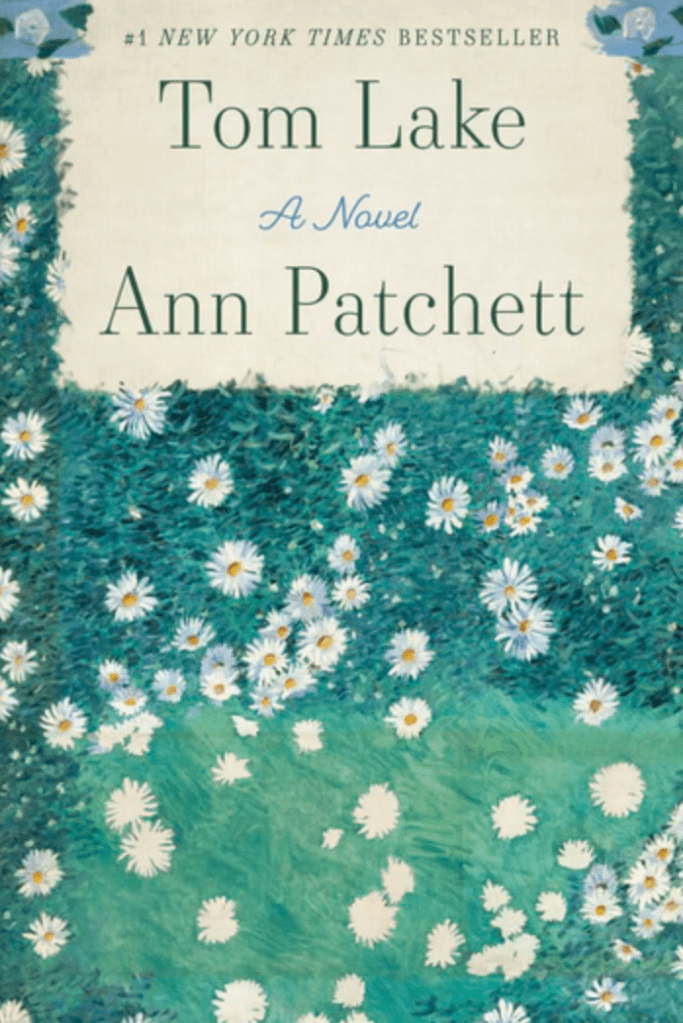
So, Patchett’s novel Tom Lake is a story about the light and dark of love. But it’s also—and this might be even more interesting and applicable to us writers—a story about storytelling. Who tells the story, when, how, why, and about whom and to whom. What’s included in the storytelling and, maybe even more importantly, what’s left out?
A dual narrative novel is difficult to pull off; I know because I’ve tried this twice. Invariably, a reader will like one narrative more than the other and grow impatient when their favorite narrative is offstage. For me, Tom Lake’s 1980s narrative, its backstory, is more compelling (because much more is happening) than the 2020 narrative, which is mostly telling, with less forward-moving action (think: literal cherry picking). Which left the modern timeline feeling more like a frame or bookends for the real story—a way to go back in time to the main action and a way to come out of it again.
I won’t digress too long on why writers like Ann Patchett feel the need for modern-day frames for historical stories. (Yes, a novel set in the 1980s is considered a historical novel.) My guess is it’s because historical novels today are often relegated to the “genre” genre, as in not the literary fiction shelf. Okay, digression over.
My favorite (oft quoted) line from Our Town, which feels very instrumental to this discussion on storytelling (and okay there’s a little spoiler here): Toward the end of the play, the dead character Emily, who returns to her life for just one day, asks the stage manager if any living person ever realizes “life as they live it,” and he says no, but then adds an exception. “The saints and poets maybe—they do some.”
There’s a lot of smart stuff happening in this novel of Patchett’s when it comes to the all-important telling of life’s story—our human way of re-living what we can’t grasp with our little human minds in the moment. We can’t all be—though maybe we can all aspire to be—saints and poets.
Patchett’s main character, Lara, who is narrating her story of young love, to her grown daughters, is basically the stage manager of her own story, choosing how and what to tell as she goes. At one point Lara equates the stage manager in Our Town with God, which brings up interesting ideas about faith (Patchett was raised Catholic and it often shows in her writing) as well as destiny/Providence in our lives, and agency in how we portray our life stories.
What about the part of our story we leave untold, for our hearts, alone? I thought about this a lot as I read Patchett’s novel. For the main character, Lara, it was a dark part, and (dare I say) foolish aspect of young romantic love she shields from her grown daughters. In not telling her whole story, the light and the dark, is she playing God? Are we all?
In my writerly opinion, the darkness in her story Lara keeps to herself isn’t earned by the character, un unusual flaw in character development on Patchett’s part. (Also very important to know when to wrap up a narrative.) But it is a stumble far outweighed by all the really fine storytelling she does in this novel. If this criticism feels vague, it’s because I don’t want to spoil the reveal. (Read it and tell me what you think!)
If there’s one author I’ve followed closely for some time, it’s Patchett. Her annotated version of Bel Canto—my favorite novel of hers—makes a great gift for the literary fiction (or opera) lover. Of her more recent novels, her 2019 release, The Dutch House, felt like a near perfect novel to me: quiet, to be sure, with none of the Le Carre-like action of Bel Canto, but an incredibly immersive read with characters who felt like my own brother and sister by the end of the book. Family ties Patchett writes about brilliantly, if she’s a little less adept at depicting romantic love and specifically sex.
Saints? I might know a few in the making. Poets? I’m honored to know a good handful. But for the rest of us, Patchett’s got me thinking about how lucky we writers are to get to craft our stories. How lucky we readers are to watch other writers and poets tell their stories just as they wish. We receive such instrumental gifts this way!
Have you read this novel? Have you seen the plays that informed this novel? What elements of craft and storytelling did they bring up for you?
And…what was your favorite bookish gift you gave or received so far this holiday season?
Check out my categories above for more guest posts, interviews, book reviews, literary musings, and writing advice we can all use. Never miss a post when you follow Rust Belt Girl. Thanks! ~Rebecca
 Rust Belt Girl
I reviewed both Tom Lake and The Dutch House on my author blog because I enjoyed them both. I did not watch the plays and I’m not so analytical in my reviews as you. I think she’s a marvelous writer with impressive story-creation skills (every book of hers so different from the others). I needed her writing after my book clubs indulge in a series of very dark, depressing works, both fiction and non.
LikeLiked by 1 person
Ah, I’m going to have to check out your reviews, Eilene. So much to love about Patchett’s work–I hate to be critical of anything. Also, she seems like a lovely person in real life! I can’t think of another contemporary writer who write family ties–I’m thinking Commonwealth in particularly–so convincingly. Glad her novels were a balm after your dark book club books. (Sounds like you’re in an interesting book club! I usually hear the opposite complaint of book club picks being too light.)
LikeLiked by 1 person
One of my book clubs is local and social. Some lighter fare, but some serious. The other club is in Idaho and is affiliated with the historical society. They discuss the books pretty seriously. Not always dark though!
LikeLiked by 1 person
Nice to have two different book clubs for different fare–since most of us have more than one book going at a time, right?
LikeLiked by 1 person
Way more than one!
LikeLiked by 1 person
I’ve not read the novel, nor the plays that inspired it, but it sounds like an interesting story. Dual narratives are tough to pull off; I actually read a book last year that featured eight different narrators (guests at a wedding). I wasn’t a big fan of that one, but just having two narrators can sometimes work.
LikeLike
It almost feels to me like the more narrators, the more diffuse the voice gets, you know? Agreed that two can work nicely. Eight would be tough! I do think sometimes those multi-voiced novels are short story collections masquerading as novels (because collections are too hard to sell). A new novel-in-stories called Sex of the Midwest (which has a great conceit actually–a bunch of Midwestern folks answering a sex survey they get in the mail) is one I’m looking forward to starting. I’ll keep you posted!
LikeLiked by 1 person
That got my attention!
LikeLiked by 1 person
Tom Lake is the first book of Anne Patchett’s that I’ve read, and I absolutely loved it! It took place in Michigan, based in or near Traverse City. We vacation every summer near there, and it’s one of our favorite areas. 🙂
LikeLiked by 1 person
Oh, I’m really glad. She’s great–and has so many books that are all very different. I’m sure you’ll find another you love. She is the one writer I go to again and again.
LikeLiked by 1 person
Yes! I’ve read a few of hers and liked them all for different reasons, but Tom Lake resonated with me that’s for sure! 🙂
LikeLiked by 1 person
I loved this book. There are so many different ways to look at love and home. I’ve been to Travers City, so I could picture it in my Midwestern brain!
Happy New Year!
LikeLiked by 1 person
That part of Michigan is definitely on my desired destination list now!
LikeLiked by 1 person
It’s beautiful!
LikeLiked by 1 person