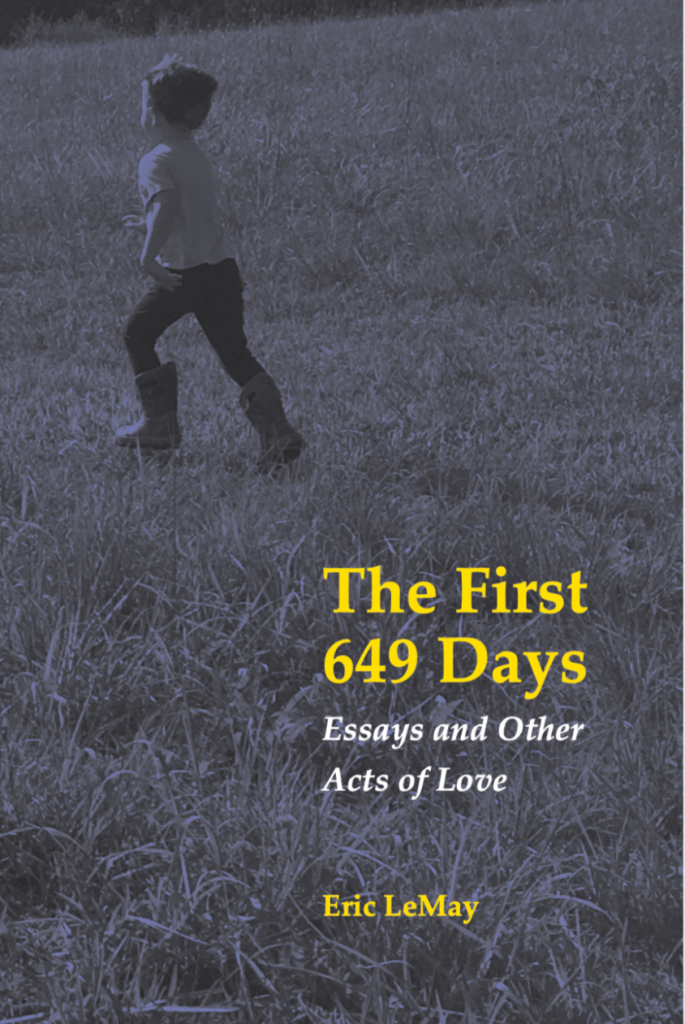
Eric LeMay’s The First 649 Days: Essays and Other Acts of Love has been called “a work of breathtaking honesty and heart,” “profoundly human,” and “a largehearted exploration of love’s capacities as well as an experiment in documenting the now via forms as various as a cancer diary, children’s book, birth story, field guide, afterworld address, medical erasures, first words journal, pandemic triptych, birdseed performance piece, and worry list, among others.”
I wrote about this collection, LeMay’s fifth book, for Pittsburgh Review of Books.
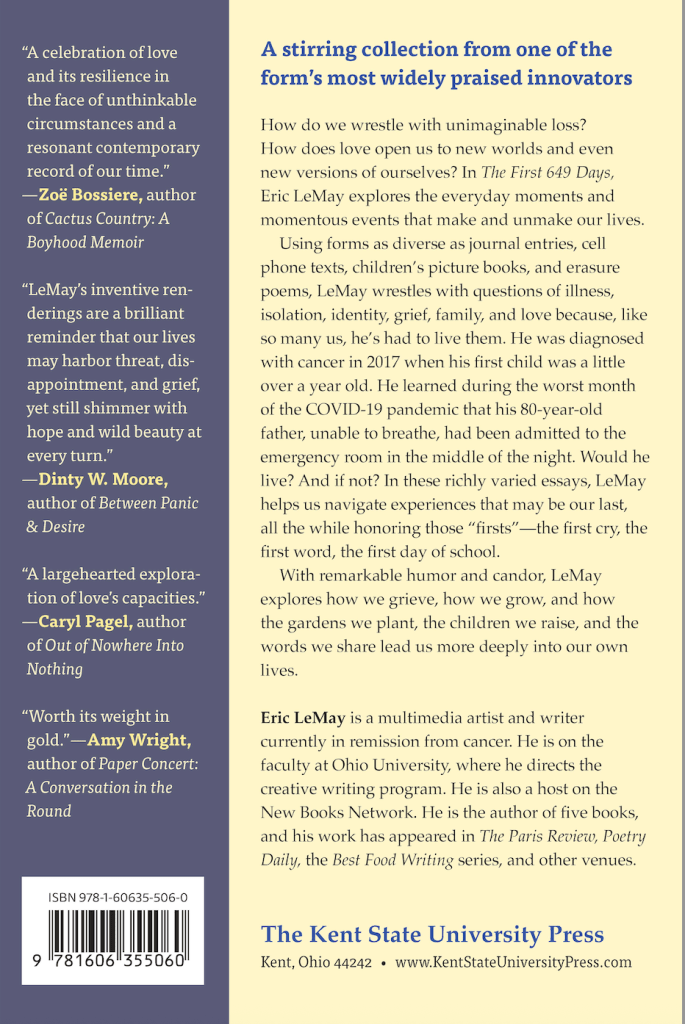
Eric LeMay is a multimedia artist and writer currently in remission from cancer. He is on the faculty at Ohio University, where he directs the creative writing program. He is also a host on the New Books Network. He is the author of five books, and his work has appeared in The Paris Review, Poetry Daily, the Best Food Writing series, and other venues.
I had the great pleasure of speaking with Eric about his latest collection, about the essay form, about writing from Ohio ground, and more. Read on, and watch him flip the script on me, ask me—the interviewer—probing questions, and even give me an assignment, just like the most delightful professor (which I’ll bet he is). I’m so happy to share some of our conversation with you here!
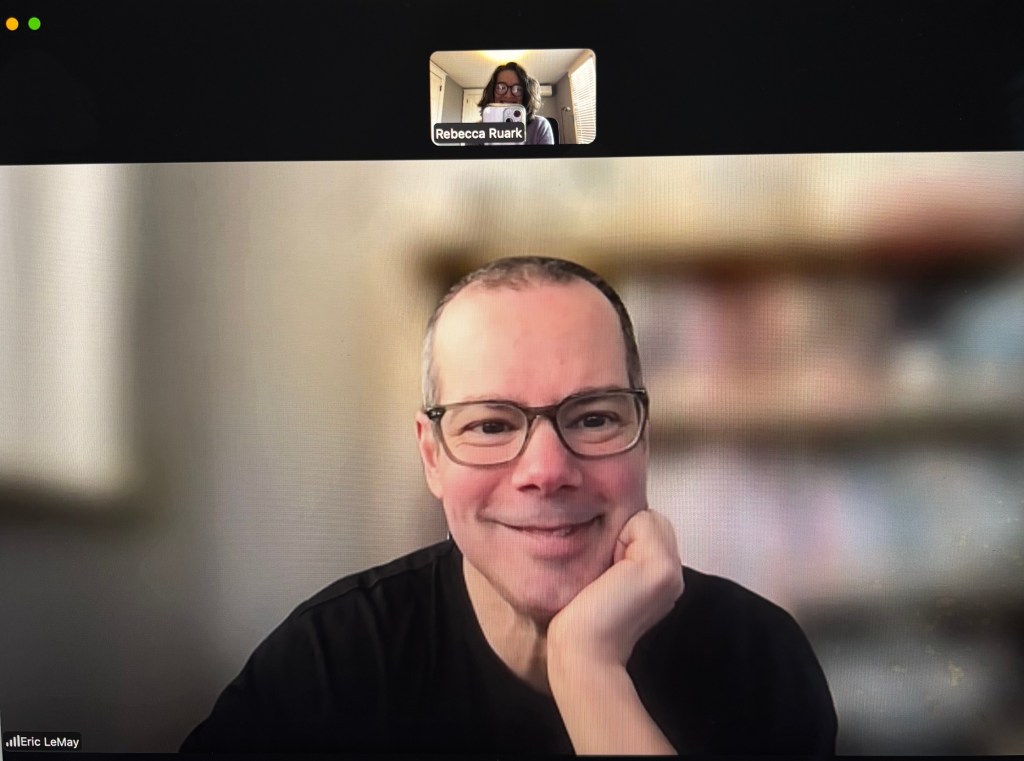
Rebecca: Eric, I loved that you call an essay an act of love. I’ve been thinking about that a lot because, lately, though I was trained as a fiction writer, when I’m writing about heart-rending stuff—love, my children, my faith—it comes out in an essay. Why is the searching essay form so loving of ourselves, when we’re writing about ourselves, or so loving of our children or others when we’re writing about them?
Eric: You have me wanting to start with a question, which is: You’re working on a novel. Why doesn’t that energy move towards fiction for you? What is it about the essay that suddenly says, this material, this emotion, or this connection with my children or my faith has to come out in the essay form?
R: I don’t know.
E: I need to know.
R: Ha, I think it’s something about the searching aspect, that I feel like there’s no time for in fiction. In fiction, things have to be moving, and of course that goes for any piece of writing that you want someone to read. But I do wonder if it’s that allowance for the searching and the asking back and forth, like we’re doing right now, which I think the essay does so well. Or, certain poetry does so well, too. I’m obsessed with Ross Gay and I love his poems that feel searching, where he asks a question or says, you know what I mean? Or, he’ll give us two metaphors instead of just landing on the one. It’s like a give and take. What are your thoughts?
E: The first place I jump to is the standard definition of the essay that I offer in the book. The word means “an attempt” or “a trial.” So, what you’re talking about in terms of searching—that’s built into the essay. You’re like: I’m not quite sure what I want to say, but I know it’s burning within me to be said. And these two things coming together—where do you go to do that? I think the essays says: This is the place where you can go.
I’m also a scholar of English literature, where the essay evolves from. For me there’s a great comfort in the fact that failure was built into the origin of the essay. It wasn’t meant to be perfect. In fact, some of the early essayists felt that if it was too good, it wasn’t an essay. It was something else, a meditation or a reflection or a history. But an essay: it’s messy, it doesn’t quite know what it’s doing. And I think for me that’s very inviting. Especially with this book, I was writing about emotions and situations, and I didn’t know how it was going to turn out. But I knew that it was at the core of who I was, and so the essay becomes this place where you can bring all that. You can say to the essay: I don’t know what I want to say, and I don’t know how I want to say it, and I don’t even know if I can say it successfully. And the essay says: Well, okay. Whereas a sonnet would say: Hold on. And, as you know, fiction would say: Wait, how does this move into character or plot, those conventions are already at work on you. Whereas the essay says: Make a mess. That’s in the design. The essay lets you bring that raw material, and then sometimes it becomes beautiful.
R: I love that. So, essays take lots of different forms, and your collection is like a funhouse of forms. Can you talk briefly about how a form comes about for you, whether you start with subject matter freewriting and a form emerges. Or, do you ever think, today, I’m going to tackle the braided essay.
E: For me the whole question of form is, what is the form that will allow me to capture what I want to capture, say what I want to say, or miss what I want to miss? Form becomes a search. It’s not so much ornamental as essential.
So, the form is dictated by the material or the content, and the content is dictated by the form, and the two are in this dance—which is a better metaphor for you, right?—and the question becomes, how does the form allow you to say what’s essential?
Eric LeMay
To take one example from the book, I have a really short piece called “1-13-21.” The way that the form works: there are three columns, and the one is a list of every Covid death that was published for January, 2021. It’s the chart all of us saw, the body count for that day, and it’s completely dehumanizing. But every one of those people who died was a life and had a story. The central text is the story of that day, what happened. So, now this form is saying, here’s the objective statistical information and here’s one individual story, and it turns out that that story is about the fact that my father could have ended up being one of those statistics, because he had gone into the ER during the pandemic with symptoms that looked very grave. And then there is a third column that is a reflection on those first two. So, it allows for more of the meditative voice to come in and ask, what does this all mean?
And there’s different weights, so the central column is a little bit darker, so it stands out, but it’s haunted by these two shadow pieces. That for me was a form that allowed for the complexity of experiencing that moment both when it was happening and after the fact. Whereas, if it was just one of those things—a list of deaths—it wouldn’t capture what it means to be human. Or, if it was just this moment, it wouldn’t capture the staggering national context of what was happening. And if it was just this moment in two forms it wouldn’t bring in that power of reflection and meditation and realization that the essay can do so well. All that comes together and you get a form that is most commiserate with the moment, the emotion, and the experience.
R: I remember in one of the later entries in the reflection, you say something about your family, like, maybe we loved each other too much, or not enough. You were reflecting on the silences your family held. And then the list of Covid deaths makes it feel universal. Like, imagine how many families were going through a similar experience on that very same day.
E: Yeah, exactly. And that day was just one day of one month among the years and years that we’d gone through. The list of Covid deaths is still being published right now, we’re just not paying attention to it. We’re looking at the list of deaths taking place in Iran and other places. And it’s the same statistical wallop—and heartbreak.
You looked just a little while ago at Ignatius’ Spiritual Exercises—a 1548 copy. That’s a very interesting form because it’s this set of instructions that’s supposed to create this experience. What were you thinking about in terms of form as you looked at that book? What was that like?
R: I was so overwhelmed. First of all, because we were allowed to touch these books. I was holding it like it was the most fragile tiny baby. And I am so much a natural-born reflector, I guess, that I write to process. In the moment I was overwhelmed. They had five tables of these rare manuscripts. I wish I’d had the clarity of an essayist to say: Now let me look at this form. Instead, I thought to myself, I really need to go on a retreat and do the exercises. I haven’t done that yet!
E: Here’s my request. This is going to bring in your talent as a reviewer and this new life chapter that you’re in, working with the Jesuits. If you do that retreat, I would love it if you wrote a review of the Spiritual Exercises. What would that look like? You take this contemporary genre of the review and bring that together with this centuries’ old practice. I think it would be really great.
R: That’s fun. I like that idea. You have good ideas.
So, last question, and I have a long preamble. A writer friend of mine, Anesa Miller, has written a couple novels steeped in Appalachian Ohio, and she wrote an article published at Belt Magazine asking if there is a distinctly Ohio literature? She laments the Ohio brand (which doesn’t sell very well) and provides statistics about how many novels are instead set in coastal locations. There has been for a long time a flight from Ohio by writers and other creatives to other parts of the country. Reading your essay, “Ohio Ground,” which touches on death, and which begs the question of where we’ll lay our mortal heads for eternity—you say “Ohio has always marked me.” You were born and raised in Ohio, left for a time but came back. Ohio may be where you end up, in the very end. What does it mean to you to be an Ohio writer?
E: There’s so much richness there. Is there such a thing as Ohio shame and we all fly from it? Then we all grow up a little bit and reconcile with it. Or is that universal? That essay, “Ohio Ground,” which is the first essay in the collection, was the last essay to be written. Part of it was my wonderful editor at Kent State University Press, Kat Saunders, said, it would be great if there could be a little more about place to frame the collection. So, after the book was basically completed, I did a lot of thinking about what it means to be a writer specifically of this place and of Ohio. For me, that was immediately complicated by the fact that Ohio isn’t that old and that it’s also a colonial construct, and there were Ohioans here for 20,000 years before the word Ohio would have even come about. How do I write myself into that history and that awareness and into geological time. The Appalachian Mountains are the oldest mountains I think in the world and so what does it mean to be in those mountains—and to also be here as a result of settler colonialism. My family comes from Scotland and France, and so I’m not indigenous to this place.
How do I write myself into that history and that awareness and into geological time?
So the question came to me: How will I become a writer of this place? Well, if I’m buried here I will contribute to this place—literally, materially, biologically, in the way that when a person dies they become part of the soil and the energy of this place. I didn’t go into that kind of larger argument in the essay. But that was the thinking behind it, and I had known that I wanted to be buried there long before I sat down to write the essay. But that helped me clarify that that was the case.
But mostly I think there are experiences in the book—we talked about Covid, and a large part of the book is that I’ve been diagnosed with cancer multiple times, and so death is hovering around. For me, the place where I learn the most about what it means to die is out in the woods, and not curated woods but woods that are allowed to be themselves. There are trees that have fallen, moss growing on the trees, new things coming up, leaves disintegrating, mushrooms doing their work breaking things down. And you can really see this cyclical energy of the way life works and the way that life comes out of death. And that to me feels like the essence of place. Where are you going to be in that cycle?
Behind the question you ask is: How are we rooted in place? What does it mean to be of these generations that can be uprooted and move to Maryland, in your case, or live in all these places—because eventually we’re going to be grounded in one.
R: Yep, compost.
E: Right, how do we become good compost?
R: That’s a good question to think about. So, one last question for you, because I’m not there and you are. Do you have a favorite “weird Ohio” place?
E: Athens is weird, because it’s still got the legacy of the 60s. There’s this sort of funky Athens, but also Athens is supposedly surrounded by a pentagram of cemeteries, so it’s this prime place for witchcraft. But Ohio is funky and quirky in so many different ways. That’s part of the beauty of it. Which brings us back to, why would you want to write your way out of Ohio? Because within the landscape, it is so diverse: you have the Rust Belt, the agricultural landscape and the way it’s tied to global food cycles, and down to the river with all its history with the Underground Railroad, and then you move into the corner where I am—where there’s Appalachia and that’s another distinct culture, with the history of coal. And all of this comes together within these lines people drew on a map 200 years ago.
I think it’s as rich a place to write out of as any.
Many thanks to Eric LeMay and The Kent State University Press for the review copy of Eric’s fantastic collection, and for the insights and time!
Like this interview? Comment below or on my fb page. And please share with your friends and social network. Want more? Follow Rust Belt Girl. Thanks! ~ Rebecca
*Book images provided by The Kent State University Press
 Rust Belt Girl