Play nice, or burn the house down? A review of Little Fires Everywhere

51kgOTJWNXL._SX329_BO1,204,203,200_


To review, or not to review, that is the blogger’s question.

This blogger says yes–even when swamped with work (like I am right this minute) and with a novel revision tap, tap, tapping its impatient foot.

We must read well to write well, and writing a review helps me understand more fully what I’ve read–and understand what I’d like to mimic, and to avoid, in my own writing. Of course, I also hope my reviews help you decide what to read next. Because, life’s too short to read a meh or even a “nice” book.

In Mark Athitakis’s handy The New Midwest: A Guide to Contemporary Fiction of the Great Lakes, Great Plains, and the Rust Belt, the critic examines modern literature set in the Midwest. He argues that, while we writers and readers may have caught up with the place as it stands today–much of it post-agrarian, post-industrial–its reputation is stuck in the past. He quotes James R. Shortridge’s take on the Midwestern character of the 1800s:

“People there were seen as self-reliant and independent, kind, open, and thrifty…idealist, moral, and humble.”

Many would argue Midwesterners are still much this way, in a word: nice. (Others have met me.) Ng complicates this notion of the nice Midwesterner as she examines the tension between the stereotypical ideal and the spontaneous real in Little Fires Everywhere, her second novel, a character-driven story with lightening-fast pacing–not an easy feat.

The setting pits the ordered (wealthy) suburban ideal against the inspired, artistic–and even a little dangerous–real. Set in Shaker Heights, Ohio, the (actual) place is described in the jacket copy, as “a placid, progressive suburb of Cleveland,” where, “everything is planned–from the layout of the winding roads to the colors of the houses to the successful lives its residents will go on to lead.”

Ng does a good job of setting this story against the larger, chaotic backdrop of America in the 90s–replete with pop culture, a la Jerry Springer on TV, Sir Mix-a-Lot on the radio, and the Bill Clinton and Monica scandal everywhere. Zoom in on Shaker Heights, however, and there are the guiding principles that drive this planned city–with its invisible trash cans and neat tree lawns, its over-achieving public schools and college-bound school children. Here is order, a refuge from chaos…so long as one abides by the rules. And the first characters upon the scene, the Richardsons–Shaker Heights royalty if there were such a thing–do, to the utmost. They are surface-y, but nice. Nice marriage, nice house, nice kids, nice bank account.

Enter the rule breakers, a single mother and artist and her teenage daughter–and the plot is off and running.

I hate the term page-turner, but this story was on fire from the first page (sorry). However, the characterization left me a little cold. For the author to examine and complicate stereotypes means the reader must bear stereotypical characters–the type-A, uber-planner matriarch, the blonde popular girl, the handsome jock, the sulky black sheep–until their characters are rounded out as they experience plot twists and turns. So…I didn’t cry for these characters when I should have; I didn’t feel their pain, because I knew them back when they were flat.

That said, if family saga is your thing, this book might be for you. The theme of mother-love running through rang true and provided an interesting examination of motherhood from various angles: genetic, adoptive, private, public, legal.

I did miss a bit of play in the language. A little rule-bending there would have added levity to the heavy theme. Yes, much of mother-love is extreme highs and lows, joy and anguish, success and defeat. But there’s also a lot of play in the happy mediums: the everyday moments of acceptance, when you look into your child’s face and see your own, reflected and real. I wouldn’t trade that for a false ideal any day.

Favorite passages from Little Fires Everywhere:

Later, when Moody saw the finished photos, he thought at first that Pearl looked like a delicate fossil, something caught for millennia in the skeleton belly of a prehistoric beast. Then he thought she looked like an angel resting with her wings spread out behind her. And then, after a moment, she looked simply like a girl asleep in a lush green bed, waiting for her lover to lie down beside her.

The idea that someone might take a mother’s child away: it horrified her. It was as if someone had slid a blade into her and with one quick twist hollowed her out, leaving nothing inside but a cold rush of air.

When the baby was found, she had been undernourished…her ribs and the small bones of her spine had been visible under her skin, like a string of beads.

My rating:

index

Have you read Little Fires Everywhere? What did you think?

A couple more honest reviews, from:
The Washington Post

The Guardian


ALL THE WAY HOME and the back- and heart-breaking art of the DIY

2205542

I was sixteen before I knew a dad who didn’t drive a pickup truck.

Of course, this speaks as much to my limited teenage powers of observation as it does to my rural Ohio upbringing. Still…

My dad’s life was–and is–in his truck. A dad without a truck? How else would one: haul his 84 Lumber finds to turn the attic into proper living quarters; bring home fresh-split logs–and the log-splitter–to stoke the wood stove in winter; tow a rotted shell of a boat to be restored from the ribs up–in the workshop designed and built yourself?

In my eyes, my dad was the original DIY-er, before that catchy name was put to skillful industriousness, craftsmanship, and thrift.

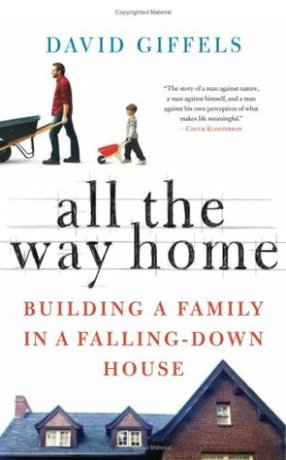
As such…reading award-winning Akron, Ohio, author David Giffels’ memoir All the Way Home: Building a Family in a Falling-Down House felt like going home. Cursory jacket copy summary:

With their infant son in tow, David Giffels and his wife comb the environs of Akron, Ohio, in search of just the right house for their burgeoning family…until they spot a beautiful, decaying Gilded Age mansion. A former rubber industry executive’s domain, the once grand residence lacks functional plumbing and electricity, leaks rain like a cartoon shack, and is infested with all manner of wildlife. But for a young man at a coming-of-age crossroads–“suspended between a perpetual youth and an inevitable adulthood”–the challenge is exactly the allure.

The tried-and-true tropes of female coming-of-age couldn’t be more different than those Giffels explores in this man vs. house tale. But in the reading of this heartfelt and oftentimes harrowing (as in Giffels hanging upside down out a second-story window to paint exterior trim) memoir, I completely understood his feeling compelled–even obsessed–to DIY.

Read more

Throwback Thursday: Why half the world should read IN ZANESVILLE

index

Even if you’ve never been there, you’ve heard enough to know the American Midwest isn’t sexy. I’m hardly the first Midwest native to admit to being from a Regular ‘Ol American Place.

The Midwest is “flyover country”–its detractors call it–between the glittering East Coast and shining West Coast. Yep, no matter how many Northeast Ohio boosters try, most of the U.S. will never be convinced of the beauty that is the “North Coast.” And that’s okay.

But…the insult that really stings: “Ohio is flat.”

It stings–not just because it’s a blanket generalization and untrue of my rolling Ohio hometown. (In fact, it stings more than memories of the same thing being said about my 6th grade chest–and that stung.)

It stings because flat is sameness. And don’t we (even States–if States had egos) want to feel special, unique, memorable: the opposite of same, boring, forgettable?

I am more than a home state booster; I’m a home state narcissist. You see, I picked up Jo Ann Beard’s novel, IN ZANESVILLE (pub. 2011), thinking it was set in Zanesville, Ohio.

It’s not. It’s set in Zanesville, Illinois, which, I sheepishly admit, is pretty much the same. In fact, it’s the sameness, the universality of the experiences of the novel’s fourteen-year-old narrator, that makes this novel so special–and yet relate-able to any reader who is or was ever a girl. And that’s about half the world. Read more

A conversation around CINDERLAND, a memoir by Amy Jo Burns (yes, spoilers)

20588664._UY400_SS400_

I don’t know about you, but I find the memoir in general a tough nut to crack. I’ll admit it’s not my favorite genre to read. As a fiction writer, I’m an escapist–I admit that too–always seeking new opportunities to inhabit the lives of fictional others.

The memoir also poses challenges for the reviewer: how to best critique a plotting of events in a life that really happened; how to critique a cast of characters who are actual people?

Then there are my own personal memoir hang-ups, which say much more about my issues–as a “good girl” raised on Rust Belt values (more on that later)–than the genre’s. As in:

  1.  Talking (or writing) about oneself is evidence of vanity.
  2.  Talking about one’s successes is risky business, as in you don’t want to jinx yourself.
  3.  Talking about one’s trials only invites more trials, as in, you think you’ve had it bad, I’ll show you bad; also as in, good girls bear their crosses with (quiet) grace or suffer the consequences.

Amy Jo Burns knows a lot about grace–and about suffering–and she has written a graceful memoir, one I can’t quite review but find myself drawn to write about.

Read more

AMERICAN RUST, restless ruin: a book review

9781742374772American Rust by Philipp Meyer, reviewed.

Ah, America. Rags to riches. Dream fulfilled country, right?

Nope.

Without spoiling too terribly much, this is not that book. This is not romance.

American Lit. nerd time-out: in his Criticism and Fiction, realist writer of the 1800s, William Dean Howells, argued that a story where “all grows naturally out of character and conditions is the supreme form of fiction.” Down with the sentimentality of romantic fiction! Realism was best suited to express the spirit of America. Then, real got real-er, and naturalist writers like Theodore Dreiser and Jack London showed what happens when natural forces overwhelm us silly humans.

American Rust is real-natural in that way. And I like it. Realism has always appealed to this Rust Belt native for whom romantic lit. often feels at best, false, and at worst, dangerous.

For me, this debut novel’s strengths are in the real and natural way Philipp Meyer’s dark story grows out of the ruinous conditions of its modern Appalachian Pennsylvania setting: post-industry, post steel money, post employment, though still (or again) naturally beautiful.

This is a story of two very different young men from the same place. Isaac is small, awkward, and MIT-smart; Billy is handsome and strong, a former high school football star. One night, the friends get caught up in/perpetrate an act of terrible violence, just as restless Isaac has decided he must head to Stanford to put his genius to work. Post-crime, Isaac makes good on his promise to leave their hometown, and Billy stays. Each man suffers for his decision, Isaac on the road and in train yards where lawlessness reigns, and Billy in prison. The men’s families become entangled in the tragedy, as does the local police chief, Harris, who must weigh his job as a lawman against his love for Billy’s mother, Grace. All suffer in the aftermath of one violent mistake.

Read more

RUST BELT BOY & holy pierogi

dumplings-2211238_640

Cleveland and Pittsburgh have always enjoyed something like a sibling rivalry. Unlike the relationship between Cleveland and Akron, or Cleveland and Chicago, Cleveland and the ’Burgh are too close in size for one to take the other under its wing like a little sister city, or to aspire to big-brother city coolness. So, rivalry it is—or always seemed to be, to this Northeastern Ohio native.

Later this summer, I will travel through (or around) both cities on my way to visit my dad in Port Clinton, Ohio—home of the annual Perch, Peach, Pierogi and Polka Festival. Along my way on the Pennsylvania and Ohio turnpikes, I will cross a lot of pierogi territory.

Read more

A hick reads HILLBILLY ELEGY, the underdog lake & and a story excerpt

screen20shot202016-08-2220at204-41-4020pm

We were “hicks.” That was the insult of choice directed at us Chardon High School Hilltoppers. Rival school children would call us that or sometimes “farmers,” which said more about the insulters than the insulted.

We were not “hillbillies” (our Hilltopper mascot being something of a misnomer). And so, while reading Hillbilly Elegy: A Memoir of a Family and Culture in Crisis by J.D. Vance, I had the feeling that not only was his family not my family but his culture was not my culture. (Not to say my culture is crisis-free.) Was his Ohio my Ohio?

Read more