“On the fifth day of Christmas, my true self gave to me…one healthy kick in the pants.”
Is that right? Are we already on the fifth day? I’m still languishing in a sugar cookie stupor. Still digging out from leftover potatoes au gratin. Still trying to convince my family of the legitimacy of stale crackers and cheese rinds as a basic food group.
Sure, I will disconnect the sugar IV, menu plan, and get back to the proper care and feeding of my brood. I might even exercise. I will resolve! But it’ll probably be next month–which is next year.
In the meandering meantime, I will look back on the 2017 fun we’ve had here at Rust Belt Girl, you and me, thanks to inspiration from my native Rust Belt and its storytellers keeping it real.
Sing along to the tune of “The Twelve Days of Christmas” if you like.
In my first month of blogging, my Rust Belt gave to me
a blog borne from necessity (I didn’t say the cadence would be right)
Raffles, bingo, coin flips–the universe generally tilts away from me.
So, I was surprised and honored to be nominated by Riya at High Noon Journal earlier this month for the Blogger Recognition Award!
Riya is a fairly new blogger charting the course of her life as a twenty-something. I admire her for detailing her journey as a young woman, currently living in China, far from her native India. Riya talks about her upbringing, what spirituality means to her, how to live a good life, and just what good luck is. With luck, we will be seeing much more from her in the coming year.
For my part, I feel lucky that Riya stumbled upon my blog. Thank you, Riya! Read more
I was sixteen before I knew a dad who didn’t drive a pickup truck.
Of course, this speaks as much to my limited teenage powers of observation as it does to my rural Ohio upbringing. Still…
My dad’s life was–and is–in his truck. A dad without a truck? How else would one: haul his 84 Lumber finds to turn the attic into proper living quarters; bring home fresh-split logs–and the log-splitter–to stoke the wood stove in winter; tow a rotted shell of a boat to be restored from the ribs up–in the workshop designed and built yourself?
In my eyes, my dad was the original DIY-er, before that catchy name was put to skillful industriousness, craftsmanship, and thrift.
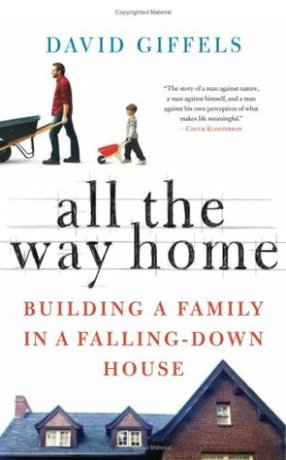
As such…reading award-winning Akron, Ohio, author David Giffels’ memoir All the Way Home: Building a Family in a Falling-Down House felt like going home. Cursory jacket copy summary:
With their infant son in tow, David Giffels and his wife comb the environs of Akron, Ohio, in search of just the right house for their burgeoning family…until they spot a beautiful, decaying Gilded Age mansion. A former rubber industry executive’s domain, the once grand residence lacks functional plumbing and electricity, leaks rain like a cartoon shack, and is infested with all manner of wildlife. But for a young man at a coming-of-age crossroads–“suspended between a perpetual youth and an inevitable adulthood”–the challenge is exactly the allure.
The tried-and-true tropes of female coming-of-age couldn’t be more different than those Giffels explores in this man vs. house tale. But in the reading of this heartfelt and oftentimes harrowing (as in Giffels hanging upside down out a second-story window to paint exterior trim) memoir, I completely understood his feeling compelled–even obsessed–to DIY.
Even if you’ve never been there, you’ve heard enough to know the American Midwest isn’t sexy. I’m hardly the first Midwest native to admit to being from a Regular ‘Ol American Place.
The Midwest is “flyover country”–its detractors call it–between the glittering East Coast and shining West Coast. Yep, no matter how many Northeast Ohio boosters try, most of the U.S. will never be convinced of the beauty that is the “North Coast.” And that’s okay.
But…the insult that really stings: “Ohio is flat.”
It stings–not just because it’s a blanket generalization and untrue of my rolling Ohio hometown. (In fact, it stings more than memories of the same thing being said about my 6th grade chest–and that stung.)
It stings because flat is sameness. And don’t we (even States–if States had egos) want to feel special, unique, memorable: the opposite of same, boring, forgettable?
I am more than a home state booster; I’m a home state narcissist. You see, I picked up Jo Ann Beard’s novel, IN ZANESVILLE (pub. 2011), thinking it was set in Zanesville, Ohio.
It’s not. It’s set in Zanesville, Illinois, which, I sheepishly admit, is pretty much the same. In fact, it’s the sameness, the universality of the experiences of the novel’s fourteen-year-old narrator, that makes this novel so special–and yet relate-able to any reader who is or was ever a girl. And that’s about half the world. Read more
By Frank Bures Photo by Garrett MacLean When Richard Florida’s new book came out earlier this year, I saw some of the reviews and was intrigued. It was called The New Urban Crisis: How Our Cities Are Increasing Inequality, Deepening Segregation, and Failing the Middle Class — and What We Can Do About It. I…
Rust Belt Girl here with regret that I can’t devote more time to a proper post. However, this article from Belt Mag got me thinking…and regretting.
I regret that I’m not more of a real do-er, a maker of things–vital things. I’m the daughter of a (retired) draftsman, whose structural engineering projects studded (or, rather, supported) the built Cleveland landscape of the 70s, 80s, and 90s. Buildings didn’t fall down around us like so many toppled snowmen–because of my dad. My brother is an accomplished marine engineer who designs hulking I-don’t-know-whats–ferries, yes, ferries, among other projects necessary for human progress. My (oh so young) sister works at the same engineering firm, and while she doesn’t design and build, herself, she knows the field, trods the landscape in steel-toed boots, and has mastered the language. That girl can talk “longshoreman” with the best of them.
I talk about…mostly…talk. I am a member of the Creative Class (or creative class).
I am a purveyor–sometimes even a perverter–of words. Marketing and communications work doesn’t feel so much like doing, perhaps because I enjoy it. But it’s also far removed from the making of things–like buildings or boats. I conduct a lot of interviews for my job; I learn about students inventing new kinds of batteries and solar cells–the technology of tomorrow–and I compile the ideas, synthesize, organize. And, yes, sometimes I create…a line or phrase or word that feels new.
But mostly, I work in an infrastructure of words that relies on a real infrastructure–of made things.
So, New Year’s resolution time: my work won’t change, and I don’t have engineering chops. But, I can do more than report. This year I do more do-ing–at least on my own time.
I start with my village, which sits on a river and creeks that are being choked by some invasive species I can’t name (because I haven’t conducted that interview yet). This spring, I will don boots and tromp in the muck. I will test the murky water. I will pick up trash.
Yes, creating is important. But, I think it’s clear the creative class can’t solve all our cities’ problems. I will still write, building worlds from my mind and the doings of others. But I will do, too.
Rust Belt Girl here, reblogging this wonderful essay that tries to answer the question: What does it mean to be a Midwesterner? Hope you enjoy it as much as I did. ~ Rebecca
Some places have easy-to-describe landscapes: Southeastern California is hot and dry. Southern Mississippi is swampy and green. Culture is something else, though — even though the Midwest’s flatness seems to define it, people mistakenly conflate its geography with its culture, which eludes easy description.
In The Hedgehog Review, Phil Christman recounts his struggle to make sense of his native Midwest after he moves back there with his wife. People call the Midwest “flyover country” and “the American breadbasket.” They comment on its orderly grid of roads and towns and its endless fields. But when locals tell Christman this is “the middle of nowhere” and “just like anywhere,” he not only realizes a place can’t be both anywhere and nowhere, but that viewing the region as average and normal works to the Midwest’s own detriment. As he wonders what normalcy in America even is, he questions what effect the Midwest’s sense…
Endings are tough, aren’t they? So, as I (sadly) tie a bow around my completed “Thanksmas” holiday with family, I present here the ending to my short story, “Sleeping Naked.”
Yep, the final snippet. Nope, still no nudity.
For those who missed it, the first two snippets of this short story, which appeared in Carve Magazine years ago, are here:
When we last met these characters, the mother–you, in this second-person point of view–has come home to discover that her pre-teen daughter, Cheryl, is missing. Hardly mother of the year, you consider the steps you should take to locate her. You consider what relative might be feeding Cheryl her dinner. You canvas the house again and again.
You are a young mother–still attractive, even sexy. Your daughter can be difficult and makes you feel older than you want to. A night without your daughter is a luxury you feel–after a drink or two–that you almost deserve. Just one night to yourself, you think with relish, as you sink into the middle of your bed and fall asleep…naked.
What kind of woman are you? What if she never comes back?
Around five o’clock, you awake to an upset stomach, make your way to the bathroom and throw up.
Over thirty hours. Gone. You crash on the couch and then drag yourself down the hall. You’re still nauseous.
You stand in the hallway, in your nightie, facing the closed door to Cheryl’s room, like some kind of gatekeeper.
You pace back and forth in front of the door until you hear a rustling sound in the room. Then there’s a slice of light, from the lamp she’s turned on, seeping under the door, and you crouch down on the floor to bathe in it. Then the slice of light is gone, and you bury your mouth and nose into the carpet, and you cry without making a sound.
You sleep for an hour or so, until you’re woken by the sound of Cheryl vomiting into her metal trashcan next to her bed. You wait there, outside, until the springs in her mattress stop squeaking. From your crouching position, you try the doorknob. It’s not locked. You remember your deal, but you break your end. She’ll owe you a tantrum the next time you have a man over. The door squeaks when you open it, and you move to her bedside and grab the trashcan, which you empty in the bathroom and set in the kitchen sink to be cleaned tomorrow. You go back to her room, step inside and close the door. You pull back the comforter on her bed. She’s sleeping in her clothes, dirtied from the bushes under her window. You crawl in next to her. She stirs, but doesn’t wake.
The End
Writers and readers, how do you feel about an unreliable narrator, an unlikable main character? Does the second-person point of view soften the mother’s character at all? Can you understand her…just a little bit?
What are you reading and writing right now? How much like you are the characters you create?
Image courtesy of LoboStudioHamburg via Pixabay.com
A good friend wrote me yesterday and shared this thought on perfectionism from Anne Lamott’s Bird by Bird: Some Instructions on Writing and Life:
Perfectionism is the voice of the oppressor, the enemy of the people. It will keep you cramped and insane your whole life… Besides, perfectionism will ruin your writing, blocking inventiveness and playfulness…
This reminder came at the perfect time, as I am currently wrapping up another season of journal-submission-frenzy. That’s when we writers offer up our fiction and poetry to the journal gods (disguised as fiction and poetry editors) and we pray they deem them worthy, these bundles of words we’ve worked and wrenched and polished and punished. Ah, perfect, we think as we hit “submit.”
But is it perfect? Or, can we wring the life out of our words with so much attention focused on making each one perfect.
I’ve said before, it’s humbling to look back on my writing from years ago. That’s another kind of writerly distance. They’re far from perfect, but old stories give us a window through which to look at our old selves.
So, without editing it, I’ll provide snippet #2 of an old short story of mine, “Sleeping Naked,” that was published in Carve Magazine years ago. (If you missed the start of the story, here’s snippet #1.)
When we last met these characters–the mother, you, in this second-person point of view, and pre-teen daughter, Cheryl–you have come home to find Cheryl is missing.
You think about what you should do, where she could be. You think about taking steps toward finding out, but instead you fix yourself a drink. (Hey, nobody’s perfect!) And you really do expect your missing daughter to come through the door any minute now…
Snippet #2 from “Sleeping Naked” by Rebecca Moon Ruark:
Maybe Cheryl’s being held up by your mother’s incessant gossip. It wouldn’t be the first time. Your mother has no idea what it’s like to raise a child in the nineties, all the nuts out there. You touch the goose bumps on your forearms. It’s getting cold out on the porch so you open the sliding glass door and go back to the living room. “God,” you whisper more to yourself than to Him, but still it startles you because you haven’t so much as said his name since your wedding, “please let her be there.” No Cheryl. You should pick up the phone to call your mom, but it’s too late, so you pick up your drink again and walk down the hallway to her room. You say your prayer. “Let her be there, let her be there,” like you’re some kind of magician. She isn’t in there, in her room. You rest your head in your hands for a minute, sitting on her bed, looking at her matching pink and purple comforter and pillow shams that really need a washing. The whole room, in fact, needs to be cleaned. “Shit, please God.” You look around like you half expect her to crawl out from under the bed, but she doesn’t. Part of you wants to scream, like in the movies when the sound is amplified, and the camera, shooting from above, makes everything swirl; then it all goes black. Read more
Banner day: I’m responding for the first time to the Daily Prompt. Today’s is “snippet.”
So, there you go. Nope, not even a snippet of nudity.
What follows is a snippet of a short story of mine, my first published short story, which appeared in Carve Magazine many moons ago. (So very early aughts–even the second-person point of view.)
It’s funny to look back on a story I wrote while I was still in graduate school, before marriage, before kids, before the first germ of yearning to indicate I might want kids (and the responsibilities that include, often, sleeping clothed and ready as an EMT for the next cry or summons from your progeny).
The protagonist in this story–she is no heroine–is in a stage of life I didn’t know when writing this piece. (I’ve discussed before my penchant for writerly distance.) She has been married; she is the mother of a pre-teen named Cheryl; she has seen her body and spirit morph to become “mother.”
Until, one day, she arrives home to find that her daughter is gone.
And so, a snippet from “Sleeping Naked” by Rebecca Moon Ruark:
You never thought to make a deal that required her to be in the house by eleven, to be home from her friend Julie’s or your sister Judy’s place down the street. You’re surprised she’s not there. She’s always in the living room, six inches away from the television screen, which casts a blue hue onto her face, when you pull into the drive around ten-thirty after your shift at Lubrizol. Tonight you stopped at the Claridon Tavern before returning to your two-bedroom split-level in the allotments. You had two glasses of Chardonnay, and after, you left your old rusted-out Mustang parked on the street before walking the five blocks home. You were smart not to take any chances and drive it, you think, as you rest your head on the doorjamb. Ever since you dumped the town’s deputy officer, Steve, he’s been eager to land you in the holding cell for something, anything. Read more