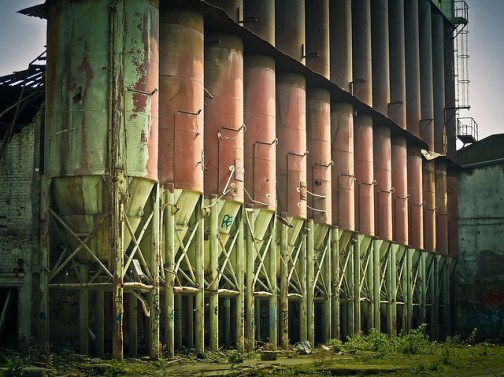
The Rust Belt: Photos by Howard Hsu

The great thing about blogging is the connections you make.

In a post a while back, I called for photos of the Rust Belt–and was subsequently linked to Howard Hsu, a photographer living in Seattle, who was kind enough to let me feature his work on my site. This post, and my previous post, feature photographs Howard took on his Rust Belt tour in 2014.

Been to any of these places? Were you as surprised as I was to learn that Toledo was once a major glass-making hub? Visited any of these spots since 2014? How have they changed.

Here’s what Howard Hsu, photographer, wrote about his Rust Belt visit:

Transition and reinvention in the U.S. rust belt in 2014–Cleveland, Detroit, Pittsburgh, Youngstown and Toledo.

The former bastions of the 20th Century industrial machine–empires built on auto, steel, glass, rubber and large-scale manufacturing–that changed the modern world but now struggle to keep up.

From art to biomedical and robotics to urban farming and community programs, each city is searching for ways to transform its economy and perhaps identity.


Part 3 of “‘Ruin Porn’ to Rust Belt beauty: her place in resurrecting the American Dream in the Belt,” and a 212-page prize

Kristen Hunninen, Senior Apprentice, Braddock Farms, PA
Photo by Howard Hsu, from his 2014 rust belt collection. Subject: “Kristen Hunninen, Senior Apprentice at Braddock Farms, an urban farm in the shadow of a working steel mill in Braddock, Pennsylvania.”

Essay continued from Part 2:

Salvage. To reclaim, recoup. In an often very subtle way, Bonnie Jo Campbell, Michigan author of 2009 story collection American Salvage (finalist for the National Book Award) saves her characters—and us in the reading. Her characters and the predicaments in which they find themselves are not pretty; yet, Campbell provides a modicum of redemption—the American Dream renewed—I’m looking for in the writing of the Rust Belt.

Campbell’s stories center on everyday people with everyday struggles—from farmers to salvage yard workers, meth addicts to the unemployed—striving to make do with the hand they’ve been dealt in the tough Michigan landscape. These stories are what Ruin Porn could do more of: show us the despairing scene and then populate it with characters to care about.

One of Campbell’s young characters, a 14-year old girl (whose story Campbell expands on for her gem of a novel, Once Upon a River), encapsulates the heart of Campbell’s fiction. In “Family Reunion,” the reader understands that the girl will take revenge by shooting the uncle who violated her. One sentence speaks volumes:

She had to do this thing for herself; nobody is going to do it for her.

Read more

Part 2 of “‘Ruin Porn’ to Rust Belt beauty: her place in resurrecting the American Dream in the Belt”

architecture-1639990_640
Another pretty awesome photograph by Michael Gaida via Pixabay

The term “American Dream” has been so overused as to lose its meaning. Researching for my novel-in-progress, a story set just before WWII, I found Made In America: Self-Styled Success from Horatio Alger to Oprah Winfrey, in which author Jeffrey Louis Decker gives some background on the oft-used phrase:

The term [American Dream] was not put into print until 1931, when middle-brow historian James Truslow Adams coined it and used it throughout the pages of a book titled The Epic of America. The American Dream is to be understood as an ethical doctrine that is symptomatic of a crisis in national identity during the thirties. The newly invented dream calls out for a supplement to the outmoded narrative uplift, which had lost its moral capacity to guide the nation during the Depression.

So, out of extreme poverty and ruin, the collective American Dream was borne.

Read more

“‘Ruin Porn’ to Rust Belt beauty: her place in resurrecting the American Dream,” a call, and a prize

Part 1 of 3 of an essay by me (and some of my favorite Rust Belt writers), Rust Belt Girl

factory-1354672_640
Photo by Michael Gaida via Pixabay. (Calling for pics: got Rust Belt images you’re willing to share?)

The term “Ruin Porn” doesn’t exactly endear this Rust Belt native to the genre of photography.

David Giffels, Akronite (Akron, Ohio) and author of the wonderfully reminiscent, inspiring, and redemptive (though he would take umbrage with that last descriptor) The Hard Way on Purpose: Essays and Dispatches from the Rust Belt, defines Ruin Porn—also called abandonment photography—in his essay, “Pretty Vacant”:

“Ruin Porn is applied mainly to photography of abandoned, decaying urban spaces and has especially been focused on the postindustrial regions … with urban explorers—ranging from amateur point-and-shooters to high-profile artists—trespassing in empty buildings and distressed neighborhoods, documenting what others have ignored.”

Read more

RUST BELT BOY & holy pierogi

dumplings-2211238_640

Cleveland and Pittsburgh have always enjoyed something like a sibling rivalry. Unlike the relationship between Cleveland and Akron, or Cleveland and Chicago, Cleveland and the ’Burgh are too close in size for one to take the other under its wing like a little sister city, or to aspire to big-brother city coolness. So, rivalry it is—or always seemed to be, to this Northeastern Ohio native.

Later this summer, I will travel through (or around) both cities on my way to visit my dad in Port Clinton, Ohio—home of the annual Perch, Peach, Pierogi and Polka Festival. Along my way on the Pennsylvania and Ohio turnpikes, I will cross a lot of pierogi territory.

Read more

A hick reads HILLBILLY ELEGY, the underdog lake & and a story excerpt

screen20shot202016-08-2220at204-41-4020pm

We were “hicks.” That was the insult of choice directed at us Chardon High School Hilltoppers. Rival school children would call us that or sometimes “farmers,” which said more about the insulters than the insulted.

We were not “hillbillies” (our Hilltopper mascot being something of a misnomer). And so, while reading Hillbilly Elegy: A Memoir of a Family and Culture in Crisis by J.D. Vance, I had the feeling that not only was his family not my family but his culture was not my culture. (Not to say my culture is crisis-free.) Was his Ohio my Ohio?

Read more

A blog is born

Welcome to Rust Belt Girl, an exploration of writing the Rust Belt, from a female perspective. Using this blog, we could discuss which states and cities should be considered part of the Rust Belt, what’s “Rust Belt” and what’s “Great Lakes Region,” where the Rust Belt ends and Appalachia begins. We could talk about whether “Rust Belt” refers more to economics than geography. But let’s not. Politics? Nope.

Here’s why I began this blog: my creative writing keeps bringing me back to my native Ohio. It’s more than setting; more than shared industry and landmarks, natural and man-made. It’s more than regional dialect or terms like “pop.” It’s even more than shared faith, ethnicity, and lineages with their feast days and foods. It’s an ethos, I think, but I need to learn more.

Read more