Last month’s AWP (the Association of Writers & Writing Programs) Conference & Bookfair—think writer-prom—wasn’t in the cards for me this year. My rational brain knew this, but that doesn’t mean I didn’t suffer from some FOMO. Writer friends, the warm L.A. sun, and the lure of the unknown—will I meet the literary agent of my dreams in the hotel bar?!—are attractive elements, for sure. But I decided to save my pennies and hold out for next year’s event in nearby Baltimore. (Who’s in?)
Really, that March weekend, I hardly had time to wallow in my FOMO (the name of my upcoming memoir, stay tuned, ha). But seriously, the indomitable Justin Hamm, poet and super solid literary citizen, created StayWP, an online poet and writers conference, to slake our literary thirst, as it were. What’s better than poetry in your pajamas!? Here’s a sampling of what us nearly 100 participants from around the country enjoyed from Friday evening through Sunday evening:
Readings from novelists including Mark Ostrowski and poets including Sean Thomas Dougherty
Generative workshops with titles like “Where the Poetry Rises like Dough Workshop” and “Rooted in Place,” led by former Missouri Poet Laureate Karen Craigo, which I attended, and “Like it’s my job. (‘Cause it is): Writing, Motherhood, and the (Re)Formation of Work”
Enthralling discussions, including “In Dialogue,” “Casting Spells for the Future,” and “Power of the Poet Posse” (that’s a gang I could get behind!)
Saturday, my super talented friend Shemaiah Gonzalez (whose debut collection of essays launches next week!) hosted a generative workshop over Zoom. The hook: How do you even begin to get ideas on what to write: let alone something joyful? Looking at three pieces of writing, we participants came up with our own. I got a couple really good starts for essays and even a prayer (for our sweet neighbor who snowplows our drive in the winter, even before he does his cousin’s drive next door).
One of the prompts was so intriguing I’ll share it, paraphrased, with Shemaiah’s permission. We were asked to draw a sketch of a place we knew well: a home, or place of work or worship. Then, we were to pick a specific spot to interrogate. I think about writing about place a lot here on the blog, but Shemaiah made that importance plain: “We write about place because place is where we keep our stuff.” And, of course, the stuff we choose to keep is important to us. I ended up writing about the rattan rocking chair—the best seat—my dad would often occupy when our family would go out on to the porch to watch rain showers. (My kids think it’s hysterical we did this. But then I also truly enjoyed The Waltons. It was a different time.)
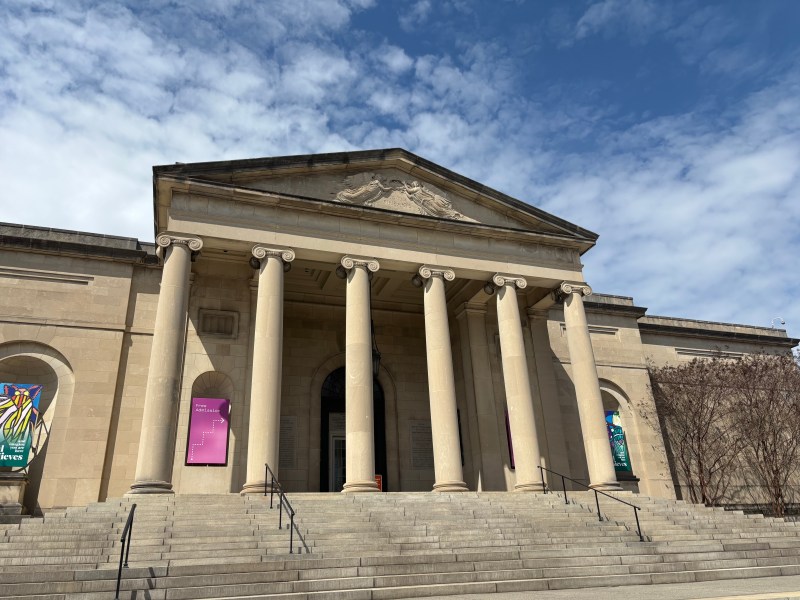
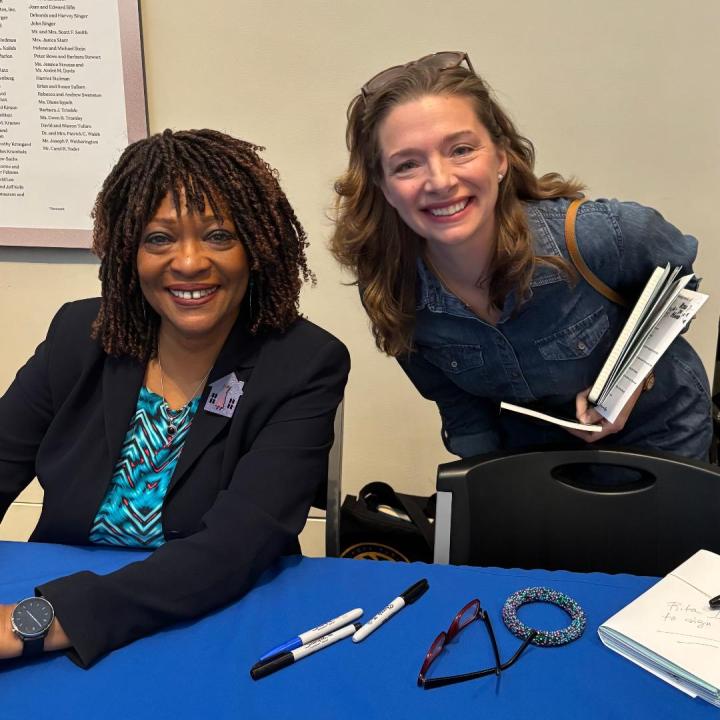
My weekend of creativity continued on Sunday, when I took one of my sons with me to hear Akron, Ohio, native poet Rita Dove (who received the National Humanities Medal from President Bill Clinton the National Medal of Arts from President Barack Obama—the only poet ever to receive both medals) at the Baltimore Museum of Art. (Thank you to co-sponsor Johns Hopkins Center for Talented Youth!) The little I knew of Dove, I learned from talking with Akron’s own David Giffels in an interview right here at Rust Belt Girl. This poetry reading was my son’s first, and so now he is ruined for all other poetry readings, I’m afraid. But what a way to go down!
As I’m wont to do, I took a notebook and jotted images I liked from the poems she read. Here are several lines from Dove’s beautiful work, which I smushed together like a found poem, a found Dove poem:
scabbed like a colt, our stuttering pride
my Cleveland cousins, hachety smiles
we were a musical lantern
tired of singing for someone else
what you bear is a lifetime of song
if you can't be free, be a mystery
Baltimore Museum of Art
Piece of art from artist Raúl de Nieves
Yes, I got it signed and it’s special. What should I read next?
Rita Dove and me (taken and posted with the poet’s permission)
Baltimore street scene–gotta love some row houses
There are few things that improve with age. Wine is one. Hutzpah is another, and don’t you know my hand was the first that shot up during the Q&A with Dove? Since I knew I’d be writing about this reading for Rust Belt Girl, I asked her what it meant to her poetry to be from the Rust Belt. Her answer was really interesting. She talked about understanding and appreciating work and its value from her family members and neighbors. She talked about the value of diversity, including a strong Hungarian presence among the immigrant groups in her part of town. A singular place, she also noted the term that makes Akron its own unique think: the “devil’s strip” for the tree lawn or berm between the sidewalk and the street. What do you call that strip, where you’re from?
Dove also talked about her journey from aspiring musician to poet. (She still plays the cello.) She noted that she was very shy and didn’t want to get up in front of people and so turned to words. Ha. There we were, all 200 or so of us. She later learned to play the viola de gamba and took voice lessons, and learned to sing opera, which helped her to “embody the words” in her poetry. She has worked with musicians on song cycles, collaborations that helped her feel “less afraid of being bold.”
I’ll end there. I know I wish for that. Here’s to words in poems and in song—and to being bold.
Now it’s your turn: tell me, if you’re a writer, have you been to AWP? Do you plan on attending next year? How do you quash FOMO in your creative life or otherwise? And how do you tap into your boldest self?
Hankering for Rust Belt author interviews, book reviews, and more? Check out my categories above. I hope you’ll follow me here, if you don’t already, so you never miss a (quite infrequent) post. Thanks! ~Rebecca
David Giffels is the author of The Beginning Was the End: Devo in Ohio, coauthored by Jade Dellinger and published by University of Akron Press in 2023.
…this is a story of five spuds from an industrial wasteland with big ideas. It never should have happened. But it did. And in its wake, it leaves a parable.
Hold onto your energy domes, readers! I spoke with award-winning author, Akron Ohio’s own David Giffels, about all things Devo–and much more.
David, how did your Devo fascination begin? How much did you know about the band before you started writing about it?
My first encounter with Devo was when they were on Saturday Night Live in 1978. I remember it being this spectacle of a rock and roll band, like something I hadn’t seen before—and being equally freaked out and intrigued. This was in their yellow suit era and they were doing their robotic stage moves. My parents were watching with us, and my mom said something about them being from Akron. I don’t know how much that resonated with me then. But I recognize now that I did associate them with the place I was from, and that meant something abstract but important to me then. And it means something very specific to me now, that in their era, Devo really did define what Akron was.
What made you want to go down the Devo rabbit hole, conducting scores of interviews with Devo members and Devo-tees to write this—and your last Devo book? And what changed between your last book and this one?
My coauthor Jade Dellinger and I met in 2000 at one of the first of the Devo fan conventions, called DEVOtionals. I was there covering the story for the Akron Beacon Journal and Jade was an independent art curator. I had been dabbling with the notion of writing a book about Devo, because there was no biography of them. At the same time, Jade had been compiling research. We were introduced and immediately hit it off and combined forces.
In 2003, we published the first serious biography of the band: Are We Not Men? We Are Devo, the title taken from the band’s first album. The book went out of print, and for years we’d wanted to bring it back. When we approached the University of Akron Press about publishing it, we hit on the idea of reshaping it into what we really felt was the heart of the book. The original book covers Devo’s entire career. But the most interesting part is everything that happens up until they become a famous, commercial band: the ten years that takes place in anonymity in Northeast Ohio.
The Beginning Was the End: Devo in Ohio is revised to tell the story of these outsider artists, who found each other in an unlikely industrial landscape and started to explore all forms of media, art, and music, and what it was like for them to not only be ignored but also almost universally reviled. And yet they stuck to it and found a way into the mainstream. What’s so fascinating is the moment of them making it is also the beginning of the end. I don’t want to spoil the book’s ending, but there’s this moment of: ah, we’ve arrived, and here at the arrival is the specter of doom.
This book includes so many wonderful photographs of the early days of Devo. That’s a change from the first book, right?
Yeah, by creating a tighter focus, there was room for more than 80 new photographs that had never been seen before. It’s an amazing collection of memorabilia that we were able to showcase in this book that we couldn’t in the last book. Most of the photos were taken by Bobbie Watson Whitaker, who was a Kent State student and there from the very beginning of the band. She was always taking pictures and really documented Devo’s whole first decade—it’s just amazing.
What was it about the Rust Belt of the 1970s, and specifically Northeast Ohio, that was the perfect petri dish to birth Devo?
I make the argument in the intro to the book that Devo couldn’t have come from anywhere except Akron and Kent, really. There are factors in their development and aesthetic and philosophy that are directly tied to their environment. The most important is that the key members of Devo were students at Kent State University on May 4, 1970, when the national guard murdered four students and wounded several others. Two of them were friends of Devo co-founder Jerry Casale. He witnessed the event, and it changed everything. Devo’s dabbling with the philosophy that humans are evolving in reverse—de-evolution, where they got their band name—became something much more real. Here was an inhuman act by the government that happened right before Casale’s eyes, and it changed his life.
Then there’s the waning industrial backdrop of Northeast Ohio, the factories and the monochromatic gray polluted skies, the monolithic blimp hanging overhead. It almost had a German Expressionist feel, and it worked like an art-directed backdrop for the music Devo was making. Early on, they were working with mechanical sounds, and while they are not an industrial band, they have a strong industrial aesthetic. The yellow suits, their defining uniform in the early days of the band, came from a janitorial supply company that supplied the factories—so they were picking up on these industrial elements.
Another very important factor specific to Northeast Ohio was a guy named Ghoulardi, who hosted a Friday night B-horror-movie show out of Cleveland. He wore a weird wig and sunglasses and performed in this hipster schtick way. He was this anti-authoritarian guy, who played primal rock and roll in the background while he was doing his monologue in between segments of the movies he made fun of. Out of Cleveland, he was seen by vast numbers of teens in the 1960s, who were also watching Ed Sullivan and the Beatles. Many artists and musicians who came from Northeast Ohio site Ghoulardi as a key influence for their twisted sense of humor and rebellious natures, and that was the case with Devo.
And then there’s the work ethic of a working factory town. Devo stuck to this not-very-commercial art project for a decade—and that’s really the heart of the book—before they got any validation. That comes from that stick to it attitude that is baked into the nature of an industrial landscape.
What’s a favorite story of yours from Devo’s early days?
One of my favorite stories is the way they would get gigs around the local music scene. Most of the bars would only hire cover bands. So the guys from Devo would call up the owner and say, “Hey, we’re this band called Devo and we play covers,” and they’d get booked. And they’d go on stage and say, “Here’s one by Bad Company,” and then they’d play one of their tuneless songs. They were using a homemade electronic drum kit at the time that made these atonal sounds of metal on metal. So this was clearly not a Bad Company song. And they’d get through one song and then say, “Okay, here’s one by Foghat,” and they’d do it again. By about the third song, they’d get the plug pulled or be paid by the club owner to leave. But they just fed on that. It was a total punk rock move—without the glamour of punk.
Do you label Devo punk rock or new wave?
I think Devo is new wave, and Iggy Pop makes the case too that they are the defining new wave band. Their quirkiness, the colorful presentation, the use of new technology, they embraced and embodied all of that. Not only would I call them new wave but I’d say they are the quintessential new wave band.
Devo was made up of art majors and outsider artists who were just as interested in Art Devo and related artistic theories as in music. How much of this was real artistic statement? Performance art? Something else?
The first two people who started playing around with this were Jerry Casale and his friend Bob Lewis, who met at end of 1960s as freshmen at Kent State. As often happens with curious people when they make that big step from high school to college, every new idea seems like a bolt of lightning. Those two started having these late-night, pot smoke-fueled conversations about the fact that humans were devolving, and they started to write poems and manifestos about this, and I’m sure it had a serious intent, but it was also theoretical and philosophical. It was something they were trying out, as one does at that stage of one’s life.
I don’t think it was a joke, but until May 4, 1970, I don’t think there was as strong a political and social intent behind it. But the Kent State shootings changed this from theoretical to graphically real, right in front of them. Everything changed going forward.
One thing Devo did well was to mix up the joke with the serious intent in a way that one can’t be extracted from the other. So many songs that could be taken on the surface one way have something completely other underneath. Take for example “Whip It,” which has been cited among the Top 5 songs about masturbation, but it’s also a song that’s very much Dale Carnegie-pull-yourself-up-by-the-bootstraps: “When a problem comes along, you must whip it,” as a serious self-help statement. As I write in the book, if the intent was serious, it was meant to be laughed at, and if it was a joke, it was meant to be taken seriously.
Devo’s costumes are iconic. Can you talk about the importance of the masks and uniforms they made into their costumes?
Masks go back to their very first performance in 1973—50 years ago—at an art festival at Kent State. Mark Mothersbaugh by default became the singer, and he was not at all comfortable on stage. The band was almost anti-music; they were making really atonal, mechanical kinds of sounds. Mothersbaugh wore a mask because he was terrified to be on stage. So it began with that, but as they went on and began experimenting with a performance art kind of presentation of their image, they started to adapt—first of all this sense of a uniform. They wanted to be seen as indistinguishable as individuals; that was part of the philosophy of Devo. It was part of the aesthetic, but also the philosophy that the individual is not important.
One thing they were trying to do was to undermine what had become part of established rock and roll culture. Men with beards, wearing faded jeans and leather—Devo wanted to reject that. The way to do it would be to put on a uniform and confront what rock and roll was. Of course, the first splash they made was by taking the quintessential rock and roll song, “Satisfaction” by The Rolling Stones, and turning it completely inside out. Musically and visually, that’s what they were doing to a rock and roll culture that thought it was radical.
How about the red, cone-shaped hats?
If you were going to have one new wave symbol, it would be those red energy dome hats they wore for the Freedom of Choice campaign of 1980, which are almost always referred to as the upside-down-flowerpots. And that seems like a silly, cartoonish, tossed-off gimmick. And yet you could write an academic thesis about what the energy domes really are. First of all, they’re drawn from an early image in Jerry Casale’s imaginative mind as a student at St. Patrick’s Elementary School in Kent, Ohio. He would walk down the hallways, and above him were these light fixtures that were art deco ziggurat shapes. Something about them stuck in his artistic mind.
Devo had a new look for every album and was very much about their visual presentation. So, when the members were designing the Freedom of Choice look, Casale went with this art deco, ziggurat shape. But it wasn’t just that. Devo also decided to call them energy domes, and the idea was that this would be a way to concentrate the psychic energy of the universe into the mind of the wearer. And of course nobody knew or cared—they were just the red flowerpot hats. But again, if it’s a joke it was meant to be taken seriously, and if it was serious it was meant to be taken as a joke. And I think the members of Devo are quite happy that the people who get it, get it, and the people who don’t, don’t.
Devo left Ohio in the late 70s and didn’t play in Akron again until 30 years later. Did you see them perform?
Yes. The last show they’d played in Akron was their homecoming tour in 1978. Then in 2008, they were invited to do a fundraiser for the local democrat party. It was Devo, Chrissie Hynde and the Black Keys—the three most iconic musical acts from Akron’s rock history—and they played together and it was an amazing night, to see those artists on the same stage. They jammed at the end, all playing together, which was really cool.
We all know Devo’s 1980 MTV pop hit “Whip It,” but what Devo songs do you think we should be listening to today?
The most interesting Devo music to me has always been what falls under the tag of hardcore Devo, which is their early demos of what became their early albums. It’s the pre-Warner Brothers recordings. There’s a new hardcore collection that just came out. [50 YEARS OF DE-EVOLUTION (1973–2023), a retrospective collection, also released in 2023.] I would recommend that more than their mainstream commercial releases, because I think it captures their rough edges. To me that’s the true spirit of Devo.
Devo has been on tour this year, what’s being called their farewell tour, though they don’t like it called that. Part of it is that they’ve been nominated for the Rock & Roll Hall of Fame the past few years. This is another one of those ironies of Devo. An outsider band being put in the museum for rock and roll—that would be very Devo.
What’s the current Northeast Ohio music scene like? In addition to writing, you play in a band. Can you tell us about it?
I’m currently playing bass in a band called Dave Rich and His Enablers. It’s sort of indie rock power pop. The drummer is Chis Butler, who was the founder of The Waitresses [“I Know What Boys Like”], another Akron new wave icon. He had a lot of interaction with Devo, because they were in the scene at the same time, so he has lots of Devo stories to tell, himself. As far as the Northeast Ohio music scene, it feels like things got splintered with Covid. Over the pandemic everything was done alone in isolation, and the music is just now creeping out of the basement and back into the light of day.
What is the Devo parable, and what can we learn from their story? One of the parables is that if you mess with the system, the system will devour you. It’s better to know that it’ll happen and do it anyway than fear it’ll happen and not do it. That’s very much what happened with Devo. At some point they changed from wanting to be pure artists to wanting to join the music industry and get signed to a commercial label. As they were undergoing that transition, they were very aware that they were just meat in a world of vultures. That’s the main parable. They knew they were going to get scalped, but they did it anyway.
The second lesson is that their own theory also defined them. Their belief that evolution is working in reverse applied to them. Their music was so vibrant and new when they began, and then they slowly fell into some of the cliches of the rock and roll world: drugs, infighting, and problems with the record label. All of that started to pull them apart and they devolved from being bold iconoclasts to having to play the game. As they devolved, their music devolved—as they had predicted it would.
David Giffels is the author of eight books of nonfiction, most recently The Beginning Was the End: Devo in Ohio, coauthored with Jade Dellinger. His 2020 book Barnstorming Ohio: To Understand America, was described by Publishers Weekly as a “trenchant mix of memoir, reportage, and political analysis,” and selected as one of Library Journal’s Best Books of 2020. His other books include the memoirs Furnishing Eternity and All the Way Home, both winners of the Ohioana Book Award, and The Hard Way on Purpose, a NewYork Times Book Review “Editors’ Choice.” A former columnist at the Akron Beacon Journal, his writing has appeared in the New York Times Magazine, The Atlantic, Parade, The Iowa Review, Esquire, Grantland, and many other publications. He also wrote for the MTV animated series Beavis and Butt-Head. He is a professor of English at the University of Akron, where he serves on the faculty of the NEOMFA creative writing program.
Like this interview? Comment below or on my fb page. And please share with your friends and social network. Want more? Follow Rust Belt Girl. Thanks! ~ Rebecca
We talk a lot about place here on the blog. While I’m usually talking about place or setting in literature, I’m also interested in the real places that inspire—especially Rust Belt places.
I never gave much thought to England’s rust belt, until a conversation with a good friend, who is English, last summer. Born a “southern softie,” a not-very-nice term for a person from the South of England, my friend recently moved to Sheffield, in the North of England. It’s basically smack dab in the middle of England’s rust belt, she told me.
As coincidence—or bots—would have it, I learned of a symposium hosted on Monday by the University of Sheffield featuring writers, community organizers, academics and the like from the UK and US. I found it fascinating and thought I’d give you a taste, here.
An “across-the-pond conversation,” the symposium featured four panels that explored how to build “thriving, integrated post-industrial cities.” There was talk of architecture, anthropology, heritage, history and more. Panelists discussed new ways of connecting with the past, such as through urban explorations and art—including writing.
As a featured speaker, David touched on the idea of our place’s “story.” He talked about sometimes feeling like our place isn’t worthy of story because it’s a humble place. But, of course, every place is worthy of story. He talked about pushing back against a prevailing narrative that comes from the outside (see: flyover journalism) by championing the local voice and lived experience.
David dug into his own past lived experience, as a student at the University of Akron during a time when the city’s downtown was full of abandoned buildings. “As young people we didn’t see it as failure,” he said, but as a place of promise. “You could reimagine the built environment”—a bookstore here, an art gallery there.
Just don’t call it a “dying” city. Rather, cities evolve. David’s story of Akron is important to tell, because “it’s the story of hard times”—and hard times can be instructive. Take the COVID-19 pandemic. Ohio was ahead of the curve, David noted. The reason? The state had been dealing with a public health crisis—the opioid crisis, with Akron at the epicenter—for years. The realigning of emergency and social services necessary to deal with such a crisis, Ohio was on it. “Our hard times had something to teach,” David said.
Let’s not “fly over” the stories of lived experience—the hard and good times—in places like Akron and Youngstown, like Sheffield and Liverpool. It’s important to get cities talking, David said. “Dialogue between cities can remind us of the value of our narrative.”
Thanks to the symposium organizers and participants, especially David, for spreading the word about this symposium. It developed from new-genre artist Jennifer Vanderpool’s social practice art exhibitions, called Untold Stories, a series of exhibitions taking place in the post-industrial Midwest region of the US and the industrial North of England. Maybe catch one of the artist’s exhibitions if you can?
What are you attending, watching, reading, and writing this month? Let me know in the comments…
Want more Rust Belt writing, author interviews, book reviews, writing advice, and more? Check out the handy categories above.
I went for the art of the place: the earthy poetry and fiction borne by writers tied to the ever-evolving American Rust Belt, which has seen its share of glories and struggles, stemming from the rise and fall of mining and heavy industry.
And, I admit, I fretted just a little bit about what to wear. Stay with me…I haven’t gone all fashion blog on you.
No surprise that among the students of creative writing, the authors, editors, publishers, and poets attending the literary conference–there were ensembles of black, a poet skirt or two, and a pair of cat face-festooned flats (for real; they were fabulous shoes).
There was also a Browns cap. Yep, those Browns. The NFL team that went win-less last year (after which the people of Cleveland held a perfect-season parade).
At the sight of that beautiful brown and orange hat at a literary festival, I knew I’d found my people.
It got me to thinking, if you Venn diagram a place (and this is as math-y as I get), how much overlap is there between the place’s art and the place’s sport? Let’s think on that a minute, while I take you with me on another trip.
Earlier this month, as the fall foliage reached its peak color, my family visited the lovely village of Cooperstown, New York.
At Cooperstown’s Farmers’ Museum’s 19th-century Historic Village, a lovely way to spend an afternoon with the kids
For its small size, Cooperstown is a place with impressive arts offerings, but it is known far and wide for being the home of the National Baseball Hall of Fame and Museum.
David Giffels is the author of Furnishing Eternity: A Father, a Son, a Coffin, and a Measure of Life, published by Scribner in 2018.
“…when he enlisted his eighty-one-year-old dad to help him with the unusual project of building his own casket, [Giffels] thought of it mostly as an opportunity to sharpen his woodworking skills and to spend time together. But life, as it usually does, had other plans.” (From the book jacket copy.)
Giffels’s father, Thomas Giffels, passed away three days after this book on loss and grief was released. “The book is so much about him, and mortality, and thinking about aging parents and all these themes that were directly connected to him,” said the author, who spoke with me earlier this month.
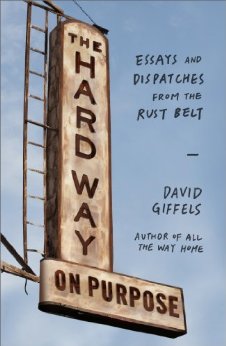
Furnishing Eternity continues the Akron, Ohio, author’s award-winning literary career. Giffels’s previous books include The Hard Way on Purpose: Essays and Dispatches From the Rust Belt and All the Way Home: Building a Family in a Falling-Down House, his first memoir. He teaches creative nonfiction in the Northeast Ohio Master of Fine Arts Program.
David–place figured majorly in your last book, The Hard Way on Purpose. How does place figure into Furnishing Eternity?
My last book was about place in a regional, communal kind of way, a place I share with a lot of people—the Rust Belt and the industrial Midwest. I think about Furnishing Eternity as being about place in a different way. It’s a much more personal book, but I identify the place of my father’s barn and workshop very directly with him. That’s where his true nature was. It’s where I communicated with him the best. The much more intimate spaces of his barn and workshop are central to this story.
In Furnishing Eternity, you experience the death of your mother and your best friend, John. I read that much in the sections about your grieving those losses began as journal entries. Can you talk about how you progressed from journal-writing to essay-writing?
This book was different, because I knew I was going to be living things as I was writing about them, which is closer to journalism than it is to memoir. So I was already doing a lot of note-taking about the process of building a casket and about spending time with my father. I was careful with my note-taking, to record things as they were happening, knowing they would be in the writing. When my mom died, unexpectedly, and John died—that note-taking became less of a literary process and more of a personal process.
The writing involved working from raw notes that were sometimes painful to read, that I took, day by day, aware that that material would be part of what I was writing for the book and aware that I was also recording my emotional life. That’s hard material to work from. It was so raw, so immediate, and so chaotic. When you grieve someone it can be a violent and unpredictable process, and writing requires stepping back and seeing the shape of things. I was trying to do that on the fly, so it took a lot of drafts and a lot of trying to distance myself. The process was different from anything I’d done as a writer. When I wrote All the Way Home, it was ten years after the events and I had settled a narrative in my head. I could see things with objective distance that made it a much different writing experience. It’s easier to regain the immediacy of something that’s in the near distant past than it is to step away from the immediacy of something ongoing.
Joan Didion’s The Year of Magical Thinking was vital to that process; not just the process of writing—she’s writing about writing about grief—but also the process of grieving. I had avoided reading the book while I was writing Furnishing Eternity, because I didn’t want my writing to be influenced by it. But when my mom died I knew I had to read that book to help me with the process of grieving my mother. Didion was vital to my personal loss and my ability to write about it.
Do you journal much, regularly?
Not very much. Spending many years as a journalist has made me much more workman-like as a writer. I have journaled at various times, but to me, writing is getting down to work and doing it when it needs to be done. I think in banker’s hours. Once I’m working on a project, it’s all-consuming. I’m always taking notes. When you’re working on a writing project, you become a selective magnet, like all of a sudden everything in the world is being tested to see whether it’s going to be drawn to your subject. If it is, it comes flying at you and sticks. I’ll hear or see something and think, I have to write that down right away. That’s urgent journaling, I guess. Read more
Top 3. Top 10. Top 100. We attach ourselves to the superlative and feel tops–if only for a moment. And that almighty numeral: even an English major gets to feel like a statistician.
So, without further ado…
A Rust Belt Girl Top 3 (according to you)
with related recommended viewing for the new year:
Number 3: A blog is born, my first-ever post, covered my rationale for starting this blog. (Among my reasons: an online search for “female and Rust Belt” turned up rust-colored ladies’ belts for sale by JCPenny.) For those of you who made it to post two, thank you!
Number 2: Life in Lima and more–from Intensity Without Mastery’s Michelle Cole (along with the second installment) featured a collaboration with the photographer and blogger with an honest eye for life and art in the Rust Belt. (Bonus points for pronouncing “Lima” correctly!) Look for more collaborations in the blogosphere in 2018.
(And, drum roll, please…)
Number 1: The big kahuna, the winner of the most views goes to my Interview with award-winning Akron, Ohio, author and journalist David Giffels, who answered all of my pressing questions about his books–including Furnishing Eternity coming out January 2–along with his teaching, his hometown, and even Lebron. Be on the lookout for another conversation right here with David on his latest memoir early in the new year.
Until then, may your days be merry and bright and your New Year’s celebrations be tops…
We are where we come from—and where we choose to make our home. For David Giffels, that’s one in the same: Akron, Ohio, Rubber Capital of the World, where he grew up and now lives, teaches, and writes. The Hard Way on Purpose: Essays and Dispatches From the Rust Belt (2014) is his fourth book, following his 2008 memoir, All the Way Home: Building a Family in a Falling-Down House. His new memoir, Furnishing Eternity, came out January 2, and I will be talking with David about it soon, right here!
In 2017, I spoke with David about Northeast Ohio’s brand of funny, fellow Akron native Lebron James, why the hard way is the best way, his latest book—and more.
David — In The Hard Way on Purpose, you use humor to great effect. You call Akron “the Ralph Malph of the American industrial belt.” With your identity so closely tied to the place, when the place gets beaten up—nearby Cleveland is “the mistake on the Lake” to many still—do you take it personally? Do you deflect with humor?
It’s part of the culture here to laugh at ourselves. When you’re in any culture that’s been misunderstood, degraded, or used as the punchline to a joke, one of your defense mechanisms is to get to the punchline, first. Most Rust Belt cities—but especially this area—have a long tradition of this kind of humor. Here, a lot of people have traced it back to Ghoulardi, a 60s late-night B-movie horror host on local TV. He had this dark, ironic, anti-authoritarian sense of humor that influenced a lot of the people who’ve become our local cultural spokes-heroes: bands Devo, The Cramps, and Pere Ubu; and filmmaker Jim Jarmusch. There’s a certain kind of homeliness to where we live, and instead of being ashamed of it, you can make fun of it—and be a part of it, too.
How did you learn to write funny?
I guess it partly comes from having two parents who had really good senses of humor. I don’t know if I learned how to do it. One of my first professional jobs was writing for MTV’s Beavis and Butthead. I learned a lot from that. I talk about this in my new book: I was writing these clever-sounding lines, but it was not working. I was trying to be the Noel Coward of MTV. And show creator Mike Judge said, “Just make it stupid.” It was a great piece of advice. A lot of humor writing comes from letting down your guard, letting things roll.
You were a newspaper columnist before becoming a professor of creative writing and an author, and you wrote about Cleveland sports teams. One of the essays in The Hard Way on Purpose focuses on fellow Akron native, Lebron James. I have to ask, how do you like Lebron now?Read more











 Rust Belt Girl