“This Woman”: an Essay by Melissa Ballard

Essayist Melissa Ballard contributes the fourth in our series of guest posts here at Rust Belt Girl, and, let me tell you, you’re in for a treat. Melissa has a talent for bringing the past to life and making her ancestors feel like our shared family. In this essay we meet Phyllis, Melissa’s grandmother, a woman of Northern Appalachian Ohio, whom Melissa writes about in a loving yet candid way, deftly delving into what makes personhood–class, sex, education, place and much more. (We also hope Phyllis is having the “time of her life,” Melissa.)


This Woman

by Melissa Ballard

This woman is my grandma, but not yet. 

In this black and white photograph, a small, dark hat of woven straw covers her hair and shades her forehead. She wears a walking suit: a jacket and skirt in a light wool pin check with a belt of the same fabric, over a silky, patterned, blouse. The tips of the fingers of her left-hand rest in the pocket of her slim skirt. Her only jewelry is a ring on the little finger of that hand. I can imagine her cropped left foot pointing out, her dark stockings and t-straps. She slouches just a bit and turns her body toward the unidentified photographer. She looks directly at the camera. Her smile is slight, but it reaches her eyes. 

This woman’s slight curves contrast with the riveted metal beam, perhaps part of a railroad bridge, that rises at a sharp diagonal behind her. In the early 1920s, her family lived on a side street a few blocks from the train station in Dennison, Ohio. Her father was an inspector for the railroad, so she had a free pass to ride. 

This woman could be waiting for the early train to Pittsburgh or Columbus, where she will walk the streets with confidence, on her way to a job interview. But she is not. Or at least I don’t think so. I know little about this brief period, but I hope she is having the time of her life.      

In 1925 she has a job in an ice cream shop, lives with her parents. Both she and her mother, who is preoccupied with social status, are named “Margaret.” This woman has already started to express her individuality and goes by her middle name, Phyllis or, on documents, “M. Phyllis.”

On June 18, 1925, eleven days before her nineteenth birthday, Phyllis and her neighbor, Harry, will travel 65.3 miles, maybe by train, to Brooke County, a tapering finger of West Virginia tucked between Ohio and Pennsylvania, where they can get a marriage license with no waiting period. Later that day, they will return to Ohio and be married at the home of the groom’s family. 

I wonder whether Phyllis’ parents even attended. They had a reception for her later, but I gather it was her mother’s attempt at saving face. I can’t imagine she approved of my grandpa or his family, and I can easily hear her saying, “He’ll never make a decent living. You’ll end up in the poor house.” 

Five months and five days later, their first child will be born. On January 14, 1928, their second child, my dad, will be born.

Phyllis c. 1920

The woman I remember, my grandma, was in her fifties. She had slim legs but a solid middle. She wore silver, cat-eye glasses before they were retro. Her short, dark hair was streaked with gray and white, her fingernails chewed to the quick. Wearing a well-washed cotton housedress covered with a flowered or checked apron and heavy lace-up shoes, she kept chickens and goats, grew vegetables and flowers, ran the laundry through a wringer before hanging it outside to dry, cooked meals from scratch. She kept a battered pan under the kitchen sink, filling it with food scraps. Every morning she fed it to the three hound dogs Grandpa had brought home from the dog pound, kept in a pen at the back of the yard. “Oh, hush up,” she said as they yipped and howled at her. 

When Grandma wasn’t busy with chores, she answered the phone for Grandpa, who was the dog warden. She wrote messages in her flowery cursive: the name, address and phone number of the caller, and a brief description of the stray dog. She followed him to his dark green truck, reading her notes out loud. Grandpa never wrote anything down. Before she finished talking, he was backing out of the long driveway, kicking up gravel as he went. 

They lived in a worn-out house on a liminal strip of land in Brightwood, part of Goshen Township, Tuscarawas County; my parents and I had moved to a suburb of Cleveland. Once a month, we made the two-hour trip down home to visit, and I spent more time there during the summer. 

On hot afternoons, Grandma and I often sat together on the front porch swing, she doing her mending and me reading, trying to catch a breeze. A two-lane road ran close to the front of the house. The cars seemed to fly by, and the exhaust from the trucks taught me to mouth breathe, a skill I perfected when I ran into the hen house to collect eggs.  

This route was nicknamed the “slow road” after a highway, the “fast road,” was built behind the house. One summer Saturday, Grandpa drove us into town on the slow road to get ice cream. Grandma and I sat on a bench with our cones, people-watching while Grandpa ran one of his mysterious errands. If Grandma asked him where he was going, he always said, “I need to see a man about a horse.” Which was odd, because my grandparents didn’t have any horses.

On the way home, I noticed a large house on a hill. “Who lives there?” I asked.

Grandma stiffened. “That’s the poor house. Where you go to live if you don’t have any money. It’s not a nice place.” 

I immediately pictured a nineteenth-century orphanage from one of the many books I read. Rows of rusty metal cots with stained mattresses, thin sheets, and scratchy blankets. Peeling paint on crumbling walls. I shuddered and looked away. 

The dining room at Grandma’s was small, with windows on three sides, some covered in plastic to keep out drafts. It was an afterthought tacked on to one side of the house next to the living room. It contained a water-spotted stand of neglected African violets, a treadle sewing machine with a clove-studded dried orange tucked in one of its small oak drawers, a large dining room table and chairs, and a handmade oak China cabinet Grandma had purchased for ten dollars with the money she made selling eggs.  

When Grandma made Sunday dinner for our extended family it was served at noon. Grandma removed elegant pieces of stemmed glassware and individual salt cellars from the cabinet and set the dining room table with her good silverware. As we passed roasted chicken with gravy, noodles, and side dishes, Grandpa arrived late (he was known for having “girlfriends”), threw his work cap in the corner, and took his seat at the head of the table. 

Only now do I realize how little Grandma wasted. Usually, she cooked one of her own chickens on Sunday, but she occasionally made a pork roast. After the meal, any scraps of meat were set aside, combined with corn meal mush (I can only imagine her reaction to polenta recipes in upscale restaurants) and baked in a loaf pan. For breakfast the next day, she fried slices and we covered them with butter and syrup. They were delicious. 

Over time, and with deaths and disagreements, our extended family grew smaller, and we began eating all our meals in the large kitchen. The food was still delicious. One time, Grandma asked how everything tasted. Grandpa was the only one who didn’t answer. She stared at him, and he finally grumbled, “If anything’s not good, I’ll let you know.” Already showing signs of Parkinson’s, he poured a bit of his coffee into a saucer with shaky hands, and leaned down to slurp it. 

Eventually, an old couch was jammed into a corner of the dining room, next to the china cabinet. It became my reading space when I visited. Now, as I sit down to read on my own sofa, I look at that same cabinet on the front wall of my living room in Oberlin, just two hours away from where Grandma lived. I have covered the top with family photographs. 
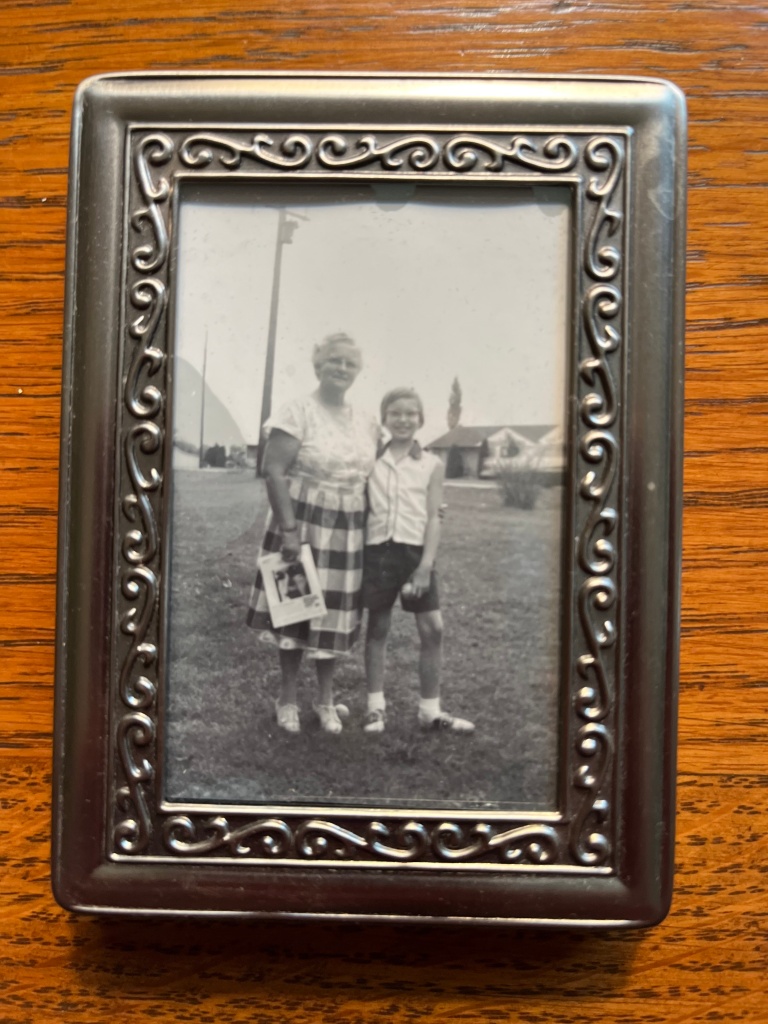
Phyllis and the author c. 1960

Grandma taught me how to tie my shoes–we were both left-handed–after everyone else had given up; gave me my first sip of coffee, strong but cut with generous portions of sugar and thick cream; slipped me some of her beer while we watched Gunsmoke. As I got older and visited less, we wrote letters.

Shortly after my twenty-first birthday, Grandma and I walk in her back yard. We stop under the hot sun to admire the clumps of purple, yellow, and white miniature pansies that flourish in the crumbling foundation of an old shed. I started college three years late; I tell her I am overwhelmed and don’t think I can do the work. She is quiet, removes a flowered hanky from her apron pocket, pats her damp forehead and the back of her neck. 

As we start slowly up the steps to the relative cool of the house, I link arms with her. I brush the cool copper of the bracelet she always wears because she believes it helps her arthritis. Her fingers are crooked, as mine are now. As I write this, I touch the copper cuff bracelet I bought years ago but have never worn. I keep it on my desk as a reminder of Grandma, and I wonder what happened to the soft, linked one she always wore. 

I open the back door with my other hand. Grandma suddenly stands as straight as she is able and says firmly, “You stay in school.” She adds this, which I will hear her say more than once: “You need to be able to make your own money.” 

After I’ve finished graduate school, married, and had a child. After Grandpa, who spent years in a nursing home with Parkinson’s, has died. On what will turn out to be the day my dad, her son, dies, Grandma moves into an assisted living facility.  With Dad being ill, no one has had the time to take Grandma to see the place prior to moving in. She’s been calling me several times a day, anxious about the change. 

She surveys the room: her favorite chair with an afghan she made folded over the back; her dresser, its top covered with a lacy scarf and family photographs, including several of my daughter; a large window that looks out on gardens; the new spread my mom placed on her bed that morning; a private bath.            

She leans close to me and whispers, “Oh, Melissa, this is beautiful. I was afraid it would be like the poor house.” 


Melissa Ballard has written essays for The Brevity Blog, BeltBerea College magazine, and other publications. She is currently working on a book-length collection of essays about the women in her Northern Appalachia family. 


Like this post? Want more? Comment below or on my FB page. And please share with your friends and social network. 

Are you a Rust Belt writer interested in seeing if your own post, or author interview, or book review might be right for Rust Belt Girl? Hit me up through this site’s contact function.

Check out my categories above for more guest posts, interviews, book reviews, literary musings, and writing advice we can all use. Never miss a post when you follow Rust Belt Girl. Thanks! ~Rebecca

Enter your email address to subscribe to this blog and receive notifications of new posts by email.

“Taking the Cow Path to Culture”: an Essay by Christina Fisanick

I’m thrilled to present the second in a series of guest posts interrogating place here at Rust Belt Girl. Christina Fisanick is a champion for Appalachian writing–and Appalachian voices, young and old. (Read her whole bio below.) “Taking the Cow Path to Culture” appears in her book, Pulling the Thread: Untangling Wheeling History, which was published in 2024 by North Meridian Press.

Taking the Cow Path to Culture 

by Christina Fisanick 

Route 88 meanders through the Ohio Valley countryside, connecting the city of Wheeling, West Virginia, to Oglebay Park and small, rural towns and farms along the way. More significantly, for some, Route 88 is the lifeline that carries students, faculty, staff and visitors to two of the area’s oldest institutions of higher education, West Liberty University and Bethany College. This important role earned Route 88 the seemingly humorous moniker, “The Cow Path to Culture,” and is a standing metaphor for much of life in the northern part of the Mountain State and throughout Appalachia.

Route 88 was once an actual cow path upon which animals were herded across the farmlands of the region. Like many other places in the country, it made more sense to locals to pave the beaten cow path than to blaze a new trail as modes of travel advanced. But as has been somewhat painfully obvious over the last century, maintaining the well-trodden road might not be the best way to go. 

In 1893, a minor New England poet, Sam Walter Foss, wrote a poem with a major message. “The Calf-Path” tells the story in verse of a path driven by a calf through Boston, which, after years of other animals, and eventually humans, following the path, was paved and became a major thoroughfare. The funny, yet poignant, poem takes readers on a journey through time and encourages deep thought about life decisions. Mainly, Foss wonders, why should we continue going down the same road in deed and thought when it might not be the most direct or even the best route?

Just like the calf path in the poem, Route 88 rambles and turns and plunges on its trek from Wheeling past Oglebay Park beyond the farmlands and homes and on to West Liberty University and then Bethany College. I commuted to West Liberty in the 1990s and cursed the winding road more than once during the icy winter months. My classmates and I anxiously wondered who would build a college on top of that hill? More so, we jokingly wondered how we made it to graduation.

Covers of three of Christina Fisanick's books: Digital Storytelling as Public History; Pulling the Thread: Untangling Wheeling History; and The Optimist Food Addict: Recovering from Binge Eating Disorder

We were not the first students to ponder such things. A 1972 Sports Illustrated article tells the tale of four student-athletes from Israel—Avraham Melamed, Moshe Gertel, Yoel Kende and Danny Stern —and their “250-pound Irish Catholic coach,” Tom Grall. The students were recruited for the West Liberty swim team. Avraham Melamed described their journey from the Pittsburgh airport along Route 88 in harrowing, awe-struck terms then concludes: “It was easier getting from Ramat Yohanan [Israel] to Pittsburgh than it was to get from Pittsburgh to West Liberty.” Writer Mortin Sharnik paraphrases Melamed:

“All roads do not lead to West Liberty, but one that does, Route 88, is called the Cow Path to Culture. The Israeli was taken on a more scenic route, a roller-coaster ride over a ribbon of cracked concrete, with no guardrails to prevent a car from taking a shortcut down a ravine. Melamed kept his nose pressed to the car window, looking for the bright lights. Instead, he saw farms, strip mines and hairpin curves.”

The effort, of course, was worth it. The Israeli students went on to make the swim team as winning as West Liberty football, which at the time the article was written had two consecutive undefeated seasons. More so, they earned great educations from the oldest institution of higher education in the state of West Virginia.

While Sharnik’s article is a fascinating and humorous look at the past, it is the title that catches my attention: “Wandering Jews in an Unpromising Land.” Clearly, Sharnik was playing on the students’ ethnicity and well-known Biblical references. Regrettably, the term “unpromising” is simply the same old stereotype of West Virginia arrived at by taking the same old mental cow path. Now, 46 years later, that cow path has been paved over again and again, and few people outside the state (and even within its borders) are willing to blaze a new trail. West Virginia needs to free itself of the shackles of presupposition that continue to hold us back from achieving greater success.

These stereotypes not only negatively color West Virginia, but all of Appalachia. We are told time and again by the popular media (and even ourselves) that there is nothing here. Appalachia is a wasteland, people say. A no man’s land of little possibility and less opportunity, they echo. And more often than not, this lack is blamed not on politicians or exploitive company owners, but on Appalachians themselves.

This blame goes back decades to early literature, TV shows and movies that exploit the region’s hardships for book sales, ratings and box office records. Few can forget The Beverly Hillbillies and their clueless, backwoods characters with hearts of gold or the psychologically deranged figures from Deliverance. Popular culture tells us that Appalachians are poor, willfully ignorant souls who are too lazy to improve their lots in life. These ideals have been further entrenched by presidential “poverty tours” conducted by presidents and other politicians throughout the 1960s to prove to the American people outside the region that Appalachians are poor, white trash that need their help.

Unfortunately, many of our own people have embraced these ill-conceived views of ourselves and live accordingly. Of course, we never see ourselves as morally-bankrupt, ne’er-do-wells, but we willingly believe it of our neighbors. J.D. Vance does this in Hillbilly Elegy, of courseHe encourages the country to continue to blame Appalachians for our misfortunes. It is our own fault that we suffer from the world’s highest rates of opiate addiction, he argues. It is our own fault that many of our children live in poverty, he states. By continuing to claim that Appalachia’s poor are responsible for their own conditions, the nation’s eyes can be averted, not out of guilt but out of blame. Our country’s hands can be washed clean since Appalachians create our own misery and wallow in it.

It is easy to see why this particular cow path has been well-worn and paved over. It is to the benefit of politicians whose pockets are lined with money from the oil and gas industry to continue to shame and blame our people so that they never ask for more. Our land has been raped of resources while our people have been underpaid and exploited. None of this could happen if not for desperation and mentally following a well-worn cow path that leads to broad, self-defeating conclusions about poverty, drug abuse, and job loss.

Even now, young men fight for jobs in the dying coal industry for the promise of what they believe once was but will never be (again). Now is the time to take a different path. One that is not littered with stereotypes and preconceived notions. I am reminded, as I am sure you are by now, of another poem that urges readers to take the road “less traveled by.” I urge you, my fellow West Virginians, imagine a different life for yourselves and for generations to come. I’ll always take the cow path to culture to serve my alma mater. West Liberty University is in my heart forever. But my mind will be on a different metaphorical route that allows for new possibilities for West Virginia, Appalachia, and its people.

We no longer have to play the role of eager simpletons to keep our jobs. There are no jobs. Let’s create our own through education, new industries, and innovation. A change in mindset will make all the difference. In this moment we must abandon who we are told we are and become who we know we are. We are West Virginians. We are Appalachians. Toughened by adversity, wizened by necessity, and softened by empathy.


A photo of the cover of Pulling the Thread: Untangling Wheeling History, essays by Christina Fisanick, Ph.D. Forward by David Haversack, Ph.D.

Pulling the Thread: Untangling Wheeling History

By Christina Fisanick, Ph.D.

North Meridian Press


Photo of Christina Fisanick, Ph.D., with red hair and gold earrings and wearing a black sweater.

Dr. Christina Fisanick is the author or editor of more than 30 books and dozens of articles, essays, and poems. Her latest book, Pulling the Thread: Untangling Wheeling History, is a collection of essays focusing on little known stories from Wheeling’s past. She is currently working on an historic novel which takes place at Fostoria Glass in Moundsville, WV, in the years immediately following WWII and co-editing an anthology, “We Are Here!”: New Writing from Northern Appalachian (forthcoming for University of Kentucky Press). In addition, Fisanick is an English professor and an internationally recognized scholar in the teaching of digital storytelling as public history. Fisanick serves as the president of the Writers Association of Northern Appalachia (WANA) and the co-host of WANA LIVE!: The Reading Series. Learn more: christinafisanick.com.


Doesn’t this essay just get you thinking? What are a place’s histories, byways, characteristics, and quirks–and how have they shaped its people and its art? How have they shaped the stories we tell? For this series, I suspect we will get some fascinating answers to these questions and many more I haven’t thought of. I hope you’ll join in and share your thoughts!

Like this post? Want more? Comment below or on my FB page. And please share with your friends and social network. 

Are you a Rust Belt writer interested in seeing if your own post, or author interview, or book review might be right for Rust Belt Girl? Hit me up through this site’s contact function.

Check out my categories above for more guest posts, interviews, book reviews, literary musings, and writing advice we can all use. Never miss a post when you follow Rust Belt Girl. Thanks! ~Rebecca

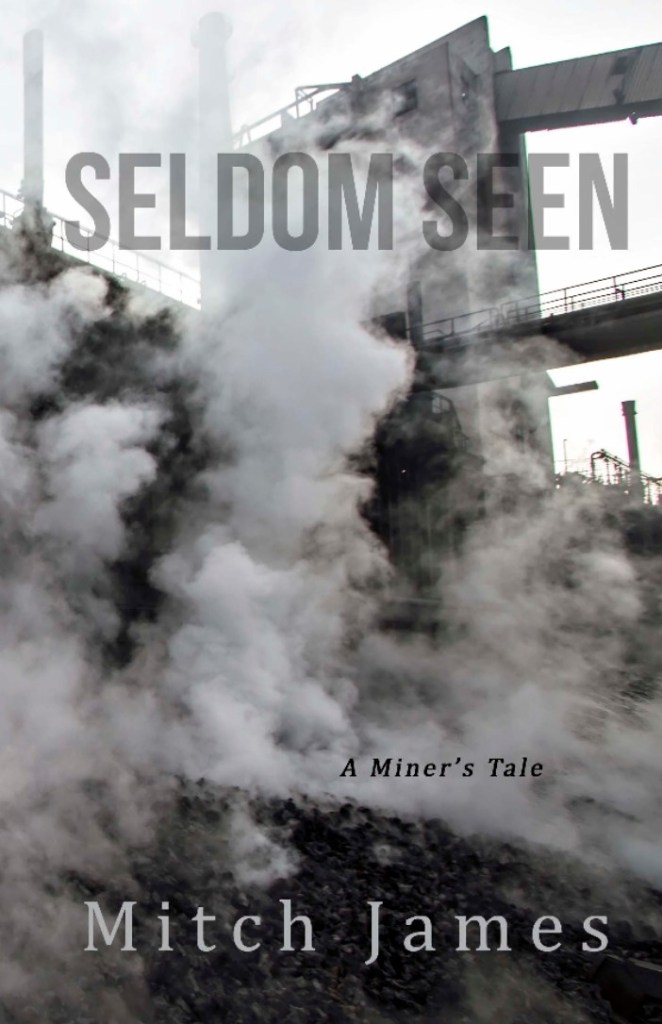
My interview with Mitch James, author of Seldom Seen: A Miner’s Tale

For my Appalachian lit aficionados, Grit Lit fans, and readers who aren’t afraid of the dark … I’m thrilled to share with you my conversation with author and professor Mitch James about his debut novel.

From the back cover, an intriguing blurb:

A dead mother. An auctioned childhood home. Loss in the womb of a coal mine.

Seldom Seen follows main character Brander, who encounters a “specter of a man who promises him that the answers to life are in Seldom Seen Mine, the largest coal mine in the United States.

With nothing holding him back, Brander … takes a job at Seldom Seen Mine, and fails at every attempt to amend his life, losing a friend, a lover, and maybe his mind.”

Reader friends, how does an author make good on such a blurb? I’ll tell you. With prose like this. I’m prefacing my first question for Mitch with one of my favorite passages in the novel. This is from early in the story, when Brander first enters Seldom Seen Mine:

Brander was surprised. The road was rather smooth and well-lit, the air stale but not dirty. They rolled along, everyone quiet. Brander stared around. The mine’s back had a skeletal structure of beams and crossbars and cribs, packed tight with backfill in places and all sealed up with gunite. It was surprisingly silent beneath the earth, the hum of the transport, the crunch of residue below the tires, the occasional whoosh of an air course. If not for the forced mechanization, there would be no sound, not like on the surface. Noise is life. But even free of men, the mine wasn’t dead, exactly; there was something, a kind of energy present in the long back road, an innate awareness, like the womb of a pulse-filled thing.

Mitch, welcome to Rust Belt Girl! Let’s dive in. The mine in this story works as much more than a compelling setting but a real character. I’d say we readers end up knowing as much about the mine as we do about Brander. How did you decide where to set this story? How did you learn so much about mines and mining? What kind of research did this entail?

I’m so happy to hear you’re engaging with the mine in that way because it is very much its own organism. It felt that way when writing the book, and it means a lot to hear that it felt that way to you as you read it. When I wrote the novel, I was up to my ears in rural Pennsylvania, working on farms, mountain biking old logging roads, kayaking rivers, and clearing land. I couldn’t get enough. I lived not far from the real Seldom Seen Mine. The research I did that allowed me to accidentally stumble into the idea for the novel also happened there. It was a perfect recipe—the need to express the region as I had experienced it as a transplant who had been there awhile, the need to tell Brander’s story, the need to imagine others’ lives and suffering alongside my own.

As for research, I read literary books on mining. There aren’t many. And I read short stories about mining in the U.S. and abroad. I read historical writing about mining at different periods in the U.S. in microfilm and microfiche. I watched a lot of YouTube videos, read instructional handbooks on mining equipment, found out who sold it, and found videos on how to operate it. I was friends with a mining engineer who guided me some.  A little bit of everything.   

Here at the Rust Belt Girl blog we’re a little fascinated with how place works in story. Place helps plots turn. Place also helps form characters. While a rural setting, I’d say that your Seldom Seen mine situates your novel squarely in Rust Belt lit territory. There are other commonly-appearing aspects to Rust Belt lit (or contemporary Grit Lit, writ large) that feature in your story: teenage pregnancy and the meth crisis for just two examples. Can you talk about how you explore such aspects of Rust Belt life and the characters living these lives without resorting to stereotypes in your novel (you do this well!)? 

I’m relieved to hear you don’t think my characters are stereotypical. I would never want that. That said, though, if I’m being honest, I think all fiction runs off a little bit of stereotype. I think most readers need to see characters that are somewhat familiar and that present themselves as equations they believe they can calculate, at least at the start. Lucky’s the gruff, crude, masculine man. Brander is the wounded, self-loathing Midwesterner. But beneath the stereotypes that reveal a small percentage of what makes up who we are is the rest of us, the best of us, the parts of us that are unique. Brander and Lucky also have these qualities within them. It’s my job to complicate their stereotypes by fleshing out the rest of their characters, for they drive the story. I see stereotypes everywhere, including in myself. But by seeing them, I can perceive their limits, their boundaries; I can peer around them to what else presents itself, and that’s gold as a writer, the stories everyone tells but doesn’t mean to.

Basically, look for the people within the people and write about that. Then be prepared to conscientiously employ a little stereotype to get the ball rolling.     

For those of us who are writers, ourselves, I wonder if you could take us through the process of crafting this novel. What was the first idea/image that came to you? When did you know you had to write this story? How long did it take? What’s your writing process like? We craft junkies want all the details!

The idea for the novel came to me when I was reading a translation of a Russian short story from the early 1800s, a story about a miner who encounters a ghost in a mine. The ghost starts manifesting in his life outside the mine until he goes insane and, if I remember correctly, kills himself. The story was so short. I wanted so much more. So I made it. 

When did I know I had to write the story? Immediately. I can always tell the difference between something I could write and something I must write. I had to write Seldom Seen.

As for the process, I woke up at 3 a.m., wrote a 1000 words a day five or so days a week, and had the first draft in a few months. Then it took me 10 years to publish the book, so you can imagine the revisions, drinking, and self-loathing that occurred after repeated failures. Brander had to get it from somewhere!  

I often wonder how Rust Belt lit will appear in American Literature textbooks a hundred years from now. Since you’re a college professor—maybe you wonder about this too? For me, my most formative American Literature course introduced me to William Dean Howells, the father of American realism. I’m not going to draw a perfectly straight line from American realism of the late 19th century to Southern Gothic of the early 20th century and the Grit Lit of today, but somebody could try. All that’s to ask where you see Seldom Seen fitting into the canon of American Literature? What are your reading/literary influences? What literary characters informed Brander, who—despite hard work and, yes, grit, fails, fails, and fails again?

It makes me feel a little pretentious to think of my work in any kind of canon. But my writing, including Seldom Seen, is influenced by myriad Appalachian, Midwestern, and American Western and South-Western writers, all rural and spread across the genres of fiction, nonfiction, and poetry. I would hope Seldom Seenwould be welcomed by the Appalachian literary community and rural literary communities more broadly. 

As for character influences, I have to be honest, I don’t know that I’ve ever consciously (though certainly subconsciously I have) created characters based on other characters about whom I’ve read. The characters begin with me, but they take over their story, and I just try and keep up and do justice through my writing to what they show me. I know that sounds mystic and woo-woo, but it’s the truth. For example, Lucky wasn’t a character I intended to have in the story, but when he showed up, he had plans, and I went along with them. Now, I can’t imagine the novel without him. 

As for the last part of your questions, I don’t need to read a book to see hard work, grit, and abundant failure in a person. I’ve witnessed it in the working poor rural communities I’ve lived in my entire life. But I want to make something clear; I’m not saying the working poor are failures or that their efforts are in vain. I was working poor until I was thirty-two years old. I worked fifty hours a week with multi-billion-dollar industries and still had no healthcare or money, and couldn’t afford a vacation or a car that could make it out of the county. Goals like a home instead of a rental, good health insurance, the ability to take a vacation or have a safe vehicle all create comfort and stability in one’s life. The working poor are grinding but failing to reach important thresholds like these and others. There are many reasons why, but amongst them are certainly socio-economic and political barriers. These folks, my mother and father, cousins, aunts, uncles, neighbors—they’ve taught me how to create characters with grit that fight and fight and fight.

This world has shown me how to write characters who fail.

And final question: What are you teaching, reading, and writing right now? What’s next?

I’m teaching various writing composition courses. I’m reading, gosh, so many random things. I feel like I read and read and finish nothing. I’m reading Larry McMurtry’s Horseman, Pass By; Marilynne Robinson’s Gilead; Adam Grims’ The Art and Science of Technical Analysis; Pema Chödrön’s When Things Fall Apart, and a textbook on world history because I screwed around too much in school when I was younger. I’m ashamed by how much basic knowledge I missed out on for being too stupid to know better. 

As far as writing goes, I just finished a book of poetry that a press requested and for which there is a promising chance of publication. I’m pitching a couple of short story collections and two novels and am kind of tinkering around on a new one, so if there are any publishers/agents out there who think my work and I might be a good fit, reach out. I’m doing some final revisions on two peer-reviewed articles due out soon as well. Keeping busy. 

Upcoming? I’m excited about the Lit Youngstown Fall Literary Festival. It’s one of my favorite events all year!  


Mitch James is a Professor of Composition and Literature at Lakeland Community College in Kirtland, OH and the Editor-at-Large at Great Lakes Review. Mitch is the author of the novel Seldom Seen: A Miner’s Tale (Sunbury Press) and has published works across the genres of short fiction, poetry, and academic scholarship. You can find his latest short fiction in Made of Rust and Glass: Midwest Literary Fiction Vol. 2Red Branch Review, and Bull; poetry at Shelia-Na-Gig, Watershed Journal, I Thought I Heard a Cardinal Sing: Ohio’s Appalachian Voices; and scholarship at Journal of Creative Writing Studies. Find more at mitchjamesauthor.com and on Twitter @mrjames5527. 


Like this interview? Comment below or on my FB page. And please share with your friends and social network.

Check out my categories above for more interviewsbook reviewsliterary musings, and writing advice we can all use. Never miss a post when you follow Rust Belt Girl. Thanks! ~Rebecca

Enter your email address to subscribe to this blog and receive notifications of new posts by email.

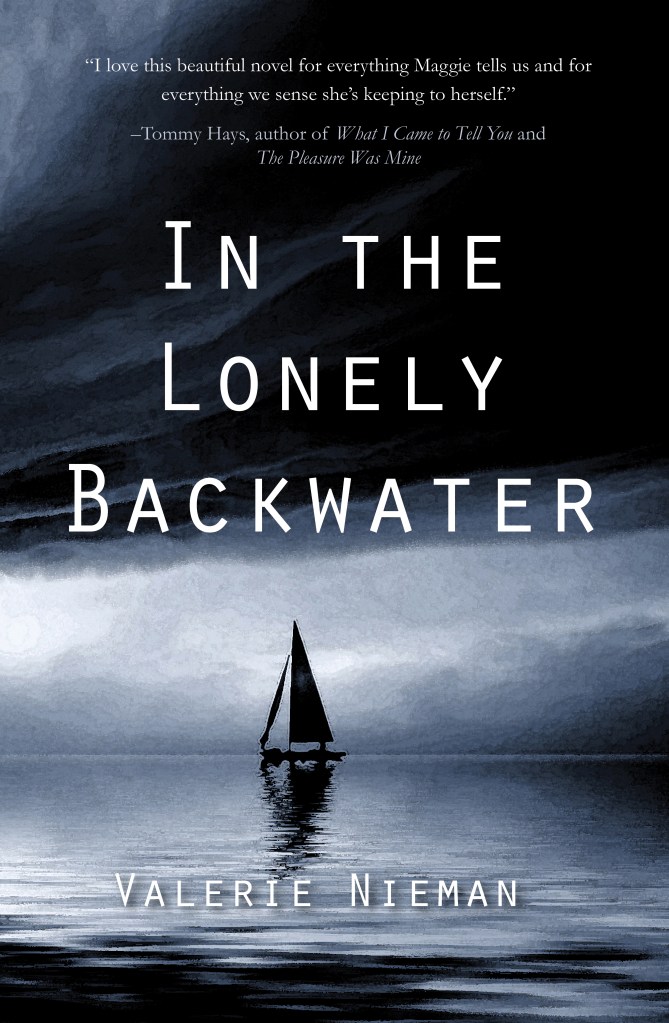
My interview with Valerie Nieman, author of In the Lonely Backwater: Part II

Part II of my interview with Valerie Nieman continues our discussion of her novel and her poetry and also covers the poetry she loved to teach her students. She also shares what she’s writing and reading, right now. (Spot the friend of Rust Belt Girl in her TBR!) Missed Part I of the interview? Find it here.)

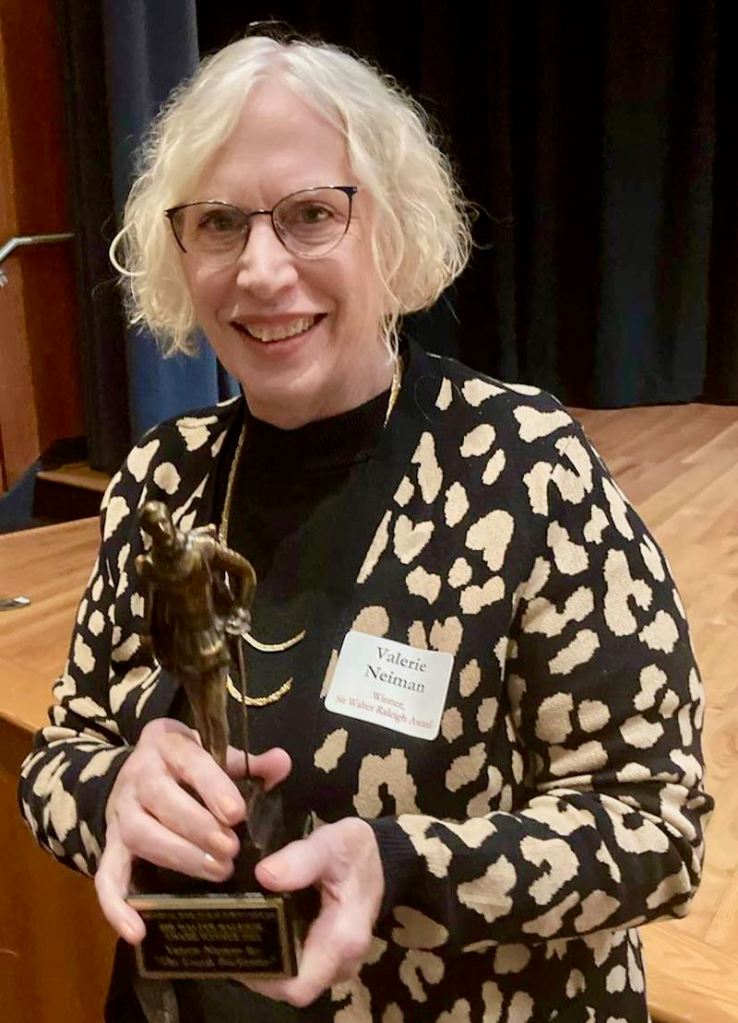
Valerie Nieman’s latest, In the Lonely Backwater, a mystery in the Southern gothic tradition, has been named the 2022 Sir Walter Raleigh Award winner for the best novel by a North Carolina writer. To the Bones, her genre-bending folk horror/thriller about coal country, was a finalist for the 2020 Manly Wade Wellman Award. She is also the author of Blood Clay (Eric Hoffer Award) and two other novels. She has published a short fiction collection and three poetry collections, most recently, Leopard Lady: A Life in Verse, which was runner-up for the Brockman-Campbell Prize. She has published widely in journals and anthologies, and appears regularly in juried reading series such as Piccolo Spoleto, Why There Are Words, and Women of Appalachia. She has held state and NEA creative writing fellowships. Nieman has degrees from West Virginia University and Queens University of Charlotte, and was a reporter and farmer in West Virginia before moving to North Carolina, where she worked as an editor and a creative writing professor at NC A&T State University. 

Valerie, In the Lonely Backwater has been praised for its “deep sense of the wonderment of the natural world.” I see this in your poetry, too:

Can you talk about this poem of yours, its impetus, its rooting in the bog but also “close to the sun?” 

This is a poem that came directly from observation. I was walking in the Bog Garden in Greensboro when I came upon a group of people staring up into the treetops. It’s that barred owl, I thought, a resident of the garden. Instead, I was shocked to see a full-grown groundhog up there grazing on the new leaves. I went home and looked it up online, finding numerous videos and learning that it’s not uncommon for woodchucks to climb trees.

Among other inspirations was the late Gerald Stern’s poem “Behaving Like a Jew” and his line about a dead opossum’s “little dancing feet.”

Poet and author Valerie Nieman

The family at the center of your novel is part of the “Appalachian diaspora.” What does this term mean for you personally—and for your poetry, especially?

Well, it’s who I am. I grew up in northern Appalachia, the Allegheny Plateau in western New York where the Allegheny River rises and flows to Pittsburgh. I went to school at West Virginia University, and worked as a reporter and editor at papers in Fairmont and Morgantown,  both on the Monongahela, before leaving the Ohio River watershed for the first time in my life. I moved to central North Carolina in 1997 for a newspaper job. Now I live one county line over from Appalachia as defined by the ARC, but Rockingham County has all the earmarks of Appalachia—rural, with faded industry and a changing agricultural life, and beautiful hills and rivers. Not really mountainous enough, I guess. So my work draws on my upbringing in dairy country, 20-plus years in the coal fields, and then working as an editor in tobacco country before a final 20 years in academia. Nature poet, blue collar writer, Appalachian writer, Southern writer.

“Tinder” feels like a nature poem, an ode to Shakespeare’s witchy “double toil and trouble,” and a horror story all at once:

Tinder

I am the woman your mother 
warned you about. 

I am boiling bones boiling bones boiling bones. 
I am washing out the war-rags at the ford,
blood pluming downstream 
gaudy to catch the heart.
 
I am scraping scraping scraping
on the stretched skin of the world. 
My pet is a scrofulous cur,
my bird a dobsonfly all wings and jaws.

I look under rocks.
I find what I expect to find. 

Can you talk about your influences here and what you want your reader to know about the persona in the poem?

Ah, that’s a dangerous woman. She harbors grudges and has a long memory for those who’ve done wrong by her. What bones are those in her broth? Difficult to say.

Influences indeed include Shakespeare, and Poe as well, a bit of Hawthorne—all of whom I read as a child, pulling the classics from the shelves during long western New York winters. I also was influenced by many years of research into early Celtic and Norse cultures. “The washer at the ford” or bean-nighe is found across the Celtic nations. She’s seen in wild places, kneeling beside a lake or river, washing the blood out of the clothes of men who are fated to die. So that was in my mind as the image of the dobsonfly appeared. It’s the quite terrifying winged adult of the hellgrammite, a stream insect with enormous pinching jaws. As a child I spent a lot of time in “the crick,” turning over rocks, and as an angler I’ve done the same for years, to see what fish might be eating, and just because I like to see what’s underneath.

What was your favorite poem or story to teach students when you were a professor at NC A&T State University?

“Out, Out” by Robert Frost is a favorite, to show how a poet can compress an entire short story into 34 lines—dialog, description, setting, plot. I liked showing students the flexibility of the sonnet, comparing traditional forms with Terrence Hayes’ “American Sonnets.” I also loved teaching humanities and exposing students to ancient work from the negative confessionsof the Egyptian Book of the Dead, to framing a discussion about war and the death of young men through Priam’s visit to Achilles.

What are you reading right now? What are you writing? What can we look forward to, next?

The top of one stack: Hemlock Hollow by Culley Holderfield, The Sound of Rabbits by Janice Deal, Red Clay Suzie by Jeffrey Dale Lofton, All the Little Hopes by Leah Weiss, and Hungry Town by Jason Kapcala. Dipping into a number of poetry books as well, including Anything that Happens by Cheryl Wilder. Eager also to get back to some science fiction, with Kim Stanley Robinson’s Ministry of the Future. There are many shelves, and many stacks, and I keep adding to the accumulation.

I’ve just (as of 4/3) completed the first draft of Dead Hand, a sequel to To the Bones. I had almost as much fun writing this as the first one! The action moves from the West Virginia coalfields to Ireland. I revisited places I’d seen a few years ago, from the Shannon Pot to County Cavan to Dublin, and added others including an Irish coal mine. While that simmers in the hands of beta readers, I’m working on pulling together a new book of poetry.

In the Lonely Backwater

By Valerie Nieman

Regal House Publishing $18.95


Like this interview? Comment below or on my FB page. And please share with your friends and social network. 

Are you a Rust Belt writer interested in seeing if an author interview or book review of yours might be right for Rust Belt Girl? Pitch me through this site’s contact function.

Check out my categories above for more interviewsbook reviewsliterary musings, and writing advice we can all use.

What are you reading and writing this week? Let us know in the comments…

And never miss a post when you follow Rust Belt Girl. Thanks! ~Rebecca

Enter your email address to subscribe to this blog and receive notifications of new posts by email.

My interview with Valerie Nieman, author of In the Lonely Backwater: Part I

Author Valerie Nieman grew up in the Rust Belt of western New York State, lived and worked for many years in the northern coalfields of West Virginia, and now lives in a North Carolina town that’s still recovering from loss of the Lucky Strike plant. In short, Valerie explains, she’s “seen a lot of industrial wastelands.”

How do these evocative locations inform her prose and poetry? In the following author interview, I asked Valerie about this, about her latest, award-winning novel–and much more.

Valerie Nieman’s latest, In the Lonely Backwater, a mystery in the Southern gothic tradition, has been named the 2022 Sir Walter Raleigh Award winner for the best novel by a North Carolina writer. To the Bones, her genre-bending folk horror/thriller about coal country, was a finalist for the 2020 Manly Wade Wellman Award. She is also the author of Blood Clay (Eric Hoffer Award) and two other novels. She has published a short fiction collection and three poetry collections, most recently, Leopard Lady: A Life in Verse, which was runner-up for the Brockman-Campbell Prize. She has published widely in journals and anthologies, and appears regularly in juried reading series such as Piccolo Spoleto, Why There Are Words, and Women of Appalachia. She has held state and NEA creative writing fellowships. Nieman has degrees from West Virginia University and Queens University of Charlotte, and was a reporter and farmer in West Virginia before moving to North Carolina, where she worked as an editor and a creative writing professor at NC A&T State University. 

Valerie, can you tell us about your Rust Belt upbringing and how it informs your creative work? What was it like to not only live but work in the coalfields of West Virginia? You were both a farmer and a reporter there. Can you talk about how those roles are similar/different?

I grew up the child of a factory worker who’d wanted to be a farmer. His plant in Jamestown, NY, built desks and filing systems. I remember copies of “The Machinist” in the bathroom, and the annual July shutdowns and factory picnics. Royal Metal was part of a thriving factory district that produced everything from heavy equipment to tools to furniture. Crescent Tool, Proto Tool, Blackstone, and so many others used to run three shifts. The last time I was there, I found a ghost district, post-apocalyptic. It’s been a long time and maybe things have gotten better, but this part of the Rust Belt was truly “rusty.”

My father had to leave the factory when it closed and go to one in South Bend, IN, that carried on for a few more years. When he could no longer walk concrete floors as a foreman because of worsening knee injuries from the Korean War, he and Mom followed me to West Virginia. They opened a bait and tackle shop near the Monongahela River just outside Fairmont, WV, where I worked for the newspaper.

That city had a prominent and troubled history as a coal center. Consolidation Coal was founded there, and the Watson mansion became an inspiration for the Kavanagh home in To the Bones. Marion County had two of the nation’s most deadly mine accidents, Monongah 1907 and Farmington No. 9 in 1968, both of which led to massive overhauls of mine safety regulations. The offices of UMWA District 31, headed by Richard Trumka, were next door to the church I attended.

During my time as a reporter, I covered the coal industry and the environment, along with the police beat, so I got to see everything from murder investigations to the working longwall at Martinka Mine. I later became editor and helmed major investigations, one into the county’s secretive dealings with a waste coal entrepreneur and another about acid mine drainage, both of which won state AP public service awards and other recognition.

My home was a small version of the classic Appalachian hill farm. It rested above some of the former Consol No. 9 workings and a mine crack furrowed the hayfield. My ex and I built a house and barn and were creating a partial subsistence lifestyle there, with beef cattle, organic garden and orchards, before divorce ended that part of my life.

I’ve never regretted the newspaper years, despite the low pay and often difficult working situations, because I got to see and experience so much! My novels and poems draw on those years still.

Valerie Nieman, Winner of the 2022 Sir Walter Raleigh Award

Your poem, “The size of West Virginia,” begins “Few know the Mountain State…” Here’s a taste:

“The size of West Virginia”

Few know the Mountain State but all
recognize it, easiest puzzle-piece of the states,
its awkward panhandles and pendulous gut
lolling into East Virginia.

A vast aquifer "lake" lies trapped under southeastern 
Greenland, larger than the size of West Virginia.

It’s a convenient scale for journalists, 
standard candle like the Cepheid Variables 
or Type Ia Supernovae that allow 
for dead reckoning on distant stars.

As of July 15th, fires have blackened nearly 21,000 
square miles. (That's nearly the size of West Virginia.)

Can you talk about that—how being from a lesser-known (or maybe even unknowable to outsiders) kind of place informs your writing?

Appalachia remains “the other” for so many in America, a stereotype compounded of Snuffy Smith comics and Disney cartoons and Deliverance. The people are lumped together as white, poor, ignorant, violent.

This didn’t happen by accident. The dispossession of Irish and Scots crofters by “noble” landowners who considered them an impediment— “lice on the land” as one said—led to mass migrations and  provided many of the region’s early immigrants. That legacy of dispossession continued with the rape of Appalachia’s land for timber and coal, at the expense of smallholders and their communities. And writers from the Northeast found a willing market for stories of the region’s exotic and dangerous folk.

The region was and is diverse, from the many Native American tribes that lived, traded, farmed, and hunted there, to German, Polish, Italian, Hungarian, Spanish immigrants who came to work the mines and mills, along with Black families moving up from the Deep South, Lebanese merchants who served the coal communities, and more recently, people from Nigeria to India and the world over who come to study at West Virginia University or  work in industry.

I began to notice the repeated use of West Virginia as a unit of size comparison for other places, did a search online and found many more, and that brought about this poem. 

Although I’ve lived in North Carolina for many years, West Virginia was where I became a writer and the place that continues to feed my work. Along the lines of this poem, my 2018 novel To the Bones uses and subverts some of those cliches about this “unknown place” in a genre-crossing tale about the coal industry and its enormous impact on the people and place.  

How did you transition from journalism to poetry and fiction? How do these disciplines influence one another?

Brevity, compression, observation are the watchwords for journalism. Equally true for poetry. And while I can wax descriptive in my prose writing, it’s always economical—no wasted words. At least I like to think so, and readers have said as much. 

Your latest novel, In the Lonely Backwater, features a teen protagonist, Maggie Warshauer. What a voice! (Take note, fiction writers.) Here’s how Maggie describes a detective who’s come to her North Carolina high school to ask her and other students about a girl who’s disappeared, a girl Maggie is related to and with whom has had some “squabbles”:

I didn't expect a detective to look like my dentist. He waited, watching me like an underfed hound. If I were going to place him in the marina, I'd say he was a fishing boat. A small one, from Sears, not on a slip but parked on the monthly lot. Plain aluminum johnboat with a little outboard.

Can you tell us when and how Maggie first started speaking to you as a writer, when you knew you needed to write this story? 

Maggie’s been speaking to me all my life: a version of my sarcastic inner voice that doesn’t get spoken aloud very often. She’s not me, but there’s a lot of me in her. Specifically, she began speaking with the opening line, “There wasn’t anything wrong between Charisse Swicegood and me except that she was her and I was me, and with the family history and all it was just natural.”

Her character has many roots, including my lifetime of solo wandering in the woods, an interest in biology and ecology, and a number of years sailing a “pocket cruiser” at Kerr Lake. Like Maggie, I was a girl who preferred boy things, in a time when the terms gender-fluid and nonperforming had not yet appeared.

The spark that brought together many disparate elements was the discovery of an inscription in my senior yearbook. A girl I do not remember wrote, “I hope all our misunderstandings are cleared up.” It’s signed Love. I do not remember anything about the disagreement, but I did recall the intensity of emotions in those years.

The town you live in now, in North Carolina, is still recovering from the loss of the Lucky Strike plant. Coal and tobacco both had their boom and bust. I’m reminded of Emma Riva’s review here at Rust Belt Girl of Tess Gunty’s novel, The Rabbit Hutch, set in a fictionalized Indiana town decimated by the loss of an auto plant. What makes these “wastelands” fertile settings for your creative work, for suspense, and even horror?

I think such hollowed-out industrial centers have much in common with haunted houses, and with the beloved ruins of the Romantic poets and artists, in the evocation of what once was and is now gone. I’m drawn to them, as I am to songs by Bruce Springsteen that depict these same broken places and the people who despair, maybe leave, or maybe find the grit to keep going and rise up again. I most like cities that have a past, Pittsburgh, Glasgow, Greensboro, but have reinvented themselves without losing that slight acrid tang of their former smokes, their former selves. 

I remember when retraining programs were offered for West Virginia miners losing their jobs in the transition from conventional mining to long wall. They were offered welding or computer coding, both honorable careers, but pretty specific. It’s good to see current efforts to train miners and legacy factory workers for careers in new industries that may better fit or expand their existing skill sets, such as wind turbine maintenance, electric motor building, ecological remediation, and solar installation.

Where I now live, in Reidsville, NC, the landscape is marked by the former tobacco warehouses, the mill houses and owner’s mansions, old curing sheds, and over all, the smokestack of the former Lucky Strike plant emblazoned with that logo. It’s been purchased and is being repurposed as an e-commerce hub. I hope they keep that emblematic stack standing as a symbol of this community.


Please check back for Part II of my interview with Valerie Nieman–for more of her poetry, for what she loved to teach her students, and for what she’s writing and reading, right now. For more about her latest novel, follow the link below:

In the Lonely Backwater

By Valerie Nieman

Regal House Publishing $18.95


Like this interview? Comment below or on my FB page. And please share with your friends and social network. 

Are you a Rust Belt writer interested in seeing if an author interview or book review of yours might be right for Rust Belt Girl? Pitch me through this site’s contact function.

Check out my categories above for more interviewsbook reviewsliterary musings, and writing advice we can all use.

In case you missed it, my review of Megan Giddings’ latest novel, The Women Could Fly, which first appeared here at Rust Belt Girl was republished at Belt Magazine last month. Check it out!

Never miss a post when you follow Rust Belt Girl. Thanks! ~Rebecca
Enter your email address to subscribe to this blog and receive notifications of new posts by email.

From Belgium to the Rust Belt

A guest post by John W. Miller

The genesis of the PBS film Moundsville and its companion blog Moundsville.org, about a classic American postindustrial town, was a mid-life crisis mixed with the 2016 election and a curiosity about the truth of Rust Belt communities. 

Six years ago, I was on staff at the Wall Street Journal, covering mining and the steel industry out of its Pittsburgh bureau. 

Like everybody else, I watched as the Trump-Clinton presidential election blew anger, confusion, and fear through the culture. 

Personally, I was going through my own crisis. I was about to turn 40, and experiencing mid-life’s deepening cravings for meaning and direction. That second mountain beckoned. 

After 13 years roaming the world for one of the world’s great newspapers, I simply wasn’t enjoying it anymore. So I quit, and started climbing. After some discernment, I decided to stay in Pittsburgh. 

Poking around for creative projects, I started driving to Moundsville, a small town in West Virginia on the Ohio River 75 minutes from Pittsburgh. In 2013, I’d reported on it for the Journal

photo of a 2,200-year old Native American burial mound in Moundsville, West Virginia
2,200-year old Native American burial mound in Moundsville, West Virginia

The town fascinated me. I grew up in Belgium, the child of American musicians who’d wandered around Europe in 1976 and dropped an anchor in Brussels. I’m fascinated by places in America that tell a deeper story about my ancestral homeland. 

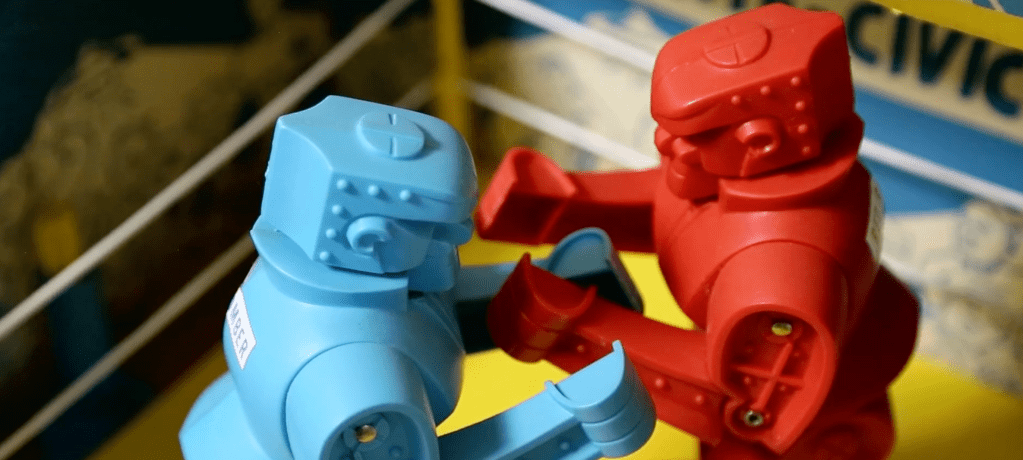
In late 2017, I connected with filmmaker Dave Bernabo. We put together a proposal to tell the story of Moundsville in a documentary.  I thought that town was a perfect place to tell a deeper story about America because it’s built around a 2,200-year old Native American burial mound, it harbored a glorious industrial age including the world’s biggest toy factory (Marx Toys, maker of Rock’em Sock’em Robots!), and it now subsists on a service-based economy anchored by a Walmart. There’s also a lot of pain and grief in Moundsville. In a generation, the town lost 8,000 jobs. The population halved. Young people left for Pittsburgh and New York. 

Rock’em Sock’em Robots! first manufactured by Marx Toys of Moundsville, West Virginia

David and I spent most of 2018 driving down to Moundsville and interviewing people. At the end of each interview, we’d ask a question about Trump and national politics. Almost always, the answers lacked depth. It dawned on me: These people didn’t know about Trump. They didn’t live in DC. They weren’t very thoughtful about politics. But when we asked them about their work lives and their parents’ work lives, they engaged with depth and wisdom. Those questions, I realized, were actually loving. Almost always, I decided, asking about Trump simply wasn’t loving. 

After experimenting with a voiceover, we opted to tell the story without a so-called “voice of God” as narrator. The movie is an oral history, without any academics or outside experts. 

In our interviews, we heard about grief a lot, but we also heard and told tales of resilience, from a back-to-the-land farming couple, a small manufacturer of kitchen cabinets, and the leaders of a burgeoning tourism sector. The ancient burial mound looming above the town is a daily reminder that civilizations ebb and flow, and that time moves only forward. My hope is that we acknowledged grief in a healing way while pointing the way forward with stories of hope and perseverance. 

In December 2018, we premiered Moundsville in the town itself, a practice of sharing work that anthropologists recommend. Over 170 people showed up. A few grumbled about our portrayal of segregation in the film, but at the end, we received an ovation. 

A month later, we screened at America, the Jesuit magazine I had started writing forin New York City, on Sixth Avenue in Manhattan across the street from News Corp., home of the Wall Street Journal

To my surprise–and gratitude–the movie holds up. People appreciate its openness and listening attitude. “This amazing project reflects a diversity of stories that I needed to experience to remind me of hope and resilience and kindness,” wrote Anupama Jain, head of a Pittsburgh diversity training group, on Twitter. 

The biggest lesson I’ve learned making and showing Moundsville is that every place carries an organic placeness that deserves respect for its uniqueness. You can find wisdom and thoughtfulness in people when you engage them over that place and recognize its differences from your place. We can’t love our neighbors as brothers and sisters if we expect them to be just like us.

I created the Moundsville.org site to promote the film, but quickly found an audience for pieces I was posting. It gets an average of 10,000 readers a month. So I keep writing and posting. I’ve written over 100 pieces for the blog, on everything from Lady Gaga’s mom, who grew up in Moundsville, to people going to watch baseball inside the prison in the 1950s.

I’m still on a journey of figuring out a new kind of journalism that suits my skills, and my heart. I’ve co-directed Out of Reach, a new movie about the American Dream. I’m developing a podcast called Philosophy with Strangers, where I go with an older friend to small towns and ask big questions. First episode: We went to Charleroi, PA and asked people: What is happiness? I contribute regularly to America, a monthly magazine run by Jesuits. I coach baseball. Lots of other stuff, too. But wherever my career takes me, it was forever changed by the road that ran through Moundsville, West Virginia.

John W. Miller is a Pittsburgh-based writer and filmmaker, and co-director of the PBS film Moundsville

~~~

What are you watching, reading, and writing this month. Let me know in the comments…

Are you a Rust Belt writer? What’s your story? Would you care to share? Do you write book reviews–or conduct interviews of Rust Belt authors? If so, think of Rust Belt Girl for a guest post. And check out the handy categories for more writing from rusty places.

Find me on FB and on IG and Twitter @MoonRuark

And follow me here. Thanks!

Enter your email address to subscribe to this blog and receive notifications of new posts by email.

“…this time they won the day.” The poetry of Rust Belt Girl guest Carrie Conners

Rebecca here–and absolutely thrilled to present this guest post featuring the poetry of Moundsville, West Virginia native, poet and professor Carrie Conners. All three poems shared here explore Rust Belt themes and can be found in Carrie’s latest collection, titled Species of Least Concern. Please read, share, and join in the conversation in the comments.

~~~

~~~

~~~

Species of Least Concern

by Carrie Conners

Main Street Rag $18 (shipped)

~~~

Carrie Conners, originally from Moundsville, West Virginia, lives in Queens, New York and is an English professor at LaGuardia Community College-CUNY. Her first poetry collection, Luscious Struggle (BrickHouse Books, 2019), was a 2020 Paterson Poetry Prize Finalist. Her second collection, Species of Least Concern was published by Main Street Rag in 2022. Her poetry has been nominated for a Pushcart Prize and has appeared in BodegaKestrelSplit Rock ReviewRHINO, and The Monarch Review, among others. She is also the author of the book, Laugh Lines: Humor, Genre, and Political Critique in Late Twentieth-Century American Poetry (University Press of Mississippi, 2022).

Are you a Rust Belt poet or writer? Do you write book reviews–or conduct interviews of Rust Belt authors? If so, think of Rust Belt Girl for a guest post. And check out the handy categories for more writing from rusty places.

Find me on FB and on IG and Twitter @MoonRuark

And follow me here. Thanks!

Enter your email address to subscribe to this blog and receive notifications of new posts by email.

*header image of fall foliage free from Pexels

“Mad Dog,” “Steel Poet” Tim Russell: a literary reflection by poet and publisher Larry Smith 

For those who don’t know poet Timothy (Tim) Russell, I want to introduce you to as solid a working-class poet as there is. Tim qualifies as a working-class poet not just because he wrote of that life (as did famed James Wright and Kenneth Patchen), but because he also lived it. He worked for 20 years as a boiler repairman in the Weirton Steel plant ‘til his lupus (MDS preleukemia disease) forced him to retire. He retired from the labor but not from the life and not from writing. For the next 30 years, he and his wife Jodi and kids lived along mile 61 of the Ohio River in small-town Toronto, Ohio. 

Tim Russell, featured in the book, A Red Shadow of Steel Mills (1991); photo credit: Jodi Russell

The Ohio River along the West Virginia panhandle is a ripe area for steel mills and poets.

I grew up about 20 minutes south of there in Mingo Junction, about 20 minutes north of Martin’s Ferry, Ohio, where Wright grew up. The Ohio River along the West Virginia panhandle is a ripe area for steel mills and poets. In 1991 David Shevin and I edited A Red Shadow of Steel Mills (a line from Wright) which included poetry chapbooks of Tim Russell, Richard Hague, David J. Adams, and Kip Knott. It was one of our first books in the Working Lives Series from Bottom Dog Press. 

Last month, other poets and I gathered with his family and friends for his memorial, at which Jodi and grandkids spread Tim’s ashes in the river about a block away from their home. Here’s a bit of West Virginia Poet Laureate Marc Harshman’s eulogy quoting Tim’s poem, “Plano.”

Because hills are not on the maps,
it's easy to get lost here, distant
neighborhoods appear to be adjacent.

“Even though I lived a long time in the rural heart of Appalachia,” Harshman said, “those words obviously ring true for Tim’s urban mill town as well. And it is ‘easy to get lost here,’ but Tim’s poems seemed always to be pointing a way, providing an anchor, enabling us, his readers, and his friends to feel just a little bit less lost. That’s a gift, a gift worth remembrance at any time but certainly here, today, as we do our best to remember and to honor Tim and know this is one of many reasons we miss him.”

Tim’s poems seemed always to be pointing a way, providing an anchor, enabling us, his readers, and his friends to feel just a little bit less lost.

In the mill, Tim was nicknamed “Mad Dog”; among poets he was the “Steel Mill Poet,” though he is equally a fine nature poet. A sample of his work reveals how enmeshed he was with the mills and his place, its people, and their language: 

In Adversa  by Timothy Russell

March is the nuthatch
skittering head-first
down the bare black walnut
or the bare silver maple.

April is forsythia
beneath hazy pastel willows
weeping over the bank
of the orange creek.

May is mock orange
scattered like mortar explosions,
the most delicate mist
rising all around.

June is the red squirrel
fleeing the blue joy
both of them caught in the morning
sun crackling in the sycamore.

August is sulfur
moths twirling above the crown
vetch, deer prints in silt
at the culvert.

September is crab
apples, so red
on the roadside
near the Tin Mill
carpenter shop.

October is a buck
swimming the river,
climbing the gray slag bank
toward red and yellow
trees on the island. 
Tim Russell; photo credit: Jodi Russell

Tim authored many books, each winning prizes and literary recognition. He is the author of the chapbook The Possibility of Turning to Salt 1987, which received the Golden Webb Award, 1987; of In Dubio 1988, which received State Street Press, 1988; and of In Medias Res, 1991. His full-length book, Adversaria, in 1993 received the Terrence des Pres Prizeia Poetry (Tri Quarterly Books). Chapbooks What We Don’t Know Hurts, 1995, and Lacrimae, 1997, followed; his haiku writing received the 4th Shiki International Haiku award Shiki team, Ehime Prefecture, Japan, 1999.

In Integrum by Timothy Russell

I’ve put my white shirt on
to celebrate my neighbor’s glaring roof,
the brick chimney leaning against its
own shadow,
the next of black branches above it all
dissolving into brilliance.
I’ve put my white shirt on
to celebrate cookies on a plate downstairs
and the pears and oranges in a bowl
with one perfectly curved banana.
I am celebrating the Christmas cactus
blooming in March.
I am celebrating nothing.
I am celebrating today.
I’ve put a white shirt on.

How did Tim share his days? Besides parenting, his wife Jodi says, “Tim tended to his gardens along the Ohio riverbank and built a stone henge across from his house fondly called ‘Tim Henge.’ He also grew poppies, zinnias, and sunflowers in it throughout the years. Battling knotweed on the hillside, he turned it into a bird and wildlife sanctuary. He would ride along the banks of the river in his boat collecting garbage and debris trying to keep the river clean. He was mindful of sharing and taking care of the earth for everyone and everything.”

Tim had a great sense of humor and a fine sense of image and form. He uses the common language to touch us. A world-published poet, he wrote many haiku and won many prizes with them, including a trip to Japan. Here is the last haiku he wrote, a few days before he died:

                 Snoozles
        The little dog knows
                 I’m toast 
   
                       – 9/13/21

A fund has been established at the University of Pittsburgh, Tim’s alma mater. It will help support a freshman majoring in English Creative Writing. Donations may be made online at http://www.giveto.pitt.edu/russellmemorial or a check may be made payable to “University of Pittsburgh” with a memo “Timothy W. Russell Fund” and mailed to: University of Pittsburgh, P.O. Box 640093, Pittsburgh, PA 15264-0093. 

~~~

Timothy W. Russell was born May 25, 1951, and raised in Follansbee, West Virginia. As a sergeant of the U.S. Army during the Vietnam Era he served as a handler of Military Police Sentry Dogs 1970-1972. He had graduated from Madonna High School (1969) in Weirton and following the war, went on to receive his bachelor’s degree from West Liberty College (1977) and master’s degree in Creative Writing from the University of Pittsburgh (1979). He passed away on September 16, 2021, at 70.

~~~

Larry Smith grew up in the industrial Ohio River Valley and graduated from Muskingum College and Kent State University with a doctorate in literature. He taught at Bowling Green State University’s Firelands College for over 35 years and is the author of 8 books of poetry, 5 books of fiction, a book of memoirs, 2 literary biographies, and more. He’s written film scripts for “James Wright’s Ohio” and “Kenneth Patchen: An Art of Engagement” and is director of Bottom Dog Press/Bird Dog Publishing in Ohio. He reviews for New York Journal of Books. Bottom Dog Press hopes to publish the collected poems of Timothy Russell soon.

Header image of Ohio River is credited to Larry Smith

~~~

Rebecca here–many thanks to Larry Smith for this beautiful tribute to the the life and work of Tim Russell. Please visit Bottom Dog Press’ website for his Working Lives series…and much more.

Are you a Rust Belt poet or writer? Do you write book reviews–or conduct interviews of Rust Belt authors? If so, think of Rust Belt Girl for a guest post. And check out the handy categories for more writing from rusty places.

Find me on FB and on IG and Twitter @MoonRuark

And follow me here. Thanks!

Enter your email address to subscribe to this blog and receive notifications of new posts by email.

My interview with Robert Miltner, author of Ohio Apertures: A Lyric Memoir

Ohio Apertures (2021) is Robert Miltner’s latest work, a collection of short creative nonfiction pieces that comprise a memoir. The author of two books of prose poetry, poetry chapbooks, and a short story collection, his memoir represents a cohesive journey. From stories of youth to young and older adulthood; from reflections of Ohio to the American West and trips abroad; from journeys by foot and by car—the car such a potent symbol of the post-industrial Midwest—the reader journeys with the author, and it is a satisfying and solace-making trip that doesn’t look away from the remains of Midwestern heydays past. Miltner provides the objects of his looking and perceiving and also the vehicle of that looking, and I think that matters in studies of observation, in studies of life, which is what we readers want in memoir—the particular and personal expanded to the universal, expanded to include our lives, too.

The objects Miltner ruminates upon in these short essays are often small—he’s so good at detail. There’s the watch pocket in a pair of Levi’s; the pneumatic tube at the bank drive thru; the crescent roll of youth and croissant of maturity; the sound an old car makes, like “sarcastic laughter”; the song that was playing at the bar after he was robbed as a young man. There’s a lot of music in these pages—a few of these pieces feel like they have their own soundtracks—but most of the music comes from the lyrical quality of these essays. And the quiet, the white space, the musical rests, the silence that is, Miltner says, “both the context for prayer and prayer itself.”

Always, the author returns to Ohio, the name alone like a song, and to the state’s flowing rivers and Great Lake Erie and its shale coastline that makes for violent, crescendo-like waves at its cliffs. My favorite piece in the collection is the last, “Black River Bridge,” an ode to a bridge that the author has traveled many times to cross his home-town river. He speaks to it, lovingly, in this essay: “Poor Black River, you lonely stepsister in this sad fairy tale of Ohio rivers…No one, lost river of industry, dark river of my youth, kisses your mouth each night along your shale and sand shoreline.” Though somber in tone, the piece ends optimistically, or in a tone I like to think of as Northeast Ohio optimism—which is as tempered as our steel.

Cover art by Morgan Dyer, “Climbing Uphill”; design by Shelby Ballweg and Colton Bahr

Recently, I asked the author a few questions about this collection, about his writing process and projects, and about writing in community:

Robert, Ohio Apertures is a lyric memoir in short pieces. You’ve written a lot of poetry and fiction, but this represents your debut memoir. What do you like about creative nonfiction? Were there things you could say about your life that you couldn’t say—or hadn’t said yet—through other mediums that you said in these pages?

I view myself as a writer, which I use in the comprehensive sense, rather than identifying by a single genre, because it feels restrictive. In terms of genre, I’ve felt compelled to “contain multitudes.” Writing in a new genre is like acquiring a new language; it’s like becoming bilingual or, for me with Ohio Apertures, trilingual. I used to think adding genres would be about learning the guidelines for new puzzles. Any new genre is like a puzzle, and what is produced is a piece of writing that is one solution to the puzzle. In that way, my collection of short stories was, for me, a collection of individual solutions to a general question regarding the art and craft of short fiction. What I discovered was an art akin to drama, to theater. I create characters then put them in situations; or, I imagine situations then insert characters. Variations on puzzles. What I learned was a way of speaking through masks, wherein the first person singular “I” is not me being lyrical, but some other person engaged in narrative action—it’s not me speaking.

When the first person singular “I” speaks in a poem or a creative nonfiction, that’s me. It’s like revelatory song lyrics or confessional poetry. And it’s risky to speak for yourself, and safer to speak through a character. In looking back at And Your Bird Can Sing, my collection of short fictions, there are several pieces that are very autobiographical, and so much so, that I can now see them as memoir that I didn’t recognize as such. So here is what my response to your question has been arching toward:

What I like about creative nonfiction, or lyric memoir, or lyric-narrative memoir, is the element of risk. Of being open and honest and as true as is possible to the material. It’s the risk of being vulnerable.

Ironically, while I was shaping individual pieces of creative nonfiction—memoir, lyric essays, narrative nonfiction, travelogue pieces—into a book where I was experiencing the most lyric freedom, I was concurrently shaping a new manuscript of poetry in which I was developing these sparse, minimalist prose poems that I can only define as not exactly a-lyrical, but more like lyric zero; they’re textual equivalents to Edward Hopper paintings: empty rooms where we sense the presence of people who are absent. Crazy, huh?

It’s like I transferred all my lyrical attention from my prose poems into my creative nonfiction memoir. The risk was exhilarating and the results of both manuscripts generated exciting new material through which I have discovered this: choice of genre is really about where I stand in relationship to the subject matter. It’s like the Wallace Stevens poem in which he writes, “I was of three minds,/Like a tree/In which there are three blackbirds.” If I read the three minds as the three genres I write—poetry, fiction, and now nonfiction—the blackbirds can be seen as the creative impulse. But what’s most interesting to me is that Stevens isn’t really addressing the puzzle of the three minds—instead he’s telling us that the blackbirds are in a tree. For them, it’s about where they perch. And for me, now, writing is about where I stand, finding the site that allows the best relationship to the subject matter.

I asked your friend and mine, memoirist David Giffels once if memoirists have great memories—I thought, how else to capture a moment from one’s distant past? He told me that, for him, there’s a lot of research involved, even for personal memoir—research in the way of interviews of family and friends who might have a different perspective on a past event. Can you tell us a little about your research process for one of the pieces in this book?

David is a brilliant nonfiction writer; he came into the creative nonfiction room through the journalism door. His The Hard Way on Purpose: Essays and Dispatches from the Rust Belt really made me keenly aware of the necessity of detail, exactness, and precision in crafting creative nonfiction. His work showed me possibilities that lead me into the creative nonfiction room. I was also influenced by the Appalachian Ohio writer Richard Hague, whom I met when we were in college together; he came to creative nonfiction through the poetry door. In his Milltown Natural, about growing up in Steubenville, Ohio—a city that is categorized as both Rust Belt and Appalachia—Richard fleshed out his collection of creative nonfiction pieces with memorable details that made his Steubenville three-dimensional. But he did something else: as a poet writing prose, the level of attention to language, syntax, the sound of words and the rhythm of sentences showed me the possibility of lyrical prose. He wonderfully disrupted my sense of how poetry and nonfiction are like lost cousins.

One of the epigrams in Ohio Apertures is from W. G. Sebald, whose creative nonfiction is mesmerizing because almost every third sentence is like a labyrinth: “You adulterate the truth as you write. There isn’t any pretense that you try to arrive at the literal truth. And the only consolation when you confess to this flaw is that you are seeking to arrive at poetic truth.” Sebald argues for the craft of writing, the attention to make art—that the idea of poetic truth is akin to an aesthetic truth. Sebald laid down the dictum to balance the literal with the poetic, and, of course, poetic license is as valid here, due the lyrical nature of both poetry and memoir. But I learned in writing my book that while the poetic/lyric/aesthetic truth is the goal, it can only be accomplished when the literal truth—much of it sharpened into precision—is researched.

The piece I recall researching the most—or perhaps the most satisfyingly—is “Desperados,” which in early drafts was very much a linear narrative only. Denver’s Capitol Hill in the 1970s; a sort of “bank” robbery; the Broker Bar on 17th Street; the culture class of the bankers, lawyers, and part-time college student working for a shady landscape company. The need for such geographical precision necessary for linear narrative is like filming a documentary. But the challenge in this piece was to get the poetic/lyric/aesthetic to be equal, co-present, operating almost like it was a character in the narrative. I began to imagine this piece as a film I could see, with me as the director and lead actor. The numerous references to film, to movie acting, the final scene where I imagine film credits, I had to research that. And when I decided a good film needs a soundtrack, I turned to Glenn Frey of the Eagles. I had to know the songs that were released before the day of the robbery, and that had me running down song lyrics.

Along the bar, bottles of liquor gathered together like an ensemble of actors in a film version of a Charles Bukowski novel. … The glint and dazzle reminded me of theater marquees on opening night. The jukebox played We may lose and we may win, we will never be here again. It could have been the final soundtrack of a movie.

As I drank that second shot of Tennessee whiskey, I swear I saw the closing credits of a film scroll down the mirror’s silver screen.

From “Desperados” by Robert Miltner

Those literal details, augmented by mirrors and movie screen allusions—as well as resonant images, emotion, language play, leaps and jump cuts—bring together the literal and the aesthetic for a poetic closure to the piece.

~~~

In a recent post here at Rust Belt Girl, I talked about the idea of writing companions, authors we avid readers and writers follow faithfully and who shape our work. In your essay, “Into the Bargain,” you describe finding a volume of Raymond Carver’s poetry, Where Water Comes Together with Other Water at a bargain book store, and you’re “entranced and transported.” The book becomes a “talisman” for you, for what it helps you discover about yourself upon reading and re-reading. Can you tell us more about what this writing companion did for you as a poet—and a writer and as founding editor of The Raymond Carver Review?

Toward the end of that piece, I contrast J. D. Salinger’s The Cather in the Rye,a book that I felt I identified with in my adolescence, with Raymond Carver’s Where Water Comes Together with Other Water, a book that I identified with during my mid-life transition. There are books and libraries and reading throughout Ohio Apertures. I was a shy, bookish middle child who stuttered, and I became a high school teacher and then a university professor, and an author. Actually, I went on to write my doctoral dissertation on Carver’s poetry, more from a sociological lens than an aesthetic one. Raymond Carver was a sort of mirror in which I could catch a glimpse of myself: an awkward child, a kid who liked to fish, a man who was drawn to rivers and lakes, a multiple-genre writer who began as a poet, eventually a university professor, and ultimately a man who came to understand and accept his human flaws enough to seek forgiveness and atonement.

The brilliance of Carver’s writing, and in particular his poetry, is his gift of stated or implied metaphor. The water of two rivers—one the past, one the present—that converge to carry him into the future resonates imagistically in Ohio Apertures. Carver was a very autobiographical writer, so much so, that at times much of his work can be read almost like creative nonfiction. Having read his letters and manuscript drafts in library archives, as well as interviews and biographical studies, many of his poems and stories are autobiographical. He wrote what his second wife, the poet Tess Gallagher, especially in his late poetry and in many of his autobiographical stories, calls “lyric narrative poems,” that is, poems in which the poet, or more so the poet’s imagination, become the hero of the narrative. That sounds to me much like a way to describe a lyric memoir, especially one that arcs toward a “poetic truth.” As a scholar-writer, I founded The Raymond Carver Review as a scholarly journal that would recognize Carver’s impact as a writer, and the quality and value of the body of his work. He was just 50 when he died, in his eleventh year of sobriety. During his last few years be began to write essays, prose poetry, and screen plays.

From my perspective as a writer and Carver scholar, I can see he was finding new sites, new places to stand in relationship to his subject material, new ways to grow as a writer.

Can you get us up to speed with what you’re working on now?

The past two years have been an amazing culmination of several concurrent projects. I published a book of prose poems, Orpheus & Echo, in the three-in-one book Triptych by Etruscan Press in March 2020; I finished Ohio Apertures, which was published by Cornerstone Press in March; and I’ve finished a new book of prose poems, Capital of Sorrows, that is under review. The pantry is empty, so to speak.

I’ve been re-reading some of my travel notebooks, and working on some new drafts of poems; I expect I’ll see what tendencies the poems take, looking for a pattern to occur that may shape a next book of poems. I’m re-reading an early draft of a novel that I’m returning to, looking to reshape and revise it into a new draft. It’s an historical novel and there have been some recent books that I’ve acquired, as research, so as to expand my original draft. I put the book aside because I couldn’t solve the puzzles the genre posed, but I’ve re-imagined the book and will write my way to a different solution than I did the first time around. I’ve located copies of some letters written by the character whose section is epistolary, and two books, both recent, are packed with new information I will cull for what can expand the character. And for another character, one who is complex yet relatively unknown, I’m drawing from the use of cinema and documentary, the site where I’m going to stand in, as I revise that section. Also, I’m sketching out notes for a book of long pieces of creative nonfiction, tentatively titled Mid-Century. While re-reading my travel notebooks I’ve come across several pages of questions I would have liked to have asked my father if he were still alive. How interesting it is that I’m ending this interview with an idea for a second book of creative nonfiction, based on questions addressed to my late father, like one would address in an interview.

~~~

Robert Miltner is the award-winning author of two books of prose poetry, Hotel Utopia and Orpheus & Echo, and a short story collection, And Your Bird Can Sing. A professor emeritus of English at Kent State University Stark and the Northeast Ohio MFA in Creative Writing, Miltner lives in Northeast Ohio.

~~~

Ohio Apertures: A Lyric Memoir

by Robert Miltner

$22.00 Cornerstone Press

~~~

Like this interview? Comment below or on my FB page. And please share with your friends and social network. Want more author interviews, book reviews, writing advice, and general Rust Belt goodness? Follow me here. Thanks! ~Rebecca

Enter your email address to subscribe to this blog and receive notifications of new posts by email.

A Distance Not Too Far to Fathom: My review of THE DISTANCE FROM FOUR POINTS

book cover of THE DISTANCE FROM FOUR POINTS by Margo Orlando Littell, with illustrations of plants

Picture London, Paris, or New York. Got it? Now picture Iowa farm country. How about Main Street USA? Easily imaginable places all, even in fiction. Right? Well, you can have them. I’m here to laud the lesser-known and in-between places in books, the fringes, places where the present hasn’t caught up to a promising past, where things are undefined, even messy—and the characters are gritty, trying to make a place their own. I’m here for the settings that remain open to interpretation, invention, and story.

Take Margo Orlando Littell’s recent novel from University of New Orleans Press, for instance.  The Distance from Four Points is set in the Laurel Highlands of Pennsylvania, murky territory straddling the Rust Belt and Appalachia. Never heard of it? All the better stage for the author to play out that age-old question:

Can you really go home again?

Quick summary: “Soon after her husband’s tragic death, Robin Besher makes a startling discovery: He had recklessly blown through their entire savings on decrepit rentals in Four Points, the Appalachian town Robin grew up in. Forced to return after decades, Robin and her daughter, Haley, set out to renovate the properties as quickly as possible—before anyone exposes Robin’s secret past as a teenage prostitute. Disaster strikes when Haley befriends a troubled teen mother, hurling Robin back into a past she’d worked so hard to escape. Robin must reshape her idea of home or risk repeating her greatest mistakes.”

In Rainer Maria Rilke’s Letters to a Young Poet, the poet says, “If your everyday life seems poor, don’t blame it; blame yourself; admit to yourself that you are not enough of a poet to call forth its riches; because for the creator there is no poverty and no poor, indifferent place.”

By this definition, Margo Orlando Littell is a poet. For me, it’s the setting of Four Points, a fictionalized version of the author’s own hometown, that makes the novel shine. Forty-something MC Robin’s hometown appears to her to be a “poor, indifferent place.” This setting is a lot like the places that dot the Pennsylvania landscape that separates my home in Maryland and my childhood home in Ohio’s Rust Belt, places where invariably my car radio loses NPR’s signal and tunes in only country music. Where tunnels through the mountains, tiled like giant bathrooms, are the highlight of the trip. Where mock-alpine ski resorts attempt to lure passersby off the Pennsylvania turnpike. I’ve happily sped through these places seeking finer points, the reinvented and cosmopolitan Pittsburgh, for one.

The author paints a picture of Four Points from Robin’s perspective: “It was coal country, or used to be, and it wasn’t always terrible. Long before she was born, businessmen made millions here, gaining wealth from the coke ovens in the foothills. Now the crumbling mansions…were barely audible echoes of the town’s better years.” This is a place many leave, but enough stay for unemployment to be high; a place old industry forgot and new-wave industry, like medicine, higher education, and tech, haven’t yet found.

Still, a place like this, steeped in the glories of a crumbling past, isn’t past—but is fully present—to the residents eking out a living there, today. And, upon her return to Four Points, this is a reality Robin has to face, and quick.

The novel starts off rather breathlessly, and we’re thrust into Robin’s predicament. Her husband died and left her with nothing to keep her and her daughter’s heads above water—except some pretty cruddy rentals in her hometown. A hometown she had tried her best to forget, living in a monied Pittsburgh-area enclave, where she’d remade herself—or fooled herself into thinking she had. A “decadence,” of forgetting where she came from and what she did to survive, the author calls it, of forgetting the “familiar equation” of “sex plus money.” This isn’t uncharted territory for women’s fiction—a salacious past comes to haunt the MC’s present—but the author handles it well.

The details of land-lording, re-making this human-built landscape with her smarts and own two hands, raises this bookclub novel to a higher level. Robin, who only recently wouldn’t be caught without her “Va-Va Vino” nail polish, takes to ripping up ruined linoleum in her tenants’ places with those nails, breaking them to the quick. This kind of work, needed to sustain herself and her daughter, does a lot to renew Robin’s sense of self, even in grief. Work, as it often does, has a way of teaching characters (and, by extension, us readers) about their capacity for living: “Tonight, the paint would dry, and in the morning the apartment would be whole. Not new, not beautiful, but ready to live in.”

The author exhibits a local’s keen sense of the distinct sights, sounds, and tastes of this place, where Sheetz and Walmart serve as modern beacons in the wintry gloom. But this is also the kind of place where communities still come out for parades on feast days and fill the same ethnic church pews their grandparents did; at home, old recipes, like Eastern European Halushki, are still passed down to the next generation. Maybe it is in such in-between times, teetering between ages—when will these hills experience their next Gilded age?—when we cling to the traditional foods that comfort, the language (all the “Yinzes!”) shared. Maybe it’s in these moments that we find grace.

I would have liked a bit more rumination in these pages on the grace found in this novel’s place. We get a brief mention of it, and there are fleeting prayers for Robin, who won’t budge from the necessity of sending her daughter to Catholic school, even when money is terribly scarce.

That touch of grace and Robin’s role as landlord reminded me of the biblical parable of the wicked tenants (Robin does have one or two), but more loosely about the need to be worthy “tenants” in this life leased to us here, in the earthly communities we call home. Will Robin turn her back again on her home, on a hard-won livelihood “cleaved to boilers and shingles, sewage stacks and electric grids.” Or, will she waste her gifts, trying to run away from herself again?

I’ll let you read to find out.

In a bit of life imitating art, the author also tried her hand at being a landlord in her hometown during the course of writing this book, and her expertise shows in her prose. You can read about that backstory and everything else related to The Distance from Four Points at her website: margoorlandolittell.com

Paris in springtime? Let’s face it: none of us is flying anytime soon. So, how about Four Points at the turning of a season—from the pages of this engrossing novel:

Robin left Four Points at five, the magical hour when the light over the mountains turned fiery and lit every branch on the maple-blanketed hills. The world was wet and weary, winter pulsing deep as blood, but in the pink sky and dripping ice from the bridges, she sensed spring. It really would come, softening those bristly mountains and coloring the sooty landscape of steel and coal. Another winter was breathing to a close…

From Margo Orlando Littell’s The Distance From Four Points

Anyone from such a place will tell you that harsh winters are worth it for the release of spring that follows—springs worth a whole book, and many more trips home.

~~~

Margo Orlando Littell grew up in a coal-mining town in southwestern Pennsylvania. Her first novel, Each Vagabond by Name, won the University of New Orleans Publishing Lab Prize and an IPPY Awards Gold Medal for Mid-Atlantic Fiction. She lives in New Jersey with her family.

Note: I received an electric copy of this book from the author’s publicist, in the hopes I would enjoy it, which I did. The book’s summary and the author’s bio, along with all the quotes, are from the book. The author was kind enough to supply photos (along with their captions) from her hometown.

Like what you read? Check out my categories above, with author and photographer interviews, essays, stories, book reviews, writing advice, and more. What are you reading and writing this week?