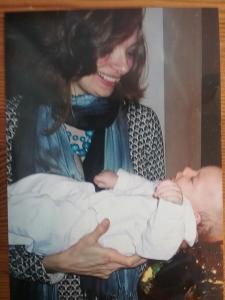
“This Woman”: an Essay by Melissa Ballard

Essayist Melissa Ballard contributes the fourth in our series of guest posts here at Rust Belt Girl, and, let me tell you, you’re in for a treat. Melissa has a talent for bringing the past to life and making her ancestors feel like our shared family. In this essay we meet Phyllis, Melissa’s grandmother, a woman of Northern Appalachian Ohio, whom Melissa writes about in a loving yet candid way, deftly delving into what makes personhood–class, sex, education, place and much more. (We also hope Phyllis is having the “time of her life,” Melissa.)


This Woman

by Melissa Ballard

This woman is my grandma, but not yet. 

In this black and white photograph, a small, dark hat of woven straw covers her hair and shades her forehead. She wears a walking suit: a jacket and skirt in a light wool pin check with a belt of the same fabric, over a silky, patterned, blouse. The tips of the fingers of her left-hand rest in the pocket of her slim skirt. Her only jewelry is a ring on the little finger of that hand. I can imagine her cropped left foot pointing out, her dark stockings and t-straps. She slouches just a bit and turns her body toward the unidentified photographer. She looks directly at the camera. Her smile is slight, but it reaches her eyes. 

This woman’s slight curves contrast with the riveted metal beam, perhaps part of a railroad bridge, that rises at a sharp diagonal behind her. In the early 1920s, her family lived on a side street a few blocks from the train station in Dennison, Ohio. Her father was an inspector for the railroad, so she had a free pass to ride. 

This woman could be waiting for the early train to Pittsburgh or Columbus, where she will walk the streets with confidence, on her way to a job interview. But she is not. Or at least I don’t think so. I know little about this brief period, but I hope she is having the time of her life.      

In 1925 she has a job in an ice cream shop, lives with her parents. Both she and her mother, who is preoccupied with social status, are named “Margaret.” This woman has already started to express her individuality and goes by her middle name, Phyllis or, on documents, “M. Phyllis.”

On June 18, 1925, eleven days before her nineteenth birthday, Phyllis and her neighbor, Harry, will travel 65.3 miles, maybe by train, to Brooke County, a tapering finger of West Virginia tucked between Ohio and Pennsylvania, where they can get a marriage license with no waiting period. Later that day, they will return to Ohio and be married at the home of the groom’s family. 

I wonder whether Phyllis’ parents even attended. They had a reception for her later, but I gather it was her mother’s attempt at saving face. I can’t imagine she approved of my grandpa or his family, and I can easily hear her saying, “He’ll never make a decent living. You’ll end up in the poor house.” 

Five months and five days later, their first child will be born. On January 14, 1928, their second child, my dad, will be born.

Phyllis c. 1920

The woman I remember, my grandma, was in her fifties. She had slim legs but a solid middle. She wore silver, cat-eye glasses before they were retro. Her short, dark hair was streaked with gray and white, her fingernails chewed to the quick. Wearing a well-washed cotton housedress covered with a flowered or checked apron and heavy lace-up shoes, she kept chickens and goats, grew vegetables and flowers, ran the laundry through a wringer before hanging it outside to dry, cooked meals from scratch. She kept a battered pan under the kitchen sink, filling it with food scraps. Every morning she fed it to the three hound dogs Grandpa had brought home from the dog pound, kept in a pen at the back of the yard. “Oh, hush up,” she said as they yipped and howled at her. 

When Grandma wasn’t busy with chores, she answered the phone for Grandpa, who was the dog warden. She wrote messages in her flowery cursive: the name, address and phone number of the caller, and a brief description of the stray dog. She followed him to his dark green truck, reading her notes out loud. Grandpa never wrote anything down. Before she finished talking, he was backing out of the long driveway, kicking up gravel as he went. 

They lived in a worn-out house on a liminal strip of land in Brightwood, part of Goshen Township, Tuscarawas County; my parents and I had moved to a suburb of Cleveland. Once a month, we made the two-hour trip down home to visit, and I spent more time there during the summer. 

On hot afternoons, Grandma and I often sat together on the front porch swing, she doing her mending and me reading, trying to catch a breeze. A two-lane road ran close to the front of the house. The cars seemed to fly by, and the exhaust from the trucks taught me to mouth breathe, a skill I perfected when I ran into the hen house to collect eggs.  

This route was nicknamed the “slow road” after a highway, the “fast road,” was built behind the house. One summer Saturday, Grandpa drove us into town on the slow road to get ice cream. Grandma and I sat on a bench with our cones, people-watching while Grandpa ran one of his mysterious errands. If Grandma asked him where he was going, he always said, “I need to see a man about a horse.” Which was odd, because my grandparents didn’t have any horses.

On the way home, I noticed a large house on a hill. “Who lives there?” I asked.

Grandma stiffened. “That’s the poor house. Where you go to live if you don’t have any money. It’s not a nice place.” 

I immediately pictured a nineteenth-century orphanage from one of the many books I read. Rows of rusty metal cots with stained mattresses, thin sheets, and scratchy blankets. Peeling paint on crumbling walls. I shuddered and looked away. 

The dining room at Grandma’s was small, with windows on three sides, some covered in plastic to keep out drafts. It was an afterthought tacked on to one side of the house next to the living room. It contained a water-spotted stand of neglected African violets, a treadle sewing machine with a clove-studded dried orange tucked in one of its small oak drawers, a large dining room table and chairs, and a handmade oak China cabinet Grandma had purchased for ten dollars with the money she made selling eggs.  

When Grandma made Sunday dinner for our extended family it was served at noon. Grandma removed elegant pieces of stemmed glassware and individual salt cellars from the cabinet and set the dining room table with her good silverware. As we passed roasted chicken with gravy, noodles, and side dishes, Grandpa arrived late (he was known for having “girlfriends”), threw his work cap in the corner, and took his seat at the head of the table. 

Only now do I realize how little Grandma wasted. Usually, she cooked one of her own chickens on Sunday, but she occasionally made a pork roast. After the meal, any scraps of meat were set aside, combined with corn meal mush (I can only imagine her reaction to polenta recipes in upscale restaurants) and baked in a loaf pan. For breakfast the next day, she fried slices and we covered them with butter and syrup. They were delicious. 

Over time, and with deaths and disagreements, our extended family grew smaller, and we began eating all our meals in the large kitchen. The food was still delicious. One time, Grandma asked how everything tasted. Grandpa was the only one who didn’t answer. She stared at him, and he finally grumbled, “If anything’s not good, I’ll let you know.” Already showing signs of Parkinson’s, he poured a bit of his coffee into a saucer with shaky hands, and leaned down to slurp it. 

Eventually, an old couch was jammed into a corner of the dining room, next to the china cabinet. It became my reading space when I visited. Now, as I sit down to read on my own sofa, I look at that same cabinet on the front wall of my living room in Oberlin, just two hours away from where Grandma lived. I have covered the top with family photographs. 
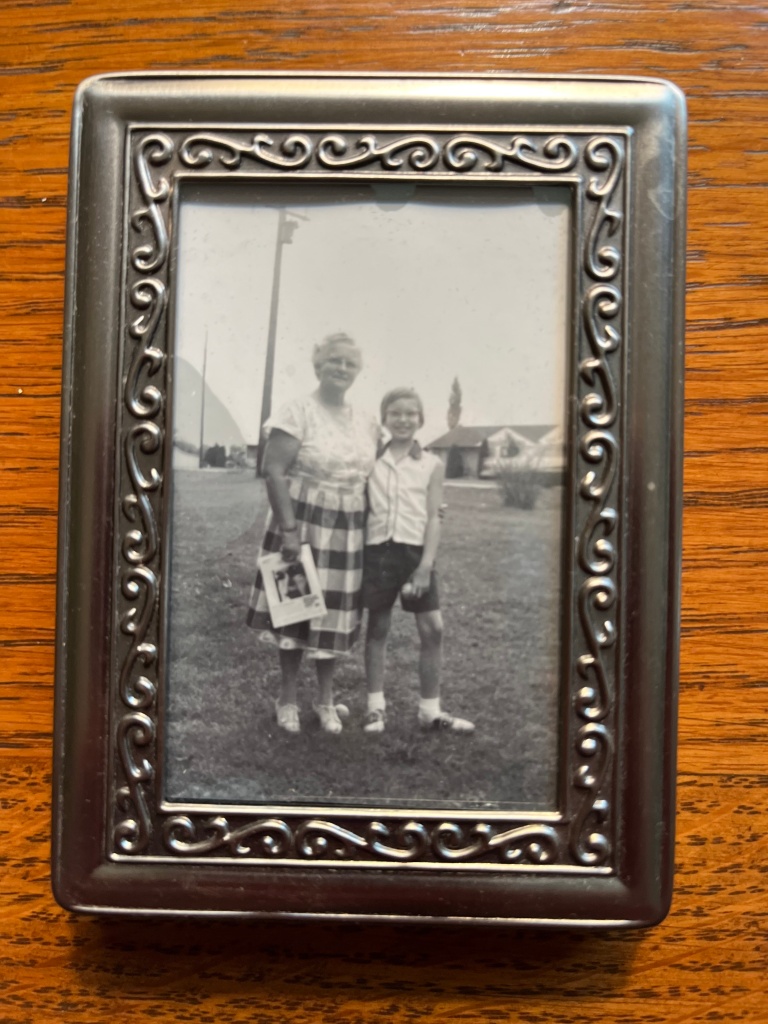
Phyllis and the author c. 1960

Grandma taught me how to tie my shoes–we were both left-handed–after everyone else had given up; gave me my first sip of coffee, strong but cut with generous portions of sugar and thick cream; slipped me some of her beer while we watched Gunsmoke. As I got older and visited less, we wrote letters.

Shortly after my twenty-first birthday, Grandma and I walk in her back yard. We stop under the hot sun to admire the clumps of purple, yellow, and white miniature pansies that flourish in the crumbling foundation of an old shed. I started college three years late; I tell her I am overwhelmed and don’t think I can do the work. She is quiet, removes a flowered hanky from her apron pocket, pats her damp forehead and the back of her neck. 

As we start slowly up the steps to the relative cool of the house, I link arms with her. I brush the cool copper of the bracelet she always wears because she believes it helps her arthritis. Her fingers are crooked, as mine are now. As I write this, I touch the copper cuff bracelet I bought years ago but have never worn. I keep it on my desk as a reminder of Grandma, and I wonder what happened to the soft, linked one she always wore. 

I open the back door with my other hand. Grandma suddenly stands as straight as she is able and says firmly, “You stay in school.” She adds this, which I will hear her say more than once: “You need to be able to make your own money.” 

After I’ve finished graduate school, married, and had a child. After Grandpa, who spent years in a nursing home with Parkinson’s, has died. On what will turn out to be the day my dad, her son, dies, Grandma moves into an assisted living facility.  With Dad being ill, no one has had the time to take Grandma to see the place prior to moving in. She’s been calling me several times a day, anxious about the change. 

She surveys the room: her favorite chair with an afghan she made folded over the back; her dresser, its top covered with a lacy scarf and family photographs, including several of my daughter; a large window that looks out on gardens; the new spread my mom placed on her bed that morning; a private bath.            

She leans close to me and whispers, “Oh, Melissa, this is beautiful. I was afraid it would be like the poor house.” 


Melissa Ballard has written essays for The Brevity Blog, BeltBerea College magazine, and other publications. She is currently working on a book-length collection of essays about the women in her Northern Appalachia family. 


Like this post? Want more? Comment below or on my FB page. And please share with your friends and social network. 

Are you a Rust Belt writer interested in seeing if your own post, or author interview, or book review might be right for Rust Belt Girl? Hit me up through this site’s contact function.

Check out my categories above for more guest posts, interviews, book reviews, literary musings, and writing advice we can all use. Never miss a post when you follow Rust Belt Girl. Thanks! ~Rebecca
Enter your email address to subscribe to this blog and receive notifications of new posts by email.

“…the holy and the ordinary rubbing shoulders…” Essay and images by Justin Hamm

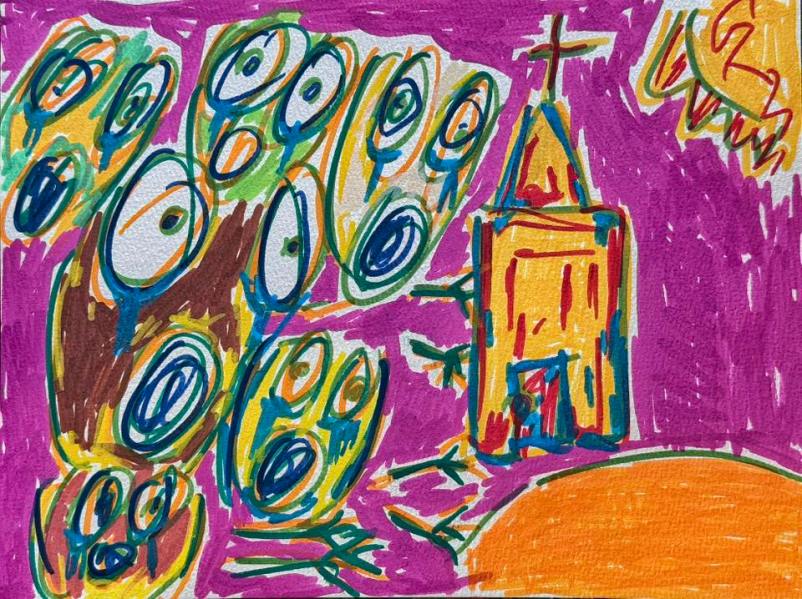
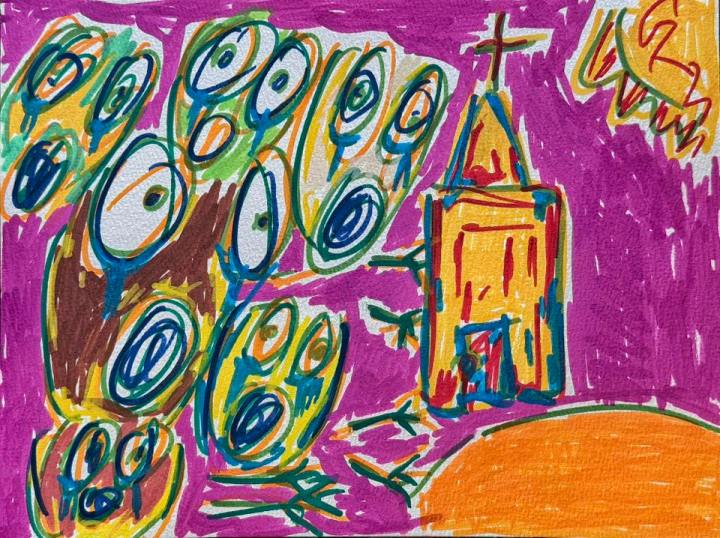
A full-color folk art image depicting open mouths and a church with a cross on top

Poet, photographer, and model literary citizen, Justin Hamm inspires with his offering–the third installment of a series of guest posts here at Rust Belt Girl. Thank you, Justin! His essay about speaking in tongues feels especially personal, presented as it is from a child’s perspective. It feels “close” to me, in more than one way. Justin’s essay is accompanied by his original folk art, and I have to say, I didn’t see this coming. But I absolutely love it. Here at Rust Belt Girl, we know the American Midwest is vast and multitudinous, and so are its people, their inspirations, their stories, and their art.

Because Justin is truly “Midwest Nice” and humble, he might not brag to you about his TEDxOshKosh Talk, “The American Midwest: A Story in Poems & Photographs, but I’ll do it for him. This is a good place to start, if you’re new to Justin. In his talk, he asks some of the same questions we’ve been asking at Rust Belt Girl all these years. A big one: Is “flyover country” an appropriate term for the Midwest? Justin explores that vital question through inspection of the overlooked or the avoided, including rust (holla!), thunderstorms, everyday people doing everyday things, politics, social class, and more. It’s well worth a watch-and-listen.

But first. Let’s read and discuss Justin Hamm’s…

The Wind With a Secret Shape 

I was eight maybe nine years old Wednesday nights my grandparents used to 

take me to a small Pentecostal church that sat on a grassy rise just outside of 

town it had once felt isolated tucked out in the quiet but the town had crept 

outward now it sat beside a gas station a lumberyard and a row of fast-food 

joints the holy and the ordinary rubbing shoulders the church rectangular part 

brick part white siding a white cross stretching off the roofline like an arrow 

pointing to the shifting Illinois sky inside the pews angled toward a low 

platform where the preacher shouted and a four-piece band laid down rhythm 

the cushions a deep royal blue clean saturated almost regal I remember that 

color better than my childhood bedroom the building always felt old but never 

run-down the women cleaned it like a calling while the men kept it maintained 

it smelled of floor polish and breath mints old hymnals and hairspray a past 

preserved a place where time seemed fixed in place 

I wanted to be a good boy I tried to follow the sermons caught a phrase here or 

there but mostly folded handouts into paper planes or built hymnbook 

pyramids sometimes I curled up on the back pew and drifted off lulled by the 

rhythm of scripture and song until the spirit moved when it hit the preacher 

everything changed he’d leap down the steps whirling stomping at the devil 

howling Jesus’ name until his face went red and purple sweat soaking his brow 

and then the tongues came strange breathless syllables rolling out like a chant 

that bypassed the brain entirely the holy ghost made you do things that was 

just how it worked I accepted it the way you’d accept sunrise or gravity 

and I believed too believed fully if somebody said the spirit is with us tonight 

I’d scan the sanctuary up in the corners where wall met ceiling under pews 

between swaying bodies I didn’t expect to see it exactly but I wanted to know 

where it was it filled me with something like fear but not only fear there was 

longing in it too hunger a sense that something just out of reach might solve 

everything the holy ghost like a wind with a secret shape a bird made of breath 

maybe God’s own breath moving invisibly through the room I believed it 

entered through the mouth that explained what came out the old men would 

rise in their too-large suits limping loops around the sanctuary hands raised 

speaking in tongues the women would fall stiff to the ground eyes rolled back 

mouths twitching that’s how I knew the ghost was on the move I tracked it 

sinner to sinner and sometimes it came close the person next to me would 

sway eyelids flickering syllables rising up like springwater through stone my 

chest would lift my legs would buzz my mouth would soften and open almost 

involuntarily I’d think this is it just let yourself go let it take you I opened my 

mouth and nothing came I tried again wider harder I prayed the best I knew 

how I swallowed the air like it might carry something eternal and then I waited 

  • A full-color folk art image depicting open mouths and a church with a cross on top
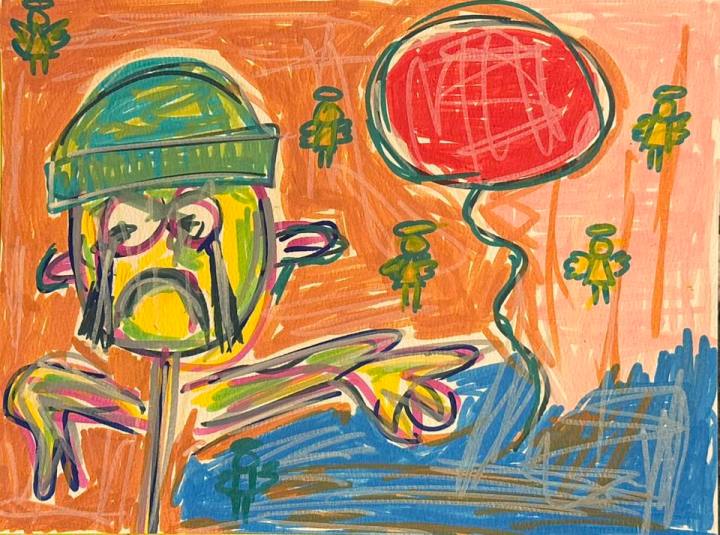
  • Full-color folk art depicting a boy with a green hat, crying over a red balloon
  • Full-color folk art depicting a hand reaching out and touching another person, while a cross glows in the background
  • Full-color folk art depicting angels and a person with a downcast face

Justin Hamm is the author of five poetry collections, including O Death (2024), Drinking Guinness With the Dead (2022), and The Inheritance (2019), as well as a book of photography, Midwestern. He is the founding editor of the museum of americana and the creator of Poet Baseball Cards. 


Like this post? Like this series? Let’s discuss! Comment below or on my FB page. And please share with your friends and social network. 

Are you a Rust Belt writer interested in seeing if your own post, or author interview, or book review might be right for Rust Belt Girl? Hit me up through this site’s contact function.

Check out my categories above for more guest posts, interviews, book reviews, literary musings, and writing advice we all cab use. Never miss a post when you follow Rust Belt Girl. Thanks! ~Rebecca
Enter your email address to subscribe to this blog and receive notifications of new posts by email.

Ohio is Ohio, and I love it

You are forgiven if you’re not up on the middle school slang that has redefined the word “Ohio” (my beautiful native state) as cringey or weird.

Does that mean the writing from Ohio authors or about Ohio places is also weird? In some cases (and often my favorite cases) yes.

It has been more than a minute, Rust Belt Girl followers, and I appreciate you for hanging on. Busy days around here with a book project going and essays popping up here and there. And of course there’s work-work to contend with. And my teenagers who keep me hip (surely that’s not a word they’d use) through their generation’s reinvention of language, music, and fashion. (A whole wardrobe of hooded sweatshirts and oversized black jeans, anyone?)

But I’m thrilled to share with you my latest essay, which is part essay and part book review. The book? Matthew Meduri’s debut novel Collegiate Gothic. Part satirical campus novel, part crime procedural, and part Italian architectural treatise, this one is quite fun (and, yes, a little Ohio.)

I’d love it if you checked out my essay–“Campus Weird: Collegiate Gothic Skewers Academia (and Ohio) in Fine Form” at Belt Magazine. (Bonus points for identifying the Ohio college campus building in the photo. I only know because a friend told me.)

Then, go check out Matthew’s novel over at Bordighera Press.

What have you been reading and writing lately, readerly and writerly friends?

Hankering for Rust Belt author interviews, book reviews, and more? Check out my categories above. I hope you’ll follow me here, if you don’t already, so you never miss a (quite infrequent) post. Thanks! ~Rebecca

Enter your email address to subscribe to this blog and receive notifications of new posts by email.

Enlarging “Rust Belt lit,” and Megan Giddings’ THE WOMEN COULD FLY

When I say “Rust Belt literature,” what comes to mind? Gritty, realistic narratives, no doubt. Hard-bitten characters. Upper Midwest settings redolent of industry and machines. Or settings found in a time of post-industry, a time of automation over humanity–of darkness. Coal or steel may factor in, or maybe it’s a landscape made barren by the extraction of one and the decline of the other. More recently, themes appear to be borne from loss after loss: environmental destruction, job loss, poverty, the opioid crisis … 

When I said “Rust Belt literature,” did fantasy or speculative fiction come to mind? How about air, water, light? How about women? How about women flying?

You won’t find Megan Giddings’ novels tagged as Rust Belt lit at your local library, but you will here. For Giddings chose to set her latest, feminist dystopian novel, The Women Could Fly (HarperCollins, 2022), a story in which witches are real, not in a fantastical place but in Michigan and the Great Lakes. And why not?

The novel’s overarching plot: main character Jo is “offered the opportunity to honor a request from her mother’s will” by traveling to an island off Michigan’s Upper Peninsula, where she will explore the “powers women have to transgress and transcend” the limits women face in this larger world.

And, of course, there will be trouble, a lot of trouble. But back to the setting.

“She [Jo’s mother] had loved the lakes. Michigan was for luxury. Erie was for mourning. Ontario was for Canadians. Huron was for daydreaming. And Superior was for mystery. The lake that kept its secrets.”

Why not set a story about the secrets women keep for self-preservation on an imaginary island off an imaginary shore? Why Michigan’s UP? Verity, I presume. In this novel, the speculative elements rub up against the very real setting, and say to this reader: don’t get too comfortable. The nightmare scenario you might think can’t happen in real life, absolutely can–and it can happen right in your backyard. For, what weight does social commentary have if it’s set in a fantastical place? Much less than if that commentary is grounded in a place we think we know so well.

This is not your typical witch story (if there is such a thing) and my regular followers know this is outside my regular reading wheelhouse. From the dust jacket copy, so you get a sense (sans spoilers) of this dystopian time not altogether different from our own, here’s some backstory on Jo and her lost mother:

“Josephine Thomas has heard every conceivable theory about her mother’s disappearance. That she’d been kidnapped; murdered; had taken on a new identity; started a new family. Most troubling of all was the charge that her mother had been a witch, for in a world where witches are real, peculiar behavior can raise suspicions and result in a woman–especially a Black woman–being put on trial for witchcraft.”

How do we writers choose where to set our stories? Do we write of the places of our dreams? Google Earth and the ease of internet searching of local customs, accents, etc., mean a writer can set her story anywhere. (So you would think more writers would eschew the default American settings of NYC and Southern California–wonderful places both, but perhaps overexposed.) What makes us craft a setting after our home? I’ll let Giddings’ gorgeous riff on Michigan answer that question:

“One of the pleasures of driving through Michigan is the trees. Farther and farther north, they shift, become taller and thinner, go from full Christmas trees to pipe cleaner versions. The sky changes too. The clouds come lower, the blue always feels a little brighter, the towns spread farther apart, and there are more dips, hills to make up the distance. It wakes up something animal in me …”

In this novel, Giddings walks a literary tightrope between realism and speculative fiction, grief and humor, old prejudices and new possibilities, pragmatism and magic–and all in concise and biting prose. Enjoy the ride. You don’t even need to know how to fly!

How would you define Rust Belt lit? What are you reading and writing this week? Let me know in the comments.

Want more Rust Belt writing, book reviews, author interviews, writing advice, essays, guest posts, and more? Follow me here. Thanks! 

And a Happy Thanksgiving to all who celebrate!

*free header image courtesy of Pexels

Enter your email address to subscribe to this blog and receive notifications of new posts by email.

a bit of writerly advice…for July 31, 2020

Free image courtesy of KathrynMaloney at Pixabay.com

We are a thing-ful culture. A quick scan of my writing desk, and I realize I’m awash in things: a mouse that needs batteries, a coffee mug, an old manuscript in a box, a calendar, a laptop with more calendars inside, kids’ immunization records, a rolodex (I know, I know, welcome to the 21st century), a mouth guard for teeth-grinding I need to boil and use, a note card with an illustration of the Eiffel Tower (a really big thing made small), a recorder that also needs new batteries, a birthday card leftover from June, a fabric-covered box with love notes from my kids inside (things inside of thing)…

Paper-things many of these, but things, nonetheless.

For a minute, Marie Kondo’s less-clutter-more-happy idea made me disdain of my multitudinous things. Pandemic 2020 made me happy for them again, especially the stacks of books I’m still reading. I guess you’d call this relationship with things complicated.

Which brings me to my spot of writing advice for today, which was inspired by today’s feature over at Parhelion Literary Magazine, where I was recently promoted from features editor to associate editor. I encourage you to check out this short essay; in it the essayist, Darcie Abbene, calls upon authors and poets, including Ray Bradbury, Terry Tempest Williams, and William Carlos Williams to help her with her own writing. In turn, her essay helped me in my thinking about my writing–and it might do the same for yours.

As for those pesky things…Williams was a poet, whose most famous poetic phrase (probably) remains:

No ideas but in things

William Carlos Williams–from his poem “A Sort of a Song” and repeated in his epic collage titled Paterson

As a leader of the movements of modernism and imagism in poetry written in English–it makes sense that the poet was concerned with things. Of course, my things are not his things, just as yours aren’t mine. Williams was a physician, and I like to imagine how his professional things–and place things like a hospital or even (ahem) a red wheelbarrow–informed his thinking. So, things before ideas.

I’m paying close attention to things in my reading today. Working down my stack of withdraws from my local library ($1 each–sad, but lucky things for me), I’m currently reading Spy of the First Person, Sam Shepard, playwright, musician, and novelist’s, final fiction. So far, I’m flooded with things: a rocking chair, a beach, a cot, corpuscles both red and white… But I’m having trouble seeing the forest for the trees (the idea for the things?). I’ll keep working on it.

Which brings me to my own writing (Lord knows something should!). I’m back at it, my novel-in-progress, working in fits and starts, but working. And for all my anxieties over the things of my current state of life: 3-ply masks, school uniforms, new kids’ sneakers… It’s things–those concrete simple images set down on paper–that keep me writing.

Maybe it’ll work for you, too?

What are you writing? What are you reading this week? Any exciting weekend plans?

Interested in Rust Belt author interviews, book reviews, essays, and more? Check out my handy-dandy categories, above. Are we social? Find me at FB and on Twitter and IG @MoonRuark

My musing on “The Everyday” at Ruminate Magazine

Happy Saturday to those of you around my side of the globe. A quick check-in: I know, I know, you just heard from me the other day with my take on Elena Ferrante’s My Brilliant Friend, the first of the Italian author’s Neapolitan quartet of novels exploring female friendship and much more. And, before that, I shared my dreams (and distractions) for 2020.

This year, I’m resolved to enjoy this writing-and-blogging community, the slow slog meditative process of writing and publishing, and the paths down memory lane I take as I write. And while I typically craft fiction–find some of it here at stories–I responded to a nonfiction call from the editors at Ruminate Magazine for readers to ruminate on “The Everyday.” That prompt led me to think of the joys of special holidays–like the baptism of my guys 10 years ago–and the joys of the mundane: Ordinary Time, ordinary time, and a warm piece of bread.

If you have a moment, my short essay (the second of the readers’ notes) is a two minute read–as are the other ruminations from readers around the country. But you might just want to stay a while, so we can, as the magazine’s About page says, “practice staying awake together.”

What are you ruminating about today?

See my mini-essay at Issue 54 The Everyday Readers Notes. (Scroll down.)

Powerful conversations and an essay by Melissa Ballard

A nuclear power plant near home

My mom wasn’t a hippie, though she lived on Hessler Road as a college student–a Cleveland street where hippie power still reigns. Late 60s, with my bearded dad at the wheel of their VW bug, they looked the hippie part, anyway. Enough to be stopped by a police officer, as they traveled country roads to my mom’s parents’ house in upstate New York. The checkpoint was in a little place called Woodstock. The officer tapped on the driver’s-side window. “Going to the music festival?”

“What music festival?”

Alas. My lovely parents weren’t hippies, but they weren’t content to become carbon copies of their parents, either. Starting fresh, newly-married, they moved to the country, where they would raise a few ducks, some chickens, a goat named Esmeralda, and eventually us human kids. What veggies she couldn’t grow in her lush garden, my mom got from the natural food co-op she helped to run. We had a local honey man and a pumpkin man. None of this struck us kids as any kind of resistance against the powers of 80s consumerism powered by…well, power.

Read more

My interview with FURNISHING ETERNITY author David Giffels

David Giffels is the author of Furnishing Eternity: A Father, a Son, a Coffin, and a Measure of Life, published by Scribner in 2018.

“…when he enlisted his eighty-one-year-old dad to help him with the unusual project of building his own casket, [Giffels] thought of it mostly as an opportunity to sharpen his woodworking skills and to spend time together. But life, as it usually does, had other plans.” (From the book jacket copy.)

Giffels’s father, Thomas Giffels, passed away three days after this book on loss and grief was released. “The book is so much about him, and mortality, and thinking about aging parents and all these themes that were directly connected to him,” said the author, who spoke with me earlier this month.

Furnishing Eternity continues the Akron, Ohio, author’s award-winning literary career. Giffels’s previous books include The Hard Way on Purpose: Essays and Dispatches From the Rust Belt and All the Way Home: Building a Family in a Falling-Down House, his first memoir. He teaches creative nonfiction in the Northeast Ohio Master of Fine Arts Program.

David–place figured majorly in your last book, The Hard Way on Purpose. How does place figure into Furnishing Eternity?

My last book was about place in a regional, communal kind of way, a place I share with a lot of people—the Rust Belt and the industrial Midwest. I think about Furnishing Eternity as being about place in a different way. It’s a much more personal book, but I identify the place of my father’s barn and workshop very directly with him. That’s where his true nature was. It’s where I communicated with him the best. The much more intimate spaces of his barn and workshop are central to this story.

In Furnishing Eternity, you experience the death of your mother and your best friend, John. I read that much in the sections about your grieving those losses began as journal entries. Can you talk about how you progressed from journal-writing to essay-writing?

This book was different, because I knew I was going to be living things as I was writing about them, which is closer to journalism than it is to memoir. So I was already doing a lot of note-taking about the process of building a casket and about spending time with my father. I was careful with my note-taking, to record things as they were happening, knowing they would be in the writing. When my mom died, unexpectedly, and John died—that note-taking became less of a literary process and more of a personal process.

The writing involved working from raw notes that were sometimes painful to read, that I took, day by day, aware that that material would be part of what I was writing for the book and aware that I was also recording my emotional life. That’s hard material to work from. It was so raw, so immediate, and so chaotic. When you grieve someone it can be a violent and unpredictable process, and writing requires stepping back and seeing the shape of things. I was trying to do that on the fly, so it took a lot of drafts and a lot of trying to distance myself. The process was different from anything I’d done as a writer. When I wrote All the Way Home, it was ten years after the events and I had settled a narrative in my head. I could see things with objective distance that made it a much different writing experience. It’s easier to regain the immediacy of something that’s in the near distant past than it is to step away from the immediacy of something ongoing.

Joan Didion’s The Year of Magical Thinking was vital to that process; not just the process of writing—she’s writing about writing about grief—but also the process of grieving. I had avoided reading the book while I was writing Furnishing Eternity, because I didn’t want my writing to be influenced by it. But when my mom died I knew I had to read that book to help me with the process of grieving my mother. Didion was vital to my personal loss and my ability to write about it.

Do you journal much, regularly?

Not very much. Spending many years as a journalist has made me much more workman-like as a writer. I have journaled at various times, but to me, writing is getting down to work and doing it when it needs to be done. I think in banker’s hours. Once I’m working on a project, it’s all-consuming. I’m always taking notes. When you’re working on a writing project, you become a selective magnet, like all of a sudden everything in the world is being tested to see whether it’s going to be drawn to your subject. If it is, it comes flying at you and sticks. I’ll hear or see something and think, I have to write that down right away. That’s urgent journaling, I guess. Read more

Creative Inspiration: Part 2 from Intensity Without Mastery’s Michelle Cole

How did we get here? Not here at Rust Belt Girl so much as here—writing, blogging, connecting? (Anyone else have that Talking Heads song running on repeat in their minds? You’re welcome.)

For me, it was my mom who was the reader in my young life, who made it okay to “waste” an hour or a day on a good book. She was my biggest fan, even when my writing hadn’t a prayer of reaching a larger audience than my immediate family. She made me feel like a writer—and sometimes a vote of confidence from someone you love is enough to begin to believe it, yourself.

As I emerge from my Thanksgiving Day food coma, I say thanks to memories of my mom and to everyone else who makes me feel like something of a writer.

Many thanks, in particular, to Intensity Without Mastery blogger and photographer Michelle Cole for this two-part collaboration. I’ve learned so much! (Please check out Part 1, here.)

For Part 2, I wanted to see where Michelle finds her inspiration, what sparks her creativity.

Michelle—what inspires you to take photographs, especially of your Ohio city? What do you shoot with?

I must first credit my parents with impressing me with the notion that hobbies are vital to happiness. My dad kept an aquarium and made pictures of ships with strings pulled around pins painstakingly positioned on canvas or velvet (there is a name for these sort of pictures that escapes me now; its popularity rose and fell alongside macramé). My mom painted and drew. She also read an ocean of genre fiction.

My dad had a significant interest in photography in the 70s. My parents’ bathroom did double duty as a dark room for a few years. My dad’s interest in photography was mostly confined to portraits of family members and some architectural photos. One of my earliest memories involves taking the elevator to the top of what was then the tallest building in Indianapolis, probably the National Bank Building. We went to the top so Dad could take a cityscape picture from that vantage point.

Like for so many Rust Belt families, the prosperity we knew in the 70s did not last, so Dad put aside his photography habit due to cost.

Despite that our fortunes rose and fell, the example of their hobbies endured. Creative pursuits had value. Eventually, my history of major depression intersected with this notion. When digital photography became widespread, I decided to try it because I wanted to see if I could develop a skill that I knew was not a total waste of my time. My parents taught me by example that all creative expression had inherent value.

Then I was struck by the idea that photography could remind me that life was worth living, that my life itself had value. The places I saw, my city especially, were a part of that value.

As I took more pictures of the places I had seen so often, I began to feel something akin to teaching a dying language. I was capturing scenes that should not be forgotten: this is how we lived, the good, the bad, the ugly . . .

I also have an enduring interest in nature photography. I feel serenity in documenting the change of seasons.

I shoot with three different cameras, a Nikon D5200, a Canon Rebel T6, and my cell phone camera (a budget LG V8). None of my equipment is expensive or super sophisticated. There is still much I should learn about the technical points of photography. My favorite shooting combo is my Nikon D5200 with a Nikkor 55-200 mm f4-5.6 VR lens.

What moves you to provide a short essay or story around your photographs?

I wish I had the time and consistent motivation to write about the pictures in every photography post on my blog. When I look at my pictures, I see shorthand for memories that I wish others could read. I suppose that great photographs past and present tell that story with no annotation necessary.

I feel like my inclination to write an essay to accompany a picture is a function of two things: time and depression. If my depression is flaring up, my picture posts have little or no text offered, and the writing is perfunctory or clinical in tone. If the text is short but optimistic in nature, I am simply too busy with work or parenting to write much more.

The photos I take of places in my city usually tap a rich vein of memory for me because I’ve seen them so often, and I really should offer an anecdote to accompany them.

Today I took a picture of a house near the downtown area that intrigues me with its longevity.

Lima house by Michelle Cole
Lima, Ohio, house by Michelle Cole

While this home has some striking Victorian details, its greatest distinction is being the last home left standing in its area. Every other home along that street for several blocks was taken by eminent domain for the construction of a new high school and stadium. I don’t know how this house escaped this dragnet that resulted in the razing of many aging homes and row houses in the vicinity. The powers that be made the school’s lawn large beyond reason to justify demolishing a problem public housing project that had been built in the 80s. This house reminds me that the place we call home stirs feelings of ambivalence.

At heart, I feel this project was like liposuction to this town; poverty and crime can’t be erased just by demolishing buildings and planting perfect lawns where they once stood. I wish some of the other houses had been spared. The perfect lawn and angled brick of the new high school are reminders that the Lima my parents and grandparents knew cannot be resurrected. At least we have this one home left from the old era.

Michelle—thank you for giving me a window into your world. Your personal journey captured in stunning images inspires me to keep growing by creating and connecting with bloggers like you. Anything else you’d like to say?

We live in a golden era of photography. Chances are you have at least one camera within reach almost all the time. No one’s life is just like yours. No one sees all of the places you’ve seen. What you’ve seen today could be gone tomorrow. Now is the time to share those images with the world.

Lima fall foliage by Michelle Cole
Lima, Ohio, fall foliage by Michelle Cole

Thanks again to Michelle Cole at Intensity Without Mastery for reminding us to keep sharing our visions in words and images. And don’t forget to visit Michelle’s site.

Do you feel you, too, are “teaching a dying language” by resurrecting memories of the past through your writing or photography?

Please share!