My interview with Jason Kapcala, author of Hungry Town: A Novel

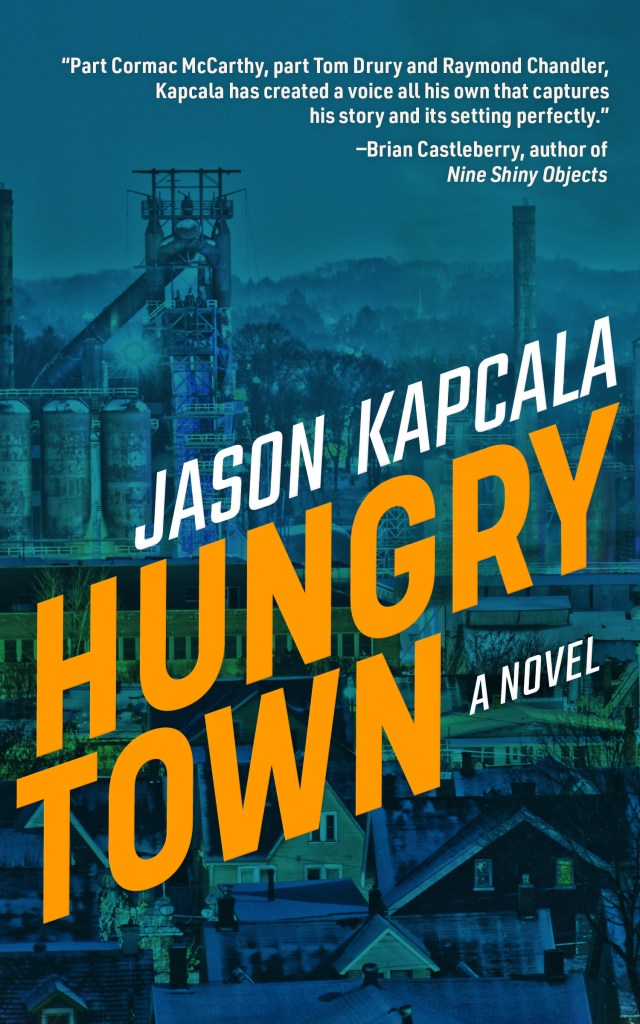
For fans of American Rust by Philipp Meyer and Ohio by Stephen Markley . . . comes Jason Kapcala’s Hungry Town (2022), a Rust Belt-set crime drama with serious literary chops. From the back cover summary:

"One October night in the depressed steel town of Lodi, Ohio, two police officers respond to a call about trespassers in the derelict Lodi Steel Machine shop. A chase through the crumbling cathedral of steel columns launches a chain of events that will test the officers' partnership and leave a boy to fend for himself in a decaying Rust Belt neighborhood choked by joblessness, boredom, and addition.

On the opposite end of town, a young woman steps out of a rust-bucket Grand Marquis into an all-night diner...She doesn't realize her ex-boyfriend has hired two brothers to track her down and bring her back, by any means necessary."

I was delighted to meet the author in person at AWP22 and even more delighted that he agreed to answer my questions about his novel—its literary (and culinary) influences, its Rust Belt influences, and more . . .

Jason, of course definitions of noir vary, but the crime genre’s traditional elements consist often of an outsider perspective, systemic failure, economic insecurity, and existential despair. To my mind, the Rust Belt feels like a perfect tableau on which to set a noir. I mean, take for example this description of setting, your novel’s fictionalized Ohio town of Lodijust stunning:

“Outside, night curdled into matte blackness, still and quiet, except for the breathy whine of motors on the hill, low rumblings as the delivery trucks downshifted on the steep grade and made their early morning runs into town.”

How did you come up with the setting for this novel? Which came first, the setting or the story? Can you talk about influences—in literature, film, TV, or other artistic mediums—for this literary crime novel?

It’s funny but I don’t know that I ever set out to write a noir. Of course, I realized, at a point, that I was working in that tradition, but I don’t recall sitting back and thinking about what makes a noir a noir, or from a definitional perspective, what I could do to adapt the noir genre to the Rust Belt setting. I just had this town—I knew it was a hard place where rusty steel meets barren farmland—and I had these characters who spent their days bearing the crucible of that place, and I followed that thread.

To that point, most of the authors who influenced me aren’t overtly noir writers. My biggest influence was Kent Haurf, particularly his book Plainsong. I love the way he uses language and image, how he ends a scene by cinematically pulling back from the characters.

For sure, Philipp Meyer’s American Rust is another novel I admire which opens with similar circumstances—an accident in an abandoned mill—but Hungry Town winds up being more related in spirit than in plot or style. 

Laurie Lynn Drummond’s Anything You Say Can and Will Be Used Against You is a story collection about women police officers in New Orleans, and I admired how much time Drummond spent establishing the little evocative details of being a police officer, some of them quite mundane, some of them anything but. 

Though it feels weird to say, I also remember thinking about William Faulkner’s As I Lay Dying when I was working with the character of Stanley Peach. Faulkner opens with the little boy Vardaman who has just caught a fish and who is processing the fact that his mother has recently died. Both the fish and his mother are dead, and Vardaman simply says, “My mother is a fish,” conflating the two. In Hungry Town, Stanley knows that his brother has died. He also knows that the last place he saw him alive was in the mill, and so he begins to believe, on some level, that his brother now resides in the mill.
Cover design by Than Saffel / WVU Press

Did you know when you began writing that the inciting action of the novel would happen in an old abandoned steel mill? And can you talk about how you how you went about researching what a mill is like in order to describe it? Did your hometown influence your selection of the mill as setting?

You have an abandoned mill, a broken window at the end of the line . . . there’s really only a few places it can go from there.

I would say the setting and the opening action came as a package deal. 

I set all my writing in fictional locales—that freedom to manipulate setting provides a lot of freedom, but it still requires an internal coherence. Early on, in order to keep things straight, I drew a map of Lodi, the setting of Hungry Town, with the mill and all of the smaller boroughs located on it, street names, and so on. That helped ensure that I was remaining geographically consistent.

Even though the setting is imagined, I took inspiration from a few places I know well. I grew up not far from Bethlehem, Pennsylvania, and have family who live in that area. I’d go there with my dad and brother to get my hair cut as a kid at the old-fashioned barber shop and then we’d stop and get hot dogs at one of the local stands in the Lehigh Valley. So I’ve probably passed the Bethlehem Steel Works hundreds of times in my life, and that wound up being an important analog for the mill in my novel.

The Bethlehem Steel plant is not attractive in the way that a beautiful natural space is attractive—a forest or a mountain—but it has its own power of attraction, and I always found that frozen industry mysterious and intriguing, especially the Number 2 Machine Shop. It’s an immense building, a quarter-mile long and eight stories high, held up inside by a seemingly endless row of steel columns on each side. It’s practically a tunnel. I had a folder on my computer full of artistic photographs of the Bethlehem Steel Works that I looked at regularly while I was writing. You mention the big event that sets off the novel, and it sort of had to occur in that space. The mill was always going to be the key setting of the book just because of my fascination with it. 

In Hungry Town, there is also a recurring image of an enormous shattered window at the very end of the machine shop. I borrowed that from the film The Crow, which opens with the main character being shot and falling through a large, round window. Not that I set out to lift it, but I know that’s where the image came from—to my knowledge, there’s no window like that in the actual machine shop. It’s just one of those images that stuck with me for whatever reason and wound up finding its way into the writing. 

You have an abandoned mill, a broken window at the end of the line . . . there’s really only a few places it can go from there. I believe Ron Carlson calls that “building an inventory”—the idea that you gather up enough details, and images, and expressions, and you observe how they begin sticking together on their own to form Story. I always picture the story like it’s a hermit crab, scuttling along, adorning itself with whatever interesting detritus it comes across. That’s pretty close to how this novel started.

I was also inspired by Athens, Ohio, where I lived for two years during grad school. It’s a much smaller town, but it shared some attributes with Bethlehem—river running through it, train tracks, an industrial past (in Athens it was the brick company), and a hot dog stand where all the dogs are named after burlesque dancers. That inspired the dog shop that Harry Mulqueen opens in the book (though Harry’s hot dogs are more pedestrian).

Noir is often characterized by cynicism and fatalism—so much so in this novel that I think your setting rises to the level of full-blown villain. The reader gets a heavy dose of that here in one of the first few chapters:

“…for all his grim toughness, Harry had trouble resigning himself to a world where kids were out screwing in mills when they should have been at home sleeping. A world where kids died of senselessness, impaled on hundred-year-old pieces of scrap in the middle of the night.”

One of your main characters, Harry, an ex-cop, fights against the fatalistic sense of doom that pervades this town. Did you need him to leave the force to do this? Without spoiling the plot, do you think he succeeds?

A lot of people have commented on how dark Hungry Town is, and they’re right, of course, but for whatever reason I don’t think of the story as being that dark or cynical. The characters do treat the mill like antagonist—at one point, Mulqueen thinks of it as a place that consumes people—but there’s beauty in Lodi, just as there is beauty in the abandoned Bethlehem Steel buildings. It may be a town of limited opportunity, but the characters are resilient and they have moments of grace, I think. They may or may not escape their circumstances—I like to think the jury is still out.

Did Mulqueen need to quit the police force in order to retain his idealism or his sense of hope? Probably. That’s the sort of guy he is. That’s how he takes a stand. And his partner, Rieux—well, she had plenty of opportunities over the years to leave the force and plenty of reason, but she stayed and made her stand that way, because that’s how she’s built.

Your cast of characters is varied, but each is an outsider in his or her own way. Even the good cop, Rieux, is an outsider; for all her excellence over many years on the police force, she is often seen as a woman playing at a man’s game. Other characters are old and dying, are on the run, are criminals, are neglected children left to their own devices. One way I think you turn traditional noir on its head is by featuring two females in main character roles. Why was that important for you to do? 

I knew, from the moment I started, that I wanted to take the tropes of cop dramas and turn them on their heads.

When I’m writing, I honestly don’t have many axes to grind. In fact, I try very hard not to make the story be “about” anything in a larger, moralistic sense. I have nothing to sell you. No lessons to impart. No greater Truths about life to reveal. Just curiosity about the characters and their circumstances, and a willingness to follow them wherever they go.

Now, I say all that, but there is one exception that comes to mind. I knew, from the moment I started, that I wanted to take the tropes of cop dramas and turn them on their heads. I grew up watching cop movies—Dirty Harry and Lethal Weapon and so on—and they are great fun, but there are also a lot of problems with that mythos. The idea that a tough, anti-hero cop can take the law into his own hands, play by his own rules, sidestep bureaucracy, clean up a dirty town, and righteously mete out justice, all because his innate sense of right or wrong somehow remains intact on some higher moral plane—well, that’s starting to become less and less attractive as it ages. So I spent a lot of time thinking about tropes and how I could flip them or subvert them in interesting ways. 

For instance, there’s usually a jaded veteran cop who gets paired with a rookie. That veteran will likely check off a number of boxes demographically. He’ll be an old-fashioned tough guy who lets his actions do the talking. His sidekick may be more emotionally intelligent but will probably also be portrayed as overeager and naïve. Often, that neophyte cop will be minoritized in some way—a woman, a person of color, an outsider of some sort. 

In Hungry Town, I very intentionally chose to make the veteran cop a woman. Rieux is the gritty one, the one who’s just a bit jaded. She’s tough and instinctive. Mulqueen may be more physically imposing, but he’s the cerebral cop and the more sensitive of the two. They both take the work home with them, but Rieux drowns her bad feelings in alcohol whereas Mulqueen sits up all night feeling guilty and pondering whether or not Freud was right about there being no such thing as an accident. That inversion of stereotypes was a conscious choice and a part of the project itself.

I find titles terribly difficult. At what point in your writing of this novel did you light on Hungry Town. And what does that title mean for you?

I’m a huge fan of music, and I always put together playlist for every project I’m working on. I try to capture the feeling or atmosphere of the project in the music I select. One of the songs I chose for this project was “Hungry Town” by Chuck Prophet. It’s a great song with a killer line: “the devil eats for free in a hungry town.” I kept coming back to that. In the book, one of the characters, Bel, says something about there being a lot of hungry people in Lodi, most of them willing to do anything in exchange for a bite to eat. Her expression takes on a metaphorical double meaning that I like, and so I landed on Hungry Town as a title. 

What are you writing, right now? What are you reading? What can you recommend?

Currently, I am reading The Other Ones by Dave Housley, about a group of office workers who win the lottery. It’s a terrific book, funny but not without considerable depth. Next on my list is Neema Avashia’s Another Appalachia: Coming Up Queer and Indian in a Mountain Place, Mike Ingram’s Notes from the Road, and Mark Powell’s Lioness.

I’m currently working on a novel that I’m calling “The Mourning Afters.” It’s set in the fictional ghost town of Stillwater, Pennsylvania, which I’m basing on Centralia, PA. There’s a mine fire that has been burning beneath the town for almost a decade, and the town is basically abandoned, most people having relocated to the neighboring town. 

The protagonist is a rock singer named Kev Cassady. About nine years earlier, he was the front man of a band called The Mourning Afters. They were on the verge of a breakthrough, had finally gotten the attention of a record producer in California, when there was a falling out. Kev skipped town with their demo tapes, took the opportunity for himself, and wound up squandering it all. 

Fast forward to the present, and Kev gets a late-night call from one of his former bandmates, Muzzie, who he hasn’t spoken to in years. He tells Kev that another member of the band has unexpectedly died. Kev decides to return to Pennsylvania for the funeral and winds up having to face all of the bandmates he left behind, including his drummer ex-girlfriend, Ramie Valentine. In the time since he left, she has raised an eight-year-old daughter, and Kev is trying to do the math on that to figure out if he’s the father. 

It all sounds very dire in exposition, but it’s actually supposed to be a comedy and the characters find themselves in one ridiculous situation after another. It’s a departure from Hungry Town, in any case.

I understand you did a lot of research into the culinary masterpiece that is the hot dog in writing this book. What do you take on your dog, and where can we find a good one if we’re in your neck of the woods in northern West Virginia?

I appreciate you ending with the most important question, and I’ve really enjoyed having a chance to chat about Hungry Town.

As I mentioned, I grew up not far from the Lehigh Valley where there’s a unique food culture and many excellent hot dog stands, so I’d been eating hot dogs a long time before writing this book. There, the hot dogs typically come with mustard and chopped onion on the bottom and chili on top. (The order of that is important.) It’s usually a thinner chili than you find other places. That’s how I’ve always taken my dogs.

When it came to writing the novel, I didn’t necessarily need to do any research, but a good writing friend, Renée K. Nicholson, found out about the project early on and offered to take me to different hot dog stands all over West Virginia in the name of research, and I figured, well . . . who am I to argue? 

We ate at a lot of hot dog joints. 

I’m going to use the fact that I am a state employee and therefore forbidden to offer endorsements as a way to weasel out of having to declare a favorite, but I will say this: if you like hot dogs and you’ve never had a West Virginia slaw dog before, you need to remedy that as soon as possible. Until my “research” trips, I had never had one before, and I quickly became a fan. Mulqueen probably doesn’t sell them at his hot dog stand in northern Ohio—at least, I never recall seeing them when I lived in Ohio—but they would be a welcome addition, for sure.

~~~

Jason Kapcala is the author of the short story collection North to Lakeville. His writing has been nominated for numerous prizes, including the Pushcart Prize. He grew up on northeastern Pennsylvania, near the ruins of the Bethlehem Steel Works, and now lives in northern West Virginia.

~~~

Hungry Town

by Jason Kapcala

$19.99 West Virginia University Press

~~~

Like this author interview? Comment below or on my FB page. And please share with your friends and social network. Want more author interviews, book reviews, writing advice, and general Rust Belt goodness? Follow me here. Thanks! ~Rebecca


Enter your email address to subscribe to this blog and receive notifications of new posts by email.

Not a post about a Christmas cookie

This is a post about a community Christmas cookie.

***

Bear with me, and hello! Happiest of holiday seasons to you and yours!

And back to the aforementioned cookie…

It was Christmas Eve Eve, and I’d waited too long to secure anise seed, a necessary ingredient in my favorite Christmas cookie, one I make religiously, each and every year: German Springerle.

I visited four stores on my search for the elusive, black licorice-scented seed and found none. I lamented supply chain issues and the state of commerce in particular and the world in general. But not for long, because Christmas.

In a last ditch attempt to keep my cookie tradition alive, my husband suggested I ask for anise seed on our village’s FB page. Within the hour, I had offers of fennel seed and star anise–the latter of which I believed just might work.

Because this is not a baking blog (you’re welcome), I won’t bore you with the recipe–unless you want it (I don’t believe in secret recipes). But suffice it to say the cookie turned out great with the substitution. Yes, it takes a village.

You probably have your own community cookie story. Maybe it’s an actual cookie. Maybe it’s something a little more poignant.

As Epiphany approaches, the Wise Men in our nativity set inch closer to the scene. These smart guys (rightly) get a lot of press. They brought pretty important ingredients to that out-of-the-way stable.

Our nativity set also features some more colorful comers–a rough-looking fellow bringing a chicken and eggs; a woman bringing several loaves of bread balanced on her head; a drummer and a bagpiper bringing the tunes.

Me, I’ve been bringing the music, this year, my first full year as a cantor at my Catholic parish and for weddings and funerals. And this singing way of things has found its way into my home-life (working on a Von Trapp vibe over here!) and my writing-life. In my novel-in-progress I ask: Can our songs save us? And in my recent nonfiction, I try to bring my voice closer to my heart.

If you know me out on Twitter–land of snark–you’ll know that in addition to cookies, I am the one who brings the shrimp ring to a party. (My Midwestern child-self would be duly impressed.) Snark aside, I try to do my small part at a time when it seems we’re all pulled apart, party-less.

Because, we can’t make all the good stuff entirely on our own. It takes community.

Community is why I started this blog way back in 2017. And it’s why I will continue to hype the poets and writers and literary-scene-makers of the Rust Belt in 2022.

If you haven’t yet checked out some of my favorite posts of this year, I hope you will. Among them: my interview with former steelworker and memoirist Eliese Colette Goldbach, author of Rust; and my interview with poet and memoirist Robert Miltner, author of Ohio Apertures: A Lyric Memoir. Many, many thanks go to those on the answering end of my queries.

2021 Rust Belt Girl blog superlatives? I’ve got those! 3,232 visitors hailing from 78 countries–not bad for a blog that reveres the regional.

My most viewed post (once again) is my gush-fest about Amor Towles’ A Gentleman in Moscow. (Have you read his new novel? On my TBR.)

My review of Michigander Dawn Newton’s The Remnants of Summer came up second.

My most-viewed interview this year was that with Cleveland native poet Teri Ellen Cross Davis, whom I got to meet in person–and even break bread with–at Lit Youngstown’s Fall Literary Festival in October. A festival I helped to plan, along with so many other members of that literary community.

The literary world just recently lost Joan Didion. The places she wrote about and from are not my places. But she has a lot to teach us about writing about place. I’m taking this quote of hers into 2022 as inspiration:

A place belongs forever to whoever claims it hardest, remembers it most obsessively, wrenches it from itself, shapes it, renders it, loves it so radically that he remakes it in his image.

Joan Didion, The White Album, 1979

Whatever place you’re shaping, whatever community you belong to, thank you for being here.

All the best in 2022, stay well, and keep in touch!

Hankering for Rust Belt author interviews, book reviews, and more? Check out my categories above. I hope you’ll follow me here, if you don’t already, so you never miss a (quite infrequent) post. ~Rebecca

Enter your email address to subscribe to this blog and receive notifications of new posts by email.

My review of RUNNING FOR HOME, Edward McClelland’s debut novel

For many years, the Lordstown Complex, a GM auto factory in Northeast Ohio, was a landmark along my drive home to family.

“Not long now,” I’d mutter to myself or say to my kids, if they were with me, and we’d marvel at the sea of cars in the auto plant’s gargantuan parking lot—and at the cars we couldn’t see, being made inside the plant’s operations. Lordstown, something like a prayer and a beacon both, calling me back to the place I still call home.

Poetical references aside, Lordstown was an economic hub for the area, for decades. In the 60s, when my dad first moved to the Cleveland area, met my mom, and married, that plant was making the Chevy Impala and then the Pontiac Firebird. And the people who worked on the line were making salaries better than anything my dad could make as a draftsman. But we all know what happened to auto-making over the next few decades. And, with each pass in recent years, that Lordstown plant held fewer cars in the parking lot, meaning fewer employees working fewer shifts making fewer cars. Last I remember in its history as an auto plant, Lordstown was the home of the Chevy Cruze. I hate to disparage, but how many Cruze drivers do you know?

It was with this point of reference—a familiar setting—that I came to Edward McClelland’s debut novel, Running for Home, out now from Bottom Dog Press. An accomplished journalist and writer of nonfiction—I loved his How to Speak Midwestern—McClelland has covered and written about the post-industrial Midwest, from which he hails, for a long time. This is the first novel for the Lansing, Michigan, native–and it hit home for me.

Running for Home opens on the Empire Motors body plant, “a permanent symbol of my hometown, as well as a gateway to opportunity,” says the narrator, high-school student and runner, Kevin. What follows is a story of the fall of industry in a place, coinciding with the rise of “a slight Midwestern youth,” our protagonist, in this coming-of-age story.

From the jacket copy: “In this moving new novel, [Kevin] deals with a rough high school and a vanishing factory town through a devotion to his running sport and his caring family. Aided by a spunky girlfriend, a humble-wise coach, loyal teammates, and his earned self-awareness, he learns the value of reliance and home.”

What sets this coming-of-age story apart? A narrator with a voice and a passion that ring absolutely true. And they should. McClelland ran track and cross country at his high school, across the street from a Fisher Body plant. McClelland creates a Michigan town setting that leaves no detail of the early 80s unexplored; from the fashion and games popular with teenagers—like windbreakers and Galaga—to movies and music—like All the Right Moves and The Sex Pistols. 

In this novel, the author doesn’t shy away from questions of economics and environmental concerns, things that are often at odds when it comes to industry. From Kevin’s perspective as a runner, we get a good view. There’s “the ever-visible rainbow slick on the river’s surface, the effluent of automaking” and the sweetly sick smell of chemicals on the air. Once the plant closes, Kevin both appreciates being able to breathe a little easier and knows life will be tougher, going forward. It hits home when his dad must take early retirement.

The author is also adept at dramatizing and characterizing the generational differences among auto workers, like the narrator’s father and grandfather before him. What did cars mean to men, especially, through these decades? To build one with other men on a line? What does it mean when your life’s work is sent elsewhere? Of course, what is done to a place is also done to the psyche of a place. From this book, I got an insider’s view, including of union operations—and what striking and winning or losing looked like in this era of plant closures and relocations.

What propels the plot, outside of the external forces of the town’s industry declining, is Kevin’s striving for success on the track. His passion is crystal clear: 

I ran because I was a runner, because running was my nature. I believed the fastest form of myself was the most perfect form of myself.

In writing fiction, we are often taught to have some kind of a “ticking clock,” to propel our plots and keep our readers turning pages. In this novel, the ticking clock is a stopwatch, and, race after race, we root for Kevin’s success in a sport where fractions of a second mean the difference between success and failure, between a scholarship to college or a ticket to an uncertain future.

What I liked the most—and you might guess by the novel’s title—is that this is not a story about success by getting out. That is an all-too-common trope. But it’s not only a trope in fiction. In an American era of urban sprawl and overcrowding, the post-industrial Midwest still has many places that lose more people each year, many young people among them, than they gain.

Leaving is easy. Just ask me. Staying, despite–or maybe because of–the odds is harder.

Do you have a favorite coming-of-age story set in your native place? Did you stick close to your hometown? Do you run? I’d love to hear about it. And, what are you reading or writing this week? 

Want more Rust Belt writing, author interviews, book reviews, writing advice, and more? Follow me here. Thanks!

Enter your email address to subscribe to this blog and receive notifications of new posts by email.

Running for Home

$18 Bottom Dog Press

The Great 2018 Blog Experiment

Hot Stuff, right here at least once a week in 2018

How’s that for hyperbole? If you’ve been here a while, you’re probably guessing that by great I mean middling and by experiment I mean absolutely nothing scientific. Still, looking at the year’s blogtivities–what you liked*, what you liked less–could help us all achieve blog bliss in 2019. It could happen. But, first, some preliminary stats, because numbers are fun so long as WordPress is doing the crunching.

I published a perfectly round 100 posts in 2018 (not counting this one) to receive 9,736 views from 5,434 visitors. Thank you for being here; without you, I’m a complete narcissist. Likes: 2,515, and my favorite thing in the world: Comments: 924. (Yep, they still count if I’m the one commenting.)

Your Favorite Posts from 2018 (in descending order, based on views)

Your Least Favorite Post from 2018

The Sunshine Blogger Award: Woot (if tardy)! featured my take on 11 probing questions and my nominations of 11 blogs that are totally worth your time. (Bad post timing? Too much in your reading queue? Are we tired of the award posts? What do you think?)

OK, I’m no statistician, but I’m seeing a trend: gimme more writerly guests, you say. I’m so glad you asked! Coming up in early 2019, I will be featuring an interview with Ohio’s Poet Laureate and hopefully one with a small press publisher. Inquiring minds and all…

So, next up on the old arcade Love Meter: Uncontrollable! I can’t picture just what an uncontrollable blog looks like, but you can help me get there. The American Rust Belt is a big place with a lot of worthy lit–stories real and imagined, memoir, poetry and more. Know a Rust Belt writer with a story to tell? Let me know in the comments.

Other bloggish lessons learned in 2018

Share the work of others and you will be recognized (see above). It’s not just about garnering views, comments, and followers–the stuff of stats. It’s about being a good citizen in this writing life, wherever and whatever you write. I’ll never forget the blogger who responded to one of my very first blog posts by saying something along the lines of “blogging isn’t just writing, it’s communicating.” This is two-way street stuff. This is our blog.

Because I truly believe that, I spend a lot of time out on the WordPress Reader scoping out new blogs; I drop comments; and I share what I love. Case in point: WordPress Discover shared their 2018 roundup: A Year of Great Writing: The Most-Read Editors’ Picks of 2018, which is a great list btw, and in conclusion the editors asked for our picks. I didn’t have to think twice before hyping in the comments Ella Ames’ blog Not Enough Middle Fingers (and not just for the name). I was thrilled to maybe send a few bloggers Ella’s way for funny, poignant, deep, and daring writing plus her homegrown illustrations. Know what happened next? My comment drew visitors–and even a few new followers–to my site. (Welcome!) So, let’s all spread the blog love in 2019.

Will next year be the year my writing hits Uncontrollable on the Love Meter? I don’t know. But, together, we can make connections that count for a lot.

All the best to you and yours for a safe, happy, and healthy New Year!

~Rebecca

*Thanks to K.M. Allan and her 2018 Blog Roundup for this post idea

Wanna join me elsewhere on the interwebs? Here’s me at FB and on Twitter @MoonRuark

A note on perseverance in writing…and everything else

20181007_150957

This is not an inspirational blog.

By that, I mean you will find no images and taglines here that you could use to make into a poster for your conference room. No cute kittens of mine will ever tell you to “hang in there”–or anywhere. (That’s my kid, above; my arms hurt just looking at him.) If I were to make such a poster, it might say, “Bitch a lot, and hope for sympathy–or at least free coffee.”

Still, I am not totally, cynically immune to pep-talks, or at least subtle reminders that bitching gets us nowhere, usually not even heard. But perseverance can get us writers, bloggers, and do-ers of all kinds off the starting block (or whatever tired motivational metaphor you prefer).

Call it perseverance. Call it stick-to-itivness. Call it sisu, if you’re in with the Finns. Please just don’t call it grit. (Am I the only one sick of that word? People: meet thesaurus; thesaurus meet people.)

All that’s to say, sometimes one (me) has to stop bitching and start working, which for this story writer looks like: composing, revising, editing, more editing; and lastly, the dreaded submitting.

The tale of my most recent story submission goes like this. (Here’s hoping it’s mildly inspirational.)

It was a story that I had to tell. While I generally enjoy a football field-sized writerly distance from the characters I explore in my fiction, this one hit much closer to home. Call it cheap therapy, but my mom was battling breast cancer and I was a 12-hour Greyhound bus ride away and English major-angsty. What to do with all that anger at the plain meanness and stupidity of cancer for targeting the one person who “got” me?

I wrote about it. I framed my confusion into a story about going home to be with the fictional her at the end and about how a cancer death–the coagulating of so many errant cells–made the fictional me dream of growing another kind of ball of cells, which would turn into a kid (or kids, as it turned out) of my own.

Like much fiction, there was truth in this story (along with much artifice). And it felt good to get my truth on the page, and then into the ether, and maybe even under the nose of a literary journal editor–or 58 (yep, I just counted).

Fast-forward a dozen years or more, and a much-revised version of this story will see the light. I received the glorious email with “acceptance” in the subject line a week after logging three rejections of other stories.

Some stories come easily; some take just a couple revisions before I’ve deemed them to be editor-ready. Not this story of my mom and me and breasts and death as beautiful as birth.

My story of writerly perseverance, by the numbers: revision No. 15; story title No. 3; 1,200 additional words since first draft, written for English 666 (no joke); and 1 fewer mention of the show, Friends, and also 9-layer dip, since that first draft (phew).

You get the gist. The story grew with me, and I with it, but I didn’t let it go–just like my little guy up there on the rock wall. I could have, but I didn’t.

More to come on my story’s new home, journal information, and issue launch.

Want more writerly advice? I’ve got a category for that.

Want to follow me on FB? Twitter? Let’s persevere together in all the social fun…


“…until you don’t suck as much.”

36341620

No, not you…me.

And so I sat at my computer last night, wondering…

How to make David Sedaris apropos for the ol’ blog.

Hmm.

The author/humorist is a native of Binghamton, New York. That’s Rust Belt-ish, right?

Who cares? It’s David Sedaris! He’s got a new book out. Bookish Beck reviews it here. And so he’s been top-of-mind.

On a day when I’m feeling kind of stuck, creative writing-wise, and even a little sucky, I went searching for some writing advice and found Sedaris’s. It’s funny and wise and talks as much about our current share-heavy-and-share-often culture as it does about writing.

So, obviously, I will share it here, now.

“David Sedaris on Keeping a Diary in the Age of Over-Sharing” in The Atlantic.

I kept a diary for all of a week, when I was nineteen. I probably called it journaling, but it’s the same thing, I think. My mistake, according to Sedaris, is that I read what I had written–and was embarrassed by the detailing of overwrought emotions in response to a series of banal-at-best events. So I stopped journaling.

In my interview with memoirist David Giffels (another very funny guy), he had this to say about journaling:

I have journaled at various times, but to me, writing is getting down to work and doing it when it needs to be done. I think in banker’s hours. Once I’m working on a project, it’s all-consuming. I’m always taking notes. When you’re working on a writing project, you become a selective magnet, like all of a sudden everything in the world is being tested to see whether it’s going to be drawn to your subject. If it is, it comes flying at you and sticks. I’ll hear or see something and think, I have to write that down right away. That’s urgent journaling, I guess.

It’s good that I stopped journaling when I did, I think, because I hadn’t lived yet. I was writing about nothing. Certainly, I didn’t know enough to feel any sense of creative urgency.

So I started living and still try to; to do otherwise scares me. (Guess I should write about it). These days, when I’m writing, I’m writing, when I’m not, I’m reading–and attempting to live outside paper-and-ink worlds. How else does one have anything to write about?

Memoirists must have an abundance of personal story, but truth makes the narrative choices fewer. Amy Jo Burns, author of Cinderland, told me this in my interview with her this spring:

I’ll put it like this–novelists suffer from having too many choices, and memoirists suffer from the lack of them. I think I’ve used the same kind of creativity to solve both problems, but the boundaries are very separate.

Nonfiction and fiction writers alike trade in personal truths, of course. We are what and who we write–no matter the genre, no matter the distance we try to create between our characters and ourselves.

So, tell me, do you journal, write in a diary? When did you start? When did you first show it to someone? Does it spark your personal essays, blogs, stories?

Here’s to journaling–urgent or not. To writing and writing until we “don’t suck as much.” To funny writers. To beautiful weekend weather that took me outside to swim, bike, and shoot hoops with my boys. To live in the world off the page, so that I might feel inspired enough to get back to it today.

Happy Monday, all.

~Rebecca

*book image from goodreads.com

“Sleeping Naked”: snippet #2

roses-66527__480
Image courtesy of LoboStudioHamburg via Pixabay.com

A good friend wrote me yesterday and shared this thought on perfectionism from Anne Lamott’s Bird by Bird: Some Instructions on Writing and Life:

Perfectionism is the voice of the oppressor, the enemy of the people. It will keep you cramped and insane your whole life… Besides, perfectionism will ruin your writing, blocking inventiveness and playfulness…

This reminder came at the perfect time, as I am currently wrapping up another season of journal-submission-frenzy. That’s when we writers offer up our fiction and poetry to the journal gods (disguised as fiction and poetry editors) and we pray they deem them worthy, these bundles of words we’ve worked and wrenched and polished and punished. Ah, perfect, we think as we hit “submit.”

But is it perfect? Or, can we wring the life out of our words with so much attention focused on making each one perfect.

I’ve said before, it’s humbling to look back on my writing from years ago. That’s another kind of writerly distance. They’re far from perfect, but old stories give us a window through which to look at our old selves.

So, without editing it, I’ll provide snippet #2 of an old short story of mine, “Sleeping Naked,” that was published in Carve Magazine years ago. (If you missed the start of the story, here’s snippet #1.)

When we last met these characters–the mother, you, in this second-person point of view, and pre-teen daughter, Cheryl–you have come home to find Cheryl is missing.

You think about what you should do, where she could be. You think about taking  steps toward finding out, but instead you fix yourself a drink. (Hey, nobody’s perfect!) And you really do expect your missing daughter to come through the door any minute now…

Snippet #2 from “Sleeping Naked” by Rebecca Moon Ruark:

Maybe Cheryl’s being held up by your mother’s incessant gossip. It wouldn’t be the first time. Your mother has no idea what it’s like to raise a child in the nineties, all the nuts out there. You touch the goose bumps on your forearms. It’s getting cold out on the porch so you open the sliding glass door and go back to the living room. “God,” you whisper more to yourself than to Him, but still it startles you because you haven’t so much as said his name since your wedding, “please let her be there.” No Cheryl. You should pick up the phone to call your mom, but it’s too late, so you pick up your drink again and walk down the hallway to her room. You say your prayer. “Let her be there, let her be there,” like you’re some kind of magician. She isn’t in there, in her room. You rest your head in your hands for a minute, sitting on her bed, looking at her matching pink and purple comforter and pillow shams that really need a washing. The whole room, in fact, needs to be cleaned. “Shit, please God.” You look around like you half expect her to crawl out from under the bed, but she doesn’t. Part of you wants to scream, like in the movies when the sound is amplified, and the camera, shooting from above, makes everything swirl; then it all goes black. Read more

100 Followers–woot, woot!

600px-Capital_C.svg

Apple may have their hot new Roman numeral-named phone. But I’ve got “C.”

That’s right, I hit 100 followers! A lot to some bloggers; a pittance to others; a gracious plenty to me.

Thanks for letting me stretch my reading, reviewing, and writing skills–and for witnessing my bumbling and stumbling into the blogosphere, as I try to plant my Rust Belt Girl flag. I know time is scarce and there are oh so many blogs. I appreciate every single one of you who tunes in!

A few more numbers of note since my blog was born on May 16, 2017:

1,628 views by 793 visitors from 37 countries around the globe

25 posts (not counting this one) including 2 author interviews, 2 book reviews, 2 story excerpts, 1 prize nomination (fingers crossed), 1 guest photographer, 1 sweet pie chart, and more references to pierogis than I can count.

225 likes and 103 comments (not all from me!)

What’s next? More, more, more. And new stuff, too. I’m currently smack dab in the middle of a short story/flash fiction submission frenzy; the more I get published, the more I can sample here (fingers and toes crossed).

I’m also interested in more collaboration with my fellow bloggers: photographers, authors, reviewers—from any and everywhere. Contact me if you’re up for it!

As always, I’m doing the Rust Belt Girl thing on Facebook, too. Find me—and self-deprecating Cleveland jokes—here.

~ Rust Belt Girl (Rebecca)