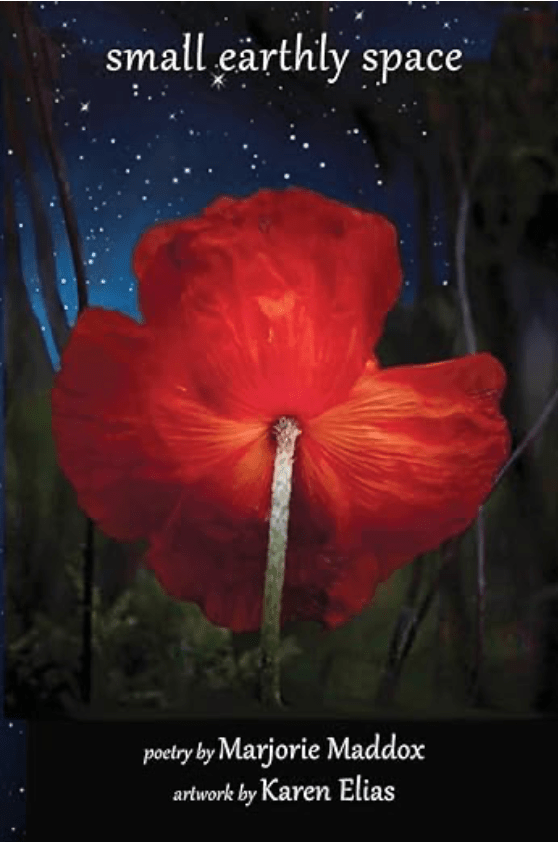
Marjorie Maddox’s new poetry collection, Small Earthly Space (Shanti Arts Publishing, 2025) accompanies a series of dreamy digital visual collages by artist Karen Elias. Together, they depict a world not only fraught with imminent disaster, but one of beauty and hope. Maddox’s poems, inspired by Ali Smith’s lyrical novel, Companion Piece, place the curlew as a central, and recurring figure in the collection. Like a canary in the coal mine, Maddox’s curlew warns about the environmental devastation that is happening now.
Known as the bringer of bad omens in Celtic folklore, forecasting bad weather, sorrow and death, the curlew, with its haunting cries, is also associated with the passing of seasons, rebirth, and renewal. “When our planetary conditions render even the saints tongue-tied and stuttering,” Maddox writes in the introduction, “the bird appears as guide, as psychopomp, as Beatrice in a kind of Dantean descent,” requiring us to “grow humble,” to “pass through the smallest of doors” and experience “the long, slow burn of loss.”
Maddox’s poems are also deeply religious and read like prayers or holy visions. “How far would you go for wisdom?” Maddox asks in “Dive Down,” where she links humanity’s fate with nature’s and invites the reader to dig deeper and discover those epiphanies hidden in daily life, to find “one drenched syllable of rescued hallelujah.” In “Tightrope Walker,” we are instructed to “unzip all our divisions” and position ourselves on the “fine line that binds sky and dirt” and “welds together every season of belief and reason.”
Known as the bringer of bad omens in Celtic folklore, forecasting bad weather, sorrow and death, the curlew, with its haunting cries, is also associated with the passing of seasons, rebirth, and renewal.
“Still Life: 1950s,” which opens section two, leaves nature and moves inward. The poem speaks of the fraught relationships of generations and the societal demands placed on mothers. “What can be said to the perfect mother?/Poised, she smiles beautifully but doesn’t hear.” In the accompanying collage, Karen Elias has created a powerful scene: the mother as a stone statue, sitting in on the sofa, elegant and demure, yet deaf to the needs of her daughter, who crouches on the stairs, doing her best to “protect… this beautiful sculpture,” not daring to speak unpleasant syllables, words that might cause her mother grief, or destroy the facade of their silent perfection.
Other poems speak of the uncertainty and allure of the unknown that lies just outside the boundaries of our perceptions and manicured lawns, and the anxiety of returning to a home that only survives in memory: a place full of phantoms, where picket fences turn to stone. “Strange Light,” the eerie black and white photo collage that accompanies the poem “Calling Hours: August 21, 2017,” has a bed that floats on water in an otherwise empty room. From the window the eclipsed sun, like a voyeur, peers in. The poem uses the eclipse (the first total eclipse since 1979 to be visible from anywhere in the U.S. mainland) as a metaphor for the death of a loved one. “What can harm us lingers there/beneath the bright posthumous display/of the body…” Maddox writes, noting that “looking directly or too long/into the face of the loved” could, like looking at the eclipsed sun, permanently harm us.
Throughout these poems of impending environmental and spiritual doom, a tempered hope permeates, a hope made possible by our faith and resilience, as well as our willingness to accept blame for the state of the world. In “Snapshot,” the dead arise and call for mercy. “Will you listen?” Maddox asks, like the prophets of old. “Will I?” she responds, before observing, “The earth/waits impatiently.”
The curlew returns in “The Witnesses” to see the devastation wrought by the 2018 wildfire in Curlew, Washington. “Smoke rewrites the sky,” Maddox writes, as “Flames attack its map and habitat.” The collection ends with a nod toward Emily Dickinson. “The curlew is the thing,” Maddox states in “Hope Is the Thing with Feathers.” It is “The beak wildly waving its frayed/but flapping ribbons/of persistence, of hope.”
Throughout these poems of impending environmental and spiritual doom, a tempered hope permeates, a hope made possible by our faith and resilience, as well as our willingness to accept blame for the state of the world.
The poems in Small Earthly Space are a dire plea to take up arms against the “Chaos/of this human-caused catastrophic carnival.” With an “ecstasy of words” Maddox dares us to “Embody the action of verbs” and “Delete the expected ending,” to imagine a world where “IF” still exists. In Maddox’s vision, however, imagining isn’t enough. It is our responsibility in the here and now to do something to ensure a better future, a world brimming with the “intoxication of possibility.”
Jason Irwin is the author of three full-length poetry collections, most recently The History of Our Vagrancies (Main Street Rag, 2020), and the memoir These Fragments I Have Shored, forthcoming from Apprentice House Press. In 2022 he was a Zoeglossia Fellow and took part in the Poetry Foundation’s Disability Poetics Project.
Like this post? Comment below or on my FB page. And please share with your friends and social network.
Are you a Rust Belt writer interested in seeing if your own post, or author interview, or book review might be right for Rust Belt Girl? Hit me up through this site’s contact function.
Check out my categories above for more guest posts, interviews, book reviews, literary musings, and writing advice we can all use. Never miss a post when you follow Rust Belt Girl. Thanks! ~Rebecca
Essayist Melissa Ballard contributes the fourth in our series of guest posts here at Rust Belt Girl, and, let me tell you, you’re in for a treat. Melissa has a talent for bringing the past to life and making her ancestors feel like our shared family. In this essay we meet Phyllis, Melissa’s grandmother, a woman of Northern Appalachian Ohio, whom Melissa writes about in a loving yet candid way, deftly delving into what makes personhood–class, sex, education, place and much more. (We also hope Phyllis is having the “time of her life,” Melissa.)
This Woman
by Melissa Ballard
This woman is my grandma, but not yet.
In this black and white photograph, a small, dark hat of woven straw covers her hair and shades her forehead. She wears a walking suit: a jacket and skirt in a light wool pin check with a belt of the same fabric, over a silky, patterned, blouse. The tips of the fingers of her left-hand rest in the pocket of her slim skirt. Her only jewelry is a ring on the little finger of that hand. I can imagine her cropped left foot pointing out, her dark stockings and t-straps. She slouches just a bit and turns her body toward the unidentified photographer. She looks directly at the camera. Her smile is slight, but it reaches her eyes.
This woman’s slight curves contrast with the riveted metal beam, perhaps part of a railroad bridge, that rises at a sharp diagonal behind her. In the early 1920s, her family lived on a side street a few blocks from the train station in Dennison, Ohio. Her father was an inspector for the railroad, so she had a free pass to ride.
This woman could be waiting for the early train to Pittsburgh or Columbus, where she will walk the streets with confidence, on her way to a job interview. But she is not. Or at least I don’t think so. I know little about this brief period, but I hope she is having the time of her life.
In 1925 she has a job in an ice cream shop, lives with her parents. Both she and her mother, who is preoccupied with social status, are named “Margaret.” This woman has already started to express her individuality and goes by her middle name, Phyllis or, on documents, “M. Phyllis.”
On June 18, 1925, eleven days before her nineteenth birthday, Phyllis and her neighbor, Harry, will travel 65.3 miles, maybe by train, to Brooke County, a tapering finger of West Virginia tucked between Ohio and Pennsylvania, where they can get a marriage license with no waiting period. Later that day, they will return to Ohio and be married at the home of the groom’s family.
I wonder whether Phyllis’ parents even attended. They had a reception for her later, but I gather it was her mother’s attempt at saving face. I can’t imagine she approved of my grandpa or his family, and I can easily hear her saying, “He’ll never make a decent living. You’ll end up in the poor house.”
Five months and five days later, their first child will be born. On January 14, 1928, their second child, my dad, will be born.
Phyllis c. 1920
The woman I remember, my grandma, was in her fifties. She had slim legs but a solid middle. She wore silver, cat-eye glasses before they were retro. Her short, dark hair was streaked with gray and white, her fingernails chewed to the quick. Wearing a well-washed cotton housedress covered with a flowered or checked apron and heavy lace-up shoes, she kept chickens and goats, grew vegetables and flowers, ran the laundry through a wringer before hanging it outside to dry, cooked meals from scratch. She kept a battered pan under the kitchen sink, filling it with food scraps. Every morning she fed it to the three hound dogs Grandpa had brought home from the dog pound, kept in a pen at the back of the yard. “Oh, hush up,” she said as they yipped and howled at her.
When Grandma wasn’t busy with chores, she answered the phone for Grandpa, who was the dog warden. She wrote messages in her flowery cursive: the name, address and phone number of the caller, and a brief description of the stray dog. She followed him to his dark green truck, reading her notes out loud. Grandpa never wrote anything down. Before she finished talking, he was backing out of the long driveway, kicking up gravel as he went.
They lived in a worn-out house on a liminal strip of land in Brightwood, part of Goshen Township, Tuscarawas County; my parents and I had moved to a suburb of Cleveland. Once a month, we made the two-hour trip down home to visit, and I spent more time there during the summer.
On hot afternoons, Grandma and I often sat together on the front porch swing, she doing her mending and me reading, trying to catch a breeze. A two-lane road ran close to the front of the house. The cars seemed to fly by, and the exhaust from the trucks taught me to mouth breathe, a skill I perfected when I ran into the hen house to collect eggs.
This route was nicknamed the “slow road” after a highway, the “fast road,” was built behind the house. One summer Saturday, Grandpa drove us into town on the slow road to get ice cream. Grandma and I sat on a bench with our cones, people-watching while Grandpa ran one of his mysterious errands. If Grandma asked him where he was going, he always said, “I need to see a man about a horse.” Which was odd, because my grandparents didn’t have any horses.
On the way home, I noticed a large house on a hill. “Who lives there?” I asked.
Grandma stiffened. “That’s the poor house. Where you go to live if you don’t have any money. It’s not a nice place.”
I immediately pictured a nineteenth-century orphanage from one of the many books I read. Rows of rusty metal cots with stained mattresses, thin sheets, and scratchy blankets. Peeling paint on crumbling walls. I shuddered and looked away.
…
The dining room at Grandma’s was small, with windows on three sides, some covered in plastic to keep out drafts. It was an afterthought tacked on to one side of the house next to the living room. It contained a water-spotted stand of neglected African violets, a treadle sewing machine with a clove-studded dried orange tucked in one of its small oak drawers, a large dining room table and chairs, and a handmade oak China cabinet Grandma had purchased for ten dollars with the money she made selling eggs.
When Grandma made Sunday dinner for our extended family it was served at noon. Grandma removed elegant pieces of stemmed glassware and individual salt cellars from the cabinet and set the dining room table with her good silverware. As we passed roasted chicken with gravy, noodles, and side dishes, Grandpa arrived late (he was known for having “girlfriends”), threw his work cap in the corner, and took his seat at the head of the table.
Only now do I realize how little Grandma wasted. Usually, she cooked one of her own chickens on Sunday, but she occasionally made a pork roast. After the meal, any scraps of meat were set aside, combined with corn meal mush (I can only imagine her reaction to polenta recipes in upscale restaurants) and baked in a loaf pan. For breakfast the next day, she fried slices and we covered them with butter and syrup. They were delicious.
Over time, and with deaths and disagreements, our extended family grew smaller, and we began eating all our meals in the large kitchen. The food was still delicious. One time, Grandma asked how everything tasted. Grandpa was the only one who didn’t answer. She stared at him, and he finally grumbled, “If anything’s not good, I’ll let you know.” Already showing signs of Parkinson’s, he poured a bit of his coffee into a saucer with shaky hands, and leaned down to slurp it.
Eventually, an old couch was jammed into a corner of the dining room, next to the china cabinet. It became my reading space when I visited. Now, as I sit down to read on my own sofa, I look at that same cabinet on the front wall of my living room in Oberlin, just two hours away from where Grandma lived. I have covered the top with family photographs.
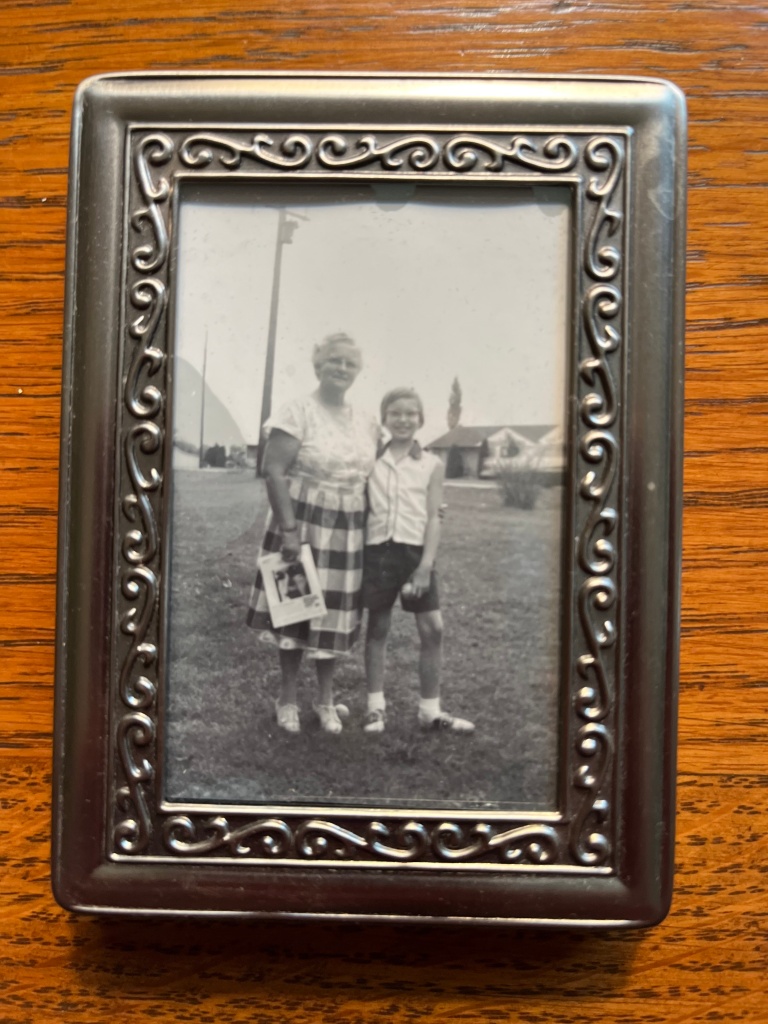
Phyllis and the author c. 1960
Grandma taught me how to tie my shoes–we were both left-handed–after everyone else had given up; gave me my first sip of coffee, strong but cut with generous portions of sugar and thick cream; slipped me some of her beer while we watched Gunsmoke. As I got older and visited less, we wrote letters.
Shortly after my twenty-first birthday, Grandma and I walk in her back yard.We stop under the hot sun to admire the clumps of purple, yellow, and white miniature pansies that flourish in the crumbling foundation of an old shed.I started college three years late; I tell her I am overwhelmed and don’t think I can do the work. She is quiet, removes a flowered hanky from her apron pocket, pats her damp forehead and the back of her neck.
As we start slowly up the steps to the relative cool of the house, I link arms with her. I brush the cool copper of the bracelet she always wears because she believes it helps her arthritis. Her fingers are crooked, as mine are now. As I write this, I touch the copper cuff bracelet I bought years ago but have never worn. I keep it on my desk as a reminder of Grandma, and I wonder what happened to the soft, linked one she always wore.
I open the back door with my other hand. Grandma suddenly stands as straight as she is able and says firmly, “You stay in school.” She adds this, which I will hear her say more than once: “You need to be able to make your own money.”
…
After I’ve finished graduate school, married, and had a child. After Grandpa, who spent years in a nursing home with Parkinson’s, has died. On what will turn out to be the day my dad, her son, dies, Grandma moves into an assisted living facility. With Dad being ill, no one has had the time to take Grandma to see the place prior to moving in. She’s been calling me several times a day, anxious about the change.
She surveys the room: her favorite chair with an afghan she made folded over the back; her dresser, its top covered with a lacy scarf and family photographs, including several of my daughter; a large window that looks out on gardens; the new spread my mom placed on her bed that morning; a private bath.
She leans close to me and whispers, “Oh, Melissa, this is beautiful. I was afraid it would be like the poor house.”
Melissa Ballard has written essays for The Brevity Blog, Belt, Berea College magazine, and other publications. She is currently working on a book-length collection of essays about the women in her Northern Appalachia family.
Like this post? Want more? Comment below or on my FB page. And please share with your friends and social network.
Are you a Rust Belt writer interested in seeing if your own post, or author interview, or book review might be right for Rust Belt Girl? Hit me up through this site’s contact function.
Check out my categories above for more guest posts, interviews, book reviews, literary musings, and writing advice we can all use. Never miss a post when you follow Rust Belt Girl. Thanks! ~Rebecca
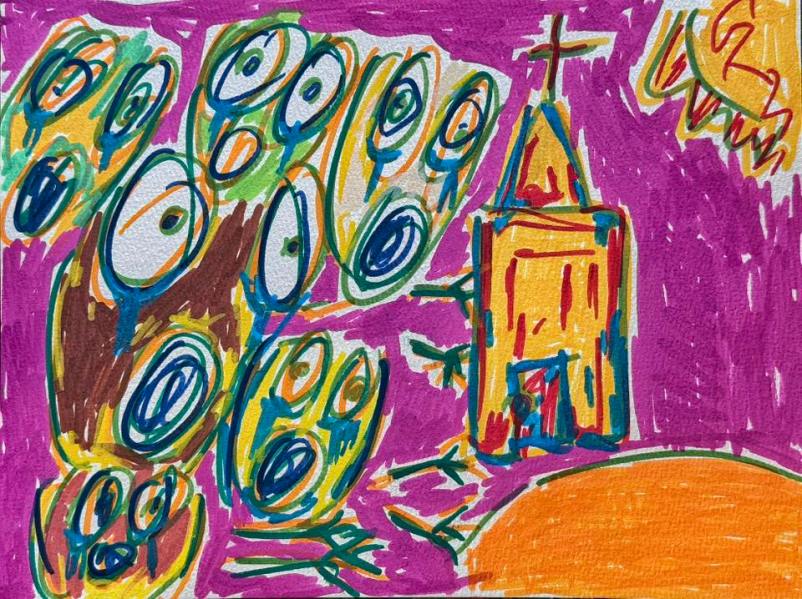
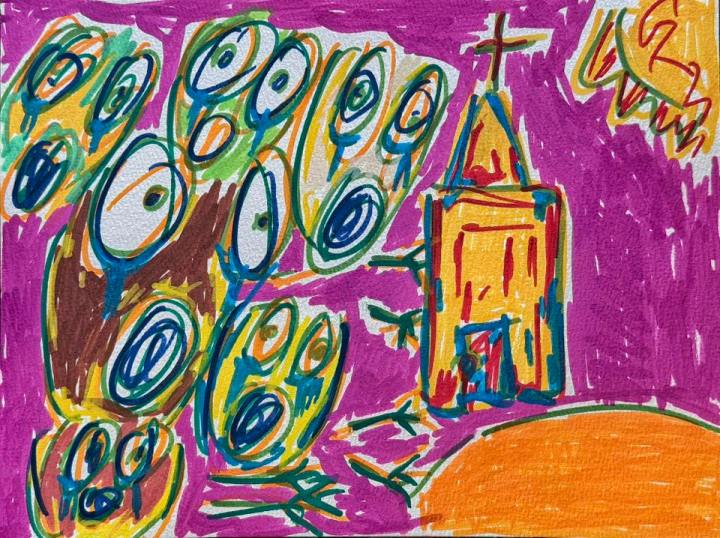
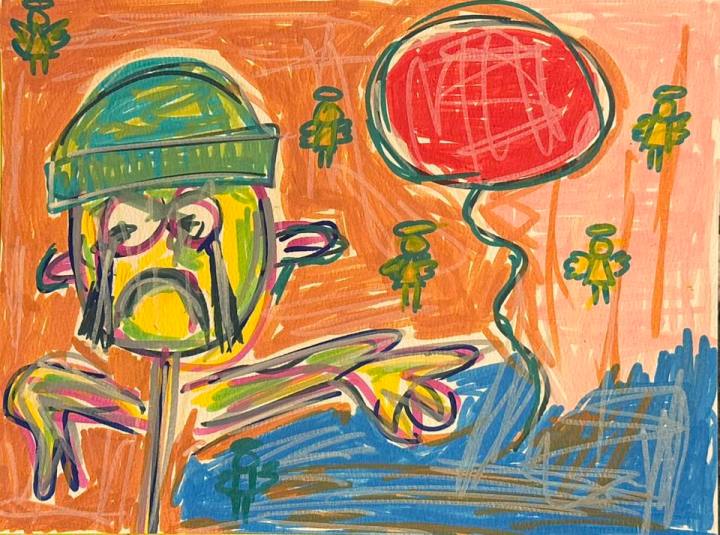
Poet, photographer, and model literary citizen, Justin Hamm inspires with his offering–the third installment of a series of guest posts here at Rust Belt Girl. Thank you, Justin! His essay about speaking in tongues feels especially personal, presented as it is from a child’s perspective. It feels “close” to me, in more than one way. Justin’s essay is accompanied by his original folk art, and I have to say, I didn’t see this coming. But I absolutely love it. Here at Rust Belt Girl, we know the American Midwest is vast and multitudinous, and so are its people, their inspirations, their stories, and their art.
Because Justin is truly “Midwest Nice” and humble, he might not brag to you about his TEDxOshKosh Talk, “The American Midwest: A Story in Poems & Photographs, but I’ll do it for him. This is a good place to start, if you’re new to Justin. In his talk, he asks some of the same questions we’ve been asking at Rust Belt Girl all these years. A big one: Is “flyover country” an appropriate term for the Midwest? Justin explores that vital question through inspection of the overlooked or the avoided, including rust (holla!), thunderstorms, everyday people doing everyday things, politics, social class, and more. It’s well worth a watch-and-listen.
But first. Let’s read and discuss Justin Hamm’s…
The Wind With a Secret Shape
I was eight maybe nine years old Wednesday nights my grandparents used to
take me to a small Pentecostal church that sat on a grassy rise just outside of
town it had once felt isolated tucked out in the quiet but the town had crept
outward now it sat beside a gas station a lumberyard and a row of fast-food
joints the holy and the ordinary rubbing shoulders the church rectangular part
brick part white siding a white cross stretching off the roofline like an arrow
pointing to the shifting Illinois sky inside the pews angled toward a low
platform where the preacher shouted and a four-piece band laid down rhythm
the cushions a deep royal blue clean saturated almost regal I remember that
color better than my childhood bedroom the building always felt old but never
run-down the women cleaned it like a calling while the men kept it maintained
it smelled of floor polish and breath mints old hymnals and hairspray a past
preserved a place where time seemed fixed in place
I wanted to be a good boy I tried to follow the sermons caught a phrase here or
there but mostly folded handouts into paper planes or built hymnbook
pyramids sometimes I curled up on the back pew and drifted off lulled by the
rhythm of scripture and song until the spirit moved when it hit the preacher
everything changed he’d leap down the steps whirling stomping at the devil
howling Jesus’ name until his face went red and purple sweat soaking his brow
and then the tongues came strange breathless syllables rolling out like a chant
that bypassed the brain entirely the holy ghost made you do things that was
just how it worked I accepted it the way you’d accept sunrise or gravity
and I believed too believed fully if somebody said the spirit is with us tonight
I’d scan the sanctuary up in the corners where wall met ceiling under pews
between swaying bodies I didn’t expect to see it exactly but I wanted to know
where it was it filled me with something like fear but not only fear there was
longing in it too hunger a sense that something just out of reach might solve
everything the holy ghost like a wind with a secret shape a bird made of breath
maybe God’s own breath moving invisibly through the room I believed it
entered through the mouth that explained what came out the old men would
rise in their too-large suits limping loops around the sanctuary hands raised
speaking in tongues the women would fall stiff to the ground eyes rolled back
mouths twitching that’s how I knew the ghost was on the move I tracked it
sinner to sinner and sometimes it came close the person next to me would
sway eyelids flickering syllables rising up like springwater through stone my
chest would lift my legs would buzz my mouth would soften and open almost
involuntarily I’d think this is it just let yourself go let it take you I opened my
mouth and nothing came I tried again wider harder I prayed the best I knew
how I swallowed the air like it might carry something eternal and then I waited
“The Hungry” by Justin Hamm
“Balloon” by Justin Hamm
“Laying on of Hands” by Justin Hamm
“Sinners Prayer” by Justin Hamm
Justin Hamm is the author of five poetry collections, including O Death (2024), Drinking Guinness With the Dead (2022), and The Inheritance (2019), as well as a book of photography, Midwestern. He is the founding editor of the museum of americana and the creator of Poet Baseball Cards.
Like this post? Like this series? Let’s discuss! Comment below or on my FB page. And please share with your friends and social network.
Are you a Rust Belt writer interested in seeing if your own post, or author interview, or book review might be right for Rust Belt Girl? Hit me up through this site’s contact function.
Check out my categories above for more guest posts, interviews, book reviews, literary musings, and writing advice we all cab use. Never miss a post when you follow Rust Belt Girl. Thanks! ~Rebecca
Thank you, thank you to Jason Irwin, who kicks off a series of guest posts at Rust Belt Girl, and to you, for being here! What is a Rust Belt place–and who defines the perameters? What does post-industrial mean today? What are a place’s histories, characteristics, and quirks–and how have they shaped its people and its art? How have they shaped the stories we tell, and what have those stories meant for Grit Lit and Rural Noir writing and for other mediums of creative expression? For this series, I suspect we will get some fascinating answers to these questions and many more I haven’t thought of.
A guest post by Jason Irwin
Though I have used film in the past, as well as digital cameras, I consider myself an amateur. I owned a flip phone for 22 years but finally gave in and bought a smart phone during the summer of 2024. Do I love my smart phone? Well, no, but it makes life easier, and I do love the camera feature.
I believe my photos are already out there waiting for me to stumble upon. I like taking photos of people naturally, most often without them knowing I’m taking their photos. I prefer them off-center. I also like wide-open, desolate landscapes and cityscapes: derelict, sometimes abandoned buildings, windows, doorways, big skies, fields, and bodies of water. My hometown of Dunkirk, New York, is a perfect place for such photos. I hope the three photos in this post show this.
Serendipity, the storefront boutique in Madison, Indiana, looked lost in time to me, as my wife and I drove past. Maybe not in the 50s but still lost in time. Using the grayscale setting on my Samsung smartphone ads to the notion that this photo is older than it appears. Madison is her hometown, or rather Deputy, an unincorporated rural community about 18 miles northwest of Madison. Just outside the borders of what the Britannica website’s map marks as the Rust Belt. Madison was first settled in 1805, five years before my hometown of Dunkirk. Though not a Rust Belt town, Madison, like Dunkirk, was once a railroad town. The Madison and Indianapolis Railroad was completed in 1836. The first train stopped in Dunkirk on May 15, 1851, and at the time it was the last stop on the New York and Erie Railroad.
I chose color for the photo of the old Regent movie theater, which closed in the late 1980s, but still stands, minus its marquee, on the corner of Washington Avenue and Third Street in Dunkirk, because of the recent addition of the mural, which pays homage to Dunkirk’s Hispanic and African American communities. As a child I went to the Regent, owned by Mr. Burget and his sad-eyed basset hound, to see movies like Back to the Future, E.T., and Rocky II. Many nights my mother would have a craving for popcorn, and she’d park our car out front and send me in to the concession stand to buy a large tub with extra salt and butter and then we’d go home and eat it while watching TV.
The harbor in Barcelona, New York (a former fishing hamlet a few miles north of the village of Westfield), was where one of the scenes from the 2020 movie A Quiet Place Part II staring Cillian Murphy was filmed. Besides its huge commercial fishing industry that died out in the 1970s, the area is home to various wineries and agriculture, including Welch’s Grape Juice. Just out of frame to the left, up a small hill sits the Barcelona Lighthouse. Built in 1829, it is the first gas-powered lighthouse in the world. My father was born next door in the lighthouse keeper’s cottage in 1941. The grayscale setting gives this photo an eerie presence, but I love how the trees reflect in the water.
Jason Irwin is the author of three full-length poetry collections, most recently The History of Our Vagrancies (Main Street Rag, 2020), and the memoir These Fragments I Have Shored, forthcoming from Apprentice House Press. In 2022 he was a Zoeglossia Fellow and took part in the Poetry Foundation’s Disability Poetics Project.
Like this post? Comment below or on my FB page. And please share with your friends and social network.
Are you a Rust Belt writer interested in seeing if your own post, or author interview, or book review might be right for Rust Belt Girl? Hit me up through this site’s contact function.
Check out my categories above for more guest posts, interviews, book reviews, literary musings, and writing advice we can all use. Never miss a post when you follow Rust Belt Girl. Thanks! ~Rebecca
I’m thrilled to share this guest post interview with Rust Belt Girl readers. What began as a Spotlight interview–between two of my favorite authors and people–for the Association of Writers & Writing Programs (AWP) has been gifted to us here, and I’m so grateful.
We talk a lot about writing as a communal act at Rust Belt Girl and about finding that community where we belong. The first time I met Karen Schubert in person, I’d just driven five hours, home to Ohio, to attend a literary festival I’d never been to before. I knew a few names but no faces. And no one knew me, so I dutifully popped on my name tag.
Even before my nerves could kick in, here comes the director, Karen Schubert, with the most gracious greeting–as if I were the keynote or a fully-fledged author, and not an emerging writer and editor with a blog.
I belonged. Just like that. And I’ve returned to that annual literary festival every year since. Last year, I served on the planning committee to do my own small part in welcoming new faces to the community.
“How does she do it?” This is a question I often ask about Karen Schubert. In addition to being co-founding director of Lit Youngstown, a literary arts nonprofit with programs for writers, readers, and storytellers…
Lit Youngstown Co-founding Director Karen Schubert; photo credit: Melanie Rae Buonavolonta
Karen Schubert is the author of The Compost Reader (Accents Publishing), Dear Youngstown (Night Ballet Press), Black Sand Beach and Bring Down the Sky (Kattywompus Press), I Left My Wings on a Chair, a Wick Poetry Center chapbook winner (Kent State Press), and The Geography of Lost Houses (Pudding House Publications). Her poems, fiction, creative nonfiction, essays, reviews and interviews have appeared in numerous publications including National Poetry Review,Diode Poetry Journal, Water~Stone Review, AGNI Online, Aeolian Harp, Best American Poetry blog and American Literary Review. Her awards include the William Dickey Memorial Broadside Award, an Ohio Arts Council Individual Excellence Award in poetry, and residencies at Headlands Center for the Arts and the Vermont Studio Center. She holds an MFA from the Northeast Ohio Master of Fine Arts.
Thank you to Robert Miltner for asking “How does she do it?” here and to Karen Schubert for telling her story–and inviting us to tell ours.
Robert Miltner: Karen, you live in Youngstown, a midwestern rust belt city located within the Appalachian Ohio region. Your city was known for its blast furnaces and mills that, as Bruce Springsteen sings in “Youngstown,” “built the tanks and bombs that won this country’s wars.” In your poem, “Letter to Youngstown,” you write “Remember the world is full /of places like Youngstown, /and places nothing like Youngstown.” How does that reflect your sense of identity as the director of Lit Youngstown?
Karen Schubert: I’m not from here, although my mother’s family has been in the area since the early 1800s. I came to live in my grandparents’ farmhouse that I loved visiting as a child, and now I live in the city, in a five bedroom brick and frame house that must have been a stunner with its slate roof and cedar shakes. I bought the house on a teaching adjunct’s salary; that tells you what’s going on here. I think there’s a benefit in having been other places and having a sense of how things might work. But I’ve also been in Youngstown long enough to know what people might miss or seek, what our assets are, and who is doing amazing work. I once attended an AWP session on starting a literary arts nonprofit and someone said, “I can’t convince anyone to get behind what I’m doing because they don’t understand the concept.” I thought, that’s a problem I’ll never have.
Youngstown is economically poor yet arts rich…
Youngstown is economically poor yet arts rich—live music, performing arts—with an opera and two extraordinary concert halls including the original Warner Brothers theater, and several local theater companies. The visual arts are available through an outstanding American arts museum and a university museum. On the river, the shell of a steel mill came down a few years ago and a new amphitheater went up. In recent years, the city has hosted Margaret Atwood, Gloria Steinem, and Tarana Burke, as well as YoYo Ma through Kennedy Center outreach. Youngstown is also rich in literary arts. Lit Youngstown hosts readings at a supportive for-profit art gallery that champions local artists. While many community-based writers and writing program faculty stayed and enrich the community, like Christopher Barzak, Steven Reese, Will Greenway, and Philip Brady, others have left to great success, like Ross Gay, Ama Codjoe, Allison Pitinii Davis, and Rochelle Hurt. There is also a local culture that benefits from the immigrant grandparents who taught their children a profound love for the arts.
Youngstown State has been a part of the Northeast Ohio Master of Fine Arts [NEOMFA]; in fact, it was founded at YSU, and we were devastated to learn that YSU has decided to sunset their participation in the consortium. We are still processing the loss that will be to Lit Youngstown and the community.
Miltner: What inspired you to start Lit Youngstown in 2015?
Schubert: I lived in Cleveland for a few years, and there were many literary gigs. The summer of 2013 I was a writer-in-residence at Headlands Center for the Arts in San Francisco, and talked to writers and artists all summer who were doing fascinating work. I began wondering what might be possible in Youngstown.
Miltner: Did your experience as an AmeriCorps VISTA at a neighborhood development nonprofit influence your decision to start Lit Youngstown?
Schubert: Yes, certainly. I was hired by Youngstown Neighborhood Development Corporation to write for the Neighborhood Conditions Report including data from every census tract in the City. Grim statistics: 40% of city land abandoned, jobs clustered in edge suburbs, and Black infant mortality rates similar to Guatemala. But I also learned that incredible things were happening, important stories that needed to be told. One day we were out interviewing residents and a woman invited us inside. She was a member of a Black women’s motorcycle club. They had filled a dining room with long tables, conveyor-belt style, and were packing stacks of to-go boxes with dinners for local residents who were struggling. This is an example of Youngstown’s story, its resilience and social weave. What I learned from the neighborhood development nonprofit is to be fearless: work hard, collaborate, research, and don’t buy the idea of staying just in your lane, because everything is connected.
Miltner: How wide an array of literary programing does Lit Youngstown offer?
Schubert: We host a monthly reading series, writers critique group, book and film discussions, writing classes, a Winter Writing Camp for all ages, teen writers workshops, and a Fall Literary Festival. We also do many one-off events and collaborations, including an NEA Big Read grant with the public library and reading lunch poems with adults with disabilities at the nonprofit Purple Cat. One of our early projects was Phenomenal Women: Twelve Youngstown Stories. We interviewed Black women between the ages of 64 and 101 and published their stories and images from their lives. The collection is a rich archive of our city’s history, and the idiosyncratic details of the lives of these tremendously strong, intrepid and insightful women. One of the women worked in the War Room during the FDR administration. Many were tapped for jobs during the Civil Rights movement, to hold newly won ground.
Also, in partnership with the YSU Art Department, the vibrant 150-foot Andrews Avenue Memory Mural along a retaining wall of a historically important corridor has just been completed. We solicited memories from the local community, and students incorporated images and pieces of those, and their own, memories. Memory is important and complicated in a place like Youngstown, a city that has suffered so much loss and is struggling to conceptualize an identity. I think it’s especially important us to offer this younger generation the opportunity to imagine a city they can believe in.
A memory mural created in partnership between Lit Youngstown and the YSU art department; photo credit: Melanie Rae Buonavolonta
Miltner: Who are some of the writers you’ve brought in for your literary community?
Schubert: So many! We’ve had the privilege of hosting wildly accomplished writers including Philip Metres, Nin Andrews, Philip Memmer, James Arthur, Cody Walker, Kevin Haworth, Jan Beatty, and many faculty of the Northeast Ohio Master of Fine Arts. We’ve also mixed it up with student essayists; storytellers; an international poetry night featuring poems in the original language and the translation; and a humor night one April 1. One December evening Mike Geither read his play Heirloom; it was so moving I found it emotionally difficult to come back to the mic to close the evening. In 2019, we partnered with the Public Library of Youngstown & Mahoning County on an NEA Big Read grant and selected Into the Beautiful North. There were dozens of related events throughout the city for a month, like a mini film festival, immigrant narratives night, and ethnic foods potluck. Luis Alberto Urrea flew in to talk about the inspiration for the individual characters in his book.
Miltner: In a community that is economically challenged, how do you develop funding? And who in the community, or local institutions, or from the state level, contributes?
Schubert: Our community has been incredibly supportive, as have the foundations. We have built up a funding structure that is a mix of support from community members, benefactors, local foundations and state agencies. Our yearly fundraiser is a raffle for a large work of art, typically a birdbath by a local steel sculptor. In all, we have received nearly $200,000 in grants from the Ohio Arts Council, Ohio Humanities, and local foundations.
Miltner: What recent programming has been successful in your literary community?
Schubert: This year’s Fall Literary Festival was successful in the quality of presenters, and the engagement of participants. It’s always so great to see local writers talking with other writers, educators, editors and nonprofit administrators, asking questions and learning more about the literary landscape.
Miltner: The 2020 Fall Literary Festival was held as a videoconference. How was it different from an in-person conference?
Schubert: Well, to begin with, we had a virtual cookie table! I made Allison Pitinii Davis’s aunt’s Greek cookie recipe from the Youngstown Cookie Table Book published by Belt Publishing. Featured writer Janet Wong found cookies in the back of her pantry and described their staleness in hilarious detail. Zoom awkwardness aside, people were wanting to feel a sense of connection. I think they did, but one missing thing was conversations that spill into the hallway and coffee shops.
And we were back in person this year and I was surprised how rusty I felt. I made clumsy organizational mistakes. More importantly, I think feeling connected was also very important this year, and even though there were masks and fewer hugs, the comradrie was everywhere. There are many very fine conferences, so I always ask folks why they come to this one. They consistently say it is the connections they make here.
Miltner: How has the festival impacted your community?
Schubert: It’s the only Youngstown conference for adult writers. The English Festival at YSU, for middle and high school students, draws thousands each year, so there is local context for such an event among literary arts enthusiasts. But previously, adults would have to drive to Cleveland, Columbus, or Pittsburgh to attend in person, which we encourage them to do, but it’s also great to have a conference here.
…they come to hear contemporary work, talks on literature and bringing literature into the community for healing and cross-cultural connection.
Another benefit to local writers is meeting and engaging with writers from throughout the U.S. Really feeling part of something bigger. Of course, some of our attendees are not writers, but readers, students, educators, administrators, and they come to hear contemporary work, talks on literature and bringing literature into the community for healing and cross-cultural connection.
Those who attend from a distance appreciate the low cost of the conference, which makes travel and lodging more possible. And we are fortunate that Youngstown State University partners with us, because this allows undergraduate students to attend free, and some faculty members require their students attend. If YSU follows through with their plan to sunset the NEOMFA, leaving only an undergraduate minor in creative writng, I don’t know yet what that will mean for the conference.
Miltner: Would you share a project Lit Youngstown is currently working on?
Schubert: We had cancellations with the lock-down, including Whitman & Brass, an event that pairs staged readings and a brass quartet playing the music of his day. I was hoping to make this into a series, and was thinking next we would pair James Baldwin and Nina Simone. So Whitman & Brass has been rescheduled for March.
During the lock-down, we sent out an extensive survey to our community, and one consistent point of feedback is that some writers are looking for more in-depth continuity. So this month, we kicked off a series of nine monthly daylong Poetry Intensive workshops. In the morning we’ll talk about books, chapbooks, journals, submissions, presses, readings, things like that. Each afternoon, a different poet will come to talk about different aspects of poetry, and we’ll look at participants’ poems through that lens. For example, when you come, Robert, we’ll talk about the music in these drafts. I’m crazy excited.
Miltner: If an anonymous donor gave you a major gift for Lit Youngstown, what is the dream project you’d immediately implement?
The Big Dream is to buy a large building and begin a writing residency.
Schubert: First I would step up the development of our outreach program. We are inspired by the Wick Poetry Center at Kent State and Director David Hassler who has been a great mentor to us. I’d like for us to be doing outreach with immigrants, veterans, retired residents, patients in medical care, and sexual assault survivors. I love Literary Cleveland’s Essential Worker narratives. Our Outreach Coordinator Cassandra Lawton is currently working in the expressive therapy program at Akron Children’s Hospital and will soon begin a study on writing with cancer survivors.
The Big Dream is to buy a large building and begin a writing residency. In Youngstown, many historic buildings are languishing empty and selling for relatively low prices. I love the model of the Vermont Studio Center, putting studios into a former fire station and school, supporting an indie bookstore, creating links between artists-in-residence and the local elementary school and college.
Miltner: What advice would you offer to someone who might want to launch a community literary program in their city?
Schubert: Collaborate on everything. Keep thinking of new people to bring to the table, to help plan and run events, to shine a spotlight on other community work. For example, when I read Mark Winne’s Closing the Food Gap, a book about food policy, I recognized that it had a lot of relevance to what was happening in Youngstown, a citywide food desert. We partnered with a local co-op on our first book group series and, along with many community development partners, we brought Winne here.
I like to see the literary arts, in addition to creative expression, as a means to understand and work toward solving problems. During the lock-down, I was thinking about the kids at home and parents and teachers looking for literacy enrichment. So we wrote grants and purchased over $10,000 worth of wonderful books for nearly 800 children in Head Start. We also purchased high quality books for children in YSU Project Pass, a program that pairs education students with city 3rd graders who would benefit from reading skills support. Each year we send a $100 donation to a literary arts nonprofit we admire, and this year we selected Black Boys Read, a local initiative.
Miltner: You are yourself the author of several chapbooks and a full-length book. How has your being a writer yourself shaped your role in leading Lit Youngstown?
The Compost Reader (Accents Publishing), 2020, by Karen Schubert
Schubert: As a student, I went to conferences where I met writers like Bruce Bond, Denise Duhamel, Kimberly Johnson, and former NEA director Dana Gioia. I gained much from classes on how to edit, submit work, and shape a manuscript. From classes and conferences, I met writers who are now lifelong friends. Part of my work is trying to recreate those great experiences for those in our literary community.
Miltner: In your poem “Youngstown Considers the Future,” you write, “We are tired of our Titanic metaphors— / can’t decide if we’re patching up the hole, / steering toward warmer waters, or / arranging the deck chairs.” It seems to me that your dual role of writer/director is encapsulated in these lines. From your perspective, what fresh metaphor would you offer instead?
Schubert:. How about the metaphor of a mural: we’ve cut back the vines, purchased more primer than we knew we’d need, and now we’re ready to create a design harvested from memory and shaped by the young. How’s that for what community building looks like?
Robert Miltner is a writer, editor, and scholar. His books of poetry include Hotel Utopia, Orpheus & Echo, and Against the Simple, the short story collection And Your Bird Can Sing, and a collection of creative nonfiction, Ohio Apertures. He has received and Ohio Arts Council Award for Poetry, an Ohio Arts Council Writing Fellowship at Vermont Studio Center, and was Poet-in-Residence at the Chautauqua Institution in summer 2021. A professor emeritus from Kent State University Stark and the NEOMFA, and Editor of The Raymond Carver Review, Robert has been a member of AWP since 2012.
~~~
Read my interview with Robert Miltner for Rust Belt Girl here. Like this interview? Comment below or on my FB page. And please share with your friends and social network.
Are you a Rust Belt writer interested in seeing if your own author interview or book review might be right for Rust Belt Girl? Pitch me through this site’s contact function.
Check out my categories above for more interviews, book reviews, literary musings, and writing advice we can all use. Never miss a post when you follow Rust Belt Girl. Thanks! ~Rebecca
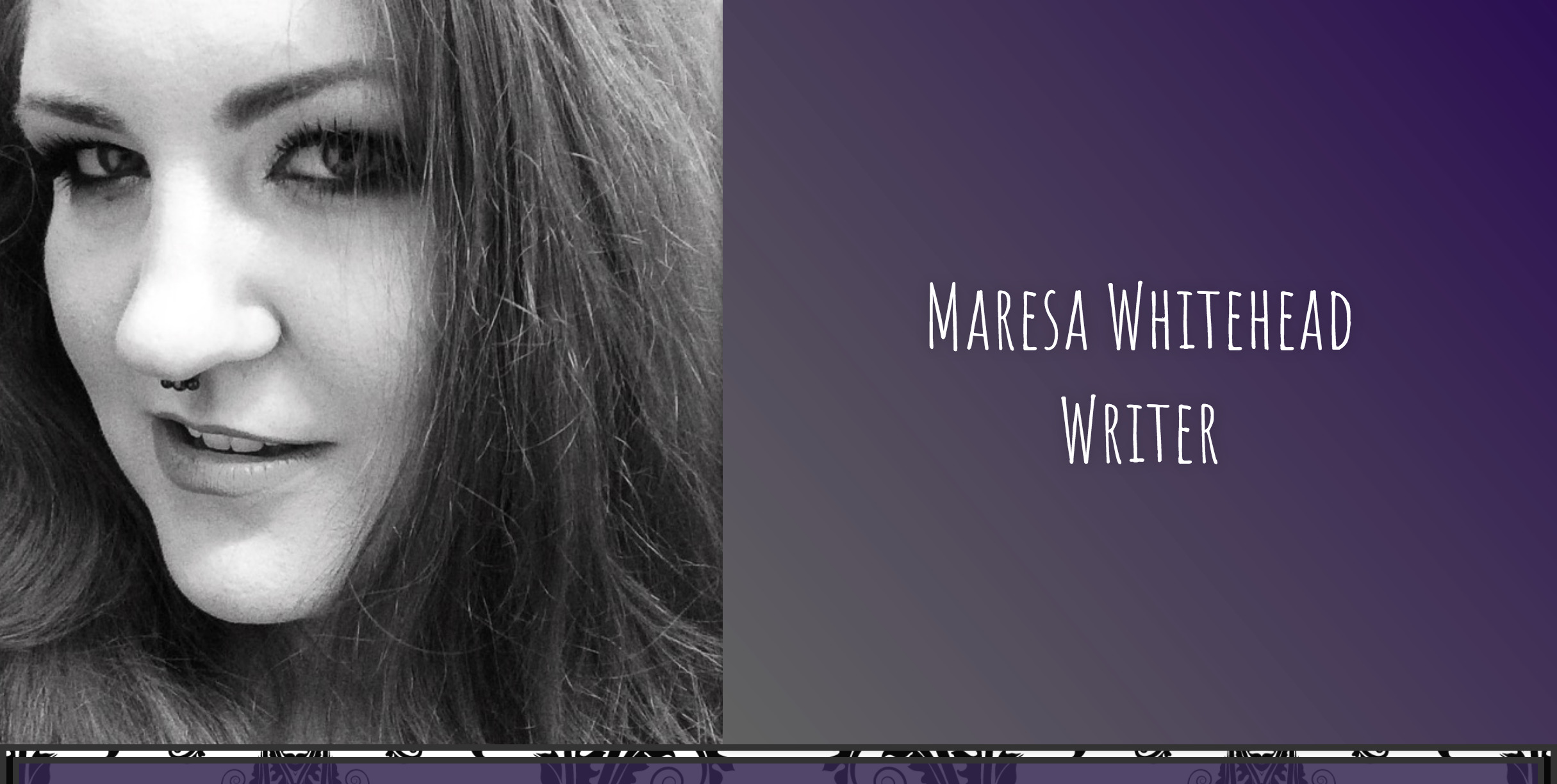
Yes! I am thrilled to introduce you to Maresa Whitehead, a talented writer and poet I met at Lit Youngstown’s Fall Literary Festival last month. From her website:
Maresa writes poetry which explores the beauty in darkness and dark images, particularly as they relate to nature and place.
Maresa currently lives in Pittsburgh, Pennsylvania, where she earned an MFA in Creative Writing–Poetry from Chatham University. I count myself so very fortunate that Maresa agreed to share with us her wonderful Rust Belt-inspired poem. Whatever season you’re experiencing where you live, I’m sure you too will appreciate the unfolding and discovery going on here:
Layers
Once, this city forebode,
dormant, suppressed
by charcoal snow,
glaciated, atrophied,
bitter as if poisonous
until thawed.
Now, defrosted,
it’s pungent as it ripens,
unfurls petals, entreats
pollination from swarms
which spread its seed.
Each season peels its rind,
extracts the pulp of Pittsburgh,
succulent, unexpected
like the creamy black-specked
marrow eclipsed at first
by the green-tipped pink
husk of the dragon fruit.
by Maresa Whitehead
Thank you again to Maresa for allowing me to publish your poem here at Rust Belt Girl!
All, please help me share her voice far and wide—on the social networks of your choice. Visit Maresa Whitehead’s site for her complete bio and more of her writing.
Have a favorite seasonal poem? One that celebrates all you love—or don’t—about your town? Share in the comments!








 Rust Belt Girl