“This Woman”: an Essay by Melissa Ballard

Essayist Melissa Ballard contributes the fourth in our series of guest posts here at Rust Belt Girl, and, let me tell you, you’re in for a treat. Melissa has a talent for bringing the past to life and making her ancestors feel like our shared family. In this essay we meet Phyllis, Melissa’s grandmother, a woman of Northern Appalachian Ohio, whom Melissa writes about in a loving yet candid way, deftly delving into what makes personhood–class, sex, education, place and much more. (We also hope Phyllis is having the “time of her life,” Melissa.)


This Woman

by Melissa Ballard

This woman is my grandma, but not yet. 

In this black and white photograph, a small, dark hat of woven straw covers her hair and shades her forehead. She wears a walking suit: a jacket and skirt in a light wool pin check with a belt of the same fabric, over a silky, patterned, blouse. The tips of the fingers of her left-hand rest in the pocket of her slim skirt. Her only jewelry is a ring on the little finger of that hand. I can imagine her cropped left foot pointing out, her dark stockings and t-straps. She slouches just a bit and turns her body toward the unidentified photographer. She looks directly at the camera. Her smile is slight, but it reaches her eyes. 

This woman’s slight curves contrast with the riveted metal beam, perhaps part of a railroad bridge, that rises at a sharp diagonal behind her. In the early 1920s, her family lived on a side street a few blocks from the train station in Dennison, Ohio. Her father was an inspector for the railroad, so she had a free pass to ride. 

This woman could be waiting for the early train to Pittsburgh or Columbus, where she will walk the streets with confidence, on her way to a job interview. But she is not. Or at least I don’t think so. I know little about this brief period, but I hope she is having the time of her life.      

In 1925 she has a job in an ice cream shop, lives with her parents. Both she and her mother, who is preoccupied with social status, are named “Margaret.” This woman has already started to express her individuality and goes by her middle name, Phyllis or, on documents, “M. Phyllis.”

On June 18, 1925, eleven days before her nineteenth birthday, Phyllis and her neighbor, Harry, will travel 65.3 miles, maybe by train, to Brooke County, a tapering finger of West Virginia tucked between Ohio and Pennsylvania, where they can get a marriage license with no waiting period. Later that day, they will return to Ohio and be married at the home of the groom’s family. 

I wonder whether Phyllis’ parents even attended. They had a reception for her later, but I gather it was her mother’s attempt at saving face. I can’t imagine she approved of my grandpa or his family, and I can easily hear her saying, “He’ll never make a decent living. You’ll end up in the poor house.” 

Five months and five days later, their first child will be born. On January 14, 1928, their second child, my dad, will be born.

Phyllis c. 1920

The woman I remember, my grandma, was in her fifties. She had slim legs but a solid middle. She wore silver, cat-eye glasses before they were retro. Her short, dark hair was streaked with gray and white, her fingernails chewed to the quick. Wearing a well-washed cotton housedress covered with a flowered or checked apron and heavy lace-up shoes, she kept chickens and goats, grew vegetables and flowers, ran the laundry through a wringer before hanging it outside to dry, cooked meals from scratch. She kept a battered pan under the kitchen sink, filling it with food scraps. Every morning she fed it to the three hound dogs Grandpa had brought home from the dog pound, kept in a pen at the back of the yard. “Oh, hush up,” she said as they yipped and howled at her. 

When Grandma wasn’t busy with chores, she answered the phone for Grandpa, who was the dog warden. She wrote messages in her flowery cursive: the name, address and phone number of the caller, and a brief description of the stray dog. She followed him to his dark green truck, reading her notes out loud. Grandpa never wrote anything down. Before she finished talking, he was backing out of the long driveway, kicking up gravel as he went. 

They lived in a worn-out house on a liminal strip of land in Brightwood, part of Goshen Township, Tuscarawas County; my parents and I had moved to a suburb of Cleveland. Once a month, we made the two-hour trip down home to visit, and I spent more time there during the summer. 

On hot afternoons, Grandma and I often sat together on the front porch swing, she doing her mending and me reading, trying to catch a breeze. A two-lane road ran close to the front of the house. The cars seemed to fly by, and the exhaust from the trucks taught me to mouth breathe, a skill I perfected when I ran into the hen house to collect eggs.  

This route was nicknamed the “slow road” after a highway, the “fast road,” was built behind the house. One summer Saturday, Grandpa drove us into town on the slow road to get ice cream. Grandma and I sat on a bench with our cones, people-watching while Grandpa ran one of his mysterious errands. If Grandma asked him where he was going, he always said, “I need to see a man about a horse.” Which was odd, because my grandparents didn’t have any horses.

On the way home, I noticed a large house on a hill. “Who lives there?” I asked.

Grandma stiffened. “That’s the poor house. Where you go to live if you don’t have any money. It’s not a nice place.” 

I immediately pictured a nineteenth-century orphanage from one of the many books I read. Rows of rusty metal cots with stained mattresses, thin sheets, and scratchy blankets. Peeling paint on crumbling walls. I shuddered and looked away. 

The dining room at Grandma’s was small, with windows on three sides, some covered in plastic to keep out drafts. It was an afterthought tacked on to one side of the house next to the living room. It contained a water-spotted stand of neglected African violets, a treadle sewing machine with a clove-studded dried orange tucked in one of its small oak drawers, a large dining room table and chairs, and a handmade oak China cabinet Grandma had purchased for ten dollars with the money she made selling eggs.  

When Grandma made Sunday dinner for our extended family it was served at noon. Grandma removed elegant pieces of stemmed glassware and individual salt cellars from the cabinet and set the dining room table with her good silverware. As we passed roasted chicken with gravy, noodles, and side dishes, Grandpa arrived late (he was known for having “girlfriends”), threw his work cap in the corner, and took his seat at the head of the table. 

Only now do I realize how little Grandma wasted. Usually, she cooked one of her own chickens on Sunday, but she occasionally made a pork roast. After the meal, any scraps of meat were set aside, combined with corn meal mush (I can only imagine her reaction to polenta recipes in upscale restaurants) and baked in a loaf pan. For breakfast the next day, she fried slices and we covered them with butter and syrup. They were delicious. 

Over time, and with deaths and disagreements, our extended family grew smaller, and we began eating all our meals in the large kitchen. The food was still delicious. One time, Grandma asked how everything tasted. Grandpa was the only one who didn’t answer. She stared at him, and he finally grumbled, “If anything’s not good, I’ll let you know.” Already showing signs of Parkinson’s, he poured a bit of his coffee into a saucer with shaky hands, and leaned down to slurp it. 

Eventually, an old couch was jammed into a corner of the dining room, next to the china cabinet. It became my reading space when I visited. Now, as I sit down to read on my own sofa, I look at that same cabinet on the front wall of my living room in Oberlin, just two hours away from where Grandma lived. I have covered the top with family photographs. 
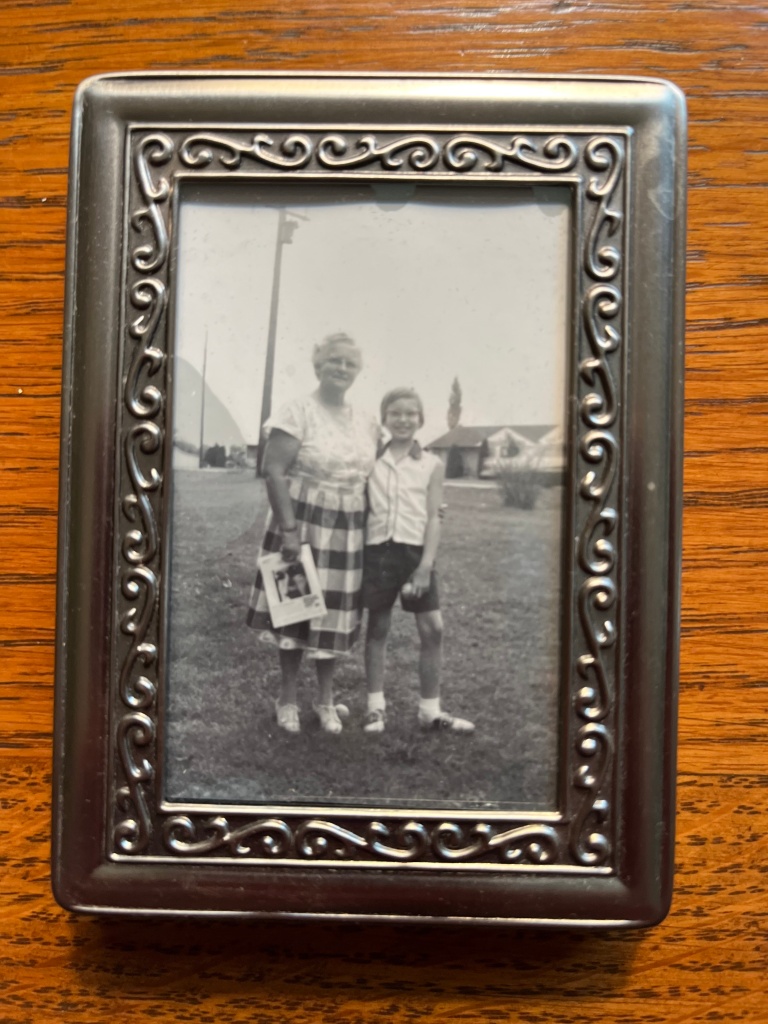
Phyllis and the author c. 1960

Grandma taught me how to tie my shoes–we were both left-handed–after everyone else had given up; gave me my first sip of coffee, strong but cut with generous portions of sugar and thick cream; slipped me some of her beer while we watched Gunsmoke. As I got older and visited less, we wrote letters.

Shortly after my twenty-first birthday, Grandma and I walk in her back yard. We stop under the hot sun to admire the clumps of purple, yellow, and white miniature pansies that flourish in the crumbling foundation of an old shed. I started college three years late; I tell her I am overwhelmed and don’t think I can do the work. She is quiet, removes a flowered hanky from her apron pocket, pats her damp forehead and the back of her neck. 

As we start slowly up the steps to the relative cool of the house, I link arms with her. I brush the cool copper of the bracelet she always wears because she believes it helps her arthritis. Her fingers are crooked, as mine are now. As I write this, I touch the copper cuff bracelet I bought years ago but have never worn. I keep it on my desk as a reminder of Grandma, and I wonder what happened to the soft, linked one she always wore. 

I open the back door with my other hand. Grandma suddenly stands as straight as she is able and says firmly, “You stay in school.” She adds this, which I will hear her say more than once: “You need to be able to make your own money.” 

After I’ve finished graduate school, married, and had a child. After Grandpa, who spent years in a nursing home with Parkinson’s, has died. On what will turn out to be the day my dad, her son, dies, Grandma moves into an assisted living facility.  With Dad being ill, no one has had the time to take Grandma to see the place prior to moving in. She’s been calling me several times a day, anxious about the change. 

She surveys the room: her favorite chair with an afghan she made folded over the back; her dresser, its top covered with a lacy scarf and family photographs, including several of my daughter; a large window that looks out on gardens; the new spread my mom placed on her bed that morning; a private bath.            

She leans close to me and whispers, “Oh, Melissa, this is beautiful. I was afraid it would be like the poor house.” 


Melissa Ballard has written essays for The Brevity Blog, BeltBerea College magazine, and other publications. She is currently working on a book-length collection of essays about the women in her Northern Appalachia family. 


Like this post? Want more? Comment below or on my FB page. And please share with your friends and social network. 

Are you a Rust Belt writer interested in seeing if your own post, or author interview, or book review might be right for Rust Belt Girl? Hit me up through this site’s contact function.

Check out my categories above for more guest posts, interviews, book reviews, literary musings, and writing advice we can all use. Never miss a post when you follow Rust Belt Girl. Thanks! ~Rebecca

Enter your email address to subscribe to this blog and receive notifications of new posts by email.

A review of Pittsburghese, Poems by Robert Gibb

By Karen J. Weyant

If you’ve ever visited Pittsburgh, you’ve likely encountered “Pittsburghese,” the local dialect of the people of Pittsburgh that distinguishes residents of the city from their Rust Belt neighbors. Pittsburghese is partially defined by dropping the words “to be” from certain phrases, such as The car needs washed instead of The car needs to be washed. It’s using words such as pop instead of soda, or buggy instead of shopping cart. Sure, many linguists may say that these examples are not pure Pittsburgh (my mother, for example, who grew up in rural Pennsylvania, always called shopping carts, buggies). But there is one word that always seems to be on the lips of Pittsburgh citizens and on the t-shirts found in city souvenir shops. That word is the second-person plural vernacular, Yinz, a contracted form of “you ones” or “you’ins.” 

It’s the word Yinz that echoed through my head as I read the latest poetry collection by Robert Gibb. Pittsburghese is an elegy for a place: Homestead, Pennsylvania, a borough located about 11 miles southeast of Pittsburgh. Homestead is rich with labor history, but like so many places, saw a huge economic decline in the 1970s and 1980s. With every image, I am reminded of the tiny Rust Belt town of my youth and the importance of story and memory.

The poems in Gibb’s collection take us through an industrial world struggling to survive, and thus, the overarching images in most of these poems have to do with debris, or rust – a word that is celebrated in the poem “The Etymologies of Rust.” In this poem, the narrator describes the red-orange oxidation that appears in so many poems written about the Rust Belt as a “slow, remorseless kind of oxidation” that is “red, orange or tawny. The ferrous of flakes.” It’s a perfect description for those of us who know rust intimately as the corrosion that flakes metal mailboxes, parts of bicycles and chain-linked fences. For Gibb, the color of rust may be beautiful, but the effects of rust are devastating for it “cankers like corrosion on idled iron.”

Physical landscapes, often held together by rust, are at the heart of many of Gibb’s poems. As someone who grew up in a small factory town, I recognize some of the images while others are new. I don’t know the slag pots described in “Deskulling the Slag Pots,” but I know the descriptions of derelict phone booths and furniture being auctioned off from fancy buildings. No matter the image, there is a story. And for many readers, the stories may be a bit familiar. For example, in the poem “Elegy for the Park Theater” the narrator tells us about a time when “we’d be plunged into darkness/Beneath the beam of light figures rode/Onto the screen.”  In this world, the images are “mantis-like invaders from Mars” and “several avatars of Tarzan.” Later, he explains that the theatre became a roller skating rink. The transformation of space is common in places struggling to survive. In Gibb’s world, the theater turns into a roller skating rink – in my world, the single movie theatre found in my tiny hometown was turned into a hardware store before it was finally torn down. Other stories can be found in such poems as “The Play of Memory of Childhood Spaces,” where a narrator remembers a class trip to St. Anthony’s Chapel in Pittsburgh, or in “Voice-Over,” where the narrator recounts working different shifts in the mills when he “never got used to eating dinner/First thing in the morning, heading to work/At bedtime.” 

Clearly, the narrator is present in many of these poems, as if drawing from personal memory, but other poems reflect more historical memory, taking their inspiration from photos and works of arts. For instance, in “Homestead, ca 1929, Oil on Canvas,” the poet describes a John Kane painting where “Homestead/Is crowded rows of houses/Steel mills billowing/identical plumes of smoke.” The first lines may not be especially picturesque, but later, the poem captures the artist at work, “painting scenes on the sides of boxcars during the lunchbreaks/at work.” The final lines in this poem are a commentary on what is to come for this world, as the “slurry is just right” because the economy is “about to tank as if in another country.”  In another poem, “Worker, Steel Mill,” Gibb focuses on the human being seen in a 1955 photograph by W. Eugene Smith, by explaining that at first, he is “anonymous in those glare-filled goggles.”  Later, in the poem, however, there is praise for this man who is “garbed/to be garbed in fire” and who works for “weeks have been divided into shifts” all because “of the cost of production.” 

In spite of my love of story and image, my favorite poem is one that interrogates etymology, echoing the title of the collection. In “Pittsburghese” the poet explores the word jaggers which is “vernacular for brambles.” Jaggers are thorns, and if one is caught in jaggers, it is painful, but it is very possible to lift the thorns away. Still, there are the ones that “splintered beneath your skin” that are the most painful, even when the jagger is removed. There is a strong metaphor here: pain may be left behind, even when the source of that pain is removed, but resilience stands. And with this resilience is some kind of hope for a less painful future. It’s this type of hope that is found in every poem in this collection – even those poems that recall painful pasts. 

In the preface to this collection, Anita Skeen, Wheelbarrow Books Series Editor, quotes Thomas Wolfe by saying “You can’t go home again.”  She explains, “I would argue that in poems and in memory, you can.”  Skeen goes on to say that the images remind her of her childhood home located near Charleston, West Virginia. Anyone who grew up in the Rust Belt will be reminded of home, and perhaps inspired to write about that home through the lens of history, memory, and image.


Pittsburghese

Poems By Robert Gibb

Wheelbarrow Books $15.95


Karen J. Weyant‘s poems and essays have been published in Chautauqua, Crab Creek Review, Crab Orchard Review, Cream City Review, Fourth River, Lake Effect, Rattle, River Styx, Slipstream, and Whiskey Island.  The author of two poetry chapbooks, her first full-length collection is Avoiding the Rapture. She is an Associate Professor of English at Jamestown Community College in Jamestown, New York.  She lives, reads, and writes in Warren, Pennsylvania.

My interview with John W. Kropf, author of Color Capital of the World

For you Rust Belt boosters, Sandusky aficionados, history buffs, arts lovers, and education champions … I’m so pleased John Kropf agreed to answer my questions about his fascinating historical memoir …

John Kropf is the author of Color Capital of the World: Growing Up with the Legacy of a Crayon Factory (University of Akron Press, 2022). Color Capital provides a history of the crayon through the build, boom, and bust of the American Crayon Company. Readers will come away feeling a greater appreciation of the human story behind the crayon and the Ohio town that produced more crayons and paints than anywhere else in the world. Melissa Scholes Young, author of The Hive and Flood, described it as a “delightful and engaging read.” Kropf’s earlier work, Unknown Sands: Travels in the World’s Most Isolated Country, was praised as a fascinating narrative bound to hook adventurers. His writing has appeared in The Baltimore Sun, Florida Sun-Sentinel, The Washington Post, the Middle West Review, and elsewhere. Kropf was born in Sandusky and raised in Erie County, Ohio. He works as an attorney in Washington, D.C., area.

John, multiple lines of your family came together to make the American Crayon Company, begun not long after the end of the Civil War. Your grandmother was the one to tell you the stories of the company. In Color Capital, you write that it was at her “Sunday afternoon dinner table with its white tablecloth and real silverware [where it] felt almost like I was receiving a sacrament in church. I was hearing the gospel of the crayon.” You also write, “Crayons were my birthright.” What did it feel like to have this legacy, as a child, and then see it decline and finally disappear? 

Be careful of the stories you tell your children! My grandmother’s stories and the magic of crayons was a powerful combination for a young child. Crayons were somehow different–not like ball bearings or rolls of finished steel. Crayons were something easily understandable and exciting for a kid. And from a kid’s perspective, I thought there must be a way to keep it going. As I mentioned in the book, I desperately wanted to find a way to be part of it, but by the time I entered high school, I realized the company had been sold from the founding families and I could see the decline of the company coming. Maybe the hardest thing was decades later reading the stories in the Sandusky Register that the abandoned factory building had been neglected for so long it was falling into ruin. It was kind of like seeing an old family relative with no one to take care of them. There’s a head-heart issue going on–your head knows it is the natural end of a business but your heart reacts to mourn the loss.

I am a big crayon fan now! I never gave so much thought to the importance of crayons. One very important point you make in the book is that this was something made and built for children. I was fascinated to learn that the crayon movement and the kindergarten movement (pushed by German immigrants) coincided. Yes, there were crayons made for train workers, carpenters, and other industries, along with crayons made for artists; but the bulk of crayons made were made with children and their art and education in mind. In your research, what was the thinking behind these Germans interested in putting color sticks in children’s hands? What a shift after a time of war, I would think, this time of color. That shift in the company from the “rugged utility of blackboard chalk and industrial markers” to “pure creativity and imagination of children and artists.” What do you make of that?

Yes–it was an exciting time in education. The crayons that American Crayon Company and others, like Binney & Smith, created in the first part of the 1900s were practical and inexpensive. American Crayon even made “penny-packs” that had different pictures on the back of the package to encourage children to color. We think of computers in a similar way being introduced in the 1980s in schools and colleges. The introduction of affordable color crayons to young children was revolutionary. Coloring contests in schools were a big deal, where the winners could earn prizes and national recognition. American Crayon even developed a magazine written by educators, called Everyday Art, to help teachers with coloring projects. 

It goes hand and hand with the art education of young students that Sandusky was a pioneer in secondary public education, as one of the first towns in Ohio to develop a public high school. From your research, can you tell us what made Sandusky an education leader? What were the conditions that made that possible?

I think some of the conditions go all the way back to Ohio being part of the Northwest Territories. The Northwest Ordinance that carved out Ohio and other Midwest states mandated public education among its first articles. The emphasis on public education created a demand for new and innovative teaching techniques–the kind that drew one of American Crayon’s founders, Marcellus Cowdrey, to Sandusky to become its first superintendent of schools. Marcellus had been educated at a teaching academy in Kirtland, Ohio, and he emphasized good penmanship as a critical skill to learning. From his start in Sandusky, Marcellus wanted to ensure his students would have practical effective means of practicing their penmanship, starting with chalk on the blackboard. His techniques helped create Sandusky as an innovative center for public schools and set the stage for better writing implements. 

Your book helped me learn about Sandusky from the ground up, as “The Color Capital of the World,” as a relative of yours said the city was known. Sandusky is also known for its gypsum mines. I had no idea what gypsum was, until I read this, and I certainly didn’t know it was used to make crayons (among other things). You detail the development of the formula for crayons (slightly different across brands). I’m thinking the crayon recipe likely ran parallel to other industrial recipes. Can you give us a sense of what else was being developed in the time period that this development is happening?

Researching the book, I learned that gypsum deposits in northern Ohio were a vestige of glaciers. The deposits are found in silts and clays in the beds of former glacial lakes. William Curtis, the crayon company’s inventor, had access to the gypsum through his brother-in-law, John Cowdery, who ran a local outdoor nursery located near an abandoned quarry with a deep pond in it.  I like to think the American Crayon Company was truly connected to the land and water of Ohio and nearby Sandusky Bay.

In your book, you also give readers a history lesson of the greater area, going back to the end of the Revolutionary War. At the time, Sandusky was part of the Northwest Territories, created in 1787 by congressional ordinance. This fascinating piece of history I didn’t know: “…the ordinance did something the U.S. Constitution had not been able to do—explicitly ban slavery throughout the territory.” That fact, along with the fact that Canada is just across Lake Erie made Sandusky a “critical link” on the Underground Railroad. Can you tell us another historical fact of the area, one that maybe didn’t make it into the book?

Sandusky had been at the center of innovation in the 1800s. I mentioned in the book that the first chartered railroad west of the Allegheny Mountains was started in Sandusky, The Mad River and Lake Erie Railroad. The railroad created a demand for skilled mechanics and engineers and that is what attracted my great, great grandfather, Jonathan Whitworth who emigrated from England. It was his son who was one of the founders of the crayon company. 

It’s also worth mentioning that at the very end of the 1800s Sandusky begin building segments of an electric interurban railway that later merged Lake Shore Electric Railway that connected numerous small communities with Cleveland, Toledo, and Detroit. The was the second railway of its kind in the country. Coincidentally, Thomas Edison had been born in Milan, Ohio, in Erie County just 10 miles south of Sandusky. 

The American Crayon Company, at its peak, employed about 500 factory workers, salespeople, and staff across several offices around the country, with the factory in Sandusky. What was Sandusky like in this heyday?

I don’t know if it was the heyday, but as a child in the 1960s, Sandusky, like so many other small and medium sized towns, still had a thriving downtown shopping district including a department store. It was in the early 1970s that the Sandusky mall was built south of town and the downtown followed the pattern of so many others with stores closing. What’s ironic is now many of these malls are struggling to survive or closing. I’d like to think people truly value the downtown experience of a real town. 

There are glossy, full-color photos in the center of the book that really are compelling. Can you talk about your favorite photo(s)—one that was a challenge to get, maybe, or one with personal significance?

I suppose the one that I’m partial to is of William Curtis in his Union Army uniform holding a sword. He has the most intense, hardened look on this face. I try to imagine what he must have been thinking at the time. 

Your personal connections are what makes this a memoir, even more than a fascinating history of a place, and I most like when you consider how the generations before you might have felt. Your great-grandfather went from grocery clerk at age fifteen to a bank president to American Crayon Company president in thirty years. This is American Dream kind of stuff. You went to law school and have a good career. What do you think he would say if he time-traveled to the here and now to see you?

I’m not so sure I could imagine what he would say or think. I know, I’d have many questions for him about how he learned about business and how he took a risk with financing the crayon company. 

I found the parallels you draw in the book between Sandusky and your personal journey really illuminating. You write of the difficult times in your family, when over the course of a few years, your grandmother died, and then your parents divorced and you moved with your mother to a nearby town. You say, “The outside world in the mid-seventies also seemed to be in decline…Familiar stores in downtown Sandusky were closing and land was being cleared south of the town for the new Sandusky Mall.” (If that’s not a death-knell for our historic downtowns, I don’t know what is.) Do you think these parallel declines helped push you to go away for your education and career? 

I didn’t think about it consciously. I suppose I didn’t see the kind of opportunities that I wanted in my future with so many businesses closing. The metals company that my father worked for in Sandusky was bought out and he was transferred out of state. I even worked there a summer in college but that foundry was later shuttered and demolished. I suppose I was lucky enough to have very supportive and encouraging parents who had lots of books in the house that exposed me to many different places and ideas. Pursuing a law degree was what I felt was a form of security in reaction to the insecurity I saw around me.

After college, you made the same journey your grandfather did 70 years before, across the U.S. from Sandusky to Pasadena, California, where he had American Crayon offices. Why did you make his trek? And what was the most important thing you learned from yours?

I think having an adventure before I stepped into the professional world was something I had to do and it was also a way for me to connect with my grandfather who had just gotten out of the army after World War I [when he made his trip]. One of the parallels that I loved was that we were both 26 when we made our trips. I was preparing to start my first job as a lawyer and he was preparing to go into the family business at American Crayon. I even hope to write a book about his trip and my trip, together. I published a magazine article out of it and I still haven’t given up the thought that I could do a book on our parallel trips, me following in his footsteps.

In 1988, you moved to D.C. and started your professional journey. Fast-forward to your book. Why did you write it when you did? What was the impetus?

In short it was loss. In 2014, I first read about the abandoned American Crayon Company in Sandusky and the long drawn out wrangling over its demolition. A short time later, I lost both my mother and sister who were part of that crayon story. Two years in a row, I returned to Oakland Cemetery in Sandusky, both times to bury them next to the founding family members of the crayon company. My father also died about this time and I felt I was the last one standing that had the stories I wanted to share.

You talk about Sandusky as a younger sibling of Cleveland to the east and Detroit to the west. I’m reminded of the smokestacks our native cities have in common. You’ve been taking your story to the Cleveland area and other neighboring places. I’m guessing you’re hearing some similar stories of the rise and fall of industry and small manufacturing in other places. What’s the reception been like?

It seems like a natural fit to me that the story of an innovative and successful industry hits its bust. People understand that story in Cleveland, Akron, Toledo, Detroit, and many of the other Midwestern industrial towns. In researching my book, I read a lot of other memoirs from these cities and understood their build, boom, and bust stories.

You write, “…under the monochrome, gray skies of northern Ohio, was an explosion of color.” Northern Ohio, along the lake, is known for its overcast skies. I think it’s romantic but it can take some getting used to. I’m imagining crayons and colors mean so much more to children who don’t get to glimpse the sun from November through March. (That might be an exaggeration.) Can you tell us a personal childhood crayon story that didn’t make it into the book?

When I wrote that, I kept thinking about the contrast between the grayness of northern Ohio in the winter and the spectrum of brilliant colors being produced on the inside of the factory, and how the colors were being sent out to the world to help brighten things up. 

The fall of the American Crayon Company mirrors the decline of manufacturing and industry across the Rust Belt. What did it mean for Sandusky when the company was sold and the manufacturing moved to Mexico? What did it mean for you, personally, as a son of Sandusky and a legacy child of the American Crayon Company?

It seemed like adding insult to injury in ending such a great company. When I spoke at the Sadusky library about my book, there were union members from the factory who told me they refused to train their Mexican counterparts and that scabs had to be brought in to try to train them on the antiquated and delicate equipment. When the venture in Mexico failed within a year of its relocation, it seemed like there was some sort of small irony at play–equipment taken from the American Crayon Company transported outside the country was never meant to operate anywhere else but Sandusky, Ohio, U.S.A. 

What has it meant for you to see Sandusky come back again, the action on the waterfront, new condos where old industry was. What are your favorite places to go when you go back? How about your favorite local beer or other beverage? And, if there is one, a particularly Sandusky meal you never miss?

It’s actually very inspiring to see Sandusky making this transition. It will never be the same type of manufacturing center it was but I don’t think that could ever come back. What I’m pleased to see is the preservation of some of its great old limestone buildings and city and business leaders looking ahead to capitalize on Sandusky’s location on the waterfront along with nearby Cedar Point Amusement Park and Sandusky’s other historical sites and markers like the Underground Railroad.

Favorite places are the downtown waterfront, including a look at the coal docks that are a prominent feature of Sandusky’s skyline. Other stops are the Sandusky Library and Oakland Cemetery and newer spots like the rooftop bar of the Kilbourne Hotel that overlooks Sandusky Bay.  

As far as food goes, whenever I’m in town, I always stop for a Lake Erie Perch sandwich. 


Be sure to follow John on Twitter (@JKropf)–especially if you’re in Ohio. His pinned tweet lists his author events, a few of them next month!


Like this interview? Comment below or on my FB page. And please share with your friends and social network.

Are you a Rust Belt writer interested in seeing if an author interview or book review of yours might be right for Rust Belt Girl? Pitch me through this site’s contact function.

Check out my categories above for more interviews, book reviews, literary musings, and writing advice we can all use. Never miss a post when you follow Rust Belt Girl. Thanks! ~Rebecca

Enter your email address to subscribe to this blog and receive notifications of new posts by email.

My interview with photographer and author Johnny Joo

I’m so thrilled to present this interview with Johnny Joo, a fellow Northeast Ohio native, whose photography* I’ve featured at the blog before. But this time, we get the stories behind the lens…

Johnny Joo is an internationally accredited artist, most notably recognized for his photography of abandoned architecture and surrealistic digital compositions. Growing up sandwiched between the urban cityscape of Cleveland and boundless fields of rural Northeast Ohio provided Johnny with a front row ticket to a specialized cycle of abandonment, destruction, and nature’s reclamation of countless structures. Since he started, his art has expanded, including the publication of four books, music, spoken word poetry, art installations, and videography.

Johnny, how did you first get into photography–and abandonment photography in particular?

I was an art student in high school, and photography was another art class I could take, so I took it to fill space with as much art stuff as I could–not thinking that I would like it as much as I did. I got super interested in the whole science behind it and being able to capture a moment in time that would not happen again. For one of the first projects, I photographed some empty rooms in the high school, and also photographed an old farm house. It reminded me of Silent Hill and other horror games and movies I enjoyed.

I thought it was a great subject for photos, and I loved the way nature wore it down to create something so dark and eerie, yet calm and beautiful. That’s the film photo of the empty class room [above]. I gave the rest of my film and binder to my photography teacher, so I don’t have anything else, but I did keep my favorite photo–and it’s the first photo I developed successfully.

I just kept photographing any abandoned or creepy historic place I could find (along with EVERYTHING else) and started sifting through papers in some of the old buildings and found so much history left behind.

I thought it was interesting to piece a life and history together–being able to know so much without ever having known any of the people beforehand.

Read more

Love in Cleveland: a story-review of CROOKED RIVER BURNING

81zSeikDc3L

There’s something special about a love story set in the time and place one’s parents fell in love.

Paris? London? Niagara Falls? Nope. I’m talking about Cleveland, Ohio.

The real love story (that eventually begat me and my siblings) started with a blind date. Here goes: the young man who would become my dad met the young woman who would become my mom at her apartment door. Her first words to him: “You’re not as bald as they said you were.” Ah, romance. Long story short, she liked his car, a racing-green Austin Healey convertible, and him too, no doubt.

Crooked River Burning*, a novel by Mark Winegardner, explores parallel love stories—between a boy from Cleveland’s West Side and a girl from Cleveland’s East Side (read: upstart vs. old money); and between the people of Cleveland and their city itself.

From the book jacket:

In 1948 Cleveland was America’s sixth biggest city; by 1969 [the year my parents married] it was the twelfth…In the summer of 1948, fourteen-year-old David Zielinsky can look forward to a job at the docks. Anne O’Connor, at twelve, is the apple of her political boss father’s eye. David and Anne will meet—and fall in love—four years later, and for the next twenty years this pair will be reluctantly star-crossed lovers in a troubled and turbulent country.

The city of Cleveland is a microcosm of this changing country. The author gives the reader a window into organized crime in the 40s, when we meet real-life Clevelander Eliot Ness; into the 50s rock and roll scene starring disc jockey Alan Freed; and into the race riots of the 60s, when we meet Carl Stokes, the first black mayor of a major U.S. city.

For sports fans (Winegardner is also the author of The Veracruz Blues about baseball), there are stories plenty about the Indians and the Browns (with Art Modell cast as the Machiavellian villain he was, IMO.) Masterfully blending fact (replete with entertaining footnotes) and fiction, this novel is comparable to the works of E.L. Doctorow. Where Doctorow explored New York, Winegardner explores Cleveland.

Does Winegardner know Cleveland! One of my favorite Cleveland bits—and never more appropriate than now, as we endure “wet-winter” into April:

“In Cleveland there is no spring. In Cleveland there is winter, then a wetter-meaner sort of winter…Then one day winter/wet-winter ends and, bingo-bango, it’s summertime.”

But why talk weather when we can talk love? Wingardner on love:

“A person can be in love with the idea of love. A person can fall in love with the idea of another person. Less commonly, a person can fall in love with another person.

In fact, a person always falls in love with the idea of another person, not the person. Falling in love with the actual person takes time and too much honesty…

Some people luck out. The thing they’ve been calling love turns out to be just that. Such people exist. Film at eleven.”

Oh, you were looking for love between David and Anne? I’m not spoiling much when I tell you that the most romantic setting in the book, a snowy New York at Christmastime in a posh hotel suite, and Anne is down with the flu. On the other extreme, the setting of the Cuyahoga (“crooked”) River on fire finds our protagonists in, well, love as real as it gets.

Is the book perfect? Not quite. For me, some of the real-life Cleveland profile sections ran a little long: among them, Mayor Carl Stokes, Cleveland newspaper editor Louie Seltzer, maybe-murderer Dr. Sam Sheppard, pioneer news broadcaster Dorothy Fuldheim. Still, this book will find a place on my bookshelves, alongside Ian McEwan’s The Innocent, perhaps, for its mastery of a real time and place in history overlaid with a timeless love story and for a lyrical yet playful use of language.

But back to our fictional lovers…through their twenties and thirties, David and Anne attempt to make their childhood professional dreams (Cleveland mayor, and war correspondent, respectively) come true. But, like thwarted love stories talk of ships passing, most of us don’t become our childhood heroes.

If the real Cleveland love story—starring my dad and my mom—could have met the imagined one starring David and Anne, they would have come together in the late 60s. Both couples were in love as the real city burned its land and its water. The Cuyahoga River burned (helping to create the Clean Water Act); and the Hough Riots, among the first of the 1960s race riots, turned Clevelanders against their neighbors and even against themselves.

Like many Clevelanders who could, my parents left the city for a house in the country, where they would raise a few chickens and ducks, a goat named Esmeralda, and three human kids. In trading one setting for another, I’m sure they’d say they gained more than they lost. I wonder about those who didn’t leave.

Did Winegardner intend for this dual love story to be a cautionary tale? In 2018, one could read the book that way—especially through the lens of race. One of the most chilling parts of the book comes from Anne’s perspective. It’s a month after the riots, and Anne is questioning everything in her life and in her city:

“Human beings don’t destroy their own homes, do they? In Anne’s experience, they do…Rome burns. Has burned, is burning, always will be burning. Look harder. Smell it. It’s not Rome we’re talking about, sport. (Who knows but on the lower frequencies, Cleveland burns for you?) Yet you sit there. We sit there. Don’t move.”

My rating: 4.5 stars

What’s the best book you’ve read about your hometown? If you were going to write your own love story, where would you set it?

*Published in 2001 by Mariner Books (576 pages). Yep, I’m late to the party.

Like this review? Check out my “reviews” category above for more.

Thanks! ~ Rebecca