To Dream of Curlews and Stars: A review of Marjorie Maddox’s Small Earthly Space

By Jason Irwin

Marjorie Maddox’s new poetry collection, Small Earthly Space (Shanti Arts Publishing, 2025) accompanies a series of dreamy digital visual collages by artist Karen Elias. Together, they depict a world not only fraught with imminent disaster, but one of beauty and hope. Maddox’s poems, inspired by Ali Smith’s lyrical novel, Companion Piece, place the curlew as a central, and recurring figure in the collection. Like a canary in the coal mine, Maddox’s curlew warns about the environmental devastation that is happening now.  

Known as the bringer of bad omens in Celtic folklore, forecasting bad weather, sorrow and death, the curlew, with its haunting cries, is also associated with the passing of seasons, rebirth, and renewal. “When our planetary conditions render even the saints tongue-tied and stuttering,” Maddox writes in the introduction, “the bird appears as guide, as psychopomp, as Beatrice in a kind of Dantean descent,” requiring us to “grow humble,” to “pass through the smallest of doors” and experience “the long, slow burn of loss.”  

Maddox’s poems are also deeply religious and read like prayers or holy visions. “How far would you go for wisdom?” Maddox asks in “Dive Down,” where she links humanity’s fate with nature’s and invites the reader to dig deeper and discover those epiphanies hidden in daily life, to find “one drenched syllable of rescued hallelujah.” In “Tightrope Walker,” we are instructed to “unzip all our divisions” and position ourselves on the “fine line that binds sky and dirt” and “welds together every season of belief and reason.” 

Known as the bringer of bad omens in Celtic folklore, forecasting bad weather, sorrow and death, the curlew, with its haunting cries, is also associated with the passing of seasons, rebirth, and renewal.

“Still Life: 1950s,” which opens section two, leaves nature and moves inward. The poem speaks of the fraught relationships of generations and the societal demands placed on mothers. “What can be said to the perfect mother?/Poised, she smiles beautifully but doesn’t hear.” In the accompanying collage, Karen Elias has created a powerful scene: the mother as a stone statue, sitting in on the sofa, elegant and demure, yet deaf to the needs of her daughter, who crouches on the stairs, doing her best to “protect… this beautiful sculpture,” not daring to speak unpleasant syllables, words that might cause her mother grief, or destroy the facade of their silent perfection. 

Other poems speak of the uncertainty and allure of the unknown that lies just outside the boundaries of our perceptions and manicured lawns, and the anxiety of returning to a home that only survives in memory: a place full of phantoms, where picket fences turn to stone. “Strange Light,” the eerie black and white photo collage that accompanies the poem “Calling Hours: August 21, 2017,” has a bed that floats on water in an otherwise empty room. From the window the eclipsed sun, like a voyeur, peers in. The poem uses the eclipse (the first total eclipse since 1979 to be visible from anywhere in the U.S. mainland) as a metaphor for the death of a loved one. “What can harm us lingers there/beneath the bright posthumous display/of the body…” Maddox writes, noting that “looking directly or too long/into the face of the loved” could, like looking at the eclipsed sun, permanently harm us. 

Throughout these poems of impending environmental and spiritual doom, a tempered hope permeates, a hope made possible by our faith and resilience, as well as our willingness to accept blame for the state of the world. In “Snapshot,” the dead arise and call for mercy. “Will you listen?” Maddox asks, like the prophets of old. “Will I?” she responds, before observing, “The earth/waits impatiently.” 

The curlew returns in “The Witnesses” to see the devastation wrought by the 2018 wildfire in Curlew, Washington. “Smoke rewrites the sky,” Maddox writes, as “Flames attack its map and habitat.” The collection ends with a nod toward Emily Dickinson. “The curlew is the thing,” Maddox states in “Hope Is the Thing with Feathers.” It is “The beak wildly waving its frayed/but flapping ribbons/of persistence, of hope.” 

Throughout these poems of impending environmental and spiritual doom, a tempered hope permeates, a hope made possible by our faith and resilience, as well as our willingness to accept blame for the state of the world. 

The poems in Small Earthly Space are a dire plea to take up arms against the “Chaos/of this human-caused catastrophic carnival.” With an “ecstasy of words” Maddox dares us to “Embody the action of verbs” and “Delete the expected ending,” to imagine a world where “IF” still exists. In Maddox’s vision, however, imagining isn’t enough. It is our responsibility in the here and now to do something to ensure a better future, a world brimming with the “intoxication of possibility.” 


Jason Irwin is the author of three full-length poetry collections, most recently The History of Our Vagrancies (Main Street Rag, 2020), and the memoir These Fragments I Have Shored, forthcoming from Apprentice House Press. In 2022 he was a Zoeglossia Fellow and took part in the Poetry Foundation’s Disability Poetics Project. 

https://jasonirwin.blogspot.com/
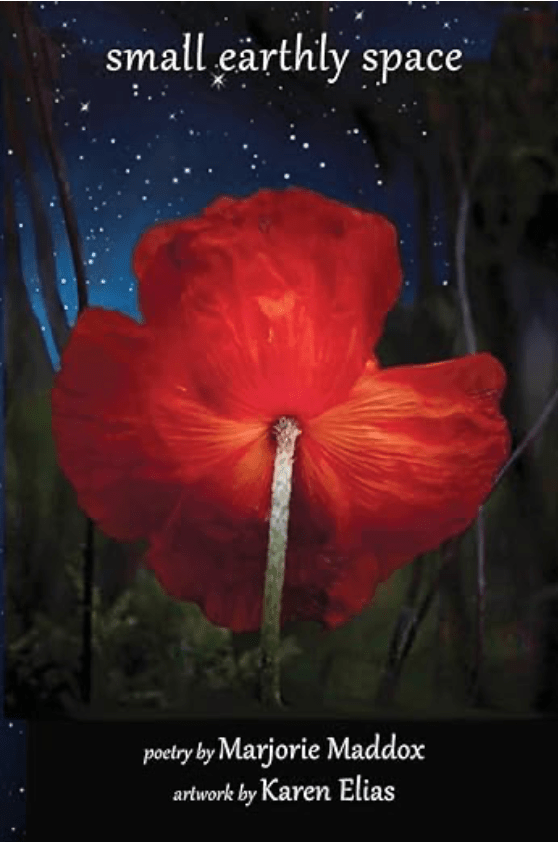

Small Earthly Space

Poetry by Marjorie Maddox; Artwork by Karen Elias

Shanti Arts $28.95


Like this post? Comment below or on my FB page. And please share with your friends and social network. 

Are you a Rust Belt writer interested in seeing if your own post, or author interview, or book review might be right for Rust Belt Girl? Hit me up through this site’s contact function.

Check out my categories above for more guest posts, interviews, book reviews, literary musings, and writing advice we can all use. Never miss a post when you follow Rust Belt Girl. Thanks! ~Rebecca

Enter your email address to subscribe to this blog and receive notifications of new posts by email.

Who comforts you now?

01 - tulane
Poet Rita Dove: Photo © by Fred Viebahn. Copied, with permission, from Rita Dove’s homepage at http://www.people.virginia.edu/~rfd4b/

Who comforts you now that the wheel has broken

the bodies of its makers? Beyond the smoke and
ashes, what you hear rising is nothing but the wind.
Who comforts you? Now that the wheel has broken,

grief is the constant. Hope: the last word spoken.

Rita Dove (from Testimony: 1968)

It’s been a minute. Or, many minutes over several days, minutes made long and weighty—even by coronavirus standards—by the turmoil raging across the U.S., in cities as close as Washington, D.C., and as close to my heart as Richmond, Virginia, and Cleveland. Racial turmoil that’s been roiling since, well, always in America, has erupted in protests.

And so the world grieves, again, more. But then, for many Black Americans grieving over human and civil rights injustices and violence is a constant. We writers like to tout our empathy, but while I’ve known grief, I’ve never known a grief that never subsides. So, what do I know?

As a reader and writer my instinct is to do just that: read and write. I read to know what I don’t know. I write to figure out what I do know and to raise new questions. And repeat. But between the reading and writing, we’re engaging—not just with text in an academic lit-crit way, but with the human being behind the words.

To engage with the community of readers and writers in the American Rust Belt and beyond is why I started this blog more than four years ago. I hope to keep this up, because I love connecting readers with the writers behind some of the literature I love most—poets (like Akron, Ohio, native Rita Dove, above), novelists, essayists, and memoirists—from a place I left behind but am still drawn to.

This blog is not a big platform, and my voice is small, but we bloggers do have the power to amplify the voices of Black writers and poets. There are many ways to do this. First, read Black authors. Thank you to novelist Courtney Maum for making me aware of a couple helpful hashtags to hone in on books for all ages by Black authors: #BlackBookReleases and #ReadingBlack.

If you’re looking to make taller your TBR, here’s a list of highly-anticipated 2020 releases by Black authors. If you’re a regular follower of this blog, you might expect that the 2020 release I’m most excited about this year is Ross Gay’s Be Holding: A Poem. Put a new book on your TBR today. Buy books, and buy them from Black-owned bookstores, if you can. Review these books. Share the work of Black authors whose work you love. I’ve been doing that over at my FB page. Maybe join me there?

Most of the poets and writers I’ve interviewed for Rust Belt Girl I met at literary festivals and readings, oftentimes fairly homogeneous events, if I’m honest. For my part, I aim to seek out more Black voices from my native Rust Belt to feature here. If you consider yourself among this group, I hope you’ll reach out when you can.

Keep safe and sane, everybody, and keep the stories coming.

With hope,

Rebecca

Of Fathers, Sons, and Seasons: Reading Marilynne Robinson’s GILEAD

The first good snow of the season on our Crepe Myrtle

I was weeping before 8:30 am. Not because of the cold and old pipes and our living room soaked, stripped, and drying now–like a child pulled from a furtive dip in the lake. No, I was weeping over a book about fathers and sons and the seasons of life–and wouldn’t you think my avid reader-cynicism could have borne me up better than that? Nope, there I was weeping, listening to the end of the story, as I trained my eyes on the winding roads that take me from my sons’ school to home and back, again and again.

Not a chance I could have held it together in the face of Marilynne Robinson’s Pulitzer Prize-winning novel Gilead, narrated by Tim Jerome of Broadway fame. From the cursory Goodreads summary: Gilead presents an “intimate tale of three generations from the Civil War to the twentieth century: a story about fathers and sons and the spiritual battles that still rage at America’s heart.”

I will admit right here that it took me this long to read anything by the matriarch of the Midwestern religious novel, and I’ll tell you why. I thought it would be not just “churchy”–an attribute Robinson has said did not define her background–but preachy. After reading (and weeping), I’d define the novel as “teachy” maybe, but only in the best way–as the narrative is presented as a sort of last will and testament from an elderly father, the Reverend John Ames, to the seven-year-old son he won’t get to see grow up. In short, it’s a quiet wonder of a book.

Read more

“Where are we sending them? Where are they going?” A photo re-blog from A Prayer Like Gravity

dsc9886-nicholas2_edit
Image from A Prayer Like Gravity

These photos from A Prayer Like Gravity stirred me nearly to tears:

Where are we sending them? Where are they going?

I suppose there’s always been a certain amount of fear around kids at school. There’s the letting go, the separation from family and home. For me, this means a willful disentanglement of my heart from my kids’, as I drop them off at school every day. There’s no drama, no tears–it’s a wonderful school–but I do have to tamp down my mother love, or else I’d never let them go.

Author Elizabeth Stone said:

Making the decision to have a child…is to decide forever to have your heart go walking outside your body.

She was right. So my little hearts leave my sight to beat and grow, and I have to remind myself it’s been eight years since we were skin to skin in the hospital at their birth. They are in their own skins now; they don’t need my mother heat like that.

They are strong. I tell myself this when they come home telling me–so nonchalantly–about lock down drills.

I don’t remember lock down drills in elementary school. I remember tornado drills, my knees pressed against the painted cement block walls of the hallway outside our classroom, my body curled like a potato bug, one in a long line of kids, our hands over the napes of our necks. I remember the Space Shuttle Challenger Disaster in fifth grade; when I returned home from school my mom was crying while folding laundry in the basement.

I wonder if my kids will associate school with fear or if, instead, they’ll think of my hand taking theirs and squeezing it before they tumble out of the car each morning, looking like mini sherpas with their packs and bags. I hope that’s all the burden they’ll ever have to carry.

Thanks to A Prayer Like Gravity for these photos:

via Where are we sending them? Where are they going?