
Author Valerie Nieman grew up in the Rust Belt of western New York State, lived and worked for many years in the northern coalfields of West Virginia, and now lives in a North Carolina town that’s still recovering from loss of the Lucky Strike plant. In short, Valerie explains, she’s “seen a lot of industrial wastelands.”
How do these evocative locations inform her prose and poetry? In the following author interview, I asked Valerie about this, about her latest, award-winning novel–and much more.
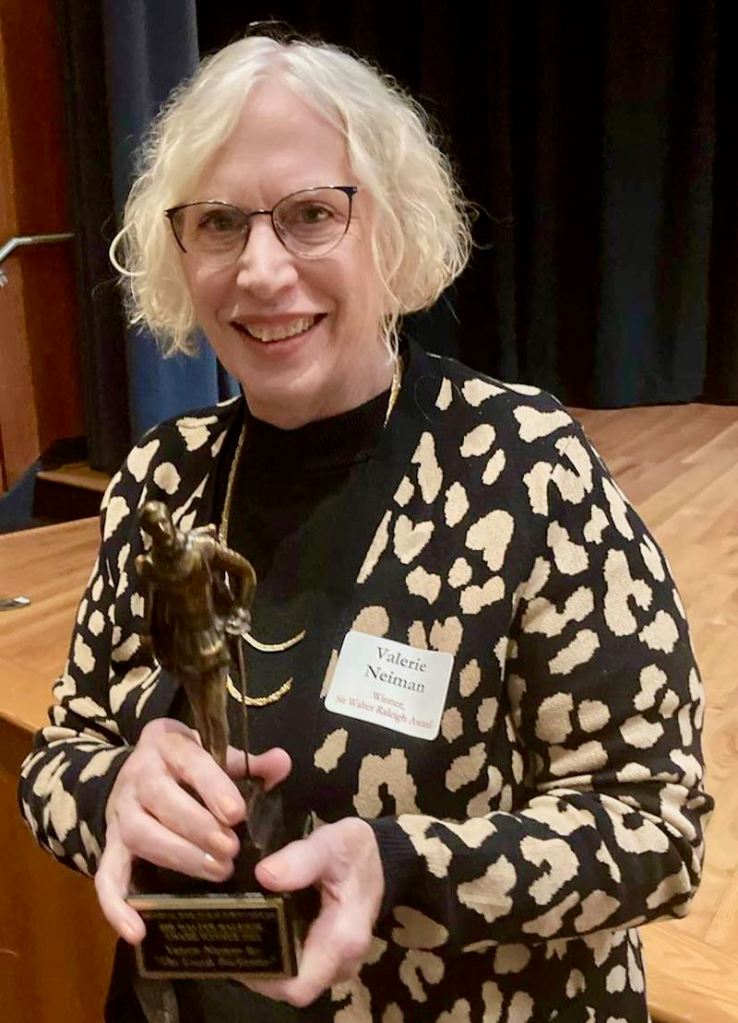
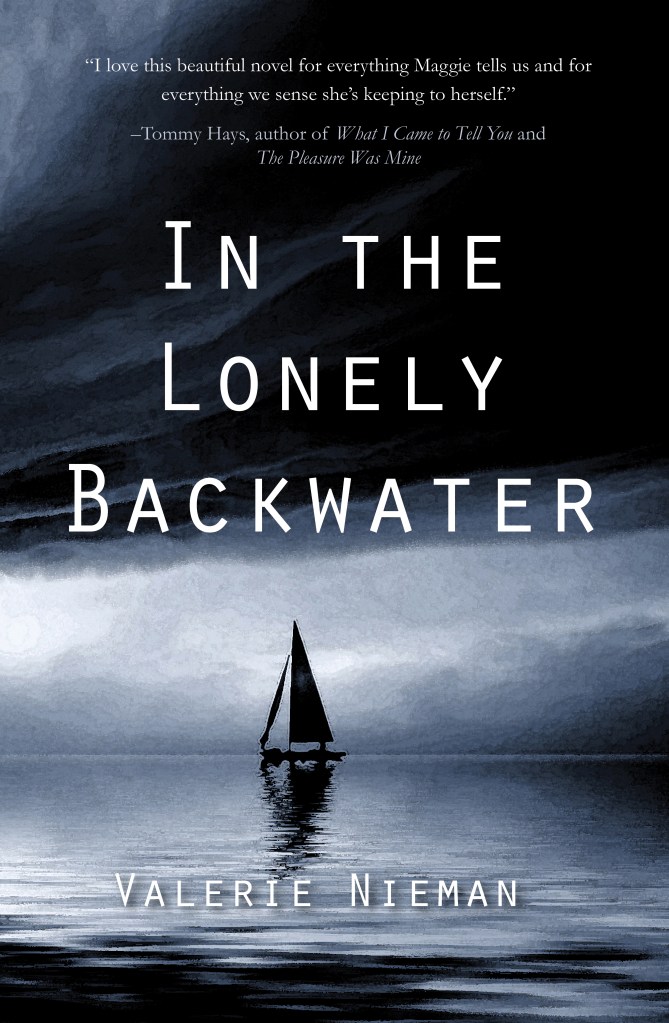
Valerie Nieman’s latest, In the Lonely Backwater, a mystery in the Southern gothic tradition, has been named the 2022 Sir Walter Raleigh Award winner for the best novel by a North Carolina writer. To the Bones, her genre-bending folk horror/thriller about coal country, was a finalist for the 2020 Manly Wade Wellman Award. She is also the author of Blood Clay (Eric Hoffer Award) and two other novels. She has published a short fiction collection and three poetry collections, most recently, Leopard Lady: A Life in Verse, which was runner-up for the Brockman-Campbell Prize. She has published widely in journals and anthologies, and appears regularly in juried reading series such as Piccolo Spoleto, Why There Are Words, and Women of Appalachia. She has held state and NEA creative writing fellowships. Nieman has degrees from West Virginia University and Queens University of Charlotte, and was a reporter and farmer in West Virginia before moving to North Carolina, where she worked as an editor and a creative writing professor at NC A&T State University.
Valerie, can you tell us about your Rust Belt upbringing and how it informs your creative work? What was it like to not only live but work in the coalfields of West Virginia? You were both a farmer and a reporter there. Can you talk about how those roles are similar/different?
I grew up the child of a factory worker who’d wanted to be a farmer. His plant in Jamestown, NY, built desks and filing systems. I remember copies of “The Machinist” in the bathroom, and the annual July shutdowns and factory picnics. Royal Metal was part of a thriving factory district that produced everything from heavy equipment to tools to furniture. Crescent Tool, Proto Tool, Blackstone, and so many others used to run three shifts. The last time I was there, I found a ghost district, post-apocalyptic. It’s been a long time and maybe things have gotten better, but this part of the Rust Belt was truly “rusty.”
My father had to leave the factory when it closed and go to one in South Bend, IN, that carried on for a few more years. When he could no longer walk concrete floors as a foreman because of worsening knee injuries from the Korean War, he and Mom followed me to West Virginia. They opened a bait and tackle shop near the Monongahela River just outside Fairmont, WV, where I worked for the newspaper.
That city had a prominent and troubled history as a coal center. Consolidation Coal was founded there, and the Watson mansion became an inspiration for the Kavanagh home in To the Bones. Marion County had two of the nation’s most deadly mine accidents, Monongah 1907 and Farmington No. 9 in 1968, both of which led to massive overhauls of mine safety regulations. The offices of UMWA District 31, headed by Richard Trumka, were next door to the church I attended.
During my time as a reporter, I covered the coal industry and the environment, along with the police beat, so I got to see everything from murder investigations to the working longwall at Martinka Mine. I later became editor and helmed major investigations, one into the county’s secretive dealings with a waste coal entrepreneur and another about acid mine drainage, both of which won state AP public service awards and other recognition.
My home was a small version of the classic Appalachian hill farm. It rested above some of the former Consol No. 9 workings and a mine crack furrowed the hayfield. My ex and I built a house and barn and were creating a partial subsistence lifestyle there, with beef cattle, organic garden and orchards, before divorce ended that part of my life.
I’ve never regretted the newspaper years, despite the low pay and often difficult working situations, because I got to see and experience so much! My novels and poems draw on those years still.
Your poem, “The size of West Virginia,” begins “Few know the Mountain State…” Here’s a taste:
“The size of West Virginia”

Few know the Mountain State but all
recognize it, easiest puzzle-piece of the states,
its awkward panhandles and pendulous gut
lolling into East Virginia.

A vast aquifer "lake" lies trapped under southeastern
Greenland, larger than the size of West Virginia.

It’s a convenient scale for journalists,
standard candle like the Cepheid Variables
or Type Ia Supernovae that allow
for dead reckoning on distant stars.

As of July 15th, fires have blackened nearly 21,000
square miles. (That's nearly the size of West Virginia.)
Can you talk about that—how being from a lesser-known (or maybe even unknowable to outsiders) kind of place informs your writing?
Appalachia remains “the other” for so many in America, a stereotype compounded of Snuffy Smith comics and Disney cartoons and Deliverance. The people are lumped together as white, poor, ignorant, violent.
This didn’t happen by accident. The dispossession of Irish and Scots crofters by “noble” landowners who considered them an impediment— “lice on the land” as one said—led to mass migrations and provided many of the region’s early immigrants. That legacy of dispossession continued with the rape of Appalachia’s land for timber and coal, at the expense of smallholders and their communities. And writers from the Northeast found a willing market for stories of the region’s exotic and dangerous folk.
The region was and is diverse, from the many Native American tribes that lived, traded, farmed, and hunted there, to German, Polish, Italian, Hungarian, Spanish immigrants who came to work the mines and mills, along with Black families moving up from the Deep South, Lebanese merchants who served the coal communities, and more recently, people from Nigeria to India and the world over who come to study at West Virginia University or work in industry.
I began to notice the repeated use of West Virginia as a unit of size comparison for other places, did a search online and found many more, and that brought about this poem.
Although I’ve lived in North Carolina for many years, West Virginia was where I became a writer and the place that continues to feed my work. Along the lines of this poem, my 2018 novel To the Bones uses and subverts some of those cliches about this “unknown place” in a genre-crossing tale about the coal industry and its enormous impact on the people and place.
How did you transition from journalism to poetry and fiction? How do these disciplines influence one another?
Brevity, compression, observation are the watchwords for journalism. Equally true for poetry. And while I can wax descriptive in my prose writing, it’s always economical—no wasted words. At least I like to think so, and readers have said as much.
Your latest novel, In the Lonely Backwater, features a teen protagonist, Maggie Warshauer. What a voice! (Take note, fiction writers.) Here’s how Maggie describes a detective who’s come to her North Carolina high school to ask her and other students about a girl who’s disappeared, a girl Maggie is related to and with whom has had some “squabbles”:
I didn't expect a detective to look like my dentist. He waited, watching me like an underfed hound. If I were going to place him in the marina, I'd say he was a fishing boat. A small one, from Sears, not on a slip but parked on the monthly lot. Plain aluminum johnboat with a little outboard.
Can you tell us when and how Maggie first started speaking to you as a writer, when you knew you needed to write this story?
Maggie’s been speaking to me all my life: a version of my sarcastic inner voice that doesn’t get spoken aloud very often. She’s not me, but there’s a lot of me in her. Specifically, she began speaking with the opening line, “There wasn’t anything wrong between Charisse Swicegood and me except that she was her and I was me, and with the family history and all it was just natural.”
Her character has many roots, including my lifetime of solo wandering in the woods, an interest in biology and ecology, and a number of years sailing a “pocket cruiser” at Kerr Lake. Like Maggie, I was a girl who preferred boy things, in a time when the terms gender-fluid and nonperforming had not yet appeared.
The spark that brought together many disparate elements was the discovery of an inscription in my senior yearbook. A girl I do not remember wrote, “I hope all our misunderstandings are cleared up.” It’s signed Love. I do not remember anything about the disagreement, but I did recall the intensity of emotions in those years.
The town you live in now, in North Carolina, is still recovering from the loss of the Lucky Strike plant. Coal and tobacco both had their boom and bust. I’m reminded of Emma Riva’s review here at Rust Belt Girl of Tess Gunty’s novel, The Rabbit Hutch, set in a fictionalized Indiana town decimated by the loss of an auto plant. What makes these “wastelands” fertile settings for your creative work, for suspense, and even horror?
I think such hollowed-out industrial centers have much in common with haunted houses, and with the beloved ruins of the Romantic poets and artists, in the evocation of what once was and is now gone. I’m drawn to them, as I am to songs by Bruce Springsteen that depict these same broken places and the people who despair, maybe leave, or maybe find the grit to keep going and rise up again. I most like cities that have a past, Pittsburgh, Glasgow, Greensboro, but have reinvented themselves without losing that slight acrid tang of their former smokes, their former selves.
I remember when retraining programs were offered for West Virginia miners losing their jobs in the transition from conventional mining to long wall. They were offered welding or computer coding, both honorable careers, but pretty specific. It’s good to see current efforts to train miners and legacy factory workers for careers in new industries that may better fit or expand their existing skill sets, such as wind turbine maintenance, electric motor building, ecological remediation, and solar installation.
Where I now live, in Reidsville, NC, the landscape is marked by the former tobacco warehouses, the mill houses and owner’s mansions, old curing sheds, and over all, the smokestack of the former Lucky Strike plant emblazoned with that logo. It’s been purchased and is being repurposed as an e-commerce hub. I hope they keep that emblematic stack standing as a symbol of this community.
Please check back for Part II of my interview with Valerie Nieman–for more of her poetry, for what she loved to teach her students, and for what she’s writing and reading, right now. For more about her latest novel, follow the link below:
Like this interview? Comment below or on my FB page. And please share with your friends and social network.
Are you a Rust Belt writer interested in seeing if an author interview or book review of yours might be right for Rust Belt Girl? Pitch me through this site’s contact function.
Check out my categories above for more interviews, book reviews, literary musings, and writing advice we can all use.
In case you missed it, my review of Megan Giddings’ latest novel, The Women Could Fly, which first appeared here at Rust Belt Girl was republished at Belt Magazine last month. Check it out!
Never miss a post when you follow Rust Belt Girl. Thanks! ~Rebecca


 Rust Belt Girl