This October I attended my eighth annual Fall Literary Festival hosted by Lit Youngstown. It was the Ohio literary organization’s ninth—and final—fall lit fest (at least for now). I could just be weepy about it (I’m weepy about much these days, tbh), but I’m too grateful to stay weepy. Since it’s a weekend to do grateful, let’s get into it…
Don’t worry, Lit Youngstown itself—with all of its amazing programming–is going strong at 10 years old. But before I get into my 2025 lit fest roundup I want to take a moment to share a few highlights from lit fests gone by (forgive my literary nostalgia), in no particular order:
Novelist Rachel Swearingen telling us craft session participants to, “Write towards change.” And “Stop thinking about characters and start thinking about relationships.” (Fiction writing changemaker right there!)
Me, getting to tell my story of my mom’s protesting of a nuclear power plant near my hometown when I was a kid (I wrote about it here) and detailing how that story turned into an integral part of my eco-novel (published someday, world!)
Exploring ekphrastic writing at the Butler Institute of American Art (great museum road-trip idea for you out of towners!) and exploring Youngstown writ large (getting to stay with friends and enjoying the local cuisine (there will never be enough pickle pizza, noggin-sized meatballs, and pierogis!))
Getting to be a student of Sandra Beasley, Ross Gay, Lawrence Coates, and so many other teacher-writers and getting to tell them over charcuterie and a glass of wine: “you wrote my favorite poem, essay, novella, thank you…”
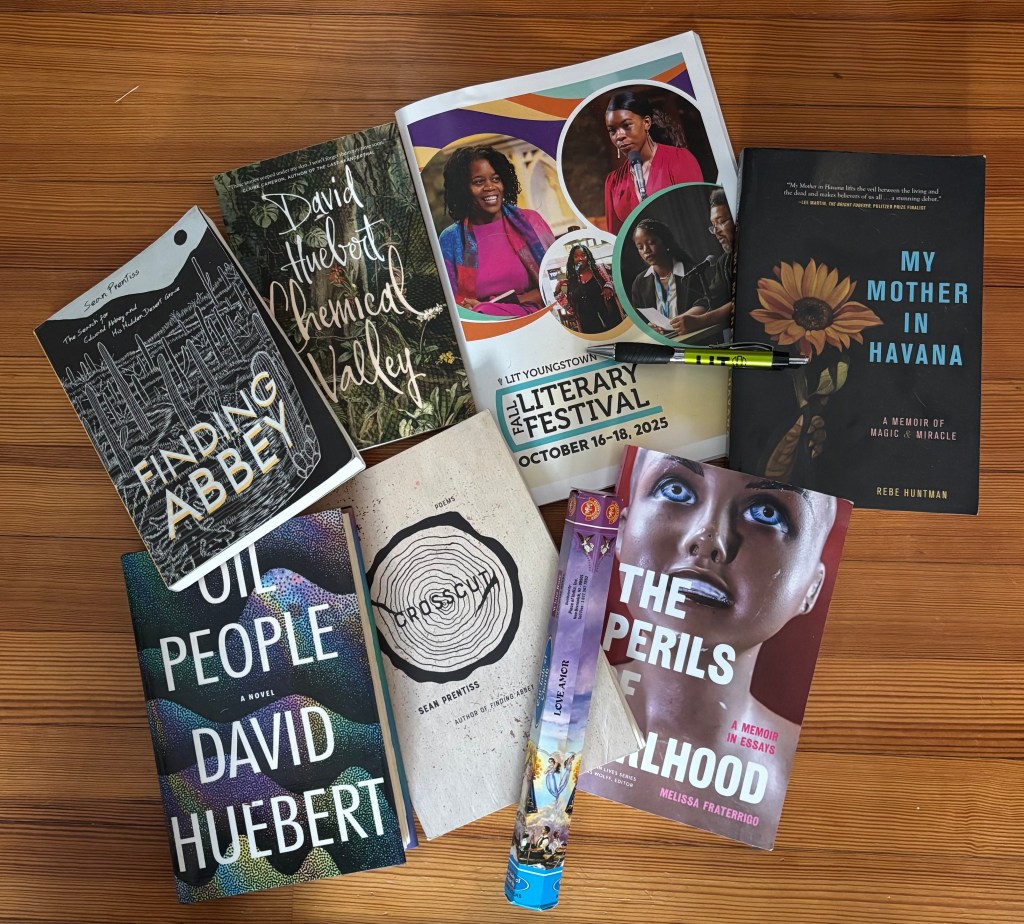
Meeting writer friends (like the talented Melissa Fraterrigo) in person after years of reading her work (her novel Glory Days inspired a lot of what I’ve been trying to highlight at this blog these last nine years or so—stay tuned for a review of her memoir in essays, pictured). And meeting other friends year after year and weaving our stories—and lives—together.
The highest highlight? You. Becoming a member of the Lit Youngstown community through the fall lit fest has been incredibly rewarding for my literary life—and my life-life. Thank you, friends.
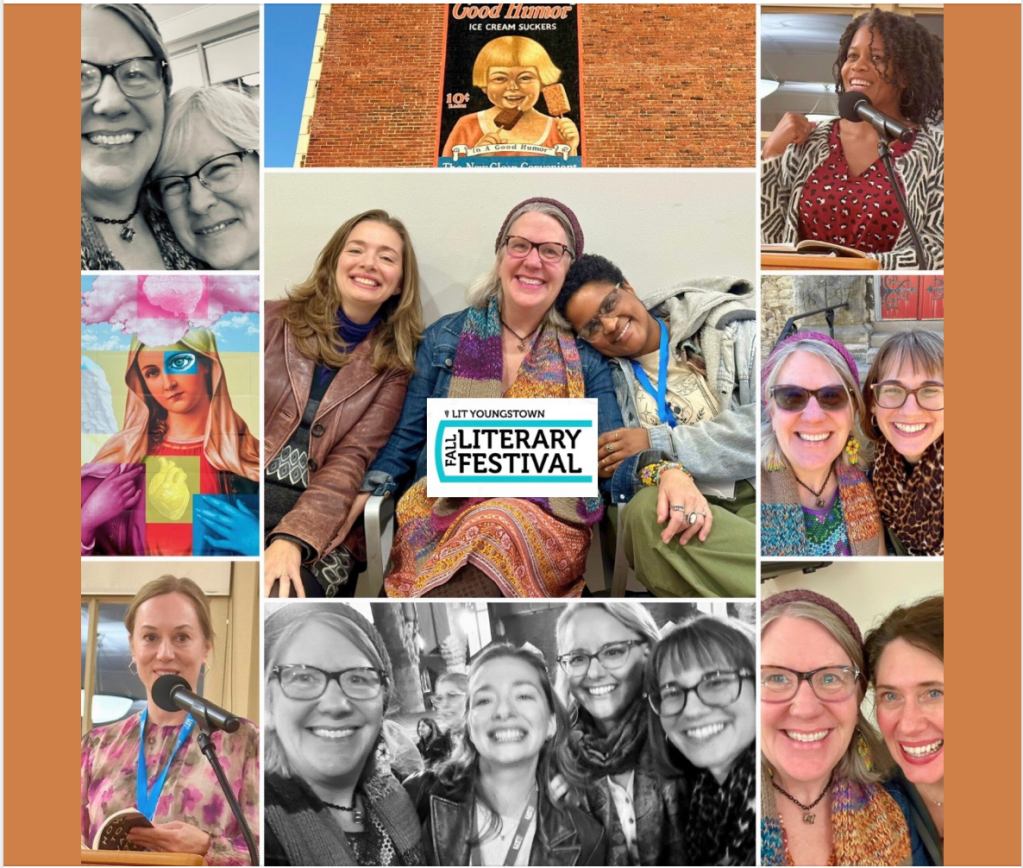
Now, 2025’s list fest was one for the books. (Peruse a few pics above and below.) And if you thought the environmental theme was going to mean a slew of nature poems…well, yes, and… Yes, and fascinating eco-fiction and challenging environmental memoir and poetry about nature redefined—from a place that was once an indigo plantation to the night sky over the Grand Canyon to trails cut by troubled teens into the Pacific Northwest woods—and so much more that “shapes our experience and identity, and represents our rootedness in earth.” Whew! I encourage you to read the impressive bios of the five 2025 featured presenters.
My preparation for this lit fest happily began months in advance of the event. (Once a student, always a student.) For my conversation with fiction writer David Huebert and memoirist and poet Sean Prentiss I read several of their books—she gestures to collage artfully displayed on her office floor—representing an array of what we lump under the term “environmental writing.” Look for a follow-up post with a good chunk of our discussion—fascinating and fun!
Other personal highlights from this year’s lit fest. (Know that this is just a fraction of the offerings and I, once again, wished I could have cloned myself, so I could make every single session.):
Day 1:
Narrative Medicine [definition: healthcare practiced with narrative competence]: A Generative Workshop, facilitated by family nurse practitioner and poet Dana Reeher. Imagine me taking furious notes for the anthology project I’m co-editing: Body of Work, essays at the intersection of dance and health. For a little workshop exercise, Dana asked us participants to respond to a writing prompt, “an expansive invitation to open the mind,” so I thought I’d write a very short piece about my own dancing and its impact on my physical and mental health outlook:
Maybe the mistake was I listened too well, that I pointed my feet too hard, that I really could feel that string coming out of the top of my head lifting me up to the studio ceiling. Maybe I postured too much, wanted too much. Maybe I turned out until I was turned in. Maybe all that looking in the mirror made me someone else. I can still spot a dancer, or an anorexic, from fifty paces.
My dancer friends here will likely recognize a lot of this, but especially the posture-reminder telling baby ballet dancers to imagine there’s a string coming out of the top of your head… After sharing my short piece of writing, a couple of the other workshop participants said the string image reminded them of a marionette. I’d never thought of that before, and I’ll tell you that image is still working on me!
The Pamela Papers: A Mostly E-pistolary Story of Academic Pandemic Pandemonium: The Musical. Based on the award-winning novel by Nancy McCabe, published by Outpost 19 in 2024, the presentation included a dramatic reading (with singing—who was expecting a musical at the lit fest? Not I. And it was such fun!).
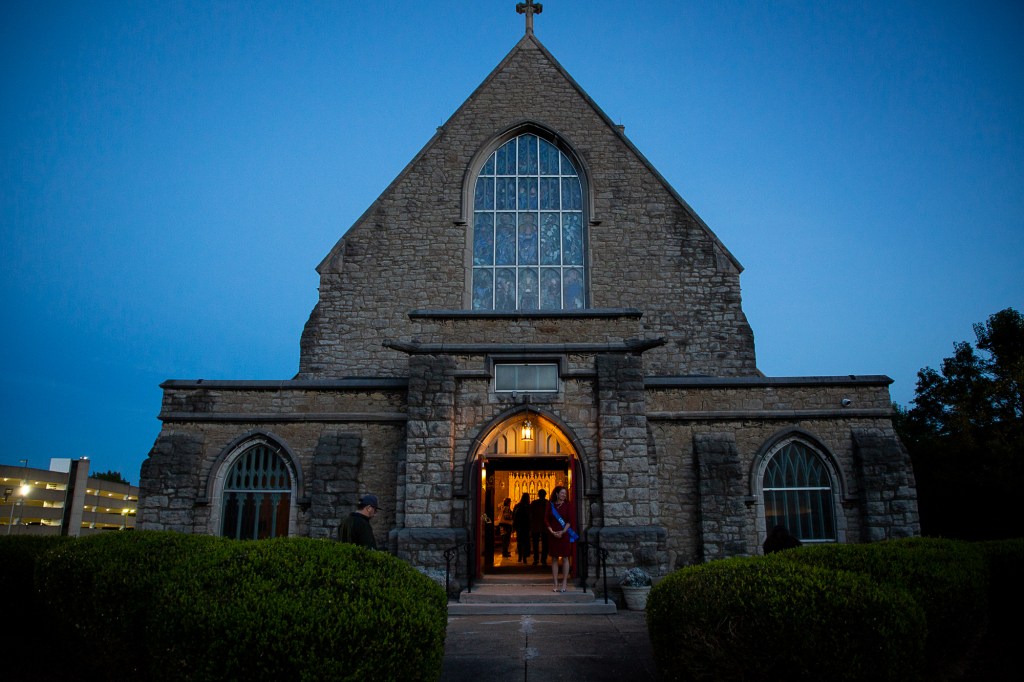
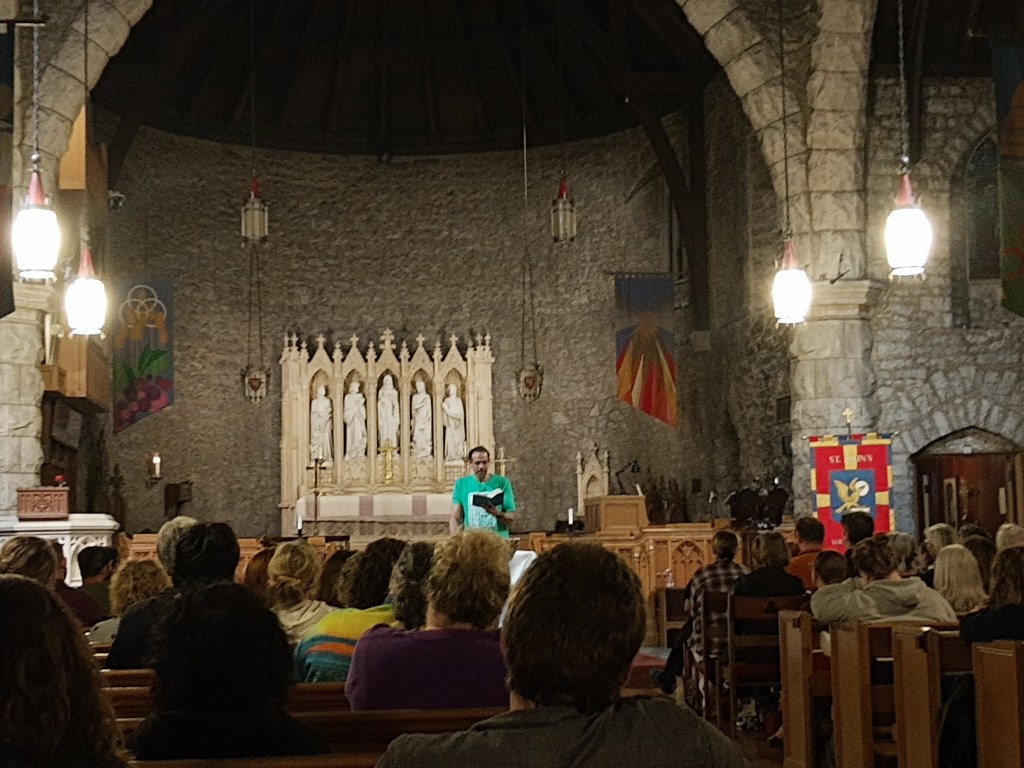
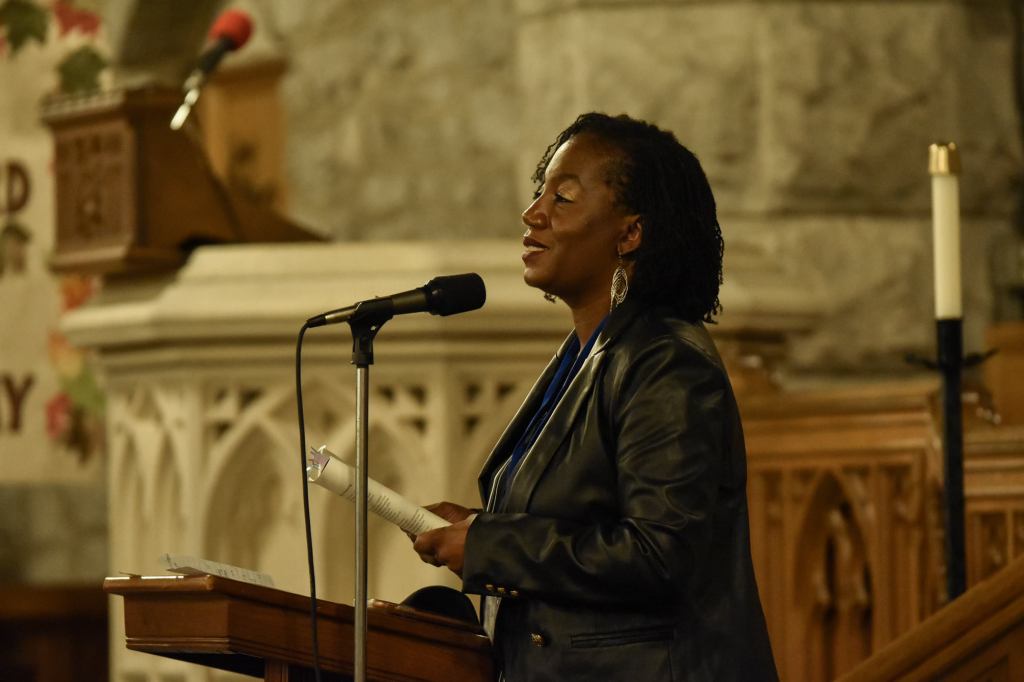
Readings by David Huebert and Sean Prentiss in St. John’s (gorgeous limestone and stained glass) Episcopal Church sanctuary. Your girl provided introductions to both writers—thanks for putting up with my unorthodox investigative process to make sure they were exciting, guys!
Day 2:
Bengal Tiger Moments: Time Perception in Creative Writing, facilitated by Sean Prentiss. In this fascinating session, we talked about speed on the page, presented in five categories from fastest to slowest: Gaps, Summary, Scene, Dilation, and Pause. Sean presented examples of these techniques from creative nonfiction and explained the brain science behind our understanding of the movement of time—irl and on the page.
Rooting the Self: Writing as an Act of Person, Political & Environmental Transformation & Transcendence, a multi-genre workshop with (beautiful and talented) Rebe Huntman, author of My Mother in Havana: A Memoir of Magic & Miracle: Rebe took us through various stages/ways of honoring our voice and our writing by making space for it and celebrating it, including meditation, morning pages, repetitive activity (including list-making), “the writing cave,” and writing constraints and freewrites. My favorite prompt, a list-making exercise we did in this session, produced these lists, below. (From there I spun out a short prose piece, “Reasons to Revere Your Vagus Nerve” (we’ll see where that weirdness goes!):
5 Things I Consider a Miracle
High arches
Warm pie
The vagus nerve
Sweating carafes of water
Tanned leather
5 Recurring Obsessions
Ballet hands
Song
Accents, dialects, and regionalisms
Mom, mom, mom
Delight
Readings by poets Lauren Camp, Todd Davis & Kourtney Morrow: poems of cityscape to countryside to the night sky over the Grand Canyon left us audience members awed.
Days After
And then, after… there’s nothing better than returning home from a literary event inspired, nurtured, and with a few new ideas for writing already on the page.
If you’re reading this on Small Business Saturday, might I suggest you also read small and lit small by supporting your local indie bookstores and your favorite literary organizations today?!
Did you attend Lit Youngstown’s Fall Literary Festival last month? Another lit fest? What was your favorite part? Have an inspiration gleaned or a piece of writing captured you’d like to share? Feel free to jot it in the comments.
Like this post? Comment below or on my FB page. And please share with your friends and social network.
Are you a Rust Belt writer interested in seeing if your own post, or author interview, or book review might be right for Rust Belt Girl? Hit me up through this site’s contact function.
Check out my categories above for more guest posts, interviews, book reviews, literary musings, and writing advice we can all use. Never miss a post when you follow Rust Belt Girl. Thanks! ~Rebecca
Last month, I attended Lit Youngstown‘s 8th annual Fall Literary Festival. From modest beginnings, the writing conference has grown to welcome some 200 attendees each year. Proud to be among them, I served on the planning committee for a couple years, have served as a session moderator, read my own creative work, sat on an editors’ panel, and, this year, engaged a featured writer in a conversation about her writing craft, process, and life.
I’ve met most of my writer friends through this literary festival. (You’re probably nodding your head, reading this. Such joy those in-between conversations, Elise, Susan, Jeremy!) Writers come to this conference for the genuine connections, the generative craft sessions, inspiring creative readings, and Youngstown pizza (or maybe that’s just me?). I was thrilled to walk away having experienced an abundance of all of the above again this year!
Can I entice you to make the trip, next year? Let’s hope this rundown does just that. (And, bring your friends.)
Day 1
My first day of the festival began with meeting Rachel Swearingen, Chicago-based author of the award-winning story collection How to Walkon Water. After reading through her stunning book, twice, I had a feeling Rachel would have a lot to teach fiction writers, like me, about the craft of writing–and the inspiration behind it. Her morning session, “The More the Merrier: Juggling Multiple Characters in a Single Scene” tackled one of those age-old fiction-writing conundrums: how to make the dinner party (or other large group) scene sing, rather than sink.
Main takeaway: big group scenes can invite drama and suspense (think: Shirley Jackson’s “The Lottery”) but things can go awry when the writer hasn’t anchored the scene. Especially helpful to me was Rachel’s discussion of panning out and zooming in, as if we’re creating a scene on film. Featuring compelling examples from classic and contemporary stories, Rachel illustrated how great writers make scenes active to “write toward change.” For those of us (all of us?) who sometimes struggle to create a propulsive plot, these tips promised to help us give our stories the jhuzh they need!
One thing I love about literary festivals is the opportunity for literary escape. (And not just geographically.) I make it my mission to get outside my usual genres and comfort zones. I’m not joking when I say it’s only been a few years since I learned what ekphrastic writing was. So, taking part in an ekphrastic poetry workshop is far outside my usual lane. Of course, I jumped at the chance, when I learned that award-winning poet (and dancer!) Ama Codjoe was leading a workshop titled “Doorways into Ekphrasis” held at the Butler Institute of American Art, right across the street from our festival headquarters. (Confession time: I usually play hooky for one session of a festival or conference to visit a museum or gallery or other local arts hotspot; this time, I didn’t have to.)
Crowdsourcing time: help me find the name and artist of the piece I wrote about, please! Yes, I stared at a stunning piece of transparent, aqua glass sculpture–two rectangular columns, one larger and standing, one smaller, reclined–and didn’t write down the name of the piece or artist. The three minutes we took to examine the art we chose, without jotting a note–which should be 10 minutes, says Ama–honestly felt like hours. But this works, folks.
It’s fascinating now to look back at the notes I made after my examination and see how I went from describing the artwork’s material–ruined glass, panes shattered, shards–to the artwork’s position and pose–teetering, discarded, toppled–to what the pose might suggest: he has dropped his partner, who does not shatter, small glass tower sheared. Finally, I wrote a little in lines, inspired by the art:
How many the pains of art we
layer and nudge and shimmy?
How shiny this body, this instrument,
until we lay it down, sharded,
but not discarded, dust to dust,
sand to glass to sand.
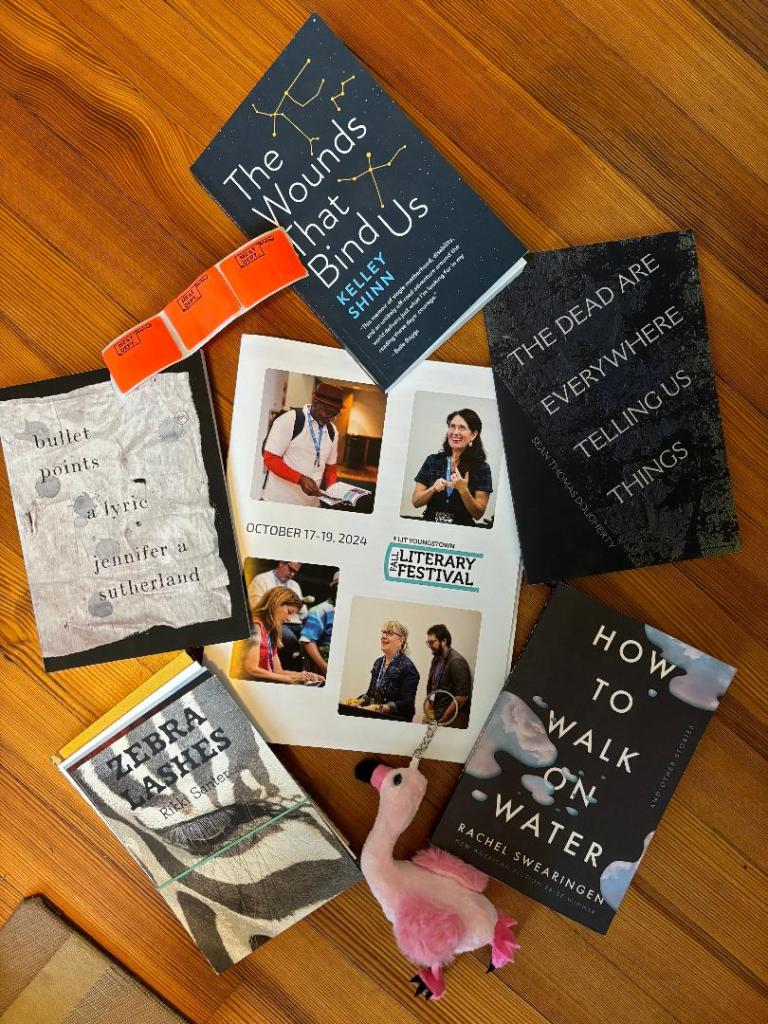
For my last session of the day, I caught up with a couple writers I follow on social media but had yet to meet in person, so I was thrilled (and got their books I brought from home signed–yes, I’m that kind of literary nerd). The prolific and super generous Sean Thomas Dougherty and Jennifer Sutherland (her debut collection is Bullet Points: A Lyric) are poets who spend some time writing in the “slipstream,” in between literary genres. They and Sarah Carson and Cynthia Maria Hoffman read from their work and talked about what writing in between genres (is it a poem, nonfiction flash, a prose poem?) means for their work and creative outlooks. I was so rapt by the writers’ creative readings that I didn’t take many notes, but I did take this gem down from Sean Thomas: “We push against genre” so forms can (paraphrasing here) dissolve and come together again to address neurodiversity, trauma, and more.
Day 2
I am often reluctant to read my creative work in public. Poetry is meant to be read aloud; not so fiction. However, I thought it might be instructive to read from a blog post I wrote here at Rust Belt Girl and then read the resulting scene that appeared in a story of mine published in Great Lakes Review last year. Like public journaling, I find blogging fertile ground for planting the seeds of story. Pro tip: keep your reading short and everyone will like it.
Thank goodness I read first, because there is no way I’d want to follow memoirist Kelley Shinn or poet Rikki Santer, whose readings were nothing short of incredible. Kelley is the author of the memoir, The Wounds That Bind Us, which I bought at the bookstore directly after her reading from it (I got the last signed copy: conference win!). Rikki read from her collection, Resurrection Letter: Leonora, her Tarot, and Me, which was inspired by the surrealist painter Leonora Carrington–fascinating stuff.
Later that day, Rachel and I joined “in conversation” in a small theater to discuss her stunning debut story collection and its influences: from contemporary art to cult film to a creepy old radio program. I wondered if she went searching for inspiration or if it found her (both). I wondered how her growing up with her family in rural Wisconsin impacted her work (a lot). I am seriously kicking myself for not recording this conversation, but also it would have been a shame to interfere with the intimacy of the conversation. Those of us who write know that it can be a sacred space, and so to share a deep conversation about the inspiration behind the writing work can also feel so meaningful–you hate to break the spell.
Craft takeaways from Rachel: her process involves repeating steps: drafting, reverse outlining, noting of turns in the narrative, noting of where things get sticky or stick out–and here, an earlier Rachel might have smoothed those over, but now she explores them–and an opening up and rooting out of those interesting sticky spots.
In chatting, Rachel and I discovered that we’re both at work on novels set in Nordic/Scandinavian places (must be a Midwest thing). We shared inspiring writers: mine, Dorthe Nors; hers, Jon Fosse.
I was also inspired by Rachel’s fierceness when it comes to trying new genres on for size–in her case, the screenplay.
And the last big takeaway from Rachel, which I jotted during our conversation and aim to never forget (ahem, there’s been a reason it’s taken me three weeks to write this rundown): “Writing is energy management.”
Oh, and there was so much more I missed–next year, I will clone myself–on editing and writing and querying and “unlocking plot.”
Thank you to Lit Youngstown director Karen Schubert and all who make it happen, year after year. And trust me, you won’t want to miss next year’s festival. Thank you also to Rebe Huntman for letting me use the beautiful photo collage she put together (now, go pre-order her gorgeous memoir).
Tell me in the comments, did you attend the festival? What was the highlight for you? What did I miss? Do you attend writing conferences in general, book fairs? What gets your creative juices flowing?
Hankering for Rust Belt author interviews, book reviews, and more? Check out my categories above. I hope you’ll follow me here, if you don’t already, so you never miss a (quite infrequent) post. Thanks! ~Rebecca
Much overdue, I’m back to recap Lit Youngstown’s 7th annual Fall Literary Festival. Who can put into words the inspiration and joy that happens when a couple hundred members of the literary community come together to create, share, and add to our towering TBRs, of course. (And did I mention nearly 50 sessions focused on various genres of writing and the writing process–how to choose, how to choose?) And, all in one fantastic Ohio city with the best Italian food around and against a backdrop of changing leaves for some extra fall magic. Well, I’ll give it a try…
Perhaps what I love most about this festival is that I can reinvent my creative self each time. I make it a habit to step outside my usual writerly lane and try something new.
Day 1
The first day of the festival I did just that. Parma, Ohio, Poet Laureate, workshopper extraordinaire, and friend Jeremy Jusek started off the day with a craft talk called “Verbal Alchemy: Visualizing Poetic Structure as a Formula.” If you couldn’t tell, Jeremy is a science guy in addition to being a poetry guy. He used chemical formulas and definitions to help “shake up” the structure of our poems. The ultimate goal: “To give structure to figurative language.” My major takeaways: the graphing of a reader’s reaction to a poem to illustrate the overcoming of a reader’s ground state to the point of truly feeling. Also, the idea of developing unit cells for a poem. (For instance a unit cell might consist of 2 similes or metaphors and one question. A poem might contain 6 of these units.)
Maybe it’s my uncertainty with writing poetry that makes me to want to learn all I can about poetic structure, but I stayed in the poetry lane that morning and attended superstar poet Sandra Beasley’s talk: “Lyric A to Z: Exploring Abecedarian Forms in Poetry and Creative Nonfiction.” If the term “Abecedarian” is new to you, you’re in good company. From Sandra’s handout: “In an ‘abecedarian,’ consecutive lines, sentences, or paragraphs lead with consecutive letters of the alphabet. Note that abecedarians can use any language system, not just American English.” (Abecedarian poetry and a Prince fan? Check out a fantastic example by poet Randall Man called, of course, “Alphabet Street.”)
Another highlight of the day was sitting in on the conversation between poet, essayist, and educator Ross Gay and poet and educator Jennifer Sperry Steinorth. Much of the discussion was pedagogy-focused. They discussed the MFA workshop, a process that has received close scrutiny in recent years. The traditional way, Ross feels isn’t “good for our soul or our work.” Instead he tries to stick close to what he notices on the page. His workshop goals are not a stellar poem or essay but are “care and imagination” in the class.
For my last session of the day, I moderated a roundtable led by author, editor and educator Meagan Lucas (whom I interviewed about her debut novel years ago for Parhelion and was excited to meet irl!). Called “I’m a Lit Mag Editor: Ask Me Anything,” the session allowed participants to get a behind-the-scenes on just what rises to the top of the “slush pile.” A couple tips I took with me: the fiction word count sweet spot for Reckon Review, where Meagan is EIC : about 3,000 words; and don’t forget the importance of a catchy title (when that’s all lit mag readers see in their queue!).
Last, if you’ve been around these blog parts for a while, you know Ross Gay’s work has inspired some of mine, including this essay. And so I was prepared to be moved by his reading at the beautiful, historic St. John’s Episcopal Church–much from his new book of essays, Inciting Joy. But reader, I wasn’t just whelmed but overwhelmed. Ross’s mission of joy has been a guiding light not just for my fledgling essays and poetry, but for a new path where my art and faith can live together. And (in 2023, as I’m sure you can imagine) that’s a lot.
With fellow VCU MFA grad, author, poet and educator John Hoppenthaler
With the fearless director of Lit Youngstown, Karen Schubert
With amazing writers and literary citizens, Jonie McIntire and R.W. Franklin
With writer, friend, and guest DJ, John Dyer
With memoirist, poet, educator and the sweetest of humans, Rebe Huntman
Ross Gay, reading at St. John’s Episcopal Church, Youngstown Ohio
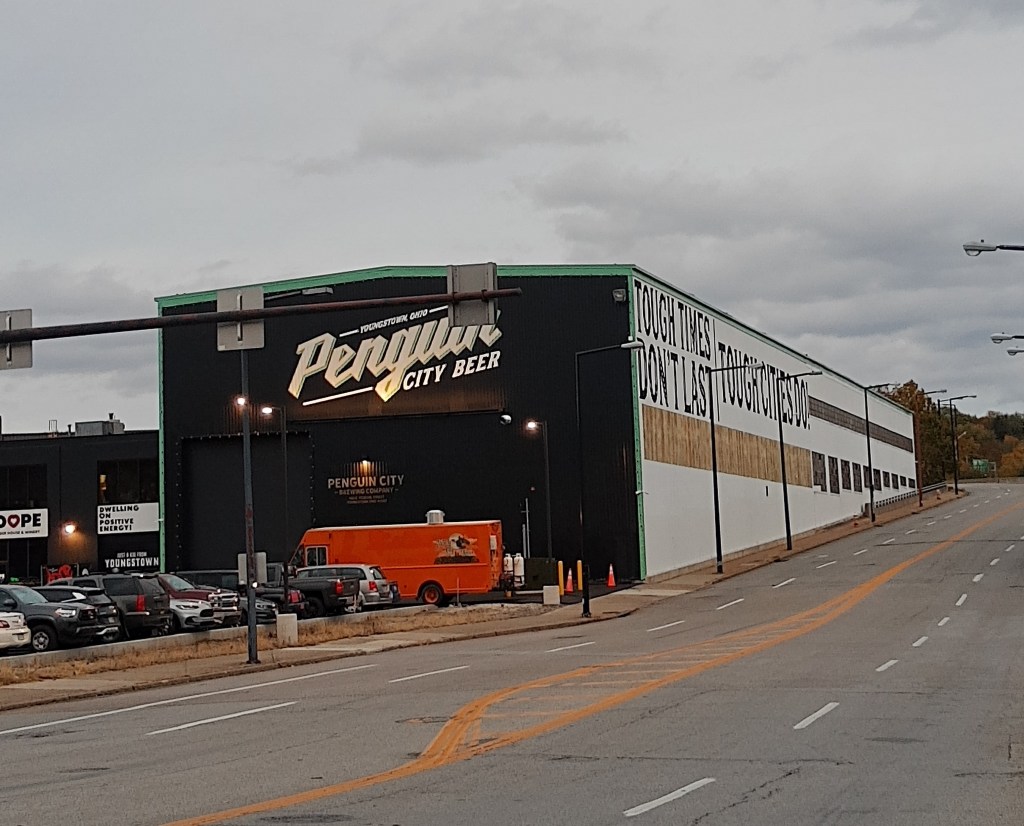
Our end-of-festival party venue, Penguin City Beer
After the festival, I soaked up the Ohio fall with a friend and her family at a pumpkin patch and apple orchard.
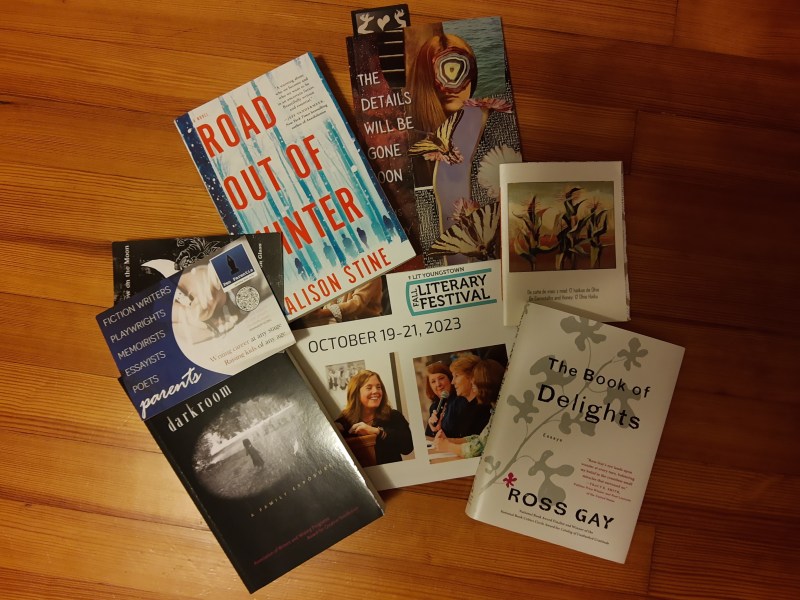
Book and swag haul
Day 2
The next day started off with a fantastic author reading. One essayist, my friend and editing co-conspirator Renée K. Nicholson; novelist Jason Kapcala, whom I interviewed here; and two poets, Amy M. Alvarez and Randi Ward read from their creative work “set in the mountains and hollers of Appalachia and the hardscrabble steel towns of the rust belt.” Themes of place and displacement ran through these works and I found myself transported–just what a creative reading should do!
The next session found me back in my fiction-writing lane. Novelist Alison Stine focused on “the urgency of cli-fi as we deal with the worsening impacts of climate change” in her craft talk called “Writing Climate Fiction as the World Burns.” Alison has a really inspiring way of talking about writing, even if she writes dystopian stories that deal with tough stuff–like the end of the environment and nature as we know it. It’s clear writing has saved Alison time and again. Writing, she said “is making people sit up straight,” and is also something that can “give us hope” and “give us a way.” And my practical takeaway from her session: wait for your characters to start acting before you start to write your ideas.
My final session of the festival found me marveling at the difference storytelling and writing can make–not just on our spirits but on our whole selves and in the ways we care for one another. Dani Naffziger led an inspiring talk called “Collaborative Writing with Adults with Disabilities,” a writing service she says “provides tangible and rewarding benefits for all involved,” highlighting stories from a population “rarely represented” and introducing “new writing processes for established and emerging writers.”
Under the umbrella of The Healing Impact of Writing, for the other part of the session West Virginia University Humanities Center director Renée K. Nicholson and physician Ryan McCarthy talked about their Healthcare is Human initiative. Through a unique partnership between WVU Medicine and the WVU Humanities Center, the initiative promotes the work of narrative medicine and health humanities. Its seeds were planted during the pandemic, when Dr. McCarthy began journaling about his own experiences and then gathering the stories of his fellow front line workers. He has said: “…projects like this, which highlight the real human stories of healthcare workers, nurture our own humanity.”
My own humanity certainly nurtured, my writing self restored, I left the festival inspired by the work of my fellow writers and by what’s to come. Thank you to Lit Youngstown director Karen Schubert and all who make it happen, year after year. And trust me, you won’t want to miss next year’s festival. Details here.
Now, tell me in the comments, did you attend the festival? What was the highlight for you? Do you attend writing conferences in general, book fairs? What gets your creative juices flowing?
Hankering for Rust Belt author interviews, book reviews, and more? Check out my categories above. I hope you’ll follow me here, if you don’t already, so you never miss a (quite infrequent) post. Thanks! ~Rebecca
I know what you’re thinking. Where are all the leaf-peeping pics? We know you drove along the PA turnpike to Ohio, climbing, winding, glimpsing down into little hamlets surrounding the sweetest, steepled white churches. All around were reds and every other burnished color. Oh, the autumn leaves!
Hold your trees for a moment, reader friends. First, a literary roundup. If you’ve never been to Lit Youngstown’s Fall Literary Festival, I’ll see you there next fall. In the meantime, here’s how I made my way through my favorite literary conference of the year (yes, even besting AWP, which I made it to in the spring).
Thursday
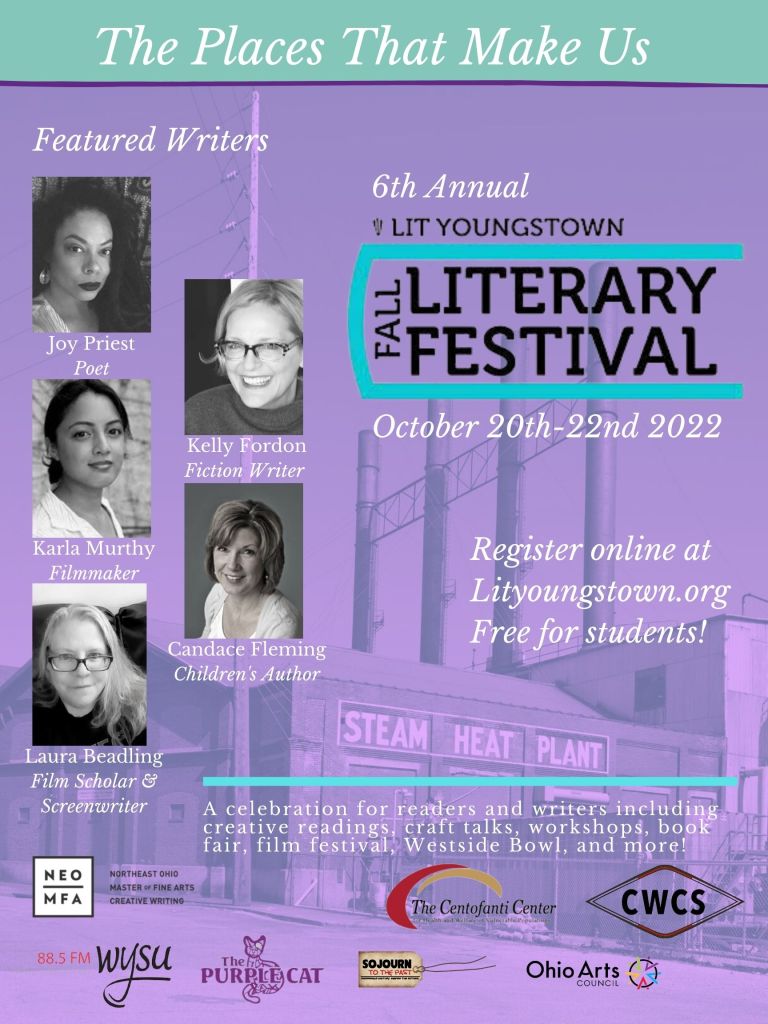
This year’s festival featured the theme, The Places that Make Us, and I was so happy to be able to return–5th year running for me–to this conference held not far from the place where I grew up in Northeast Ohio. Big shoutout to all my fellow festival planning committee members. We did it (again)!
Special in a lot of ways, besides all the usual literary goodness, this year’s festival provided attendees front-row access to three film screenings.
But really, year in and year out, this festival always impresses me. What’s so special? Lit Youngstown’s director, Karen Schubert, is a literary conference alchemist, joining poets, fiction writers, memoirists, and even filmmakers this year for just the right mix of craft talks, generative workshops, creative readings, and roundtable and panel discussions. What do you get? Literary conference gold, no exaggeration.
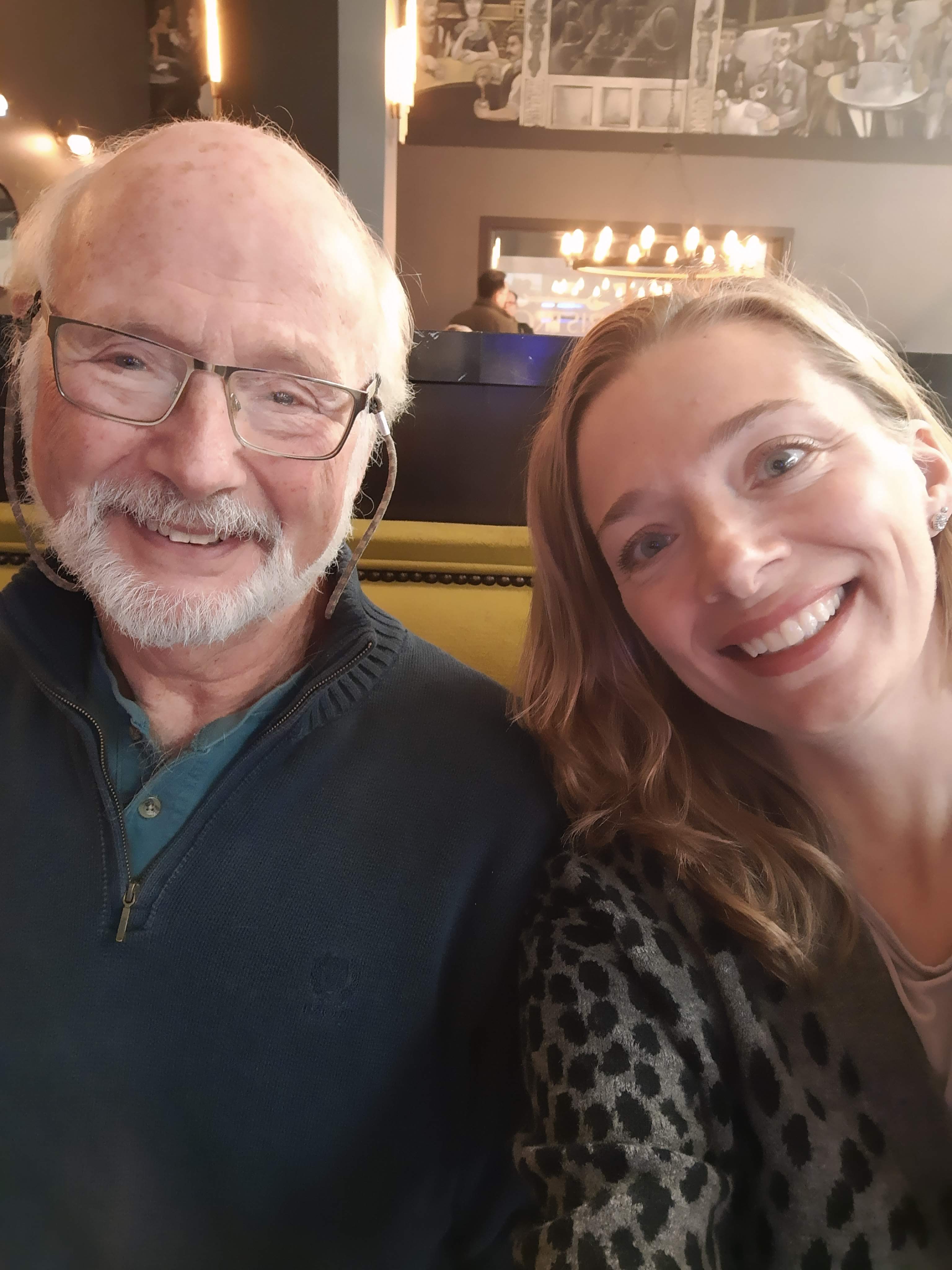
OK, onward … Thursday evening featured the Gathering In, with a reception and open-mic to begin the conference. This year, I had a special guest in tow. My dad drove in from Port Clinton; we had dinner beforehand (your meatballs are outstanding, Bistro 1907) and then headed to the Gathering In. I will tell you, my dad did not even doze at what I believe was his first-ever open mic and found it delightful. We salute you poets and writers who can whittle your words down to a few minutes of magic!
Friday
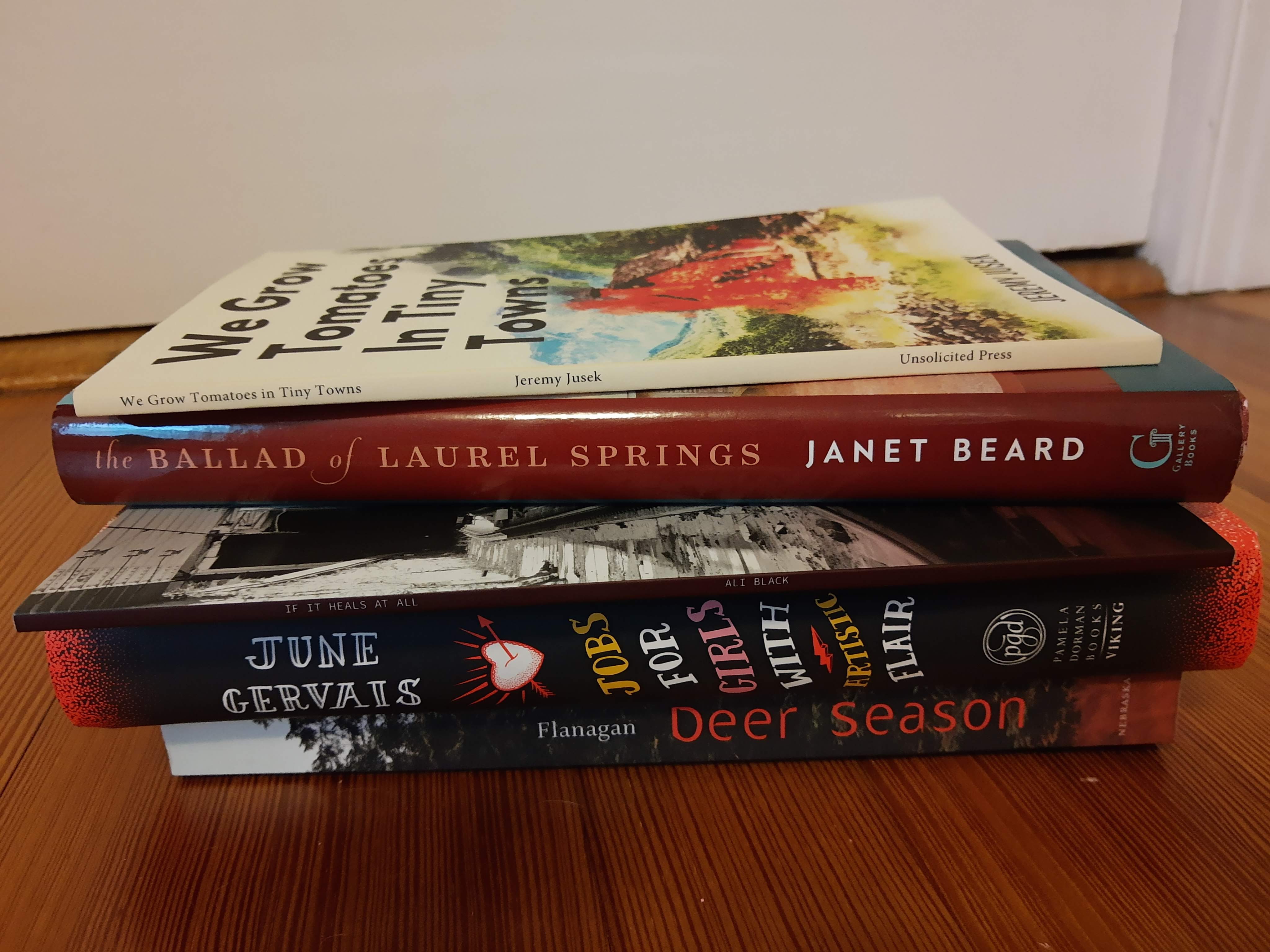
My first full day of the festival began with a craft talk by novelist June Gervais titled Honoring Others with Our Fiction Research. Intentional and inspirational are the two words that come to mind when I think about this talk. In it, June described her research process for her debut novel, Jobs for Girls with Artistic Flair. Braving the sometimes-fraught conversation around appropriation, authenticity, and sensitivity, when it comes to depicting readers from different professions or backgrounds, June exuded positivity. So, how do we honor others with our research?
First, have a goal. For June, she decided, “to make the most beautiful and honest book possible.” Second: do the research well–whether that’s in-person interviews, archival research, or hiring authenticity and sensitivity readers in later writing stages. Third (and this is June’s whole beautiful thing): show gratitude by thanking the helpers along the journey. Sometimes this means generous payment. Sometimes this means reciprocity–trading literary favors. Always this means a real thank-you in the mail and on social media and all the shoutouts possible, including on the old Acknowledgements page. “I try to be a living acknowledgement,” she said.
This year, I was intentional about attending the sessions (there are so many, I wish I could attend them all!) in my writerly “lane.” But I don’t seem to be able to resist the poets. In a roundtable discussion called “Moving Past Influence,” poets Mary Biddinger, Ali Black, and Dylan Morris talked about influences in creative writing–model writers and how they influence a poet’s style, and moving past influences as we develop our craft. When asked why she writes and why poetry, Ali talked about writing as an act of remembrance for those who’ve gone before her, those she’s lost. The stories are hers to tell, and poetry her form, she said, before she delivered one of the best lines of the weekend: “Poetry is my baby, and I’m poetry’s baby.”
Marketing-me felt right at home in Gabriel Welsch‘s craft talkMarketing Your Book–Tips From a Professional Marketer and Writer. How to generate pre-orders for your book … how to get it reviewed … how to develop a (shudder at the word) platform … and, ya know, actually sell your book. These were just a few of the practical tips covered. We listeners were asked first to consider our goal. What do we want from our book: readers? high regard? money? Gabriel covered Marketing’s 4 Ps: product, price, promotion, and place. Who said it first, I can’t remember now, but he repeated this gem a few times: “All arts marketing is local.” Along those lines, he said, don’t underestimate the wideness of one’s potential audience. Think about local clubs that aren’t book clubs, local fraternal organizations, historical societies, etc., etc. And, as if he and June had shared notes beforehand, he stressed gratitude. “Don’t underestimate the power of thanking.” (Thank you, Gabriel!)
Short story writer and poet Kelly Fordon (of Let’s Deconstruct a Story podcast fame–do check it out) led a generative workshop. I caught the second of two parts: the first, a workshop to deconstruct a story to understand its parts and how they work together; the second, a chance to get some words of our own on the page. There’s something about a good writing prompt. The simpler the better seems to work for me. Kelly gave this prompt: “Start with ‘We lived then …'” I’m not always in the writerly frame of mind to churn it out on demand, but here’s what I got:
We lived then spitting distance from the train tracks, the river, and the West Virginia border--so much winding, the running tracks leading not to any home I understood. A limbo, the twins not yet in school, not babies either. How many times did we stop the car by the tracks, watch the train pull tractors east and west--Kubota, Deere. In our rental house, the boys slept on a mattress on the floor, when they slept.
One positive of the pandemic was finding a new writing group. I guess Zoom is good for some things. Among the Cleveland-area members is Jeremy Jusek, Parma, Ohio’s poet laureate, host of the Ohio Poetry Association’s podcast Poetry Spotlight (check it out), and consummate literary citizen. Jeremy’s craft talk, Strengthening Artistic Communication Through Podcasts, covered how podcasts can be used by small creative groups to humanize its members and strengthen communities. I love bookish podcasts and meeting the person behind the book. He called podcasts “the ultimate bridging medium,” and I can totally see that. He said that when he edits the podcast interviews of poets–the last one was with Hanif Abdurraqib(!)–he shoots for no more than 7 percent Jeremy, the rest the interviewee, an impressive stat I will remember when I conduct interviews.
OK, this isn’t a great pic (sorry Karla, thank you, Rebe!) of one fantastic panel discussion with the featured presenters (minus Laura Beadling). The gist: the writers Karla Murthy, Candace Fleming, Joy Priest, and Kelly Fordon weighed in on “the element of place, real and imagined, in the literary arts.” Side note: if you can catch a Joy Priest poetry reading, run don’t walk to catch it.
Now, don’t let my festival book fair’s book haul–pictured below–throw you, I guarantee there was plenty of time in the evenings for catching up with literary friends over jazz and a local craft beer (and pierogi and pickle pizza–someone saw me coming!).
Saturday
June Gervais started off the second full day of the conference tackling a subject close to my heart–and that of anyone about to dive into the query trenches. In her craft talk, Persevering to Publication: Some Practical Tips, June covered her (long) journey to the publication of her debut novel. Again, she walked the line between inspiration and practical steps to take. “Expect difficulty, but leave room for wonder,” she said. Now, could I please have a June Gervais quote-a-day calendar?
Along the practical side of things, she discussed making a practice of community while writing a novel (or anything else really). My favorite analogy she offered: think of the novel as the Thanksgiving turkey. It’s not enough. You need to support the turkey-novel with delicious sides, including the writing and publication of short pieces (short stories, essays, craft pieces, poems, etc.) Other crucial sides: an author website, a social media presence, and a literary community. (Check!)
Oh, the literary agent querying-getting-sustaining process. Should you want to endure the agent search, be prepared for it to be long and winding, June said. Most of all, enjoy life in this tough stage of the writing, find gratitude in the work and in your community, and “become a master of the polite check-in.”
I was happy to moderate two sessions during this festival. The first was a creative reading featuring poet and memoirist Jennifer Militello, whose love poems were nothing short of arresting and awe-inspiring. Youngstown native, poet Rikki Santer also read from her vast portfolio of poems, many centered on place–including some that explore the imaginary realm of place through old Twilight Zone episodes. And novelist Janet Beard read–and sang!–from her latest novel, The Ballad of Laurel Springs, which shares with readers some of the stories delivered by the old murder ballads Janet grew up hearing in her Appalachian hometown in East Tennessee.
The second session I moderated was novelist Erin Flanagan’s The Window or the Door: Transitioning from Writing Stories to Novels. (Or, The Plight of the MFA Grad–ha.) This craft talk was super instructional and featured 13 handy novel-writing tips. I’ll give you just a few and you’re going to have to hunt Erin down for the rest. #2: Start a novel-writing journal. #6: Figure out where your novel ends in time. (Also check out The Art of Time in Fiction for help with pacing.) #10: (Oh, this one is hard–but so necessary–to swallow.) Keep in mind that chapters aren’t short stories, meaning your chapter end needs to create more questions, more tension, etc., to pull the reader through.
If I have pulled you through this post this far, you have shown your readerly diligence and win a star! Or, how about a slideshow of the foliage, cliffs, boulders, and even 200-year-old petroglyphs I enjoyed with one of my oldest (she’s not old, our relationship is) and best friends and her son (who poses for pics like a Jet from West Side Story–and this is my everything now!). Please enjoy the treasures of Cuyahoga Valley National Park, where I visited on a post-conference side trip.
Have you attended this festival or another literary festival? What’s your favorite part of a writing conference? Have you been to this national park? Let’s chat in the comments.
Want more Rust Belt writing, author interviews, book reviews, guest posts, writing advice, and more? Check out the handy categories above.
Find me on FB and on IG and Twitter @MoonRuark. Find me at Goodreads and learn what novel I listened to on my way to and from the conference. Hint: I’m recommending it for fans of Tea Obrecht’s latest novel, Inland.
Also, please follow me here at Rust Belt Girl, so you never miss a (fairly infrequent) post, and feel free to share this post with the world. Want me to consider a guest post featuring you, yep, you!? Hit me up. There’s a lot of Rust Belt literary goodness to spread around.
*free header image of a fall foliage-colored door from Pexels
I take umbrage with whomever coined the phrase “lazy days of summer.” And I might demand a refund. Except, while my summer has been anything but lazy, it has been fun.
After a little hiatus I return to you loveliest of followers with Rust Belt pics and books–and news of a reading in one of my favorite port cities (and rollercoaster capital), Sandusky, Ohio.
Off to OHio
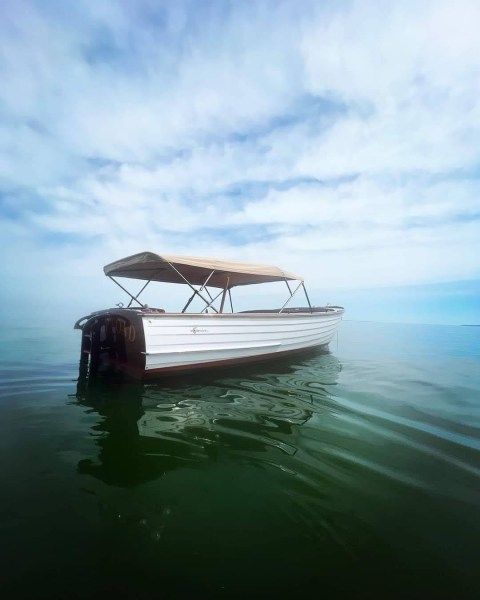
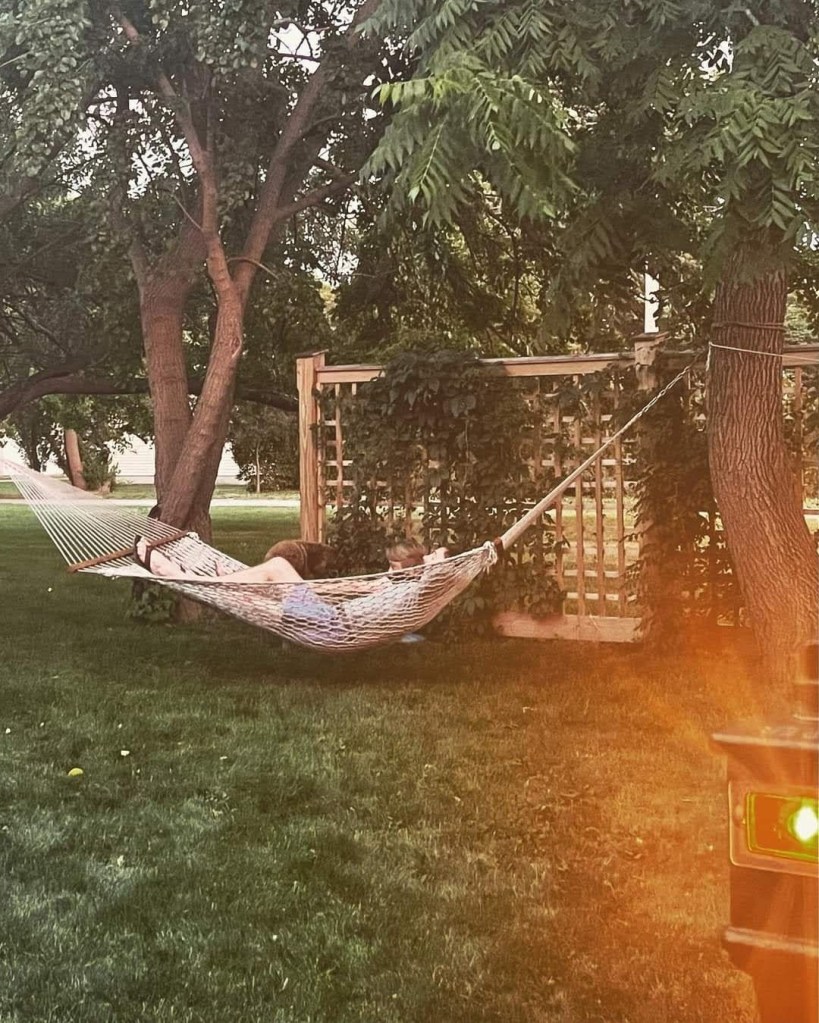
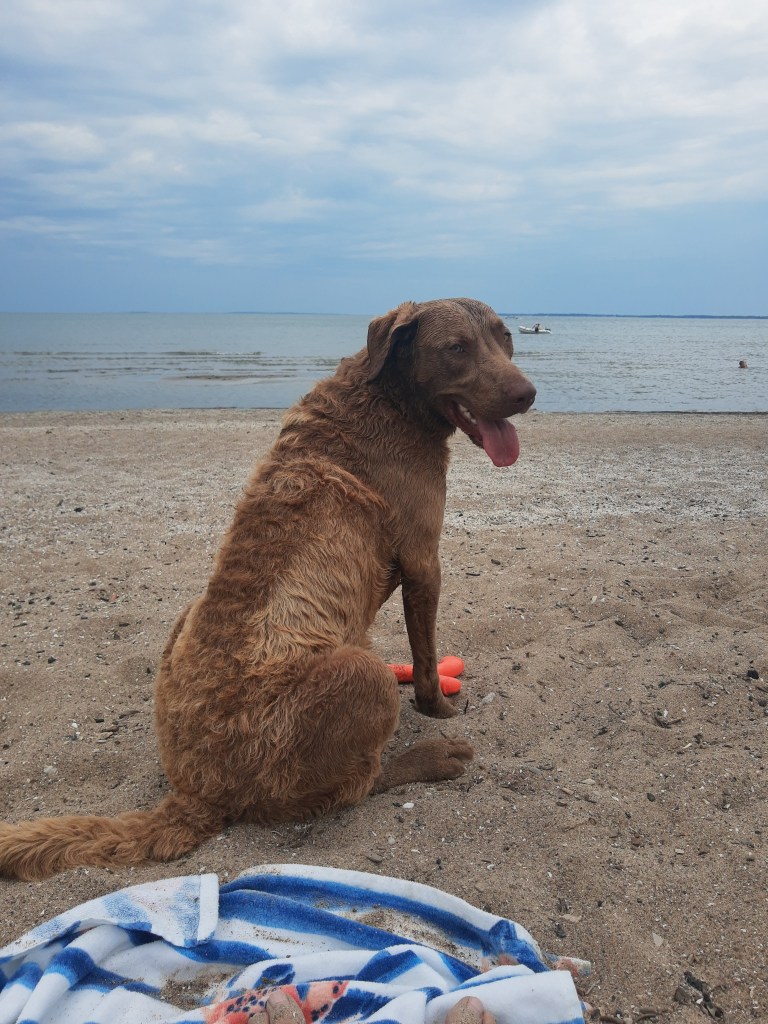
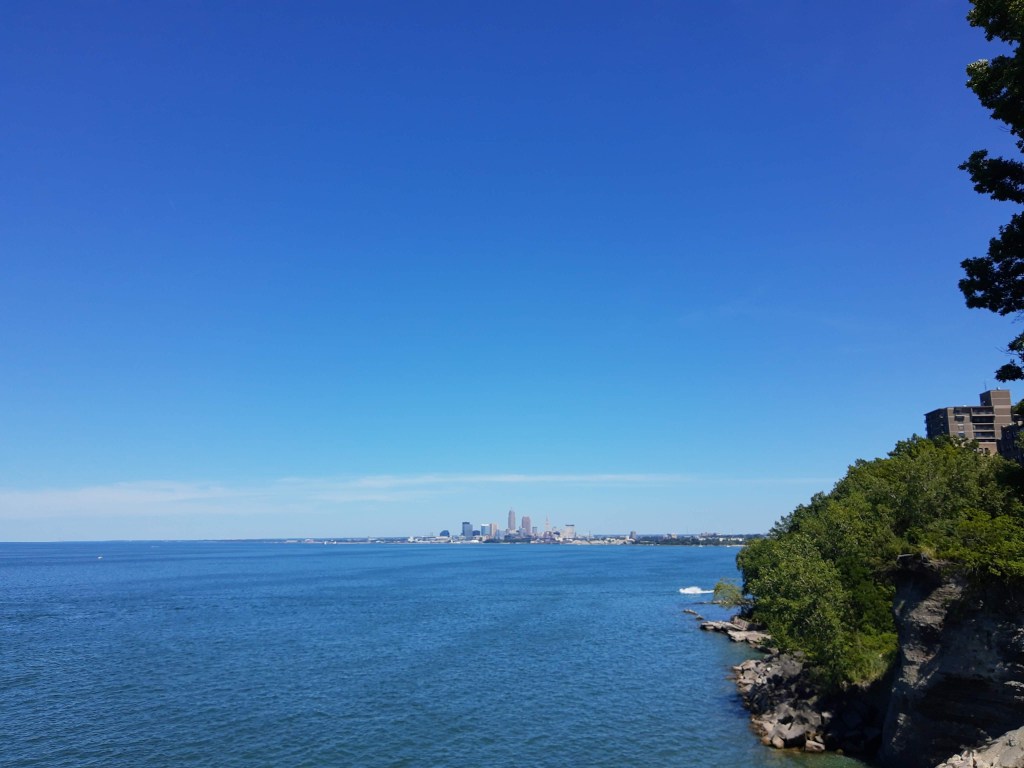
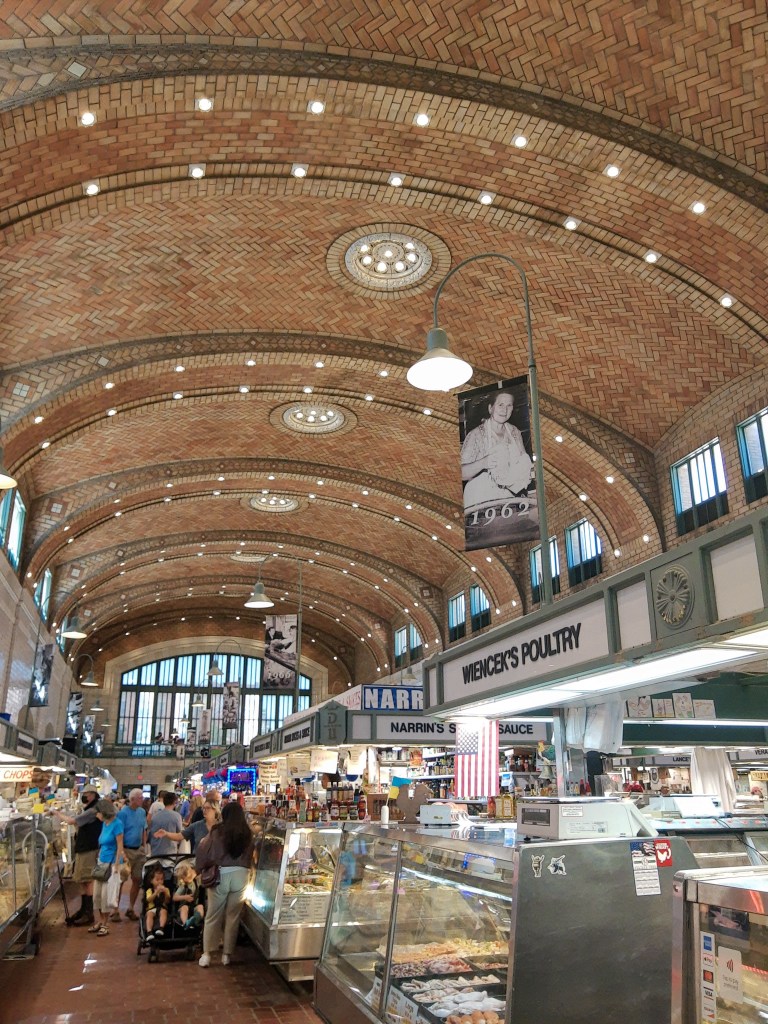
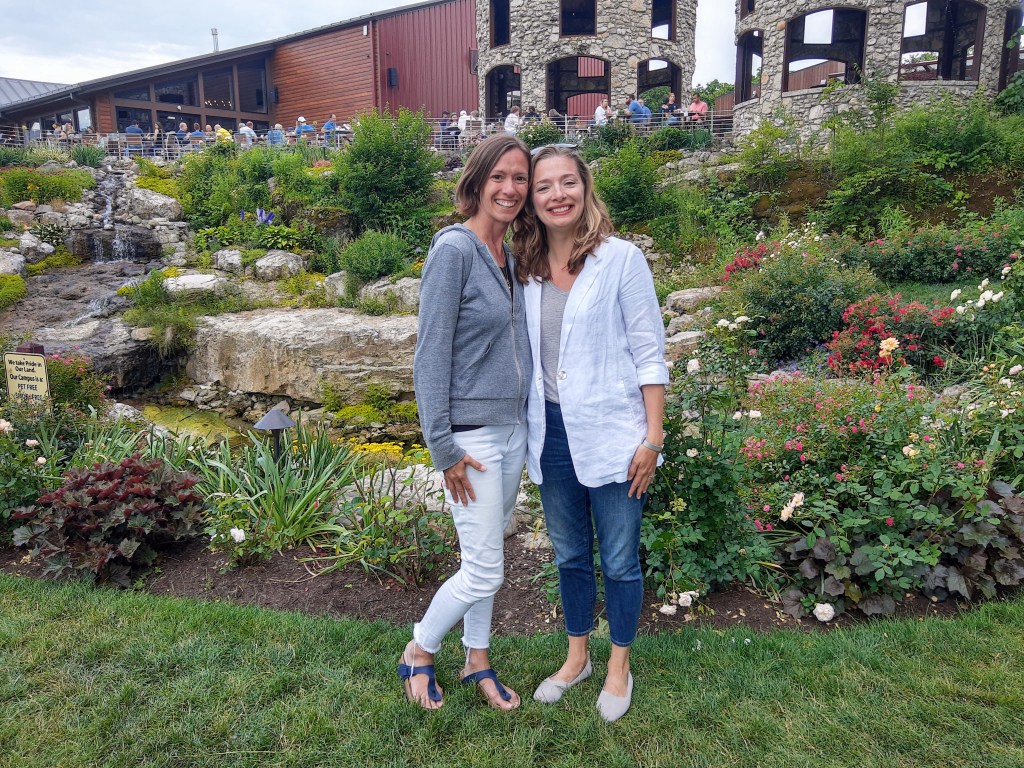
The fam and I headed to Port Clinton, Ohio, walleye capital of the world–don’t fight me on this, MN friends–in June. Sailing for my little guys, boating for the rest of us, swimming, sisters-lunching, friends reuniting, and plenty of hammock-ing and back porch-sitting were the highlights. Of course, no visit to Northern Ohio is complete without a trip to Cleveland and a visit to the West Side Market. And who could forget Rufus, who lived his best Lake Erie Shores & Islands life for a week. Boat aficionados, make sure to check out my dad’s antique Lyman boat above, his fourth child basically. Boat name? Hoptoad, named for Pippi Longstocking’s father’s ship in the favorite book series. (Who woulda thunk I’d become a writer?)
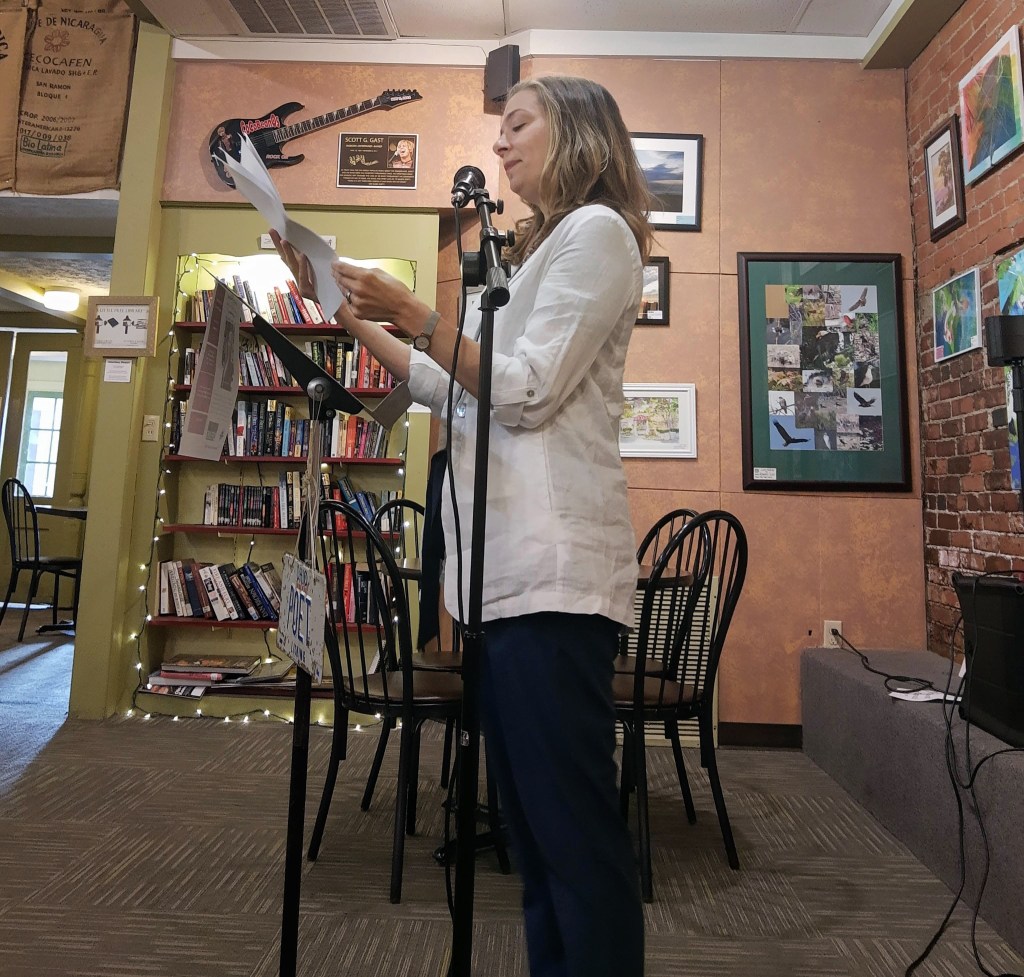
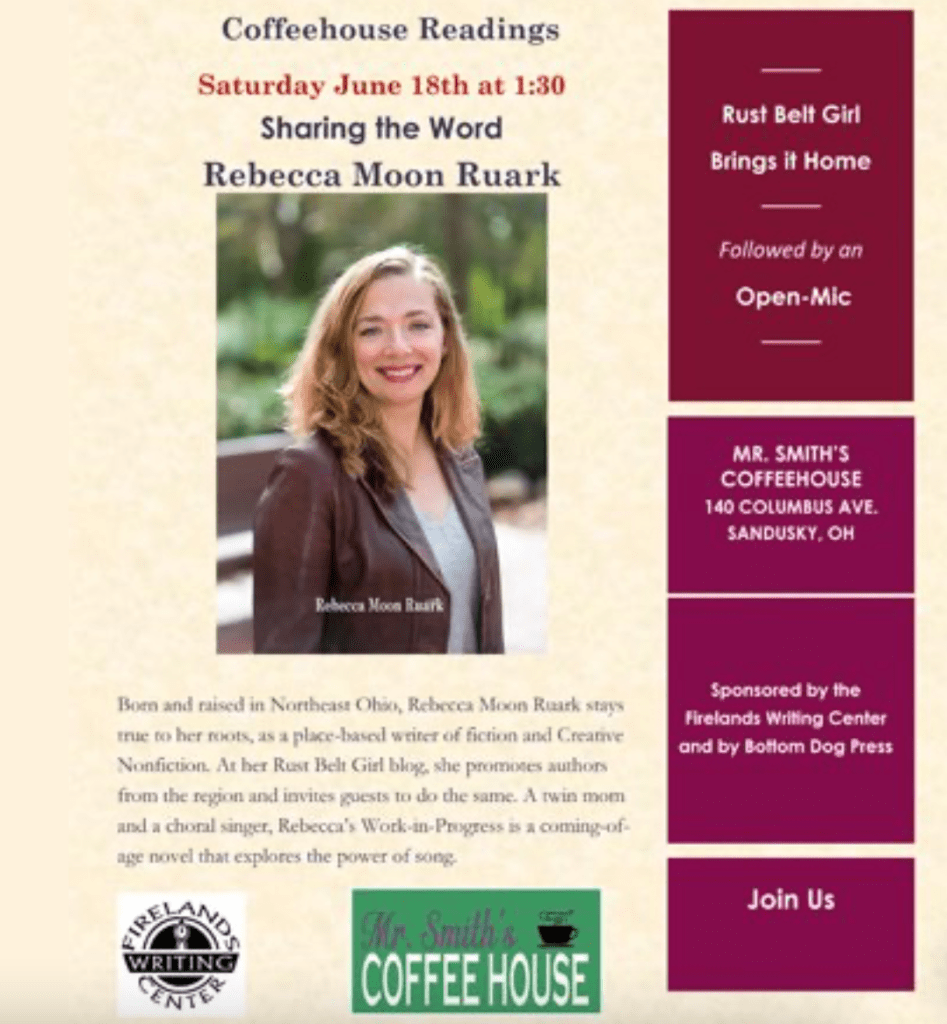
While in the area, I had the honor of serving as the featured reader for the Firelands Writing Center’s monthly reading series in Sandusky. Thank you again to fearless leader Larry Smith and his Bottom Dog Press for sponsoring the event (and putting me on a flyer–that doesn’t happen often). I read some older work and some newer pieces from my WIP, a coming of age novel partly set in Ohio that explores the power of song. And thanks to those who came out (or in) on a beautiful afternoon to share their own work with the group. It felt very much like home. (Flyer photo credit: @melanieraebuonavolonta)
Reading the Rust Belt…
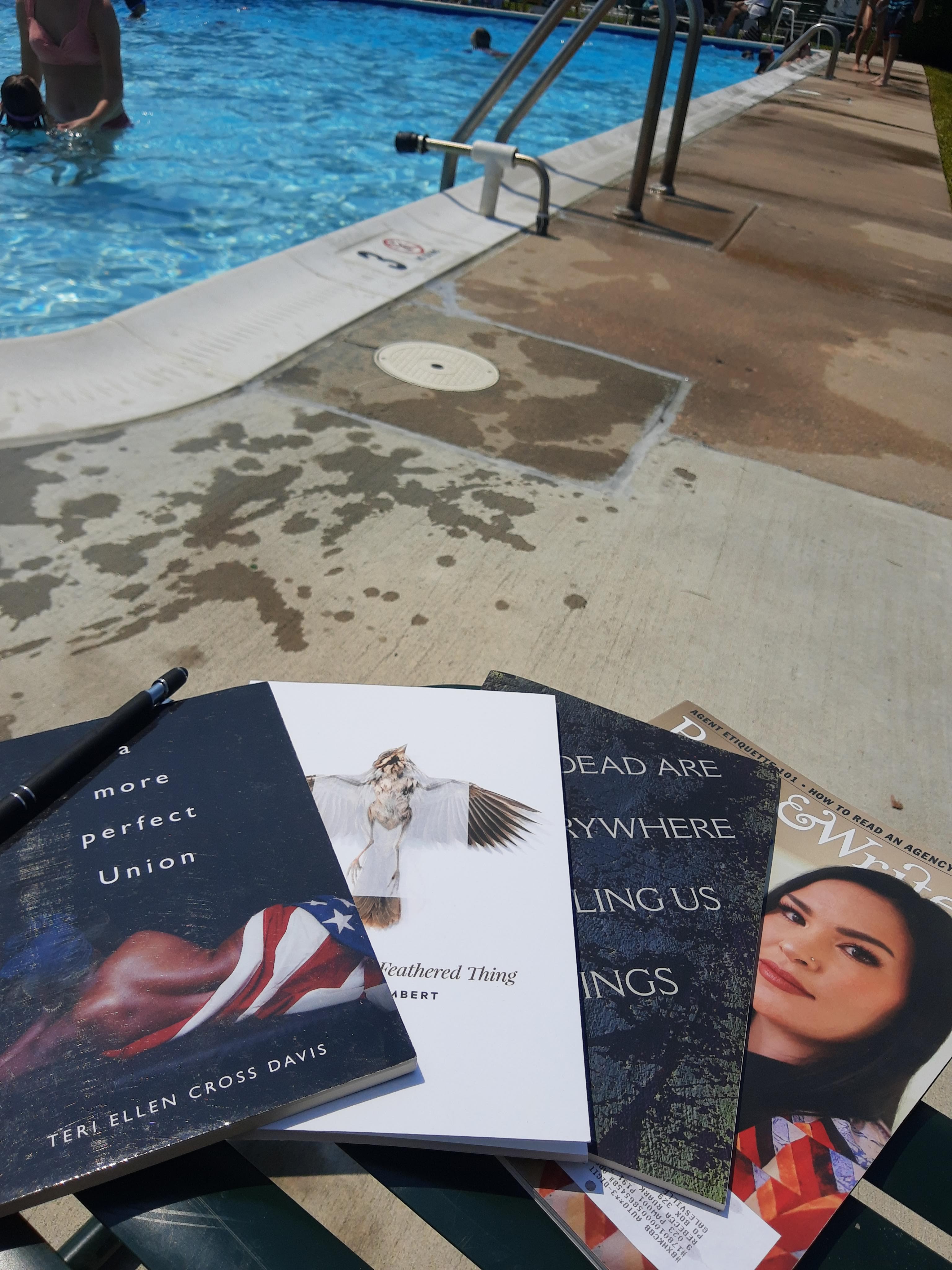
Of course, I’ve fit in some Rust Belt reading. And who said summer reads can’t be deep? Poolside poetry is just my speed, and here are a few I’ve enjoyed immensely: Cleveland native Teri Ellen Cross Davis‘ A More Perfect Union; Columbus, Ohio, poet Paula J. Lambert’s The Ghost of Every Feathered Thing, and Erie, Pennsylvania, poet Sean Thomas Dougherty’s The Dead are Everywhere Telling Us Things. Btw, if we’re not connected on Goodreads, where I recently reviewed another poetry collection, let’s do!
And Beyond
There’s an old, writerly adage that says if you’re talking about it you’re not writing it. So, let’s just keep all our fingers and toes crossed for my WIP as I begin to query literary agents for it this fall.
Unfortunately, there’s no adage I know of that says if you’re talking about your editing you’re not working on it. But what would be the fun in that? You may know I’m the associate editor of Parhelion Literary Magazine, in charge of the features department. How I love my craft essays, book reviews, and author interviews! But you might not know that I got that gig because the magazine’s editor-in-chief saw what I was doing right here on Rust Belt Girl and wanted some for her Richmond, Virginia-based online publication.
In addition to editing features for Parhelion, I’m a reader for fiction. (If you aspire to write literary fiction, creative nonfiction, or poetry, there is no better way to become better at it than to read literary journal submissions, imho.) Parhelion’s summer issue (our journal’s 14th–not too shabby) launched this week. If you like fresh and bold fiction, CNF, and poetry I hope you’ll check it out.
Must we? OK, I suppose the pool days will come to a close. My small guys (who are quickly catching up to me) will head back to school. And I will start packing for the literary highlight of the season, Lit Youngstown’s Fall Literary Festival. If by some strange occurrence you live within driving distance of the festival and I haven’t hit you up, my apologies. This is the best literary conference of the year–if you like a supportive community, generative workshops, eye-opening and ear-bending panel discussions, inspiring readings, and affordability. Oh, and this year’s book fair promises to be the best yet. Also, there will be bowling and films. So, what are you waiting for? The Rust Belt calls.
And that, most patient of readers, is what I’ve been up to. But, as blogging is a two-way street, let’s keep the convo going. What has your summer looked like–or whatever season it is where you hang your hat? Where are you visiting. What are you writing, reading, and discovering? Do tell!
Want more Rust Belt writing, author interviews, book reviews, writing advice, and more? Check out the handy categories above.
I’m thrilled to share this guest post interview with Rust Belt Girl readers. What began as a Spotlight interview–between two of my favorite authors and people–for the Association of Writers & Writing Programs (AWP) has been gifted to us here, and I’m so grateful.
We talk a lot about writing as a communal act at Rust Belt Girl and about finding that community where we belong. The first time I met Karen Schubert in person, I’d just driven five hours, home to Ohio, to attend a literary festival I’d never been to before. I knew a few names but no faces. And no one knew me, so I dutifully popped on my name tag.
Even before my nerves could kick in, here comes the director, Karen Schubert, with the most gracious greeting–as if I were the keynote or a fully-fledged author, and not an emerging writer and editor with a blog.
I belonged. Just like that. And I’ve returned to that annual literary festival every year since. Last year, I served on the planning committee to do my own small part in welcoming new faces to the community.
“How does she do it?” This is a question I often ask about Karen Schubert. In addition to being co-founding director of Lit Youngstown, a literary arts nonprofit with programs for writers, readers, and storytellers…
Lit Youngstown Co-founding Director Karen Schubert; photo credit: Melanie Rae Buonavolonta
Karen Schubert is the author of The Compost Reader (Accents Publishing), Dear Youngstown (Night Ballet Press), Black Sand Beach and Bring Down the Sky (Kattywompus Press), I Left My Wings on a Chair, a Wick Poetry Center chapbook winner (Kent State Press), and The Geography of Lost Houses (Pudding House Publications). Her poems, fiction, creative nonfiction, essays, reviews and interviews have appeared in numerous publications including National Poetry Review,Diode Poetry Journal, Water~Stone Review, AGNI Online, Aeolian Harp, Best American Poetry blog and American Literary Review. Her awards include the William Dickey Memorial Broadside Award, an Ohio Arts Council Individual Excellence Award in poetry, and residencies at Headlands Center for the Arts and the Vermont Studio Center. She holds an MFA from the Northeast Ohio Master of Fine Arts.
Thank you to Robert Miltner for asking “How does she do it?” here and to Karen Schubert for telling her story–and inviting us to tell ours.
Robert Miltner: Karen, you live in Youngstown, a midwestern rust belt city located within the Appalachian Ohio region. Your city was known for its blast furnaces and mills that, as Bruce Springsteen sings in “Youngstown,” “built the tanks and bombs that won this country’s wars.” In your poem, “Letter to Youngstown,” you write “Remember the world is full /of places like Youngstown, /and places nothing like Youngstown.” How does that reflect your sense of identity as the director of Lit Youngstown?
Karen Schubert: I’m not from here, although my mother’s family has been in the area since the early 1800s. I came to live in my grandparents’ farmhouse that I loved visiting as a child, and now I live in the city, in a five bedroom brick and frame house that must have been a stunner with its slate roof and cedar shakes. I bought the house on a teaching adjunct’s salary; that tells you what’s going on here. I think there’s a benefit in having been other places and having a sense of how things might work. But I’ve also been in Youngstown long enough to know what people might miss or seek, what our assets are, and who is doing amazing work. I once attended an AWP session on starting a literary arts nonprofit and someone said, “I can’t convince anyone to get behind what I’m doing because they don’t understand the concept.” I thought, that’s a problem I’ll never have.
Youngstown is economically poor yet arts rich…
Youngstown is economically poor yet arts rich—live music, performing arts—with an opera and two extraordinary concert halls including the original Warner Brothers theater, and several local theater companies. The visual arts are available through an outstanding American arts museum and a university museum. On the river, the shell of a steel mill came down a few years ago and a new amphitheater went up. In recent years, the city has hosted Margaret Atwood, Gloria Steinem, and Tarana Burke, as well as YoYo Ma through Kennedy Center outreach. Youngstown is also rich in literary arts. Lit Youngstown hosts readings at a supportive for-profit art gallery that champions local artists. While many community-based writers and writing program faculty stayed and enrich the community, like Christopher Barzak, Steven Reese, Will Greenway, and Philip Brady, others have left to great success, like Ross Gay, Ama Codjoe, Allison Pitinii Davis, and Rochelle Hurt. There is also a local culture that benefits from the immigrant grandparents who taught their children a profound love for the arts.
Youngstown State has been a part of the Northeast Ohio Master of Fine Arts [NEOMFA]; in fact, it was founded at YSU, and we were devastated to learn that YSU has decided to sunset their participation in the consortium. We are still processing the loss that will be to Lit Youngstown and the community.
Miltner: What inspired you to start Lit Youngstown in 2015?
Schubert: I lived in Cleveland for a few years, and there were many literary gigs. The summer of 2013 I was a writer-in-residence at Headlands Center for the Arts in San Francisco, and talked to writers and artists all summer who were doing fascinating work. I began wondering what might be possible in Youngstown.
Miltner: Did your experience as an AmeriCorps VISTA at a neighborhood development nonprofit influence your decision to start Lit Youngstown?
Schubert: Yes, certainly. I was hired by Youngstown Neighborhood Development Corporation to write for the Neighborhood Conditions Report including data from every census tract in the City. Grim statistics: 40% of city land abandoned, jobs clustered in edge suburbs, and Black infant mortality rates similar to Guatemala. But I also learned that incredible things were happening, important stories that needed to be told. One day we were out interviewing residents and a woman invited us inside. She was a member of a Black women’s motorcycle club. They had filled a dining room with long tables, conveyor-belt style, and were packing stacks of to-go boxes with dinners for local residents who were struggling. This is an example of Youngstown’s story, its resilience and social weave. What I learned from the neighborhood development nonprofit is to be fearless: work hard, collaborate, research, and don’t buy the idea of staying just in your lane, because everything is connected.
Miltner: How wide an array of literary programing does Lit Youngstown offer?
Schubert: We host a monthly reading series, writers critique group, book and film discussions, writing classes, a Winter Writing Camp for all ages, teen writers workshops, and a Fall Literary Festival. We also do many one-off events and collaborations, including an NEA Big Read grant with the public library and reading lunch poems with adults with disabilities at the nonprofit Purple Cat. One of our early projects was Phenomenal Women: Twelve Youngstown Stories. We interviewed Black women between the ages of 64 and 101 and published their stories and images from their lives. The collection is a rich archive of our city’s history, and the idiosyncratic details of the lives of these tremendously strong, intrepid and insightful women. One of the women worked in the War Room during the FDR administration. Many were tapped for jobs during the Civil Rights movement, to hold newly won ground.
Also, in partnership with the YSU Art Department, the vibrant 150-foot Andrews Avenue Memory Mural along a retaining wall of a historically important corridor has just been completed. We solicited memories from the local community, and students incorporated images and pieces of those, and their own, memories. Memory is important and complicated in a place like Youngstown, a city that has suffered so much loss and is struggling to conceptualize an identity. I think it’s especially important us to offer this younger generation the opportunity to imagine a city they can believe in.
A memory mural created in partnership between Lit Youngstown and the YSU art department; photo credit: Melanie Rae Buonavolonta
Miltner: Who are some of the writers you’ve brought in for your literary community?
Schubert: So many! We’ve had the privilege of hosting wildly accomplished writers including Philip Metres, Nin Andrews, Philip Memmer, James Arthur, Cody Walker, Kevin Haworth, Jan Beatty, and many faculty of the Northeast Ohio Master of Fine Arts. We’ve also mixed it up with student essayists; storytellers; an international poetry night featuring poems in the original language and the translation; and a humor night one April 1. One December evening Mike Geither read his play Heirloom; it was so moving I found it emotionally difficult to come back to the mic to close the evening. In 2019, we partnered with the Public Library of Youngstown & Mahoning County on an NEA Big Read grant and selected Into the Beautiful North. There were dozens of related events throughout the city for a month, like a mini film festival, immigrant narratives night, and ethnic foods potluck. Luis Alberto Urrea flew in to talk about the inspiration for the individual characters in his book.
Miltner: In a community that is economically challenged, how do you develop funding? And who in the community, or local institutions, or from the state level, contributes?
Schubert: Our community has been incredibly supportive, as have the foundations. We have built up a funding structure that is a mix of support from community members, benefactors, local foundations and state agencies. Our yearly fundraiser is a raffle for a large work of art, typically a birdbath by a local steel sculptor. In all, we have received nearly $200,000 in grants from the Ohio Arts Council, Ohio Humanities, and local foundations.
Miltner: What recent programming has been successful in your literary community?
Schubert: This year’s Fall Literary Festival was successful in the quality of presenters, and the engagement of participants. It’s always so great to see local writers talking with other writers, educators, editors and nonprofit administrators, asking questions and learning more about the literary landscape.
Miltner: The 2020 Fall Literary Festival was held as a videoconference. How was it different from an in-person conference?
Schubert: Well, to begin with, we had a virtual cookie table! I made Allison Pitinii Davis’s aunt’s Greek cookie recipe from the Youngstown Cookie Table Book published by Belt Publishing. Featured writer Janet Wong found cookies in the back of her pantry and described their staleness in hilarious detail. Zoom awkwardness aside, people were wanting to feel a sense of connection. I think they did, but one missing thing was conversations that spill into the hallway and coffee shops.
And we were back in person this year and I was surprised how rusty I felt. I made clumsy organizational mistakes. More importantly, I think feeling connected was also very important this year, and even though there were masks and fewer hugs, the comradrie was everywhere. There are many very fine conferences, so I always ask folks why they come to this one. They consistently say it is the connections they make here.
Miltner: How has the festival impacted your community?
Schubert: It’s the only Youngstown conference for adult writers. The English Festival at YSU, for middle and high school students, draws thousands each year, so there is local context for such an event among literary arts enthusiasts. But previously, adults would have to drive to Cleveland, Columbus, or Pittsburgh to attend in person, which we encourage them to do, but it’s also great to have a conference here.
…they come to hear contemporary work, talks on literature and bringing literature into the community for healing and cross-cultural connection.
Another benefit to local writers is meeting and engaging with writers from throughout the U.S. Really feeling part of something bigger. Of course, some of our attendees are not writers, but readers, students, educators, administrators, and they come to hear contemporary work, talks on literature and bringing literature into the community for healing and cross-cultural connection.
Those who attend from a distance appreciate the low cost of the conference, which makes travel and lodging more possible. And we are fortunate that Youngstown State University partners with us, because this allows undergraduate students to attend free, and some faculty members require their students attend. If YSU follows through with their plan to sunset the NEOMFA, leaving only an undergraduate minor in creative writng, I don’t know yet what that will mean for the conference.
Miltner: Would you share a project Lit Youngstown is currently working on?
Schubert: We had cancellations with the lock-down, including Whitman & Brass, an event that pairs staged readings and a brass quartet playing the music of his day. I was hoping to make this into a series, and was thinking next we would pair James Baldwin and Nina Simone. So Whitman & Brass has been rescheduled for March.
During the lock-down, we sent out an extensive survey to our community, and one consistent point of feedback is that some writers are looking for more in-depth continuity. So this month, we kicked off a series of nine monthly daylong Poetry Intensive workshops. In the morning we’ll talk about books, chapbooks, journals, submissions, presses, readings, things like that. Each afternoon, a different poet will come to talk about different aspects of poetry, and we’ll look at participants’ poems through that lens. For example, when you come, Robert, we’ll talk about the music in these drafts. I’m crazy excited.
Miltner: If an anonymous donor gave you a major gift for Lit Youngstown, what is the dream project you’d immediately implement?
The Big Dream is to buy a large building and begin a writing residency.
Schubert: First I would step up the development of our outreach program. We are inspired by the Wick Poetry Center at Kent State and Director David Hassler who has been a great mentor to us. I’d like for us to be doing outreach with immigrants, veterans, retired residents, patients in medical care, and sexual assault survivors. I love Literary Cleveland’s Essential Worker narratives. Our Outreach Coordinator Cassandra Lawton is currently working in the expressive therapy program at Akron Children’s Hospital and will soon begin a study on writing with cancer survivors.
The Big Dream is to buy a large building and begin a writing residency. In Youngstown, many historic buildings are languishing empty and selling for relatively low prices. I love the model of the Vermont Studio Center, putting studios into a former fire station and school, supporting an indie bookstore, creating links between artists-in-residence and the local elementary school and college.
Miltner: What advice would you offer to someone who might want to launch a community literary program in their city?
Schubert: Collaborate on everything. Keep thinking of new people to bring to the table, to help plan and run events, to shine a spotlight on other community work. For example, when I read Mark Winne’s Closing the Food Gap, a book about food policy, I recognized that it had a lot of relevance to what was happening in Youngstown, a citywide food desert. We partnered with a local co-op on our first book group series and, along with many community development partners, we brought Winne here.
I like to see the literary arts, in addition to creative expression, as a means to understand and work toward solving problems. During the lock-down, I was thinking about the kids at home and parents and teachers looking for literacy enrichment. So we wrote grants and purchased over $10,000 worth of wonderful books for nearly 800 children in Head Start. We also purchased high quality books for children in YSU Project Pass, a program that pairs education students with city 3rd graders who would benefit from reading skills support. Each year we send a $100 donation to a literary arts nonprofit we admire, and this year we selected Black Boys Read, a local initiative.
Miltner: You are yourself the author of several chapbooks and a full-length book. How has your being a writer yourself shaped your role in leading Lit Youngstown?
The Compost Reader (Accents Publishing), 2020, by Karen Schubert
Schubert: As a student, I went to conferences where I met writers like Bruce Bond, Denise Duhamel, Kimberly Johnson, and former NEA director Dana Gioia. I gained much from classes on how to edit, submit work, and shape a manuscript. From classes and conferences, I met writers who are now lifelong friends. Part of my work is trying to recreate those great experiences for those in our literary community.
Miltner: In your poem “Youngstown Considers the Future,” you write, “We are tired of our Titanic metaphors— / can’t decide if we’re patching up the hole, / steering toward warmer waters, or / arranging the deck chairs.” It seems to me that your dual role of writer/director is encapsulated in these lines. From your perspective, what fresh metaphor would you offer instead?
Schubert:. How about the metaphor of a mural: we’ve cut back the vines, purchased more primer than we knew we’d need, and now we’re ready to create a design harvested from memory and shaped by the young. How’s that for what community building looks like?
Robert Miltner is a writer, editor, and scholar. His books of poetry include Hotel Utopia, Orpheus & Echo, and Against the Simple, the short story collection And Your Bird Can Sing, and a collection of creative nonfiction, Ohio Apertures. He has received and Ohio Arts Council Award for Poetry, an Ohio Arts Council Writing Fellowship at Vermont Studio Center, and was Poet-in-Residence at the Chautauqua Institution in summer 2021. A professor emeritus from Kent State University Stark and the NEOMFA, and Editor of The Raymond Carver Review, Robert has been a member of AWP since 2012.
~~~
Read my interview with Robert Miltner for Rust Belt Girl here. Like this interview? Comment below or on my FB page. And please share with your friends and social network.
Are you a Rust Belt writer interested in seeing if your own author interview or book review might be right for Rust Belt Girl? Pitch me through this site’s contact function.
Check out my categories above for more interviews, book reviews, literary musings, and writing advice we can all use. Never miss a post when you follow Rust Belt Girl. Thanks! ~Rebecca
I am not a poet, though some of my prose has aspirations. However, if writing is about invention–and re-invention–maybe my prose knows something I don’t.
How glorious to reinvent ourselves through our writing, over and over, on the page (or screen). I do find invention the most exciting part of being a fiction writer, blogger, and even a marketing professional–well, second only to the excitement of connecting with likeminded creative folks.
Remember in-person literary events? I’d almost forgotten that some of my favorite writerly faces can been seen in the literary wild, outside of their confining Zoom boxes. For those of you readers who’ve been around these blog parts for a while, this festival gave the pleasure of meeting several of my Rust Belt interviewees in person for the first time: memoirist and poet Robert Miltner, poet Teri Ellen Cross Davis, and novelist Margo Orlando Littell. Also, in small-literary-world news, a writer friend I made while attending a writing retreat in Virginia in the spring made it to the fall conference (hi, Rebe!).
Teri Ellen Cross Davis reads from A More Perfect Union, her latest book of poems. (Photo by Ashley Dillon.)
Author Bonnie Proudfoot reads from her novel, Goshen Road. (Photo by Ashley Dillon.)
Playwright Mike Geither interwove excerpts of songs throughout his staged reading of The Body is the Best, and his voice resonated in this space. (Photo by Ashley Dillon.)
Brendan Burke on bass, Andrew Karkosiak on guitar, and Owen Davis on drums. (Photo by Ashley Dillon.)
So, what exactly goes down at a literary festival? The “gathering in” night at a downtown art studio included a cookie table, a local tradition. And, not only did I cookie, but I also put on my brave writer pants and read a short piece at the open mic (following maybe some of my best advice for speaking–or singing–in public).
The first full day of the festival, I moderated a craft session on writing memoir; attended a panel discussion on rewriting women into history (take that Jack London–just trust me); attended a poetry discussion on transforming grief into a gift; and took an epistolary poetry workshop. Yes, me, the non-poet. At the risk of total embarrassment, here’s my epistolary poem from the class:
Dear Son,
A hotel bed big enough for the four of us, but it sleeps only me. I could say I wish you were here,
but Youngstown, this place I only discovered when I was no longer young, feels like mine
alone. Here, the people talk like me, the nasal accent that cuts through a crowd. You will love
a campus like this someday, a place that will watch you become a stronger you, tempered
like the steel of this place. Your Youngstown might be Annapolis or College Park or Cambridge.
You know we can't afford the Ivies, right? Do your homework, get a good night's sleep, and know
I love you.
~Mom
One of the coolest aspects of having a literary festival on a college campus is the other arts to be found. A short walk took me to a university art museum that was featuring an installation by artist Diane Samuels. My photos don’t do her work justice, so you’re going to want to check out her site. Here, you see Moby Dick, Romeo and Juliet, and The Overstory–with every word of those texts hand-transcribed on various materials. The quilt-like pieces are gorgeous from afar or up close, where you can read every word.
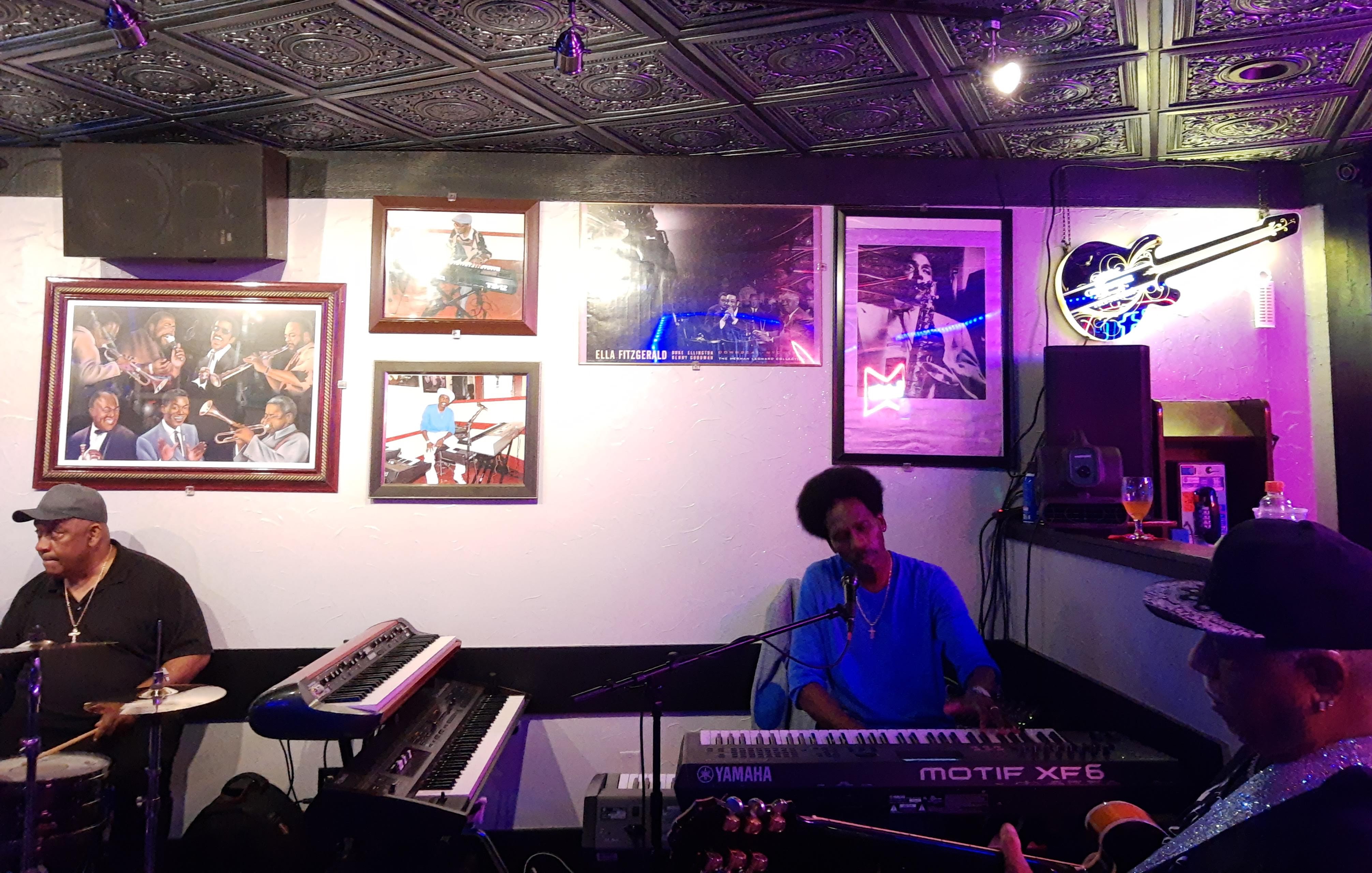
From the art museum, we then had dinner–pierogi and halushki–at a local, historic stone church, where after, in the sanctuary we heard from a jazz trio before the evening’s creative readings. (See pics above.) From there, I followed the locals to a tiny jazz and blues club where we heard, you guessed it, live jazz and blues–some originals and some covers of Marvin Gaye, Otis Redding, and other sing-alongable songs. And my weekend just kept getting more art-full.
The second day of the conference, I played hooky. It’s true. Rule-following me. Of course, before that I did my duty as part of the planning committee and worked at the book fair (which was a lot of fun!). I also took poet Teri Ellen Cross Davis’ poetry workshop about writing from family history (one of her best tips: to avoid sentimentality, get very specific and use details sparingly); I’m still working on that poem. And later, I took a poetry workshop on the Golden Shovel form (news-to-me: it has nothing to do with a shovel shape). And then, I played hooky.
Book fair book haul: Don’t miss Teri Ellen Cross Davis’ latest book of poems, A More Perfect Union.
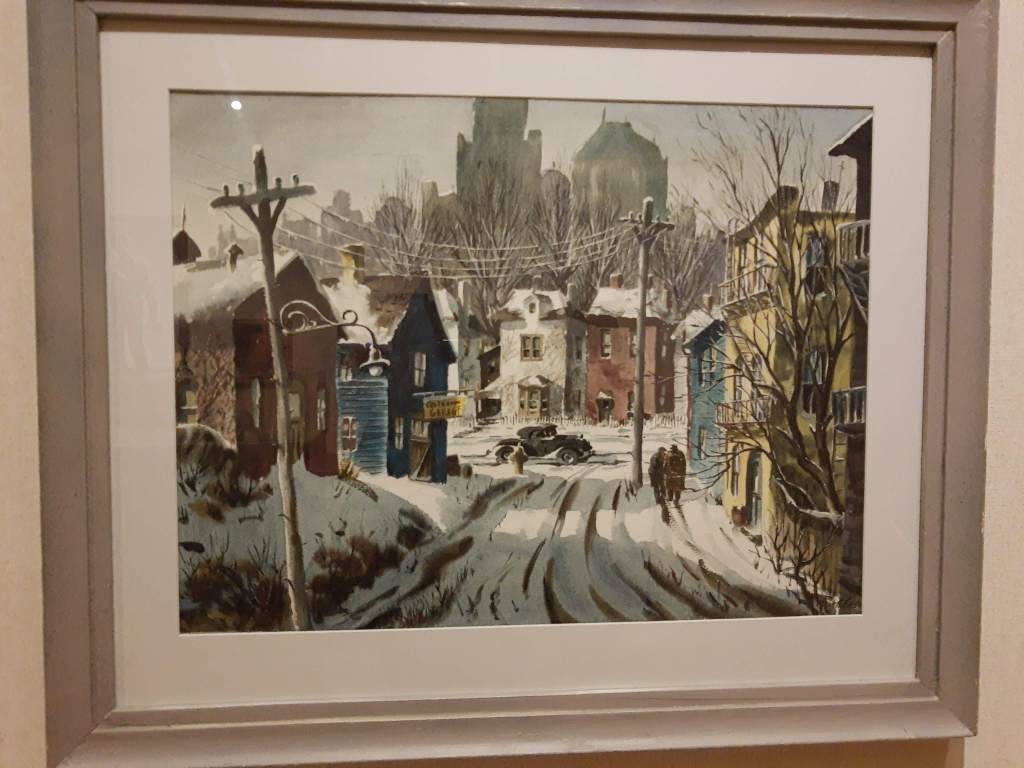
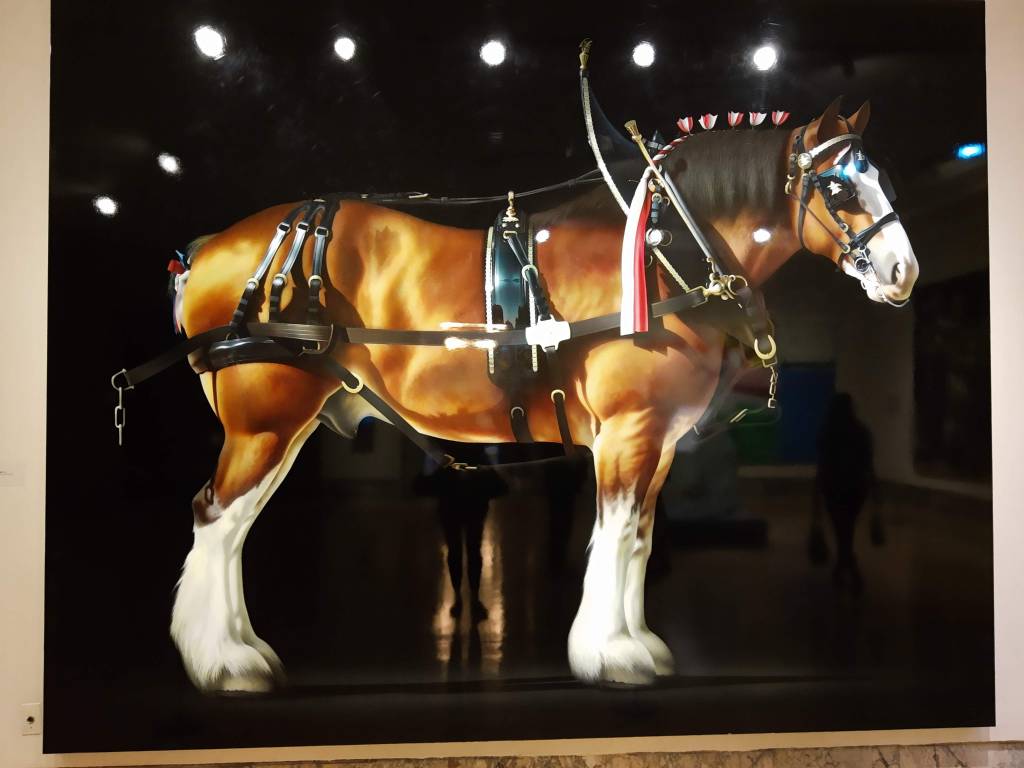
For the several years I’ve been attending this literary festival, everyone’s told me I must make it to the Butler Museum of American Art, a short walk from the conference venue. This time, a couple writer friends and I made it, took the tour, the whole thing. Reader, there was an Edward Hopper. I knew I was in the right place. (Pictured: Edward Hopper’s Pennsylvania Coal Town, William Gropper’s Youngstown Strike, Henry Martin Gasser’s Intersection, Grant Wood’s In the Spring, a name-that-abstract piece I didn’t take a good enough picture of the id card, Peter Maier’s Horse-Power (Ben)–a floor-to-ceiling rendering of a Clydesdale painted on metal–and Alfred Leslie’s High Tea.)
After my fill of American art, I enjoyed dinner (Italian, if you’re keeping track) and literary conversation that alternately had me jotting notes (the TBR pile grows ever taller) and laughing. There again, my idea of heaven. To cap off the final evening of the festival: another reading (at another downtown art gallery), this time by Jan Beatty–raw, real, and revelational! I can’t wait to dive into this one, too.
Huge kudos to Lit Youngstown director Karen Schubert and outreach coordinator Cassandra Lawton, the board, and planning committee folks–for another successful literary festival. It felt like a miracle that was over too soon!
Have you ever been to a literary festival or conference? What were the highlights for you? Did you stay in your literary lane or reinvent yourself in a weekend? Do you enjoy creative readings? What makes a reading memorable for you?
I’ve been terrible about keeping in touch, but I hope you’ll check in here. What are you reading, writing? What authors have moved you, lately? Are you getting out to any in-person activities?
Hankering for Rust Belt author interviews, book reviews, and more? Check out my categories above. I hope you’ll follow me here, if you don’t already, so you never miss a (quite infrequent) post. Thanks! ~Rebecca
A few years ago, while organizing my computer desktop, I changed a folder name. I know, I know, riveting inciting action, right? But stick with me.
I changed the name of that folder from “PR”–forgive me, I’m a marketing professional–to “Writing in Community.” There was little in that folder at that point, but I was starting to get out there, as in sitting on a panel and doing a reading at a literary conference, and figured I should be organized about it. Out there meant knowing there is a public side to writing and publishing that this introvert would have to get used to.
That folder grew when a publishing opportunity turned into an editing opportunity, and I started working for a literary magazine–and working with dozens of writers, so far. For some, I interviewed them about their new books; for others, I served as book reviewer; and for still others, I helped hone essays that got their stories, you know, out there.
There are lots of platitudes like: the best gift to yourself is to give of yourself; there is no “us” without “u,” I don’t know. So, insert your favorite one here. We bloggers know that connection with community is everything; it just took me a while to think of the writing life–one that’s often depicted as solitary and broody–in just the same way.
And that “Writing in Community” folder keeps growing: writing groups and beta readers live in that folder, as do notes on classes, conferences, and group retreats (again, someday!)–a whole lot of writing “us.” Recently, I was asked if I wanted to serve on the planning committee for my favorite literary festival, and of course I said yes.
So, here’s where the magic happens, where our folders could hang out together. Even better, we could hang out together–do all the writerly stuff, like in actual person! It’s two days of readings, craft talks, and panel discussions. In other words: writerly nirvana!
Here’s the pitch: Are you–or do you know–a terrific writer, reader, teacher, lit community organizer, or publisher? Please help me spread this call for proposals for Lit Youngstown’s 5th Annual Fall Literary Festival, with the theme of “Our Shared Story,” to be held in Youngstown, Ohio, October 7 – 9, 2021. Simply share the link with your literary-type friends (on social media, over email, on your blog) anywhere in the vicinity of Youngstown–which is halfway between Pittsburgh and Cleveland.
One last thing: read carefully, my gracious, frequent followers, and note the visiting writers at this year’s conference. (You see what I mean about good things coming to those writers who commune!?)
Lit Youngstown’s 5th Annual Fall Literary Festival October 7-9, 2021 Youngstown, Ohio Conference Theme: “Our Shared Story” Visiting Writers: Ross Gay, Jan Beatty, Bonnie Proudfoot & Mike Geither
This year has been (among other things) one giant exercise in imagining. Imagine this is a regular writing workshop. Imagine enjoying this poetry reading in an art gallery (instead of in your bathrobe). Imagine actual happy hour. But if we writers are good at anything, it’s imagining.
So, it shouldn’t have been a surprise that my favorite literary festival, the literary highlight of my year, the 2020 Fall Literary Festival hosted by Lit Youngstown (Ohio), was a great remote success. I was incredibly impressed at the quality of the craft workshops, readings, and community spirit–even from a few hundred miles away.
From the festival description, “This year’s conference [was] centered around the theme In Many Tongues, a conversation bringing together writing and publishing, literary inclusion, translating and translation…and the generational, political, ecological, and experimental elements that add to the wider literary conversation.” Whew!
If only I could have attended each and every session, heard each and every voice. But, there is only one of me, so I picked and chose from the many literary offerings. Here, I’m happy to provide highlights in the hopes I whet your appetite for next year’s festival–or a literary event in one of your favorite places in the world:
Jacqueline Marino, who edited two anthologies focused on the stories of Youngstown, Ohio, titled Car Bombs to Cookie Tables, taught a craft workshop, Write Your Rust Belt Story. You know I was there. The journalism professor and writer talked about crafting place in our stories, establishing voice, and finding the moment of connection in a piece. With a little free-writing, I started on a piece about my own Ohio hometown.
David Giffels was this year’s keynote speaker. In his talk, “Thank you Cleveland Good Night: How the reluctant writer becomes a performer,” Giffels shared his own personal story–from a shy, bookish kid to a newspaper columnist to the award-winning author and essayist–and spectacular storyteller–he is today. His latest book, Barnstorming Ohio: To Understand America is an on-the-ground look at Ohio and its people and place in American politics. For the first time, Giffels narrated his own audio book, and he related ideas of (actual) voice and (literary) voice. You write “the way you wish you could talk,” he said. And, as for writing about place, he recommended looking for what’s odd about your spot. Further, explore “a question you know you can’t answer.” (Oh, so many questions.)
Writer Quincy Flowers’ craft talk, On Polyphony: Writing a Novel and Making Meaning in Dialogue with Others discussed incorporating texts, including historical and para-texts, along with documents real and imagined, into our fiction. For this historical fiction writer, Flowers gave me a lot to think about, including, when does historical invention cross the line into untruth… and why haven’t I read more Percival Everett?
Dr. Ken Schneck, an author, editor, and professor of education, led a session called Shameless Self Promotion, which focused on helping us writers market our work–and ourselves–to build our audience for our books, journals, or even (ahem) blogs. Top takeaways: writers need a thing to market (not themselves) and a measurable goal; writers need to know who’s doing the kinds of writing we’re doing (our “comp” writers); and writers need not shy away from self promotion. Most helpful: Schneck’s discussion on the importance of our “elevator pitch.” You know, the succinct, pithy answer to “What do you do?” (I’ll share mine in the comments.) This talk also inspired me to update my About page at this blog–let me know what you think.
Fiction writer, playwright, and teacher Toni Thayer led a session called Finding your Voice in the Voices of Others, in which she urged us participants to carefully consider short pieces by “a diverse range of writers to fuel playful, creative imitation, with the end result of expanding one’s own style.” I studied a poem by Ohio poet Hanif Abdurraqib, in which music dictates the sound and the meaning of the piece–and applied some song to a WIP of my own. Refining your own voice through imitation is such great exercise!
Keynote speaker David Giffels talked shop in Relatively Speaking: Writing about Family in Personal Essays and Memoirs, and I’m happy to share some of the best tips for my writer friends here. What’s tough about writing about family, said Giffels, is we know too much. And also too little. Our own memory of an event is only the beginning. What comes next? Research. Interview family members to get their take; research events on YouTube; refresh your memory through photos and artifacts and by revisiting the place. But the bottom line in how NOT to get in trouble when writing about family, Giffels said: “empathy is everything.”
And there was so much more literary goodness over the 2+ day festival–even a happy hour.
Have you attended a literary festival or conference in this age of Zoom? What was the highlight? Any tips to share? Do you write about family on your blog or elsewhere? How do you avoid the pitfalls while telling your story? Do you have an elevator pitch at the ready, when people ask, what do you write about, what do you blog about?
Interested in Rust Belt author interviews, book reviews, essays, and more? Check out my categories, above. Are we social? Find me at FB and on Twitter and IG @MoonRuark
Are you a Rust Belt writer or poet interested in doing a guest spot at this blog? My more than 1,500 followers love to discover new voices. Let’s connect!
It’s festival season around here. Whether that means discovering just the right pumpkin, a new lager, or a better, more flexible version of your writing self, don’t forget to stretch (more on that in a bit).
Earlier this month, I headed to Youngstown, Ohio, for the third annual Lit Youngstown Fall Literary Festival held on the YSU campus. Here’s a rundown, plus tips, and–of course–a list of the autographed books I lugged home! (First, shout-out to my cousin, Theresa and her husband, Steven, who kindly fed me homemade pizza and put me up for the night along my way through PA.)































 Rust Belt Girl