Lit Fest Roundup 2025: who I met, what I wrote, how much pizza I consumed


This October I attended my eighth annual Fall Literary Festival hosted by Lit Youngstown. It was the Ohio literary organization’s ninth—and final—fall lit fest (at least for now). I could just be weepy about it (I’m weepy about much these days, tbh), but I’m too grateful to stay weepy. Since it’s a weekend to do grateful, let’s get into it…

Don’t worry, Lit Youngstown itself—with all of its amazing programming–is going strong at 10 years old. But before I get into my 2025 lit fest roundup I want to take a moment to share a few highlights from lit fests gone by (forgive my literary nostalgia), in no particular order:

  • Novelist Rachel Swearingen telling us craft session participants to, “Write towards change.” And “Stop thinking about characters and start thinking about relationships.” (Fiction writing changemaker right there!)
  • Me, getting to tell my story of my mom’s protesting of a nuclear power plant near my hometown when I was a kid (I wrote about it here) and detailing how that story turned into an integral part of my eco-novel (published someday, world!)
  • Exploring ekphrastic writing at the Butler Institute of American Art (great museum road-trip idea for you out of towners!) and exploring Youngstown writ large (getting to stay with friends and enjoying the local cuisine (there will never be enough pickle pizza, noggin-sized meatballs, and pierogis!))
  • Getting to be a student of Sandra Beasley, Ross Gay, Lawrence Coates, and so many other teacher-writers and getting to tell them over charcuterie and a glass of wine: “you wrote my favorite poem, essay, novella, thank you…”
  • Meeting writer friends (like the talented Melissa Fraterrigo) in person after years of reading her work (her novel Glory Days inspired a lot of what I’ve been trying to highlight at this blog these last nine years or so—stay tuned for a review of her memoir in essays, pictured). And meeting other friends year after year and weaving our stories—and lives—together.
  • The highest highlight? You. Becoming a member of the Lit Youngstown community through the fall lit fest has been incredibly rewarding for my literary life—and my life-life. Thank you, friends.
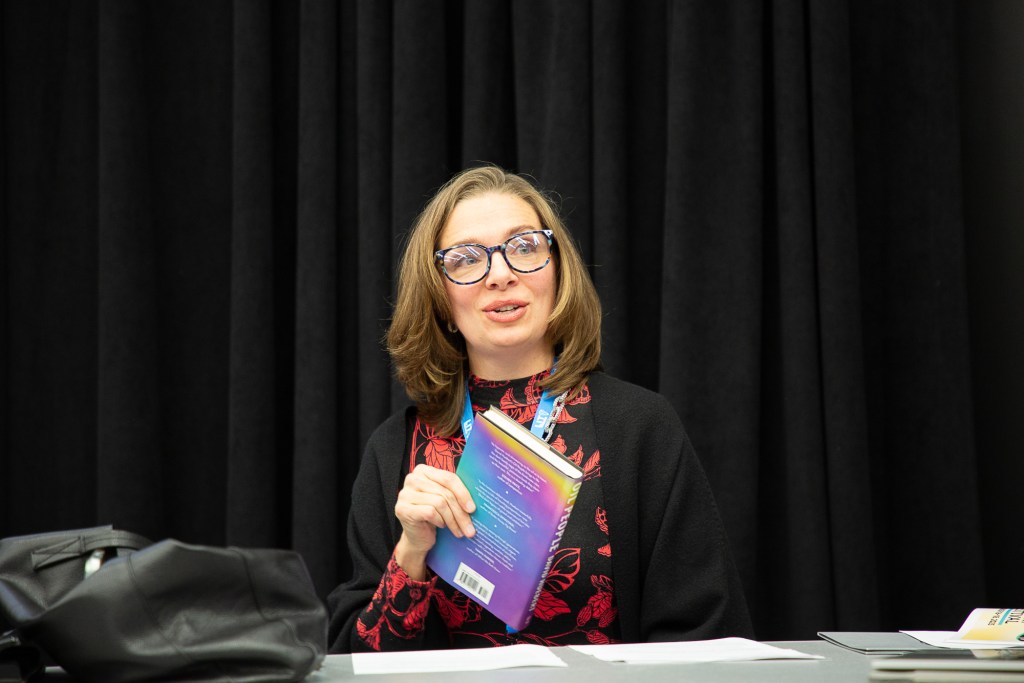
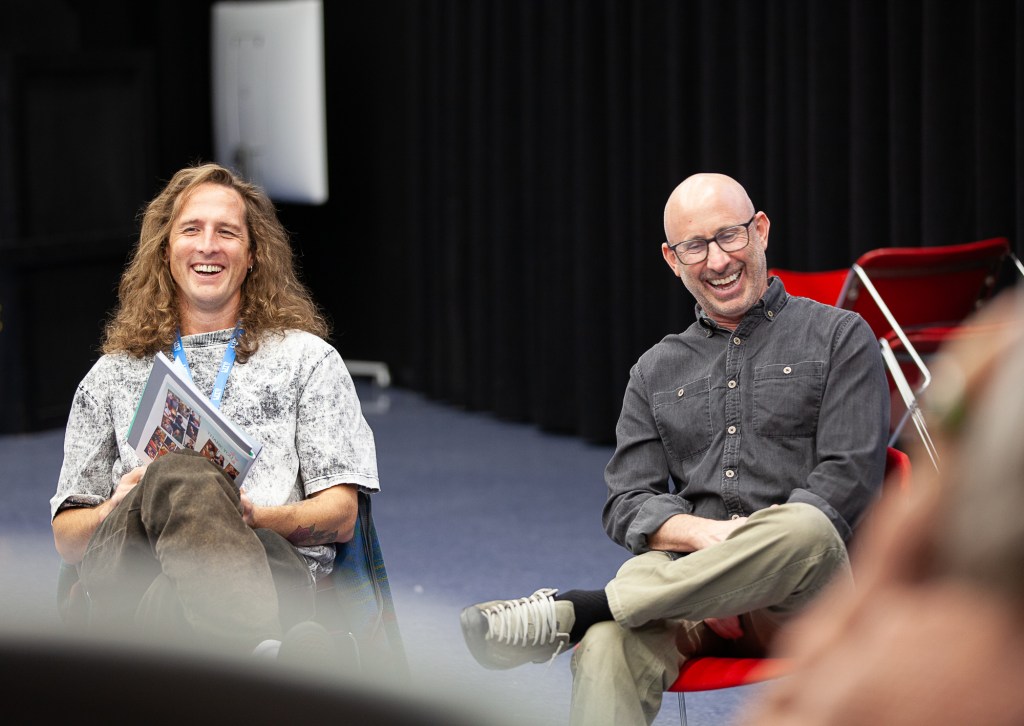
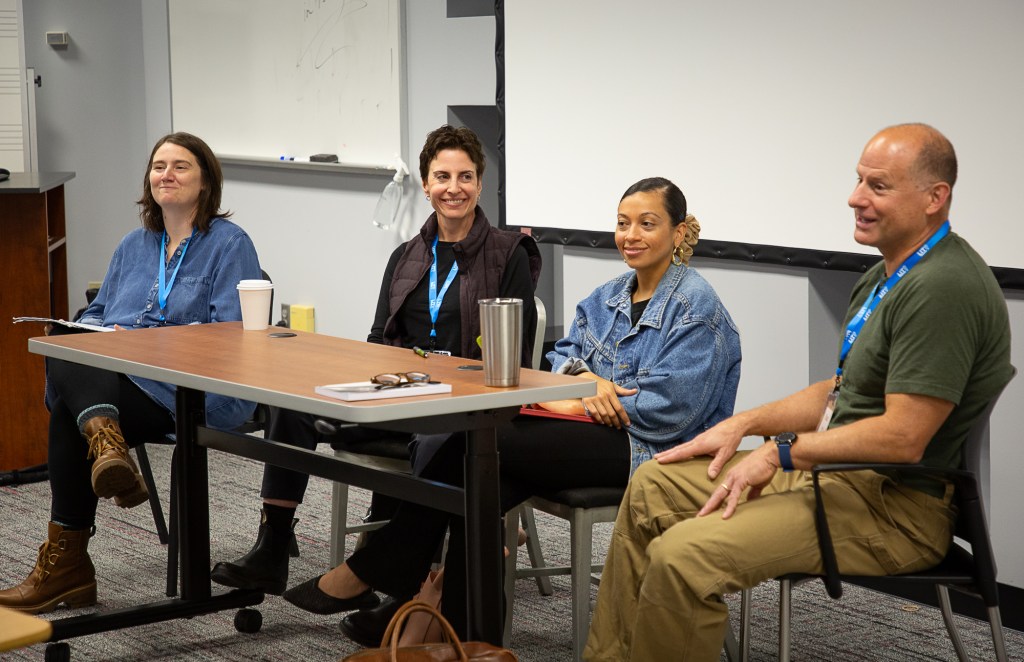
Now, 2025’s list fest was one for the books. (Peruse a few pics above and below.) And if you thought the environmental theme was going to mean a slew of nature poems…well, yes, and… Yes, and fascinating eco-fiction and challenging environmental memoir and poetry about nature redefined—from a place that was once an indigo plantation to the night sky over the Grand Canyon to trails cut by troubled teens into the Pacific Northwest woods—and so much more that “shapes our experience and identity, and represents our rootedness in earth.” Whew! I encourage you to read the impressive bios of the five 2025 featured presenters

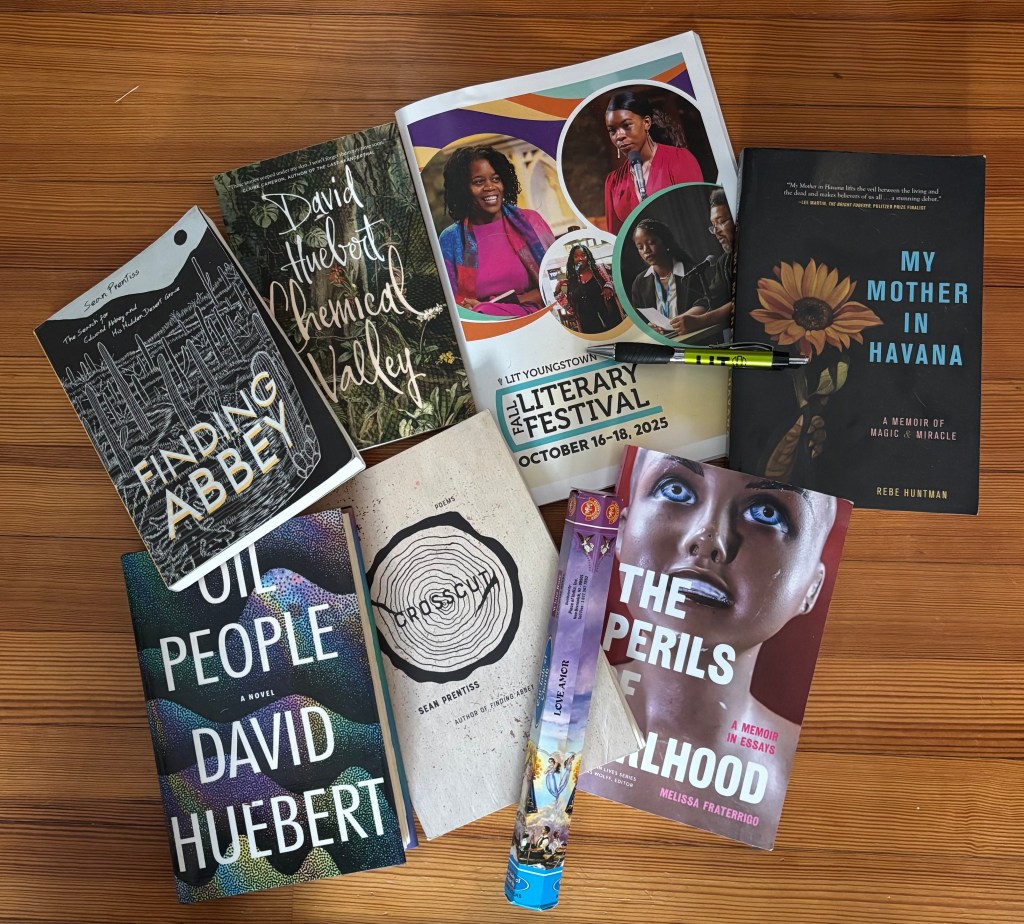
My preparation for this lit fest happily began months in advance of the event. (Once a student, always a student.) For my conversation with fiction writer David Huebert and memoirist and poet Sean Prentiss I read several of their books—she gestures to collage artfully displayed on her office floor—representing an array of what we lump under the term “environmental writing.” Look for a follow-up post with a good chunk of our discussion—fascinating and fun!

Other personal highlights from this year’s lit fest. (Know that this is just a fraction of the offerings and I, once again, wished I could have cloned myself, so I could make every single session.):

Day 1:

  • Narrative Medicine [definition: healthcare practiced with narrative competence]: A Generative Workshop, facilitated by family nurse practitioner and poet Dana Reeher. Imagine me taking furious notes for the anthology project I’m co-editing: Body of Work, essays at the intersection of dance and health. For a little workshop exercise, Dana asked us participants to respond to a writing prompt, “an expansive invitation to open the mind,” so I thought I’d write a very short piece about my own dancing and its impact on my physical and mental health outlook:
Maybe the mistake was I listened too well, that I pointed my feet too hard, that I really could feel that string coming out of the top of my head lifting me up to the studio ceiling. Maybe I postured too much, wanted too much. Maybe I turned out until I was turned in. Maybe all that looking in the mirror made me someone else. I can still spot a dancer, or an anorexic, from fifty paces.

My dancer friends here will likely recognize a lot of this, but especially the posture-reminder telling baby ballet dancers to imagine there’s a string coming out of the top of your head… After sharing my short piece of writing, a couple of the other workshop participants said the string image reminded them of a marionette. I’d never thought of that before, and I’ll tell you that image is still working on me!

  • The Pamela Papers: A Mostly E-pistolary Story of Academic Pandemic Pandemonium: The Musical. Based on the award-winning novel by Nancy McCabe, published by Outpost 19 in 2024, the presentation included a dramatic reading (with singing—who was expecting a musical at the lit fest? Not I. And it was such fun!).
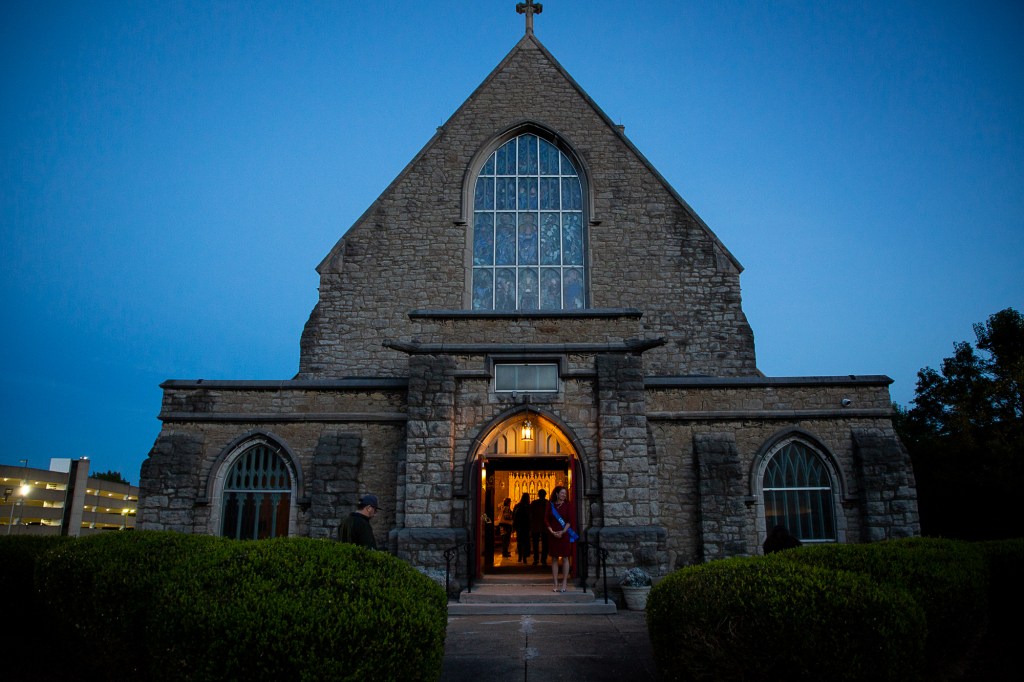
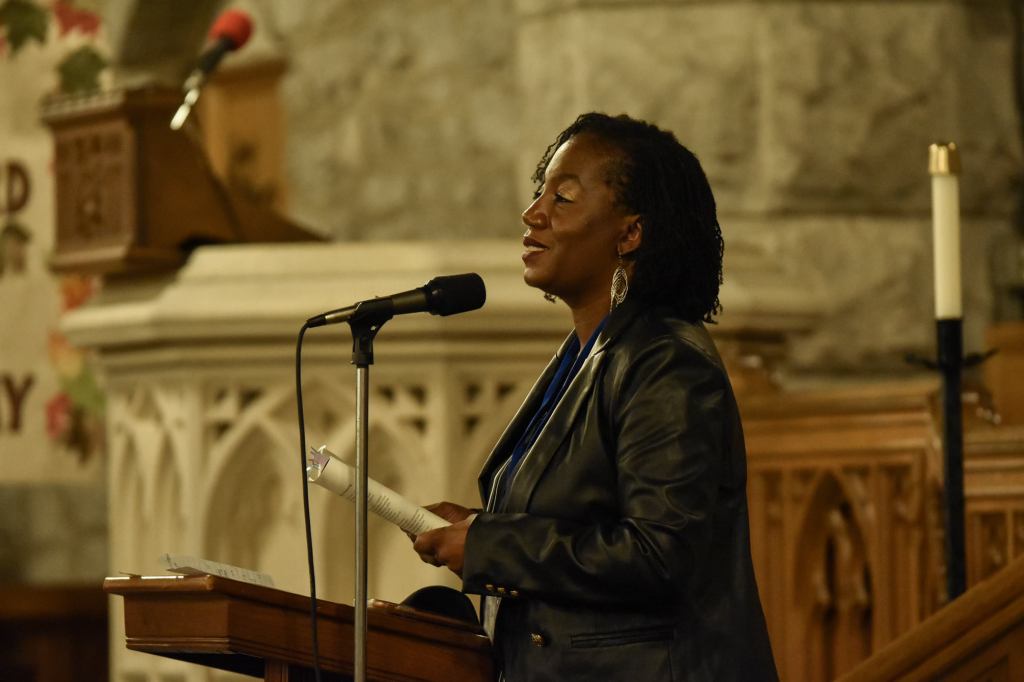
  • Readings by David Huebert and Sean Prentiss in St. John’s (gorgeous limestone and stained glass) Episcopal Church sanctuary. Your girl provided introductions to both writers—thanks for putting up with my unorthodox investigative process to make sure they were exciting, guys!

Day 2:

  • Bengal Tiger Moments: Time Perception in Creative Writing, facilitated by Sean Prentiss. In this fascinating session, we talked about speed on the page, presented in five categories from fastest to slowest: Gaps, Summary, Scene, Dilation, and Pause. Sean presented examples of these techniques from creative nonfiction and explained the brain science behind our understanding of the movement of time—irl and on the page.
  • Rooting the Self: Writing as an Act of Person, Political & Environmental Transformation & Transcendence, a multi-genre workshop with (beautiful and talented) Rebe Huntman, author of My Mother in Havana: A Memoir of Magic & Miracle: Rebe took us through various stages/ways of honoring our voice and our writing by making space for it and celebrating it, including meditation, morning pages, repetitive activity (including list-making), “the writing cave,” and writing constraints and freewrites. My favorite prompt, a list-making exercise we did in this session, produced these lists, below. (From there I spun out a short prose piece, “Reasons to Revere Your Vagus Nerve” (we’ll see where that weirdness goes!):
5 Things I Consider a Miracle
High arches
Warm pie
The vagus nerve
Sweating carafes of water
Tanned leather
5 Recurring Obsessions
Ballet hands
Song
Accents, dialects, and regionalisms
Mom, mom, mom
Delight
  • Readings by poets Lauren Camp, Todd Davis & Kourtney Morrow: poems of cityscape to countryside to the night sky over the Grand Canyon left us audience members awed.

Days After

And then, after… there’s nothing better than returning home from a literary event inspired, nurtured, and with a few new ideas for writing already on the page.

If you’re reading this on Small Business Saturday, might I suggest you also read small and lit small by supporting your local indie bookstores and your favorite literary organizations today?!

Did you attend Lit Youngstown’s Fall Literary Festival last month? Another lit fest? What was your favorite part? Have an inspiration gleaned or a piece of writing captured you’d like to share? Feel free to jot it in the comments. 

Like this post? Comment below or on my FB page. And please share with your friends and social network. 

Are you a Rust Belt writer interested in seeing if your own post, or author interview, or book review might be right for Rust Belt Girl? Hit me up through this site’s contact function.

Check out my categories above for more guest posts, interviews, book reviews, literary musings, and writing advice we can all use. Never miss a post when you follow Rust Belt Girl. Thanks! ~Rebecca

Enter your email address to subscribe to this blog and receive notifications of new posts by email.


Poet for a weekend, and other literary festival miracles

I am not a poet, though some of my prose has aspirations. However, if writing is about invention–and re-invention–maybe my prose knows something I don’t.

How glorious to reinvent ourselves through our writing, over and over, on the page (or screen). I do find invention the most exciting part of being a fiction writer, blogger, and even a marketing professional–well, second only to the excitement of connecting with likeminded creative folks.

And so, I was in literary heaven at Lit Youngstown’s fifth annual Fall Literary Festival, held on the campus of Youngtown State University in Youngstown, Ohio. (Heaven is in Ohio? Yes, yes it is.)

Remember in-person literary events? I’d almost forgotten that some of my favorite writerly faces can been seen in the literary wild, outside of their confining Zoom boxes. For those of you readers who’ve been around these blog parts for a while, this festival gave the pleasure of meeting several of my Rust Belt interviewees in person for the first time: memoirist and poet Robert Miltner, poet Teri Ellen Cross Davis, and novelist Margo Orlando Littell. Also, in small-literary-world news, a writer friend I made while attending a writing retreat in Virginia in the spring made it to the fall conference (hi, Rebe!).

So, what exactly goes down at a literary festival? The “gathering in” night at a downtown art studio included a cookie table, a local tradition. And, not only did I cookie, but I also put on my brave writer pants and read a short piece at the open mic (following maybe some of my best advice for speaking–or singing–in public).

The first full day of the festival, I moderated a craft session on writing memoir; attended a panel discussion on rewriting women into history (take that Jack London–just trust me); attended a poetry discussion on transforming grief into a gift; and took an epistolary poetry workshop. Yes, me, the non-poet. At the risk of total embarrassment, here’s my epistolary poem from the class:

Dear Son,
A hotel bed big enough for the four of us, but it sleeps only me. I could say I wish you were here,
but Youngstown, this place I only discovered when I was no longer young, feels like mine
alone. Here, the people talk like me, the nasal accent that cuts through a crowd. You will love
a campus like this someday, a place that will watch you become a stronger you, tempered
like the steel of this place. Your Youngstown might be Annapolis or College Park or Cambridge.
You know we can't afford the Ivies, right? Do your homework, get a good night's sleep, and know
I love you.
~Mom

One of the coolest aspects of having a literary festival on a college campus is the other arts to be found. A short walk took me to a university art museum that was featuring an installation by artist Diane Samuels. My photos don’t do her work justice, so you’re going to want to check out her site. Here, you see Moby Dick, Romeo and Juliet, and The Overstory–with every word of those texts hand-transcribed on various materials. The quilt-like pieces are gorgeous from afar or up close, where you can read every word.

From the art museum, we then had dinner–pierogi and halushki–at a local, historic stone church, where after, in the sanctuary we heard from a jazz trio before the evening’s creative readings. (See pics above.) From there, I followed the locals to a tiny jazz and blues club where we heard, you guessed it, live jazz and blues–some originals and some covers of Marvin Gaye, Otis Redding, and other sing-alongable songs. And my weekend just kept getting more art-full.

The second day of the conference, I played hooky. It’s true. Rule-following me. Of course, before that I did my duty as part of the planning committee and worked at the book fair (which was a lot of fun!). I also took poet Teri Ellen Cross Davis’ poetry workshop about writing from family history (one of her best tips: to avoid sentimentality, get very specific and use details sparingly); I’m still working on that poem. And later, I took a poetry workshop on the Golden Shovel form (news-to-me: it has nothing to do with a shovel shape). And then, I played hooky.

Book fair book haul: Don’t miss Teri Ellen Cross Davis’ latest book of poems, A More Perfect Union.

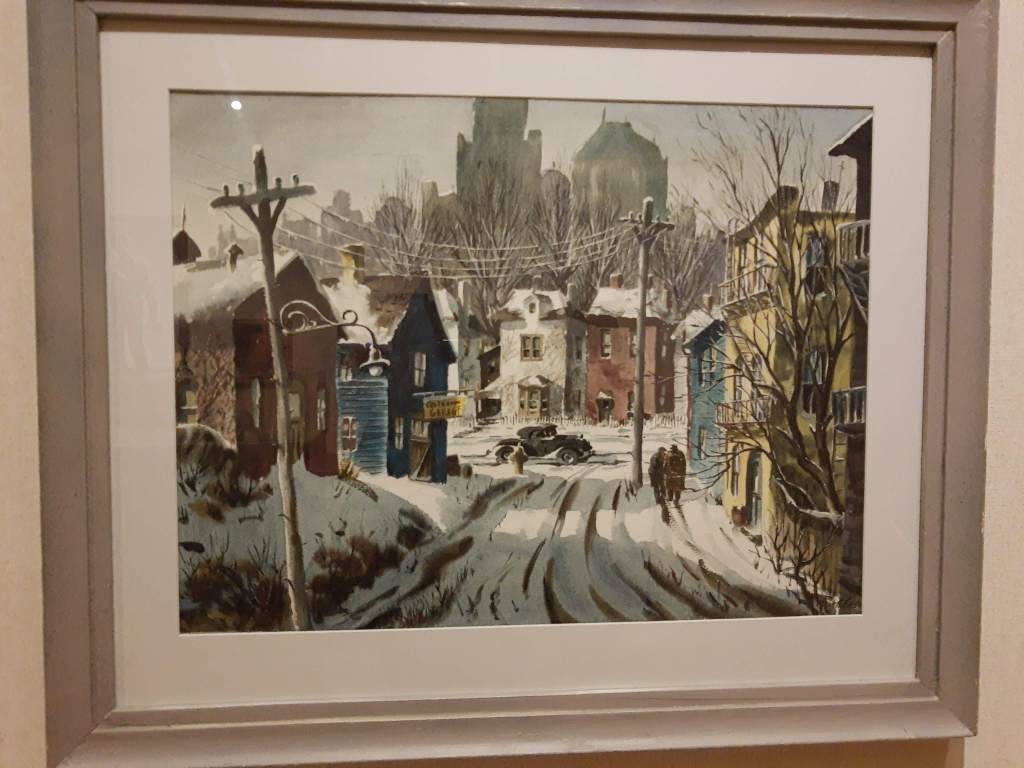
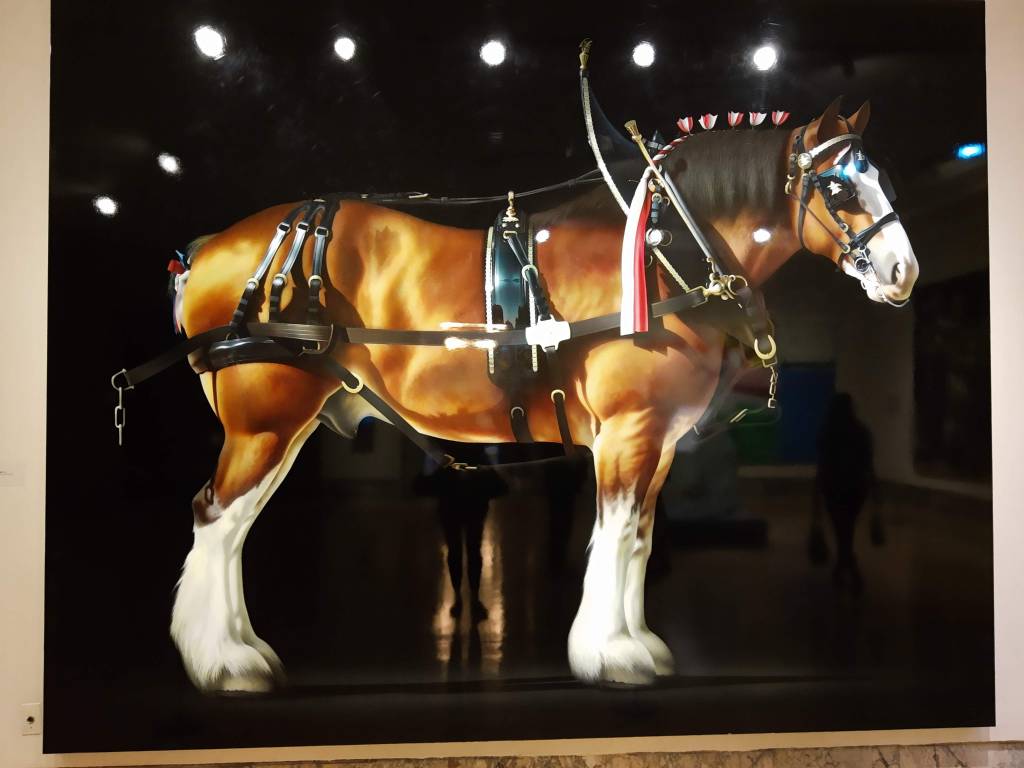
For the several years I’ve been attending this literary festival, everyone’s told me I must make it to the Butler Museum of American Art, a short walk from the conference venue. This time, a couple writer friends and I made it, took the tour, the whole thing. Reader, there was an Edward Hopper. I knew I was in the right place. (Pictured: Edward Hopper’s Pennsylvania Coal Town, William Gropper’s Youngstown Strike, Henry Martin Gasser’s Intersection, Grant Wood’s In the Spring, a name-that-abstract piece I didn’t take a good enough picture of the id card, Peter Maier’s Horse-Power (Ben)–a floor-to-ceiling rendering of a Clydesdale painted on metal–and Alfred Leslie’s High Tea.)

After my fill of American art, I enjoyed dinner (Italian, if you’re keeping track) and literary conversation that alternately had me jotting notes (the TBR pile grows ever taller) and laughing. There again, my idea of heaven. To cap off the final evening of the festival: another reading (at another downtown art gallery), this time by Jan Beatty–raw, real, and revelational! I can’t wait to dive into this one, too.

Huge kudos to Lit Youngstown director Karen Schubert and outreach coordinator Cassandra Lawton, the board, and planning committee folks–for another successful literary festival. It felt like a miracle that was over too soon!

Have you ever been to a literary festival or conference? What were the highlights for you? Did you stay in your literary lane or reinvent yourself in a weekend? Do you enjoy creative readings? What makes a reading memorable for you?

I’ve been terrible about keeping in touch, but I hope you’ll check in here. What are you reading, writing? What authors have moved you, lately? Are you getting out to any in-person activities?

Hankering for Rust Belt author interviews, book reviews, and more? Check out my categories above. I hope you’ll follow me here, if you don’t already, so you never miss a (quite infrequent) post. Thanks! ~Rebecca

Enter your email address to subscribe to this blog and receive notifications of new posts by email.

Lit Fest Lowdown: 2020 highlights

Last year’s festival dinner view.

This year has been (among other things) one giant exercise in imagining. Imagine this is a regular writing workshop. Imagine enjoying this poetry reading in an art gallery (instead of in your bathrobe). Imagine actual happy hour. But if we writers are good at anything, it’s imagining.

So, it shouldn’t have been a surprise that my favorite literary festival, the literary highlight of my year, the 2020 Fall Literary Festival hosted by Lit Youngstown (Ohio), was a great remote success. I was incredibly impressed at the quality of the craft workshops, readings, and community spirit–even from a few hundred miles away.

From the festival description, “This year’s conference [was] centered around the theme In Many Tongues, a conversation bringing together writing and publishing, literary inclusion, translating and translation…and the generational, political, ecological, and experimental elements that add to the wider literary conversation.” Whew!

If only I could have attended each and every session, heard each and every voice. But, there is only one of me, so I picked and chose from the many literary offerings. Here, I’m happy to provide highlights in the hopes I whet your appetite for next year’s festival–or a literary event in one of your favorite places in the world:

Jacqueline Marino, who edited two anthologies focused on the stories of Youngstown, Ohio, titled Car Bombs to Cookie Tables, taught a craft workshop, Write Your Rust Belt Story. You know I was there. The journalism professor and writer talked about crafting place in our stories, establishing voice, and finding the moment of connection in a piece. With a little free-writing, I started on a piece about my own Ohio hometown.

David Giffels was this year’s keynote speaker. In his talk, “Thank you Cleveland Good Night: How the reluctant writer becomes a performer,” Giffels shared his own personal story–from a shy, bookish kid to a newspaper columnist to the award-winning author and essayist–and spectacular storyteller–he is today. His latest book, Barnstorming Ohio: To Understand America is an on-the-ground look at Ohio and its people and place in American politics. For the first time, Giffels narrated his own audio book, and he related ideas of (actual) voice and (literary) voice. You write “the way you wish you could talk,” he said. And, as for writing about place, he recommended looking for what’s odd about your spot. Further, explore “a question you know you can’t answer.” (Oh, so many questions.)

Writer Quincy Flowers’ craft talk, On Polyphony: Writing a Novel and Making Meaning in Dialogue with Others discussed incorporating texts, including historical and para-texts, along with documents real and imagined, into our fiction. For this historical fiction writer, Flowers gave me a lot to think about, including, when does historical invention cross the line into untruth… and why haven’t I read more Percival Everett?

Dr. Ken Schneck, an author, editor, and professor of education, led a session called Shameless Self Promotion, which focused on helping us writers market our work–and ourselves–to build our audience for our books, journals, or even (ahem) blogs. Top takeaways: writers need a thing to market (not themselves) and a measurable goal; writers need to know who’s doing the kinds of writing we’re doing (our “comp” writers); and writers need not shy away from self promotion. Most helpful: Schneck’s discussion on the importance of our “elevator pitch.” You know, the succinct, pithy answer to “What do you do?” (I’ll share mine in the comments.) This talk also inspired me to update my About page at this blog–let me know what you think.

Fiction writer, playwright, and teacher Toni Thayer led a session called Finding your Voice in the Voices of Others, in which she urged us participants to carefully consider short pieces by “a diverse range of writers to fuel playful, creative imitation, with the end result of expanding one’s own style.” I studied a poem by Ohio poet Hanif Abdurraqib, in which music dictates the sound and the meaning of the piece–and applied some song to a WIP of my own. Refining your own voice through imitation is such great exercise!

Keynote speaker David Giffels talked shop in Relatively Speaking: Writing about Family in Personal Essays and Memoirs, and I’m happy to share some of the best tips for my writer friends here. What’s tough about writing about family, said Giffels, is we know too much. And also too little. Our own memory of an event is only the beginning. What comes next? Research. Interview family members to get their take; research events on YouTube; refresh your memory through photos and artifacts and by revisiting the place. But the bottom line in how NOT to get in trouble when writing about family, Giffels said: “empathy is everything.”

And there was so much more literary goodness over the 2+ day festival–even a happy hour.

Have you attended a literary festival or conference in this age of Zoom? What was the highlight? Any tips to share? Do you write about family on your blog or elsewhere? How do you avoid the pitfalls while telling your story? Do you have an elevator pitch at the ready, when people ask, what do you write about, what do you blog about?

Interested in Rust Belt author interviews, book reviews, essays, and more? Check out my categories, above. Are we social? Find me at FB and on Twitter and IG @MoonRuark

Are you a Rust Belt writer or poet interested in doing a guest spot at this blog? My more than 1,500 followers love to discover new voices. Let’s connect!