“…the holy and the ordinary rubbing shoulders…” Essay and images by Justin Hamm

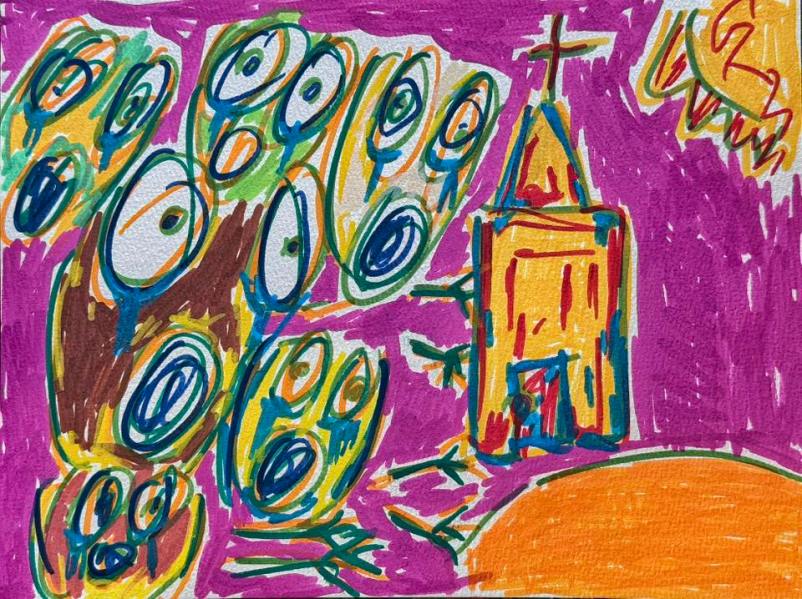
A full-color folk art image depicting open mouths and a church with a cross on top

Poet, photographer, and model literary citizen, Justin Hamm inspires with his offering–the third installment of a series of guest posts here at Rust Belt Girl. Thank you, Justin! His essay about speaking in tongues feels especially personal, presented as it is from a child’s perspective. It feels “close” to me, in more than one way. Justin’s essay is accompanied by his original folk art, and I have to say, I didn’t see this coming. But I absolutely love it. Here at Rust Belt Girl, we know the American Midwest is vast and multitudinous, and so are its people, their inspirations, their stories, and their art.

Because Justin is truly “Midwest Nice” and humble, he might not brag to you about his TEDxOshKosh Talk, “The American Midwest: A Story in Poems & Photographs, but I’ll do it for him. This is a good place to start, if you’re new to Justin. In his talk, he asks some of the same questions we’ve been asking at Rust Belt Girl all these years. A big one: Is “flyover country” an appropriate term for the Midwest? Justin explores that vital question through inspection of the overlooked or the avoided, including rust (holla!), thunderstorms, everyday people doing everyday things, politics, social class, and more. It’s well worth a watch-and-listen.

But first. Let’s read and discuss Justin Hamm’s…

The Wind With a Secret Shape 

I was eight maybe nine years old Wednesday nights my grandparents used to 

take me to a small Pentecostal church that sat on a grassy rise just outside of 

town it had once felt isolated tucked out in the quiet but the town had crept 

outward now it sat beside a gas station a lumberyard and a row of fast-food 

joints the holy and the ordinary rubbing shoulders the church rectangular part 

brick part white siding a white cross stretching off the roofline like an arrow 

pointing to the shifting Illinois sky inside the pews angled toward a low 

platform where the preacher shouted and a four-piece band laid down rhythm 

the cushions a deep royal blue clean saturated almost regal I remember that 

color better than my childhood bedroom the building always felt old but never 

run-down the women cleaned it like a calling while the men kept it maintained 

it smelled of floor polish and breath mints old hymnals and hairspray a past 

preserved a place where time seemed fixed in place 

I wanted to be a good boy I tried to follow the sermons caught a phrase here or 

there but mostly folded handouts into paper planes or built hymnbook 

pyramids sometimes I curled up on the back pew and drifted off lulled by the 

rhythm of scripture and song until the spirit moved when it hit the preacher 

everything changed he’d leap down the steps whirling stomping at the devil 

howling Jesus’ name until his face went red and purple sweat soaking his brow 

and then the tongues came strange breathless syllables rolling out like a chant 

that bypassed the brain entirely the holy ghost made you do things that was 

just how it worked I accepted it the way you’d accept sunrise or gravity 

and I believed too believed fully if somebody said the spirit is with us tonight 

I’d scan the sanctuary up in the corners where wall met ceiling under pews 

between swaying bodies I didn’t expect to see it exactly but I wanted to know 

where it was it filled me with something like fear but not only fear there was 

longing in it too hunger a sense that something just out of reach might solve 

everything the holy ghost like a wind with a secret shape a bird made of breath 

maybe God’s own breath moving invisibly through the room I believed it 

entered through the mouth that explained what came out the old men would 

rise in their too-large suits limping loops around the sanctuary hands raised 

speaking in tongues the women would fall stiff to the ground eyes rolled back 

mouths twitching that’s how I knew the ghost was on the move I tracked it 

sinner to sinner and sometimes it came close the person next to me would 

sway eyelids flickering syllables rising up like springwater through stone my 

chest would lift my legs would buzz my mouth would soften and open almost 

involuntarily I’d think this is it just let yourself go let it take you I opened my 

mouth and nothing came I tried again wider harder I prayed the best I knew 

how I swallowed the air like it might carry something eternal and then I waited 
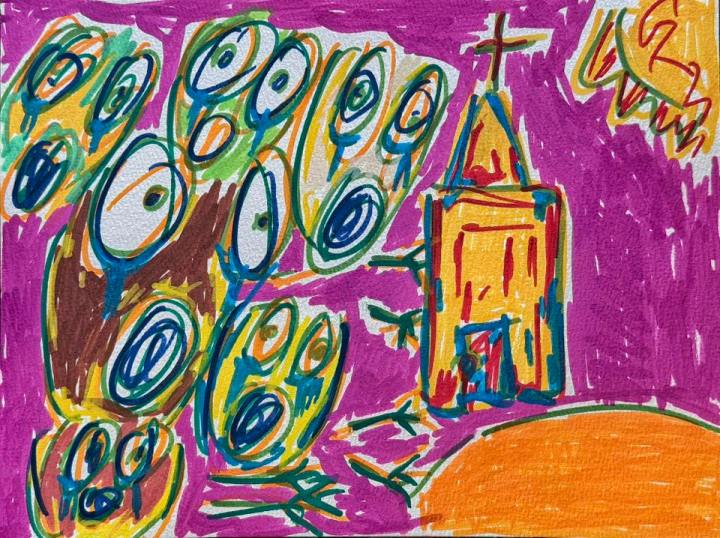
  • A full-color folk art image depicting open mouths and a church with a cross on top
  • Full-color folk art depicting a boy with a green hat, crying over a red balloon
  • Full-color folk art depicting a hand reaching out and touching another person, while a cross glows in the background
  • Full-color folk art depicting angels and a person with a downcast face

Justin Hamm is the author of five poetry collections, including O Death (2024), Drinking Guinness With the Dead (2022), and The Inheritance (2019), as well as a book of photography, Midwestern. He is the founding editor of the museum of americana and the creator of Poet Baseball Cards. 


Like this post? Like this series? Let’s discuss! Comment below or on my FB page. And please share with your friends and social network. 

Are you a Rust Belt writer interested in seeing if your own post, or author interview, or book review might be right for Rust Belt Girl? Hit me up through this site’s contact function.

Check out my categories above for more guest posts, interviews, book reviews, literary musings, and writing advice we all cab use. Never miss a post when you follow Rust Belt Girl. Thanks! ~Rebecca

Enter your email address to subscribe to this blog and receive notifications of new posts by email.

On reading GLORY DAYS…and other summertime scares

It starts with fire sirens, so loud the littlest children clap their hands over their ears. But not my guys, old enough now to tough it out–and join the parade on their decorated bikes to cheers from neighbors lined on both sides of the street.

Only … this Fourth of July Parade, one boy returned after he’d finished the short parade route, red-faced and sweating. The other wasn’t with him. “Where’s your brother?” was answered with a shrug. The street was empty. And I had the feeling of dread every parent knows, that hollowing out, followed by cold palms–on a very hot day.

Read more

Trash on Easter

“Tie-dyed variety this year–cute, right?

This Easter, I’m thinking about trash. Of course, I’m also thinking about the usual holiday trappings—the decorated eggs, the leg of lamb, and flowers for the table. Then, there are small shirts to be ironed, my slip to find… Wait. Why trash? Well, as I was listening to The Passion read at Good Friday mass, last night, arm around one of my boys, I tried to see myself in the “Crowd” role we congregants play. You know, the crowd, who witnesses the suffering and death of Jesus, the crowd who yells out in unison “crucify him,” several times—something which felt fairly naughty to me when I was a kid and feels just plain conflicting now.

Before I lose you… whether you view Jesus as a savior, a prophet, or simply a literary figure, today, it can be instructive to think how we might have viewed him if we were his contemporaries. This poor vagabond, wandering around preaching too loud, associating with prostitutes, beggars, and the diseased. We might have thought his sandal-ed feet smelled bad. We might have even called Jesus “trash.”

This one terrible word, “trash,” shorthand (on our worst days and in the worst ways) for something we Americans have a hard time discussing—class—is following me around in my wider reading and pondering.

I just finished the audio version of Elizabeth Strout’s novel, MY NAME IS LUCY BARTON, in anticipation of the sequel to her Pulitzer Prize-winning OLIVE KITTERIDGE. In the deft, character-studying way Strout has with fiction, her Lucy Barton character discusses her family’s poor upbringing in the Midwest with her mother, who visits at her hospital bedside. (And this is the thrust of the entire novel; do not expect plot from this one.) After a strained discussion between mother and daughter about Elvis Presley and his upbringing, Lucy’s mother says he was from a “trash” family. Then, in a moment of painful clarity, Lucy responds: “We were trash. That’s exactly what we were.”

Really, I should have pulled the car over, listening to those words, like a gut punch if there ever was one in literature. But, why? I wondered. Why is it so hard to even hear—from a character at that, not even a real person—that insult, “trash.”

In my tandem-reading way (find my last tandem read here) I consulted Sarah Smarsh’s well-researched HEARTLAND: A MEMOIR OF WORKING HARD AND BEING BROKE IN THE RICHEST COUNTRY ON EARTH (a finalist for the National Book Award) in which the journalist author examines class in America through her own personal lens, having grown up in a working poor family in Kansas.

We were “below the poverty line,” I’d later understand…And we were of a place, the Great Plains, spurned by more powerful corners of the country…”Flyover country,” people called it…Its people were “backward,” “rednecks.” Maybe even “trash.”

Sarah Smarsh in Heartland

And, so what? We read about it, think about it, write about it, publish the stories of the underdog if we have the means. For the rest of us, our influence may be small. But witnessing something is something. As is finding our voice, however small, in the crowd.

Now, it’s your turn. Have you read either of these books? Do you read or write about that other C-word: class?

And on a lighter, holiday note, Happy Easter to you and yours from me and mine…

~Rebecca

Throwback Thursday: Why half the world should read IN ZANESVILLE

index

Even if you’ve never been there, you’ve heard enough to know the American Midwest isn’t sexy. I’m hardly the first Midwest native to admit to being from a Regular ‘Ol American Place.

The Midwest is “flyover country”–its detractors call it–between the glittering East Coast and shining West Coast. Yep, no matter how many Northeast Ohio boosters try, most of the U.S. will never be convinced of the beauty that is the “North Coast.” And that’s okay.

But…the insult that really stings: “Ohio is flat.”

It stings–not just because it’s a blanket generalization and untrue of my rolling Ohio hometown. (In fact, it stings more than memories of the same thing being said about my 6th grade chest–and that stung.)

It stings because flat is sameness. And don’t we (even States–if States had egos) want to feel special, unique, memorable: the opposite of same, boring, forgettable?

I am more than a home state booster; I’m a home state narcissist. You see, I picked up Jo Ann Beard’s novel, IN ZANESVILLE (pub. 2011), thinking it was set in Zanesville, Ohio.

It’s not. It’s set in Zanesville, Illinois, which, I sheepishly admit, is pretty much the same. In fact, it’s the sameness, the universality of the experiences of the novel’s fourteen-year-old narrator, that makes this novel so special–and yet relate-able to any reader who is or was ever a girl. And that’s about half the world. Read more