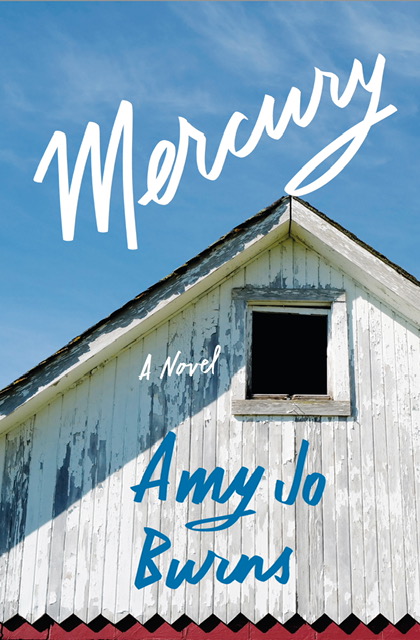
My interview with Amy Jo Burns, author of Mercury


Let’s begin with a sample paragraph from Amy Jo’s stunning literary (also mystery) family saga:

Spring was breaking through in lilac buds and daffodil shoots, but winter held on. Tufts of dirty snow clung to curbs, and porch steps, and parking lots. The heat had stopped working in the Citation, and Marley shivered. Theo was bundled in the backseat; she caught a glimpse of him in the rearview mirror. Then her eye snagged something else behind her–someone limping from a snowbank into the intersection. Marley slowed to a stop and turned around.

Whew. Good stuff.

Amy Jo, your main character in this Western-PA-set novel is Marley, whom we first meet when she’s 17. You left your Western-PA hometown for college around that age. What was it like to write this book and “inhabit” Marley’s character in a place (and time) similar to the one you were raised in? And how similar is your real-life family to Marley’s found family?

    Marley is a really special character to me. When I was creating her, I took the qualities I love most about my best friends from home and put them into her character. Her willingness to step into someone else’s messiness, her ability to tell the truth in such a loving way, and her desire to build a business with her own creative stamp on it are all qualities I really admire about my oldest friends. Marley showcases what I think real resilience actually looks like. It isn’t perfection or misery or loneliness—it just comes through in a big-hearted, flawed human who shows up for the people in her life. 

    The Joseph family in the novel is like mine in that we’re both a family of roofers—which means both houses were full of grand storytellers, brave hearts, and lots of tar-stained jeans. The house I imagined the Josephs living in was inspired by the old Victorian house my grandparents used to own in my hometown. I’d always loved that house and couldn’t imagine any other place a family of roofers would live. The characters in Mercury come from my imagination, but the bond they feel with each other—the sometimes too-close intimacy they have with one another is absolutely something any member of my extended family can relate to. When it comes down to it, I’d say both families care about the same thing—keeping people safe under roofs and on top of them.

    This novel is mostly set in the fictionalized town of Mercury. How did you go about constructing this place, this “forgotten Rust Belt town.” Did you use Pinterest boards or clip photos from magazines? Was there map-making involved to mark where the salon, post office, and library stand? And, as the daughter of real-life roofers, do you picture this town from an aerial/rooftop view?

    Mercury is heavily inspired by my own hometown, which I also wrote about in my memoir Cinderland. When I started writing the early pages of this book, I knew it had to be set in Mercury—a place I know, love, and left. So most of the early “research” came from my own memory, and then I squared it with pictures from the 1990s and also by talking with my parents. My dad drew a map of the church steeple and attic (which both play an important role in the story), and I talked with my mom about what it was like to help build a roofing business from an administrative perspective. It was really special to get to share a bit of this project with them, especially since so much of the book is about what it means to belong and how we claim home for ourselves.

    I hadn’t imagined my hometown from any aerial views until I started putting characters on roofs pretty early in the process of drafting the book, and it was the coolest thing to envision this place anew from an entirely fresh perspective. I was able to find a few aerial videos of my hometown to watch, which really helped me fill in the landscape for what these characters find when they’re up higher than everyone else.

    I’d call this book a literary family saga; however, there is also a lot of romance—some steamy! What’s your best tip for writing romance or sex that deepens character and moves plot?

    I would say my best tip is that sex is never just sex. Falling in love is one of the most monumental things we experience as humans—it shows us at our best and our worst—and I think it’s really important to reflect it in literature. When I’m writing romantic scenes, I’m always considering what each character is risking about themselves in a very unique way—are they sharing something no one else knows? Are they saying one thing and thinking another? What is it about falling in (or out of) love that changes how they see themselves? What past events have shaped how a person approaches their most intimate moments? Those scenes are such a great way to show what a character deeply wants and what they fear, whether they’re aware of it or not. And when all that juicy backstory collides with someone else who is just as complicated—it’s fictional gold!

    Like in your last (gorgeous) novel, Shiner, you explore profound female friendships in Mercury. Can you talk about how you developed the friendship on the page between Marley and Jade? When you’re writing, do you do character studies/background/backstory with detailed info–any that doesn’t make it into the book?

    Mostly what I do when I’m building relationships between characters is think about it A LOT. I write many drafts over a long period of time and throw out a lot of material, usually because that’s how I’m getting to know the characters. Scenes will start off as sketches and they get more detailed as I learn who the characters are. Many of the scenes between Jade and Marley felt very cliché for a long time as I was working, and I’d have to go back in and re-work them to go deeper so they felt earned and true. 

    I am such an impatient person (what a terrible trait for a writer!), so character studies always feel like they’re detracting from the real heat of the story I’m working on. The only thing I usually do outside of drafting itself is create a playlist for each book that I write, and I’ll include songs for each of the characters. It helps me track down their psyches, their moods, their secrets. You can learn a lot about a person if you know what songs they’re listening to when they’re alone.

    In this novel you touch on dementia. What kind of research was involved there? As this book is set in the 90s mostly, was there any other, historical research you had to conduct for verisimilitude?

    I had a family member with a form of dementia (though under different circumstances than those in the book), so I used that as the basis for building it in the novel. I decided not to do much clinical research on it because I wanted to portray it through the eyes of a family who isn’t sure what is going on. So often we don’t get the answers we are looking for in real life when it comes to medical diagnoses, and it was really important to me to give that truth a lot of space in the novel. 

    Motherhood is portrayed in a very real, and sometimes heartbreaking, way in this novel. Marley’s mother-in-law says, “This life is unmerciful to mothers.” You’ve got two young children at home. How has your writing practice (and product) changed since becoming a mom? And, follow-up, what is your favorite novel for exploring themes of motherhood?

    The biggest difference in my writing practice is that I have to keep my working hours to match my kids’ schedule. It is GIGANTICALLY easier now that they’re both in school, though I rarely get done what I’d like to in the course of a day. I remember when my son was an infant and my writing sessions were so short, I thought I’d never finish the book I was working on, which turned out to be Shiner. Sometimes my writing sessions would only produce a few hundred words. I had to learn to talk myself through it and say, “Maybe no one will ever see it, but I’d still like to try.” And I’d repeat that to myself over and over when my daily frustrations came. And the book got done!

    In terms of my favorite book about motherhood, I once attended a talk by Nicole Krauss just after she’d published Great House. Someone in the audience asked her how she was able to write and be a mother, and she said, “I wouldn’t have been able to write this book if I hadn’t become a mother.” It was so encouraging to me, as I was contemplating how I might have kids and continue to write. That story inspires me still.

    A lot of the plot of Mercury centers around the family’s church—but not necessarily around worship. No spoilers, but can you talk about how religion, faith, and or belief works in the world of this novel—and maybe also in your own life?

    My faith is a huge part of my life and my creative process. I think maybe writing books is a form of prayer for me. What I love about it is that the page becomes a place for my uncensored thoughts, my questions, my frustrations, and—most powerfully—the things that I love and I think are worth fighting for. It feels like a quiet place where I can meet God without judgment, where I don’t have to be any other version of myself but the real one. Also, I do a lot of listening when I’m writing which feels very peaceful.

    In this particular story, many of the characters have an idea of what “religion” is, but what they’re all hungry for is faith. Faith in a God who loves them just as they are, and faith in each other. I like to think each of them encounters God in an unexpectedly meaningful way in the book, and usually it’s through they way they learn to love each other.

    For those of us who aren’t just readers but who are also writers, what’s your favorite generative prompt for a writing day when the words just aren’t coming?

    I absolutely recommend starting with a memory from childhood you can’t get out of your head. Try retelling it to yourself from an adult perspective (which you can interpret any way you like). I actually began Mercury in just this way—the opening scene of the book is a memory of mine from a little league game when I was around nine years old. This exercise was how Waylon’s character first came to life.

    Tell us how the reaction to Mercury has been on your visits to libraries, bookstores, etc.?

    It’s been really wonderful. When Shiner came out in spring of 2020, there were no stores open, so getting to visit libraries and bookstores has been the best thing about publishing Mercury. My favorite thing is hearing about readers’ favorite characters and how they saw themselves in the story. I love it when that happens in a book I’m reading, so getting to provide that experience for fellow readers is a real gift.

    What are you writing and reading right now? And what are your kids’ favorite children’s books, lately?

      I love this question! This year I’ve been trying to take my time and read longer books (which I’m calling “biggies”), so right now I’m reading two—Iron Flame by Rebecca Yarros and East of Eden by John Steinbeck. I’m really enjoying them both. Right now my son, who is nine, is loving the entire Percy Jackson universe by Rick Riordan, and my six-year-old daughter is very into Dog Man by Dav Pilkey and the Max Meow series by John Gallagher. I love seeing them read!

      Writing-wise, right now I’m working on a novel about the true story behind a famous country-folk singer’s disappearance. I don’t know if it will be my next book or not, but I’m really enjoying the work itself. Thank you so much, Rebecca!


      Amy Jo Burns is the author of the memoir Cinderland and the novel Shiner, which was a Barnes & Noble Discover Pick, NPR Best Book of the year, and “told in language as incandescent as smoldering coal,” according to The New York Times. Her latest novel, Mercury, is a Barnes & Noble Book Club Pick, a Book of the Month Pick, a People Magazine Book of the Week, and an Editor’s Choice selection in The New York Times. Amy Jo’s writing has appeared in The Paris Review Daily, Elle, Good Housekeeping, and the anthology Not That Bad.

      You can find her on Instagram at @burnsamyjo.


      Mercury

      By Amy Jo Burns

      Celadon Books

      Many thanks to Amy Jo Burns for sharing her insights and time–and kid book recs– with us here at Rust Belt Girl. I know I can’t wait to read what’s next from Amy Jo!

      Like this interview? Comment below or on my fb page. And please share with your friends and social network. Want more? Follow Rust Belt Girl. Thanks! ~ Rebecca

      *Photos provided by Amy Jo Burns

      Enter your email address to subscribe to this blog and receive notifications of new posts by email.

      Laughter in the End Times

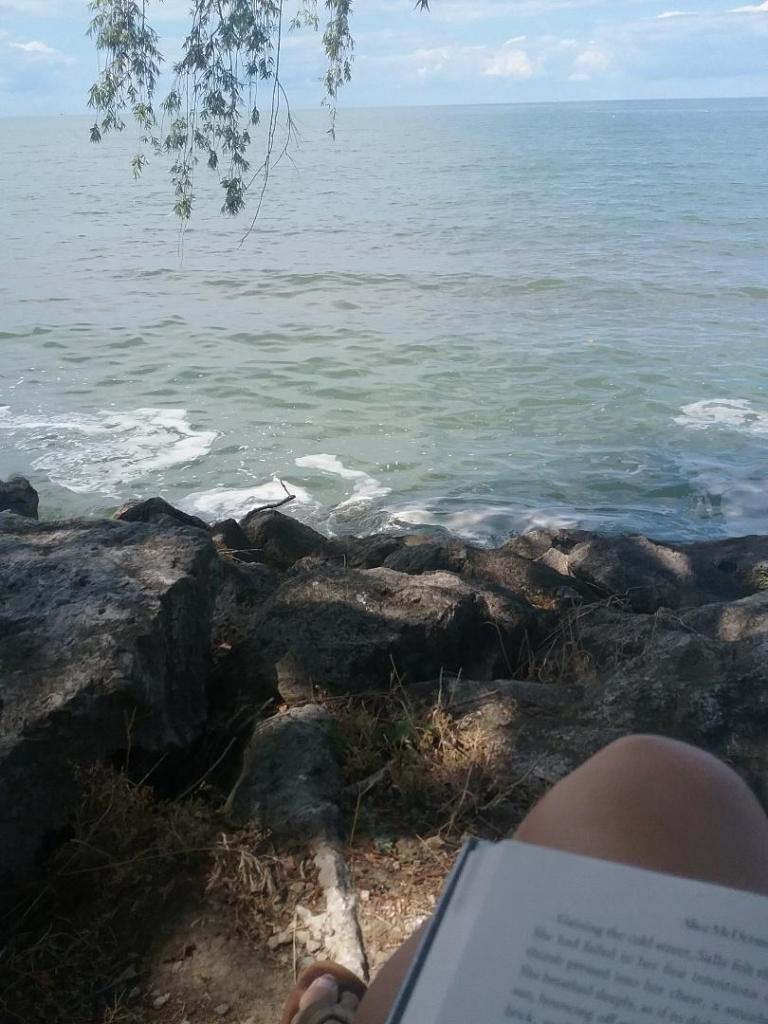
      Welcome to my lake-side reading spot.

      OK, sorry for the click bait-y title. The gallows humor. I neither take lightly “these uncertain times” we’re enduring, nor do I think we’re in for a siege of locusts next. But then there were murder hornets, so who knows? Those who’ve been around here a while know I’m a worrier. Uncertain times always feel dire until the next round of uncertain times comes along to take their place.

      I mean, who here remembers the joys of labor, delivery, and early motherhood?

      *raises both hands at once*

      End Times at every turn, right? Maybe that’s a bridge too far, but hear me out…when I say that my children’s birth–my guys I love like mad now–felt like the End Times. It was the end of my childlessness, of course, the end of my marriage as one with no children. It was also the beginning of a wonder-filled new stage of life, but that was hard to see through the haze of sleeplessness. I watch the quick videos my husband captured of those times, now, and I train my eyes only on the boys–round-cheeked and elbow-dimpled–because if I glance at then-me, I think of what I wasted. Busy worrying, instead of laughing, through it.

      I’ve been drawn to novels with strong themes of motherhood, this summer. (Maybe seeking some kind of fictional map to follow?)

      Margo Orlando Littell’s The Distance from Four Points, which I reviewed here last month, features a mother and her teenage daughter, and answers the question (among many other interesting questions): How does motherhood change when a mother takes her teenage daughter from their comfortable present to a past of painful secrets–the home the mother thought she left for good when she herself was a teenager?

      Aimee Liu’s Glorious Boy is an ambitious historical novel that follows an American couple and their “beloved but mysteriously mute” four-year-old boy. Family ties are tested–and severed–as the family is evacuated during World War II from their home in the remote Adaman Islands in the Bay of Bengal. At the heart is a question of motherhood: how does one best mother a child so unlike herself he seems, at times, a stranger?

      Which brings me to my current read (or one of them), Lydia Kiesling’s debut novel, The Golden State, which draws the reader into the panic-inducing, tear-filled, amorphous days of mothering a young toddler, alone. Here’s a taste:

      Finally we sit in the big bed and have milk which is warm in the sippy cup from this morning because I haven’t brought a carton and we have two stories Goodnight Moon and Goodnight Gorilla, trying to emphasize the goodnight aspect and the sleeping aspect, and I decide to forgo brushing teeth and then think no no no it’s too easy to fail to establish good habits and I haul her into the bathroom and poke at her with the toothbrush and she clamps her mouth shut and cries and then I lay her in the Pack ‘n Play turn on the sound machine say “I love you I love you I love you” and close the door and listen to her scream.*

      from Lydia Kiesling’s The Golden State

      Are your palms sweaty, like mine are, after reading that? Really, the prose is as funny as it is visceral. Though I don’t think I would have found it as funny when my boys were small, so there is such a thing as coming to a book at the right time.

      As for my writing, it’s been both heartening and depressing that one of my most popular blog posts remains a post from March, which ties these times to my own Dead Mom Club in highlighting Kübler-Ross and company’s stages of grief. These times can feel like the End Times, but there is still escape, and even laughter, if we look for it.

      What are you reading–and writing–this week? Are you able to laugh at all through these uncertain times? Show us whatcha got in the comments!

      * Did you notice the quote from The Golden State is one long sentence? (How I love a well-done run-on!) Up for a little writing challenge? Task yourself with writing just one sentence, when you feel stuck. Learn more from “The Case for Single-Sentence Prose in the Age of Insecurity,” by Jason Thayer and featured on the Brevity blog, yesterday.

      Mythologizing Mom…and other stories we tell to remember the lost

      Yearbook artwork by Cathy Doran, Class of 1963

      In another month, I’ll celebrate my mom’s birthday–for the 12th time since her death. A dozen years, a milestone of remembering. With the day comes a sort of dread, that I will forget–that I’ve already forgotten how the back of her hand felt under my fingertips, how much she liked her hair brushed, how she looked while telling her favorite jokes (I can’t repeat in polite company).

      Am I remembering all that right?

      Since my last post on the myths–and reality–we make around boys, I’ve been thinking a lot about the myths we create to remember. And I realize I’ve done that with my mom, picked key memories to cobble together her story–one to tell myself, over and over–because we don’t forget a good story. And forgetting is the most frightening thing.

      And so it was with relief that I got ahold of my mom’s high school yearbook, senior year, 1963–all skinny ties and strands of pearls–knowing the photographs and notes from my mom’s teenage friends would bolster the Mom-myth I’d written (providing supporting backstory, if no surprises).

      Read more

      My interview with author Amy Jo Burns

      Bio Pic-1

      Amy Jo Burns is the author of Cinderland, and her writing has appeared in Salon, Good Housekeeping, The Rumpus, Electric Literature, Tin House’s Open Bar, Ploughshares Online, and in Roxane Gay’s anthology Not That Bad. Her novel Shiner is forthcoming from Riverhead Books.

      Amy Jo was gracious enough to answer a few questions from another Rust Belt girl–me–about her literary memoir, Cinderland, which I discussed in a previous post; about her Rust Belt upbringing; about juggling the responsibilities of writing and motherhood; and about her upcoming novel, Shiner, which I can’t wait to read!

      Amy Jo–your memoir, Cinderland, is set in your hometown outside Pittsburgh. How did that particular post-industrial place inform your upbringing? Does your memoir’s title reflect the place in which you were raised, the abuse you suffered as a girl, both?

      I chose the title Cinderland because it represents an inner fire that remains after old, unnecessary things have died away. I see so much of myself in the landscape that I grew up in. The abandoned buildings, overgrown lots, and empty warehouses of my youth were (and are) placeholders for new things to come, and they are so beautiful to me. The story of the Rust Belt is still being written, even if some people call it a dead zone. There is life inside! Rust and cinders aren’t dead things. They’re just in a state of transformation, and I think that became a powerful metaphor for me to explore my own coming of age in my memoir.

      BURNS-Cinderland

      In your memoir, you discuss your Christian upbringing and throughout the book use biblical allusions. (Your abuser you call Mr. Lotte.) In using the language of the Bible, did you feel like you were wresting some control over that part of your childhood? Something else?

      The Bible was my first introduction to language, so it felt very natural for me to use biblical references as a way to represent how I see the world. This was such a good question for me to consider, because I just realized in borrowing some of that language, I was actually able to release some control over the painful parts of my past. For so long I tried to manage what had happened to me and my grief over it, and it only ended up suffocating me. I was afraid to let it be what it was.

      Sometimes I think “religion” tries to manhandle who God is, and having faith is the opposite: letting God be God, and finding rest because of it. For me, that meant letting Mr. Lotte be held accountable for what he did. It was not “Christian” for me to try to hide away his transgressions, even if some people in my community swore it was. When I was writing the book, I came across this verse in Proverbs 17:15:

      “Whitewashing bad people and throwing mud on good people are equally abhorrent to God.”

      I’d never heard that before. It’s not an exaggeration to say it changed my life to see that God has no interest in camouflaging a man’s true character for the sake of fake peace.

      You were a student of ballet, growing up. Had you known the true story you present in your essay, “Body on Fire,” of Emma Livry, a young ballerina whose costume caught on fire during a performance at the Paris Opera in 1862, or did you come upon it more recently? Can you talk about this idea of burning or “consuming” of women with respect to today’s #metoo movement?

      I came across that story about two years ago, and I still can’t stop thinking about it. Emma Livry had GUTS as an artist and as a woman, and I think she probably felt just as frustrated to perform for an audience full of men she didn’t trust as so many women still feel right now. Livry’s biographer, a male, seemed to suggest she was a victim of her own making, that it was her own vanity in wanting a certain kind of ballet skirt to wear that ultimately killed her when her tutu caught fire. I call foul! I think she knew her patrons saw her as nothing but a body for consumption. She fought to dance the way she wanted– wearing what she wanted–for herself, first and foremost. She paid a price for it. Livry wasn’t spared because of her talent or her drive. Instead, she was treated like a piece of machinery. That’s what resonates for me with today’s #metoo movement–she was blamed for choices that were never really hers to make.

      Have you changed as a writer since becoming a mother, besides having less time and energy to write?

      Yes! I wanted to finish Cinderland before I had children because I thought parenthood would make me overly sentimental. I didn’t want to write about my own childhood with too much nostalgia. It’s funny, though, because the opposite has been true. I’m much more raw as a person and as a writer now that I’m a mother, and I like it. My sense of self has totally shifted. I’m constantly becoming someone I’ve never been before, which is weird and wonderful and a little scary. There’s a new urgency to what I write now, like I’m trying to capture each meaningful truth before it disappears.

      Also: now I write while Paw Patrol plays in the background. I gave up on trying to find the ideal working environment. It doesn’t exist. That helps me value my writing time without letting it become too precious.

      Read more

      “Where are we sending them? Where are they going?” A photo re-blog from A Prayer Like Gravity

      dsc9886-nicholas2_edit
      Image from A Prayer Like Gravity

      These photos from A Prayer Like Gravity stirred me nearly to tears:

      Where are we sending them? Where are they going?

      I suppose there’s always been a certain amount of fear around kids at school. There’s the letting go, the separation from family and home. For me, this means a willful disentanglement of my heart from my kids’, as I drop them off at school every day. There’s no drama, no tears–it’s a wonderful school–but I do have to tamp down my mother love, or else I’d never let them go.

      Author Elizabeth Stone said:

      Making the decision to have a child…is to decide forever to have your heart go walking outside your body.

      She was right. So my little hearts leave my sight to beat and grow, and I have to remind myself it’s been eight years since we were skin to skin in the hospital at their birth. They are in their own skins now; they don’t need my mother heat like that.

      They are strong. I tell myself this when they come home telling me–so nonchalantly–about lock down drills.

      I don’t remember lock down drills in elementary school. I remember tornado drills, my knees pressed against the painted cement block walls of the hallway outside our classroom, my body curled like a potato bug, one in a long line of kids, our hands over the napes of our necks. I remember the Space Shuttle Challenger Disaster in fifth grade; when I returned home from school my mom was crying while folding laundry in the basement.

      I wonder if my kids will associate school with fear or if, instead, they’ll think of my hand taking theirs and squeezing it before they tumble out of the car each morning, looking like mini sherpas with their packs and bags. I hope that’s all the burden they’ll ever have to carry.

      Thanks to A Prayer Like Gravity for these photos:

      via Where are we sending them? Where are they going?

      Our Characters, Ourselves*


      OK, that title is a bit of a misnomer–this post isn’t wholly about bodies–but I liked it.

      This post is about the characters we create: both on paper and on, well, us.

      What happened is this: I was told I needed a headshot for story I wrote that will be published later this spring. My rarely-needed “headshots” are usually crop-jobs needed to extricate my face from the face of a small child or two. My last good headshot (above, left) was taken when I was 18 and an aspiring dancer–a whole lifetime and profession ago.

      I figured it was time. So I made an appointment for a blow-out at my local salon, where they said they would also make sure my makeup was camera-ready. Then I had my husband shoot a couple pics of my face, sans offspring, so that this journal can have my modern-day visage (above, right) for viewing alongside my story.

      Also, I will be recording myself reading my story, so that the journal can have my voice along with my story along with my face. This is all OK and even flattering; this is what we call exposure (ahem).

      Do you ever think about your own character? As bloggers we all have a handle, a personality. Mine’s Rust Belt Girl.

      I realize I spend so much time thinking about the characters I create on paper that I forget my own character, my dominant persona. I was a ballet dancer in my youth; then a student; then a young married woman; then an aspiring writer; then a mom.

      The “mom” character is basically all-consuming. The funny “mom” memes you see online–that’s for real. In writing, what “mom” means is that I’m supposed to write children’s literature now that I’ve birthed children who read literature. Instead, lately, I like to write about taboo subjects; a little incest anyone? (Please don’t message me with weird responses to this aside I meant to be funny/not funny.)

      Onward…this story of mine that will be published later this spring (or wet-winter), I actually let my children read. This is a first.

      One of my boys said he thought it was going to be funnier; one said he didn’t. Both read it until “The End”–4,000 words–so in my eyes it passed 8-year-old-boy muster. But I did have to “clean it up” first, which my more astute of my astute sons said meant, “Take out the bad words.” And the drug references and the…

      I create characters to live a different life, though I love mine. I’ve talked here before about my penchant for writerly distance. Still, the characters we create are extensions of ourselves.

      The other night, I attended a lecture/Q&A on developing believable characters in our writing, hosted by the Maryland Writers Association’s Annapolis chapter and featuring author and editor Barbara Esstman. My character-building takeaways:

      Characters inhabit a world–closed or confined systems can work well: think Lord of the Flies or The Handmaid’s Tale–with walls of some kind that will lean on and pressure a character. These boundaries that test a character can help the writer show what the character is made of.

      At least one of the main characters must have a problem to solve; when the character arrives at a solution, the story ends.

      Characters have a history before the start of the story. The writer should know it, but must decide what the reader needs to know and what the reader doesn’t.

      You know, sorta like this whole blogging thing. The reader needs to know us writers and highlights of our history–the stuff that matters–to understand our character, to feel invested in us and want to follow our story.

      I’ve said it before and I’ll say it again: Thank you for following my story.

      Do you consider your blogging persona? (Is it just me?) Is it one in the same with you? Somehow different?

      Have any tips for creating believable characters in essay, memoir, or fiction?

      * A little nod to Our Bodies, Ourselves (a book about women’s health and sexuality first published in the late 1960s). A relevant character-building takeaway: characters, like real people, have needs and wants. Characters, like us, go grocery shopping and sneak ice cream at 10:30pm. (Oh, is that just me?)

      a bit of writerly advice

      banner-2748305__480

      As a gift to celebrate the birth of my twins (more than eight years ago!) a good friend gave me a book, Writing Motherhood, by award-winning writer and educator Lisa Garrigues. (Many thanks, again, R.!)

      In the book, the author draws from her own efforts to balance motherhood with writing and shows that mothering “provides endless material for writing at the same time that writing brings clarity and insight to mothering.”

      Some of her best advice applies to mothers or anyone else feeling emotionally and physically drained by the rigors and responsibilities of life:

      [They ] arrived feeling physically exhausted and emotionally spent–in some cases “brain-dead”…they discovered that motherhood need not be an impediment to creativity. On the contrary, it can be a limitless source for story–a mother lode, if you will.

      Write on!