The Shape of Things: Reading Sarah Smarsh’s HEARTLAND

Image by David Mark from Pixabay

One particular shape captured my attention freshman year of college. That was Maslow’s hierarchy of needs theory triangle. Remember that one? A foundation of basic needs building up, I.M. Pei style, to more lofty psychic needs, like self-actualization: the needs-lite, if you will, that keep people like us writing and reading.

I don’t recall taking any social science courses in high school, so introductory Psychology and Sociology were a revelation. Our high school courses were cut and dry: dates, times, rules of usage, facts, and figures that were set, that didn’t depend on personal or group experience. An isosceles triangle was the same, whether it sat in a wheat field in Kansas or a steel mill in Ohio.

Of course, like shapes, people are also the same everywhere. Isn’t this what we like to think? Americans are Americans, wherever they’re set down? Heck, I grew up in Ohio, The Heart of It All (my home state’s tourism slogan then). The world was my oyster, or, perhaps, zebra mussel. But I digress…

I did not grow up in Sarah Smarsh’s American heartland of Kansas. Yet, Smarsh, the author of HEARTLAND: A Memoir of Working Hard and Being Broke in the Richest Country on Earth, and I share enough similarities that I recognized much of the emotional terrain of her memoir. We’re both white females who were born into Catholic Midwestern families of German extraction with Amish down the road; we’re both college educated (at state schools). Only, our roads to college were decidedly different, due in large part to what sociologist and journalist Barbara Ehrenreich calls “America’s most taboo subject”: class.

Read more

My interview with author, poet, and publisher Larry Smith

When I first met Larry Smith in Ohio, he was sporting a Cleveland Browns cap–not an unusual fashion choice for a sports venue or bar, but we were at a literary conference. From this first impression, I could sense two things: the cap wasn’t ironical and Larry was my kind of literary people.

As it turns out, the Ohio-based author, poet, and director of Bottom Dog Press/Bird Dog Publishing and I have much more in common than rooting for the home team. There’s an abiding sense of creative responsibility, a promise to tell our own stories, that comes with hailing from a place like ours. I’m going to go out on a limb and say Larry and I try to make good on that promise. Larry has definitely made good on his.

This National Poetry Month of April, Larry was also gracious enough to take the time to answer over email my questions–about the writing life and what it means to publish poems and stories rooted in place. “There is always some blurring of identity here,” says Larry, “between Larry Smith and Bottom Dog Press.”

Though much of my life is Bottom Dog Press, my life extends beyond that, and Bottom Dog Press is more than I am, too, it’s over 210 books and about 500 authors.

Let’s learn more…

Larry, how did growing up in the Rust Belt, specifically an Ohio mill town, affect your writing sensibilities and choices?

Well, this goes to the heart of it and of myself. You can’t take out of me the Ohio Valley and the working-class world I grew up in. I was nurtured on that life and those values of hard work and character, of family and neighborhood, of just accepting and caring for each other. I write from who I am, and though I worked as a college professor and live in a middle class neighborhood now, I am still that kid getting up to deliver morning papers and watch my father pack his lunch for work on the railroad. Read more

From Architectural Afterlife: “This Cleveland Church has Sat Abandoned for 27 Years”

Interior of Nativity of the Blessed Virgin Mary Roman Catholic Church in Cleveland, Ohio. Photo and story credit: Johnny Joo, architecturalafterlife.com

Maybe old buildings are in my blood. For forty years, my dad worked as a draftsman and designer for structural engineering firms, drawing up plans by hand. On trips into Cleveland for the art museum or bagels, Dad would point out the buildings he’d had a hand in. His job: ensuring they would stay standing.

So, it feels like a personal affront to watch buildings–especially beautiful historic places–go to ruin, abandoned.

I’ve talked on the blog before about “Ruin Porn,” a type of photography that glorifies falling-down structures, often in post-industrial places, like my native Cleveland. I’ve said before, that to me Ruin Porn looks like the American Dream on its knees with no dreamer in the scene. (I wrote a three-part essay you can read here, here, and here.) So, what do we do? How to salvage falling-down places?

Read more

My interview with Ohio Poet Laureate Dave Lucas

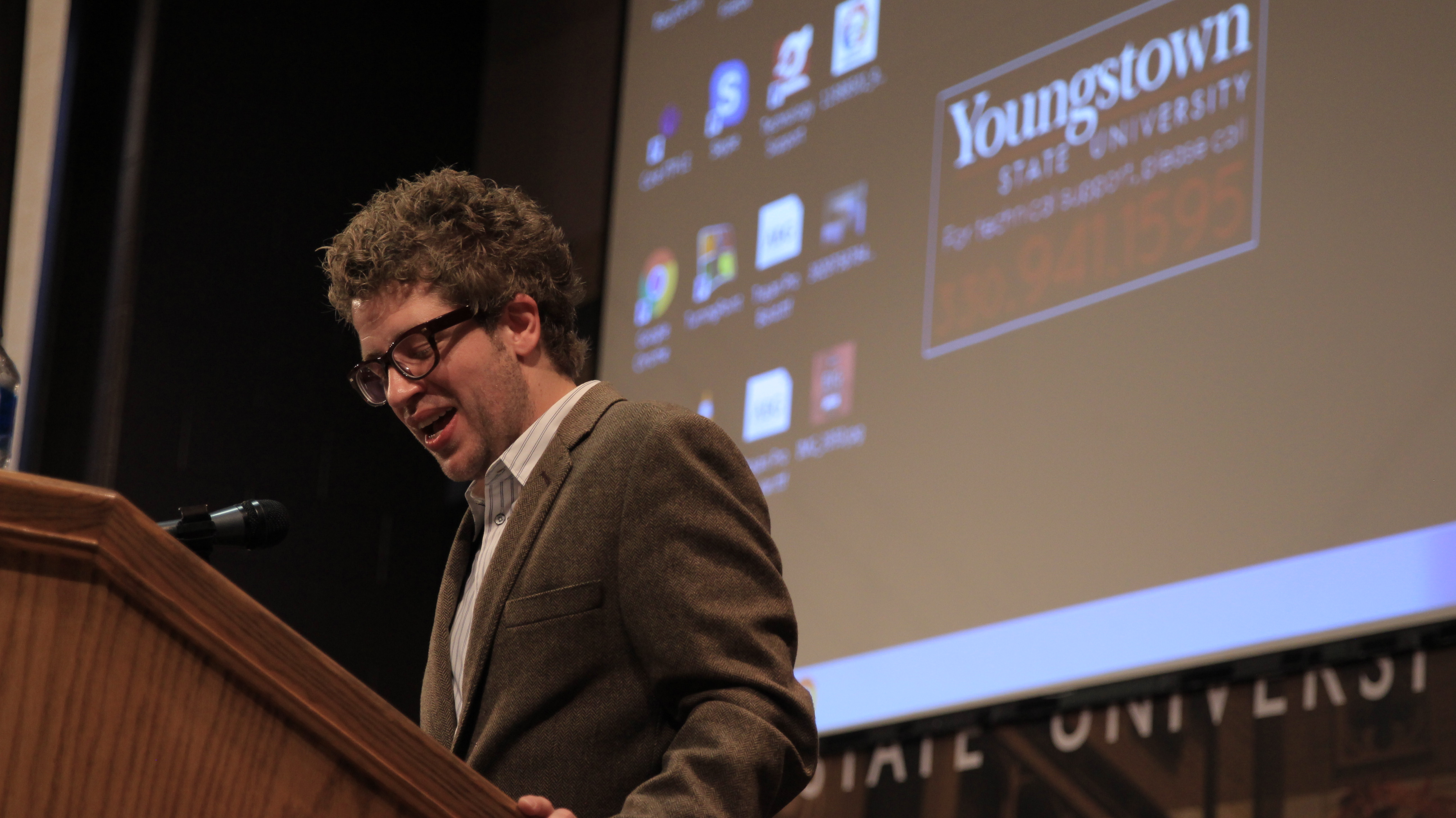
Ohio Poet Laureate Dave Lucas presenting at Lit Youngstown’s 2018 Fall Literary Festival*

Love poetry or hate it (btw, you don’t really hate it), Ohio Poet Laureate Dave Lucas is right there with you.

What’s it like to be a poet laureate? I asked Dave Lucas that–and more–in this interview over email. Here’s what the author, teacher, and “poetry evangelist” had to say.

Dave, how much does it mean for you to have been chosen as Poet Laureate of Ohio, and what’s up next for 2019?

If you’d asked me this a year ago, I would have said how honored I felt by the selection and how excited I was for the two years to come.  A year into my term I still feel honored and excited, but more than anything I feel gratitude.  I’m grateful for the opportunity to see parts of my home state I’ve never visited before, to talk about poetry in such varied settings and with so many people for whom poetry is a way of making meaning of their lives.

In 2019 I hope to continue those travels, but I also hope to “meet” more Ohioans virtually through the “Poetry for People Who Hate Poetry” project.  The project entails a monthly column syndicated in Ohio newspapers and media outlets; this year we hope to create a podcast version as well, so that we can promote poetry in whatever medium Ohioans get their information and culture.

As Poet Laureate, I imagine you’ve met many Ohioans in your travels around the state. What has surprised you most?

I’ve certainly been struck by the number and quality of poetry programs taking place at the regional and local levels.  These are workshops, reading groups, recitations, slams, and more, and I’ve encountered them everywhere I’ve traveled in Ohio.  The internet has of course been revolutionary for bringing people together around a common interest, but there’s something wonderful about seeing people gather in common physical space to talk about poetry.

In your Poet Laureate column on the Ohio Arts Council site, as well as in the classroom, you send the message that most of us love poetry, even if we don’t know it yet. Can you talk a little about how you define poetry and give us a couple examples of the kinds of poetic language we can find outside of what we traditionally think of as poetry?

Literary history tells us that anyone who attempts to define poetry today is about to be proven wrong tomorrow.  That’s both the pleasure and challenge of trying to say what poetry is or isn’t.  So I try to maintain as broad and flexible a definition as possible.  I think that poetry is the aesthetic pleasure we take in language.  Words are for play as well as work, as the groan-worthy puns of any good “Dad joke” will demonstrate.

So puns and jokes in general might be examples of the poetry we find outside of “poems.”  So are the metaphors we use to describe the world.  Riddles, jingles, lyrics, mnemonics, and more.  For instance, I’ve just finished a column (my sixth installment) about the artistry of slang, which Walt Whitman treats as the democratic aspect of poetry.  In this column I argue that even if you haven’t read a poem since high school, you participate every day in the artistry of language simply via the creativity of the slang you use. Read more

Powerful conversations and an essay by Melissa Ballard

A nuclear power plant near home

My mom wasn’t a hippie, though she lived on Hessler Road as a college student–a Cleveland street where hippie power still reigns. Late 60s, with my bearded dad at the wheel of their VW bug, they looked the hippie part, anyway. Enough to be stopped by a police officer, as they traveled country roads to my mom’s parents’ house in upstate New York. The checkpoint was in a little place called Woodstock. The officer tapped on the driver’s-side window. “Going to the music festival?”

“What music festival?”

Alas. My lovely parents weren’t hippies, but they weren’t content to become carbon copies of their parents, either. Starting fresh, newly-married, they moved to the country, where they would raise a few ducks, some chickens, a goat named Esmeralda, and eventually us human kids. What veggies she couldn’t grow in her lush garden, my mom got from the natural food co-op she helped to run. We had a local honey man and a pumpkin man. None of this struck us kids as any kind of resistance against the powers of 80s consumerism powered by…well, power.

Read more

3 Reasons to Connect with Your Creative Community; 3 Words of Thanks; 3 Inspiring Writers

The writing life is often, necessarily, an isolated one. To create a world on paper (or screen) takes holing ourselves up, cutting ourselves off from the myriad distractions of modern life.

For our writing to matter to anyone outside our own heads, however, we must connect.

20180922_171431

3 good reasons to connect with your creative community:

To find readers: Not surprisingly, most of the followers of this blog are other bloggers; the readers of my short fiction are other writers. You will find readers in writers, and v.v.

To research that next WIP: Let’s not research entirely online (pleads this former college composition instructor). Speaking of research, heartfelt Kiiitos paljon (Thanks a lot!) to all the wonderful folks at the Finnish Heritage Museum and to Lasse Hiltunen, president, in particular for the wonderful tour and background information on everything Finnish! (If you ever find yourself near Fairport Harbor, Ohio, don’t miss this gem of a museum.) Lesson-learned: take your research on-site, when you can.


To gain inspiration: How inspiring is that library carrel? As delightful as isolation can be, even the most introverted writer needs to get “out there” once in a while.

While online writing communities and critique groups, library databases and catalogues have been invaluable to my perspective, there’s no substitute for the in-the-flesh writing community.

I’m a writer interested in exploring place, specifically the U.S. Rust Belt (more specifically, Ohio), and yet I no longer live in that place. No, the irony isn’t lost on me. It’s one of the reasons I started this blog–to connect with readers and writers and photographers in my native place.

20180922_171453.jpg

But virtual connection is not enough. Sometimes one has to be boots-on-the-ground there. And so, after some preparation to make the most of the conference, I drove my proverbial boots the five-and-a-half hours to attend Lit Youngstown’s 2nd Annual Literary Festival this past weekend. 3 inspiring festival highlights–not just to plug this literary festival (but do come next year, if you’re in the area; I plan to) but every and all such excuses to communally share our stories:

Dave Lucas, Ohio Poet Laureate and author of Weather: Poems, presented a piece about the mythic in poetry for an audience of fiction writers, creative nonfiction writers, and poets. (Poetry not your thing? I get that, and have talked about my on-again-off-again relationship with poetry. But Lucas is all about finding the poetic in the everyday; he talks about that here–from about minute 8 on).

Lesley Nneka Arimah, author of the amazing short story collection What It Means When a Man Falls from the Sky, read a few of her stories and graciously shared a little from her formative years. Arimah told a story about visiting the public library in summer with her sister, where they would each check out the max amount of books–50–and when finished with her tower, trade, and read her sister’s. Sure, Arimah read literature with a capital “L”, she joked; but she also read romance novels and fantasy, and continues to do so today–and her literary short fiction is all the more playful and magical because of it.

Jon Kerstetter, read from his memoir, Crossings: A Doctor-Soldier’s Story, which chronicles a life begun in poverty on the Oneida Reservation in Wisconsin to a life in business before Kerstetter pursued his dream of becoming a physician. When his days as an emergency doctor weren’t proving exciting enough, he volunteered for tours as an emergency military medic. After three tours in Iraq, Kerstetter returned to the U.S., injured, but this was only the start of his stateside struggles, as he suffered a stroke–leading to his reinvention as an author through the writing of his life’s story.


Inspiration abounded at this literary conference–and not just from the big names but from the poems and stories bravely shared by writers at all stages at open-mic and in conversation.

Me, I braved the mic to read a flash fiction piece of mine set not far from where we sat, amid the rolling hills and history of Northeastern Ohio. I also took part in a publishing panel to extol the virtues of connecting through traditional and nontraditional publishing, including sites like this blog–when we can’t connect in person.

And today I returned to my writing desk feeling inspired and connected in a meaningful way to the stories of home. Thanks a lot to all who made it happen!

Have you done the conference thing–for writing, blogging, or anything else? What are the benefits to in-the-flesh arts and literary communities?

Are you a Rust Belt author, blogger, or photographer? I’m always looking for stories to share.


*Photos from top down are of Youngstown, Ohio, buildings, the Finnish Heritage Museum in Fairport Harbor, and interior shots of St. John’s Episcopal Church in Youngtown, where the Arimah and Kerstetter readings were held.


OH

37517946_10161121436100455_3609514206598004736_o

I have to say, I felt a little bit vindicated when reading author Lauren Groff‘s latest interview with Poets & Writers magazine (her short story collection, Florida, was released earlier this year) in which she asserts: “Florida is the biggest joke of all the states. It is the punchline to every other state’s joke.”

Oh?

That statement, itself, feels like a joke to this Cleveland, Ohio native. A quick recap for the Buckeye State-uninitiated: OH is flyover country; Cleveland is the “Mistake on the Lake”; the home team Cleveland Browns’ last season went 0 and 16. (Yep, it’s a rebuilding year–again.)

Read more

Love in Cleveland: a story-review of CROOKED RIVER BURNING

81zSeikDc3L

There’s something special about a love story set in the time and place one’s parents fell in love.

Paris? London? Niagara Falls? Nope. I’m talking about Cleveland, Ohio.

The real love story (that eventually begat me and my siblings) started with a blind date. Here goes: the young man who would become my dad met the young woman who would become my mom at her apartment door. Her first words to him: “You’re not as bald as they said you were.” Ah, romance. Long story short, she liked his car, a racing-green Austin Healey convertible, and him too, no doubt.

Crooked River Burning*, a novel by Mark Winegardner, explores parallel love stories—between a boy from Cleveland’s West Side and a girl from Cleveland’s East Side (read: upstart vs. old money); and between the people of Cleveland and their city itself.

From the book jacket:

In 1948 Cleveland was America’s sixth biggest city; by 1969 [the year my parents married] it was the twelfth…In the summer of 1948, fourteen-year-old David Zielinsky can look forward to a job at the docks. Anne O’Connor, at twelve, is the apple of her political boss father’s eye. David and Anne will meet—and fall in love—four years later, and for the next twenty years this pair will be reluctantly star-crossed lovers in a troubled and turbulent country.

The city of Cleveland is a microcosm of this changing country. The author gives the reader a window into organized crime in the 40s, when we meet real-life Clevelander Eliot Ness; into the 50s rock and roll scene starring disc jockey Alan Freed; and into the race riots of the 60s, when we meet Carl Stokes, the first black mayor of a major U.S. city.

For sports fans (Winegardner is also the author of The Veracruz Blues about baseball), there are stories plenty about the Indians and the Browns (with Art Modell cast as the Machiavellian villain he was, IMO.) Masterfully blending fact (replete with entertaining footnotes) and fiction, this novel is comparable to the works of E.L. Doctorow. Where Doctorow explored New York, Winegardner explores Cleveland.

Does Winegardner know Cleveland! One of my favorite Cleveland bits—and never more appropriate than now, as we endure “wet-winter” into April:

“In Cleveland there is no spring. In Cleveland there is winter, then a wetter-meaner sort of winter…Then one day winter/wet-winter ends and, bingo-bango, it’s summertime.”

But why talk weather when we can talk love? Wingardner on love:

“A person can be in love with the idea of love. A person can fall in love with the idea of another person. Less commonly, a person can fall in love with another person.

In fact, a person always falls in love with the idea of another person, not the person. Falling in love with the actual person takes time and too much honesty…

Some people luck out. The thing they’ve been calling love turns out to be just that. Such people exist. Film at eleven.”

Oh, you were looking for love between David and Anne? I’m not spoiling much when I tell you that the most romantic setting in the book, a snowy New York at Christmastime in a posh hotel suite, and Anne is down with the flu. On the other extreme, the setting of the Cuyahoga (“crooked”) River on fire finds our protagonists in, well, love as real as it gets.

Is the book perfect? Not quite. For me, some of the real-life Cleveland profile sections ran a little long: among them, Mayor Carl Stokes, Cleveland newspaper editor Louie Seltzer, maybe-murderer Dr. Sam Sheppard, pioneer news broadcaster Dorothy Fuldheim. Still, this book will find a place on my bookshelves, alongside Ian McEwan’s The Innocent, perhaps, for its mastery of a real time and place in history overlaid with a timeless love story and for a lyrical yet playful use of language.

But back to our fictional lovers…through their twenties and thirties, David and Anne attempt to make their childhood professional dreams (Cleveland mayor, and war correspondent, respectively) come true. But, like thwarted love stories talk of ships passing, most of us don’t become our childhood heroes.

If the real Cleveland love story—starring my dad and my mom—could have met the imagined one starring David and Anne, they would have come together in the late 60s. Both couples were in love as the real city burned its land and its water. The Cuyahoga River burned (helping to create the Clean Water Act); and the Hough Riots, among the first of the 1960s race riots, turned Clevelanders against their neighbors and even against themselves.

Like many Clevelanders who could, my parents left the city for a house in the country, where they would raise a few chickens and ducks, a goat named Esmeralda, and three human kids. In trading one setting for another, I’m sure they’d say they gained more than they lost. I wonder about those who didn’t leave.

Did Winegardner intend for this dual love story to be a cautionary tale? In 2018, one could read the book that way—especially through the lens of race. One of the most chilling parts of the book comes from Anne’s perspective. It’s a month after the riots, and Anne is questioning everything in her life and in her city:

“Human beings don’t destroy their own homes, do they? In Anne’s experience, they do…Rome burns. Has burned, is burning, always will be burning. Look harder. Smell it. It’s not Rome we’re talking about, sport. (Who knows but on the lower frequencies, Cleveland burns for you?) Yet you sit there. We sit there. Don’t move.”

My rating: 4.5 stars

What’s the best book you’ve read about your hometown? If you were going to write your own love story, where would you set it?

*Published in 2001 by Mariner Books (576 pages). Yep, I’m late to the party.

Like this review? Check out my “reviews” category above for more.

Thanks! ~ Rebecca


Revisiting summers past through the abandonment photography of Johnny Joo

Geauga Lake image_Johnny Joo
This and all images in this post are by Johnny Joo at architecturalafterlife.com.

Go ahead and call it nostalgia. Or rose-colored glasses, cockeyed Midwestern optimism, or plain delusion. (Or, as snow remains in the forecast well into April here in my adopted southern home, call it willful reversion.) Whatever.

I dream of childhood summers in Ohio.

Summer, especially, felt like a gift from the heavens after enduring a frigid (Daily Prompt) winter in the Snowbelt and a five-minute spring that brought little more than a white Easter, a lackluster Maple Festival, and mud.

Summer, glorious, oblivious 1980s summer brought us SeaWorld.

Yep, that SeaWorld–not in California or Florida but in Ohio. No joke. The smallest of the SeaWorld parks, at 50 acres, SeaWorld Ohio opened in 1970 and was located on Geauga Lake, where 1950s-esque good-guy-gets-the-girl acts were performed atop pyramids of water-skiers. (How I wanted to be one of those girls!) Then there were the animals: the sea lions show, the jumping dolphins, the otters who were made to “talk” with piped-in chipmunk voices. The shark and penguin encounters. And, of course, the stars: Shamu and Mamu, the killer whales.

This was long before your average theme park attendee called them orcas or gave a thought to the health and socialization of large animals in captivity. Zoos still thrived; the circus hadn’t died.

By 2004, SeaWorld Ohio was basically abandoned. You can view eerie before and after photos taken by former SeaWorld Ohio animal trainer Nico Maragos.

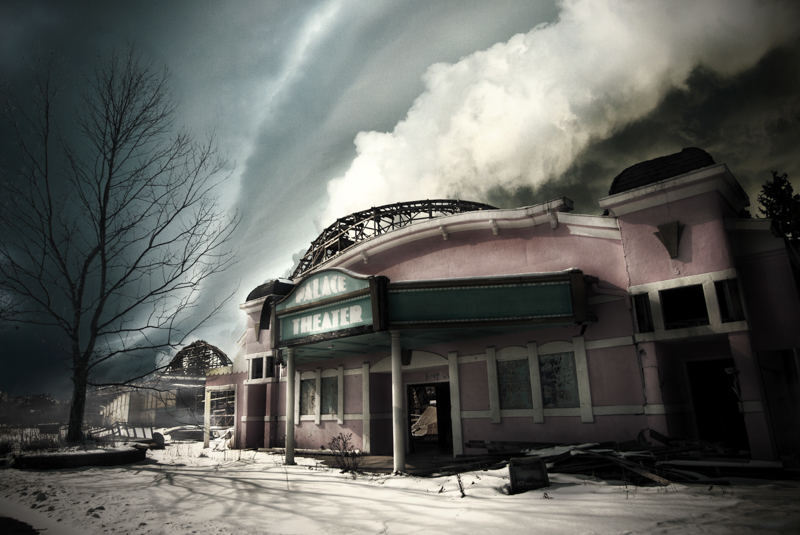
More of a thrill-seeker? Geauga Lake amusement park was right across the lake from SeaWorld’s water-ski shows and called to us with her skyline of roller coasters. Ohio-based photographer Johnny Joo has captured stunning images of the theme park (like the one at the top of this post), which closed in 2007.

Here’s a couple more:

See them all via The Abandoned Geauga Lake pre-demolition

I’ve included Rust Belt photography on my blog before, but Joo covers not only abandoned places of work but of play.

I’ve also railed against abandonment photography, sometimes called ruin porn, for forgetting the people the places left behind. (Of course many of us did leave these places behind, in droves, often for warmer climes.) Still, Joo’s mission is exactly the opposite for his blog Architectural Afterlife: Preserving History Through Imagery. I hope you’ll check it out.

Are you a Rust Belt photographer with images to share? Let me know! Just summer-dreaming?

Post a comment here or on my FB page.

My interview with FURNISHING ETERNITY author David Giffels

David Giffels is the author of Furnishing Eternity: A Father, a Son, a Coffin, and a Measure of Life, published by Scribner in 2018.

“…when he enlisted his eighty-one-year-old dad to help him with the unusual project of building his own casket, [Giffels] thought of it mostly as an opportunity to sharpen his woodworking skills and to spend time together. But life, as it usually does, had other plans.” (From the book jacket copy.)

Giffels’s father, Thomas Giffels, passed away three days after this book on loss and grief was released. “The book is so much about him, and mortality, and thinking about aging parents and all these themes that were directly connected to him,” said the author, who spoke with me earlier this month.

Furnishing Eternity continues the Akron, Ohio, author’s award-winning literary career. Giffels’s previous books include The Hard Way on Purpose: Essays and Dispatches From the Rust Belt and All the Way Home: Building a Family in a Falling-Down House, his first memoir. He teaches creative nonfiction in the Northeast Ohio Master of Fine Arts Program.

David–place figured majorly in your last book, The Hard Way on Purpose. How does place figure into Furnishing Eternity?

My last book was about place in a regional, communal kind of way, a place I share with a lot of people—the Rust Belt and the industrial Midwest. I think about Furnishing Eternity as being about place in a different way. It’s a much more personal book, but I identify the place of my father’s barn and workshop very directly with him. That’s where his true nature was. It’s where I communicated with him the best. The much more intimate spaces of his barn and workshop are central to this story.

In Furnishing Eternity, you experience the death of your mother and your best friend, John. I read that much in the sections about your grieving those losses began as journal entries. Can you talk about how you progressed from journal-writing to essay-writing?

This book was different, because I knew I was going to be living things as I was writing about them, which is closer to journalism than it is to memoir. So I was already doing a lot of note-taking about the process of building a casket and about spending time with my father. I was careful with my note-taking, to record things as they were happening, knowing they would be in the writing. When my mom died, unexpectedly, and John died—that note-taking became less of a literary process and more of a personal process.

The writing involved working from raw notes that were sometimes painful to read, that I took, day by day, aware that that material would be part of what I was writing for the book and aware that I was also recording my emotional life. That’s hard material to work from. It was so raw, so immediate, and so chaotic. When you grieve someone it can be a violent and unpredictable process, and writing requires stepping back and seeing the shape of things. I was trying to do that on the fly, so it took a lot of drafts and a lot of trying to distance myself. The process was different from anything I’d done as a writer. When I wrote All the Way Home, it was ten years after the events and I had settled a narrative in my head. I could see things with objective distance that made it a much different writing experience. It’s easier to regain the immediacy of something that’s in the near distant past than it is to step away from the immediacy of something ongoing.

Joan Didion’s The Year of Magical Thinking was vital to that process; not just the process of writing—she’s writing about writing about grief—but also the process of grieving. I had avoided reading the book while I was writing Furnishing Eternity, because I didn’t want my writing to be influenced by it. But when my mom died I knew I had to read that book to help me with the process of grieving my mother. Didion was vital to my personal loss and my ability to write about it.

Do you journal much, regularly?

Not very much. Spending many years as a journalist has made me much more workman-like as a writer. I have journaled at various times, but to me, writing is getting down to work and doing it when it needs to be done. I think in banker’s hours. Once I’m working on a project, it’s all-consuming. I’m always taking notes. When you’re working on a writing project, you become a selective magnet, like all of a sudden everything in the world is being tested to see whether it’s going to be drawn to your subject. If it is, it comes flying at you and sticks. I’ll hear or see something and think, I have to write that down right away. That’s urgent journaling, I guess. Read more