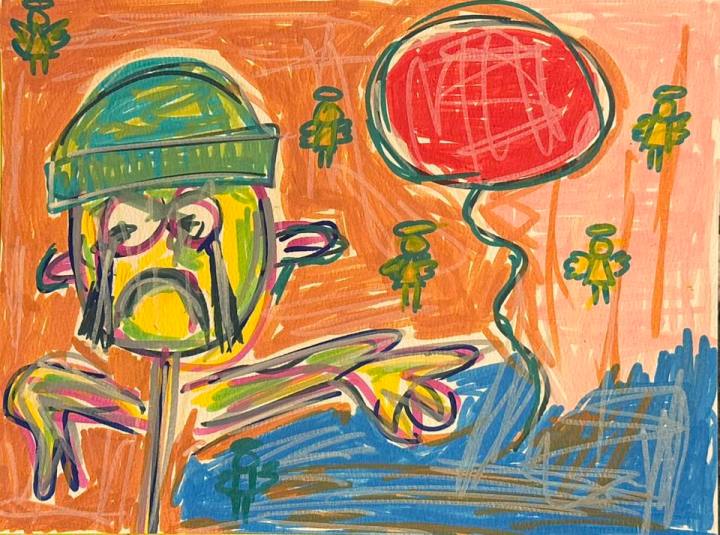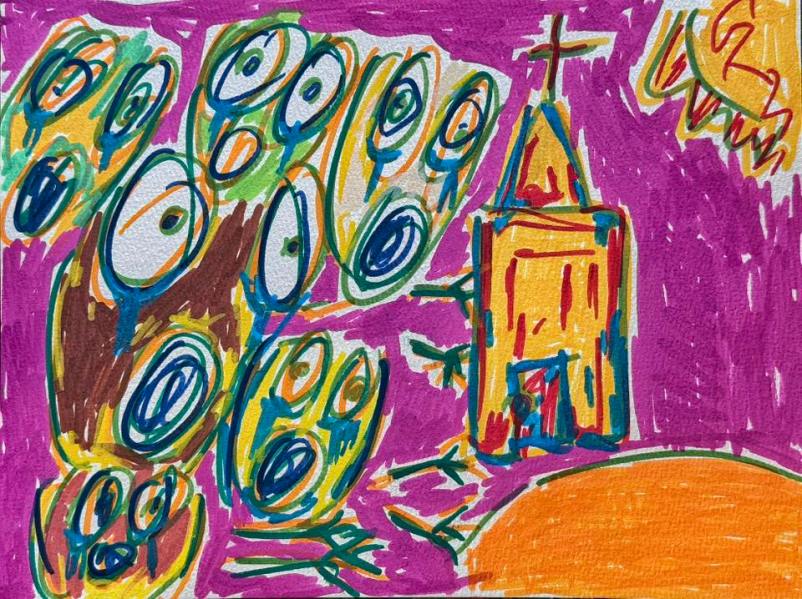
“…the holy and the ordinary rubbing shoulders…” Essay and images by Justin Hamm

A full-color folk art image depicting open mouths and a church with a cross on top

Poet, photographer, and model literary citizen, Justin Hamm inspires with his offering–the third installment of a series of guest posts here at Rust Belt Girl. Thank you, Justin! His essay about speaking in tongues feels especially personal, presented as it is from a child’s perspective. It feels “close” to me, in more than one way. Justin’s essay is accompanied by his original folk art, and I have to say, I didn’t see this coming. But I absolutely love it. Here at Rust Belt Girl, we know the American Midwest is vast and multitudinous, and so are its people, their inspirations, their stories, and their art.

Because Justin is truly “Midwest Nice” and humble, he might not brag to you about his TEDxOshKosh Talk, “The American Midwest: A Story in Poems & Photographs, but I’ll do it for him. This is a good place to start, if you’re new to Justin. In his talk, he asks some of the same questions we’ve been asking at Rust Belt Girl all these years. A big one: Is “flyover country” an appropriate term for the Midwest? Justin explores that vital question through inspection of the overlooked or the avoided, including rust (holla!), thunderstorms, everyday people doing everyday things, politics, social class, and more. It’s well worth a watch-and-listen.

But first. Let’s read and discuss Justin Hamm’s…

The Wind With a Secret Shape 

I was eight maybe nine years old Wednesday nights my grandparents used to 

take me to a small Pentecostal church that sat on a grassy rise just outside of 

town it had once felt isolated tucked out in the quiet but the town had crept 

outward now it sat beside a gas station a lumberyard and a row of fast-food 

joints the holy and the ordinary rubbing shoulders the church rectangular part 

brick part white siding a white cross stretching off the roofline like an arrow 

pointing to the shifting Illinois sky inside the pews angled toward a low 

platform where the preacher shouted and a four-piece band laid down rhythm 

the cushions a deep royal blue clean saturated almost regal I remember that 

color better than my childhood bedroom the building always felt old but never 

run-down the women cleaned it like a calling while the men kept it maintained 

it smelled of floor polish and breath mints old hymnals and hairspray a past 

preserved a place where time seemed fixed in place 

I wanted to be a good boy I tried to follow the sermons caught a phrase here or 

there but mostly folded handouts into paper planes or built hymnbook 

pyramids sometimes I curled up on the back pew and drifted off lulled by the 

rhythm of scripture and song until the spirit moved when it hit the preacher 

everything changed he’d leap down the steps whirling stomping at the devil 

howling Jesus’ name until his face went red and purple sweat soaking his brow 

and then the tongues came strange breathless syllables rolling out like a chant 

that bypassed the brain entirely the holy ghost made you do things that was 

just how it worked I accepted it the way you’d accept sunrise or gravity 

and I believed too believed fully if somebody said the spirit is with us tonight 

I’d scan the sanctuary up in the corners where wall met ceiling under pews 

between swaying bodies I didn’t expect to see it exactly but I wanted to know 

where it was it filled me with something like fear but not only fear there was 

longing in it too hunger a sense that something just out of reach might solve 

everything the holy ghost like a wind with a secret shape a bird made of breath 

maybe God’s own breath moving invisibly through the room I believed it 

entered through the mouth that explained what came out the old men would 

rise in their too-large suits limping loops around the sanctuary hands raised 

speaking in tongues the women would fall stiff to the ground eyes rolled back 

mouths twitching that’s how I knew the ghost was on the move I tracked it 

sinner to sinner and sometimes it came close the person next to me would 

sway eyelids flickering syllables rising up like springwater through stone my 

chest would lift my legs would buzz my mouth would soften and open almost 

involuntarily I’d think this is it just let yourself go let it take you I opened my 

mouth and nothing came I tried again wider harder I prayed the best I knew 

how I swallowed the air like it might carry something eternal and then I waited 
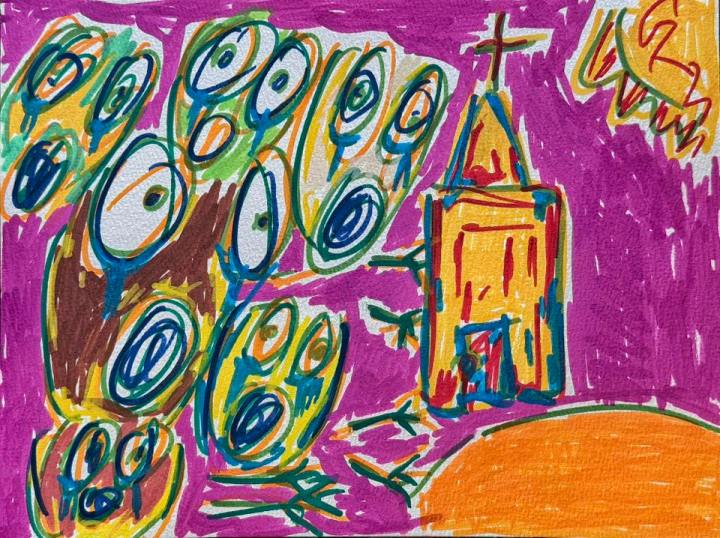
  • A full-color folk art image depicting open mouths and a church with a cross on top
  • Full-color folk art depicting a boy with a green hat, crying over a red balloon
  • Full-color folk art depicting a hand reaching out and touching another person, while a cross glows in the background
  • Full-color folk art depicting angels and a person with a downcast face

Justin Hamm is the author of five poetry collections, including O Death (2024), Drinking Guinness With the Dead (2022), and The Inheritance (2019), as well as a book of photography, Midwestern. He is the founding editor of the museum of americana and the creator of Poet Baseball Cards. 


Like this post? Like this series? Let’s discuss! Comment below or on my FB page. And please share with your friends and social network. 

Are you a Rust Belt writer interested in seeing if your own post, or author interview, or book review might be right for Rust Belt Girl? Hit me up through this site’s contact function.

Check out my categories above for more guest posts, interviews, book reviews, literary musings, and writing advice we all cab use. Never miss a post when you follow Rust Belt Girl. Thanks! ~Rebecca

Enter your email address to subscribe to this blog and receive notifications of new posts by email.

“My photos are already out there waiting for me…” Photography by Jason Irwin

A black and white photograph of a Westfield, NY, lake, featuring small houses along the water and bare trees that are reflected.

Thank you, thank you to Jason Irwin, who kicks off a series of guest posts at Rust Belt Girl, and to you, for being here! What is a Rust Belt place–and who defines the perameters? What does post-industrial mean today? What are a place’s histories, characteristics, and quirks–and how have they shaped its people and its art? How have they shaped the stories we tell, and what have those stories meant for Grit Lit and Rural Noir writing and for other mediums of creative expression? For this series, I suspect we will get some fascinating answers to these questions and many more I haven’t thought of.

A guest post by Jason Irwin

Though I have used film in the past, as well as digital cameras, I consider myself an amateur. I owned a flip phone for 22 years but finally gave in and bought a smart phone during the summer of 2024. Do I love my smart phone? Well, no, but it makes life easier, and I do love the camera feature.

I believe my photos are already out there waiting for me to stumble upon. I like taking photos of people naturally, most often without them knowing I’m taking their photos. I prefer them off-center. I also like wide-open, desolate landscapes and cityscapes: derelict, sometimes abandoned buildings, windows, doorways, big skies, fields, and bodies of water. My hometown of Dunkirk, New York, is a perfect place for such photos. I hope the three photos in this post show this. 

A black and white photo of a vintage boutique called Serendipity. There are headless, dressed mannequins in the window, along with a decorated Christmas tree.

Serendipity, the storefront boutique in Madison, Indiana, looked lost in time to me, as my wife and I drove past. Maybe not in the 50s but still lost in time. Using the grayscale setting on my Samsung smartphone ads to the notion that this photo is older than it appears. Madison is her hometown, or rather Deputy, an unincorporated rural community about 18 miles northwest of Madison. Just outside the borders of what the Britannica website’s map marks as the Rust Belt. Madison was first settled in 1805, five years before my hometown of Dunkirk. Though not a Rust Belt town, Madison, like Dunkirk, was once a railroad town. The Madison and Indianapolis Railroad was completed in 1836. The first train stopped in Dunkirk on May 15, 1851, and at the time it was the last stop on the New York and Erie Railroad. 

A color photo features a brick building adorned with a colorful mural. The mural features a young, dark-skinned girl in pigtails with a white dress on. Outlines of various African and Latine countries adorn the mural, as does a tree held up by many hands.

I chose color for the photo of the old Regent movie theater, which closed in the late 1980s, but still stands, minus its marquee, on the corner of Washington Avenue and Third Street in Dunkirk, because of the recent addition of the mural, which pays homage to Dunkirk’s Hispanic and African American communities. As a child I went to the Regent, owned by Mr. Burget and his sad-eyed basset hound, to see movies like Back to the FutureE.T., and Rocky II. Many nights my mother would have a craving for popcorn, and she’d park our car out front and send me in to the concession stand to buy a large tub with extra salt and butter and then we’d go home and eat it while watching TV.

A black and white photo features a harbor, located in Barcelona, NY, dotted with small buildings and lined by bare trees, which are reflected in the still water.

The harbor in Barcelona, New York (a former fishing hamlet a few miles north of the village of Westfield), was where one of the scenes from the 2020 movie A Quiet Place Part II staring Cillian Murphy was filmed. Besides its huge commercial fishing industry that died out in the 1970s, the area is home to various wineries and agriculture, including Welch’s Grape Juice. Just out of frame to the left, up a small hill sits the Barcelona Lighthouse. Built in 1829, it is the first gas-powered lighthouse in the world. My father was born next door in the lighthouse keeper’s cottage in 1941. The grayscale setting gives this photo an eerie presence, but I love how the trees reflect in the water.


Photographer and author Jason Irwin looking straight into the camera.

Jason Irwin is the author of three full-length poetry collections, most recently The History of Our Vagrancies (Main Street Rag, 2020), and the memoir These Fragments I Have Shored, forthcoming from Apprentice House Press. In 2022 he was a Zoeglossia Fellow and took part in the Poetry Foundation’s Disability Poetics Project. 

https://jasonirwin.blogspot.com/


Like this post? Comment below or on my FB page. And please share with your friends and social network. 

Are you a Rust Belt writer interested in seeing if your own post, or author interview, or book review might be right for Rust Belt Girl? Hit me up through this site’s contact function.

Check out my categories above for more guest posts, interviews, book reviews, literary musings, and writing advice we can all use. Never miss a post when you follow Rust Belt Girl. Thanks! ~Rebecca

Enter your email address to subscribe to this blog and receive notifications of new posts by email.

My interview with photographer and author Johnny Joo

I’m so thrilled to present this interview with Johnny Joo, a fellow Northeast Ohio native, whose photography* I’ve featured at the blog before. But this time, we get the stories behind the lens…

Johnny Joo is an internationally accredited artist, most notably recognized for his photography of abandoned architecture and surrealistic digital compositions. Growing up sandwiched between the urban cityscape of Cleveland and boundless fields of rural Northeast Ohio provided Johnny with a front row ticket to a specialized cycle of abandonment, destruction, and nature’s reclamation of countless structures. Since he started, his art has expanded, including the publication of four books, music, spoken word poetry, art installations, and videography.

Johnny, how did you first get into photography–and abandonment photography in particular?

I was an art student in high school, and photography was another art class I could take, so I took it to fill space with as much art stuff as I could–not thinking that I would like it as much as I did. I got super interested in the whole science behind it and being able to capture a moment in time that would not happen again. For one of the first projects, I photographed some empty rooms in the high school, and also photographed an old farm house. It reminded me of Silent Hill and other horror games and movies I enjoyed.

I thought it was a great subject for photos, and I loved the way nature wore it down to create something so dark and eerie, yet calm and beautiful. That’s the film photo of the empty class room [above]. I gave the rest of my film and binder to my photography teacher, so I don’t have anything else, but I did keep my favorite photo–and it’s the first photo I developed successfully.

I just kept photographing any abandoned or creepy historic place I could find (along with EVERYTHING else) and started sifting through papers in some of the old buildings and found so much history left behind.

I thought it was interesting to piece a life and history together–being able to know so much without ever having known any of the people beforehand.

Read more

100 Followers–woot, woot!

600px-Capital_C.svg

Apple may have their hot new Roman numeral-named phone. But I’ve got “C.”

That’s right, I hit 100 followers! A lot to some bloggers; a pittance to others; a gracious plenty to me.

Thanks for letting me stretch my reading, reviewing, and writing skills–and for witnessing my bumbling and stumbling into the blogosphere, as I try to plant my Rust Belt Girl flag. I know time is scarce and there are oh so many blogs. I appreciate every single one of you who tunes in!

A few more numbers of note since my blog was born on May 16, 2017:

1,628 views by 793 visitors from 37 countries around the globe

25 posts (not counting this one) including 2 author interviews, 2 book reviews, 2 story excerpts, 1 prize nomination (fingers crossed), 1 guest photographer, 1 sweet pie chart, and more references to pierogis than I can count.

225 likes and 103 comments (not all from me!)

What’s next? More, more, more. And new stuff, too. I’m currently smack dab in the middle of a short story/flash fiction submission frenzy; the more I get published, the more I can sample here (fingers and toes crossed).

I’m also interested in more collaboration with my fellow bloggers: photographers, authors, reviewers—from any and everywhere. Contact me if you’re up for it!

As always, I’m doing the Rust Belt Girl thing on Facebook, too. Find me—and self-deprecating Cleveland jokes—here.

~ Rust Belt Girl (Rebecca)