Lit Fest Roundup 2025: who I met, what I wrote, how much pizza I consumed


This October I attended my eighth annual Fall Literary Festival hosted by Lit Youngstown. It was the Ohio literary organization’s ninth—and final—fall lit fest (at least for now). I could just be weepy about it (I’m weepy about much these days, tbh), but I’m too grateful to stay weepy. Since it’s a weekend to do grateful, let’s get into it…

Don’t worry, Lit Youngstown itself—with all of its amazing programming–is going strong at 10 years old. But before I get into my 2025 lit fest roundup I want to take a moment to share a few highlights from lit fests gone by (forgive my literary nostalgia), in no particular order:

  • Novelist Rachel Swearingen telling us craft session participants to, “Write towards change.” And “Stop thinking about characters and start thinking about relationships.” (Fiction writing changemaker right there!)
  • Me, getting to tell my story of my mom’s protesting of a nuclear power plant near my hometown when I was a kid (I wrote about it here) and detailing how that story turned into an integral part of my eco-novel (published someday, world!)
  • Exploring ekphrastic writing at the Butler Institute of American Art (great museum road-trip idea for you out of towners!) and exploring Youngstown writ large (getting to stay with friends and enjoying the local cuisine (there will never be enough pickle pizza, noggin-sized meatballs, and pierogis!))
  • Getting to be a student of Sandra Beasley, Ross Gay, Lawrence Coates, and so many other teacher-writers and getting to tell them over charcuterie and a glass of wine: “you wrote my favorite poem, essay, novella, thank you…”
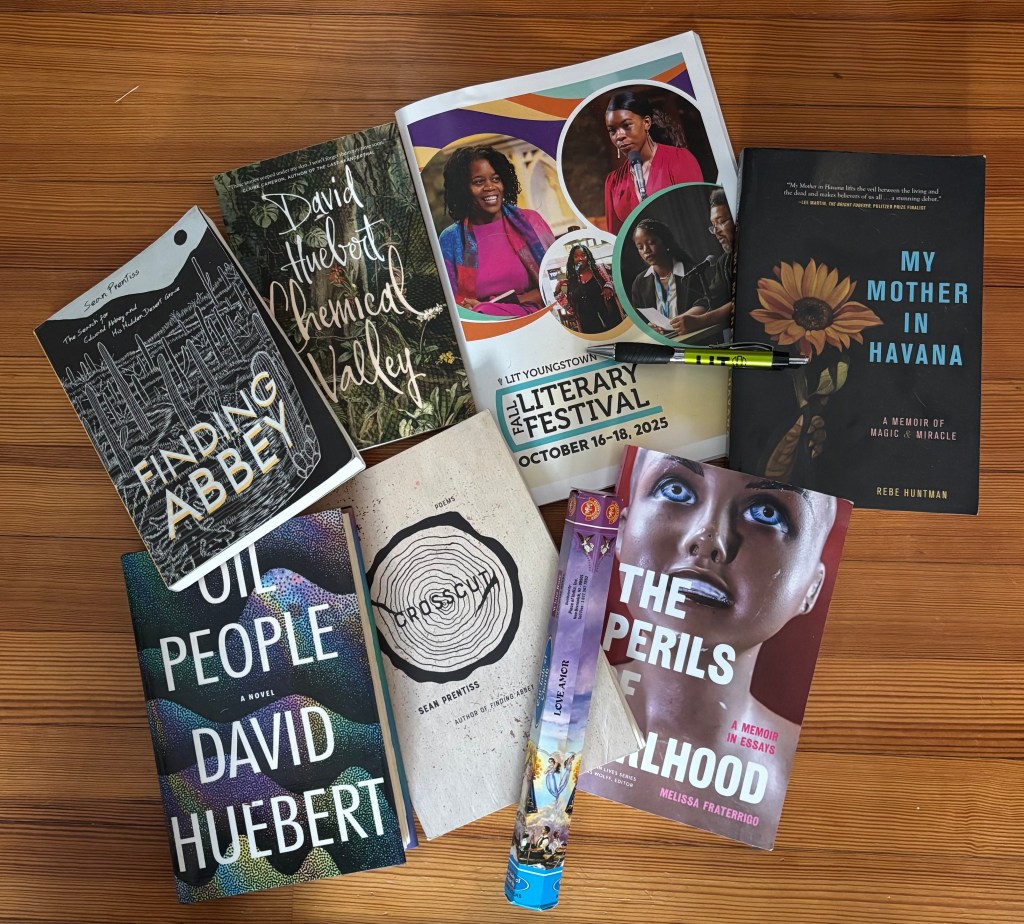
  • Meeting writer friends (like the talented Melissa Fraterrigo) in person after years of reading her work (her novel Glory Days inspired a lot of what I’ve been trying to highlight at this blog these last nine years or so—stay tuned for a review of her memoir in essays, pictured). And meeting other friends year after year and weaving our stories—and lives—together.
  • The highest highlight? You. Becoming a member of the Lit Youngstown community through the fall lit fest has been incredibly rewarding for my literary life—and my life-life. Thank you, friends.
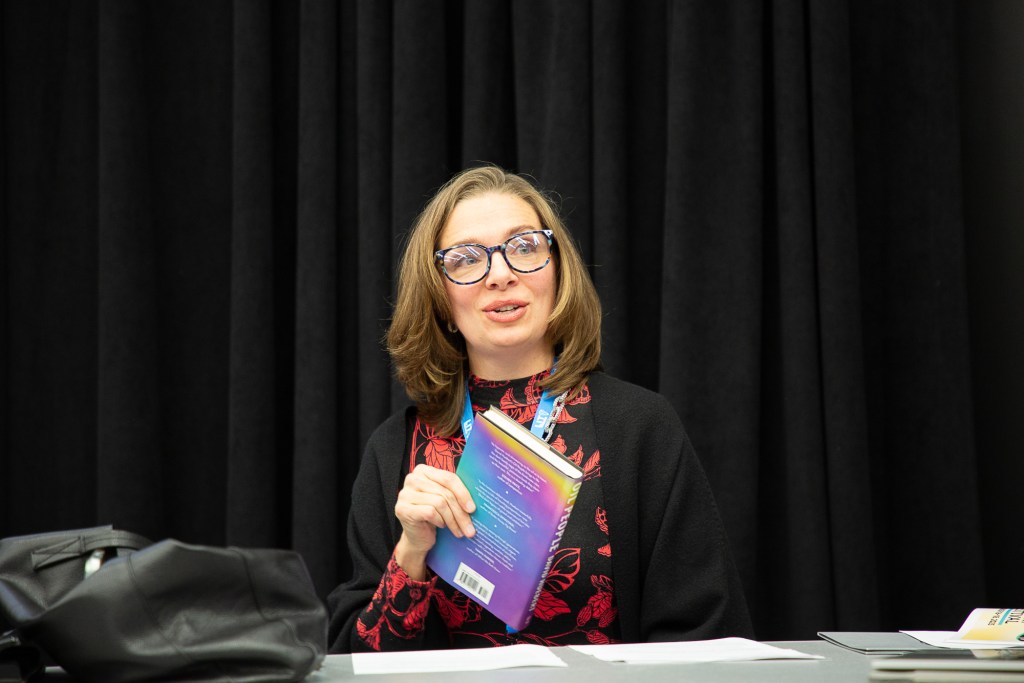
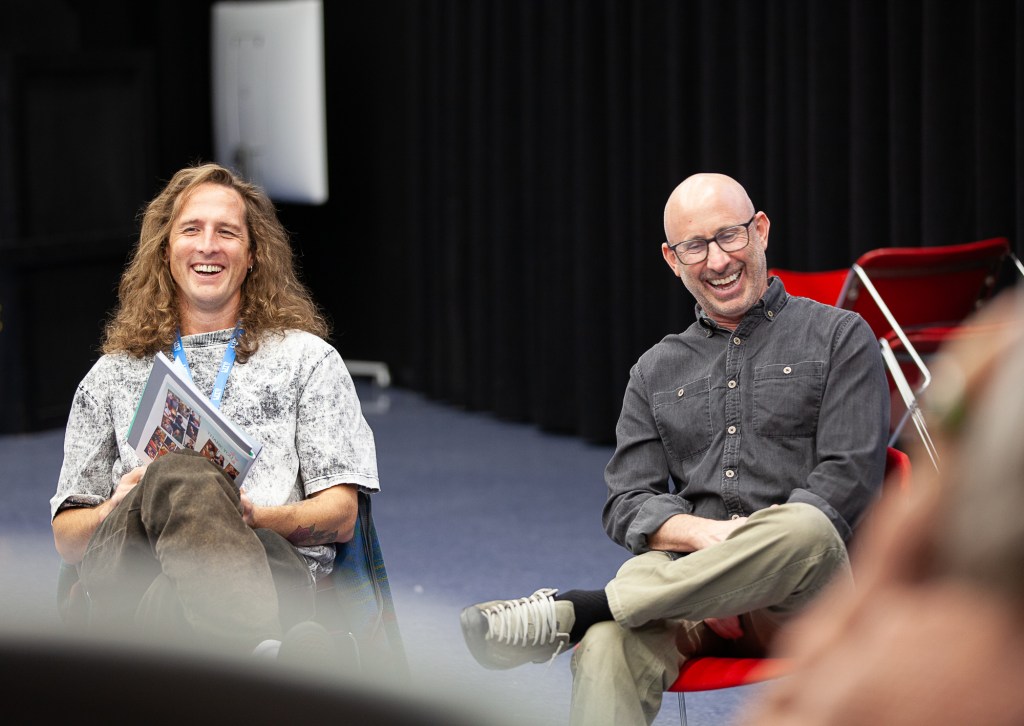
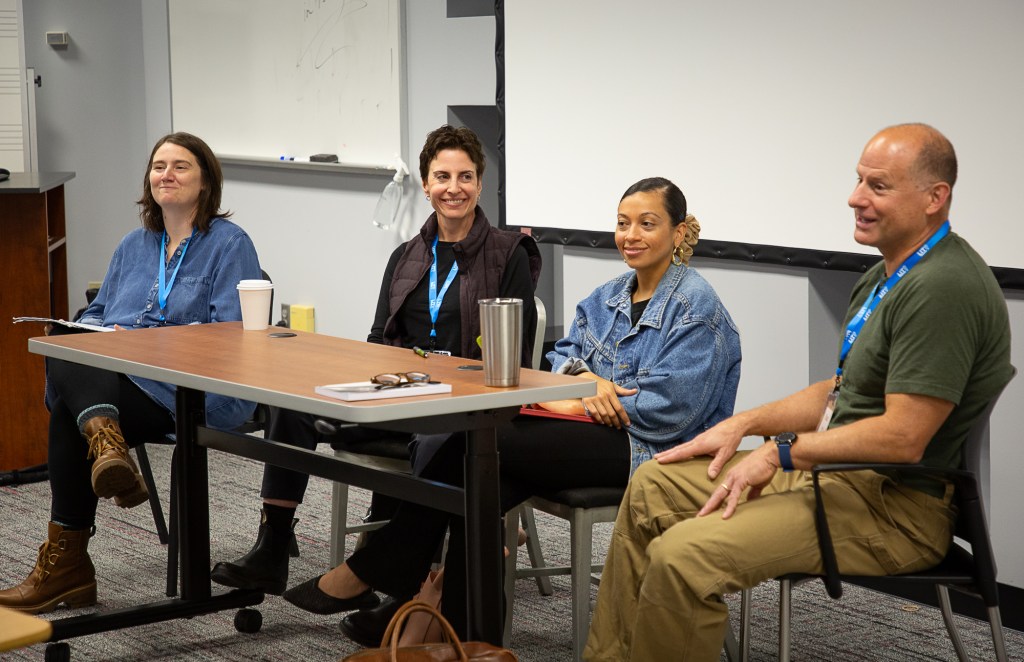
Now, 2025’s list fest was one for the books. (Peruse a few pics above and below.) And if you thought the environmental theme was going to mean a slew of nature poems…well, yes, and… Yes, and fascinating eco-fiction and challenging environmental memoir and poetry about nature redefined—from a place that was once an indigo plantation to the night sky over the Grand Canyon to trails cut by troubled teens into the Pacific Northwest woods—and so much more that “shapes our experience and identity, and represents our rootedness in earth.” Whew! I encourage you to read the impressive bios of the five 2025 featured presenters

My preparation for this lit fest happily began months in advance of the event. (Once a student, always a student.) For my conversation with fiction writer David Huebert and memoirist and poet Sean Prentiss I read several of their books—she gestures to collage artfully displayed on her office floor—representing an array of what we lump under the term “environmental writing.” Look for a follow-up post with a good chunk of our discussion—fascinating and fun!

Other personal highlights from this year’s lit fest. (Know that this is just a fraction of the offerings and I, once again, wished I could have cloned myself, so I could make every single session.):

Day 1:

  • Narrative Medicine [definition: healthcare practiced with narrative competence]: A Generative Workshop, facilitated by family nurse practitioner and poet Dana Reeher. Imagine me taking furious notes for the anthology project I’m co-editing: Body of Work, essays at the intersection of dance and health. For a little workshop exercise, Dana asked us participants to respond to a writing prompt, “an expansive invitation to open the mind,” so I thought I’d write a very short piece about my own dancing and its impact on my physical and mental health outlook:
Maybe the mistake was I listened too well, that I pointed my feet too hard, that I really could feel that string coming out of the top of my head lifting me up to the studio ceiling. Maybe I postured too much, wanted too much. Maybe I turned out until I was turned in. Maybe all that looking in the mirror made me someone else. I can still spot a dancer, or an anorexic, from fifty paces.

My dancer friends here will likely recognize a lot of this, but especially the posture-reminder telling baby ballet dancers to imagine there’s a string coming out of the top of your head… After sharing my short piece of writing, a couple of the other workshop participants said the string image reminded them of a marionette. I’d never thought of that before, and I’ll tell you that image is still working on me!

  • The Pamela Papers: A Mostly E-pistolary Story of Academic Pandemic Pandemonium: The Musical. Based on the award-winning novel by Nancy McCabe, published by Outpost 19 in 2024, the presentation included a dramatic reading (with singing—who was expecting a musical at the lit fest? Not I. And it was such fun!).
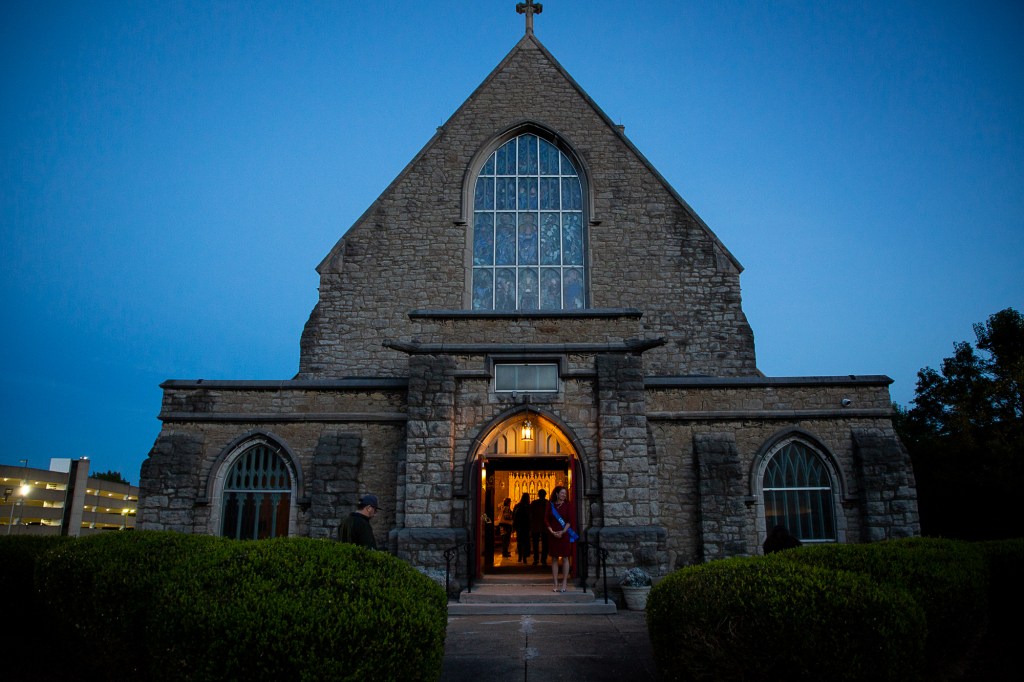
  • Readings by David Huebert and Sean Prentiss in St. John’s (gorgeous limestone and stained glass) Episcopal Church sanctuary. Your girl provided introductions to both writers—thanks for putting up with my unorthodox investigative process to make sure they were exciting, guys!

Day 2:

  • Bengal Tiger Moments: Time Perception in Creative Writing, facilitated by Sean Prentiss. In this fascinating session, we talked about speed on the page, presented in five categories from fastest to slowest: Gaps, Summary, Scene, Dilation, and Pause. Sean presented examples of these techniques from creative nonfiction and explained the brain science behind our understanding of the movement of time—irl and on the page.
  • Rooting the Self: Writing as an Act of Person, Political & Environmental Transformation & Transcendence, a multi-genre workshop with (beautiful and talented) Rebe Huntman, author of My Mother in Havana: A Memoir of Magic & Miracle: Rebe took us through various stages/ways of honoring our voice and our writing by making space for it and celebrating it, including meditation, morning pages, repetitive activity (including list-making), “the writing cave,” and writing constraints and freewrites. My favorite prompt, a list-making exercise we did in this session, produced these lists, below. (From there I spun out a short prose piece, “Reasons to Revere Your Vagus Nerve” (we’ll see where that weirdness goes!):
5 Things I Consider a Miracle
High arches
Warm pie
The vagus nerve
Sweating carafes of water
Tanned leather
5 Recurring Obsessions
Ballet hands
Song
Accents, dialects, and regionalisms
Mom, mom, mom
Delight
  • Readings by poets Lauren Camp, Todd Davis & Kourtney Morrow: poems of cityscape to countryside to the night sky over the Grand Canyon left us audience members awed.

Days After

And then, after… there’s nothing better than returning home from a literary event inspired, nurtured, and with a few new ideas for writing already on the page.

If you’re reading this on Small Business Saturday, might I suggest you also read small and lit small by supporting your local indie bookstores and your favorite literary organizations today?!

Did you attend Lit Youngstown’s Fall Literary Festival last month? Another lit fest? What was your favorite part? Have an inspiration gleaned or a piece of writing captured you’d like to share? Feel free to jot it in the comments. 

Like this post? Comment below or on my FB page. And please share with your friends and social network. 

Are you a Rust Belt writer interested in seeing if your own post, or author interview, or book review might be right for Rust Belt Girl? Hit me up through this site’s contact function.

Check out my categories above for more guest posts, interviews, book reviews, literary musings, and writing advice we can all use. Never miss a post when you follow Rust Belt Girl. Thanks! ~Rebecca

Enter your email address to subscribe to this blog and receive notifications of new posts by email.


“My photos are already out there waiting for me…” Photography by Jason Irwin

A black and white photograph of a Westfield, NY, lake, featuring small houses along the water and bare trees that are reflected.

Thank you, thank you to Jason Irwin, who kicks off a series of guest posts at Rust Belt Girl, and to you, for being here! What is a Rust Belt place–and who defines the perameters? What does post-industrial mean today? What are a place’s histories, characteristics, and quirks–and how have they shaped its people and its art? How have they shaped the stories we tell, and what have those stories meant for Grit Lit and Rural Noir writing and for other mediums of creative expression? For this series, I suspect we will get some fascinating answers to these questions and many more I haven’t thought of.

A guest post by Jason Irwin

Though I have used film in the past, as well as digital cameras, I consider myself an amateur. I owned a flip phone for 22 years but finally gave in and bought a smart phone during the summer of 2024. Do I love my smart phone? Well, no, but it makes life easier, and I do love the camera feature.

I believe my photos are already out there waiting for me to stumble upon. I like taking photos of people naturally, most often without them knowing I’m taking their photos. I prefer them off-center. I also like wide-open, desolate landscapes and cityscapes: derelict, sometimes abandoned buildings, windows, doorways, big skies, fields, and bodies of water. My hometown of Dunkirk, New York, is a perfect place for such photos. I hope the three photos in this post show this. 

A black and white photo of a vintage boutique called Serendipity. There are headless, dressed mannequins in the window, along with a decorated Christmas tree.

Serendipity, the storefront boutique in Madison, Indiana, looked lost in time to me, as my wife and I drove past. Maybe not in the 50s but still lost in time. Using the grayscale setting on my Samsung smartphone ads to the notion that this photo is older than it appears. Madison is her hometown, or rather Deputy, an unincorporated rural community about 18 miles northwest of Madison. Just outside the borders of what the Britannica website’s map marks as the Rust Belt. Madison was first settled in 1805, five years before my hometown of Dunkirk. Though not a Rust Belt town, Madison, like Dunkirk, was once a railroad town. The Madison and Indianapolis Railroad was completed in 1836. The first train stopped in Dunkirk on May 15, 1851, and at the time it was the last stop on the New York and Erie Railroad. 

A color photo features a brick building adorned with a colorful mural. The mural features a young, dark-skinned girl in pigtails with a white dress on. Outlines of various African and Latine countries adorn the mural, as does a tree held up by many hands.

I chose color for the photo of the old Regent movie theater, which closed in the late 1980s, but still stands, minus its marquee, on the corner of Washington Avenue and Third Street in Dunkirk, because of the recent addition of the mural, which pays homage to Dunkirk’s Hispanic and African American communities. As a child I went to the Regent, owned by Mr. Burget and his sad-eyed basset hound, to see movies like Back to the FutureE.T., and Rocky II. Many nights my mother would have a craving for popcorn, and she’d park our car out front and send me in to the concession stand to buy a large tub with extra salt and butter and then we’d go home and eat it while watching TV.

A black and white photo features a harbor, located in Barcelona, NY, dotted with small buildings and lined by bare trees, which are reflected in the still water.

The harbor in Barcelona, New York (a former fishing hamlet a few miles north of the village of Westfield), was where one of the scenes from the 2020 movie A Quiet Place Part II staring Cillian Murphy was filmed. Besides its huge commercial fishing industry that died out in the 1970s, the area is home to various wineries and agriculture, including Welch’s Grape Juice. Just out of frame to the left, up a small hill sits the Barcelona Lighthouse. Built in 1829, it is the first gas-powered lighthouse in the world. My father was born next door in the lighthouse keeper’s cottage in 1941. The grayscale setting gives this photo an eerie presence, but I love how the trees reflect in the water.


Photographer and author Jason Irwin looking straight into the camera.

Jason Irwin is the author of three full-length poetry collections, most recently The History of Our Vagrancies (Main Street Rag, 2020), and the memoir These Fragments I Have Shored, forthcoming from Apprentice House Press. In 2022 he was a Zoeglossia Fellow and took part in the Poetry Foundation’s Disability Poetics Project. 

https://jasonirwin.blogspot.com/


Like this post? Comment below or on my FB page. And please share with your friends and social network. 

Are you a Rust Belt writer interested in seeing if your own post, or author interview, or book review might be right for Rust Belt Girl? Hit me up through this site’s contact function.

Check out my categories above for more guest posts, interviews, book reviews, literary musings, and writing advice we can all use. Never miss a post when you follow Rust Belt Girl. Thanks! ~Rebecca

Enter your email address to subscribe to this blog and receive notifications of new posts by email.

From Belgium to the Rust Belt

A guest post by John W. Miller

The genesis of the PBS film Moundsville and its companion blog Moundsville.org, about a classic American postindustrial town, was a mid-life crisis mixed with the 2016 election and a curiosity about the truth of Rust Belt communities. 

Six years ago, I was on staff at the Wall Street Journal, covering mining and the steel industry out of its Pittsburgh bureau. 

Like everybody else, I watched as the Trump-Clinton presidential election blew anger, confusion, and fear through the culture. 

Personally, I was going through my own crisis. I was about to turn 40, and experiencing mid-life’s deepening cravings for meaning and direction. That second mountain beckoned. 

After 13 years roaming the world for one of the world’s great newspapers, I simply wasn’t enjoying it anymore. So I quit, and started climbing. After some discernment, I decided to stay in Pittsburgh. 

Poking around for creative projects, I started driving to Moundsville, a small town in West Virginia on the Ohio River 75 minutes from Pittsburgh. In 2013, I’d reported on it for the Journal

photo of a 2,200-year old Native American burial mound in Moundsville, West Virginia
2,200-year old Native American burial mound in Moundsville, West Virginia

The town fascinated me. I grew up in Belgium, the child of American musicians who’d wandered around Europe in 1976 and dropped an anchor in Brussels. I’m fascinated by places in America that tell a deeper story about my ancestral homeland. 

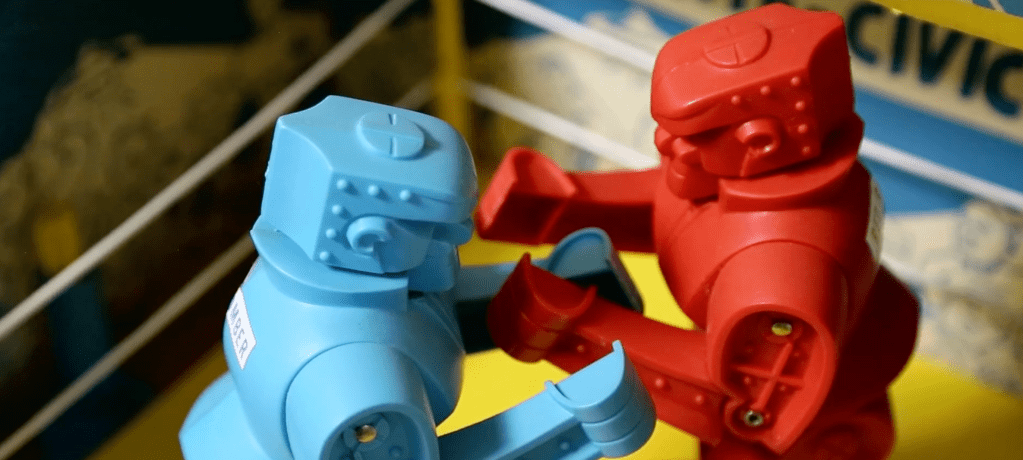
In late 2017, I connected with filmmaker Dave Bernabo. We put together a proposal to tell the story of Moundsville in a documentary.  I thought that town was a perfect place to tell a deeper story about America because it’s built around a 2,200-year old Native American burial mound, it harbored a glorious industrial age including the world’s biggest toy factory (Marx Toys, maker of Rock’em Sock’em Robots!), and it now subsists on a service-based economy anchored by a Walmart. There’s also a lot of pain and grief in Moundsville. In a generation, the town lost 8,000 jobs. The population halved. Young people left for Pittsburgh and New York. 

Rock’em Sock’em Robots! first manufactured by Marx Toys of Moundsville, West Virginia

David and I spent most of 2018 driving down to Moundsville and interviewing people. At the end of each interview, we’d ask a question about Trump and national politics. Almost always, the answers lacked depth. It dawned on me: These people didn’t know about Trump. They didn’t live in DC. They weren’t very thoughtful about politics. But when we asked them about their work lives and their parents’ work lives, they engaged with depth and wisdom. Those questions, I realized, were actually loving. Almost always, I decided, asking about Trump simply wasn’t loving. 

After experimenting with a voiceover, we opted to tell the story without a so-called “voice of God” as narrator. The movie is an oral history, without any academics or outside experts. 

In our interviews, we heard about grief a lot, but we also heard and told tales of resilience, from a back-to-the-land farming couple, a small manufacturer of kitchen cabinets, and the leaders of a burgeoning tourism sector. The ancient burial mound looming above the town is a daily reminder that civilizations ebb and flow, and that time moves only forward. My hope is that we acknowledged grief in a healing way while pointing the way forward with stories of hope and perseverance. 

In December 2018, we premiered Moundsville in the town itself, a practice of sharing work that anthropologists recommend. Over 170 people showed up. A few grumbled about our portrayal of segregation in the film, but at the end, we received an ovation. 

A month later, we screened at America, the Jesuit magazine I had started writing forin New York City, on Sixth Avenue in Manhattan across the street from News Corp., home of the Wall Street Journal

To my surprise–and gratitude–the movie holds up. People appreciate its openness and listening attitude. “This amazing project reflects a diversity of stories that I needed to experience to remind me of hope and resilience and kindness,” wrote Anupama Jain, head of a Pittsburgh diversity training group, on Twitter. 

The biggest lesson I’ve learned making and showing Moundsville is that every place carries an organic placeness that deserves respect for its uniqueness. You can find wisdom and thoughtfulness in people when you engage them over that place and recognize its differences from your place. We can’t love our neighbors as brothers and sisters if we expect them to be just like us.

I created the Moundsville.org site to promote the film, but quickly found an audience for pieces I was posting. It gets an average of 10,000 readers a month. So I keep writing and posting. I’ve written over 100 pieces for the blog, on everything from Lady Gaga’s mom, who grew up in Moundsville, to people going to watch baseball inside the prison in the 1950s.

I’m still on a journey of figuring out a new kind of journalism that suits my skills, and my heart. I’ve co-directed Out of Reach, a new movie about the American Dream. I’m developing a podcast called Philosophy with Strangers, where I go with an older friend to small towns and ask big questions. First episode: We went to Charleroi, PA and asked people: What is happiness? I contribute regularly to America, a monthly magazine run by Jesuits. I coach baseball. Lots of other stuff, too. But wherever my career takes me, it was forever changed by the road that ran through Moundsville, West Virginia.

John W. Miller is a Pittsburgh-based writer and filmmaker, and co-director of the PBS film Moundsville

~~~

What are you watching, reading, and writing this month. Let me know in the comments…

Are you a Rust Belt writer? What’s your story? Would you care to share? Do you write book reviews–or conduct interviews of Rust Belt authors? If so, think of Rust Belt Girl for a guest post. And check out the handy categories for more writing from rusty places.

Find me on FB and on IG and Twitter @MoonRuark

And follow me here. Thanks!

Enter your email address to subscribe to this blog and receive notifications of new posts by email.