“Important stories needed to be told.” Robert Miltner interviews Karen Schubert, Director of Lit Youngstown

I’m thrilled to share this guest post interview with Rust Belt Girl readers. What began as a Spotlight interview–between two of my favorite authors and people–for the Association of Writers & Writing Programs (AWP) has been gifted to us here, and I’m so grateful.

We talk a lot about writing as a communal act at Rust Belt Girl and about finding that community where we belong. The first time I met Karen Schubert in person, I’d just driven five hours, home to Ohio, to attend a literary festival I’d never been to before. I knew a few names but no faces. And no one knew me, so I dutifully popped on my name tag.

Even before my nerves could kick in, here comes the director, Karen Schubert, with the most gracious greeting–as if I were the keynote or a fully-fledged author, and not an emerging writer and editor with a blog.

I belonged. Just like that. And I’ve returned to that annual literary festival every year since. Last year, I served on the planning committee to do my own small part in welcoming new faces to the community.

“How does she do it?” This is a question I often ask about Karen Schubert. In addition to being co-founding director of Lit Youngstown, a literary arts nonprofit with programs for writers, readers, and storytellers…
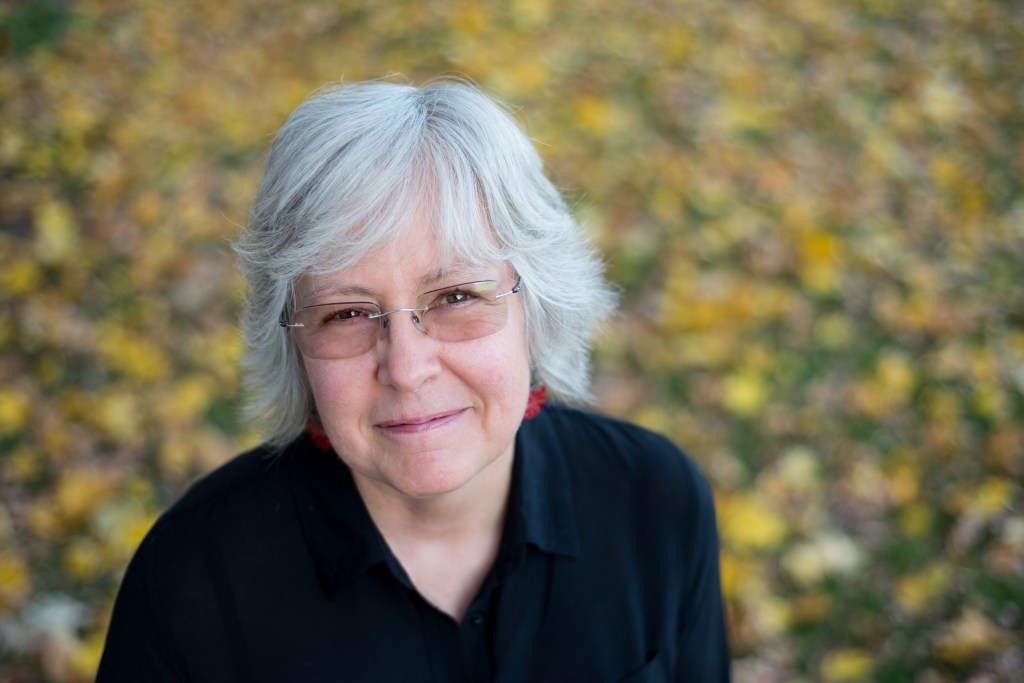
Lit Youngstown Co-founding Director Karen Schubert; photo credit: Melanie Rae Buonavolonta

Karen Schubert is the author of The Compost Reader (Accents Publishing), Dear Youngstown (Night Ballet Press), Black Sand Beach and Bring Down the Sky (Kattywompus Press), I Left My Wings on a Chair, a Wick Poetry Center chapbook winner (Kent State Press), and The Geography of Lost Houses (Pudding House Publications). Her poems, fiction, creative nonfiction, essays, reviews and interviews have appeared in numerous publications including National Poetry Review, Diode Poetry Journal, Water~Stone Review, AGNI Online, Aeolian Harp, Best American Poetry blog and American Literary Review. Her awards include the William Dickey Memorial Broadside Award, an Ohio Arts Council Individual Excellence Award in poetry, and residencies at Headlands Center for the Arts and the Vermont Studio Center. She holds an MFA from the Northeast Ohio Master of Fine Arts.

Thank you to Robert Miltner for asking “How does she do it?” here and to Karen Schubert for telling her story–and inviting us to tell ours.

Robert Miltner: Karen, you live in Youngstown, a midwestern rust belt city located within the Appalachian Ohio region. Your city was known for its blast furnaces and mills that, as Bruce Springsteen sings in “Youngstown,” “built the tanks and bombs that won this country’s wars.” In your poem, “Letter to Youngstown,” you write “Remember the world is full /of places like Youngstown, /and places nothing like Youngstown.” How does that reflect your sense of identity as the director of Lit Youngstown?

Karen Schubert: I’m not from here, although my mother’s family has been in the area since the early 1800s. I came to live in my grandparents’ farmhouse that I loved visiting as a child, and now I live in the city, in a five bedroom brick and frame house that must have been a stunner with its slate roof and cedar shakes. I bought the house on a teaching adjunct’s salary; that tells you what’s going on here. I think there’s a benefit in having been other places and having a sense of how things might work. But I’ve also been in Youngstown long enough to know what people might miss or seek, what our assets are, and who is doing amazing work. I once attended an AWP session on starting a literary arts nonprofit and someone said, “I can’t convince anyone to get behind what I’m doing because they don’t understand the concept.” I thought, that’s a problem I’ll never have.

Youngstown is economically poor yet arts rich…

Youngstown is economically poor yet arts rich—live music, performing arts—with an opera and two extraordinary concert halls including the original Warner Brothers theater, and several local theater companies. The visual arts are available through an outstanding American arts museum and a university museum. On the river, the shell of a steel mill came down a few years ago and a new amphitheater went up. In recent years, the city has hosted Margaret Atwood, Gloria Steinem, and Tarana Burke, as well as YoYo Ma through Kennedy Center outreach. Youngstown is also rich in literary arts. Lit Youngstown hosts readings at a supportive for-profit art gallery that champions local artists. While many community-based writers and writing program faculty stayed and enrich the community, like Christopher Barzak, Steven Reese, Will Greenway, and Philip Brady, others have left to great success, like Ross Gay, Ama Codjoe, Allison Pitinii Davis, and Rochelle Hurt. There is also a local culture that benefits from the immigrant grandparents who taught their children a profound love for the arts. 

Youngstown State has been a part of the Northeast Ohio Master of Fine Arts [NEOMFA]; in fact, it was founded at YSU, and we were devastated to learn that YSU has decided to sunset their participation in the consortium. We are still processing the loss that will be to Lit Youngstown and the community. 

Miltner: What inspired you to start Lit Youngstown in 2015?  

Schubert: I lived in Cleveland for a few years, and there were many literary gigs. The summer of 2013 I was a writer-in-residence at Headlands Center for the Arts in San Francisco, and talked to writers and artists all summer who were doing fascinating work. I began wondering what might be possible in Youngstown. 

Miltner: Did your experience as an AmeriCorps VISTA at a neighborhood development nonprofit influence your decision to start Lit Youngstown? 

Schubert: Yes, certainly. I was hired by Youngstown Neighborhood Development Corporation to write for the Neighborhood Conditions Report including data from every census tract in the City. Grim statistics: 40% of city land abandoned, jobs clustered in edge suburbs, and Black infant mortality rates similar to Guatemala. But I also learned that incredible things were happening, important stories that needed to be told. One day we were out interviewing residents and a woman invited us inside. She was a member of a Black women’s motorcycle club. They had filled a dining room with long tables, conveyor-belt style, and were packing stacks of to-go boxes with dinners for local residents who were struggling. This is an example of Youngstown’s story, its resilience and social weave. What I learned from the neighborhood development nonprofit is to be fearless: work hard, collaborate, research, and don’t buy the idea of staying just in your lane, because everything is connected. 

Miltner: How wide an array of literary programing does Lit Youngstown offer?

Schubert: We host a monthly reading series, writers critique group, book and film discussions, writing classes, a Winter Writing Camp for all ages, teen writers workshops, and a Fall Literary Festival. We also do many one-off events and collaborations, including an NEA Big Read grant with the public library and reading lunch poems with adults with disabilities at the nonprofit Purple Cat. One of our early projects was Phenomenal Women: Twelve Youngstown Stories. We interviewed Black women between the ages of 64 and 101 and published their stories and images from their lives. The collection is a rich archive of our city’s history, and the idiosyncratic details of the lives of these tremendously strong, intrepid and insightful women. One of the women worked in the War Room during the FDR administration. Many were tapped for jobs during the Civil Rights movement, to hold newly won ground. 

Also, in partnership with the YSU Art Department, the vibrant 150-foot Andrews Avenue Memory Mural along a retaining wall of a historically important corridor has just been completed. We solicited memories from the local community, and students incorporated images and pieces of those, and their own, memories. Memory is important and complicated in a place like Youngstown, a city that has suffered so much loss and is struggling to conceptualize an identity. I think it’s especially important us to offer this younger generation the opportunity to imagine a city they can believe in. 

A memory mural created in partnership between Lit Youngstown and the YSU art department; photo credit: Melanie Rae Buonavolonta

Miltner: Who are some of the writers you’ve brought in for your literary community?

Schubert: So many! We’ve had the privilege of hosting wildly accomplished writers including Philip Metres, Nin Andrews, Philip Memmer, James Arthur, Cody Walker, Kevin Haworth, Jan Beatty, and many faculty of the Northeast Ohio Master of Fine Arts. We’ve also mixed it up with student essayists; storytellers; an international poetry night featuring poems in the original language and the translation; and a humor night one April 1. One December evening Mike Geither read his play Heirloom; it was so moving I found it emotionally difficult to come back to the mic to close the evening. In 2019, we partnered with the Public Library of Youngstown & Mahoning County on an NEA Big Read grant and selected Into the Beautiful North. There were dozens of related events throughout the city for a month, like a mini film festival, immigrant narratives night, and ethnic foods potluck. Luis Alberto Urrea flew in to talk about the inspiration for the individual characters in his book. 

Miltner: In a community that is economically challenged, how do you develop funding? And who in the community, or local institutions, or from the state level, contributes?

Schubert: Our community has been incredibly supportive, as have the foundations. We have built up a funding structure that is a mix of support from community members, benefactors, local foundations and state agencies. Our yearly fundraiser is a raffle for a large work of art, typically a birdbath by a local steel sculptor. In all, we have received nearly $200,000 in grants from the Ohio Arts Council, Ohio Humanities, and local foundations. 

Miltner: What recent programming has been successful in your literary community?

Schubert: This year’s Fall Literary Festival was successful in the quality of presenters, and the engagement of participants. It’s always so great to see local writers talking with other writers, educators, editors and nonprofit administrators, asking questions and learning more about the literary landscape. 

Miltner: The 2020 Fall Literary Festival was held as a videoconference. How was it different from an in-person conference?

Schubert: Well, to begin with, we had a virtual cookie table! I made Allison Pitinii Davis’s aunt’s Greek cookie recipe from the Youngstown Cookie Table Book published by Belt Publishing. Featured writer Janet Wong found cookies in the back of her pantry and described their staleness in hilarious detail. Zoom awkwardness aside, people were wanting to feel a sense of connection. I think they did, but one missing thing was conversations that spill into the hallway and coffee shops.

And we were back in person this year and I was surprised how rusty I felt. I made clumsy organizational mistakes. More importantly, I think feeling connected was also very important this year, and even though there were masks and fewer hugs, the comradrie was everywhere. There are many very fine conferences, so I always ask folks why they come to this one. They consistently say it is the connections they make here. 

Miltner: How has the festival impacted your community?

Schubert: It’s the only Youngstown conference for adult writers. The English Festival at YSU, for middle and high school students, draws thousands each year, so there is local context for such an event among literary arts enthusiasts. But previously, adults would have to drive to Cleveland, Columbus, or Pittsburgh to attend in person, which we encourage them to do, but it’s also great to have a conference here.

…they come to hear contemporary work, talks on literature and bringing literature into the community for healing and cross-cultural connection.

Another benefit to local writers is meeting and engaging with writers from throughout the U.S. Really feeling part of something bigger. Of course, some of our attendees are not writers, but readers, students, educators, administrators, and they come to hear contemporary work, talks on literature and bringing literature into the community for healing and cross-cultural connection.

Those who attend from a distance appreciate the low cost of the conference, which makes travel and lodging more possible. And we are fortunate that Youngstown State University partners with us, because this allows undergraduate students to attend free, and some faculty members require their students attend. If YSU follows through with their plan to sunset the NEOMFA, leaving only an undergraduate minor in creative writng, I don’t know yet what that will mean for the conference. 

Miltner: Would you share a project Lit Youngstown is currently working on?

Schubert: We had cancellations with the lock-down, including Whitman & Brass, an event that pairs staged readings and a brass quartet playing the music of his day. I was hoping to make this into a series, and was thinking next we would pair James Baldwin and Nina Simone. So Whitman & Brass has been rescheduled for March. 

During the lock-down, we sent out an extensive survey to our community, and one consistent point of feedback is that some writers are looking for more in-depth continuity. So this month, we kicked off a series of nine monthly daylong Poetry Intensive workshops. In the morning we’ll talk about books, chapbooks, journals, submissions, presses, readings, things like that. Each afternoon, a different poet will come to talk about different aspects of poetry, and we’ll look at participants’ poems through that lens. For example, when you come, Robert, we’ll talk about the music in these drafts. I’m crazy excited. 

Miltner: If an anonymous donor gave you a major gift for Lit Youngstown, what is the dream project you’d immediately implement?

The Big Dream is to buy a large building and begin a writing residency.

Schubert: First I would step up the development of our outreach program. We are inspired by the Wick Poetry Center at Kent State and Director David Hassler who has been a great mentor to us. I’d like for us to be doing outreach with immigrants, veterans, retired residents, patients in medical care, and sexual assault survivors. I love Literary Cleveland’s Essential Worker narratives. Our Outreach Coordinator Cassandra Lawton is currently working in the expressive therapy program at Akron Children’s Hospital and will soon begin a study on writing with cancer survivors.

The Big Dream is to buy a large building and begin a writing residency. In Youngstown, many historic buildings are languishing empty and selling for relatively low prices. I love the model of the Vermont Studio Center, putting studios into a former fire station and school, supporting an indie bookstore, creating links between artists-in-residence and the local elementary school and college. 

Miltner: What advice would you offer to someone who might want to launch a community literary program in their city?

Schubert: Collaborate on everything. Keep thinking of new people to bring to the table, to help plan and run events, to shine a spotlight on other community work. For example, when I read Mark Winne’s Closing the Food Gap, a book about food policy, I recognized that it had a lot of relevance to what was happening in Youngstown, a citywide food desert. We partnered with a local co-op on our first book group series and, along with many community development partners, we brought Winne here.

I like to see the literary arts, in addition to creative expression, as a means to understand and work toward solving problems. During the lock-down, I was thinking about the kids at home and parents and teachers looking for literacy enrichment. So we wrote grants and purchased over $10,000 worth of wonderful books for nearly 800 children in Head Start. We also purchased high quality books for children in YSU Project Pass, a program that pairs education students with city 3rd graders who would benefit from reading skills support. Each year we send a $100 donation to a literary arts nonprofit we admire, and this year we selected Black Boys Read, a local initiative. 

Miltner: You are yourself the author of several chapbooks and a full-length book. How has your being a writer yourself shaped your role in leading Lit Youngstown?  

The Compost Reader (Accents Publishing), 2020, by Karen Schubert

Schubert: As a student, I went to conferences where I met writers like Bruce Bond, Denise Duhamel, Kimberly Johnson, and former NEA director Dana Gioia. I gained much from classes on how to edit, submit work, and shape a manuscript. From classes and conferences, I met writers who are now lifelong friends. Part of my work is trying to recreate those great experiences for those in our literary community. 

Miltner: In your poem “Youngstown Considers the Future,” you write, “We are tired of our Titanic metaphors— / can’t decide if we’re patching up the hole, / steering toward warmer waters, or / arranging the deck chairs.” It seems to me that your dual role of writer/director is encapsulated in these lines. From your perspective, what fresh metaphor would you offer instead? 

Schubert:. How about the metaphor of a mural: we’ve cut back the vines, purchased more primer than we knew we’d need, and now we’re ready to create a design harvested from memory and shaped by the young. How’s that for what community building looks like?

Learn more about Lit Youngstown and Karen Schubert by following the links.

~~~
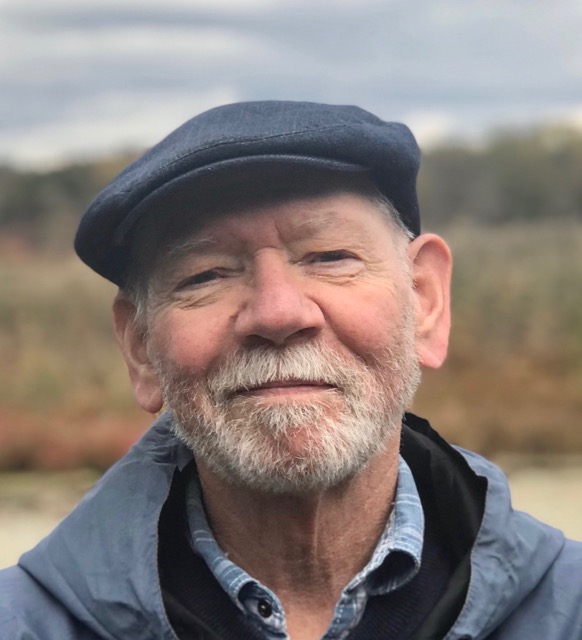
photo credit: Molly Fuller

Robert Miltner is a writer, editor, and scholar. His books of poetry include Hotel Utopia, Orpheus & Echo, and Against the Simple, the short story collection And Your Bird Can Sing, and a collection of creative nonfiction, Ohio Apertures. He has received and Ohio Arts Council Award for Poetry, an Ohio Arts Council Writing Fellowship at Vermont Studio Center, and was Poet-in-Residence at the Chautauqua Institution in summer 2021. A professor emeritus from Kent State University Stark and the NEOMFA, and Editor of The Raymond Carver Review, Robert has been a member of AWP since 2012.

~~~

Read my interview with Robert Miltner for Rust Belt Girl here. Like this interview? Comment below or on my FB page. And please share with your friends and social network.

Are you a Rust Belt writer interested in seeing if your own author interview or book review might be right for Rust Belt Girl? Pitch me through this site’s contact function.

Check out my categories above for more interviews, book reviews, literary musings, and writing advice we can all use. Never miss a post when you follow Rust Belt Girl. Thanks! ~Rebecca

Enter your email address to subscribe to this blog and receive notifications of new posts by email.

Not a post about a Christmas cookie

This is a post about a community Christmas cookie.

***

Bear with me, and hello! Happiest of holiday seasons to you and yours!

And back to the aforementioned cookie…

It was Christmas Eve Eve, and I’d waited too long to secure anise seed, a necessary ingredient in my favorite Christmas cookie, one I make religiously, each and every year: German Springerle.

I visited four stores on my search for the elusive, black licorice-scented seed and found none. I lamented supply chain issues and the state of commerce in particular and the world in general. But not for long, because Christmas.

In a last ditch attempt to keep my cookie tradition alive, my husband suggested I ask for anise seed on our village’s FB page. Within the hour, I had offers of fennel seed and star anise–the latter of which I believed just might work.

Because this is not a baking blog (you’re welcome), I won’t bore you with the recipe–unless you want it (I don’t believe in secret recipes). But suffice it to say the cookie turned out great with the substitution. Yes, it takes a village.

You probably have your own community cookie story. Maybe it’s an actual cookie. Maybe it’s something a little more poignant.

As Epiphany approaches, the Wise Men in our nativity set inch closer to the scene. These smart guys (rightly) get a lot of press. They brought pretty important ingredients to that out-of-the-way stable.

Our nativity set also features some more colorful comers–a rough-looking fellow bringing a chicken and eggs; a woman bringing several loaves of bread balanced on her head; a drummer and a bagpiper bringing the tunes.

Me, I’ve been bringing the music, this year, my first full year as a cantor at my Catholic parish and for weddings and funerals. And this singing way of things has found its way into my home-life (working on a Von Trapp vibe over here!) and my writing-life. In my novel-in-progress I ask: Can our songs save us? And in my recent nonfiction, I try to bring my voice closer to my heart.

If you know me out on Twitter–land of snark–you’ll know that in addition to cookies, I am the one who brings the shrimp ring to a party. (My Midwestern child-self would be duly impressed.) Snark aside, I try to do my small part at a time when it seems we’re all pulled apart, party-less.

Because, we can’t make all the good stuff entirely on our own. It takes community.

Community is why I started this blog way back in 2017. And it’s why I will continue to hype the poets and writers and literary-scene-makers of the Rust Belt in 2022.

If you haven’t yet checked out some of my favorite posts of this year, I hope you will. Among them: my interview with former steelworker and memoirist Eliese Colette Goldbach, author of Rust; and my interview with poet and memoirist Robert Miltner, author of Ohio Apertures: A Lyric Memoir. Many, many thanks go to those on the answering end of my queries.

2021 Rust Belt Girl blog superlatives? I’ve got those! 3,232 visitors hailing from 78 countries–not bad for a blog that reveres the regional.

My most viewed post (once again) is my gush-fest about Amor Towles’ A Gentleman in Moscow. (Have you read his new novel? On my TBR.)

My review of Michigander Dawn Newton’s The Remnants of Summer came up second.

My most-viewed interview this year was that with Cleveland native poet Teri Ellen Cross Davis, whom I got to meet in person–and even break bread with–at Lit Youngstown’s Fall Literary Festival in October. A festival I helped to plan, along with so many other members of that literary community.

The literary world just recently lost Joan Didion. The places she wrote about and from are not my places. But she has a lot to teach us about writing about place. I’m taking this quote of hers into 2022 as inspiration:

A place belongs forever to whoever claims it hardest, remembers it most obsessively, wrenches it from itself, shapes it, renders it, loves it so radically that he remakes it in his image.

Joan Didion, The White Album, 1979

Whatever place you’re shaping, whatever community you belong to, thank you for being here.

All the best in 2022, stay well, and keep in touch!

Hankering for Rust Belt author interviews, book reviews, and more? Check out my categories above. I hope you’ll follow me here, if you don’t already, so you never miss a (quite infrequent) post. ~Rebecca

Enter your email address to subscribe to this blog and receive notifications of new posts by email.

Poet for a weekend, and other literary festival miracles

I am not a poet, though some of my prose has aspirations. However, if writing is about invention–and re-invention–maybe my prose knows something I don’t.

How glorious to reinvent ourselves through our writing, over and over, on the page (or screen). I do find invention the most exciting part of being a fiction writer, blogger, and even a marketing professional–well, second only to the excitement of connecting with likeminded creative folks.

And so, I was in literary heaven at Lit Youngstown’s fifth annual Fall Literary Festival, held on the campus of Youngtown State University in Youngstown, Ohio. (Heaven is in Ohio? Yes, yes it is.)

Remember in-person literary events? I’d almost forgotten that some of my favorite writerly faces can been seen in the literary wild, outside of their confining Zoom boxes. For those of you readers who’ve been around these blog parts for a while, this festival gave the pleasure of meeting several of my Rust Belt interviewees in person for the first time: memoirist and poet Robert Miltner, poet Teri Ellen Cross Davis, and novelist Margo Orlando Littell. Also, in small-literary-world news, a writer friend I made while attending a writing retreat in Virginia in the spring made it to the fall conference (hi, Rebe!).

So, what exactly goes down at a literary festival? The “gathering in” night at a downtown art studio included a cookie table, a local tradition. And, not only did I cookie, but I also put on my brave writer pants and read a short piece at the open mic (following maybe some of my best advice for speaking–or singing–in public).

The first full day of the festival, I moderated a craft session on writing memoir; attended a panel discussion on rewriting women into history (take that Jack London–just trust me); attended a poetry discussion on transforming grief into a gift; and took an epistolary poetry workshop. Yes, me, the non-poet. At the risk of total embarrassment, here’s my epistolary poem from the class:

Dear Son,
A hotel bed big enough for the four of us, but it sleeps only me. I could say I wish you were here,
but Youngstown, this place I only discovered when I was no longer young, feels like mine
alone. Here, the people talk like me, the nasal accent that cuts through a crowd. You will love
a campus like this someday, a place that will watch you become a stronger you, tempered
like the steel of this place. Your Youngstown might be Annapolis or College Park or Cambridge.
You know we can't afford the Ivies, right? Do your homework, get a good night's sleep, and know
I love you.
~Mom

One of the coolest aspects of having a literary festival on a college campus is the other arts to be found. A short walk took me to a university art museum that was featuring an installation by artist Diane Samuels. My photos don’t do her work justice, so you’re going to want to check out her site. Here, you see Moby Dick, Romeo and Juliet, and The Overstory–with every word of those texts hand-transcribed on various materials. The quilt-like pieces are gorgeous from afar or up close, where you can read every word.

From the art museum, we then had dinner–pierogi and halushki–at a local, historic stone church, where after, in the sanctuary we heard from a jazz trio before the evening’s creative readings. (See pics above.) From there, I followed the locals to a tiny jazz and blues club where we heard, you guessed it, live jazz and blues–some originals and some covers of Marvin Gaye, Otis Redding, and other sing-alongable songs. And my weekend just kept getting more art-full.

The second day of the conference, I played hooky. It’s true. Rule-following me. Of course, before that I did my duty as part of the planning committee and worked at the book fair (which was a lot of fun!). I also took poet Teri Ellen Cross Davis’ poetry workshop about writing from family history (one of her best tips: to avoid sentimentality, get very specific and use details sparingly); I’m still working on that poem. And later, I took a poetry workshop on the Golden Shovel form (news-to-me: it has nothing to do with a shovel shape). And then, I played hooky.

Book fair book haul: Don’t miss Teri Ellen Cross Davis’ latest book of poems, A More Perfect Union.

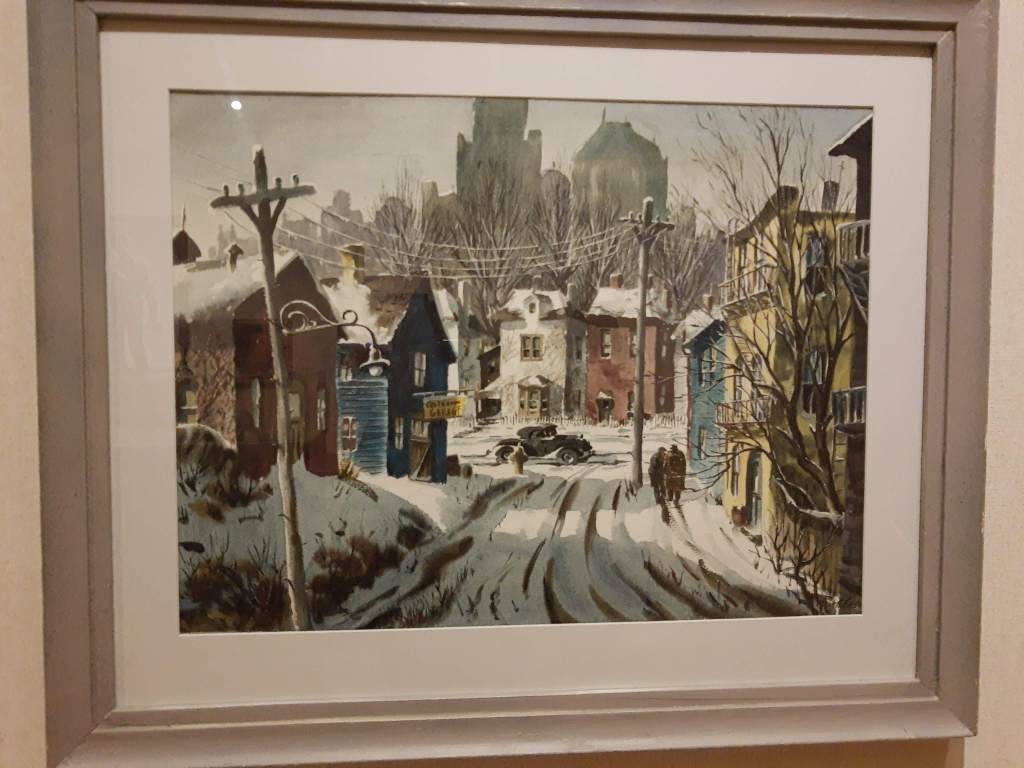
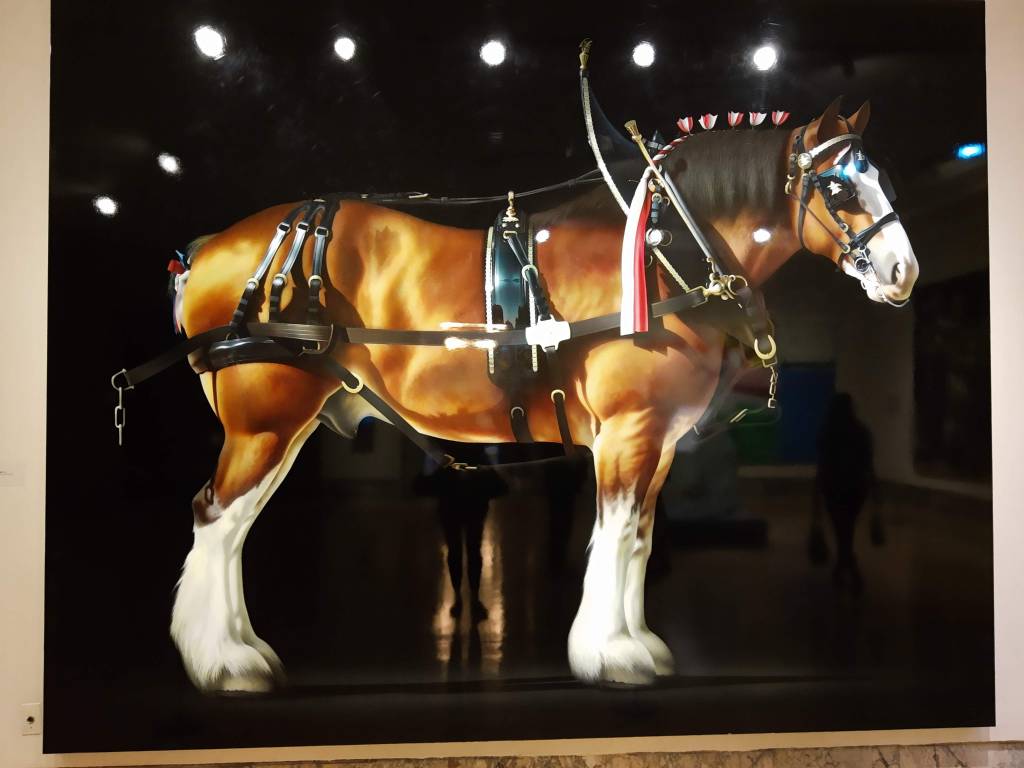
For the several years I’ve been attending this literary festival, everyone’s told me I must make it to the Butler Museum of American Art, a short walk from the conference venue. This time, a couple writer friends and I made it, took the tour, the whole thing. Reader, there was an Edward Hopper. I knew I was in the right place. (Pictured: Edward Hopper’s Pennsylvania Coal Town, William Gropper’s Youngstown Strike, Henry Martin Gasser’s Intersection, Grant Wood’s In the Spring, a name-that-abstract piece I didn’t take a good enough picture of the id card, Peter Maier’s Horse-Power (Ben)–a floor-to-ceiling rendering of a Clydesdale painted on metal–and Alfred Leslie’s High Tea.)

After my fill of American art, I enjoyed dinner (Italian, if you’re keeping track) and literary conversation that alternately had me jotting notes (the TBR pile grows ever taller) and laughing. There again, my idea of heaven. To cap off the final evening of the festival: another reading (at another downtown art gallery), this time by Jan Beatty–raw, real, and revelational! I can’t wait to dive into this one, too.

Huge kudos to Lit Youngstown director Karen Schubert and outreach coordinator Cassandra Lawton, the board, and planning committee folks–for another successful literary festival. It felt like a miracle that was over too soon!

Have you ever been to a literary festival or conference? What were the highlights for you? Did you stay in your literary lane or reinvent yourself in a weekend? Do you enjoy creative readings? What makes a reading memorable for you?

I’ve been terrible about keeping in touch, but I hope you’ll check in here. What are you reading, writing? What authors have moved you, lately? Are you getting out to any in-person activities?

Hankering for Rust Belt author interviews, book reviews, and more? Check out my categories above. I hope you’ll follow me here, if you don’t already, so you never miss a (quite infrequent) post. Thanks! ~Rebecca

Enter your email address to subscribe to this blog and receive notifications of new posts by email.

My interview with Robert Miltner, author of Ohio Apertures: A Lyric Memoir

Ohio Apertures (2021) is Robert Miltner’s latest work, a collection of short creative nonfiction pieces that comprise a memoir. The author of two books of prose poetry, poetry chapbooks, and a short story collection, his memoir represents a cohesive journey. From stories of youth to young and older adulthood; from reflections of Ohio to the American West and trips abroad; from journeys by foot and by car—the car such a potent symbol of the post-industrial Midwest—the reader journeys with the author, and it is a satisfying and solace-making trip that doesn’t look away from the remains of Midwestern heydays past. Miltner provides the objects of his looking and perceiving and also the vehicle of that looking, and I think that matters in studies of observation, in studies of life, which is what we readers want in memoir—the particular and personal expanded to the universal, expanded to include our lives, too.

The objects Miltner ruminates upon in these short essays are often small—he’s so good at detail. There’s the watch pocket in a pair of Levi’s; the pneumatic tube at the bank drive thru; the crescent roll of youth and croissant of maturity; the sound an old car makes, like “sarcastic laughter”; the song that was playing at the bar after he was robbed as a young man. There’s a lot of music in these pages—a few of these pieces feel like they have their own soundtracks—but most of the music comes from the lyrical quality of these essays. And the quiet, the white space, the musical rests, the silence that is, Miltner says, “both the context for prayer and prayer itself.”

Always, the author returns to Ohio, the name alone like a song, and to the state’s flowing rivers and Great Lake Erie and its shale coastline that makes for violent, crescendo-like waves at its cliffs. My favorite piece in the collection is the last, “Black River Bridge,” an ode to a bridge that the author has traveled many times to cross his home-town river. He speaks to it, lovingly, in this essay: “Poor Black River, you lonely stepsister in this sad fairy tale of Ohio rivers…No one, lost river of industry, dark river of my youth, kisses your mouth each night along your shale and sand shoreline.” Though somber in tone, the piece ends optimistically, or in a tone I like to think of as Northeast Ohio optimism—which is as tempered as our steel.

Cover art by Morgan Dyer, “Climbing Uphill”; design by Shelby Ballweg and Colton Bahr

Recently, I asked the author a few questions about this collection, about his writing process and projects, and about writing in community:

Robert, Ohio Apertures is a lyric memoir in short pieces. You’ve written a lot of poetry and fiction, but this represents your debut memoir. What do you like about creative nonfiction? Were there things you could say about your life that you couldn’t say—or hadn’t said yet—through other mediums that you said in these pages?

I view myself as a writer, which I use in the comprehensive sense, rather than identifying by a single genre, because it feels restrictive. In terms of genre, I’ve felt compelled to “contain multitudes.” Writing in a new genre is like acquiring a new language; it’s like becoming bilingual or, for me with Ohio Apertures, trilingual. I used to think adding genres would be about learning the guidelines for new puzzles. Any new genre is like a puzzle, and what is produced is a piece of writing that is one solution to the puzzle. In that way, my collection of short stories was, for me, a collection of individual solutions to a general question regarding the art and craft of short fiction. What I discovered was an art akin to drama, to theater. I create characters then put them in situations; or, I imagine situations then insert characters. Variations on puzzles. What I learned was a way of speaking through masks, wherein the first person singular “I” is not me being lyrical, but some other person engaged in narrative action—it’s not me speaking.

When the first person singular “I” speaks in a poem or a creative nonfiction, that’s me. It’s like revelatory song lyrics or confessional poetry. And it’s risky to speak for yourself, and safer to speak through a character. In looking back at And Your Bird Can Sing, my collection of short fictions, there are several pieces that are very autobiographical, and so much so, that I can now see them as memoir that I didn’t recognize as such. So here is what my response to your question has been arching toward:

What I like about creative nonfiction, or lyric memoir, or lyric-narrative memoir, is the element of risk. Of being open and honest and as true as is possible to the material. It’s the risk of being vulnerable.

Ironically, while I was shaping individual pieces of creative nonfiction—memoir, lyric essays, narrative nonfiction, travelogue pieces—into a book where I was experiencing the most lyric freedom, I was concurrently shaping a new manuscript of poetry in which I was developing these sparse, minimalist prose poems that I can only define as not exactly a-lyrical, but more like lyric zero; they’re textual equivalents to Edward Hopper paintings: empty rooms where we sense the presence of people who are absent. Crazy, huh?

It’s like I transferred all my lyrical attention from my prose poems into my creative nonfiction memoir. The risk was exhilarating and the results of both manuscripts generated exciting new material through which I have discovered this: choice of genre is really about where I stand in relationship to the subject matter. It’s like the Wallace Stevens poem in which he writes, “I was of three minds,/Like a tree/In which there are three blackbirds.” If I read the three minds as the three genres I write—poetry, fiction, and now nonfiction—the blackbirds can be seen as the creative impulse. But what’s most interesting to me is that Stevens isn’t really addressing the puzzle of the three minds—instead he’s telling us that the blackbirds are in a tree. For them, it’s about where they perch. And for me, now, writing is about where I stand, finding the site that allows the best relationship to the subject matter.

I asked your friend and mine, memoirist David Giffels once if memoirists have great memories—I thought, how else to capture a moment from one’s distant past? He told me that, for him, there’s a lot of research involved, even for personal memoir—research in the way of interviews of family and friends who might have a different perspective on a past event. Can you tell us a little about your research process for one of the pieces in this book?

David is a brilliant nonfiction writer; he came into the creative nonfiction room through the journalism door. His The Hard Way on Purpose: Essays and Dispatches from the Rust Belt really made me keenly aware of the necessity of detail, exactness, and precision in crafting creative nonfiction. His work showed me possibilities that lead me into the creative nonfiction room. I was also influenced by the Appalachian Ohio writer Richard Hague, whom I met when we were in college together; he came to creative nonfiction through the poetry door. In his Milltown Natural, about growing up in Steubenville, Ohio—a city that is categorized as both Rust Belt and Appalachia—Richard fleshed out his collection of creative nonfiction pieces with memorable details that made his Steubenville three-dimensional. But he did something else: as a poet writing prose, the level of attention to language, syntax, the sound of words and the rhythm of sentences showed me the possibility of lyrical prose. He wonderfully disrupted my sense of how poetry and nonfiction are like lost cousins.

One of the epigrams in Ohio Apertures is from W. G. Sebald, whose creative nonfiction is mesmerizing because almost every third sentence is like a labyrinth: “You adulterate the truth as you write. There isn’t any pretense that you try to arrive at the literal truth. And the only consolation when you confess to this flaw is that you are seeking to arrive at poetic truth.” Sebald argues for the craft of writing, the attention to make art—that the idea of poetic truth is akin to an aesthetic truth. Sebald laid down the dictum to balance the literal with the poetic, and, of course, poetic license is as valid here, due the lyrical nature of both poetry and memoir. But I learned in writing my book that while the poetic/lyric/aesthetic truth is the goal, it can only be accomplished when the literal truth—much of it sharpened into precision—is researched.

The piece I recall researching the most—or perhaps the most satisfyingly—is “Desperados,” which in early drafts was very much a linear narrative only. Denver’s Capitol Hill in the 1970s; a sort of “bank” robbery; the Broker Bar on 17th Street; the culture class of the bankers, lawyers, and part-time college student working for a shady landscape company. The need for such geographical precision necessary for linear narrative is like filming a documentary. But the challenge in this piece was to get the poetic/lyric/aesthetic to be equal, co-present, operating almost like it was a character in the narrative. I began to imagine this piece as a film I could see, with me as the director and lead actor. The numerous references to film, to movie acting, the final scene where I imagine film credits, I had to research that. And when I decided a good film needs a soundtrack, I turned to Glenn Frey of the Eagles. I had to know the songs that were released before the day of the robbery, and that had me running down song lyrics.

Along the bar, bottles of liquor gathered together like an ensemble of actors in a film version of a Charles Bukowski novel. … The glint and dazzle reminded me of theater marquees on opening night. The jukebox played We may lose and we may win, we will never be here again. It could have been the final soundtrack of a movie.

As I drank that second shot of Tennessee whiskey, I swear I saw the closing credits of a film scroll down the mirror’s silver screen.

From “Desperados” by Robert Miltner

Those literal details, augmented by mirrors and movie screen allusions—as well as resonant images, emotion, language play, leaps and jump cuts—bring together the literal and the aesthetic for a poetic closure to the piece.

~~~

In a recent post here at Rust Belt Girl, I talked about the idea of writing companions, authors we avid readers and writers follow faithfully and who shape our work. In your essay, “Into the Bargain,” you describe finding a volume of Raymond Carver’s poetry, Where Water Comes Together with Other Water at a bargain book store, and you’re “entranced and transported.” The book becomes a “talisman” for you, for what it helps you discover about yourself upon reading and re-reading. Can you tell us more about what this writing companion did for you as a poet—and a writer and as founding editor of The Raymond Carver Review?

Toward the end of that piece, I contrast J. D. Salinger’s The Cather in the Rye,a book that I felt I identified with in my adolescence, with Raymond Carver’s Where Water Comes Together with Other Water, a book that I identified with during my mid-life transition. There are books and libraries and reading throughout Ohio Apertures. I was a shy, bookish middle child who stuttered, and I became a high school teacher and then a university professor, and an author. Actually, I went on to write my doctoral dissertation on Carver’s poetry, more from a sociological lens than an aesthetic one. Raymond Carver was a sort of mirror in which I could catch a glimpse of myself: an awkward child, a kid who liked to fish, a man who was drawn to rivers and lakes, a multiple-genre writer who began as a poet, eventually a university professor, and ultimately a man who came to understand and accept his human flaws enough to seek forgiveness and atonement.

The brilliance of Carver’s writing, and in particular his poetry, is his gift of stated or implied metaphor. The water of two rivers—one the past, one the present—that converge to carry him into the future resonates imagistically in Ohio Apertures. Carver was a very autobiographical writer, so much so, that at times much of his work can be read almost like creative nonfiction. Having read his letters and manuscript drafts in library archives, as well as interviews and biographical studies, many of his poems and stories are autobiographical. He wrote what his second wife, the poet Tess Gallagher, especially in his late poetry and in many of his autobiographical stories, calls “lyric narrative poems,” that is, poems in which the poet, or more so the poet’s imagination, become the hero of the narrative. That sounds to me much like a way to describe a lyric memoir, especially one that arcs toward a “poetic truth.” As a scholar-writer, I founded The Raymond Carver Review as a scholarly journal that would recognize Carver’s impact as a writer, and the quality and value of the body of his work. He was just 50 when he died, in his eleventh year of sobriety. During his last few years be began to write essays, prose poetry, and screen plays.

From my perspective as a writer and Carver scholar, I can see he was finding new sites, new places to stand in relationship to his subject material, new ways to grow as a writer.

Can you get us up to speed with what you’re working on now?

The past two years have been an amazing culmination of several concurrent projects. I published a book of prose poems, Orpheus & Echo, in the three-in-one book Triptych by Etruscan Press in March 2020; I finished Ohio Apertures, which was published by Cornerstone Press in March; and I’ve finished a new book of prose poems, Capital of Sorrows, that is under review. The pantry is empty, so to speak.

I’ve been re-reading some of my travel notebooks, and working on some new drafts of poems; I expect I’ll see what tendencies the poems take, looking for a pattern to occur that may shape a next book of poems. I’m re-reading an early draft of a novel that I’m returning to, looking to reshape and revise it into a new draft. It’s an historical novel and there have been some recent books that I’ve acquired, as research, so as to expand my original draft. I put the book aside because I couldn’t solve the puzzles the genre posed, but I’ve re-imagined the book and will write my way to a different solution than I did the first time around. I’ve located copies of some letters written by the character whose section is epistolary, and two books, both recent, are packed with new information I will cull for what can expand the character. And for another character, one who is complex yet relatively unknown, I’m drawing from the use of cinema and documentary, the site where I’m going to stand in, as I revise that section. Also, I’m sketching out notes for a book of long pieces of creative nonfiction, tentatively titled Mid-Century. While re-reading my travel notebooks I’ve come across several pages of questions I would have liked to have asked my father if he were still alive. How interesting it is that I’m ending this interview with an idea for a second book of creative nonfiction, based on questions addressed to my late father, like one would address in an interview.

~~~

Robert Miltner is the award-winning author of two books of prose poetry, Hotel Utopia and Orpheus & Echo, and a short story collection, And Your Bird Can Sing. A professor emeritus of English at Kent State University Stark and the Northeast Ohio MFA in Creative Writing, Miltner lives in Northeast Ohio.

~~~

Ohio Apertures: A Lyric Memoir

by Robert Miltner

$22.00 Cornerstone Press

~~~

Like this interview? Comment below or on my FB page. And please share with your friends and social network. Want more author interviews, book reviews, writing advice, and general Rust Belt goodness? Follow me here. Thanks! ~Rebecca

Enter your email address to subscribe to this blog and receive notifications of new posts by email.