Ann Patchett’s Tom Lake, and playing God in our life stories:

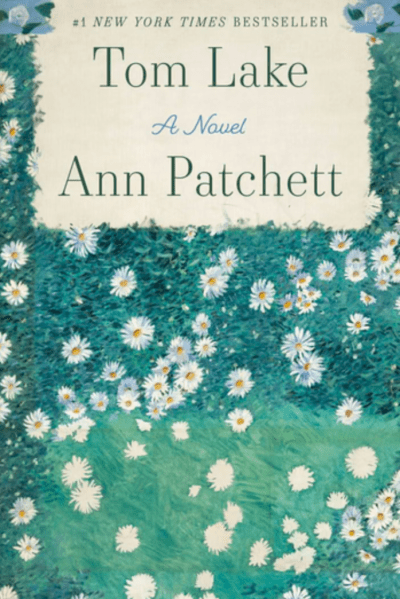
Image of cover of Ann Patchett's novel Tom Lake

I am a writer who loves story—and homework. I’m sure I’m not alone there. So, before I sat down to read—or more specifically listen to Meryl Streep read—Ann Patchett’s most recent novel, Tom Lake, I watched Thornton Wilder’s classic play Our Town, which features quite a bit in Patchett’s story. I caught the excellent PBS “Great Performances” production from the 1980s featuring Spaulding Gray as the narrating stage manager, a young Penelope Ann Miller as Emily Webb, and Eric Stolz (swoon) as George Gibbs, her love interest.

Tom Lake, then, is a story about a story about telling stories—or, the act of dramatic portrayal. Lights, camera, characters. Confused yet?

Okay, the front story, or more immediate narrative of Tom Lake, follows 50-something Lara Nelson, a wife and mother living on a Northern Michigan cherry farm (another dramatic subtext) as she tells her three grown daughters, home during the 2020 pandemic, about her long-ago love affair with famous actor Peter Duke (think: a 1980s James Dean; I’m picturing 90210-era Luke Perry). 

Note that in this novel there is not a whole lot of Rust Belt significance to hang our hats on here at Rust Belt Girl. This setting is not Rust Belt Michigan, but the Michigan of the Upper Midwest’s Fruit Belt. But, hey, we contain—and read—multitudes, right? And, really, Patchett rarely disappoints.

Told as a dual narrative, Tom Lake’s backstory follows the love affair between then-young actors, Lara and Peter, at a summer stock theatre in Michigan where they perform both Our Town and Sam Shepard’s one-act Fool for Love, which I need to watch next. (A girl can only do so much homework.) Quick distillation, Our Town is a gentle (even genteel in that puritanical New England way) portrayal of young love; Fool for Love explores romantic love’s dark and destructive side.
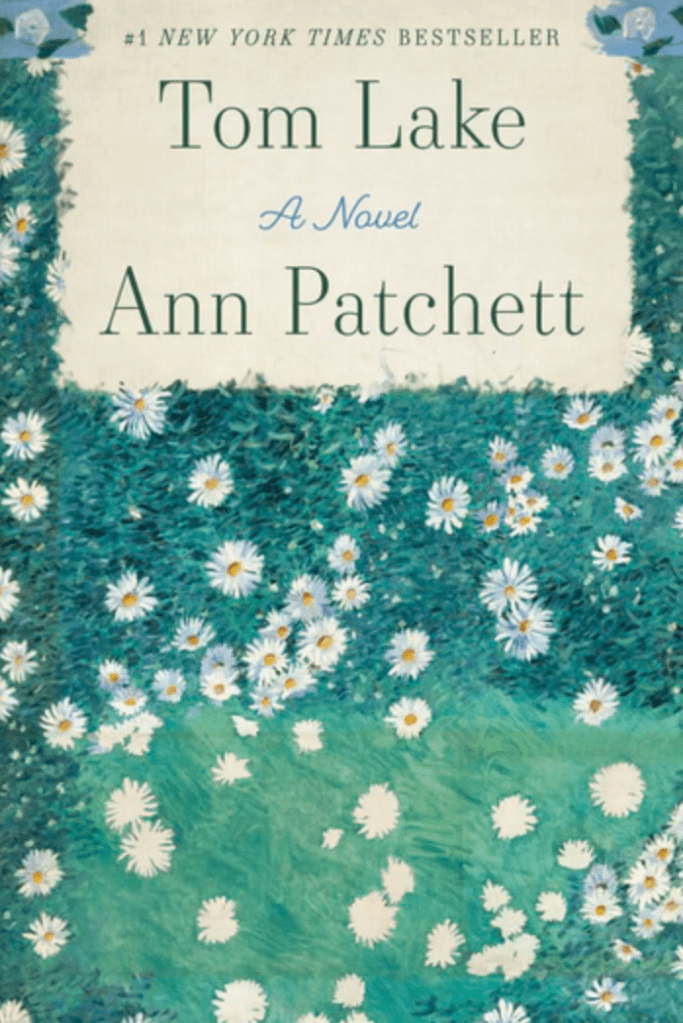
Image: Harper Collins website

So, Patchett’s novel Tom Lake is a story about the light and dark of love. But it’s also—and this might be even more interesting and applicable to us writers—a story about storytelling. Who tells the story, when, how, why, and about whom and to whom. What’s included in the storytelling and, maybe even more importantly, what’s left out?

A dual narrative novel is difficult to pull off; I know because I’ve tried this twice. Invariably, a reader will like one narrative more than the other and grow impatient when their favorite narrative is offstage. For me, Tom Lake’s 1980s narrative, its backstory, is more compelling (because much more is happening) than the 2020 narrative, which is mostly telling, with less forward-moving action (think: literal cherry picking). Which left the modern timeline feeling more like a frame or bookends for the real story—a way to go back in time to the main action and a way to come out of it again. 

I won’t digress too long on why writers like Ann Patchett feel the need for modern-day frames for historical stories. (Yes, a novel set in the 1980s is considered a historical novel.) My guess is it’s because historical novels today are often relegated to the “genre” genre, as in not the literary fiction shelf. Okay, digression over.

My favorite (oft quoted) line from Our Town, which feels very instrumental to this discussion on storytelling (and okay there’s a little spoiler here): Toward the end of the play, the dead character Emily, who returns to her life for just one day, asks the stage manager if any living person ever realizes “life as they live it,” and he says no, but then adds an exception. “The saints and poets maybe—they do some.” 

There’s a lot of smart stuff happening in this novel of Patchett’s when it comes to the all-important telling of life’s story—our human way of re-living what we can’t grasp with our little human minds in the moment. We can’t all be—though maybe we can all aspire to be—saints and poets.

Patchett’s main character, Lara, who is narrating her story of young love, to her grown daughters, is basically the stage manager of her own story, choosing how and what to tell as she goes. At one point Lara equates the stage manager in Our Town with God, which brings up interesting ideas about faith (Patchett was raised Catholic and it often shows in her writing) as well as destiny/Providence in our lives, and agency in how we portray our life stories.

What about the part of our story we leave untold, for our hearts, alone? I thought about this a lot as I read Patchett’s novel. For the main character, Lara, it was a dark part, and (dare I say) foolish aspect of young romantic love she shields from her grown daughters. In not telling her whole story, the light and the dark, is she playing God? Are we all?

In my writerly opinion, the darkness in her story Lara keeps to herself isn’t earned by the character, un unusual flaw in character development on Patchett’s part. (Also very important to know when to wrap up a narrative.) But it is a stumble far outweighed by all the really fine storytelling she does in this novel. If this criticism feels vague, it’s because I don’t want to spoil the reveal. (Read it and tell me what you think!)

If there’s one author I’ve followed closely for some time, it’s Patchett. Her annotated version of Bel Canto—my favorite novel of hers—makes a great gift for the literary fiction (or opera) lover. Of her more recent novels, her 2019 release, The Dutch House, felt like a near perfect novel to me: quiet, to be sure, with none of the Le Carre-like action of Bel Canto, but an incredibly immersive read with characters who felt like my own brother and sister by the end of the book. Family ties Patchett writes about brilliantly, if she’s a little less adept at depicting romantic love and specifically sex.

Saints? I might know a few in the making. Poets? I’m honored to know a good handful. But for the rest of us, Patchett’s got me thinking about how lucky we writers are to get to craft our stories. How lucky we readers are to watch other writers and poets tell their stories just as they wish. We receive such instrumental gifts this way!

Have you read this novel? Have you seen the plays that informed this novel? What elements of craft and storytelling did they bring up for you?

And…what was your favorite bookish gift you gave or received so far this holiday season?

Check out my categories above for more guest posts, interviews, book reviews, literary musings, and writing advice we can all use. Never miss a post when you follow Rust Belt Girl. Thanks! ~Rebecca
Enter your email address to subscribe to this blog and receive notifications of new posts by email.


Lit Fest ’23 Lowdown (with slideshow)

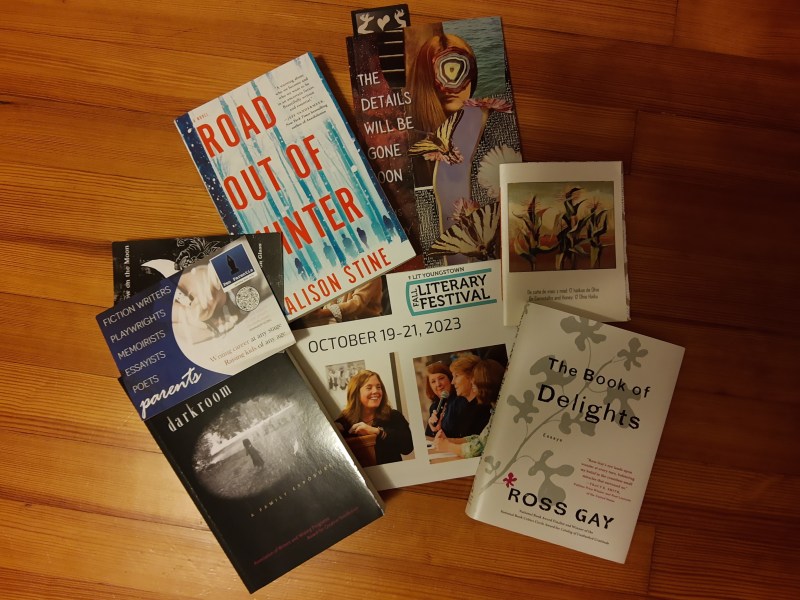
Much overdue, I’m back to recap Lit Youngstown’s 7th annual Fall Literary Festival. Who can put into words the inspiration and joy that happens when a couple hundred members of the literary community come together to create, share, and add to our towering TBRs, of course. (And did I mention nearly 50 sessions focused on various genres of writing and the writing process–how to choose, how to choose?) And, all in one fantastic Ohio city with the best Italian food around and against a backdrop of changing leaves for some extra fall magic. Well, I’ll give it a try…

Perhaps what I love most about this festival is that I can reinvent my creative self each time. I make it a habit to step outside my usual writerly lane and try something new.

Day 1

The first day of the festival I did just that. Parma, Ohio, Poet Laureate, workshopper extraordinaire, and friend Jeremy Jusek started off the day with a craft talk called “Verbal Alchemy: Visualizing Poetic Structure as a Formula.” If you couldn’t tell, Jeremy is a science guy in addition to being a poetry guy. He used chemical formulas and definitions to help “shake up” the structure of our poems. The ultimate goal: “To give structure to figurative language.” My major takeaways: the graphing of a reader’s reaction to a poem to illustrate the overcoming of a reader’s ground state to the point of truly feeling. Also, the idea of developing unit cells for a poem. (For instance a unit cell might consist of 2 similes or metaphors and one question. A poem might contain 6 of these units.)

Maybe it’s my uncertainty with writing poetry that makes me to want to learn all I can about poetic structure, but I stayed in the poetry lane that morning and attended superstar poet Sandra Beasley’s talk: “Lyric A to Z: Exploring Abecedarian Forms in Poetry and Creative Nonfiction.” If the term “Abecedarian” is new to you, you’re in good company. From Sandra’s handout: “In an ‘abecedarian,’ consecutive lines, sentences, or paragraphs lead with consecutive letters of the alphabet. Note that abecedarians can use any language system, not just American English.” (Abecedarian poetry and a Prince fan? Check out a fantastic example by poet Randall Man called, of course, “Alphabet Street.”)

Another highlight of the day was sitting in on the conversation between poet, essayist, and educator Ross Gay and poet and educator Jennifer Sperry Steinorth. Much of the discussion was pedagogy-focused. They discussed the MFA workshop, a process that has received close scrutiny in recent years. The traditional way, Ross feels isn’t “good for our soul or our work.” Instead he tries to stick close to what he notices on the page. His workshop goals are not a stellar poem or essay but are “care and imagination” in the class.

For my last session of the day, I moderated a roundtable led by author, editor and educator Meagan Lucas (whom I interviewed about her debut novel years ago for Parhelion and was excited to meet irl!). Called “I’m a Lit Mag Editor: Ask Me Anything,” the session allowed participants to get a behind-the-scenes on just what rises to the top of the “slush pile.” A couple tips I took with me: the fiction word count sweet spot for Reckon Review, where Meagan is EIC : about 3,000 words; and don’t forget the importance of a catchy title (when that’s all lit mag readers see in their queue!).

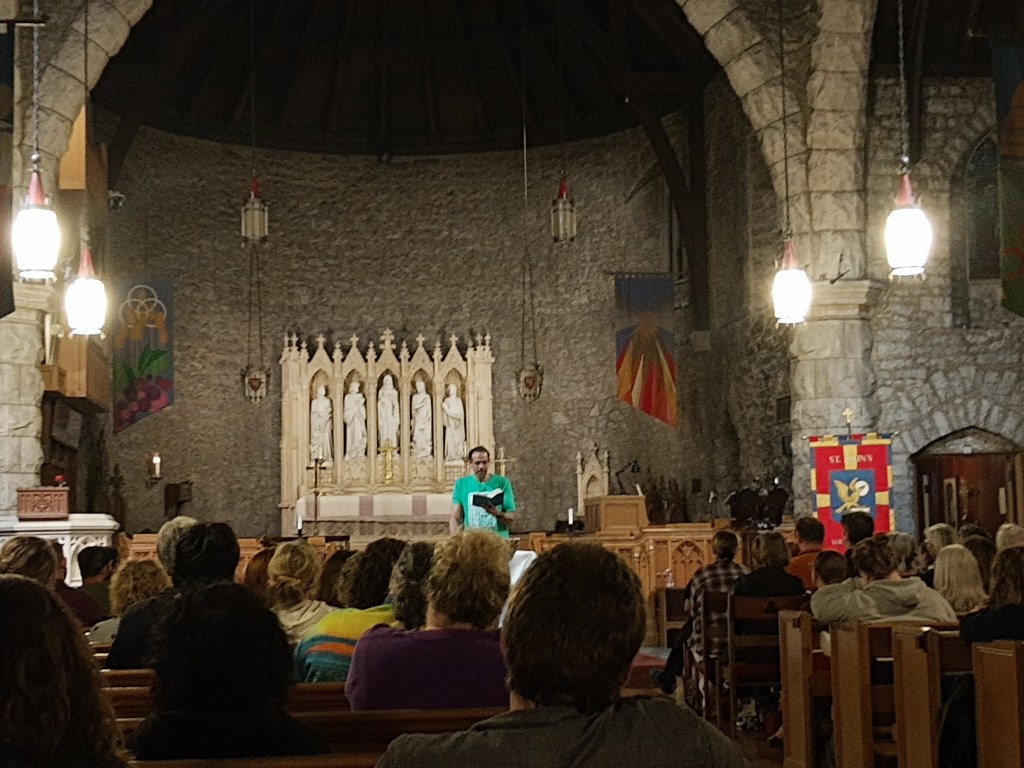
Last, if you’ve been around these blog parts for a while, you know Ross Gay’s work has inspired some of mine, including this essay. And so I was prepared to be moved by his reading at the beautiful, historic St. John’s Episcopal Church–much from his new book of essays, Inciting Joy. But reader, I wasn’t just whelmed but overwhelmed. Ross’s mission of joy has been a guiding light not just for my fledgling essays and poetry, but for a new path where my art and faith can live together. And (in 2023, as I’m sure you can imagine) that’s a lot.

Day 2

The next day started off with a fantastic author reading. One essayist, my friend and editing co-conspirator Renée K. Nicholson; novelist Jason Kapcala, whom I interviewed here; and two poets, Amy M. Alvarez and Randi Ward read from their creative work “set in the mountains and hollers of Appalachia and the hardscrabble steel towns of the rust belt.” Themes of place and displacement ran through these works and I found myself transported–just what a creative reading should do!

The next session found me back in my fiction-writing lane. Novelist Alison Stine focused on “the urgency of cli-fi as we deal with the worsening impacts of climate change” in her craft talk called “Writing Climate Fiction as the World Burns.” Alison has a really inspiring way of talking about writing, even if she writes dystopian stories that deal with tough stuff–like the end of the environment and nature as we know it. It’s clear writing has saved Alison time and again. Writing, she said “is making people sit up straight,” and is also something that can “give us hope” and “give us a way.” And my practical takeaway from her session: wait for your characters to start acting before you start to write your ideas.

My final session of the festival found me marveling at the difference storytelling and writing can make–not just on our spirits but on our whole selves and in the ways we care for one another. Dani Naffziger led an inspiring talk called “Collaborative Writing with Adults with Disabilities,” a writing service she says “provides tangible and rewarding benefits for all involved,” highlighting stories from a population “rarely represented” and introducing “new writing processes for established and emerging writers.”

Under the umbrella of The Healing Impact of Writing, for the other part of the session West Virginia University Humanities Center director Renée K. Nicholson and physician Ryan McCarthy talked about their Healthcare is Human initiative. Through a unique partnership between WVU Medicine and the WVU Humanities Center, the initiative promotes the work of narrative medicine and health humanities. Its seeds were planted during the pandemic, when Dr. McCarthy began journaling about his own experiences and then gathering the stories of his fellow front line workers. He has said: “…projects like this, which highlight the real human stories of healthcare workers, nurture our own humanity.”

My own humanity certainly nurtured, my writing self restored, I left the festival inspired by the work of my fellow writers and by what’s to come. Thank you to Lit Youngstown director Karen Schubert and all who make it happen, year after year. And trust me, you won’t want to miss next year’s festival. Details here.

Now, tell me in the comments, did you attend the festival? What was the highlight for you? Do you attend writing conferences in general, book fairs? What gets your creative juices flowing?

Hankering for Rust Belt author interviews, book reviews, and more? Check out my categories above. I hope you’ll follow me here, if you don’t already, so you never miss a (quite infrequent) post. Thanks! ~Rebecca

Enter your email address to subscribe to this blog and receive notifications of new posts by email.