“Taking the Cow Path to Culture”: an Essay by Christina Fisanick

I’m thrilled to present the second in a series of guest posts interrogating place here at Rust Belt Girl. Christina Fisanick is a champion for Appalachian writing–and Appalachian voices, young and old. (Read her whole bio below.) “Taking the Cow Path to Culture” appears in her book, Pulling the Thread: Untangling Wheeling History, which was published in 2024 by North Meridian Press.

Taking the Cow Path to Culture 

by Christina Fisanick 

Route 88 meanders through the Ohio Valley countryside, connecting the city of Wheeling, West Virginia, to Oglebay Park and small, rural towns and farms along the way. More significantly, for some, Route 88 is the lifeline that carries students, faculty, staff and visitors to two of the area’s oldest institutions of higher education, West Liberty University and Bethany College. This important role earned Route 88 the seemingly humorous moniker, “The Cow Path to Culture,” and is a standing metaphor for much of life in the northern part of the Mountain State and throughout Appalachia.

Route 88 was once an actual cow path upon which animals were herded across the farmlands of the region. Like many other places in the country, it made more sense to locals to pave the beaten cow path than to blaze a new trail as modes of travel advanced. But as has been somewhat painfully obvious over the last century, maintaining the well-trodden road might not be the best way to go. 

In 1893, a minor New England poet, Sam Walter Foss, wrote a poem with a major message. “The Calf-Path” tells the story in verse of a path driven by a calf through Boston, which, after years of other animals, and eventually humans, following the path, was paved and became a major thoroughfare. The funny, yet poignant, poem takes readers on a journey through time and encourages deep thought about life decisions. Mainly, Foss wonders, why should we continue going down the same road in deed and thought when it might not be the most direct or even the best route?

Just like the calf path in the poem, Route 88 rambles and turns and plunges on its trek from Wheeling past Oglebay Park beyond the farmlands and homes and on to West Liberty University and then Bethany College. I commuted to West Liberty in the 1990s and cursed the winding road more than once during the icy winter months. My classmates and I anxiously wondered who would build a college on top of that hill? More so, we jokingly wondered how we made it to graduation.
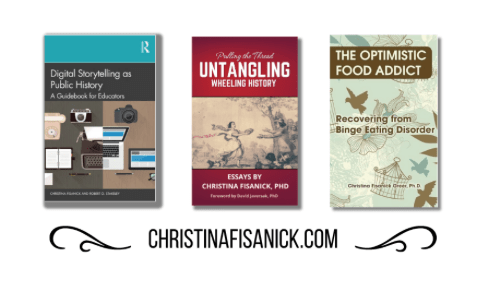
Covers of three of Christina Fisanick's books: Digital Storytelling as Public History; Pulling the Thread: Untangling Wheeling History; and The Optimist Food Addict: Recovering from Binge Eating Disorder

We were not the first students to ponder such things. A 1972 Sports Illustrated article tells the tale of four student-athletes from Israel—Avraham Melamed, Moshe Gertel, Yoel Kende and Danny Stern —and their “250-pound Irish Catholic coach,” Tom Grall. The students were recruited for the West Liberty swim team. Avraham Melamed described their journey from the Pittsburgh airport along Route 88 in harrowing, awe-struck terms then concludes: “It was easier getting from Ramat Yohanan [Israel] to Pittsburgh than it was to get from Pittsburgh to West Liberty.” Writer Mortin Sharnik paraphrases Melamed:

“All roads do not lead to West Liberty, but one that does, Route 88, is called the Cow Path to Culture. The Israeli was taken on a more scenic route, a roller-coaster ride over a ribbon of cracked concrete, with no guardrails to prevent a car from taking a shortcut down a ravine. Melamed kept his nose pressed to the car window, looking for the bright lights. Instead, he saw farms, strip mines and hairpin curves.”

The effort, of course, was worth it. The Israeli students went on to make the swim team as winning as West Liberty football, which at the time the article was written had two consecutive undefeated seasons. More so, they earned great educations from the oldest institution of higher education in the state of West Virginia.

While Sharnik’s article is a fascinating and humorous look at the past, it is the title that catches my attention: “Wandering Jews in an Unpromising Land.” Clearly, Sharnik was playing on the students’ ethnicity and well-known Biblical references. Regrettably, the term “unpromising” is simply the same old stereotype of West Virginia arrived at by taking the same old mental cow path. Now, 46 years later, that cow path has been paved over again and again, and few people outside the state (and even within its borders) are willing to blaze a new trail. West Virginia needs to free itself of the shackles of presupposition that continue to hold us back from achieving greater success.

These stereotypes not only negatively color West Virginia, but all of Appalachia. We are told time and again by the popular media (and even ourselves) that there is nothing here. Appalachia is a wasteland, people say. A no man’s land of little possibility and less opportunity, they echo. And more often than not, this lack is blamed not on politicians or exploitive company owners, but on Appalachians themselves.

This blame goes back decades to early literature, TV shows and movies that exploit the region’s hardships for book sales, ratings and box office records. Few can forget The Beverly Hillbillies and their clueless, backwoods characters with hearts of gold or the psychologically deranged figures from Deliverance. Popular culture tells us that Appalachians are poor, willfully ignorant souls who are too lazy to improve their lots in life. These ideals have been further entrenched by presidential “poverty tours” conducted by presidents and other politicians throughout the 1960s to prove to the American people outside the region that Appalachians are poor, white trash that need their help.

Unfortunately, many of our own people have embraced these ill-conceived views of ourselves and live accordingly. Of course, we never see ourselves as morally-bankrupt, ne’er-do-wells, but we willingly believe it of our neighbors. J.D. Vance does this in Hillbilly Elegy, of courseHe encourages the country to continue to blame Appalachians for our misfortunes. It is our own fault that we suffer from the world’s highest rates of opiate addiction, he argues. It is our own fault that many of our children live in poverty, he states. By continuing to claim that Appalachia’s poor are responsible for their own conditions, the nation’s eyes can be averted, not out of guilt but out of blame. Our country’s hands can be washed clean since Appalachians create our own misery and wallow in it.

It is easy to see why this particular cow path has been well-worn and paved over. It is to the benefit of politicians whose pockets are lined with money from the oil and gas industry to continue to shame and blame our people so that they never ask for more. Our land has been raped of resources while our people have been underpaid and exploited. None of this could happen if not for desperation and mentally following a well-worn cow path that leads to broad, self-defeating conclusions about poverty, drug abuse, and job loss.

Even now, young men fight for jobs in the dying coal industry for the promise of what they believe once was but will never be (again). Now is the time to take a different path. One that is not littered with stereotypes and preconceived notions. I am reminded, as I am sure you are by now, of another poem that urges readers to take the road “less traveled by.” I urge you, my fellow West Virginians, imagine a different life for yourselves and for generations to come. I’ll always take the cow path to culture to serve my alma mater. West Liberty University is in my heart forever. But my mind will be on a different metaphorical route that allows for new possibilities for West Virginia, Appalachia, and its people.

We no longer have to play the role of eager simpletons to keep our jobs. There are no jobs. Let’s create our own through education, new industries, and innovation. A change in mindset will make all the difference. In this moment we must abandon who we are told we are and become who we know we are. We are West Virginians. We are Appalachians. Toughened by adversity, wizened by necessity, and softened by empathy.


A photo of the cover of Pulling the Thread: Untangling Wheeling History, essays by Christina Fisanick, Ph.D. Forward by David Haversack, Ph.D.

Pulling the Thread: Untangling Wheeling History

By Christina Fisanick, Ph.D.

North Meridian Press


Photo of Christina Fisanick, Ph.D., with red hair and gold earrings and wearing a black sweater.

Dr. Christina Fisanick is the author or editor of more than 30 books and dozens of articles, essays, and poems. Her latest book, Pulling the Thread: Untangling Wheeling History, is a collection of essays focusing on little known stories from Wheeling’s past. She is currently working on an historic novel which takes place at Fostoria Glass in Moundsville, WV, in the years immediately following WWII and co-editing an anthology, “We Are Here!”: New Writing from Northern Appalachian (forthcoming for University of Kentucky Press). In addition, Fisanick is an English professor and an internationally recognized scholar in the teaching of digital storytelling as public history. Fisanick serves as the president of the Writers Association of Northern Appalachia (WANA) and the co-host of WANA LIVE!: The Reading Series. Learn more: christinafisanick.com.


Doesn’t this essay just get you thinking? What are a place’s histories, byways, characteristics, and quirks–and how have they shaped its people and its art? How have they shaped the stories we tell? For this series, I suspect we will get some fascinating answers to these questions and many more I haven’t thought of. I hope you’ll join in and share your thoughts!

Like this post? Want more? Comment below or on my FB page. And please share with your friends and social network. 

Are you a Rust Belt writer interested in seeing if your own post, or author interview, or book review might be right for Rust Belt Girl? Hit me up through this site’s contact function.

Check out my categories above for more guest posts, interviews, book reviews, literary musings, and writing advice we can all use. Never miss a post when you follow Rust Belt Girl. Thanks! ~Rebecca

My interview with Valerie Nieman, author of In the Lonely Backwater: Part II

Part II of my interview with Valerie Nieman continues our discussion of her novel and her poetry and also covers the poetry she loved to teach her students. She also shares what she’s writing and reading, right now. (Spot the friend of Rust Belt Girl in her TBR!) Missed Part I of the interview? Find it here.)

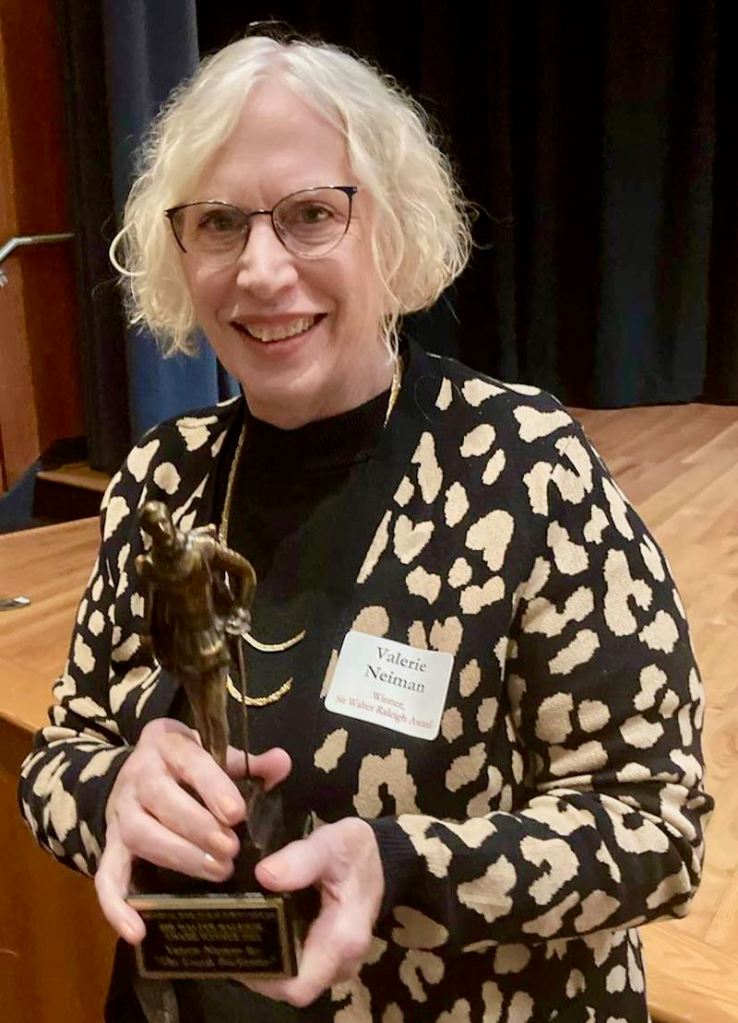
Valerie Nieman’s latest, In the Lonely Backwater, a mystery in the Southern gothic tradition, has been named the 2022 Sir Walter Raleigh Award winner for the best novel by a North Carolina writer. To the Bones, her genre-bending folk horror/thriller about coal country, was a finalist for the 2020 Manly Wade Wellman Award. She is also the author of Blood Clay (Eric Hoffer Award) and two other novels. She has published a short fiction collection and three poetry collections, most recently, Leopard Lady: A Life in Verse, which was runner-up for the Brockman-Campbell Prize. She has published widely in journals and anthologies, and appears regularly in juried reading series such as Piccolo Spoleto, Why There Are Words, and Women of Appalachia. She has held state and NEA creative writing fellowships. Nieman has degrees from West Virginia University and Queens University of Charlotte, and was a reporter and farmer in West Virginia before moving to North Carolina, where she worked as an editor and a creative writing professor at NC A&T State University. 

Valerie, In the Lonely Backwater has been praised for its “deep sense of the wonderment of the natural world.” I see this in your poetry, too:

Can you talk about this poem of yours, its impetus, its rooting in the bog but also “close to the sun?” 

This is a poem that came directly from observation. I was walking in the Bog Garden in Greensboro when I came upon a group of people staring up into the treetops. It’s that barred owl, I thought, a resident of the garden. Instead, I was shocked to see a full-grown groundhog up there grazing on the new leaves. I went home and looked it up online, finding numerous videos and learning that it’s not uncommon for woodchucks to climb trees.

Among other inspirations was the late Gerald Stern’s poem “Behaving Like a Jew” and his line about a dead opossum’s “little dancing feet.”

Poet and author Valerie Nieman

The family at the center of your novel is part of the “Appalachian diaspora.” What does this term mean for you personally—and for your poetry, especially?

Well, it’s who I am. I grew up in northern Appalachia, the Allegheny Plateau in western New York where the Allegheny River rises and flows to Pittsburgh. I went to school at West Virginia University, and worked as a reporter and editor at papers in Fairmont and Morgantown,  both on the Monongahela, before leaving the Ohio River watershed for the first time in my life. I moved to central North Carolina in 1997 for a newspaper job. Now I live one county line over from Appalachia as defined by the ARC, but Rockingham County has all the earmarks of Appalachia—rural, with faded industry and a changing agricultural life, and beautiful hills and rivers. Not really mountainous enough, I guess. So my work draws on my upbringing in dairy country, 20-plus years in the coal fields, and then working as an editor in tobacco country before a final 20 years in academia. Nature poet, blue collar writer, Appalachian writer, Southern writer.

“Tinder” feels like a nature poem, an ode to Shakespeare’s witchy “double toil and trouble,” and a horror story all at once:

Tinder

I am the woman your mother 
warned you about. 

I am boiling bones boiling bones boiling bones. 
I am washing out the war-rags at the ford,
blood pluming downstream 
gaudy to catch the heart.
 
I am scraping scraping scraping
on the stretched skin of the world. 
My pet is a scrofulous cur,
my bird a dobsonfly all wings and jaws.

I look under rocks.
I find what I expect to find. 

Can you talk about your influences here and what you want your reader to know about the persona in the poem?

Ah, that’s a dangerous woman. She harbors grudges and has a long memory for those who’ve done wrong by her. What bones are those in her broth? Difficult to say.

Influences indeed include Shakespeare, and Poe as well, a bit of Hawthorne—all of whom I read as a child, pulling the classics from the shelves during long western New York winters. I also was influenced by many years of research into early Celtic and Norse cultures. “The washer at the ford” or bean-nighe is found across the Celtic nations. She’s seen in wild places, kneeling beside a lake or river, washing the blood out of the clothes of men who are fated to die. So that was in my mind as the image of the dobsonfly appeared. It’s the quite terrifying winged adult of the hellgrammite, a stream insect with enormous pinching jaws. As a child I spent a lot of time in “the crick,” turning over rocks, and as an angler I’ve done the same for years, to see what fish might be eating, and just because I like to see what’s underneath.

What was your favorite poem or story to teach students when you were a professor at NC A&T State University?

“Out, Out” by Robert Frost is a favorite, to show how a poet can compress an entire short story into 34 lines—dialog, description, setting, plot. I liked showing students the flexibility of the sonnet, comparing traditional forms with Terrence Hayes’ “American Sonnets.” I also loved teaching humanities and exposing students to ancient work from the negative confessionsof the Egyptian Book of the Dead, to framing a discussion about war and the death of young men through Priam’s visit to Achilles.

What are you reading right now? What are you writing? What can we look forward to, next?

The top of one stack: Hemlock Hollow by Culley Holderfield, The Sound of Rabbits by Janice Deal, Red Clay Suzie by Jeffrey Dale Lofton, All the Little Hopes by Leah Weiss, and Hungry Town by Jason Kapcala. Dipping into a number of poetry books as well, including Anything that Happens by Cheryl Wilder. Eager also to get back to some science fiction, with Kim Stanley Robinson’s Ministry of the Future. There are many shelves, and many stacks, and I keep adding to the accumulation.

I’ve just (as of 4/3) completed the first draft of Dead Hand, a sequel to To the Bones. I had almost as much fun writing this as the first one! The action moves from the West Virginia coalfields to Ireland. I revisited places I’d seen a few years ago, from the Shannon Pot to County Cavan to Dublin, and added others including an Irish coal mine. While that simmers in the hands of beta readers, I’m working on pulling together a new book of poetry.

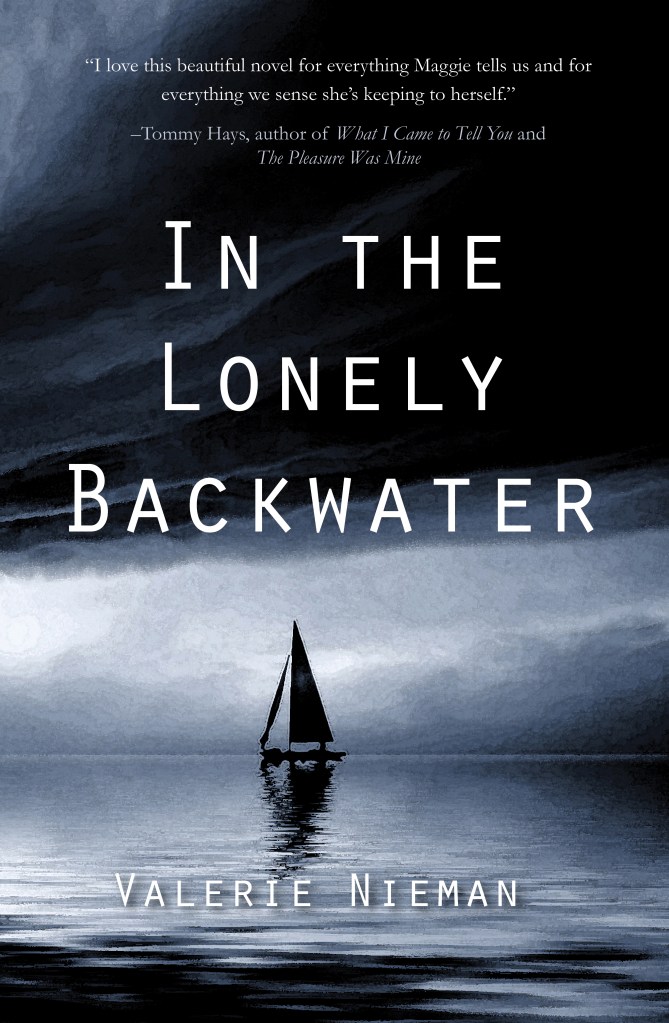
In the Lonely Backwater

By Valerie Nieman

Regal House Publishing $18.95


Like this interview? Comment below or on my FB page. And please share with your friends and social network. 

Are you a Rust Belt writer interested in seeing if an author interview or book review of yours might be right for Rust Belt Girl? Pitch me through this site’s contact function.

Check out my categories above for more interviewsbook reviewsliterary musings, and writing advice we can all use.

What are you reading and writing this week? Let us know in the comments…

And never miss a post when you follow Rust Belt Girl. Thanks! ~Rebecca

Enter your email address to subscribe to this blog and receive notifications of new posts by email.

My interview with Valerie Nieman, author of In the Lonely Backwater: Part I

Author Valerie Nieman grew up in the Rust Belt of western New York State, lived and worked for many years in the northern coalfields of West Virginia, and now lives in a North Carolina town that’s still recovering from loss of the Lucky Strike plant. In short, Valerie explains, she’s “seen a lot of industrial wastelands.”

How do these evocative locations inform her prose and poetry? In the following author interview, I asked Valerie about this, about her latest, award-winning novel–and much more.

Valerie Nieman’s latest, In the Lonely Backwater, a mystery in the Southern gothic tradition, has been named the 2022 Sir Walter Raleigh Award winner for the best novel by a North Carolina writer. To the Bones, her genre-bending folk horror/thriller about coal country, was a finalist for the 2020 Manly Wade Wellman Award. She is also the author of Blood Clay (Eric Hoffer Award) and two other novels. She has published a short fiction collection and three poetry collections, most recently, Leopard Lady: A Life in Verse, which was runner-up for the Brockman-Campbell Prize. She has published widely in journals and anthologies, and appears regularly in juried reading series such as Piccolo Spoleto, Why There Are Words, and Women of Appalachia. She has held state and NEA creative writing fellowships. Nieman has degrees from West Virginia University and Queens University of Charlotte, and was a reporter and farmer in West Virginia before moving to North Carolina, where she worked as an editor and a creative writing professor at NC A&T State University. 

Valerie, can you tell us about your Rust Belt upbringing and how it informs your creative work? What was it like to not only live but work in the coalfields of West Virginia? You were both a farmer and a reporter there. Can you talk about how those roles are similar/different?

I grew up the child of a factory worker who’d wanted to be a farmer. His plant in Jamestown, NY, built desks and filing systems. I remember copies of “The Machinist” in the bathroom, and the annual July shutdowns and factory picnics. Royal Metal was part of a thriving factory district that produced everything from heavy equipment to tools to furniture. Crescent Tool, Proto Tool, Blackstone, and so many others used to run three shifts. The last time I was there, I found a ghost district, post-apocalyptic. It’s been a long time and maybe things have gotten better, but this part of the Rust Belt was truly “rusty.”

My father had to leave the factory when it closed and go to one in South Bend, IN, that carried on for a few more years. When he could no longer walk concrete floors as a foreman because of worsening knee injuries from the Korean War, he and Mom followed me to West Virginia. They opened a bait and tackle shop near the Monongahela River just outside Fairmont, WV, where I worked for the newspaper.

That city had a prominent and troubled history as a coal center. Consolidation Coal was founded there, and the Watson mansion became an inspiration for the Kavanagh home in To the Bones. Marion County had two of the nation’s most deadly mine accidents, Monongah 1907 and Farmington No. 9 in 1968, both of which led to massive overhauls of mine safety regulations. The offices of UMWA District 31, headed by Richard Trumka, were next door to the church I attended.

During my time as a reporter, I covered the coal industry and the environment, along with the police beat, so I got to see everything from murder investigations to the working longwall at Martinka Mine. I later became editor and helmed major investigations, one into the county’s secretive dealings with a waste coal entrepreneur and another about acid mine drainage, both of which won state AP public service awards and other recognition.

My home was a small version of the classic Appalachian hill farm. It rested above some of the former Consol No. 9 workings and a mine crack furrowed the hayfield. My ex and I built a house and barn and were creating a partial subsistence lifestyle there, with beef cattle, organic garden and orchards, before divorce ended that part of my life.

I’ve never regretted the newspaper years, despite the low pay and often difficult working situations, because I got to see and experience so much! My novels and poems draw on those years still.

Valerie Nieman, Winner of the 2022 Sir Walter Raleigh Award

Your poem, “The size of West Virginia,” begins “Few know the Mountain State…” Here’s a taste:

“The size of West Virginia”

Few know the Mountain State but all
recognize it, easiest puzzle-piece of the states,
its awkward panhandles and pendulous gut
lolling into East Virginia.

A vast aquifer "lake" lies trapped under southeastern 
Greenland, larger than the size of West Virginia.

It’s a convenient scale for journalists, 
standard candle like the Cepheid Variables 
or Type Ia Supernovae that allow 
for dead reckoning on distant stars.

As of July 15th, fires have blackened nearly 21,000 
square miles. (That's nearly the size of West Virginia.)

Can you talk about that—how being from a lesser-known (or maybe even unknowable to outsiders) kind of place informs your writing?

Appalachia remains “the other” for so many in America, a stereotype compounded of Snuffy Smith comics and Disney cartoons and Deliverance. The people are lumped together as white, poor, ignorant, violent.

This didn’t happen by accident. The dispossession of Irish and Scots crofters by “noble” landowners who considered them an impediment— “lice on the land” as one said—led to mass migrations and  provided many of the region’s early immigrants. That legacy of dispossession continued with the rape of Appalachia’s land for timber and coal, at the expense of smallholders and their communities. And writers from the Northeast found a willing market for stories of the region’s exotic and dangerous folk.

The region was and is diverse, from the many Native American tribes that lived, traded, farmed, and hunted there, to German, Polish, Italian, Hungarian, Spanish immigrants who came to work the mines and mills, along with Black families moving up from the Deep South, Lebanese merchants who served the coal communities, and more recently, people from Nigeria to India and the world over who come to study at West Virginia University or  work in industry.

I began to notice the repeated use of West Virginia as a unit of size comparison for other places, did a search online and found many more, and that brought about this poem. 

Although I’ve lived in North Carolina for many years, West Virginia was where I became a writer and the place that continues to feed my work. Along the lines of this poem, my 2018 novel To the Bones uses and subverts some of those cliches about this “unknown place” in a genre-crossing tale about the coal industry and its enormous impact on the people and place.  

How did you transition from journalism to poetry and fiction? How do these disciplines influence one another?

Brevity, compression, observation are the watchwords for journalism. Equally true for poetry. And while I can wax descriptive in my prose writing, it’s always economical—no wasted words. At least I like to think so, and readers have said as much. 

Your latest novel, In the Lonely Backwater, features a teen protagonist, Maggie Warshauer. What a voice! (Take note, fiction writers.) Here’s how Maggie describes a detective who’s come to her North Carolina high school to ask her and other students about a girl who’s disappeared, a girl Maggie is related to and with whom has had some “squabbles”:

I didn't expect a detective to look like my dentist. He waited, watching me like an underfed hound. If I were going to place him in the marina, I'd say he was a fishing boat. A small one, from Sears, not on a slip but parked on the monthly lot. Plain aluminum johnboat with a little outboard.

Can you tell us when and how Maggie first started speaking to you as a writer, when you knew you needed to write this story? 

Maggie’s been speaking to me all my life: a version of my sarcastic inner voice that doesn’t get spoken aloud very often. She’s not me, but there’s a lot of me in her. Specifically, she began speaking with the opening line, “There wasn’t anything wrong between Charisse Swicegood and me except that she was her and I was me, and with the family history and all it was just natural.”

Her character has many roots, including my lifetime of solo wandering in the woods, an interest in biology and ecology, and a number of years sailing a “pocket cruiser” at Kerr Lake. Like Maggie, I was a girl who preferred boy things, in a time when the terms gender-fluid and nonperforming had not yet appeared.

The spark that brought together many disparate elements was the discovery of an inscription in my senior yearbook. A girl I do not remember wrote, “I hope all our misunderstandings are cleared up.” It’s signed Love. I do not remember anything about the disagreement, but I did recall the intensity of emotions in those years.

The town you live in now, in North Carolina, is still recovering from the loss of the Lucky Strike plant. Coal and tobacco both had their boom and bust. I’m reminded of Emma Riva’s review here at Rust Belt Girl of Tess Gunty’s novel, The Rabbit Hutch, set in a fictionalized Indiana town decimated by the loss of an auto plant. What makes these “wastelands” fertile settings for your creative work, for suspense, and even horror?

I think such hollowed-out industrial centers have much in common with haunted houses, and with the beloved ruins of the Romantic poets and artists, in the evocation of what once was and is now gone. I’m drawn to them, as I am to songs by Bruce Springsteen that depict these same broken places and the people who despair, maybe leave, or maybe find the grit to keep going and rise up again. I most like cities that have a past, Pittsburgh, Glasgow, Greensboro, but have reinvented themselves without losing that slight acrid tang of their former smokes, their former selves. 

I remember when retraining programs were offered for West Virginia miners losing their jobs in the transition from conventional mining to long wall. They were offered welding or computer coding, both honorable careers, but pretty specific. It’s good to see current efforts to train miners and legacy factory workers for careers in new industries that may better fit or expand their existing skill sets, such as wind turbine maintenance, electric motor building, ecological remediation, and solar installation.

Where I now live, in Reidsville, NC, the landscape is marked by the former tobacco warehouses, the mill houses and owner’s mansions, old curing sheds, and over all, the smokestack of the former Lucky Strike plant emblazoned with that logo. It’s been purchased and is being repurposed as an e-commerce hub. I hope they keep that emblematic stack standing as a symbol of this community.


Please check back for Part II of my interview with Valerie Nieman–for more of her poetry, for what she loved to teach her students, and for what she’s writing and reading, right now. For more about her latest novel, follow the link below:

In the Lonely Backwater

By Valerie Nieman

Regal House Publishing $18.95


Like this interview? Comment below or on my FB page. And please share with your friends and social network. 

Are you a Rust Belt writer interested in seeing if an author interview or book review of yours might be right for Rust Belt Girl? Pitch me through this site’s contact function.

Check out my categories above for more interviewsbook reviewsliterary musings, and writing advice we can all use.

In case you missed it, my review of Megan Giddings’ latest novel, The Women Could Fly, which first appeared here at Rust Belt Girl was republished at Belt Magazine last month. Check it out!

Never miss a post when you follow Rust Belt Girl. Thanks! ~Rebecca
Enter your email address to subscribe to this blog and receive notifications of new posts by email.

From Belgium to the Rust Belt

A guest post by John W. Miller

The genesis of the PBS film Moundsville and its companion blog Moundsville.org, about a classic American postindustrial town, was a mid-life crisis mixed with the 2016 election and a curiosity about the truth of Rust Belt communities. 

Six years ago, I was on staff at the Wall Street Journal, covering mining and the steel industry out of its Pittsburgh bureau. 

Like everybody else, I watched as the Trump-Clinton presidential election blew anger, confusion, and fear through the culture. 

Personally, I was going through my own crisis. I was about to turn 40, and experiencing mid-life’s deepening cravings for meaning and direction. That second mountain beckoned. 

After 13 years roaming the world for one of the world’s great newspapers, I simply wasn’t enjoying it anymore. So I quit, and started climbing. After some discernment, I decided to stay in Pittsburgh. 

Poking around for creative projects, I started driving to Moundsville, a small town in West Virginia on the Ohio River 75 minutes from Pittsburgh. In 2013, I’d reported on it for the Journal

photo of a 2,200-year old Native American burial mound in Moundsville, West Virginia
2,200-year old Native American burial mound in Moundsville, West Virginia

The town fascinated me. I grew up in Belgium, the child of American musicians who’d wandered around Europe in 1976 and dropped an anchor in Brussels. I’m fascinated by places in America that tell a deeper story about my ancestral homeland. 

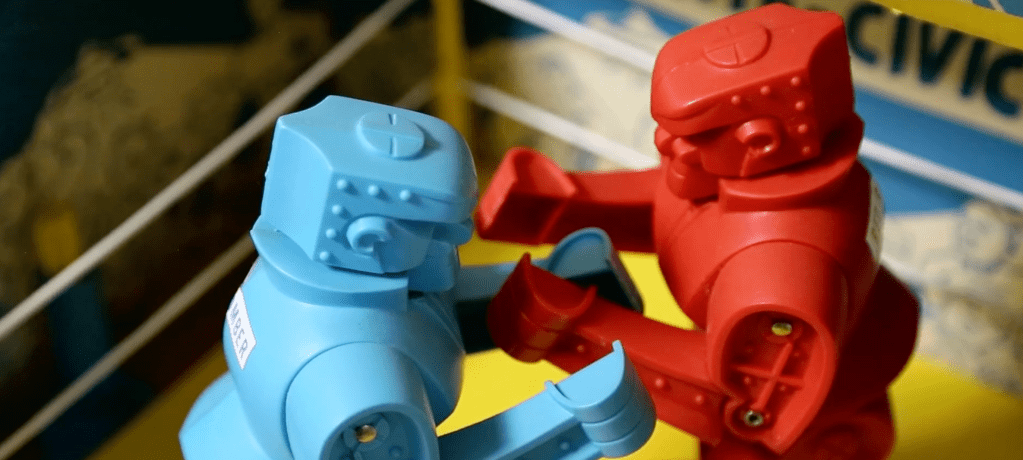
In late 2017, I connected with filmmaker Dave Bernabo. We put together a proposal to tell the story of Moundsville in a documentary.  I thought that town was a perfect place to tell a deeper story about America because it’s built around a 2,200-year old Native American burial mound, it harbored a glorious industrial age including the world’s biggest toy factory (Marx Toys, maker of Rock’em Sock’em Robots!), and it now subsists on a service-based economy anchored by a Walmart. There’s also a lot of pain and grief in Moundsville. In a generation, the town lost 8,000 jobs. The population halved. Young people left for Pittsburgh and New York. 

Rock’em Sock’em Robots! first manufactured by Marx Toys of Moundsville, West Virginia

David and I spent most of 2018 driving down to Moundsville and interviewing people. At the end of each interview, we’d ask a question about Trump and national politics. Almost always, the answers lacked depth. It dawned on me: These people didn’t know about Trump. They didn’t live in DC. They weren’t very thoughtful about politics. But when we asked them about their work lives and their parents’ work lives, they engaged with depth and wisdom. Those questions, I realized, were actually loving. Almost always, I decided, asking about Trump simply wasn’t loving. 

After experimenting with a voiceover, we opted to tell the story without a so-called “voice of God” as narrator. The movie is an oral history, without any academics or outside experts. 

In our interviews, we heard about grief a lot, but we also heard and told tales of resilience, from a back-to-the-land farming couple, a small manufacturer of kitchen cabinets, and the leaders of a burgeoning tourism sector. The ancient burial mound looming above the town is a daily reminder that civilizations ebb and flow, and that time moves only forward. My hope is that we acknowledged grief in a healing way while pointing the way forward with stories of hope and perseverance. 

In December 2018, we premiered Moundsville in the town itself, a practice of sharing work that anthropologists recommend. Over 170 people showed up. A few grumbled about our portrayal of segregation in the film, but at the end, we received an ovation. 

A month later, we screened at America, the Jesuit magazine I had started writing forin New York City, on Sixth Avenue in Manhattan across the street from News Corp., home of the Wall Street Journal

To my surprise–and gratitude–the movie holds up. People appreciate its openness and listening attitude. “This amazing project reflects a diversity of stories that I needed to experience to remind me of hope and resilience and kindness,” wrote Anupama Jain, head of a Pittsburgh diversity training group, on Twitter. 

The biggest lesson I’ve learned making and showing Moundsville is that every place carries an organic placeness that deserves respect for its uniqueness. You can find wisdom and thoughtfulness in people when you engage them over that place and recognize its differences from your place. We can’t love our neighbors as brothers and sisters if we expect them to be just like us.

I created the Moundsville.org site to promote the film, but quickly found an audience for pieces I was posting. It gets an average of 10,000 readers a month. So I keep writing and posting. I’ve written over 100 pieces for the blog, on everything from Lady Gaga’s mom, who grew up in Moundsville, to people going to watch baseball inside the prison in the 1950s.

I’m still on a journey of figuring out a new kind of journalism that suits my skills, and my heart. I’ve co-directed Out of Reach, a new movie about the American Dream. I’m developing a podcast called Philosophy with Strangers, where I go with an older friend to small towns and ask big questions. First episode: We went to Charleroi, PA and asked people: What is happiness? I contribute regularly to America, a monthly magazine run by Jesuits. I coach baseball. Lots of other stuff, too. But wherever my career takes me, it was forever changed by the road that ran through Moundsville, West Virginia.

John W. Miller is a Pittsburgh-based writer and filmmaker, and co-director of the PBS film Moundsville

~~~

What are you watching, reading, and writing this month. Let me know in the comments…

Are you a Rust Belt writer? What’s your story? Would you care to share? Do you write book reviews–or conduct interviews of Rust Belt authors? If so, think of Rust Belt Girl for a guest post. And check out the handy categories for more writing from rusty places.

Find me on FB and on IG and Twitter @MoonRuark

And follow me here. Thanks!

Enter your email address to subscribe to this blog and receive notifications of new posts by email.

“…this time they won the day.” The poetry of Rust Belt Girl guest Carrie Conners

Rebecca here–and absolutely thrilled to present this guest post featuring the poetry of Moundsville, West Virginia native, poet and professor Carrie Conners. All three poems shared here explore Rust Belt themes and can be found in Carrie’s latest collection, titled Species of Least Concern. Please read, share, and join in the conversation in the comments.

~~~

~~~

~~~

Species of Least Concern

by Carrie Conners

Main Street Rag $18 (shipped)

~~~

Carrie Conners, originally from Moundsville, West Virginia, lives in Queens, New York and is an English professor at LaGuardia Community College-CUNY. Her first poetry collection, Luscious Struggle (BrickHouse Books, 2019), was a 2020 Paterson Poetry Prize Finalist. Her second collection, Species of Least Concern was published by Main Street Rag in 2022. Her poetry has been nominated for a Pushcart Prize and has appeared in BodegaKestrelSplit Rock ReviewRHINO, and The Monarch Review, among others. She is also the author of the book, Laugh Lines: Humor, Genre, and Political Critique in Late Twentieth-Century American Poetry (University Press of Mississippi, 2022).

Are you a Rust Belt poet or writer? Do you write book reviews–or conduct interviews of Rust Belt authors? If so, think of Rust Belt Girl for a guest post. And check out the handy categories for more writing from rusty places.

Find me on FB and on IG and Twitter @MoonRuark

And follow me here. Thanks!

Enter your email address to subscribe to this blog and receive notifications of new posts by email.

*header image of fall foliage free from Pexels