Lit Fest ’24 Rundown

Or, the post you’ve been waiting for, maybe.

Last month, I attended Lit Youngstown‘s 8th annual Fall Literary Festival. From modest beginnings, the writing conference has grown to welcome some 200 attendees each year. Proud to be among them, I served on the planning committee for a couple years, have served as a session moderator, read my own creative work, sat on an editors’ panel, and, this year, engaged a featured writer in a conversation about her writing craft, process, and life.

I’ve met most of my writer friends through this literary festival. (You’re probably nodding your head, reading this. Such joy those in-between conversations, Elise, Susan, Jeremy!) Writers come to this conference for the genuine connections, the generative craft sessions, inspiring creative readings, and Youngstown pizza (or maybe that’s just me?). I was thrilled to walk away having experienced an abundance of all of the above again this year!

Can I entice you to make the trip, next year? Let’s hope this rundown does just that. (And, bring your friends.)

Day 1

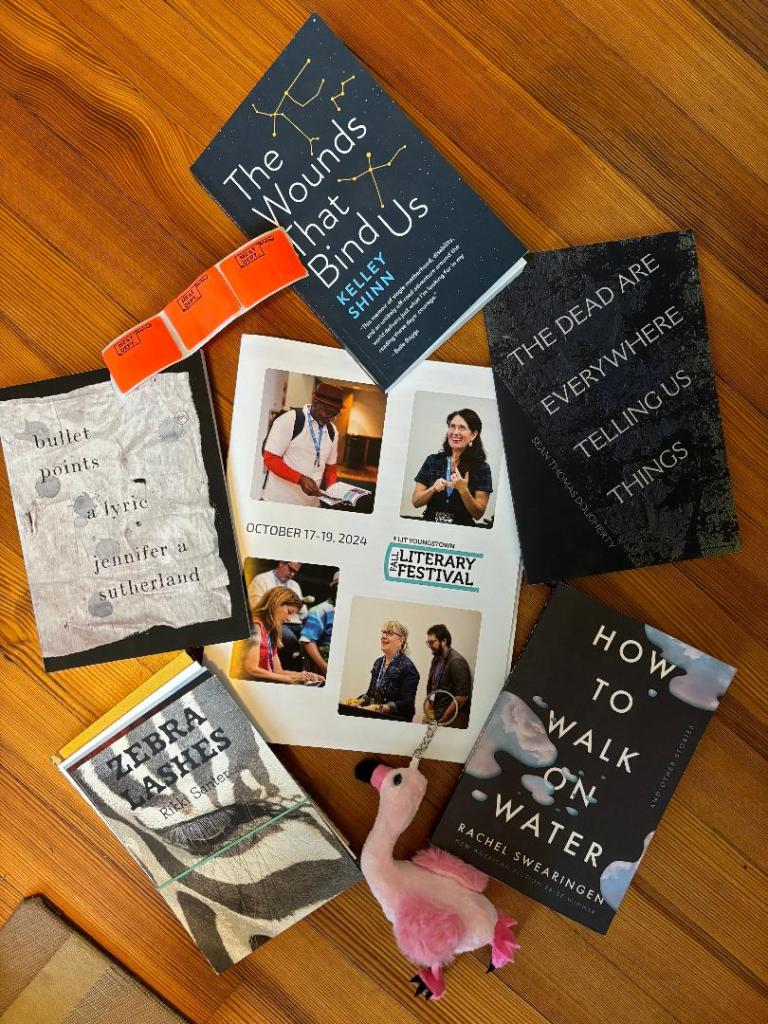
My first day of the festival began with meeting Rachel Swearingen, Chicago-based author of the award-winning story collection How to Walk on Water. After reading through her stunning book, twice, I had a feeling Rachel would have a lot to teach fiction writers, like me, about the craft of writing–and the inspiration behind it. Her morning session, “The More the Merrier: Juggling Multiple Characters in a Single Scene” tackled one of those age-old fiction-writing conundrums: how to make the dinner party (or other large group) scene sing, rather than sink.

Main takeaway: big group scenes can invite drama and suspense (think: Shirley Jackson’s “The Lottery”) but things can go awry when the writer hasn’t anchored the scene. Especially helpful to me was Rachel’s discussion of panning out and zooming in, as if we’re creating a scene on film. Featuring compelling examples from classic and contemporary stories, Rachel illustrated how great writers make scenes active to “write toward change.” For those of us (all of us?) who sometimes struggle to create a propulsive plot, these tips promised to help us give our stories the jhuzh they need!

One thing I love about literary festivals is the opportunity for literary escape. (And not just geographically.) I make it my mission to get outside my usual genres and comfort zones. I’m not joking when I say it’s only been a few years since I learned what ekphrastic writing was. So, taking part in an ekphrastic poetry workshop is far outside my usual lane. Of course, I jumped at the chance, when I learned that award-winning poet (and dancer!) Ama Codjoe was leading a workshop titled “Doorways into Ekphrasis” held at the Butler Institute of American Art, right across the street from our festival headquarters. (Confession time: I usually play hooky for one session of a festival or conference to visit a museum or gallery or other local arts hotspot; this time, I didn’t have to.)

Crowdsourcing time: help me find the name and artist of the piece I wrote about, please! Yes, I stared at a stunning piece of transparent, aqua glass sculpture–two rectangular columns, one larger and standing, one smaller, reclined–and didn’t write down the name of the piece or artist. The three minutes we took to examine the art we chose, without jotting a note–which should be 10 minutes, says Ama–honestly felt like hours. But this works, folks.

It’s fascinating now to look back at the notes I made after my examination and see how I went from describing the artwork’s material–ruined glass, panes shattered, shards–to the artwork’s position and pose–teetering, discarded, toppled–to what the pose might suggest: he has dropped his partner, who does not shatter, small glass tower sheared. Finally, I wrote a little in lines, inspired by the art:

How many the pains of art we 
layer and nudge and shimmy?
How shiny this body, this instrument,
until we lay it down, sharded,
but not discarded, dust to dust,
sand to glass to sand.

For my last session of the day, I caught up with a couple writers I follow on social media but had yet to meet in person, so I was thrilled (and got their books I brought from home signed–yes, I’m that kind of literary nerd). The prolific and super generous Sean Thomas Dougherty and Jennifer Sutherland (her debut collection is Bullet Points: A Lyric) are poets who spend some time writing in the “slipstream,” in between literary genres. They and Sarah Carson and Cynthia Maria Hoffman read from their work and talked about what writing in between genres (is it a poem, nonfiction flash, a prose poem?) means for their work and creative outlooks. I was so rapt by the writers’ creative readings that I didn’t take many notes, but I did take this gem down from Sean Thomas: “We push against genre” so forms can (paraphrasing here) dissolve and come together again to address neurodiversity, trauma, and more.

Day 2

I am often reluctant to read my creative work in public. Poetry is meant to be read aloud; not so fiction. However, I thought it might be instructive to read from a blog post I wrote here at Rust Belt Girl and then read the resulting scene that appeared in a story of mine published in Great Lakes Review last year. Like public journaling, I find blogging fertile ground for planting the seeds of story. Pro tip: keep your reading short and everyone will like it.

Thank goodness I read first, because there is no way I’d want to follow memoirist Kelley Shinn or poet Rikki Santer, whose readings were nothing short of incredible. Kelley is the author of the memoir, The Wounds That Bind Us, which I bought at the bookstore directly after her reading from it (I got the last signed copy: conference win!). Rikki read from her collection, Resurrection Letter: Leonora, her Tarot, and Me, which was inspired by the surrealist painter Leonora Carrington–fascinating stuff.

Later that day, Rachel and I joined “in conversation” in a small theater to discuss her stunning debut story collection and its influences: from contemporary art to cult film to a creepy old radio program. I wondered if she went searching for inspiration or if it found her (both). I wondered how her growing up with her family in rural Wisconsin impacted her work (a lot). I am seriously kicking myself for not recording this conversation, but also it would have been a shame to interfere with the intimacy of the conversation. Those of us who write know that it can be a sacred space, and so to share a deep conversation about the inspiration behind the writing work can also feel so meaningful–you hate to break the spell.

Craft takeaways from Rachel: her process involves repeating steps: drafting, reverse outlining, noting of turns in the narrative, noting of where things get sticky or stick out–and here, an earlier Rachel might have smoothed those over, but now she explores them–and an opening up and rooting out of those interesting sticky spots.

In chatting, Rachel and I discovered that we’re both at work on novels set in Nordic/Scandinavian places (must be a Midwest thing). We shared inspiring writers: mine, Dorthe Nors; hers, Jon Fosse.

I was also inspired by Rachel’s fierceness when it comes to trying new genres on for size–in her case, the screenplay.

And the last big takeaway from Rachel, which I jotted during our conversation and aim to never forget (ahem, there’s been a reason it’s taken me three weeks to write this rundown): “Writing is energy management.”

Oh, and there was so much more I missed–next year, I will clone myself–on editing and writing and querying and “unlocking plot.”

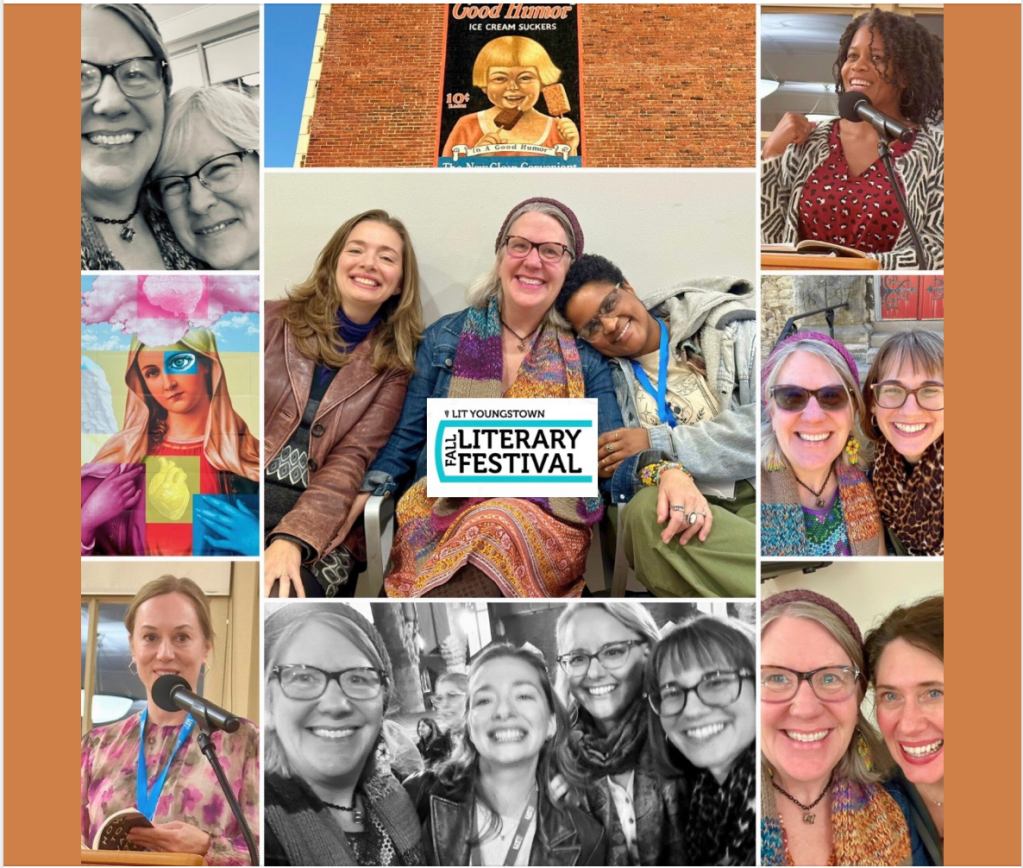
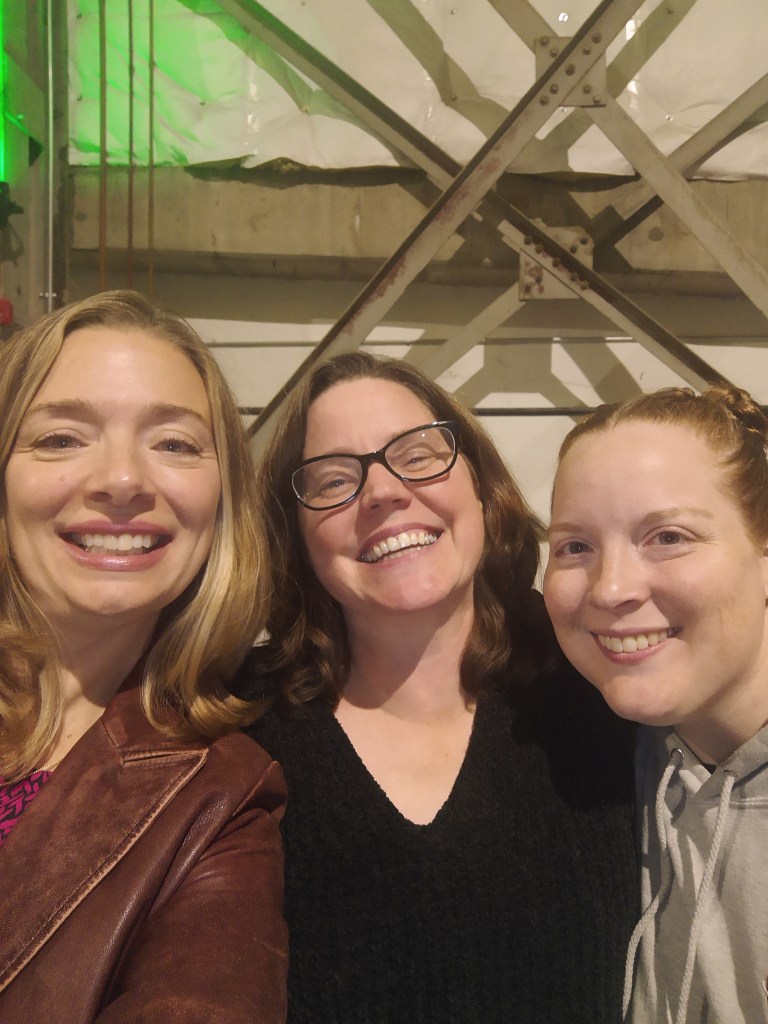
Thank you to Lit Youngstown director Karen Schubert and all who make it happen, year after year. And trust me, you won’t want to miss next year’s festival. Thank you also to Rebe Huntman for letting me use the beautiful photo collage she put together (now, go pre-order her gorgeous memoir).

Tell me in the comments, did you attend the festival? What was the highlight for you? What did I miss? Do you attend writing conferences in general, book fairs? What gets your creative juices flowing?

Hankering for Rust Belt author interviews, book reviews, and more? Check out my categories above. I hope you’ll follow me here, if you don’t already, so you never miss a (quite infrequent) post. Thanks! ~Rebecca

Enter your email address to subscribe to this blog and receive notifications of new posts by email.

New poem published by Trampoline Poetry

I’ve been operating far outside my comfort zone and way outside my fiction-writer lane lately.

Querying a novel will do that to a writer. Fiction-writing feels a little fraught when you’re trying to woo agents and presses with your fiction. So, I turned my attention to writing essays–and even a little poetry. Here’s:

“Satie Sestina: YouTube Comments on Gymnopedies”

Thanks to Trampoline Poetry‘s editor Justin Lacour. And many thanks to my writing critique group–present and past members alike–who, first, told me this long poem I was working on would work best as a sestina (a what?); and, second, gave me the permission to play with the form (just) a little.

If you’re interested, you can read my bio out at Trampoline Poetry, where I explain how the idea for this poem came to be. (Thank you, YouTube comments!)

Now, who else is a Satie fan?

More Rust Belt literary goodness soon. ~Rebecca

A review of Pittsburghese, Poems by Robert Gibb

By Karen J. Weyant

If you’ve ever visited Pittsburgh, you’ve likely encountered “Pittsburghese,” the local dialect of the people of Pittsburgh that distinguishes residents of the city from their Rust Belt neighbors. Pittsburghese is partially defined by dropping the words “to be” from certain phrases, such as The car needs washed instead of The car needs to be washed. It’s using words such as pop instead of soda, or buggy instead of shopping cart. Sure, many linguists may say that these examples are not pure Pittsburgh (my mother, for example, who grew up in rural Pennsylvania, always called shopping carts, buggies). But there is one word that always seems to be on the lips of Pittsburgh citizens and on the t-shirts found in city souvenir shops. That word is the second-person plural vernacular, Yinz, a contracted form of “you ones” or “you’ins.” 

It’s the word Yinz that echoed through my head as I read the latest poetry collection by Robert Gibb. Pittsburghese is an elegy for a place: Homestead, Pennsylvania, a borough located about 11 miles southeast of Pittsburgh. Homestead is rich with labor history, but like so many places, saw a huge economic decline in the 1970s and 1980s. With every image, I am reminded of the tiny Rust Belt town of my youth and the importance of story and memory.

The poems in Gibb’s collection take us through an industrial world struggling to survive, and thus, the overarching images in most of these poems have to do with debris, or rust – a word that is celebrated in the poem “The Etymologies of Rust.” In this poem, the narrator describes the red-orange oxidation that appears in so many poems written about the Rust Belt as a “slow, remorseless kind of oxidation” that is “red, orange or tawny. The ferrous of flakes.” It’s a perfect description for those of us who know rust intimately as the corrosion that flakes metal mailboxes, parts of bicycles and chain-linked fences. For Gibb, the color of rust may be beautiful, but the effects of rust are devastating for it “cankers like corrosion on idled iron.”

Physical landscapes, often held together by rust, are at the heart of many of Gibb’s poems. As someone who grew up in a small factory town, I recognize some of the images while others are new. I don’t know the slag pots described in “Deskulling the Slag Pots,” but I know the descriptions of derelict phone booths and furniture being auctioned off from fancy buildings. No matter the image, there is a story. And for many readers, the stories may be a bit familiar. For example, in the poem “Elegy for the Park Theater” the narrator tells us about a time when “we’d be plunged into darkness/Beneath the beam of light figures rode/Onto the screen.”  In this world, the images are “mantis-like invaders from Mars” and “several avatars of Tarzan.” Later, he explains that the theatre became a roller skating rink. The transformation of space is common in places struggling to survive. In Gibb’s world, the theater turns into a roller skating rink – in my world, the single movie theatre found in my tiny hometown was turned into a hardware store before it was finally torn down. Other stories can be found in such poems as “The Play of Memory of Childhood Spaces,” where a narrator remembers a class trip to St. Anthony’s Chapel in Pittsburgh, or in “Voice-Over,” where the narrator recounts working different shifts in the mills when he “never got used to eating dinner/First thing in the morning, heading to work/At bedtime.” 

Clearly, the narrator is present in many of these poems, as if drawing from personal memory, but other poems reflect more historical memory, taking their inspiration from photos and works of arts. For instance, in “Homestead, ca 1929, Oil on Canvas,” the poet describes a John Kane painting where “Homestead/Is crowded rows of houses/Steel mills billowing/identical plumes of smoke.” The first lines may not be especially picturesque, but later, the poem captures the artist at work, “painting scenes on the sides of boxcars during the lunchbreaks/at work.” The final lines in this poem are a commentary on what is to come for this world, as the “slurry is just right” because the economy is “about to tank as if in another country.”  In another poem, “Worker, Steel Mill,” Gibb focuses on the human being seen in a 1955 photograph by W. Eugene Smith, by explaining that at first, he is “anonymous in those glare-filled goggles.”  Later, in the poem, however, there is praise for this man who is “garbed/to be garbed in fire” and who works for “weeks have been divided into shifts” all because “of the cost of production.” 

In spite of my love of story and image, my favorite poem is one that interrogates etymology, echoing the title of the collection. In “Pittsburghese” the poet explores the word jaggers which is “vernacular for brambles.” Jaggers are thorns, and if one is caught in jaggers, it is painful, but it is very possible to lift the thorns away. Still, there are the ones that “splintered beneath your skin” that are the most painful, even when the jagger is removed. There is a strong metaphor here: pain may be left behind, even when the source of that pain is removed, but resilience stands. And with this resilience is some kind of hope for a less painful future. It’s this type of hope that is found in every poem in this collection – even those poems that recall painful pasts. 

In the preface to this collection, Anita Skeen, Wheelbarrow Books Series Editor, quotes Thomas Wolfe by saying “You can’t go home again.”  She explains, “I would argue that in poems and in memory, you can.”  Skeen goes on to say that the images remind her of her childhood home located near Charleston, West Virginia. Anyone who grew up in the Rust Belt will be reminded of home, and perhaps inspired to write about that home through the lens of history, memory, and image.


Pittsburghese

Poems By Robert Gibb

Wheelbarrow Books $15.95


Karen J. Weyant‘s poems and essays have been published in Chautauqua, Crab Creek Review, Crab Orchard Review, Cream City Review, Fourth River, Lake Effect, Rattle, River Styx, Slipstream, and Whiskey Island.  The author of two poetry chapbooks, her first full-length collection is Avoiding the Rapture. She is an Associate Professor of English at Jamestown Community College in Jamestown, New York.  She lives, reads, and writes in Warren, Pennsylvania.

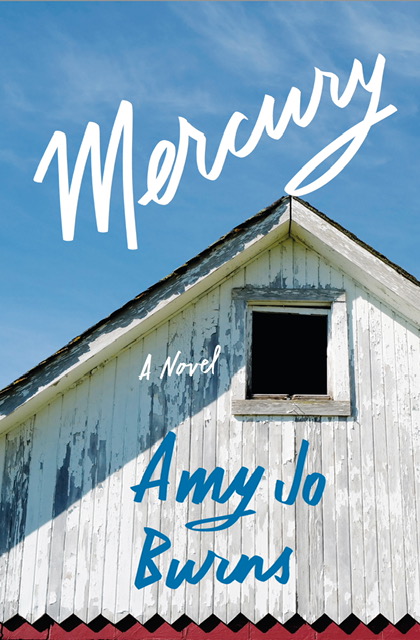
My interview with Amy Jo Burns, author of Mercury


Let’s begin with a sample paragraph from Amy Jo’s stunning literary (also mystery) family saga:

Spring was breaking through in lilac buds and daffodil shoots, but winter held on. Tufts of dirty snow clung to curbs, and porch steps, and parking lots. The heat had stopped working in the Citation, and Marley shivered. Theo was bundled in the backseat; she caught a glimpse of him in the rearview mirror. Then her eye snagged something else behind her–someone limping from a snowbank into the intersection. Marley slowed to a stop and turned around.

Whew. Good stuff.

Amy Jo, your main character in this Western-PA-set novel is Marley, whom we first meet when she’s 17. You left your Western-PA hometown for college around that age. What was it like to write this book and “inhabit” Marley’s character in a place (and time) similar to the one you were raised in? And how similar is your real-life family to Marley’s found family?

    Marley is a really special character to me. When I was creating her, I took the qualities I love most about my best friends from home and put them into her character. Her willingness to step into someone else’s messiness, her ability to tell the truth in such a loving way, and her desire to build a business with her own creative stamp on it are all qualities I really admire about my oldest friends. Marley showcases what I think real resilience actually looks like. It isn’t perfection or misery or loneliness—it just comes through in a big-hearted, flawed human who shows up for the people in her life. 

    The Joseph family in the novel is like mine in that we’re both a family of roofers—which means both houses were full of grand storytellers, brave hearts, and lots of tar-stained jeans. The house I imagined the Josephs living in was inspired by the old Victorian house my grandparents used to own in my hometown. I’d always loved that house and couldn’t imagine any other place a family of roofers would live. The characters in Mercury come from my imagination, but the bond they feel with each other—the sometimes too-close intimacy they have with one another is absolutely something any member of my extended family can relate to. When it comes down to it, I’d say both families care about the same thing—keeping people safe under roofs and on top of them.

    This novel is mostly set in the fictionalized town of Mercury. How did you go about constructing this place, this “forgotten Rust Belt town.” Did you use Pinterest boards or clip photos from magazines? Was there map-making involved to mark where the salon, post office, and library stand? And, as the daughter of real-life roofers, do you picture this town from an aerial/rooftop view?

    Mercury is heavily inspired by my own hometown, which I also wrote about in my memoir Cinderland. When I started writing the early pages of this book, I knew it had to be set in Mercury—a place I know, love, and left. So most of the early “research” came from my own memory, and then I squared it with pictures from the 1990s and also by talking with my parents. My dad drew a map of the church steeple and attic (which both play an important role in the story), and I talked with my mom about what it was like to help build a roofing business from an administrative perspective. It was really special to get to share a bit of this project with them, especially since so much of the book is about what it means to belong and how we claim home for ourselves.

    I hadn’t imagined my hometown from any aerial views until I started putting characters on roofs pretty early in the process of drafting the book, and it was the coolest thing to envision this place anew from an entirely fresh perspective. I was able to find a few aerial videos of my hometown to watch, which really helped me fill in the landscape for what these characters find when they’re up higher than everyone else.

    I’d call this book a literary family saga; however, there is also a lot of romance—some steamy! What’s your best tip for writing romance or sex that deepens character and moves plot?

    I would say my best tip is that sex is never just sex. Falling in love is one of the most monumental things we experience as humans—it shows us at our best and our worst—and I think it’s really important to reflect it in literature. When I’m writing romantic scenes, I’m always considering what each character is risking about themselves in a very unique way—are they sharing something no one else knows? Are they saying one thing and thinking another? What is it about falling in (or out of) love that changes how they see themselves? What past events have shaped how a person approaches their most intimate moments? Those scenes are such a great way to show what a character deeply wants and what they fear, whether they’re aware of it or not. And when all that juicy backstory collides with someone else who is just as complicated—it’s fictional gold!

    Like in your last (gorgeous) novel, Shiner, you explore profound female friendships in Mercury. Can you talk about how you developed the friendship on the page between Marley and Jade? When you’re writing, do you do character studies/background/backstory with detailed info–any that doesn’t make it into the book?

    Mostly what I do when I’m building relationships between characters is think about it A LOT. I write many drafts over a long period of time and throw out a lot of material, usually because that’s how I’m getting to know the characters. Scenes will start off as sketches and they get more detailed as I learn who the characters are. Many of the scenes between Jade and Marley felt very cliché for a long time as I was working, and I’d have to go back in and re-work them to go deeper so they felt earned and true. 

    I am such an impatient person (what a terrible trait for a writer!), so character studies always feel like they’re detracting from the real heat of the story I’m working on. The only thing I usually do outside of drafting itself is create a playlist for each book that I write, and I’ll include songs for each of the characters. It helps me track down their psyches, their moods, their secrets. You can learn a lot about a person if you know what songs they’re listening to when they’re alone.

    In this novel you touch on dementia. What kind of research was involved there? As this book is set in the 90s mostly, was there any other, historical research you had to conduct for verisimilitude?

    I had a family member with a form of dementia (though under different circumstances than those in the book), so I used that as the basis for building it in the novel. I decided not to do much clinical research on it because I wanted to portray it through the eyes of a family who isn’t sure what is going on. So often we don’t get the answers we are looking for in real life when it comes to medical diagnoses, and it was really important to me to give that truth a lot of space in the novel. 

    Motherhood is portrayed in a very real, and sometimes heartbreaking, way in this novel. Marley’s mother-in-law says, “This life is unmerciful to mothers.” You’ve got two young children at home. How has your writing practice (and product) changed since becoming a mom? And, follow-up, what is your favorite novel for exploring themes of motherhood?

    The biggest difference in my writing practice is that I have to keep my working hours to match my kids’ schedule. It is GIGANTICALLY easier now that they’re both in school, though I rarely get done what I’d like to in the course of a day. I remember when my son was an infant and my writing sessions were so short, I thought I’d never finish the book I was working on, which turned out to be Shiner. Sometimes my writing sessions would only produce a few hundred words. I had to learn to talk myself through it and say, “Maybe no one will ever see it, but I’d still like to try.” And I’d repeat that to myself over and over when my daily frustrations came. And the book got done!

    In terms of my favorite book about motherhood, I once attended a talk by Nicole Krauss just after she’d published Great House. Someone in the audience asked her how she was able to write and be a mother, and she said, “I wouldn’t have been able to write this book if I hadn’t become a mother.” It was so encouraging to me, as I was contemplating how I might have kids and continue to write. That story inspires me still.

    A lot of the plot of Mercury centers around the family’s church—but not necessarily around worship. No spoilers, but can you talk about how religion, faith, and or belief works in the world of this novel—and maybe also in your own life?

    My faith is a huge part of my life and my creative process. I think maybe writing books is a form of prayer for me. What I love about it is that the page becomes a place for my uncensored thoughts, my questions, my frustrations, and—most powerfully—the things that I love and I think are worth fighting for. It feels like a quiet place where I can meet God without judgment, where I don’t have to be any other version of myself but the real one. Also, I do a lot of listening when I’m writing which feels very peaceful.

    In this particular story, many of the characters have an idea of what “religion” is, but what they’re all hungry for is faith. Faith in a God who loves them just as they are, and faith in each other. I like to think each of them encounters God in an unexpectedly meaningful way in the book, and usually it’s through they way they learn to love each other.

    For those of us who aren’t just readers but who are also writers, what’s your favorite generative prompt for a writing day when the words just aren’t coming?

    I absolutely recommend starting with a memory from childhood you can’t get out of your head. Try retelling it to yourself from an adult perspective (which you can interpret any way you like). I actually began Mercury in just this way—the opening scene of the book is a memory of mine from a little league game when I was around nine years old. This exercise was how Waylon’s character first came to life.

    Tell us how the reaction to Mercury has been on your visits to libraries, bookstores, etc.?

    It’s been really wonderful. When Shiner came out in spring of 2020, there were no stores open, so getting to visit libraries and bookstores has been the best thing about publishing Mercury. My favorite thing is hearing about readers’ favorite characters and how they saw themselves in the story. I love it when that happens in a book I’m reading, so getting to provide that experience for fellow readers is a real gift.

    What are you writing and reading right now? And what are your kids’ favorite children’s books, lately?

      I love this question! This year I’ve been trying to take my time and read longer books (which I’m calling “biggies”), so right now I’m reading two—Iron Flame by Rebecca Yarros and East of Eden by John Steinbeck. I’m really enjoying them both. Right now my son, who is nine, is loving the entire Percy Jackson universe by Rick Riordan, and my six-year-old daughter is very into Dog Man by Dav Pilkey and the Max Meow series by John Gallagher. I love seeing them read!

      Writing-wise, right now I’m working on a novel about the true story behind a famous country-folk singer’s disappearance. I don’t know if it will be my next book or not, but I’m really enjoying the work itself. Thank you so much, Rebecca!


      Amy Jo Burns is the author of the memoir Cinderland and the novel Shiner, which was a Barnes & Noble Discover Pick, NPR Best Book of the year, and “told in language as incandescent as smoldering coal,” according to The New York Times. Her latest novel, Mercury, is a Barnes & Noble Book Club Pick, a Book of the Month Pick, a People Magazine Book of the Week, and an Editor’s Choice selection in The New York Times. Amy Jo’s writing has appeared in The Paris Review Daily, Elle, Good Housekeeping, and the anthology Not That Bad.

      You can find her on Instagram at @burnsamyjo.


      Mercury

      By Amy Jo Burns

      Celadon Books

      Many thanks to Amy Jo Burns for sharing her insights and time–and kid book recs– with us here at Rust Belt Girl. I know I can’t wait to read what’s next from Amy Jo!

      Like this interview? Comment below or on my fb page. And please share with your friends and social network. Want more? Follow Rust Belt Girl. Thanks! ~ Rebecca

      *Photos provided by Amy Jo Burns

      Enter your email address to subscribe to this blog and receive notifications of new posts by email.

      Welcome to the 2023 Rust Belt Girl round-up…

      I interrupt this Covid haze–mine, yes, I was gifted the virus for Christmas–to present a round-up of all the Rust Belt Girl goodness in 2023, made possible by you amazing readers and followers. (For you math and science types, here are your facts and stats):

      2023 total views: 5,069, from 3,575 viewers, for 231 likes, and 170 comments. Thank you for engaging!

      Most Viewed Post (MVP) 2023: A stellar review of Jason Irwin’s poetry collection, The History of Our Vagrancies, by Marjorie Maddox (Side note: I met Jason in person for the first time and reconnected with Marjorie in October at the Fall Literary Festival in Youngstown.)

      2nd Place for MVP 2023 (and tops for most–and most heartwarming–comments): “Mad Dog, “Steel Poet,” Tim Russell, a literary reflection by poet and publisher Larry Smith. Thank you to Larry for being such a pillar of this literary community. (I also met Tim’s widow, Jodi, for the first time, in October–there were hugs!)

      3rd Place for MVP 2023: The Rabbit Hutch‘s Rust Belt Renaissance, a review by Emma Riva, an author and art writer living in Pittsburgh, who is also the founder and EIC of Petrichor, Pittsburgh’s art scene magazine. Check it out!

      Most Viewed Author Interview: My interview with John W. Kropf, author of Color Capital of the World. (Though John and I both live in the Greater Washington D.C. area, as luck would have it, we were in Ohio at the same time earlier this year, and I was able to meet him and his lovely wife Eileen at a reading and book-signing not far from where Color Capital takes place.)

      And don’t miss all the other 2023 bloggo goodness, including interviews with Mitch James, author of the rural noir novel Seldom Seen; Valerie Neiman, author of YA novel The Lonely Backwater; and David Giffels, author of The Beginning Was the End: Devo in Ohio. (This makes three interviews with David at Rust Belt Girl, some kind of interviewing trifecta!)

      Then there was John W. Miller’s beautiful guest essay: From Belgium to the Rust Belt. (In a fun coincidence, John and I ended up in the same storytelling course this fall–the writing world is a small one.)

      And in other fun blog news, my 2022 review, Enlarging “Rust Belt lit” and Megan Giddings’ The Women Could Fly, was picked up by Belt Magazine in 2023.

      2023 felt pretty good and creative outside of the blog, too: I published a short story and a poem(!) and started querying a novel (a couple of you blog followers and friends beta-read!). I am infinitely lucky and grateful to cross paths with as many of you as I do–even if only on these interwebs.

      I think we deserve a happy and healthy 2024 with all the writerly and readerly connections we desire. Those of you local to these D.C./Baltimore parts, find me on January 14 at EC Poetry & Prose’s Salon Series. Thank you again to Patti, my fellow blogger–and extraordinary poet and spoken word artist “little pi”–for inviting me to read!

      As for Rust Belt Girl, keep in mind that I love a guest post–author interview, book review, or essay on the writing life and beyond–so hit me up.

      Want more Rust Belt writing, book reviewsauthor interviewswriting adviceessaysguest posts, and more in your life? Follow me here. Thanks! 

      Oh, and if you want to check out my reading superlatives for 2023, they’re at Goodreads. Or, find me on FB. Share your top posts or top reads for 2023 in the comments. I’d love to hear about your writerly, readerly year.

      (Off to nap…again.)

      *free header image courtesy of Pexels

      Lit Fest ’23 Lowdown (with slideshow)

      Much overdue, I’m back to recap Lit Youngstown’s 7th annual Fall Literary Festival. Who can put into words the inspiration and joy that happens when a couple hundred members of the literary community come together to create, share, and add to our towering TBRs, of course. (And did I mention nearly 50 sessions focused on various genres of writing and the writing process–how to choose, how to choose?) And, all in one fantastic Ohio city with the best Italian food around and against a backdrop of changing leaves for some extra fall magic. Well, I’ll give it a try…

      Perhaps what I love most about this festival is that I can reinvent my creative self each time. I make it a habit to step outside my usual writerly lane and try something new.

      Day 1

      The first day of the festival I did just that. Parma, Ohio, Poet Laureate, workshopper extraordinaire, and friend Jeremy Jusek started off the day with a craft talk called “Verbal Alchemy: Visualizing Poetic Structure as a Formula.” If you couldn’t tell, Jeremy is a science guy in addition to being a poetry guy. He used chemical formulas and definitions to help “shake up” the structure of our poems. The ultimate goal: “To give structure to figurative language.” My major takeaways: the graphing of a reader’s reaction to a poem to illustrate the overcoming of a reader’s ground state to the point of truly feeling. Also, the idea of developing unit cells for a poem. (For instance a unit cell might consist of 2 similes or metaphors and one question. A poem might contain 6 of these units.)

      Maybe it’s my uncertainty with writing poetry that makes me to want to learn all I can about poetic structure, but I stayed in the poetry lane that morning and attended superstar poet Sandra Beasley’s talk: “Lyric A to Z: Exploring Abecedarian Forms in Poetry and Creative Nonfiction.” If the term “Abecedarian” is new to you, you’re in good company. From Sandra’s handout: “In an ‘abecedarian,’ consecutive lines, sentences, or paragraphs lead with consecutive letters of the alphabet. Note that abecedarians can use any language system, not just American English.” (Abecedarian poetry and a Prince fan? Check out a fantastic example by poet Randall Man called, of course, “Alphabet Street.”)

      Another highlight of the day was sitting in on the conversation between poet, essayist, and educator Ross Gay and poet and educator Jennifer Sperry Steinorth. Much of the discussion was pedagogy-focused. They discussed the MFA workshop, a process that has received close scrutiny in recent years. The traditional way, Ross feels isn’t “good for our soul or our work.” Instead he tries to stick close to what he notices on the page. His workshop goals are not a stellar poem or essay but are “care and imagination” in the class.

      For my last session of the day, I moderated a roundtable led by author, editor and educator Meagan Lucas (whom I interviewed about her debut novel years ago for Parhelion and was excited to meet irl!). Called “I’m a Lit Mag Editor: Ask Me Anything,” the session allowed participants to get a behind-the-scenes on just what rises to the top of the “slush pile.” A couple tips I took with me: the fiction word count sweet spot for Reckon Review, where Meagan is EIC : about 3,000 words; and don’t forget the importance of a catchy title (when that’s all lit mag readers see in their queue!).

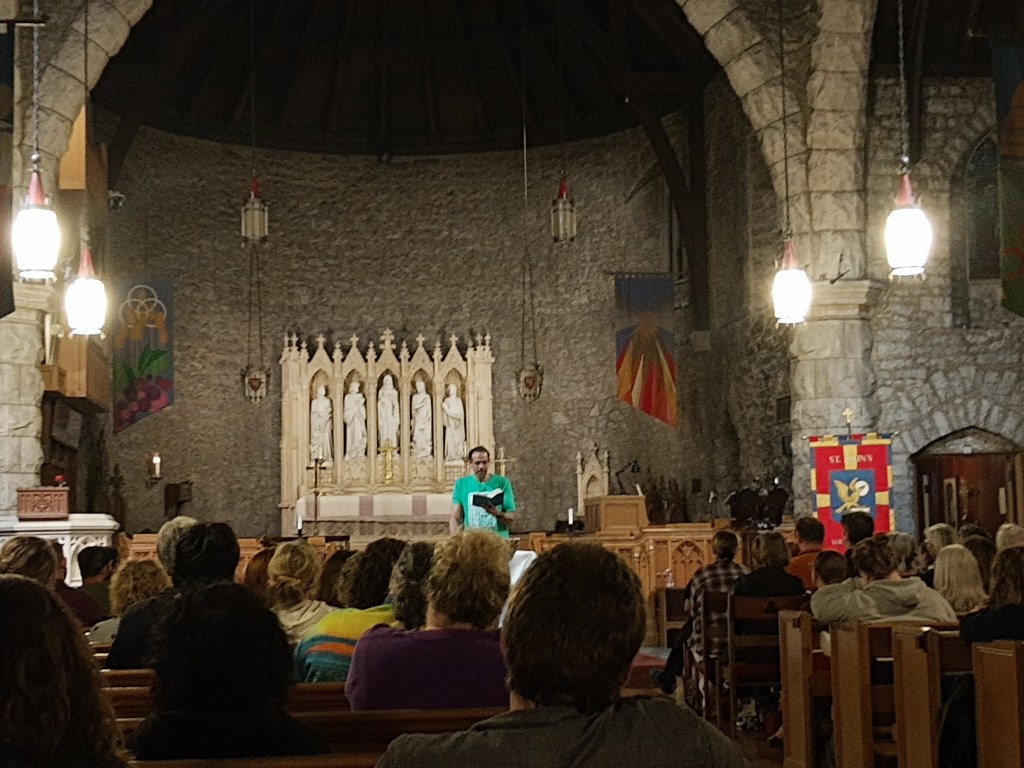
      Last, if you’ve been around these blog parts for a while, you know Ross Gay’s work has inspired some of mine, including this essay. And so I was prepared to be moved by his reading at the beautiful, historic St. John’s Episcopal Church–much from his new book of essays, Inciting Joy. But reader, I wasn’t just whelmed but overwhelmed. Ross’s mission of joy has been a guiding light not just for my fledgling essays and poetry, but for a new path where my art and faith can live together. And (in 2023, as I’m sure you can imagine) that’s a lot.

      Day 2

      The next day started off with a fantastic author reading. One essayist, my friend and editing co-conspirator Renée K. Nicholson; novelist Jason Kapcala, whom I interviewed here; and two poets, Amy M. Alvarez and Randi Ward read from their creative work “set in the mountains and hollers of Appalachia and the hardscrabble steel towns of the rust belt.” Themes of place and displacement ran through these works and I found myself transported–just what a creative reading should do!

      The next session found me back in my fiction-writing lane. Novelist Alison Stine focused on “the urgency of cli-fi as we deal with the worsening impacts of climate change” in her craft talk called “Writing Climate Fiction as the World Burns.” Alison has a really inspiring way of talking about writing, even if she writes dystopian stories that deal with tough stuff–like the end of the environment and nature as we know it. It’s clear writing has saved Alison time and again. Writing, she said “is making people sit up straight,” and is also something that can “give us hope” and “give us a way.” And my practical takeaway from her session: wait for your characters to start acting before you start to write your ideas.

      My final session of the festival found me marveling at the difference storytelling and writing can make–not just on our spirits but on our whole selves and in the ways we care for one another. Dani Naffziger led an inspiring talk called “Collaborative Writing with Adults with Disabilities,” a writing service she says “provides tangible and rewarding benefits for all involved,” highlighting stories from a population “rarely represented” and introducing “new writing processes for established and emerging writers.”

      Under the umbrella of The Healing Impact of Writing, for the other part of the session West Virginia University Humanities Center director Renée K. Nicholson and physician Ryan McCarthy talked about their Healthcare is Human initiative. Through a unique partnership between WVU Medicine and the WVU Humanities Center, the initiative promotes the work of narrative medicine and health humanities. Its seeds were planted during the pandemic, when Dr. McCarthy began journaling about his own experiences and then gathering the stories of his fellow front line workers. He has said: “…projects like this, which highlight the real human stories of healthcare workers, nurture our own humanity.”

      My own humanity certainly nurtured, my writing self restored, I left the festival inspired by the work of my fellow writers and by what’s to come. Thank you to Lit Youngstown director Karen Schubert and all who make it happen, year after year. And trust me, you won’t want to miss next year’s festival. Details here.

      Now, tell me in the comments, did you attend the festival? What was the highlight for you? Do you attend writing conferences in general, book fairs? What gets your creative juices flowing?

      Hankering for Rust Belt author interviews, book reviews, and more? Check out my categories above. I hope you’ll follow me here, if you don’t already, so you never miss a (quite infrequent) post. Thanks! ~Rebecca

      Enter your email address to subscribe to this blog and receive notifications of new posts by email.

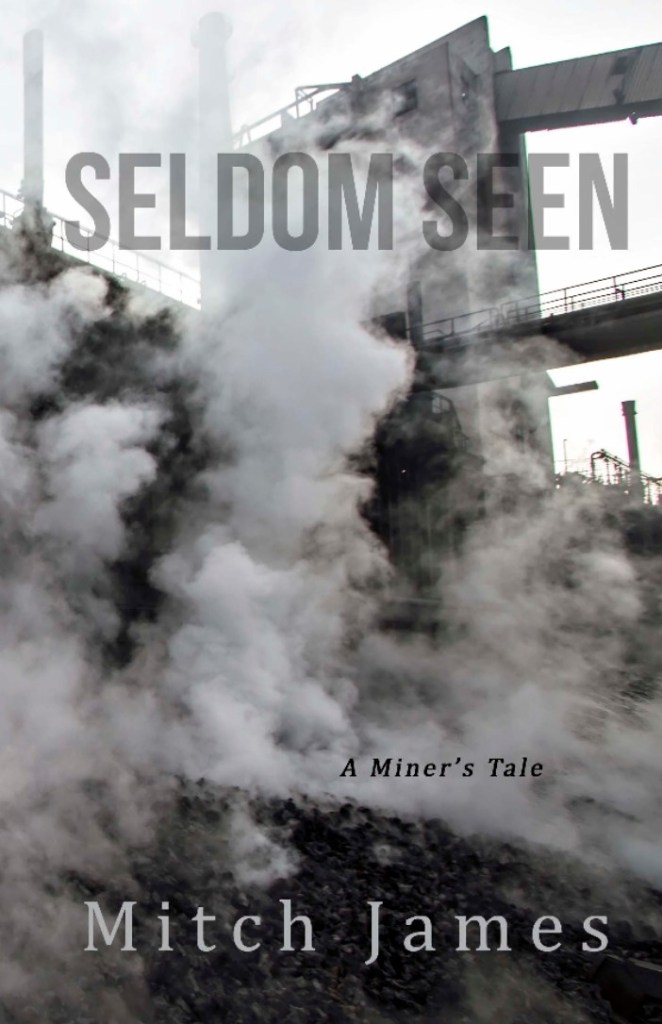
      My interview with Mitch James, author of Seldom Seen: A Miner’s Tale

      For my Appalachian lit aficionados, Grit Lit fans, and readers who aren’t afraid of the dark … I’m thrilled to share with you my conversation with author and professor Mitch James about his debut novel.

      From the back cover, an intriguing blurb:

      A dead mother. An auctioned childhood home. Loss in the womb of a coal mine.

      Seldom Seen follows main character Brander, who encounters a “specter of a man who promises him that the answers to life are in Seldom Seen Mine, the largest coal mine in the United States.

      With nothing holding him back, Brander … takes a job at Seldom Seen Mine, and fails at every attempt to amend his life, losing a friend, a lover, and maybe his mind.”

      Reader friends, how does an author make good on such a blurb? I’ll tell you. With prose like this. I’m prefacing my first question for Mitch with one of my favorite passages in the novel. This is from early in the story, when Brander first enters Seldom Seen Mine:

      Brander was surprised. The road was rather smooth and well-lit, the air stale but not dirty. They rolled along, everyone quiet. Brander stared around. The mine’s back had a skeletal structure of beams and crossbars and cribs, packed tight with backfill in places and all sealed up with gunite. It was surprisingly silent beneath the earth, the hum of the transport, the crunch of residue below the tires, the occasional whoosh of an air course. If not for the forced mechanization, there would be no sound, not like on the surface. Noise is life. But even free of men, the mine wasn’t dead, exactly; there was something, a kind of energy present in the long back road, an innate awareness, like the womb of a pulse-filled thing.

      Mitch, welcome to Rust Belt Girl! Let’s dive in. The mine in this story works as much more than a compelling setting but a real character. I’d say we readers end up knowing as much about the mine as we do about Brander. How did you decide where to set this story? How did you learn so much about mines and mining? What kind of research did this entail?

      I’m so happy to hear you’re engaging with the mine in that way because it is very much its own organism. It felt that way when writing the book, and it means a lot to hear that it felt that way to you as you read it. When I wrote the novel, I was up to my ears in rural Pennsylvania, working on farms, mountain biking old logging roads, kayaking rivers, and clearing land. I couldn’t get enough. I lived not far from the real Seldom Seen Mine. The research I did that allowed me to accidentally stumble into the idea for the novel also happened there. It was a perfect recipe—the need to express the region as I had experienced it as a transplant who had been there awhile, the need to tell Brander’s story, the need to imagine others’ lives and suffering alongside my own.

      As for research, I read literary books on mining. There aren’t many. And I read short stories about mining in the U.S. and abroad. I read historical writing about mining at different periods in the U.S. in microfilm and microfiche. I watched a lot of YouTube videos, read instructional handbooks on mining equipment, found out who sold it, and found videos on how to operate it. I was friends with a mining engineer who guided me some.  A little bit of everything.   

      Here at the Rust Belt Girl blog we’re a little fascinated with how place works in story. Place helps plots turn. Place also helps form characters. While a rural setting, I’d say that your Seldom Seen mine situates your novel squarely in Rust Belt lit territory. There are other commonly-appearing aspects to Rust Belt lit (or contemporary Grit Lit, writ large) that feature in your story: teenage pregnancy and the meth crisis for just two examples. Can you talk about how you explore such aspects of Rust Belt life and the characters living these lives without resorting to stereotypes in your novel (you do this well!)? 

      I’m relieved to hear you don’t think my characters are stereotypical. I would never want that. That said, though, if I’m being honest, I think all fiction runs off a little bit of stereotype. I think most readers need to see characters that are somewhat familiar and that present themselves as equations they believe they can calculate, at least at the start. Lucky’s the gruff, crude, masculine man. Brander is the wounded, self-loathing Midwesterner. But beneath the stereotypes that reveal a small percentage of what makes up who we are is the rest of us, the best of us, the parts of us that are unique. Brander and Lucky also have these qualities within them. It’s my job to complicate their stereotypes by fleshing out the rest of their characters, for they drive the story. I see stereotypes everywhere, including in myself. But by seeing them, I can perceive their limits, their boundaries; I can peer around them to what else presents itself, and that’s gold as a writer, the stories everyone tells but doesn’t mean to.

      Basically, look for the people within the people and write about that. Then be prepared to conscientiously employ a little stereotype to get the ball rolling.     

      For those of us who are writers, ourselves, I wonder if you could take us through the process of crafting this novel. What was the first idea/image that came to you? When did you know you had to write this story? How long did it take? What’s your writing process like? We craft junkies want all the details!

      The idea for the novel came to me when I was reading a translation of a Russian short story from the early 1800s, a story about a miner who encounters a ghost in a mine. The ghost starts manifesting in his life outside the mine until he goes insane and, if I remember correctly, kills himself. The story was so short. I wanted so much more. So I made it. 

      When did I know I had to write the story? Immediately. I can always tell the difference between something I could write and something I must write. I had to write Seldom Seen.

      As for the process, I woke up at 3 a.m., wrote a 1000 words a day five or so days a week, and had the first draft in a few months. Then it took me 10 years to publish the book, so you can imagine the revisions, drinking, and self-loathing that occurred after repeated failures. Brander had to get it from somewhere!  

      I often wonder how Rust Belt lit will appear in American Literature textbooks a hundred years from now. Since you’re a college professor—maybe you wonder about this too? For me, my most formative American Literature course introduced me to William Dean Howells, the father of American realism. I’m not going to draw a perfectly straight line from American realism of the late 19th century to Southern Gothic of the early 20th century and the Grit Lit of today, but somebody could try. All that’s to ask where you see Seldom Seen fitting into the canon of American Literature? What are your reading/literary influences? What literary characters informed Brander, who—despite hard work and, yes, grit, fails, fails, and fails again?

      It makes me feel a little pretentious to think of my work in any kind of canon. But my writing, including Seldom Seen, is influenced by myriad Appalachian, Midwestern, and American Western and South-Western writers, all rural and spread across the genres of fiction, nonfiction, and poetry. I would hope Seldom Seenwould be welcomed by the Appalachian literary community and rural literary communities more broadly. 

      As for character influences, I have to be honest, I don’t know that I’ve ever consciously (though certainly subconsciously I have) created characters based on other characters about whom I’ve read. The characters begin with me, but they take over their story, and I just try and keep up and do justice through my writing to what they show me. I know that sounds mystic and woo-woo, but it’s the truth. For example, Lucky wasn’t a character I intended to have in the story, but when he showed up, he had plans, and I went along with them. Now, I can’t imagine the novel without him. 

      As for the last part of your questions, I don’t need to read a book to see hard work, grit, and abundant failure in a person. I’ve witnessed it in the working poor rural communities I’ve lived in my entire life. But I want to make something clear; I’m not saying the working poor are failures or that their efforts are in vain. I was working poor until I was thirty-two years old. I worked fifty hours a week with multi-billion-dollar industries and still had no healthcare or money, and couldn’t afford a vacation or a car that could make it out of the county. Goals like a home instead of a rental, good health insurance, the ability to take a vacation or have a safe vehicle all create comfort and stability in one’s life. The working poor are grinding but failing to reach important thresholds like these and others. There are many reasons why, but amongst them are certainly socio-economic and political barriers. These folks, my mother and father, cousins, aunts, uncles, neighbors—they’ve taught me how to create characters with grit that fight and fight and fight.

      This world has shown me how to write characters who fail.

      And final question: What are you teaching, reading, and writing right now? What’s next?

      I’m teaching various writing composition courses. I’m reading, gosh, so many random things. I feel like I read and read and finish nothing. I’m reading Larry McMurtry’s Horseman, Pass By; Marilynne Robinson’s Gilead; Adam Grims’ The Art and Science of Technical Analysis; Pema Chödrön’s When Things Fall Apart, and a textbook on world history because I screwed around too much in school when I was younger. I’m ashamed by how much basic knowledge I missed out on for being too stupid to know better. 

      As far as writing goes, I just finished a book of poetry that a press requested and for which there is a promising chance of publication. I’m pitching a couple of short story collections and two novels and am kind of tinkering around on a new one, so if there are any publishers/agents out there who think my work and I might be a good fit, reach out. I’m doing some final revisions on two peer-reviewed articles due out soon as well. Keeping busy. 

      Upcoming? I’m excited about the Lit Youngstown Fall Literary Festival. It’s one of my favorite events all year!  


      Mitch James is a Professor of Composition and Literature at Lakeland Community College in Kirtland, OH and the Editor-at-Large at Great Lakes Review. Mitch is the author of the novel Seldom Seen: A Miner’s Tale (Sunbury Press) and has published works across the genres of short fiction, poetry, and academic scholarship. You can find his latest short fiction in Made of Rust and Glass: Midwest Literary Fiction Vol. 2Red Branch Review, and Bull; poetry at Shelia-Na-Gig, Watershed Journal, I Thought I Heard a Cardinal Sing: Ohio’s Appalachian Voices; and scholarship at Journal of Creative Writing Studies. Find more at mitchjamesauthor.com and on Twitter @mrjames5527. 


      Like this interview? Comment below or on my FB page. And please share with your friends and social network.

      Check out my categories above for more interviewsbook reviewsliterary musings, and writing advice we can all use. Never miss a post when you follow Rust Belt Girl. Thanks! ~Rebecca

      Enter your email address to subscribe to this blog and receive notifications of new posts by email.

      From Belgium to the Rust Belt

      A guest post by John W. Miller

      The genesis of the PBS film Moundsville and its companion blog Moundsville.org, about a classic American postindustrial town, was a mid-life crisis mixed with the 2016 election and a curiosity about the truth of Rust Belt communities. 

      Six years ago, I was on staff at the Wall Street Journal, covering mining and the steel industry out of its Pittsburgh bureau. 

      Like everybody else, I watched as the Trump-Clinton presidential election blew anger, confusion, and fear through the culture. 

      Personally, I was going through my own crisis. I was about to turn 40, and experiencing mid-life’s deepening cravings for meaning and direction. That second mountain beckoned. 

      After 13 years roaming the world for one of the world’s great newspapers, I simply wasn’t enjoying it anymore. So I quit, and started climbing. After some discernment, I decided to stay in Pittsburgh. 

      Poking around for creative projects, I started driving to Moundsville, a small town in West Virginia on the Ohio River 75 minutes from Pittsburgh. In 2013, I’d reported on it for the Journal

      photo of a 2,200-year old Native American burial mound in Moundsville, West Virginia
      2,200-year old Native American burial mound in Moundsville, West Virginia

      The town fascinated me. I grew up in Belgium, the child of American musicians who’d wandered around Europe in 1976 and dropped an anchor in Brussels. I’m fascinated by places in America that tell a deeper story about my ancestral homeland. 

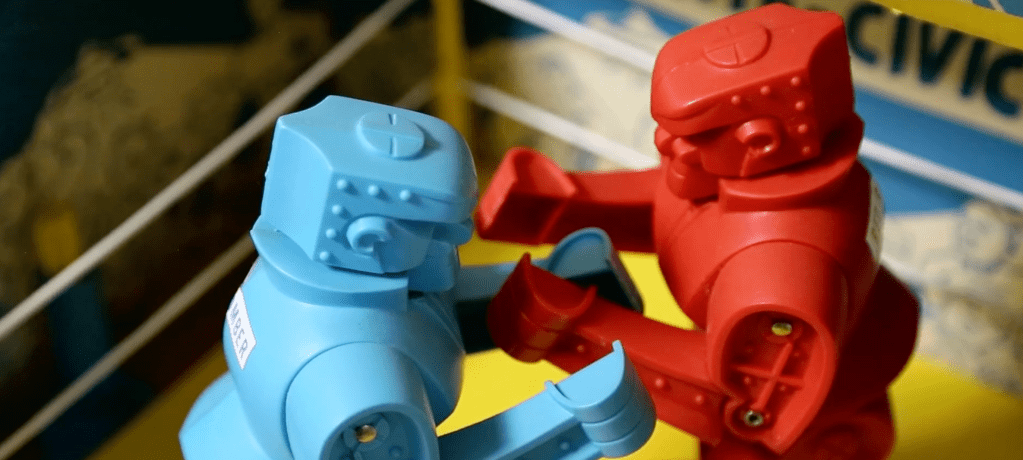
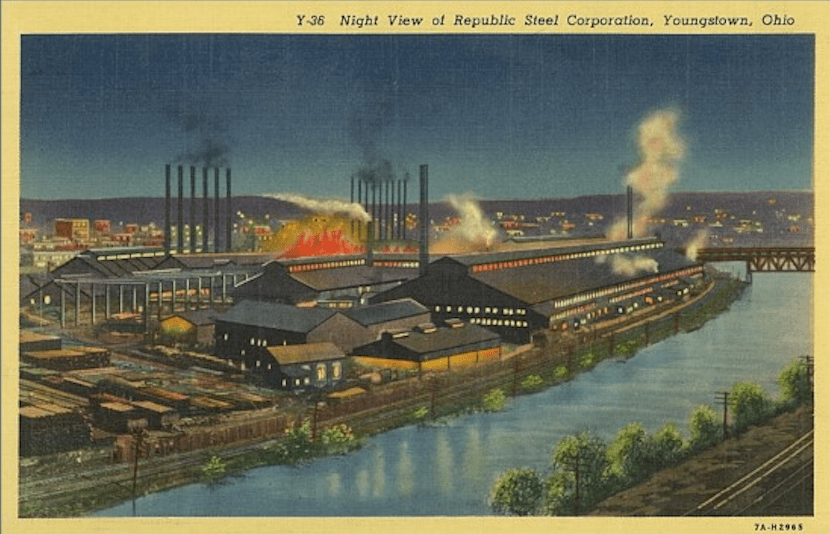
      In late 2017, I connected with filmmaker Dave Bernabo. We put together a proposal to tell the story of Moundsville in a documentary.  I thought that town was a perfect place to tell a deeper story about America because it’s built around a 2,200-year old Native American burial mound, it harbored a glorious industrial age including the world’s biggest toy factory (Marx Toys, maker of Rock’em Sock’em Robots!), and it now subsists on a service-based economy anchored by a Walmart. There’s also a lot of pain and grief in Moundsville. In a generation, the town lost 8,000 jobs. The population halved. Young people left for Pittsburgh and New York. 

      Rock’em Sock’em Robots! first manufactured by Marx Toys of Moundsville, West Virginia

      David and I spent most of 2018 driving down to Moundsville and interviewing people. At the end of each interview, we’d ask a question about Trump and national politics. Almost always, the answers lacked depth. It dawned on me: These people didn’t know about Trump. They didn’t live in DC. They weren’t very thoughtful about politics. But when we asked them about their work lives and their parents’ work lives, they engaged with depth and wisdom. Those questions, I realized, were actually loving. Almost always, I decided, asking about Trump simply wasn’t loving. 

      After experimenting with a voiceover, we opted to tell the story without a so-called “voice of God” as narrator. The movie is an oral history, without any academics or outside experts. 

      In our interviews, we heard about grief a lot, but we also heard and told tales of resilience, from a back-to-the-land farming couple, a small manufacturer of kitchen cabinets, and the leaders of a burgeoning tourism sector. The ancient burial mound looming above the town is a daily reminder that civilizations ebb and flow, and that time moves only forward. My hope is that we acknowledged grief in a healing way while pointing the way forward with stories of hope and perseverance. 

      In December 2018, we premiered Moundsville in the town itself, a practice of sharing work that anthropologists recommend. Over 170 people showed up. A few grumbled about our portrayal of segregation in the film, but at the end, we received an ovation. 

      A month later, we screened at America, the Jesuit magazine I had started writing forin New York City, on Sixth Avenue in Manhattan across the street from News Corp., home of the Wall Street Journal

      To my surprise–and gratitude–the movie holds up. People appreciate its openness and listening attitude. “This amazing project reflects a diversity of stories that I needed to experience to remind me of hope and resilience and kindness,” wrote Anupama Jain, head of a Pittsburgh diversity training group, on Twitter. 

      The biggest lesson I’ve learned making and showing Moundsville is that every place carries an organic placeness that deserves respect for its uniqueness. You can find wisdom and thoughtfulness in people when you engage them over that place and recognize its differences from your place. We can’t love our neighbors as brothers and sisters if we expect them to be just like us.

      I created the Moundsville.org site to promote the film, but quickly found an audience for pieces I was posting. It gets an average of 10,000 readers a month. So I keep writing and posting. I’ve written over 100 pieces for the blog, on everything from Lady Gaga’s mom, who grew up in Moundsville, to people going to watch baseball inside the prison in the 1950s.

      I’m still on a journey of figuring out a new kind of journalism that suits my skills, and my heart. I’ve co-directed Out of Reach, a new movie about the American Dream. I’m developing a podcast called Philosophy with Strangers, where I go with an older friend to small towns and ask big questions. First episode: We went to Charleroi, PA and asked people: What is happiness? I contribute regularly to America, a monthly magazine run by Jesuits. I coach baseball. Lots of other stuff, too. But wherever my career takes me, it was forever changed by the road that ran through Moundsville, West Virginia.

      John W. Miller is a Pittsburgh-based writer and filmmaker, and co-director of the PBS film Moundsville

      ~~~

      What are you watching, reading, and writing this month. Let me know in the comments…

      Are you a Rust Belt writer? What’s your story? Would you care to share? Do you write book reviews–or conduct interviews of Rust Belt authors? If so, think of Rust Belt Girl for a guest post. And check out the handy categories for more writing from rusty places.

      Find me on FB and on IG and Twitter @MoonRuark

      And follow me here. Thanks!

      Enter your email address to subscribe to this blog and receive notifications of new posts by email.

      Enlarging “Rust Belt lit,” and Megan Giddings’ THE WOMEN COULD FLY

      When I say “Rust Belt literature,” what comes to mind? Gritty, realistic narratives, no doubt. Hard-bitten characters. Upper Midwest settings redolent of industry and machines. Or settings found in a time of post-industry, a time of automation over humanity–of darkness. Coal or steel may factor in, or maybe it’s a landscape made barren by the extraction of one and the decline of the other. More recently, themes appear to be borne from loss after loss: environmental destruction, job loss, poverty, the opioid crisis … 

      When I said “Rust Belt literature,” did fantasy or speculative fiction come to mind? How about air, water, light? How about women? How about women flying?

      You won’t find Megan Giddings’ novels tagged as Rust Belt lit at your local library, but you will here. For Giddings chose to set her latest, feminist dystopian novel, The Women Could Fly (HarperCollins, 2022), a story in which witches are real, not in a fantastical place but in Michigan and the Great Lakes. And why not?

      The novel’s overarching plot: main character Jo is “offered the opportunity to honor a request from her mother’s will” by traveling to an island off Michigan’s Upper Peninsula, where she will explore the “powers women have to transgress and transcend” the limits women face in this larger world.

      And, of course, there will be trouble, a lot of trouble. But back to the setting.

      “She [Jo’s mother] had loved the lakes. Michigan was for luxury. Erie was for mourning. Ontario was for Canadians. Huron was for daydreaming. And Superior was for mystery. The lake that kept its secrets.”

      Why not set a story about the secrets women keep for self-preservation on an imaginary island off an imaginary shore? Why Michigan’s UP? Verity, I presume. In this novel, the speculative elements rub up against the very real setting, and say to this reader: don’t get too comfortable. The nightmare scenario you might think can’t happen in real life, absolutely can–and it can happen right in your backyard. For, what weight does social commentary have if it’s set in a fantastical place? Much less than if that commentary is grounded in a place we think we know so well.

      This is not your typical witch story (if there is such a thing) and my regular followers know this is outside my regular reading wheelhouse. From the dust jacket copy, so you get a sense (sans spoilers) of this dystopian time not altogether different from our own, here’s some backstory on Jo and her lost mother:

      “Josephine Thomas has heard every conceivable theory about her mother’s disappearance. That she’d been kidnapped; murdered; had taken on a new identity; started a new family. Most troubling of all was the charge that her mother had been a witch, for in a world where witches are real, peculiar behavior can raise suspicions and result in a woman–especially a Black woman–being put on trial for witchcraft.”

      How do we writers choose where to set our stories? Do we write of the places of our dreams? Google Earth and the ease of internet searching of local customs, accents, etc., mean a writer can set her story anywhere. (So you would think more writers would eschew the default American settings of NYC and Southern California–wonderful places both, but perhaps overexposed.) What makes us craft a setting after our home? I’ll let Giddings’ gorgeous riff on Michigan answer that question:

      “One of the pleasures of driving through Michigan is the trees. Farther and farther north, they shift, become taller and thinner, go from full Christmas trees to pipe cleaner versions. The sky changes too. The clouds come lower, the blue always feels a little brighter, the towns spread farther apart, and there are more dips, hills to make up the distance. It wakes up something animal in me …”

      In this novel, Giddings walks a literary tightrope between realism and speculative fiction, grief and humor, old prejudices and new possibilities, pragmatism and magic–and all in concise and biting prose. Enjoy the ride. You don’t even need to know how to fly!

      How would you define Rust Belt lit? What are you reading and writing this week? Let me know in the comments.

      Want more Rust Belt writing, book reviews, author interviews, writing advice, essays, guest posts, and more? Follow me here. Thanks! 

      And a Happy Thanksgiving to all who celebrate!

      *free header image courtesy of Pexels

      Enter your email address to subscribe to this blog and receive notifications of new posts by email.

      Lit Fest Roundup (plus bonus nature content for the win)

      I know what you’re thinking. Where are all the leaf-peeping pics? We know you drove along the PA turnpike to Ohio, climbing, winding, glimpsing down into little hamlets surrounding the sweetest, steepled white churches. All around were reds and every other burnished color. Oh, the autumn leaves!

      Hold your trees for a moment, reader friends. First, a literary roundup. If you’ve never been to Lit Youngstown’s Fall Literary Festival, I’ll see you there next fall. In the meantime, here’s how I made my way through my favorite literary conference of the year (yes, even besting AWP, which I made it to in the spring).

      Thursday

      This year’s festival featured the theme, The Places that Make Us, and I was so happy to be able to return–5th year running for me–to this conference held not far from the place where I grew up in Northeast Ohio. Big shoutout to all my fellow festival planning committee members. We did it (again)!

      Special in a lot of ways, besides all the usual literary goodness, this year’s festival provided attendees front-row access to three film screenings.

      But really, year in and year out, this festival always impresses me. What’s so special? Lit Youngstown’s director, Karen Schubert, is a literary conference alchemist, joining poets, fiction writers, memoirists, and even filmmakers this year for just the right mix of craft talks, generative workshops, creative readings, and roundtable and panel discussions. What do you get? Literary conference gold, no exaggeration.

      OK, onward … Thursday evening featured the Gathering In, with a reception and open-mic to begin the conference. This year, I had a special guest in tow. My dad drove in from Port Clinton; we had dinner beforehand (your meatballs are outstanding, Bistro 1907) and then headed to the Gathering In. I will tell you, my dad did not even doze at what I believe was his first-ever open mic and found it delightful. We salute you poets and writers who can whittle your words down to a few minutes of magic!

      Friday

      My first full day of the festival began with a craft talk by novelist June Gervais titled Honoring Others with Our Fiction Research. Intentional and inspirational are the two words that come to mind when I think about this talk. In it, June described her research process for her debut novel, Jobs for Girls with Artistic Flair. Braving the sometimes-fraught conversation around appropriation, authenticity, and sensitivity, when it comes to depicting readers from different professions or backgrounds, June exuded positivity. So, how do we honor others with our research?

      First, have a goal. For June, she decided, “to make the most beautiful and honest book possible.” Second: do the research well–whether that’s in-person interviews, archival research, or hiring authenticity and sensitivity readers in later writing stages. Third (and this is June’s whole beautiful thing): show gratitude by thanking the helpers along the journey. Sometimes this means generous payment. Sometimes this means reciprocity–trading literary favors. Always this means a real thank-you in the mail and on social media and all the shoutouts possible, including on the old Acknowledgements page. “I try to be a living acknowledgement,” she said.

      This year, I was intentional about attending the sessions (there are so many, I wish I could attend them all!) in my writerly “lane.” But I don’t seem to be able to resist the poets. In a roundtable discussion called “Moving Past Influence,” poets Mary Biddinger, Ali Black, and Dylan Morris talked about influences in creative writing–model writers and how they influence a poet’s style, and moving past influences as we develop our craft. When asked why she writes and why poetry, Ali talked about writing as an act of remembrance for those who’ve gone before her, those she’s lost. The stories are hers to tell, and poetry her form, she said, before she delivered one of the best lines of the weekend: “Poetry is my baby, and I’m poetry’s baby.”

      Marketing-me felt right at home in Gabriel Welsch‘s craft talk Marketing Your Book–Tips From a Professional Marketer and Writer. How to generate pre-orders for your book … how to get it reviewed … how to develop a (shudder at the word) platform … and, ya know, actually sell your book. These were just a few of the practical tips covered. We listeners were asked first to consider our goal. What do we want from our book: readers? high regard? money? Gabriel covered Marketing’s 4 Ps: product, price, promotion, and place. Who said it first, I can’t remember now, but he repeated this gem a few times: “All arts marketing is local.” Along those lines, he said, don’t underestimate the wideness of one’s potential audience. Think about local clubs that aren’t book clubs, local fraternal organizations, historical societies, etc., etc. And, as if he and June had shared notes beforehand, he stressed gratitude. “Don’t underestimate the power of thanking.” (Thank you, Gabriel!)

      Short story writer and poet Kelly Fordon (of Let’s Deconstruct a Story podcast fame–do check it out) led a generative workshop. I caught the second of two parts: the first, a workshop to deconstruct a story to understand its parts and how they work together; the second, a chance to get some words of our own on the page. There’s something about a good writing prompt. The simpler the better seems to work for me. Kelly gave this prompt: “Start with ‘We lived then …'” I’m not always in the writerly frame of mind to churn it out on demand, but here’s what I got:

      We lived then spitting distance from the train tracks, the river, and the West Virginia border--so much winding, the running tracks leading not to any home I understood. A limbo, the twins not yet in school, not babies either. How many times did we stop the car by the tracks, watch the train pull tractors east and west--Kubota, Deere. In our rental house, the boys slept on a mattress on the floor, when they slept.

      One positive of the pandemic was finding a new writing group. I guess Zoom is good for some things. Among the Cleveland-area members is Jeremy Jusek, Parma, Ohio’s poet laureate, host of the Ohio Poetry Association’s podcast Poetry Spotlight (check it out), and consummate literary citizen. Jeremy’s craft talk, Strengthening Artistic Communication Through Podcasts, covered how podcasts can be used by small creative groups to humanize its members and strengthen communities. I love bookish podcasts and meeting the person behind the book. He called podcasts “the ultimate bridging medium,” and I can totally see that. He said that when he edits the podcast interviews of poets–the last one was with Hanif Abdurraqib(!)–he shoots for no more than 7 percent Jeremy, the rest the interviewee, an impressive stat I will remember when I conduct interviews.

      OK, this isn’t a great pic (sorry Karla, thank you, Rebe!) of one fantastic panel discussion with the featured presenters (minus Laura Beadling). The gist: the writers Karla Murthy, Candace Fleming, Joy Priest, and Kelly Fordon weighed in on “the element of place, real and imagined, in the literary arts.” Side note: if you can catch a Joy Priest poetry reading, run don’t walk to catch it.

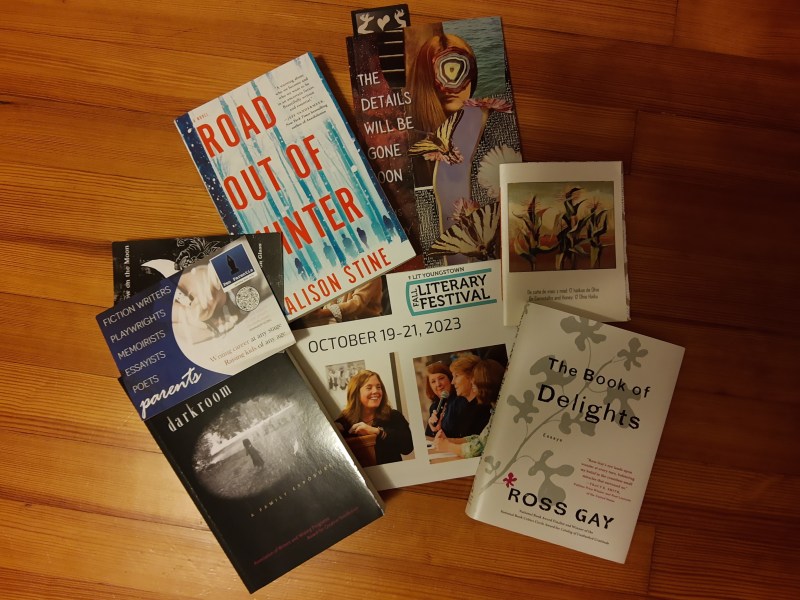
      Now, don’t let my festival book fair’s book haul–pictured below–throw you, I guarantee there was plenty of time in the evenings for catching up with literary friends over jazz and a local craft beer (and pierogi and pickle pizza–someone saw me coming!).

      Saturday

      June Gervais started off the second full day of the conference tackling a subject close to my heart–and that of anyone about to dive into the query trenches. In her craft talk, Persevering to Publication: Some Practical Tips, June covered her (long) journey to the publication of her debut novel. Again, she walked the line between inspiration and practical steps to take. “Expect difficulty, but leave room for wonder,” she said. Now, could I please have a June Gervais quote-a-day calendar?

      Along the practical side of things, she discussed making a practice of community while writing a novel (or anything else really). My favorite analogy she offered: think of the novel as the Thanksgiving turkey. It’s not enough. You need to support the turkey-novel with delicious sides, including the writing and publication of short pieces (short stories, essays, craft pieces, poems, etc.) Other crucial sides: an author website, a social media presence, and a literary community. (Check!)

      Oh, the literary agent querying-getting-sustaining process. Should you want to endure the agent search, be prepared for it to be long and winding, June said. Most of all, enjoy life in this tough stage of the writing, find gratitude in the work and in your community, and “become a master of the polite check-in.”

      I was happy to moderate two sessions during this festival. The first was a creative reading featuring poet and memoirist Jennifer Militello, whose love poems were nothing short of arresting and awe-inspiring. Youngstown native, poet Rikki Santer also read from her vast portfolio of poems, many centered on place–including some that explore the imaginary realm of place through old Twilight Zone episodes. And novelist Janet Beard read–and sang!–from her latest novel, The Ballad of Laurel Springs, which shares with readers some of the stories delivered by the old murder ballads Janet grew up hearing in her Appalachian hometown in East Tennessee.

      The second session I moderated was novelist Erin Flanagan’s The Window or the Door: Transitioning from Writing Stories to Novels. (Or, The Plight of the MFA Grad–ha.) This craft talk was super instructional and featured 13 handy novel-writing tips. I’ll give you just a few and you’re going to have to hunt Erin down for the rest. #2: Start a novel-writing journal. #6: Figure out where your novel ends in time. (Also check out The Art of Time in Fiction for help with pacing.) #10: (Oh, this one is hard–but so necessary–to swallow.) Keep in mind that chapters aren’t short stories, meaning your chapter end needs to create more questions, more tension, etc., to pull the reader through. 

      If I have pulled you through this post this far, you have shown your readerly diligence and win a star! Or, how about a slideshow of the foliage, cliffs, boulders, and even 200-year-old petroglyphs I enjoyed with one of my oldest (she’s not old, our relationship is) and best friends and her son (who poses for pics like a Jet from West Side Story–and this is my everything now!). Please enjoy the treasures of Cuyahoga Valley National Park, where I visited on a post-conference side trip.

      Have you attended this festival or another literary festival? What’s your favorite part of a writing conference? Have you been to this national park? Let’s chat in the comments.

      Want more Rust Belt writing, author interviews, book reviews, guest posts, writing advice, and more? Check out the handy categories above.

      Find me on FB and on IG and Twitter @MoonRuark. Find me at Goodreads and learn what novel I listened to on my way to and from the conference. Hint: I’m recommending it for fans of Tea Obrecht’s latest novel, Inland.

      Also, please follow me here at Rust Belt Girl, so you never miss a (fairly infrequent) post, and feel free to share this post with the world. Want me to consider a guest post featuring you, yep, you!? Hit me up. There’s a lot of Rust Belt literary goodness to spread around.

      *free header image of a fall foliage-colored door from Pexels