Or, the post you’ve been waiting for, maybe.
Last month, I attended Lit Youngstown‘s 8th annual Fall Literary Festival. From modest beginnings, the writing conference has grown to welcome some 200 attendees each year. Proud to be among them, I served on the planning committee for a couple years, have served as a session moderator, read my own creative work, sat on an editors’ panel, and, this year, engaged a featured writer in a conversation about her writing craft, process, and life.
I’ve met most of my writer friends through this literary festival. (You’re probably nodding your head, reading this. Such joy those in-between conversations, Elise, Susan, Jeremy!) Writers come to this conference for the genuine connections, the generative craft sessions, inspiring creative readings, and Youngstown pizza (or maybe that’s just me?). I was thrilled to walk away having experienced an abundance of all of the above again this year!
Can I entice you to make the trip, next year? Let’s hope this rundown does just that. (And, bring your friends.)
Day 1
My first day of the festival began with meeting Rachel Swearingen, Chicago-based author of the award-winning story collection How to Walk on Water. After reading through her stunning book, twice, I had a feeling Rachel would have a lot to teach fiction writers, like me, about the craft of writing–and the inspiration behind it. Her morning session, “The More the Merrier: Juggling Multiple Characters in a Single Scene” tackled one of those age-old fiction-writing conundrums: how to make the dinner party (or other large group) scene sing, rather than sink.
Main takeaway: big group scenes can invite drama and suspense (think: Shirley Jackson’s “The Lottery”) but things can go awry when the writer hasn’t anchored the scene. Especially helpful to me was Rachel’s discussion of panning out and zooming in, as if we’re creating a scene on film. Featuring compelling examples from classic and contemporary stories, Rachel illustrated how great writers make scenes active to “write toward change.” For those of us (all of us?) who sometimes struggle to create a propulsive plot, these tips promised to help us give our stories the jhuzh they need!
One thing I love about literary festivals is the opportunity for literary escape. (And not just geographically.) I make it my mission to get outside my usual genres and comfort zones. I’m not joking when I say it’s only been a few years since I learned what ekphrastic writing was. So, taking part in an ekphrastic poetry workshop is far outside my usual lane. Of course, I jumped at the chance, when I learned that award-winning poet (and dancer!) Ama Codjoe was leading a workshop titled “Doorways into Ekphrasis” held at the Butler Institute of American Art, right across the street from our festival headquarters. (Confession time: I usually play hooky for one session of a festival or conference to visit a museum or gallery or other local arts hotspot; this time, I didn’t have to.)
Crowdsourcing time: help me find the name and artist of the piece I wrote about, please! Yes, I stared at a stunning piece of transparent, aqua glass sculpture–two rectangular columns, one larger and standing, one smaller, reclined–and didn’t write down the name of the piece or artist. The three minutes we took to examine the art we chose, without jotting a note–which should be 10 minutes, says Ama–honestly felt like hours. But this works, folks.
It’s fascinating now to look back at the notes I made after my examination and see how I went from describing the artwork’s material–ruined glass, panes shattered, shards–to the artwork’s position and pose–teetering, discarded, toppled–to what the pose might suggest: he has dropped his partner, who does not shatter, small glass tower sheared. Finally, I wrote a little in lines, inspired by the art:
How many the pains of art we
layer and nudge and shimmy?
How shiny this body, this instrument,
until we lay it down, sharded,
but not discarded, dust to dust,
sand to glass to sand.
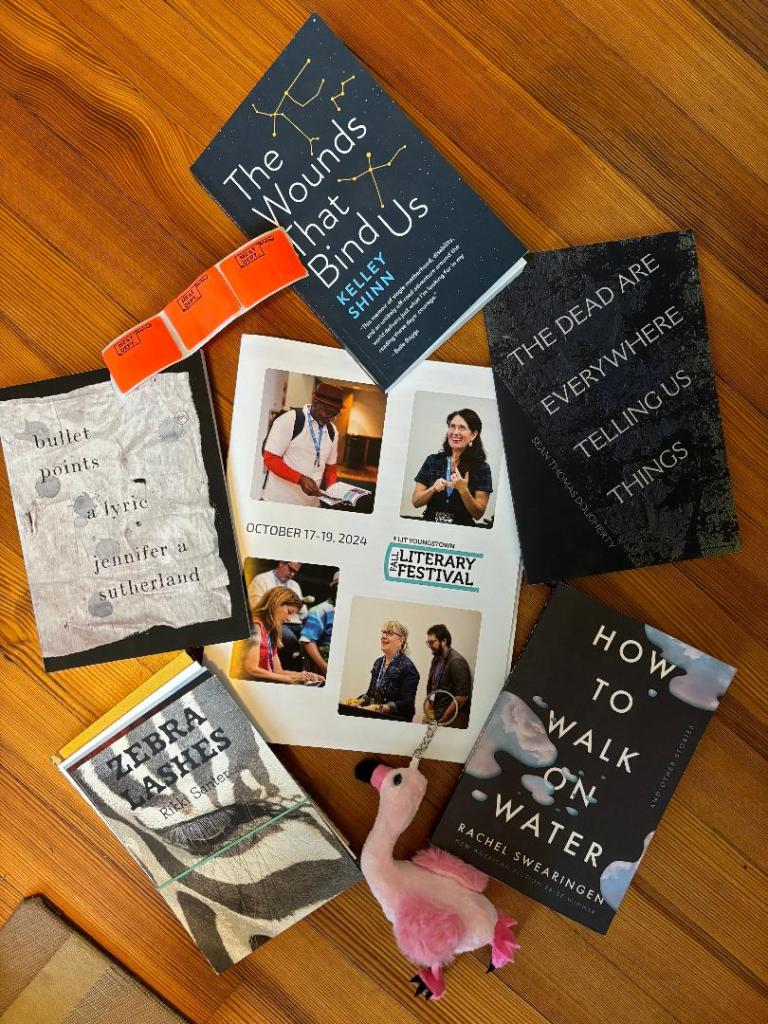
For my last session of the day, I caught up with a couple writers I follow on social media but had yet to meet in person, so I was thrilled (and got their books I brought from home signed–yes, I’m that kind of literary nerd). The prolific and super generous Sean Thomas Dougherty and Jennifer Sutherland (her debut collection is Bullet Points: A Lyric) are poets who spend some time writing in the “slipstream,” in between literary genres. They and Sarah Carson and Cynthia Maria Hoffman read from their work and talked about what writing in between genres (is it a poem, nonfiction flash, a prose poem?) means for their work and creative outlooks. I was so rapt by the writers’ creative readings that I didn’t take many notes, but I did take this gem down from Sean Thomas: “We push against genre” so forms can (paraphrasing here) dissolve and come together again to address neurodiversity, trauma, and more.
Day 2
I am often reluctant to read my creative work in public. Poetry is meant to be read aloud; not so fiction. However, I thought it might be instructive to read from a blog post I wrote here at Rust Belt Girl and then read the resulting scene that appeared in a story of mine published in Great Lakes Review last year. Like public journaling, I find blogging fertile ground for planting the seeds of story. Pro tip: keep your reading short and everyone will like it.
Thank goodness I read first, because there is no way I’d want to follow memoirist Kelley Shinn or poet Rikki Santer, whose readings were nothing short of incredible. Kelley is the author of the memoir, The Wounds That Bind Us, which I bought at the bookstore directly after her reading from it (I got the last signed copy: conference win!). Rikki read from her collection, Resurrection Letter: Leonora, her Tarot, and Me, which was inspired by the surrealist painter Leonora Carrington–fascinating stuff.
Later that day, Rachel and I joined “in conversation” in a small theater to discuss her stunning debut story collection and its influences: from contemporary art to cult film to a creepy old radio program. I wondered if she went searching for inspiration or if it found her (both). I wondered how her growing up with her family in rural Wisconsin impacted her work (a lot). I am seriously kicking myself for not recording this conversation, but also it would have been a shame to interfere with the intimacy of the conversation. Those of us who write know that it can be a sacred space, and so to share a deep conversation about the inspiration behind the writing work can also feel so meaningful–you hate to break the spell.
Craft takeaways from Rachel: her process involves repeating steps: drafting, reverse outlining, noting of turns in the narrative, noting of where things get sticky or stick out–and here, an earlier Rachel might have smoothed those over, but now she explores them–and an opening up and rooting out of those interesting sticky spots.
In chatting, Rachel and I discovered that we’re both at work on novels set in Nordic/Scandinavian places (must be a Midwest thing). We shared inspiring writers: mine, Dorthe Nors; hers, Jon Fosse.
I was also inspired by Rachel’s fierceness when it comes to trying new genres on for size–in her case, the screenplay.
And the last big takeaway from Rachel, which I jotted during our conversation and aim to never forget (ahem, there’s been a reason it’s taken me three weeks to write this rundown): “Writing is energy management.”
Oh, and there was so much more I missed–next year, I will clone myself–on editing and writing and querying and “unlocking plot.”
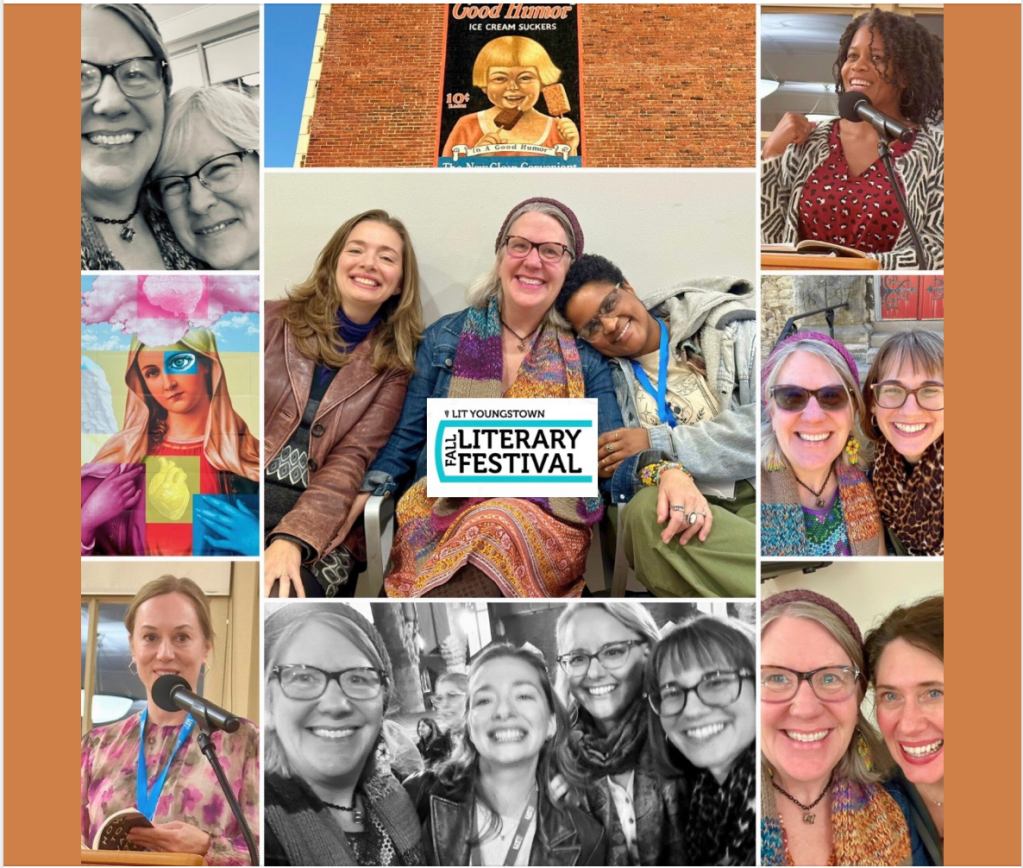
Thank you to Lit Youngstown director Karen Schubert and all who make it happen, year after year. And trust me, you won’t want to miss next year’s festival. Thank you also to Rebe Huntman for letting me use the beautiful photo collage she put together (now, go pre-order her gorgeous memoir).
Tell me in the comments, did you attend the festival? What was the highlight for you? What did I miss? Do you attend writing conferences in general, book fairs? What gets your creative juices flowing?
Hankering for Rust Belt author interviews, book reviews, and more? Check out my categories above. I hope you’ll follow me here, if you don’t already, so you never miss a (quite infrequent) post. Thanks! ~Rebecca
 Rust Belt Girl
I love events like this, and bravo to you for shining a spotlight!
LikeLiked by 1 person
Thanks for reading, John. It’s definitely my happy place!
LikeLike
Sounds like an awesome event!
LikeLiked by 1 person
It really is, every year. I love that there’s not an agent in sight, so the focus is on the craft of writing, not the selling of writing. Those pitch conferences have a place, too, of course. But they also seem to come with a high price tag and a feeling of competition–oh, to be the one to get stuck in the elevator with the dream agent!
I hope you’re doing well! I’ve been terrible about keeping up with my fellow bloggers–too much work and not enough creative energy.
LikeLiked by 1 person
I am doing well, thanks. I hope you are too. This year has been a lot for everyone, I think. So many bloggers aren’t posting anymore or engaging as much. I think we’re all very tired after the turmoil of the last few years.
LikeLiked by 1 person
I think you’re right. Glad there’s still a core group out here. Your posts are always top-notch. Wish I could keep up with all I want to!
LikeLiked by 1 person
Thank you 😊.
LikeLiked by 1 person
Wow, that sounds like it was a very inspiring and interesting conference!
LikeLiked by 1 person
It really is a super supportive community of writers of all stripes–some with many books under their belts and some (like me!) with none. We’re all just there to share and be inspired to write that next thing. Very much worth the five-hour drive I make to get there. Thanks for reading, Rhonda!
LikeLiked by 1 person
The second best thing to being there is reading your post! So glad for all the connections you made, all the stretching moments you’ve experienced over the years– and the learning! Wow. Those verses you shared. Gorgeous. The way the sounds touch each other gave me the shivers. More poetry from the Rust Belt Girl, please! xoxo
LikeLiked by 1 person
Thank you, my friend!! I missed you at the festival. Next year I’ll pop on by to see you, at the least!
LikeLiked by 1 person
Sounds like an amazing conference! I’m putting a couple of the books you listed on my TBR. Thanks for sharing them with all of us. I do attend writing conferences. I’m always looking for ways to improve my craft. Maybe someday I can make the trip to Ohio and check out this one!
LikeLiked by 1 person
It would be such fun to meet you in person one day, Lisa!
LikeLike
Wow! I’m glad you attended the lit fest and got so much out of it 🙂. It’s so much fun to talk to writers and learn from them. We have literature festivals in India but I’ve only attended one. And I’m not sure if I can call it a lit fest. It featured people from Harper Collins giving speeches on how to get published, etc. We do however have a big literature festival in Jaipur. It takes place every year and famous writers give speeches and workshops. Maybe one day I’ll get a chance to attend. I usually get the creative juices flowing by sitting at home and reading since I’m a bit of an introvert! Nowadays I find it hard to pen anything creative down lol
LikeLiked by 1 person
Reading will always be the best inspiration, I think. And I find that I have months where I’m writing a lot and months where I don’t write much at all but read a lot. But I do like to get out of my comfort zone and meet up with other writers and avid readers–once or twice a year is good for me. I avoid those publishing conferences, where it’s all agents and publishers and enjoy conferences where it’s more about the craft. I always enjoy your blog posts; somehow blogging always feels like a private space, shared, if that makes sense. Thanks for being here and sorry for my late reply!
LikeLiked by 2 people