Author Q&A with Paul Hertneky of RUST BELT BOY: Stories of an American Childhood

Rust-Belt-Boy-jacket-2-jpg.jpg

Here at Rust Belt Girl, I’m thrilled to connect with other writers who explore America’s post-industrial heartland, the Rust Belt, and find that its rich history is still being discovered. Paul Hertneky and I share no relation except for a love of these hardscrabble places and for representing the voices of these places truthfully. For more than twenty-six years, Paul Hertneky has written stories, essays, and scripts for the Boston Globe, Pittsburgh Post-Gazette, NBC News, and many more outlets. Rust Belt Boy: Stories of an American Childhood is his memoir.

“Rust Belt Boy brings to life in loving, lyric detail an essential but over-looked portrait of America’s blue collar heart,” writes National Book Award Finalist, Sy Montgomery. [It] illuminates moments that change our lives and the small recurrences that shape our decisions. In a millworker’s milieu—seldom seen by outsiders, filled with soot, solvents, and sharp edges—we encounter the work ethic of immigrants, then as now. These pages explore the push-and-pull of family and a hometown, the gravity—nearby or at a distance—that keeps us in orbit around our roots. (Book jacket copy)

Paul—Rust Belt Boy is an exploration of your roots, your personal history and the history of your hometown of Ambridge, Pennsylvania. In the writing of this memoir, what was the most surprising thing you learned about your native place?

That honor goes to the Harmonists. By most people’s reckoning [the Christian separatist society—a celibate “utopia”—founded in Pennsylvania in the early 1800s] was the most financially successful community of the time, probably anywhere. To have three stanzas devoted to the society in Lord Byron’s Don Juan; to be a subject of discussion between Marx and Engels; to have more money at the time under the bed of the founder than in the U.S. treasury. What a force these people were. How we ignored it! That might be the biggest surprise: the fact that we were not entirely cognizant of where we were.

6732025_orig
Image of Old Economy Village (the Harmonist Society’s historic settlement) courtesy of ambridgeconnection.com

The question is: does our writing in some way put people in touch with their past? That’s the role we can play. That was maybe most surprising. This place was far more pivotal in American history than we knew. It points out how little attention we paid to the past—that distance between the immigrant experience of the here and now and the heritage of where we were.

Read more

Interview with award-winning author and journalist David Giffels

David Giffels headshot 2017

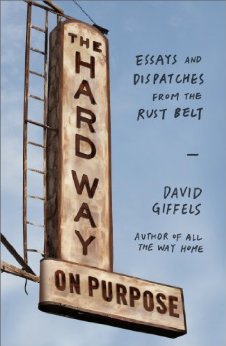
We are where we come from—and where we choose to make our home. For David Giffels, that’s one in the same: Akron, Ohio, Rubber Capital of the World, where he grew up and now lives, teaches, and writes. The Hard Way on Purpose: Essays and Dispatches From the Rust Belt (2014) is his fourth book, following his 2008 memoir, All the Way Home: Building a Family in a Falling-Down House. His new memoir, Furnishing Eternity, came out January 2, and I will be talking with David about it soon, right here!

In 2017, I spoke with David about Northeast Ohio’s brand of funny, fellow Akron native Lebron James, why the hard way is the best way, his latest book—and more.

David — In The Hard Way on Purpose, you use humor to great effect. You call Akron “the Ralph Malph of the American industrial belt.” With your identity so closely tied to the place, when the place gets beaten up—nearby Cleveland is “the mistake on the Lake” to many still—do you take it personally? Do you deflect with humor?

It’s part of the culture here to laugh at ourselves. When you’re in any culture that’s been misunderstood, degraded, or used as the punchline to a joke, one of your defense mechanisms is to get to the punchline, first. Most Rust Belt cities—but especially this area—have a long tradition of this kind of humor. Here, a lot of people have traced it back to Ghoulardi, a 60s late-night B-movie horror host on local TV. He had this dark, ironic, anti-authoritarian sense of humor that influenced a lot of the people who’ve become our local cultural spokes-heroes: bands Devo, The Cramps, and Pere Ubu; and filmmaker Jim Jarmusch. There’s a certain kind of homeliness to where we live, and instead of being ashamed of it, you can make fun of it—and be a part of it, too.

How did you learn to write funny?

I guess it partly comes from having two parents who had really good senses of humor. I don’t know if I learned how to do it. One of my first professional jobs was writing for MTV’s Beavis and Butthead. I learned a lot from that. I talk about this in my new book: I was writing these clever-sounding lines, but it was not working. I was trying to be the Noel Coward of MTV. And show creator Mike Judge said, “Just make it stupid.” It was a great piece of advice. A lot of humor writing comes from letting down your guard, letting things roll.

the hard way on purpose cover-1

You were a newspaper columnist before becoming a professor of creative writing and an author, and you wrote about Cleveland sports teams. One of the essays in The Hard Way on Purpose focuses on fellow Akron native, Lebron James. I have to ask, how do you like Lebron now? Read more