Lit Fest Roundup 2025: who I met, what I wrote, how much pizza I consumed


This October I attended my eighth annual Fall Literary Festival hosted by Lit Youngstown. It was the Ohio literary organization’s ninth—and final—fall lit fest (at least for now). I could just be weepy about it (I’m weepy about much these days, tbh), but I’m too grateful to stay weepy. Since it’s a weekend to do grateful, let’s get into it…

Don’t worry, Lit Youngstown itself—with all of its amazing programming–is going strong at 10 years old. But before I get into my 2025 lit fest roundup I want to take a moment to share a few highlights from lit fests gone by (forgive my literary nostalgia), in no particular order:

  • Novelist Rachel Swearingen telling us craft session participants to, “Write towards change.” And “Stop thinking about characters and start thinking about relationships.” (Fiction writing changemaker right there!)
  • Me, getting to tell my story of my mom’s protesting of a nuclear power plant near my hometown when I was a kid (I wrote about it here) and detailing how that story turned into an integral part of my eco-novel (published someday, world!)
  • Exploring ekphrastic writing at the Butler Institute of American Art (great museum road-trip idea for you out of towners!) and exploring Youngstown writ large (getting to stay with friends and enjoying the local cuisine (there will never be enough pickle pizza, noggin-sized meatballs, and pierogis!))
  • Getting to be a student of Sandra Beasley, Ross Gay, Lawrence Coates, and so many other teacher-writers and getting to tell them over charcuterie and a glass of wine: “you wrote my favorite poem, essay, novella, thank you…”
  • Meeting writer friends (like the talented Melissa Fraterrigo) in person after years of reading her work (her novel Glory Days inspired a lot of what I’ve been trying to highlight at this blog these last nine years or so—stay tuned for a review of her memoir in essays, pictured). And meeting other friends year after year and weaving our stories—and lives—together.
  • The highest highlight? You. Becoming a member of the Lit Youngstown community through the fall lit fest has been incredibly rewarding for my literary life—and my life-life. Thank you, friends.
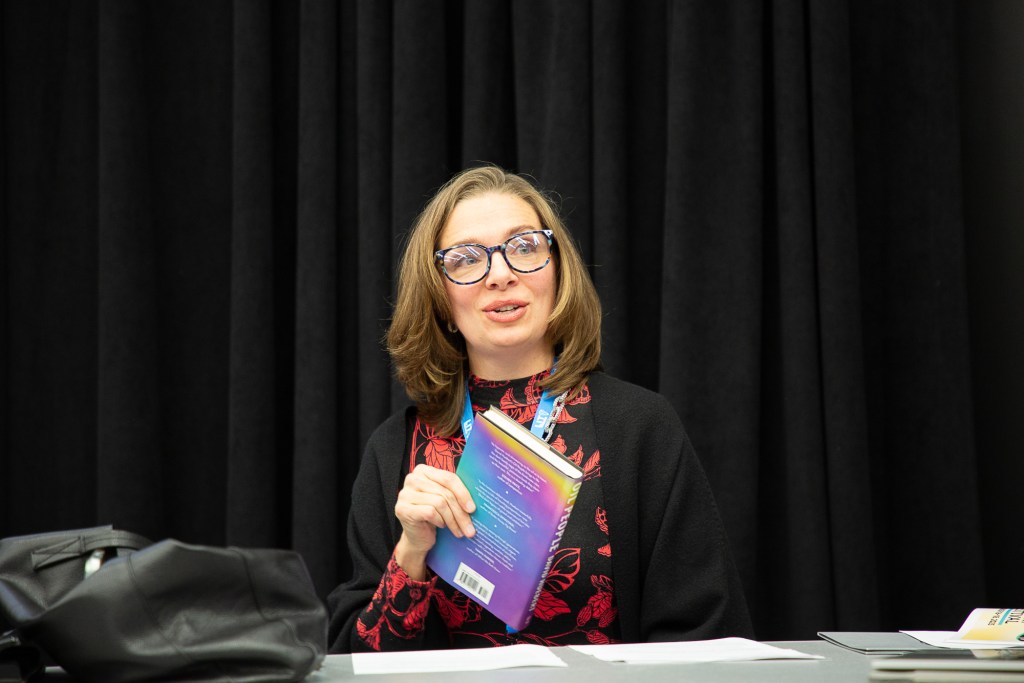
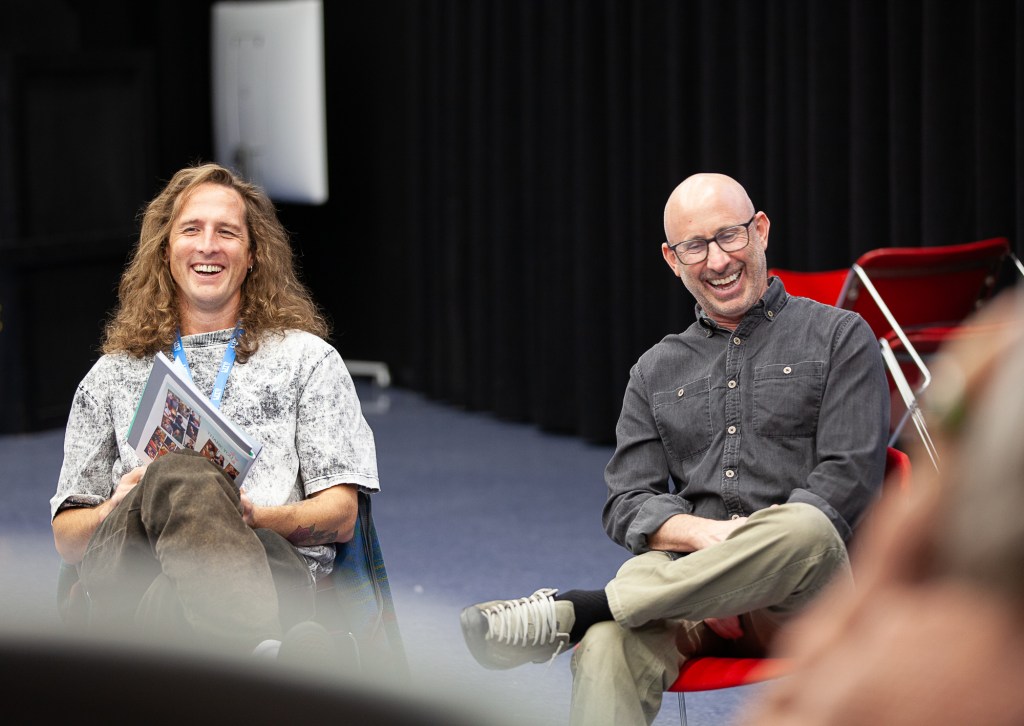
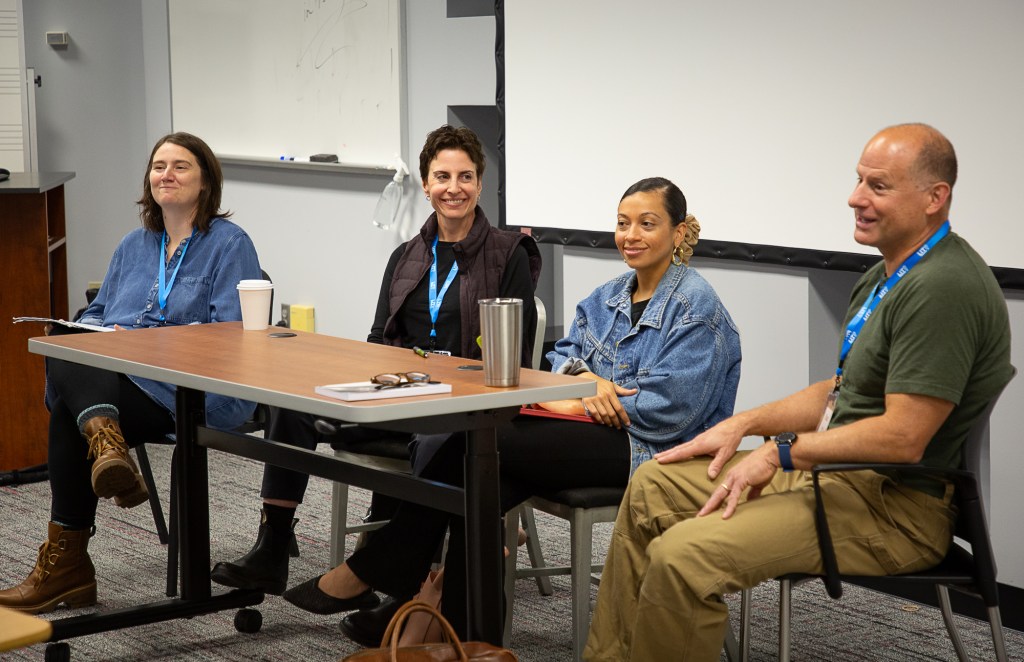
Now, 2025’s list fest was one for the books. (Peruse a few pics above and below.) And if you thought the environmental theme was going to mean a slew of nature poems…well, yes, and… Yes, and fascinating eco-fiction and challenging environmental memoir and poetry about nature redefined—from a place that was once an indigo plantation to the night sky over the Grand Canyon to trails cut by troubled teens into the Pacific Northwest woods—and so much more that “shapes our experience and identity, and represents our rootedness in earth.” Whew! I encourage you to read the impressive bios of the five 2025 featured presenters

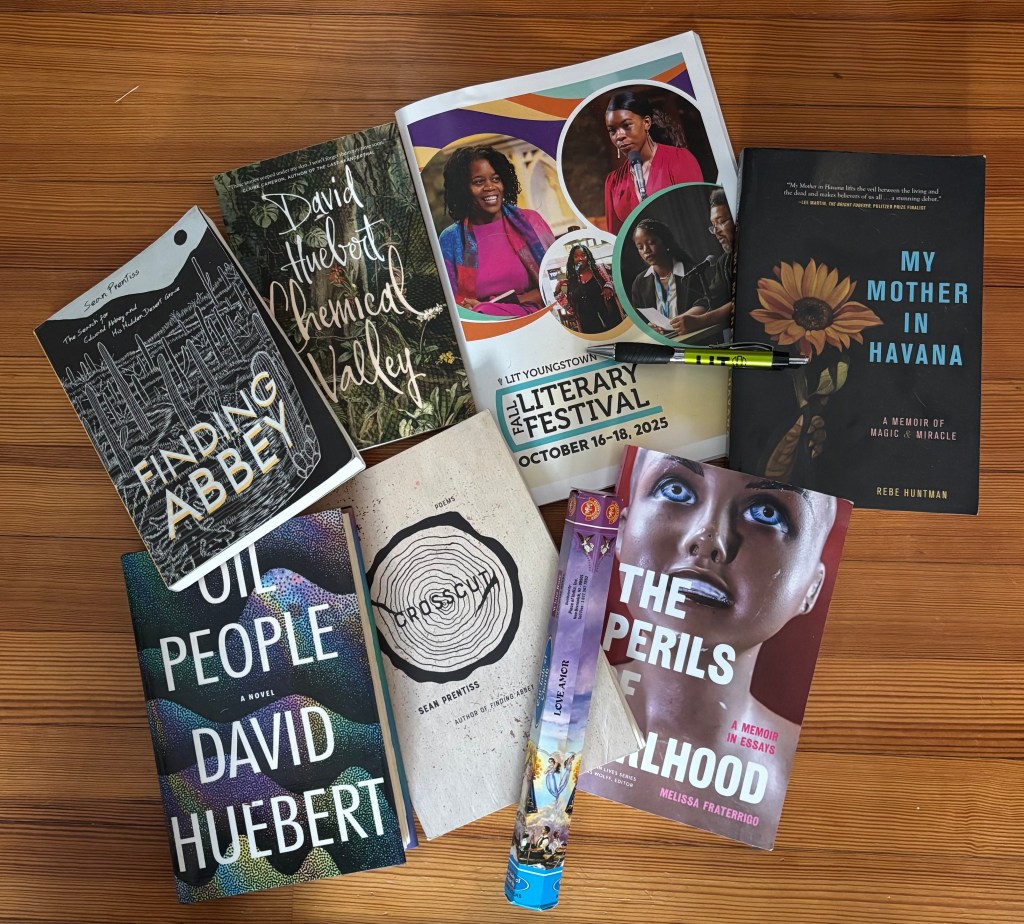
My preparation for this lit fest happily began months in advance of the event. (Once a student, always a student.) For my conversation with fiction writer David Huebert and memoirist and poet Sean Prentiss I read several of their books—she gestures to collage artfully displayed on her office floor—representing an array of what we lump under the term “environmental writing.” Look for a follow-up post with a good chunk of our discussion—fascinating and fun!

Other personal highlights from this year’s lit fest. (Know that this is just a fraction of the offerings and I, once again, wished I could have cloned myself, so I could make every single session.):

Day 1:

  • Narrative Medicine [definition: healthcare practiced with narrative competence]: A Generative Workshop, facilitated by family nurse practitioner and poet Dana Reeher. Imagine me taking furious notes for the anthology project I’m co-editing: Body of Work, essays at the intersection of dance and health. For a little workshop exercise, Dana asked us participants to respond to a writing prompt, “an expansive invitation to open the mind,” so I thought I’d write a very short piece about my own dancing and its impact on my physical and mental health outlook:
Maybe the mistake was I listened too well, that I pointed my feet too hard, that I really could feel that string coming out of the top of my head lifting me up to the studio ceiling. Maybe I postured too much, wanted too much. Maybe I turned out until I was turned in. Maybe all that looking in the mirror made me someone else. I can still spot a dancer, or an anorexic, from fifty paces.

My dancer friends here will likely recognize a lot of this, but especially the posture-reminder telling baby ballet dancers to imagine there’s a string coming out of the top of your head… After sharing my short piece of writing, a couple of the other workshop participants said the string image reminded them of a marionette. I’d never thought of that before, and I’ll tell you that image is still working on me!

  • The Pamela Papers: A Mostly E-pistolary Story of Academic Pandemic Pandemonium: The Musical. Based on the award-winning novel by Nancy McCabe, published by Outpost 19 in 2024, the presentation included a dramatic reading (with singing—who was expecting a musical at the lit fest? Not I. And it was such fun!).
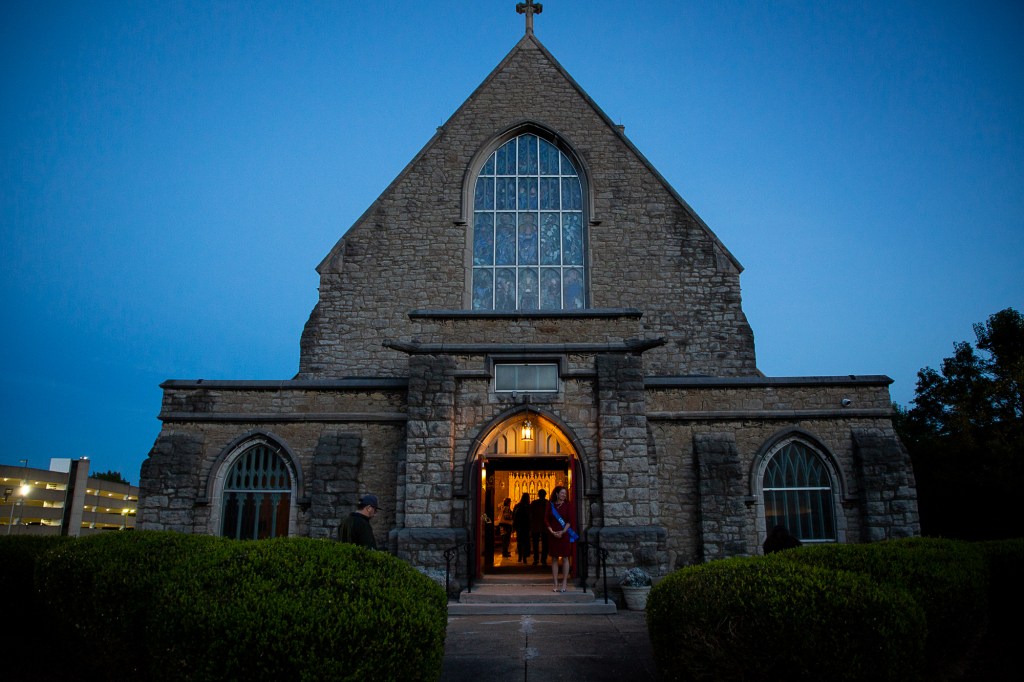
  • Readings by David Huebert and Sean Prentiss in St. John’s (gorgeous limestone and stained glass) Episcopal Church sanctuary. Your girl provided introductions to both writers—thanks for putting up with my unorthodox investigative process to make sure they were exciting, guys!

Day 2:

  • Bengal Tiger Moments: Time Perception in Creative Writing, facilitated by Sean Prentiss. In this fascinating session, we talked about speed on the page, presented in five categories from fastest to slowest: Gaps, Summary, Scene, Dilation, and Pause. Sean presented examples of these techniques from creative nonfiction and explained the brain science behind our understanding of the movement of time—irl and on the page.
  • Rooting the Self: Writing as an Act of Person, Political & Environmental Transformation & Transcendence, a multi-genre workshop with (beautiful and talented) Rebe Huntman, author of My Mother in Havana: A Memoir of Magic & Miracle: Rebe took us through various stages/ways of honoring our voice and our writing by making space for it and celebrating it, including meditation, morning pages, repetitive activity (including list-making), “the writing cave,” and writing constraints and freewrites. My favorite prompt, a list-making exercise we did in this session, produced these lists, below. (From there I spun out a short prose piece, “Reasons to Revere Your Vagus Nerve” (we’ll see where that weirdness goes!):
5 Things I Consider a Miracle
High arches
Warm pie
The vagus nerve
Sweating carafes of water
Tanned leather
5 Recurring Obsessions
Ballet hands
Song
Accents, dialects, and regionalisms
Mom, mom, mom
Delight
  • Readings by poets Lauren Camp, Todd Davis & Kourtney Morrow: poems of cityscape to countryside to the night sky over the Grand Canyon left us audience members awed.

Days After

And then, after… there’s nothing better than returning home from a literary event inspired, nurtured, and with a few new ideas for writing already on the page.

If you’re reading this on Small Business Saturday, might I suggest you also read small and lit small by supporting your local indie bookstores and your favorite literary organizations today?!

Did you attend Lit Youngstown’s Fall Literary Festival last month? Another lit fest? What was your favorite part? Have an inspiration gleaned or a piece of writing captured you’d like to share? Feel free to jot it in the comments. 

Like this post? Comment below or on my FB page. And please share with your friends and social network. 

Are you a Rust Belt writer interested in seeing if your own post, or author interview, or book review might be right for Rust Belt Girl? Hit me up through this site’s contact function.

Check out my categories above for more guest posts, interviews, book reviews, literary musings, and writing advice we can all use. Never miss a post when you follow Rust Belt Girl. Thanks! ~Rebecca

Enter your email address to subscribe to this blog and receive notifications of new posts by email.


Welcome to the 2023 Rust Belt Girl round-up…

I interrupt this Covid haze–mine, yes, I was gifted the virus for Christmas–to present a round-up of all the Rust Belt Girl goodness in 2023, made possible by you amazing readers and followers. (For you math and science types, here are your facts and stats):

2023 total views: 5,069, from 3,575 viewers, for 231 likes, and 170 comments. Thank you for engaging!

Most Viewed Post (MVP) 2023: A stellar review of Jason Irwin’s poetry collection, The History of Our Vagrancies, by Marjorie Maddox (Side note: I met Jason in person for the first time and reconnected with Marjorie in October at the Fall Literary Festival in Youngstown.)

2nd Place for MVP 2023 (and tops for most–and most heartwarming–comments): “Mad Dog, “Steel Poet,” Tim Russell, a literary reflection by poet and publisher Larry Smith. Thank you to Larry for being such a pillar of this literary community. (I also met Tim’s widow, Jodi, for the first time, in October–there were hugs!)

3rd Place for MVP 2023: The Rabbit Hutch‘s Rust Belt Renaissance, a review by Emma Riva, an author and art writer living in Pittsburgh, who is also the founder and EIC of Petrichor, Pittsburgh’s art scene magazine. Check it out!

Most Viewed Author Interview: My interview with John W. Kropf, author of Color Capital of the World. (Though John and I both live in the Greater Washington D.C. area, as luck would have it, we were in Ohio at the same time earlier this year, and I was able to meet him and his lovely wife Eileen at a reading and book-signing not far from where Color Capital takes place.)

And don’t miss all the other 2023 bloggo goodness, including interviews with Mitch James, author of the rural noir novel Seldom Seen; Valerie Neiman, author of YA novel The Lonely Backwater; and David Giffels, author of The Beginning Was the End: Devo in Ohio. (This makes three interviews with David at Rust Belt Girl, some kind of interviewing trifecta!)

Then there was John W. Miller’s beautiful guest essay: From Belgium to the Rust Belt. (In a fun coincidence, John and I ended up in the same storytelling course this fall–the writing world is a small one.)

And in other fun blog news, my 2022 review, Enlarging “Rust Belt lit” and Megan Giddings’ The Women Could Fly, was picked up by Belt Magazine in 2023.

2023 felt pretty good and creative outside of the blog, too: I published a short story and a poem(!) and started querying a novel (a couple of you blog followers and friends beta-read!). I am infinitely lucky and grateful to cross paths with as many of you as I do–even if only on these interwebs.

I think we deserve a happy and healthy 2024 with all the writerly and readerly connections we desire. Those of you local to these D.C./Baltimore parts, find me on January 14 at EC Poetry & Prose’s Salon Series. Thank you again to Patti, my fellow blogger–and extraordinary poet and spoken word artist “little pi”–for inviting me to read!

As for Rust Belt Girl, keep in mind that I love a guest post–author interview, book review, or essay on the writing life and beyond–so hit me up.

Want more Rust Belt writing, book reviewsauthor interviewswriting adviceessaysguest posts, and more in your life? Follow me here. Thanks! 

Oh, and if you want to check out my reading superlatives for 2023, they’re at Goodreads. Or, find me on FB. Share your top posts or top reads for 2023 in the comments. I’d love to hear about your writerly, readerly year.

(Off to nap…again.)

*free header image courtesy of Pexels

Building thriving post-industrial cities, one story at a time

We talk a lot about place here on the blog. While I’m usually talking about place or setting in literature, I’m also interested in the real places that inspire—especially Rust Belt places.

I never gave much thought to England’s rust belt, until a conversation with a good friend, who is English, last summer. Born a “southern softie,” a not-very-nice term for a person from the South of England, my friend recently moved to Sheffield, in the North of England. It’s basically smack dab in the middle of England’s rust belt, she told me.

As coincidence—or bots—would have it, I learned of a symposium hosted on Monday by the University of Sheffield featuring writers, community organizers, academics and the like from the UK and US. I found it fascinating and thought I’d give you a taste, here. 

An “across-the-pond conversation,” the symposium featured four panels that explored how to build “thriving, integrated post-industrial cities.” There was talk of architecture, anthropology, heritage, history and more. Panelists discussed new ways of connecting with the past, such as through urban explorations and art—including writing.

Thanks to Zoom, I was able to check in on the first panel of the half-day event, which included a presentation by award-winning author, essayist, and journalist David Giffels—dubbed “the bard of Akron” [Ohio] by the New York Times. If you’ve been here at Rust Belt Girl for a while, that’s a name you’ll recognize. David has graciously talked with us before about a couple of his books: The Hard Way on Purpose: Essays and Dispatches from the Rust Belt and Furnishing Eternity: A Father, a Son, a Coffin, and a Measure of Life.

As a featured speaker, David touched on the idea of our place’s “story.” He talked about sometimes feeling like our place isn’t worthy of story because it’s a humble place. But, of course, every place is worthy of story. He talked about pushing back against a prevailing narrative that comes from the outside (see: flyover journalism) by championing the local voice and lived experience.

David dug into his own past lived experience, as a student at the University of Akron during a time when the city’s downtown was full of abandoned buildings. “As young people we didn’t see it as failure,” he said, but as a place of promise. “You could reimagine the built environment”—a bookstore here, an art gallery there. 

Just don’t call it a “dying” city. Rather, cities evolve. David’s story of Akron is important to tell, because “it’s the story of hard times”—and hard times can be instructive. Take the COVID-19 pandemic. Ohio was ahead of the curve, David noted. The reason? The state had been dealing with a public health crisis—the opioid crisis, with Akron at the epicenter—for years. The realigning of emergency and social services necessary to deal with such a crisis, Ohio was on it. “Our hard times had something to teach,” David said.

Let’s not “fly over” the stories of lived experience—the hard and good times—in places like Akron and Youngstown, like Sheffield and Liverpool. It’s important to get cities talking, David said. “Dialogue between cities can remind us of the value of our narrative.”

Thanks to the symposium organizers and participants, especially David, for spreading the word about this symposium. It developed from new-genre artist Jennifer Vanderpool’s social practice art exhibitions, called Untold Stories, a series of exhibitions taking place in the post-industrial Midwest region of the US and the industrial North of England. Maybe catch one of the artist’s exhibitions if you can? 


What are you attending, watching, reading, and writing this month? Let me know in the comments…

Want more Rust Belt writing, author interviews, book reviews, writing advice, and more? Check out the handy categories above. 

Find me on FB and on IG and Twitter @MoonRuark

And follow me here. Thanks!

Behind the Scenes: “A New Nuclear”

The lovely folks at Great Lakes Review published my story, “A New Nuclear,” about my favorite fictional dental hygienist Patty’s struggle to find herself during the last summer before her child leaves for college. It is a most Rust Belt-y story, and I’m grateful to editor Mitch James for giving it a fine home along my favorite Great Lake.

One of the questions writers hear most–even about fictional works–is: “Is this story inspired by your life? Is this you?” Yes and no. Do I understand Patty’s situation? Do I feel a sense of my nest emptying out? Sure, my boys are 13 now, and every day becoming more independent. But also no. Patty is not me, and is definitely not my mom (read on). But I thought I’d give a little backstory in case my followers want a peek into the real-life influences and (really weird) brain of a fiction writer.

Family might recognize Patty’s stint with the No Nukes! environmental chapter. My mom–who would have been proud to be called a tree hugger, if we used that term then–did a stint with the group that protested the local nuclear power plant. (The plant’s still in operation, btw. Planned to be deactivated in 2021, it’s now licensed to operate until 2037.) I remember my mom’s bright yellow No Nukes! shirt. She might have participated in one protest but was much more often spotted at the church basement food co-op she helped run. Also, note the spiderwort plants in my story–plants that are able to detect small amounts of radiation. My mom would have loved that fact. Maybe she knew it? I wish I could ask her.

A writer friend–hi, Jessica!–who is more perceptive than I noted that I have teeth on the creative brain as of late. She also read a prose poem of mine, recently published in the print journal, Presence: A Journal of Catholic Poetry,” titled “Jesus, My Son’s Buckteeth.” What do they say about teeth dreams? Spurred on by anxiety, right? Should I be worried if teeth are taking over my creative mind? (Don’t tell me.)

And a note on the craft of writing and the novel process: Writer friends who’ve read my WIP–a novel set over one Ohio summer, bridging two lakeshores and three generations–will recognize Patty. Early drafts of the novel included Patty’s perspective and more time for her on the page. In later revisions, Patty’s POV–but not Patty’s character–was cut. Still, I couldn’t leave the protest scene (or the dental chair scene!) on the cutting room floor. “Kill your darlings,” they say. But, also, sometimes those darlings can make for a good story.

I hope you like it: “A New Nuclear”

What are you reading and writing this week, this weekend? Want more stories from me, or author interviews, book reviews, guest posts, more? Follow me here:

Enter your email address to subscribe to this blog and receive notifications of new posts by email.

*free header image from Pexels

What are you reading for Short Story Month?

Mother’s Day. Memorial Day. Let’s not forget the significance of the month of May for the lowly short story!

Yes, May is Short Story Month. You didn’t know? You didn’t send a card? Well, me neither. But I didn’t want this busiest of months to pass without sharing a bit of good news with my loyal Rust Belt Girl followers–that’s you.

My short story, “The Pearl Diver” has been published in the latest issue of CutBank, the literary journal of the University of Montana. You can read the opening excerpt here–or purchase an issue if you’d like to read the whole thing (and more fiction and poetry goodness therein).

My pearl-diving main character has never been to Montana (nor have I), but I sure am glad she and her story struck a chord with the journal editors there. It probably won’t surprise you to know that this story is set in Ohio–at a fictionalized SeaWorld Ohio, in fact. The fact that this SeaWorld no longer exists makes it historical fiction, I guess, though the story takes place in the 90s, which feels like just yesterday to me.

Here are some great pics of SeaWorld Ohio in its heyday.

Where I grew up in Northeast Ohio, we were just a half hour or so from SeaWorld, and the summers we visited for killer whale (remember we used to call orcas “killer whales?”) and dolphin shows; visit the penguins; and admire the human water-skier pyramids were the best summers. Of course, that was a different time, and we look at animals in captivity differently now.

I don’t remember if my parents ever bought me a pearl from the SeaWorld pearl diving exhibit, where divers, ya know, dove for pearls in a pool. But it was fun to think about working as a diver (I can’t dive well, myself) in a pool, kept captive for a summer–much like the animals swimming around in their tanks. What trouble might an almost-sixteen-year-old girl diver get into over such a summer? (Lots, as it turns out.)

I wrote the first drafts of this coming-of-age story in grad school (ages ago) and it landed me on a couple finalist lists for contests. But “The Pearl Diver” never found a home until now. And it’s a beautiful home–check out those illustrations and cover art!

I hope you enjoy the excerpt, and many more stories, as we close out Short Story Month.

Happy reading! ~Rebecca

~~~

Let’s chat! Comment below or on my FB page or find me at Twitter @MoonRuark. Want more Rust Belt writing, author interviews, book reviews, writing advice, and more? Follow me here. Thanks!

Enter your email address to subscribe to this blog and receive notifications of new posts by email.

In Praise of the Short Story

These pandemic days feel both interminable and brief all at once. Time both drags and flies by. And even us rabid readers find our towering TBRs just keep growing taller. Anxiety and ennui make it hard to concentrate for long periods of time, making it tough to hold a long story in the imagination.

Short story to the rescue.

I mean, who wants to read one more doomsday article or essay. (OK, I read those, too.) But fiction in pandemic times? Yes, please! Anything to distract from the world on fire. But short fiction? As you might imagine, the novel beats out the short story collection in sales, everywhere. Sure, there are popular short story collections. But, as this Guardian article notes: “Most don’t sell many copies (a debut collection from one of the major publishing houses might have a print run of 3,000, with little expectation of a reprint).” Even when sales of short story collections surge, as they did in 2018, they’ll never beat out the novel.

But right about now might be a good time to revisit the short form. For escape, sure, and for craft–for those of us who write fiction–and also, and maybe most importantly right now, for connection with other readers. One of the most delightful virtual connections I’ve made in these pandemic days is with a book club (hosted by jesuit.org if you’re interested) that meets over at FB. The last book we read was, you guessed it, a short story collection, Night at the Fiestas by Kirstin Valdez Quade, which I highly recommend.

At the moment, I’m reading short stories before bed (“they” say escapism is better for relaxation than, say, a nonfiction book about the plague). I’m still working through short stories by Finnish writer Tove Jansson, which are often just a handful of pages long. They “escape” me to far-away Finland with its woods and lakes, its terrain of moss and lichens that feels foreign and inviting and cool. I save novels for daytime reading: right now that’s Jansson’s Fair Play; and Pete Beatty’s debut novel Cuyahoga, which is a Rust Belt novel if I’ve ever met one, and I plan to discuss it here.

Of course, many short stories birth novels. Valdez Quade’s “The Five Wounds” inspired her to build on that world for her debut novel, The Five Wounds, which will launch in 2021.

Then there are the movies that have grown out of short stories: famously, Shawshank Redemption, based on Stephen King’s novella (OK, not quite as brief as a short story but he’s adapted a lot of those, too): “Rita Hayworth and Shawshank Redemption.” A little more recently, there was Annie Proulx’s story “Brokeback Mountain.” And, then there was “The Curious Case of Benjamin Button,” which was a story by F. Scott Fitzgerald, which inspired a movie that released 86 years later–testament to the lasting power of the short story (or, at least, short stories by masters, like Fitzgerald).

I love a good short story. I love their self-contained quietude. I love the kind of short story where nothing really happens, except an all-important shift in perception or understanding. We readers don’t always need the classical story arc in short fiction (that many of us seem to desire in a novel: inciting incident, rising action, climax, falling action, resolution). A short story can capture a moment, a day, a year, or many years–and the plot doesn’t need to be tied up with a bow.

Take Raymond Carver’s famous story “Cathedral,” probably the story that cemented in college my love for American fiction and my desire to write it. It’s often-anthologized, often found within the same big American Lit 101 tomes as the classic stories by Fitzgerald and Ernest Hemingway, O’Connor and Kate Chopin, and more modern short story masters of the world, like George Saunders, Jhumpa Lahiri, and Amy Hempel. (And it’s totally not how I write, but aspire to.) Let me know what you think of it, if you read it!

Do you read short stories? Write them? What’s your favorite? Need a suggestion for some pandemic escapist short story reading?

Last year, Lit Hub recommended “The 10 Best Short Story Collections of the Decade” and the year before that Esquire recommended some “great literature in small portions” with “15 Short Story Collections Everyone Should Read.”

Thank you to Lorna of Gin & Lemonade, for putting me in a short story frame of mind–and for inspiring this post. Blogging groups are invaluable, for sure.

Happy reading and writing, all–whether short, long, or in between! Want to read a short story of mine? I’ve linked to a few over at my About page.

Interested in Rust Belt author interviews, book reviews, essays, and more? Check out my categories, above. Are we social? Find me at FB and on Twitter and IG @MoonRuark

Are you a Rust Belt writer or poet interested in doing a guest spot at this blog? My more than 1,500 followers love to discover new voices with connections to the American Rust Belt. Let’s connect!

*Header photo by Suzy Hazelwood on Pexels.com

My musing on “The Everyday” at Ruminate Magazine

Happy Saturday to those of you around my side of the globe. A quick check-in: I know, I know, you just heard from me the other day with my take on Elena Ferrante’s My Brilliant Friend, the first of the Italian author’s Neapolitan quartet of novels exploring female friendship and much more. And, before that, I shared my dreams (and distractions) for 2020.

This year, I’m resolved to enjoy this writing-and-blogging community, the slow slog meditative process of writing and publishing, and the paths down memory lane I take as I write. And while I typically craft fiction–find some of it here at stories–I responded to a nonfiction call from the editors at Ruminate Magazine for readers to ruminate on “The Everyday.” That prompt led me to think of the joys of special holidays–like the baptism of my guys 10 years ago–and the joys of the mundane: Ordinary Time, ordinary time, and a warm piece of bread.

If you have a moment, my short essay (the second of the readers’ notes) is a two minute read–as are the other ruminations from readers around the country. But you might just want to stay a while, so we can, as the magazine’s About page says, “practice staying awake together.”

What are you ruminating about today?

See my mini-essay at Issue 54 The Everyday Readers Notes. (Scroll down.)

“Rust in Bloom”

Issue No. 8 from Barren Magazine is out, and features my story, “The Virgins,” among among so much fantastic poetry, prose, and photography for your weekend entertainment. (Thank you to the editors for letting my story sit among such great company!) See also my friend (and Rust Belt Girl follower) DS Levy’s flash fiction piece, “Tengku,” my fave poem of the day, “Barrels of Fruit,” by Caroline Plasket, and more gritty, rusty photography–along with sweeping skies and far-off places–than a girl could shake a stick at.

Happy weekend, and happy reading and viewing.

What’s in store for your weekend?

~Rebecca

When a journal editor says no more death stories* **

Photo by Kat Jayne on Pexels.com

I submitted “Scooter Kid,” a story about conception (of a couple different kinds)–of creation, chaos, and control. (Spot the nod to Stockard Channing’s character in the 1993 movie, Six Degrees of Separation? Yeah, I’m still a little obsessed.)

Many thanks to Elizabeth Varel, Editor in Chief and Fiction Editor, and all the editors of Parhelion Literary Review for publishing my story in your lovely journal. Alongside my fiction, you’ll find a trove of thought-provoking prose, poetry, and art: right here.

Happy weekend. Happy reading. What’s on tap for you?

Thanks for stopping by!

~Rebecca

*Seriously though, submitting to literary journals? Check those submissions guidelines.

**OK, OK, all stories are death stories.

Little Patuxent Review issue launch

Photo by Pixabay on Pexels.com

I’m delighted that my story, “While Our Grown Men Played,” will appear in the Winter 2019 issue of Little Patuxent Review. I’m also delighted to be reading at the issue launch event. For more information or to purchase the issue–or subscribe to this lovely regional literary magazine–click on through.

There’s truth in every piece of fiction, of course–despite my penchant for writerly distance. But if there’s one story of mine that tells the tale of my mom and me, it’s this one. In it, I got to call my mom a “world-class whiner,” which she was. But she never whined about what mattered: the breasts that failed her when they let cancer in, twice; the chemo and wig; the daughter living 12 hours away by Greyhound bus. She whined about the little things we could share: overdue library book fines, our pear shapes, cold noses in winter.

“While Our Grown Men Played” is a story about being female, sure; but even more so, it’s about being together, despite distance over roads and time–and cosmos, even. As I write, she’s still with me in the way I am, the things I whine about, and in my body: our ballet bearing, my veiny hands that are hers, the accent that won’t leave me.

Maybe most stories don’t take years and great personal loss to write, but this one did. It is a bittersweet thing to let it go, to read from it in front of others, to somehow tie a bow on grief. But it is sweet, and a testament to perseverance in writing and in living. I hope my mom would agree.

So, today I urge against writerly distance. Let’s try it, together. Let’s close the distances between past and present, between the living and the dead, between fact and fiction–and mine for story that heals.

That’s what I’ll be doing anyway.

~ Rebecca