In my last post, I talked about how we mythologize the loved ones we’ve lost–in my case, Mom.
I also asked the pressing question: Who the hell is Walt? The references to this mystery guy were plenty in Mom’s high school yearbook, which recently came into my possession.
Barb
Well, it’s been a long year but so far it ain’t been too bad. It’s been great knowing you this year. Be good and keep ahol’ of ol’ Walter.
B.o.L.
Rick
After last week’s post, I received emails from my mom’s sister, sister-in-law, cousin, niece, and best friend–a veritable social media reunion!–filling me in on bits I’d forgotten or never knew about my mom’s younger years. Spoiler: Mom did not keep ahol’ of Walter.
If you haven’t guessed, that’s him–the elusive Walt–up there with Mom, king and queen of the 1963 senior prom. I’m wondering if my mom’s Grandma Rose, a seamstress, made Mom’s dress. I’m also thinking not all the ladies in the court look pleased. I now remember my mom mentioning this “crowning,” saying it was only because she was the girlfriend of the king–that this was an automatic appointment to royalty. Until I saw this photo, though, I’d forgotten all that.
Really, some of the pleasure of remembering those we’ve lost must come from the selective forgetting, or curating–to use a popular word–of their personal narrative.
In another month, I’ll celebrate my mom’s birthday–for the 12th time since her death. A dozen years, a milestone of remembering. With the day comes a sort of dread, that I will forget–that I’ve already forgotten how the back of her hand felt under my fingertips, how much she liked her hair brushed, how she looked while telling her favorite jokes (I can’t repeat in polite company).
Am I remembering all that right?
Since my last post on the myths–and reality–we make around boys, I’ve been thinking a lot about the myths we create to remember. And I realize I’ve done that with my mom, picked key memories to cobble together her story–one to tell myself, over and over–because we don’t forget a good story. And forgetting is the most frightening thing.
And so it was with relief that I got ahold of my mom’s high school yearbook, senior year, 1963–all skinny ties and strands of pearls–knowing the photographs and notes from my mom’s teenage friends would bolster the Mom-myth I’d written (providing supporting backstory, if no surprises).
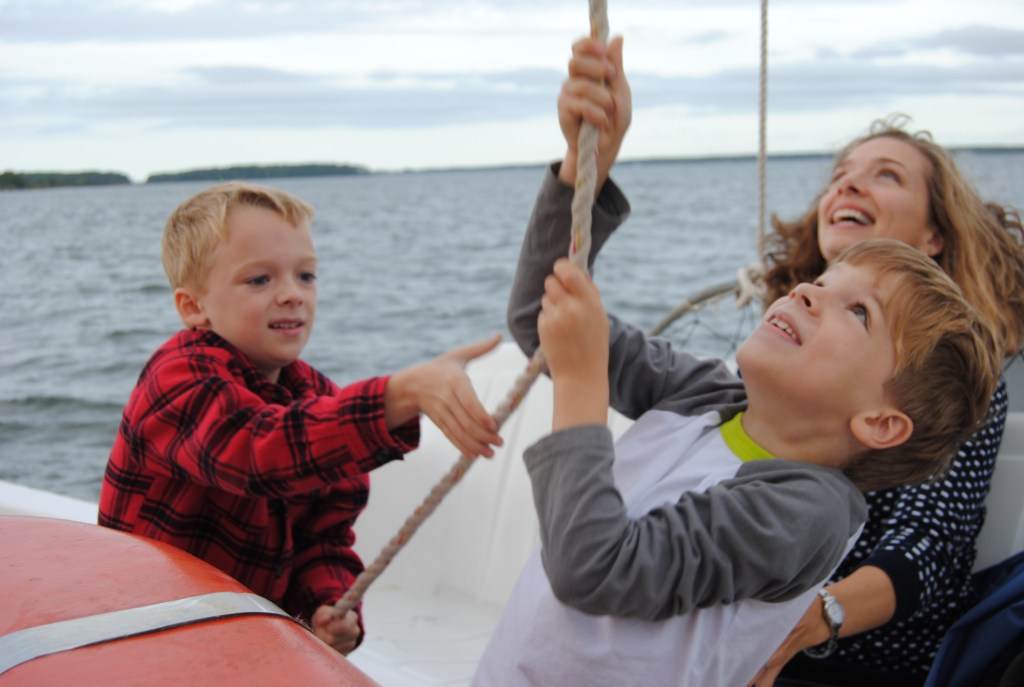
One of my favorite shots of my boys (age 6) and me (not age 6)
When I was on bed-rest, hugely pregnant with my twin boys, I did what I do in any anxiety-producing situation, especially one that would have me lying on my side for three months: I read. In addition to the care-and-feeding-of-babies books, I read about the raising of boys into men, the emotional aspects and the pitfalls to avoid.
In my reading, I found prevalent boy-myths to steer clear of (in life, not in writing–myths are fun there, but more on that in a bit). Two common ones: boy as animal (he simply can’t be good); and boy as prince (he can do no wrong, no matter how he tries).
Once I delivered my boys into the world, I became uber-focused not on their boyhood but on their infant hood–a precarious time made more precarious by sleep deprivation (mine, not theirs). “Your job is to keep them alive,” the pediatrician said. (If that sounds dire or needlessly heartless, I’ve since learned this is something pediatricians regularly say to moms of twins.) For me, nursing day and night, there was no time or energy for thinking ahead to boyhood–or mythologizing or otherwise romanticizing it in any way.
Amid the mental and physical haze of exhaustion, I did fall prey to infant-mom advertising: you know, the stuff of soft lighting illuminating mother placidly cradling baby in her arms–that’s one baby, not two. And so much gazing–lovingly–into each other’s bright eyes. Kenny G might have been playing his muzak as soundtrack to the ad–trying its best to sell me bottles, bjorns, fancy diapers, or other stuff I wasn’t buying.
What I was buying, however, (and internalizing like the marketing writer I am by day) was that romantic image presented. I was buying that hook, line, and sinker. Yet, I remember a turn of phrase that left me feeling heartless and creeped out all at once: fall in love with your baby boy.
Of course, myths abound in culture and literature through the ages that feature a mother falling in love with her son: not Pampers-love, but romantic–even erotic–love.
It’s festival season around here. Whether that means discovering just the right pumpkin, a new lager, or a better, more flexible version of your writing self, don’t forget to stretch (more on that in a bit).
Earlier this month, I headed to Youngstown, Ohio, for the third annual Lit Youngstown Fall Literary Festival held on the YSU campus. Here’s a rundown, plus tips, and–of course–a list of the autographed books I lugged home! (First, shout-out to my cousin, Theresa and her husband, Steven, who kindly fed me homemade pizza and put me up for the night along my way through PA.)
I’ve developed a love affair with poetry this year. So, I found Teri Ellen Cross Davis’ poetry collection, HAINT, at just the right time. I met the author at a recent literary conference and was delighted to discover that she too grew up in Northeast Ohio. Names and images of our home set the stage in her poems of childhood, such as “East 149th Street (Symphony for a Black Girl)” and “Akron at Night,” but many more of her poems present a powerful universal ode to girlhood, adolescence, and adulthood as a woman seeking love. Poet Ross Gay, another Northeast Ohio native, said of HAINT, “Although heartbreak is the origin of so many of these poems, it’s love that makes them go. Love to which they plead and aspire and pray.”
Teri was kind and generous enough to tell me more about what makes her poetry–and life–“go.”
I’m so thrilled to present this interview with Johnny Joo, a fellow Northeast Ohio native, whose photography* I’ve featured at the blog before. But this time, we get the stories behind the lens…
Johnny Joo is an internationally accredited artist, most notably recognized for his photography of abandoned architecture and surrealistic digital compositions. Growing up sandwiched between the urban cityscape of Cleveland and boundless fields of rural Northeast Ohio provided Johnny with a front row ticket to a specialized cycle of abandonment, destruction, and nature’s reclamation of countless structures. Since he started, his art has expanded, including the publication of four books, music, spoken word poetry, art installations, and videography.
Johnny, how did you first get into photography–and abandonment photography in particular?
I was an art student in high school, and photography was another art class I could take, so I took it to fill space with as much art stuff as I could–not thinking that I would like it as much as I did. I got super interested in the whole science behind it and being able to capture a moment in time that would not happen again. For one of the first projects, I photographed some empty rooms in the high school, and also photographed an old farm house. It reminded me of Silent Hill and other horror games and movies I enjoyed.
I thought it was a great subject for photos, and I loved the way nature wore it down to create something so dark and eerie, yet calm and beautiful. That’s the film photo of the empty class room [above]. I gave the rest of my film and binder to my photography teacher, so I don’t have anything else, but I did keep my favorite photo–and it’s the first photo I developed successfully.
I just kept photographing any abandoned or creepy historic place I could find (along with EVERYTHING else) and started sifting through papers in some of the old buildings and found so much history left behind.
I thought it was interesting to piece a life and history together–being able to know so much without ever having known any of the people beforehand.
It might not feel like it today, when we’re supposed to top out at 95, but fall is closing in. And even though I’m more than 15 years from being in the classroom–first as a student, then as an instructor–the change of seasons still signals a renewed sense of dedication. And I’m ready.
It’s also a good time to re-focus this blog. If you remember, I met a poet and a memoirist at the last writing conference I attended (click for conference tips)–both from Rust Belt places. I love nothing more than picking the brains of my fellow writers and presenting their thoughts to you, here. So, I’ll be keeping up the interviews–and the reading required to conduct thoughtful queries.
Funny interview story for you: a few years ago, I thought I’d parlay my interviewing skills for the blog–and managed to convince essayist, memoirist, and journalist, David Giffels, into talking to me here and again here.
For the first interview, I had read–and loved–every word of David’s book of essays. But, breaking one of my own rules of interviewing, I hadn’t read David widely (yet). A music journalist and Akron, Ohio, native, David also wrote the rock biography, We are Devo!, with Jade Dellinger. Akron is famous for a few things. Among them: tires, Chrissie Hynde, Lebron, and that safety cone-hatted band, Devo.
Disclaimer: I’m not from Akron. Still, I should have known but didn’t. And, so… when I had David fact-check our interview, which I’d recorded, among his local cultural spokes-heroes appeared Steve-O, the stunt performing comedian known for Jackass. Not, Devo (as it certainly reads now).
David didn’t ask that I pull the interview or even laugh at me for my mistake (at least not to me). I was mortified…but mortification can instruct (when it doesn’t kill).
Here we still are. Thanks for sticking with me.
For me, fall also means another season of literary festivals, my favorite of which–Lit Youngstown’s–will take me home to Northeast Ohio. Last year, that festival inspired my post: 3 Reasons to Connect with Your Writing Community… And I’ll be sure to cover the event again this year, when I’m not reading my own fiction, sitting on a panel of editors, and moderating a couple sessions. It’s two full days of literary conversation–and my idea of heaven.
Of course, as our fall weather turns a bit cooler and the evenings darken sooner, my twin guys start discussing Halloween costumes and plans. Last year they played a rather nondescript, skull-faced “death” and a soccer star, which sounds like a good title for a horror movie. Stay tuned.
With darker evenings comes darker reading, as my editor gig with Parhelion Literary Magazine has had me reading fiction for a themed October issue. And I’ve been so inspired! I hope you’ll stop by for your fiction, creative nonfiction, poetry, or photography fix. The summer issue is live now. You’ll also see what fun I’ve been having as features editor there.
Now, it’s your turn…What’s on tap for your fall? Pumpkin or literary festivals? Local wine or craft beer tent? Hike or bike? Write or read?
For those of you who don’t go in for such self-flagellation, I’m talking about submitting to literary agents, entreating them to represent me and my book.
If you’re not an aspiring author, don’t back-arrow just yet–these lessons learned can be applied to many facets of our writing lives. (And, bloggers are writers, I say over and over and over.)
First, because everybody loves query results in hard-and-fast numbers, here you go: cycle one of querying, I submitted a total of 20 queries. Of those, I had:
1 request for a partial (first three chapters); and
1 request for the full manuscript (after the agent read the partial).
Not bad, really: some action from 10 percent. I feel confident I’ll do better next query cycle, beginning this fall, knowing what I now know…
Amy Jo has said this essay took her 10 years to write, and I think the essay is better for its long gestation. But, wow, this is also a good lesson for us writers to stick with, or return to, those ideas that keep us up at night!
Essays not your thing? Writer, editor, and blogger at daily (w)rite, Damyanti, featured a really interesting guest post by Felix Cheong, a poet living in Singapore. In it, he talks about the process of writing poetry, and he goes back to old drafts a lot–calling himself a scavenger. He says: “Given the right time, they [old, discarded writing material] could be salvaged, given a makeover and presented as shiny and new.”
Here’s to reviving what we thought was lost. Here’s to sticking to a good idea for a good long while. And here’s to new inspiration.
Amy Jo Burns is the author of Cinderland, and her writing has appeared in Salon, Good Housekeeping, The Rumpus, Electric Literature, Tin House’s Open Bar, Ploughshares Online, and in Roxane Gay’s anthology Not That Bad. Her novel Shiner is forthcoming from Riverhead Books.
Amy Jo was gracious enough to answer a few questions from another Rust Belt girl–me–about her literary memoir, Cinderland, which I discussed in a previous post; about her Rust Belt upbringing; about juggling the responsibilities of writing and motherhood; and about her upcoming novel, Shiner, which I can’t wait to read!
Amy Jo–your memoir, Cinderland, is set in your hometown outside Pittsburgh. How did that particular post-industrial place inform your upbringing? Does your memoir’s title reflect the place in which you were raised, the abuse you suffered as a girl, both?
I chose the title Cinderland because it represents an inner fire that…
Free image courtesy or KathrynMaloney at Pixabay.com
It’s been a long time since I’ve shared some good writing advice from an author. This piece comes from Ross Gay, award-winning poet and essayist, whose latest collection, The Book of Delights: Essays came out earlier this year. He’s also a professor at Indiana University and a big sports fan and former college football player–and what delights Gay are many and varied things, which is, for this reader, delightful.
Before I share his advice, I’ll share a story: I’m a little embarrassed to say that while I’m only 27K into my new WIP, I already have its epigraph–you know, the quote or quotes at the start of a book that suggest theme. In my WIP’s case, the working themes are around loss, sorrow, and joy. Loss we can all try to get our heads around together.
But sorrow is really loaded–especially for me as a Catholic. Funny thing, a friend of ours recently learned what my family’s parish is called. “Our Lady of Sorrows,” he said. “How depressing.” I’d never thought about the name, a common descriptor for Jesus’s mother, Mary, as depressing. For, like Mary’s, our sorrows are borne together; sometimes, they’re necessary, even life-changing, lifting us all up. I couldn’t articulate this to our friend at the time, but his words got me to thinking about the transformative power of sorrow.
That’s about when I started reading Ross Gay, and who knows if his words will stick as one of two quotes in the epigraph of a novel not even half finished, but these words of his, from his essay “Joy is Such a Human Madness,” have served as a good thematic guide:
What if we joined our sorrows, I’m saying. / I’m saying: What if that is joy?
Ross Gay, The BOOK Of Delights: Essays
About the time I jotted this quote down was when I learned that Gay, like this aspiring author, is a Northeast Ohio native–making the possibility that I might one day hear him read in person pretty decent. (Joy!)
Until then, I’ll read his poems and essays and delight in learning about this inspirational author through interviews, like this one with Toni Fitzgerald in The Writer, in which Gay talks about his writing inspirations and process–our writing advice for the day:
…usually it’s thinking, reading, studying, trying to find something that turns you on and going for a bit.







 Rust Belt Girl