Take that New York Times: My not-list of the best books of vague parameters according to me

If there’s anything readers like more than a Top Reads list, it’s complaining about a Top Reads list. Earlier this summer, the New York Times published “The 100 Best Books of the 21st Century.” Remember that? Of course you do. Reddit basically blew up that day.

We all had definite feelings about said list. Namely, that it didn’t include genre fiction and books of poetry, the latter an egregious omission imo. It did include several of my favorites: Tayari Jones’s An American Marriage (gutting), Helen MacDonald’s H is For Hawk (gorgeous), Jhumpa Lahiri’s The Interpreter of Maladies (instructive in the very best way), Cormac McCarthy’s The Road (what’s a synonym for gutting?), Ann Patchett’s Bel Canto (magnificent), Elizabeth’s Strout’s Olive Kitteridge (sleepy in the best way), Marilynne Robinson’s Gilead (transcendent), and Donna Tartt’s The Goldfinch (masterful and also long).

Only a couple have I discussed here at Rust Belt Girl: Robinson’s Gilead (cue the car-sobbing) and the novel that came in at No. 1 on the NYT list: Elena Ferrante’s My Brilliant Friend. None of the books on the list that I’ve read could be described as Rust Belt books, so I protest! But not really.

The wonderful thing about Top Reads lists is that we avid readers read them, get mad, and then the maddening lists beget more lists. Which is great. After we got mad at the NYT, they featured another story, “Readers Respond to the ‘Best Books of the 21st Century,’” chock full of the books that should have been on the first list. I saw Best Books lists featuring Appalachian Reads and reading roundups galore. All this leads me to believe that there are never enough lists, the lists are never long enough, and yet they are also ALWAYS incomplete. There’s room for my book and there’s room for your book on those lists. So get to it, writers!

Really, my blog is my ever-changing (let’s say “curated,” cuz that sounds fancy) list. I’d love to know what your favorite book from my list is. (How about from your list?) And then Goodreads is my dump—everything goes there, unless I really hated it, in which case I probably DNF’ed anyway. Are we connected out there at the dump?

Recent (ly read) books that stunned this Rust Belt Girl but aren’t necessarily Rust Belt books are basically the books I keep thinking about and talking about: A Line in the World: A Year on the North Sea Coast by Dorthe Nors (let’s all read more essays in translation!); Sonata: A Memoir by Andrea Avery (lyrical, musical, and propulsive); The End of Drum-Time by Hanna Pylvainen (interestingly atmospheric); The Beginning Was the End: Devo in Ohio by Jade Dillinger and Akron’s own David Giffels (so that’s what New Wave was all about!?); and Shuggie Bain by Douglas Stuart (gutting x 12—what exactly is wrong with me?).

You see, once you get started list-making, it never stops.

Looking for a review or an author review–or even a little writerly advice (I try to take myself)? See my categories above. And find me on Goodreads, where I try to at least rank what I’ve read. Let’s be friends there and on FB and at all the places!

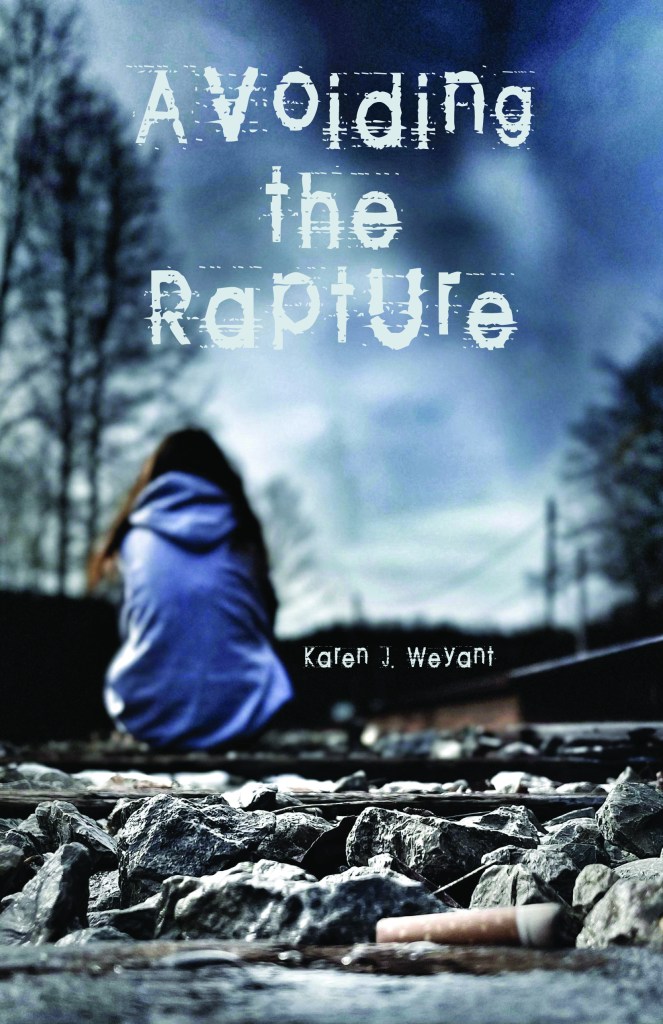
A review of Avoiding the Rapture by Karen J. Weyant

By Marjorie Maddox

In Karen J. Weyant’s first full-length book of poetry, Avoiding the Rapture, there is no avoiding the evocative and sometimes contradictory landscape and convictions of the Rust Belt. In a town defined by its bars and churches, river and railroad tracks, closed factories and forbidden swimming holes, Weyant gives us both the desire to leave and the need to cleave. No matter our background, she makes this space ours—ownership and rebellion a familiar if not always pleasant home.

We begin with belief so strong it takes hold of a town—“Every girl I knew got religion/at the same time they caught Disco Fever.” Salvation is a type of escape to be embraced or rejected. “Facing uncertain futures,” the poet explains, “we waited to be whisked away in [both kinds of] sparkle.” And yet by “avoiding the rapture,” she counters, “[w]hen everything disappears, everything you see will be yours,” a mixed motivator for a place that when you aren’t reveling in it, you’re scheming a quick departure.

Within this back-and-forth identity quest, the narrator looks for signs and visions in roadkill rising from the dead, in Jesus in dryer steam at the local laundromat, in “one of the Horsemen/in the hind leg of a Holstein cow,” and in “saints/in real estate signs buckling under buckshot.” There are also “man-made miracles” where the narrator­­ “dump[s] grape juice into Gallagher Run,/hoping the muddy swirl would turn into wine,/. . . [or] pretend[s] the stale angel food cake. . . was really manna.” 

Woven throughout the book is a sequence that often begins “The Girl Who…” and perceptively defines identity. “The Girl Who Parted Mill Creek with Her Toes” offers nature as one way to “ignore the grown-up talk/of factory closings, lost jobs, and foreclosures.” This path also allows for leaving the church while retaining its lore and, at times, alure. For example, the post-industrial mass exodus of families is linked to the narrator’s Exodus-like parting of the creek with her toes. Likewise, in another poem, an abandoned and deteriorating church evolves into a new type of sanctuary.

Throughout, insects swarm, dazzle, or sting. There is “the drone/of factories in a metallic round of cricket song” and “june bugs hurling against back doors.” Not unlike the town’s inhabitants, in “To the Girl Who Talked to Summer Insects” “[s]ome insects were silent, others angry or lost.” Elsewhere, mayflies—“ghost stories [come] alive”—become reminders “we lived among the dead.” The plague-like buzzing of blackflies usher in arguments over money and heat. “June/ [is] heavy with horseflies. . . .cicada shells. . .cracked under our feet.” In dreams, butterflies get “caught in backyard grills”; in real life yellowjackets die in/escape from a flaming nest; the narrator rescues grasshoppers from a ball of ice. Eventually, end-of-the-world prophesies drown out miracles.  

In this way, even the word “miracles” begins to lose its mystery. In family life, the word becomes synonymous with describing impossible situations: a truck that “would need a miracle to get through the summer,” a sister who “would need a miracle to get through high school,” and a father who “would need/a miracle to get a job at his age.” 

As tensions increase in the run-down town, so does the narrator’s desire for flight. “[W]e planned our new world. . . . we knew we had to leave,” she recalls. The coming-of-age departures are small and large: heels, makeup, drinking, boyfriends with the nicknames of beers, the recognition that, on many levels, “every ripple has danger” and that [r]eal girls learn to toughen/the soles of their feet. . . .Accept . . .fate.” 

That doesn’t mean, however, that there aren’t moments of daring and flight. Through sheer determination, the narrator “[spins] in the August heat until [she] could fly.” Bravely, she catches bees or reaches out to touch a two-headed calf. We watch as her father helps her bury a dead bird. Always drawn to water, she listens to rivers talk and “sw[ims] late at night/in the gravel pit pond.” She counsels, “Follow the fireflies.”  

In these ways and others, Avoiding the Rapture whoops and hollers with independence and survival. It is a stirring, well-crafted ode to place, where “girls still ride the beds of pickup trucks . . . .[and] learn how to catch maple seeds/in their teeth, and how to spit them out.” It is a depiction of individuals who, even if they don’t learn to fly, learn to balance while wind “comb[s] through their long hair.”

Here’s to the young women of the Rust Belt, fiercely and perceptively portrayed in Karen J. Weyant’s new collection, Avoiding the Rapture.  


Avoiding the Rapture

By Karen J. Weyant

Riot in Your Throat $17


Karen J. Weyant‘s poems and essays have been published in Chautauqua, Crab Creek Review, Crab Orchard Review, Cream City Review, Fourth River, Lake Effect, Rattle, River Styx, Slipstream, and Whiskey Island.  The author of two poetry chapbooks, her first full-length collection is Avoiding the Rapture. She is an Associate Professor of English at Jamestown Community College in Jamestown, New York.  She lives, reads, and writes in Warren, Pennsylvania.


Professor of English at the Lock Haven campus of Commonwealth University, Marjorie Maddox has published 14 collections of poetry—including Transplant, Transport, Transubstantiation (Yellowglen Prize); Begin with a Question (International Book and Illumination Book Award Winners); and the Shanti Arts ekphrastic collaborations Heart Speaks, Is Spoken For (with photographer Karen Elias) and In the Museum of My Daughter’s Minda collaboration with her artist daughter, Anna Lee Hafer (www.hafer.work) and others. How Can I Look It Up When I Don’t Know How It’s Spelled? Spelling Mnemonics and Grammar Tricks (Kelsay) and Seeing Things (Wildhouse) are forthcoming in 2024. In addition, she has published the story collection What She Was Saying (Fomite) and 4 children’s and YA books. With Jerry Wemple, she is co-editor of Common Wealth: Contemporary Poets on Pennsylvania and the forthcoming Keystone: Contemporary Poets on Pennsylvania (PSU Press) and is assistant editor of Presence. She hosts Poetry Moment at WPSU. See www.marjoriemaddox.com 


Rebecca here, with many thanks to Marjorie for this beautiful review of Karen’s poetry collection. I can’t wait to dig in! What are you reading and writing this month, as we start working our way through the new year? Let’s discuss in the comments.

Are you a Rust Belt poet or writer? Do you write book reviews–or conduct interviews of Rust Belt authors? If so, think of Rust Belt Girl for a guest post, like this one. And check out the handy categories above for more writing from rusty places.

Find me on FB and on IG, Twitter, and Bluesky @MoonRuark

And follow me here. Thanks!

Enter your email address to subscribe to this blog and receive notifications of new posts by email.

Welcome to the 2023 Rust Belt Girl round-up…

I interrupt this Covid haze–mine, yes, I was gifted the virus for Christmas–to present a round-up of all the Rust Belt Girl goodness in 2023, made possible by you amazing readers and followers. (For you math and science types, here are your facts and stats):

2023 total views: 5,069, from 3,575 viewers, for 231 likes, and 170 comments. Thank you for engaging!

Most Viewed Post (MVP) 2023: A stellar review of Jason Irwin’s poetry collection, The History of Our Vagrancies, by Marjorie Maddox (Side note: I met Jason in person for the first time and reconnected with Marjorie in October at the Fall Literary Festival in Youngstown.)

2nd Place for MVP 2023 (and tops for most–and most heartwarming–comments): “Mad Dog, “Steel Poet,” Tim Russell, a literary reflection by poet and publisher Larry Smith. Thank you to Larry for being such a pillar of this literary community. (I also met Tim’s widow, Jodi, for the first time, in October–there were hugs!)

3rd Place for MVP 2023: The Rabbit Hutch‘s Rust Belt Renaissance, a review by Emma Riva, an author and art writer living in Pittsburgh, who is also the founder and EIC of Petrichor, Pittsburgh’s art scene magazine. Check it out!

Most Viewed Author Interview: My interview with John W. Kropf, author of Color Capital of the World. (Though John and I both live in the Greater Washington D.C. area, as luck would have it, we were in Ohio at the same time earlier this year, and I was able to meet him and his lovely wife Eileen at a reading and book-signing not far from where Color Capital takes place.)

And don’t miss all the other 2023 bloggo goodness, including interviews with Mitch James, author of the rural noir novel Seldom Seen; Valerie Neiman, author of YA novel The Lonely Backwater; and David Giffels, author of The Beginning Was the End: Devo in Ohio. (This makes three interviews with David at Rust Belt Girl, some kind of interviewing trifecta!)

Then there was John W. Miller’s beautiful guest essay: From Belgium to the Rust Belt. (In a fun coincidence, John and I ended up in the same storytelling course this fall–the writing world is a small one.)

And in other fun blog news, my 2022 review, Enlarging “Rust Belt lit” and Megan Giddings’ The Women Could Fly, was picked up by Belt Magazine in 2023.

2023 felt pretty good and creative outside of the blog, too: I published a short story and a poem(!) and started querying a novel (a couple of you blog followers and friends beta-read!). I am infinitely lucky and grateful to cross paths with as many of you as I do–even if only on these interwebs.

I think we deserve a happy and healthy 2024 with all the writerly and readerly connections we desire. Those of you local to these D.C./Baltimore parts, find me on January 14 at EC Poetry & Prose’s Salon Series. Thank you again to Patti, my fellow blogger–and extraordinary poet and spoken word artist “little pi”–for inviting me to read!

As for Rust Belt Girl, keep in mind that I love a guest post–author interview, book review, or essay on the writing life and beyond–so hit me up.

Want more Rust Belt writing, book reviewsauthor interviewswriting adviceessaysguest posts, and more in your life? Follow me here. Thanks! 

Oh, and if you want to check out my reading superlatives for 2023, they’re at Goodreads. Or, find me on FB. Share your top posts or top reads for 2023 in the comments. I’d love to hear about your writerly, readerly year.

(Off to nap…again.)

*free header image courtesy of Pexels

Not a post about a Christmas cookie

This is a post about a community Christmas cookie.

***

Bear with me, and hello! Happiest of holiday seasons to you and yours!

And back to the aforementioned cookie…

It was Christmas Eve Eve, and I’d waited too long to secure anise seed, a necessary ingredient in my favorite Christmas cookie, one I make religiously, each and every year: German Springerle.

I visited four stores on my search for the elusive, black licorice-scented seed and found none. I lamented supply chain issues and the state of commerce in particular and the world in general. But not for long, because Christmas.

In a last ditch attempt to keep my cookie tradition alive, my husband suggested I ask for anise seed on our village’s FB page. Within the hour, I had offers of fennel seed and star anise–the latter of which I believed just might work.

Because this is not a baking blog (you’re welcome), I won’t bore you with the recipe–unless you want it (I don’t believe in secret recipes). But suffice it to say the cookie turned out great with the substitution. Yes, it takes a village.

You probably have your own community cookie story. Maybe it’s an actual cookie. Maybe it’s something a little more poignant.

As Epiphany approaches, the Wise Men in our nativity set inch closer to the scene. These smart guys (rightly) get a lot of press. They brought pretty important ingredients to that out-of-the-way stable.

Our nativity set also features some more colorful comers–a rough-looking fellow bringing a chicken and eggs; a woman bringing several loaves of bread balanced on her head; a drummer and a bagpiper bringing the tunes.

Me, I’ve been bringing the music, this year, my first full year as a cantor at my Catholic parish and for weddings and funerals. And this singing way of things has found its way into my home-life (working on a Von Trapp vibe over here!) and my writing-life. In my novel-in-progress I ask: Can our songs save us? And in my recent nonfiction, I try to bring my voice closer to my heart.

If you know me out on Twitter–land of snark–you’ll know that in addition to cookies, I am the one who brings the shrimp ring to a party. (My Midwestern child-self would be duly impressed.) Snark aside, I try to do my small part at a time when it seems we’re all pulled apart, party-less.

Because, we can’t make all the good stuff entirely on our own. It takes community.

Community is why I started this blog way back in 2017. And it’s why I will continue to hype the poets and writers and literary-scene-makers of the Rust Belt in 2022.

If you haven’t yet checked out some of my favorite posts of this year, I hope you will. Among them: my interview with former steelworker and memoirist Eliese Colette Goldbach, author of Rust; and my interview with poet and memoirist Robert Miltner, author of Ohio Apertures: A Lyric Memoir. Many, many thanks go to those on the answering end of my queries.

2021 Rust Belt Girl blog superlatives? I’ve got those! 3,232 visitors hailing from 78 countries–not bad for a blog that reveres the regional.

My most viewed post (once again) is my gush-fest about Amor Towles’ A Gentleman in Moscow. (Have you read his new novel? On my TBR.)

My review of Michigander Dawn Newton’s The Remnants of Summer came up second.

My most-viewed interview this year was that with Cleveland native poet Teri Ellen Cross Davis, whom I got to meet in person–and even break bread with–at Lit Youngstown’s Fall Literary Festival in October. A festival I helped to plan, along with so many other members of that literary community.

The literary world just recently lost Joan Didion. The places she wrote about and from are not my places. But she has a lot to teach us about writing about place. I’m taking this quote of hers into 2022 as inspiration:

A place belongs forever to whoever claims it hardest, remembers it most obsessively, wrenches it from itself, shapes it, renders it, loves it so radically that he remakes it in his image.

Joan Didion, The White Album, 1979

Whatever place you’re shaping, whatever community you belong to, thank you for being here.

All the best in 2022, stay well, and keep in touch!

Hankering for Rust Belt author interviews, book reviews, and more? Check out my categories above. I hope you’ll follow me here, if you don’t already, so you never miss a (quite infrequent) post. ~Rebecca

Enter your email address to subscribe to this blog and receive notifications of new posts by email.

We’re turning 1!

20170916_072703
(Not my dinghy.) Thanks for the pic, Dad!

Happy Paper Anniversary! (Ironic, but true.) It’s Rust Belt Girl’s one year blogiversary.

Happy, happy day! We made it a year. I appreciate you sticking by me—and just think of all the writing paper we haven’t wasted!

For the obligatory anniversary stats: this post make 51, with an average word count of 370 (wordy me), for 347 total comments (lots by me) from 593 total followers, some of whom hopped on this train on that banner day when my post was a WordPress Discover feature. Thanks again, WordPress editors!

I started this blog to wrap my head around the literature of my native Rust Belt. For sure, one of my favorite comments, starting out in the Community Pool (best place to be on a Monday) went something like this: I don’t know where the *#$& the Rust Belt is, but I like it!

WordPress is definitely global. As much as I enjoy connecting with my fellow native or current Midwesterners (and I really do), one of the best things about this blog has been finding commonalities between far flung people and places—and the literature and art that comes out of those places.

Author interviews, photography, blogger collaborations, book reviews, apropos re-blogs (thank you, Belt Magazine), stories, essays, and—new this calendar year—writerly advice and notes on traditional publishing. Whew! Hopefully, even if you’ve never heard of the Rust Belt, you can find something here that suits your taste. Even if it’s funny. Especially if it’s weird.

This blogiversary coincides with the anniversary of my jump onto social media via FB. Yep, you read that right. When everyone else starts jumping ship, I’m like: that boat looks nice and sturdy! (Really, dinghy pics definitely forthcoming.) What have I found as a social media newbie? If I let it, social media zaps my focus so that I have the attention span of a hyper puppy. (Nope, still haven’t taken the real puppy plunge yet; I’ll keep you posted.) Social media also keeps me connected to friends, family, and writers too nice to ignore my friend requests! But those connections are more like taps on the shoulder—“remember me?”—than conversations.

We’re conversing here—real two-way street stuff. So, now it’s your turn. Happy Blogiversary to you, because it definitely takes two! What would you like to see from me in year two? (Cotton anniversary, btw.) I’ll try to oblige. ~ Rebecca