Last month, I attended Lit Youngstown‘s 8th annual Fall Literary Festival. From modest beginnings, the writing conference has grown to welcome some 200 attendees each year. Proud to be among them, I served on the planning committee for a couple years, have served as a session moderator, read my own creative work, sat on an editors’ panel, and, this year, engaged a featured writer in a conversation about her writing craft, process, and life.
I’ve met most of my writer friends through this literary festival. (You’re probably nodding your head, reading this. Such joy those in-between conversations, Elise, Susan, Jeremy!) Writers come to this conference for the genuine connections, the generative craft sessions, inspiring creative readings, and Youngstown pizza (or maybe that’s just me?). I was thrilled to walk away having experienced an abundance of all of the above again this year!
Can I entice you to make the trip, next year? Let’s hope this rundown does just that. (And, bring your friends.)
Day 1
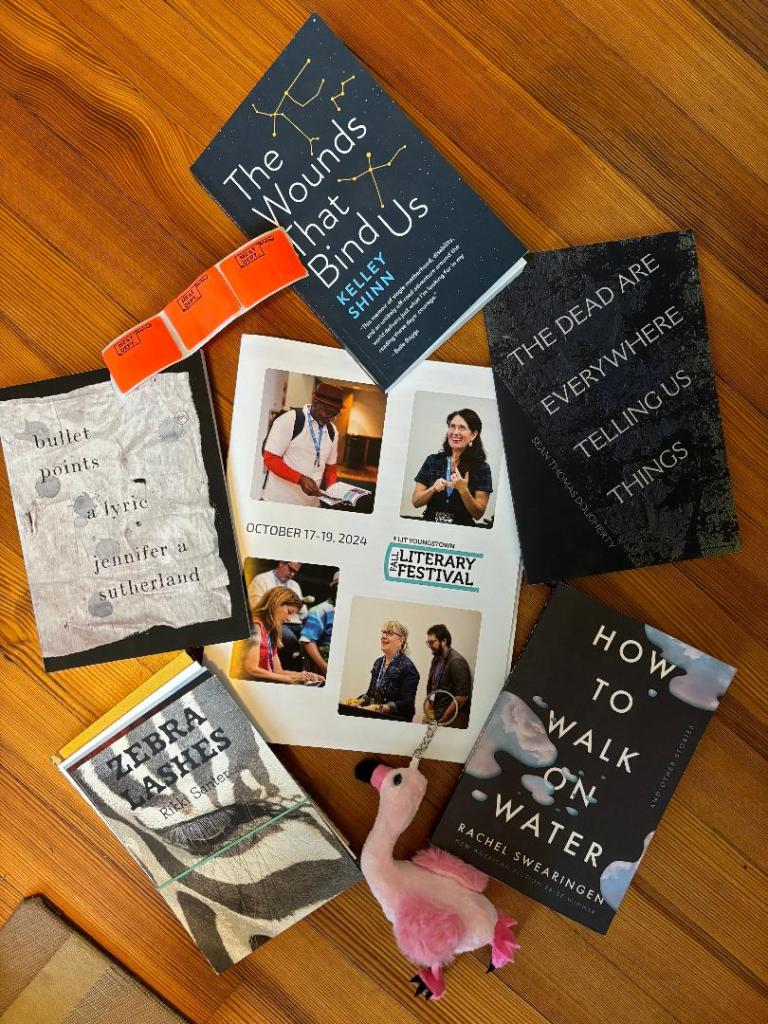
My first day of the festival began with meeting Rachel Swearingen, Chicago-based author of the award-winning story collection How to Walkon Water. After reading through her stunning book, twice, I had a feeling Rachel would have a lot to teach fiction writers, like me, about the craft of writing–and the inspiration behind it. Her morning session, “The More the Merrier: Juggling Multiple Characters in a Single Scene” tackled one of those age-old fiction-writing conundrums: how to make the dinner party (or other large group) scene sing, rather than sink.
Main takeaway: big group scenes can invite drama and suspense (think: Shirley Jackson’s “The Lottery”) but things can go awry when the writer hasn’t anchored the scene. Especially helpful to me was Rachel’s discussion of panning out and zooming in, as if we’re creating a scene on film. Featuring compelling examples from classic and contemporary stories, Rachel illustrated how great writers make scenes active to “write toward change.” For those of us (all of us?) who sometimes struggle to create a propulsive plot, these tips promised to help us give our stories the jhuzh they need!
One thing I love about literary festivals is the opportunity for literary escape. (And not just geographically.) I make it my mission to get outside my usual genres and comfort zones. I’m not joking when I say it’s only been a few years since I learned what ekphrastic writing was. So, taking part in an ekphrastic poetry workshop is far outside my usual lane. Of course, I jumped at the chance, when I learned that award-winning poet (and dancer!) Ama Codjoe was leading a workshop titled “Doorways into Ekphrasis” held at the Butler Institute of American Art, right across the street from our festival headquarters. (Confession time: I usually play hooky for one session of a festival or conference to visit a museum or gallery or other local arts hotspot; this time, I didn’t have to.)
Crowdsourcing time: help me find the name and artist of the piece I wrote about, please! Yes, I stared at a stunning piece of transparent, aqua glass sculpture–two rectangular columns, one larger and standing, one smaller, reclined–and didn’t write down the name of the piece or artist. The three minutes we took to examine the art we chose, without jotting a note–which should be 10 minutes, says Ama–honestly felt like hours. But this works, folks.
It’s fascinating now to look back at the notes I made after my examination and see how I went from describing the artwork’s material–ruined glass, panes shattered, shards–to the artwork’s position and pose–teetering, discarded, toppled–to what the pose might suggest: he has dropped his partner, who does not shatter, small glass tower sheared. Finally, I wrote a little in lines, inspired by the art:
How many the pains of art we
layer and nudge and shimmy?
How shiny this body, this instrument,
until we lay it down, sharded,
but not discarded, dust to dust,
sand to glass to sand.
For my last session of the day, I caught up with a couple writers I follow on social media but had yet to meet in person, so I was thrilled (and got their books I brought from home signed–yes, I’m that kind of literary nerd). The prolific and super generous Sean Thomas Dougherty and Jennifer Sutherland (her debut collection is Bullet Points: A Lyric) are poets who spend some time writing in the “slipstream,” in between literary genres. They and Sarah Carson and Cynthia Maria Hoffman read from their work and talked about what writing in between genres (is it a poem, nonfiction flash, a prose poem?) means for their work and creative outlooks. I was so rapt by the writers’ creative readings that I didn’t take many notes, but I did take this gem down from Sean Thomas: “We push against genre” so forms can (paraphrasing here) dissolve and come together again to address neurodiversity, trauma, and more.
Day 2
I am often reluctant to read my creative work in public. Poetry is meant to be read aloud; not so fiction. However, I thought it might be instructive to read from a blog post I wrote here at Rust Belt Girl and then read the resulting scene that appeared in a story of mine published in Great Lakes Review last year. Like public journaling, I find blogging fertile ground for planting the seeds of story. Pro tip: keep your reading short and everyone will like it.
Thank goodness I read first, because there is no way I’d want to follow memoirist Kelley Shinn or poet Rikki Santer, whose readings were nothing short of incredible. Kelley is the author of the memoir, The Wounds That Bind Us, which I bought at the bookstore directly after her reading from it (I got the last signed copy: conference win!). Rikki read from her collection, Resurrection Letter: Leonora, her Tarot, and Me, which was inspired by the surrealist painter Leonora Carrington–fascinating stuff.
Later that day, Rachel and I joined “in conversation” in a small theater to discuss her stunning debut story collection and its influences: from contemporary art to cult film to a creepy old radio program. I wondered if she went searching for inspiration or if it found her (both). I wondered how her growing up with her family in rural Wisconsin impacted her work (a lot). I am seriously kicking myself for not recording this conversation, but also it would have been a shame to interfere with the intimacy of the conversation. Those of us who write know that it can be a sacred space, and so to share a deep conversation about the inspiration behind the writing work can also feel so meaningful–you hate to break the spell.
Craft takeaways from Rachel: her process involves repeating steps: drafting, reverse outlining, noting of turns in the narrative, noting of where things get sticky or stick out–and here, an earlier Rachel might have smoothed those over, but now she explores them–and an opening up and rooting out of those interesting sticky spots.
In chatting, Rachel and I discovered that we’re both at work on novels set in Nordic/Scandinavian places (must be a Midwest thing). We shared inspiring writers: mine, Dorthe Nors; hers, Jon Fosse.
I was also inspired by Rachel’s fierceness when it comes to trying new genres on for size–in her case, the screenplay.
And the last big takeaway from Rachel, which I jotted during our conversation and aim to never forget (ahem, there’s been a reason it’s taken me three weeks to write this rundown): “Writing is energy management.”
Oh, and there was so much more I missed–next year, I will clone myself–on editing and writing and querying and “unlocking plot.”
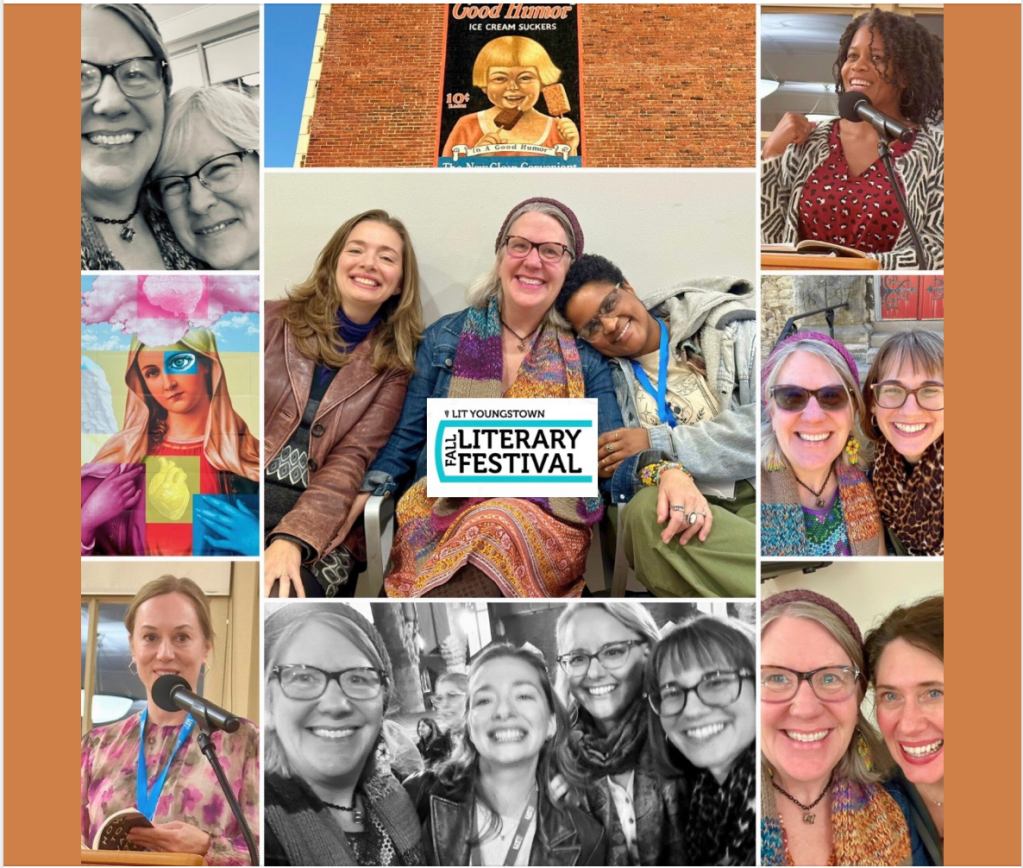
Thank you to Lit Youngstown director Karen Schubert and all who make it happen, year after year. And trust me, you won’t want to miss next year’s festival. Thank you also to Rebe Huntman for letting me use the beautiful photo collage she put together (now, go pre-order her gorgeous memoir).
Tell me in the comments, did you attend the festival? What was the highlight for you? What did I miss? Do you attend writing conferences in general, book fairs? What gets your creative juices flowing?
Hankering for Rust Belt author interviews, book reviews, and more? Check out my categories above. I hope you’ll follow me here, if you don’t already, so you never miss a (quite infrequent) post. Thanks! ~Rebecca
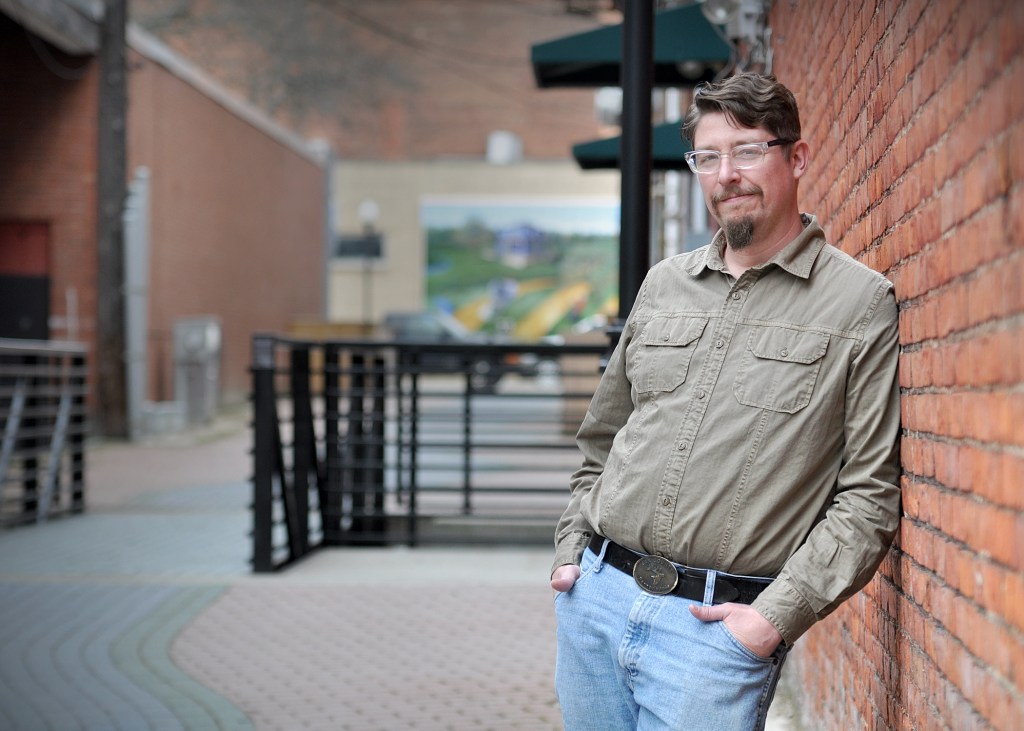
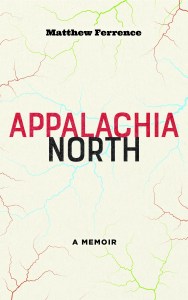
For a blog focused on the idea of place in all the stories we tell, I can’t think of a better person to talk to today. I met author and professor, Matthew Ferrence, at a writers conference in the spring, where I picked up his memoir, Appalachia North — the first book-length treatment of the cultural position of Northern Appalachia.
Matthew and I are from similar places. But more than a book of essays exploring geology and place, Appalachia North is a very personal memoir that allows the reader to journey alongside the writer as he is diagnosed with a brain tumor. From the book jacket:
Appalachia North is an investigation of how the labels of Appalachia have been drawn and written, and also a reckoning with how a body always in recovery can, like a region viewed always as a site of extraction, find new territories of growth.
***
Matthew, how did you come to write this book?
I wrote through a somewhat circuitous path for Appalachia North. The project began with a rejection, for a collection of essays I’d been working on for some time. But that opened up a conversation with Andrew Berzanskis, who was then editor-at-large for WVU Press (he’s now a senior acquisitions editor at the University of Washington Press), and a contract to write a book about northern Appalachia. While we both knew this was to take the form of a memoir, what we didn’t know is that I was going to be banging on the keys and finding some dreadful resistance. I’d recently finished treatments for my brain tumor, and I wrote an essay called “The Foxes of Prince Edward Island,” which was all about that. And I knew that I really wanted to write about recovery and brains and foxes.
So, one day I just decided that I’d do both, and see what happened if I tried to simultaneously write the book I had a contract for, and the book that was gnawing at me, somehow as one book. With that, the writing started to open up, and I began to see the connections between geography and self, between recovered bodies and recovered regions, of how erosion could function as a reframing metaphor of beauty and hope. Then, draft done, I had to tell Andrew. Who, much to his credit, looked at this new book he hadn’t bargained for, saw what it could be, pushed me to revise toward directions I’d neglected, and Appalachia North came into form.
I love the idea of mapping — both of your native geography and (the native geography) of your body. Could you describe the process by which you came to “see” the terrain of your journey enough to write it?
Mapping as a literal act came with the earliest versions of the book, that I would seek out the corners of the official parts of Appalachia north of the Mason Dixon line, to sort of survey and consider the delineations. As I did that, I was surprised by the recurring mutability of the lines that seem so permanent on an actual map. Most of all, I was struck by how the three counties of northeastern Ohio included in the official Appalachian Regional Commission map were late entries, “becoming” Appalachia forty-some years after the ARC put out its first map. So I became preoccupied with thinking about ways that map lines just don’t work. That connected with my figurative sense of self as an Appalachian exiled by birth, simply by the fate of being from Pennsylvania instead of the parts that usually count as Appalachia. This has bugged me for a long time.
For the body, I experienced the way clinical treatment exiles a person from a sense of self, because your body becomes defined by blood test numbers, and MRI scans, and radiation beam coordinates. Your sense of self becomes a cartography of medical rationality, and that makes you feel, well, not yourself really. You get lost the more you’re mapped. Somewhere in that irony, you start to get a sense that you’re tired of letting other people draw the maps.
In your essay, “Conduits,” you discuss those who make geographical maps — generally, those people in power. By writing about place, you do feel you’re map-making? Do you see this as a way to wrest some control over your native place?
For sure. Like, just the other day, a colleague was saying they didn’t really agree with my “claims” that Pennsylvania is part of Appalachia, because they spent a lot of time in “real” Appalachia in the North Carolina mountains. I was sort of stunned, frankly, because even the official maps back me up on this one! But at the same time, this is the tyranny of cartography: that people can draw lines for whatever reason they want. Money. Politics. Taxes. On and on. And there was some weird power exercised here in this very moment, about who gets to actually lay claim to the definition of a region…and in this case, as is often the case, the person making the definitive claim was not from the region and “correcting” someone from the region. We don’t even get to draw maps of our own places.
Yet the terrain — I love that word! — just doesn’t care. Trees grow. Dirt erodes. Mountains emerge. When you’re walking in the woods on many borders so clear on a map, you really can’t tell where the line is, since terrain is fluid. Really, there is no line. So in looking around at places on the ground where the lines are supposed to be, I started thinking a lot about all the lines that people try to place on our lives: healthy and not, for one, or legit Appalachian or not. Maybe because I’m on the “wrong” side of both of those lines, I became determined to refuse the lines altogether.
You challenge the conventions of regional dialect in one of your essays. As in, we’re supposed to say “Appalachia” a certain way — to prove we’re an insider in the region. Why this struggle for Appalachian authenticity, do you think? Why does it remain a region so intent on staying true to its roots? What does it mean for you?
I get the hard and fast claims for rightness in saying App-uh-latch-a, because lots of people have been made to feel small and unimportant for being themselves. Authenticity — including accent — becomes a way to fight for your own sense of worth. So on one hand I totally root for that, and I kind of relish the way Appalachians can smack down the folks who don’t know anything about the region. But at the same time, well, I don’t want to be kicked out of where I’m from. That’s the trouble of the northern part, for sure. We can feel sort of absent. Another one of my pet peeves: all sorts of people (again, who are not from here) keep telling me this is the Midwest. And I’m always thinking, fuck off on your Midwest. They’ll make some claim about jello salads or politeness, but it all comes with this sense of diminishment. Because they usually mean this in the context of explaining either how they’re from more sophisticated spaces not the Midwest, or as a way to deepen their disdain for northern Appalachia by refusing to even acknowledge it as being a place with its own claim to regionality.
I want to be clear, I don’t mean this to disparage the Midwest, but very much to defend how places like it, and like Appalachia, have to stick up for themselves as legitimate locales, as distinctive and meaningful, because everyone basically says over and over, fly-over country. So, on pronunciations, I love the variance of Appalachia, which has a whole spectrum of pronunciations, which is another way of saying it’s a place of vibrancy and nuance. I’m not going to give away my corner of that, so I’ve become comfortable using both the soft and hard vowels, but will still totally make fun of someone from outside the region who pronounces it wrong. The nice thing is, I can make fun of them no matter what they say. Cruel, I suppose.
In your memoir’s preface, you say, “So many writers…seek to make a declaration: this is what a place is.” You, like a good essayist, seem to be happier delving into the ambiguities of place. You also seek to reclaim your native place for the next generation — your own kids among them. How do you do this without defining that place?
Yes! This is what we love, I think, ambiguity and gray edges and journeys. I say this a bit cheekily: essayists love to squirm away from anything declarative, relish the provisional, even as we love to make big claims…which we then overturn and twist and turn inside out. On the matter of place, the big thing to me is that it matters, but when a place seems to carry rigid definitions — Trump Country, Red States, Fly-Over, all that — such restrictions wind up wrecking a place. That’s when we become totemic monoliths or, really, tools. So, for me and for my kids, I long for a vibrant connection to terrain and geography, with a sense that what a place means can also evolve and contradict and carry the fluidity the essayist loves. I want my kids to love a place, but I want them to be able to live in it with a sense of reciprocal love. I’m frustrated and angry, these days, by how places redouble their restrictive sense of who counts, who looks or loves or behaves the “right” way. That’s the wreckage of definition, as it crushes back to stereotype and turfiness and xenophobia and trope. Ambiguity, I think, invites inclusion and expansiveness. Because we can’t say this instead of that.
The language of geography and of the body — especially around medicine — can get really technical; yet, you do a lovely job of softening both of these languages. Instead of unapproachable moments of medical jargon, you note the moments of “mercy” between you and our doctors. You call it: “The precise language of medicine facing off against my growing recognition of life.” Yet, as a writer, language is your tool. Did it ever feel useless? Did you ever think, I don’t know how to write about what’s happening to my body in my language?
The veer to the metaphorical helps, for me at least. The peripheral look, the askance view, the detailed description of some concrete object that suddenly emerges with a new dimension of meaning, well for me, that’s how language becomes the only way to make sense of the ineffable. The biggest example is my recognition of the geology of my home, that it’s a dissected plateau instead of a worn out mountain. My Dad filled me in on that, part way through the writing, and it was a literal geological process that changed everything for me, metaphorically. Suddenly, I could see the post-surgical me in a different way, not as something grand that is now worn out and wrecked, but something shaping into a new form that can carry its own beauty. The metaphor was everything. On the flip side, cliché strikes me as the enemy of health writing, because it’s almost all you get from people when you’re ill. Directness felt better, on the page, that this happened and that happened. Combining the direct with the cascading metaphors helped me use language very much as the tool for narrative recovery.
In your essay, “The Molt,” you compare your emotional state, traversing your medical condition, to molting, as an animal does. Through your sickness you waited for “the hardening,” for a new shell, as it were, to help you bear up. Yet, the best writing, I believe, comes from exploring those times before the hardening, don’t you think?
I agree. Totally! I guess the hardening is the lived desire, that you just want things to stop being difficult, to end, maybe to stop feeling, at least for a little bit. Because things are so difficult. But, no, the hardening is a false desire, because actually developing it would be catastrophic. Maybe the essayist’s stance is to write about the moments when hardening fails and, more so, to write as an act of resisting hardening. Writing softens us up, so we can actually find the substance.
What’s your favorite thing to teach students in your college courses — about nonfiction writing and about Appalachian Studies?
About Appalachia, it’s pretty much always a combo of you’re in it and you are it. Up here in the northwest corner of Pennsylvania, there aren’t a lot of people who actively think about themselves as Appalachians, nor who have had any reason to think deeply about the region. Yet close to half of our students are from places that are literally in Appalachia. I love the immediate shake-up that provides, which I shared. First you think, that can’t be right. Then something like, but I’m not… And then, …but wait I am. So what we all think about Appalachia is…not accurate!
That moment of recognition and depth is what I love most about nonfiction itself, that we find new avenues constantly, so long as we cultivate a practice of curiosity and attention.
I love helping students unlock the potential in two disparate personal narratives, or figuring out how oblique research can deepen a complicated narrative line. Most of all, I love getting to spend time with a group of students all committed to the deep reflection of the world we walk around in. And language. Maybe this is really the best part: helping students understand the power of the lyric sentence, how the gestures of poetry and art, applied to real experience, yield the best nonfiction.
In thinking about your take on place, I learned that you’re taking a run at the PA House in 2020. In what ways did your writing get you to this decision?
Without a doubt, part of the motivation stems from writing books that have allowed me to dive deeply into how my home turf has been used and exploited by politics. That’s part of the framing of my candidacy, in fact, that there are stories that we tell ourselves over and over again that never turn out well for us. So let’s write new ones. The incumbent, as well, has not been, shall we say, a friend of the arts during his decade-and-a-half in office. My rallying cry, I suppose, came from his remarks suggesting that the state shouldn’t give student aid to people majoring in “poetry or other pre-Walmart majors.” Well now. Hmmm. That didn’t sit with me. Even if we want to stay in the spheres of practicality and economic policy, the arts sector is huge, and can have a tremendously positive impact on rural areas like ours. And at the same time, I long for a politics that doesn’t limit its vision to the spreadsheet. Politics is about people, in fact is the people. We talk about vision in politics, but we rarely see candidates who want to run on creativity and possibility.
I’d say the brain tumor factors in here, too: for one thing, I saw first hand what it means to get sick and suddenly see how expensive staying alive is. I was lucky, because of my insurance. Many other people would be bankrupt now, if they’d faced what I did. That’s not right. Then, existentially, I’m tired of living in a world attenuated by the small-minded nightmares of regressive politicians. Part of the after-effect of having a brain tumor is the relative ease at which I find myself saying, fuck it, and doing the thing that matters to me that’s the sort of thing we all have a tendency to be afraid to undertake. Running for office is that. I refuse to leave Appalachia to the troglodytes. The national narrative tells us that’s who we all are, and we most definitely are not. I want to stand up and write it differently.
What’s next for your writing? What should readers look out for?
I have two projects I’m wrestling with right now, each in very early stages. One is fiction, which is taking shape as either a novel or a collection of linked stories. Appalachian. Eco-futurist. Focusing on the possible presence of magical creatures in nighttimes threatened by a radical growth in light pollution. The other is an essay project, more or less the writing of a Catholic Mass, to address the ways I am simultaneously deeply lapsed from the Church yet unable to shake the feeling of mystical deep spirituality I find within it. In both projects, I’m trying to find a way to toggle toward radical beauty, to write of dark things but with gratitude and joy. I’m thinking of Ross Gay’s work in both poetry and nonfiction here, and how moving I find his devotion to that serious artistic stance. More and more, I find myself wanting to write toward hope and goodness, particularly as the world churning around us seems to only call us to critique, which is vital, but also wearying. Art helps us imagine new futures, and I long to imagine my way toward hopeful ones even when most of what we see suggests dystopia as our fate. Maybe we can write a better future into being.
***
Matthew Ferrence lives and writes at the confluence of Appalachia. He is the author of Appalachia North: a memoir and All-American Redneck, a well as numerous essays published in North American literary journals. He teaches creative writing at Allegheny College and in 2020 is vying for a seat in the Pennsylvania House of Representatives, representing Crawford and Erie Counties.

 Rust Belt Girl