What to do with sacred art when churches close?

-ccfcc17ba2079104
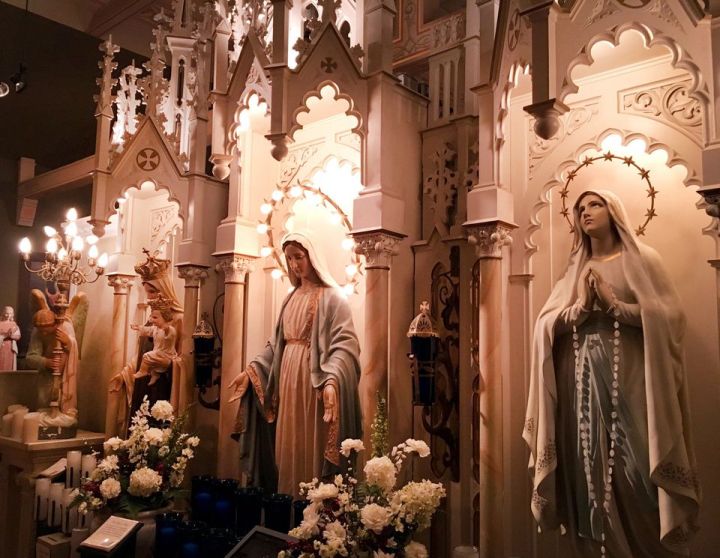
Image from the Museum of Divine Statues in Lakewood, Ohio, courtesy of The Plain Dealer

If the Rust Belt is a bastion of anything, that thing might be Catholicism. Or, maybe not–given that about 40 Catholic churches were shuttered in Cleveland, Ohio, alone over the last few decades.

As the city’s population waned and its churches closed, some of the sacred art was shipped out to existing and new churches; some wasn’t.

Thanks to a good friend and follower of Rust Belt Girl for putting me onto the story of Lou McClung. A makeup artist with his own cosmetics line housed in a former Catholic school, McClung bought the closed St. Hedwig Church (named for a beloved Polish queen) in the Cleveland suburb of Lakewood, Ohio, in 2011, and began restoring its statues. In an article in a 2017 issue of Catholic Digest, McClung said:

I do restoration artwork across the country and I thought it was important to remember where all of these statues came up. The art represents the immigrants and all their hard work and sacrifices that made these [now closed] parishes possible.

The artist lovingly restores the statues and researches and shares the provenance of each piece in the Museum of Divine Statues he founded. Lately, McClung’s museum has been receiving religious artwork not only from the Cleveland area but from all over the country.

Other Rust Belt locales preserving shuttered churches and their art include the Buffalo [New York] Religious Arts Center and the Jubilee Museum in Columbus, Ohio.

McClung’s restoration work for his Museum of Divine Statues is beautiful. Great pics can be found at these sites:

http://www.cleveland.com/style/index.ssf/2017/02/lou_mcclung_restores_curates_m.html#incart_river_home

https://patch.com/ohio/lakewood-oh/new-life-for-shuttered-catholic-church-in-lakewood


Me talk pretty one day*? Probably not.

20180114_165850
Mentor-on-the-Lake (pronounced Menner-on-the-Lake), Ohio. Photo credit: Bill Moon. Thanks, Dad!)

“You sound funny,” my son said.

“I know. I’m from Ohio.”

Too many of my conversations with my kids begin this way. But it’s true:

I sound funny here in Maryland. I am a linguistic fish out of water. My Maryland-born kids and I may speak the same language, but regionalisms and accent say a lot.

This time, my recorded voice was one half of a mock interview conducted by my son. I played the author of a book he’d read for a second grade school project. He sounded normal; I sounded every bit of my Cleveland-area upbringing.

Of course, growing up, I thought I sounded normal. Because Clevelanders “do naht hayev ayaccents.” Whether you cop to having an accent or not, they can raise spirited debate; they do in my house, where my Maryland-native husband’s “league” somehow rhymes with “pig.” Huh?

Accents seem to be having something of a heyday. Last month, a Bawlmerese–that’s Baltimore-ese–video went viral; in it, innocent words like “water,” “Tuesday,” and “ambulance” are murdered to become “wooder,” “Toosdee,” and “amblance.”

Back in my native land, Cleveland’s Belt Publishing has just published How to Speak Midwestern by Edward McClelland, who says:

Accents are part of our regional identity. And there is a feeling that these distinct accents aren’t as distinctive as they used to be.

In addition to regionalisms (like “pop” instead of “soda”), accents are a way to represent one’s native place. I do this with not a bit of shame! My “plaza”–hold your nose and you’ll get the a-sound right–is my son’s “plahza”; my “pajamas” is his “pajahmas.”

In this article, McClelland explains that the Cleveland accent is the Inland North accent, “marked by a raised ‘a’ that makes ‘cat’ sound like ‘cayat,’ a fronted ‘o’ that makes ‘box’ sound like ‘bahx.'”

What does all this mean for us writers?

Accent can be portrayed in our writing, and it can work well if done with a deft hand. In my current WIP, I’m writing characters who have an Italian accent, which often drops the “h” sound and rolls or taps the “r” sound–there’s a real musicality there. Not easy to write, but worth it to try.

Veering into dialect can get a little dicey. This Guardian article puts it plainly:

“Do ‘dialect-lite’ or be damned.”

Whether blogging or engaging in other creative writing, accent can provide interesting subtext.

Does your accent shine through? What do you say funny? I’ll start, below.

Comment here or join this Rust Belt Girl on FB.

*Title borrowed from the amazingly funny David Sedaris’s book of essays: Me Talk Pretty One Day


You’re the tops! (A shameless Top 3)

tophat

Who doesn’t love a “Top”  list?

Top 3. Top 10. Top 100. We attach ourselves to the superlative and feel tops–if only for a moment. And that almighty numeral: even an English major gets to feel like a statistician.

So, without further ado…

A Rust Belt Girl Top 3 (according to you)

with related recommended viewing for the new year:

Number 3: A blog is born, my first-ever post, covered my rationale for starting this blog. (Among my reasons: an online search for “female and Rust Belt” turned up rust-colored ladies’ belts for sale by JCPenny.) For those of you who made it to post two, thank you!

Number 2: Life in Lima and more–from Intensity Without Mastery’s Michelle Cole (along with the second installment) featured a collaboration with the photographer and blogger with an honest eye for life and art in the Rust Belt. (Bonus points for pronouncing “Lima” correctly!) Look for more collaborations in the blogosphere in 2018.

(And, drum roll, please…)

Number 1: The big kahuna, the winner of the most views goes to my Interview with award-winning Akron, Ohio, author and journalist David Giffels, who answered all of my pressing questions about his books–including Furnishing Eternity coming out January 2–along with his teaching, his hometown, and even Lebron. Be on the lookout for another conversation right here with David on his latest memoir early in the new year.

Until then, may your days be merry and bright and your New Year’s celebrations be tops…

Happy 2018!

~ Rebecca


ALL THE WAY HOME and the back- and heart-breaking art of the DIY

2205542

I was sixteen before I knew a dad who didn’t drive a pickup truck.

Of course, this speaks as much to my limited teenage powers of observation as it does to my rural Ohio upbringing. Still…

My dad’s life was–and is–in his truck. A dad without a truck? How else would one: haul his 84 Lumber finds to turn the attic into proper living quarters; bring home fresh-split logs–and the log-splitter–to stoke the wood stove in winter; tow a rotted shell of a boat to be restored from the ribs up–in the workshop designed and built yourself?

In my eyes, my dad was the original DIY-er, before that catchy name was put to skillful industriousness, craftsmanship, and thrift.

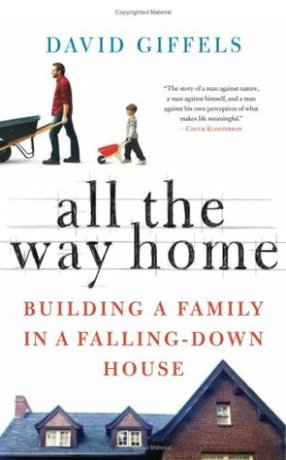
As such…reading award-winning Akron, Ohio, author David Giffels’ memoir All the Way Home: Building a Family in a Falling-Down House felt like going home. Cursory jacket copy summary:

With their infant son in tow, David Giffels and his wife comb the environs of Akron, Ohio, in search of just the right house for their burgeoning family…until they spot a beautiful, decaying Gilded Age mansion. A former rubber industry executive’s domain, the once grand residence lacks functional plumbing and electricity, leaks rain like a cartoon shack, and is infested with all manner of wildlife. But for a young man at a coming-of-age crossroads–“suspended between a perpetual youth and an inevitable adulthood”–the challenge is exactly the allure.

The tried-and-true tropes of female coming-of-age couldn’t be more different than those Giffels explores in this man vs. house tale. But in the reading of this heartfelt and oftentimes harrowing (as in Giffels hanging upside down out a second-story window to paint exterior trim) memoir, I completely understood his feeling compelled–even obsessed–to DIY.

Read more

Throwback Thursday: Why half the world should read IN ZANESVILLE

index

Even if you’ve never been there, you’ve heard enough to know the American Midwest isn’t sexy. I’m hardly the first Midwest native to admit to being from a Regular ‘Ol American Place.

The Midwest is “flyover country”–its detractors call it–between the glittering East Coast and shining West Coast. Yep, no matter how many Northeast Ohio boosters try, most of the U.S. will never be convinced of the beauty that is the “North Coast.” And that’s okay.

But…the insult that really stings: “Ohio is flat.”

It stings–not just because it’s a blanket generalization and untrue of my rolling Ohio hometown. (In fact, it stings more than memories of the same thing being said about my 6th grade chest–and that stung.)

It stings because flat is sameness. And don’t we (even States–if States had egos) want to feel special, unique, memorable: the opposite of same, boring, forgettable?

I am more than a home state booster; I’m a home state narcissist. You see, I picked up Jo Ann Beard’s novel, IN ZANESVILLE (pub. 2011), thinking it was set in Zanesville, Ohio.

It’s not. It’s set in Zanesville, Illinois, which, I sheepishly admit, is pretty much the same. In fact, it’s the sameness, the universality of the experiences of the novel’s fourteen-year-old narrator, that makes this novel so special–and yet relate-able to any reader who is or was ever a girl. And that’s about half the world. Read more

BLOG PARTY!

Traveling Shana–hello, Ohio!–is hosting a Blog Party this weekend (close enough), and we–this Rust Belt Girl and my lovely followers–are invited. Let’s see what new blogs we discover…

Traveling Shana's avatar Traveling Shana

It’s the Meet and Greet weekend everyone!! Strap on your party shoes and join the fun! Ok so here are the rules: Leave a link to your page or post in the comments of this post. Reblog this post. It helps you, it helps me, it helps everyone! Edit your reblog post and […]

via Meet and Greet: 11/9/17 — Dream Big, Dream Often

View original post

Re-sharing Rust Belt Arcana; and the natural history of my native place

Tarot and Natural History in the Exurban Wilds By Matt Stansberry with Illustrations by David Wilson People have used Tarot cards for over 500 years to reveal some hidden information The post New Book September 2018: Rust Belt Arcana appeared first on Belt Magazine | Dispatches From The Rust Belt.

via New Book September 2018: Rust Belt Arcana — Belt Magazine | Dispatches From The Rust Belt

Exploring this natural history helps us to find our place in the landscape, to know our home and ourselves.

Rust Belt Girl here. News of this new book got me to thinking… How much of my place’s natural history do I know? Read more

Part 2 of “‘Ruin Porn’ to Rust Belt beauty: her place in resurrecting the American Dream in the Belt”

architecture-1639990_640
Another pretty awesome photograph by Michael Gaida via Pixabay

The term “American Dream” has been so overused as to lose its meaning. Researching for my novel-in-progress, a story set just before WWII, I found Made In America: Self-Styled Success from Horatio Alger to Oprah Winfrey, in which author Jeffrey Louis Decker gives some background on the oft-used phrase:

The term [American Dream] was not put into print until 1931, when middle-brow historian James Truslow Adams coined it and used it throughout the pages of a book titled The Epic of America. The American Dream is to be understood as an ethical doctrine that is symptomatic of a crisis in national identity during the thirties. The newly invented dream calls out for a supplement to the outmoded narrative uplift, which had lost its moral capacity to guide the nation during the Depression.

So, out of extreme poverty and ruin, the collective American Dream was borne.

Read more