More from The Rabbit Hutch: Reflecting on a conversation with National Book Award winner Tess Gunty

Tess Gunty’s 2022 debut novel, The Rabbit Hutch, won that year’s National Book Award for Fiction (and other awards) and also won hearts—especially among Rust Belt readers.

Pittsburgh-based author and art writer Emma Riva wrote a wonderful essay about The Rabbit Hutch published here at Rust Belt Girl I encourage you to read next—if you haven’t already.

I was late to the novel, myself, and was struck by how Catholic it felt, despite not being marketed that way (for obvious reasons).

I was thrilled to “meet” Gunty yesterday evening through the Jesuit Media Lab‘s conversation over Zoom with the author. A sizable group of us avid readers tuned in to listen to Gunty talk about being raised Catholic and writing about The Rabbit Hutch main character’s deep interest in female mystics and mysticism, about researching Hildegard von Bingen and discovering her “extraordinary theatre of mental activity” and agency, about technology and art and how Mary Shelley’s Frankenstein is a “perfect allegory for AI,” and much more!

“I wanted to make art out of my characters’ lives, including their digital lives,” the author said about her novel that still feels very much of this technological moment. (Gunty herself doesn’t partake in social media and, clearly, it benefits her writing. “You need to keep the tool of your mind as sharp and clean as possible,” she said.)
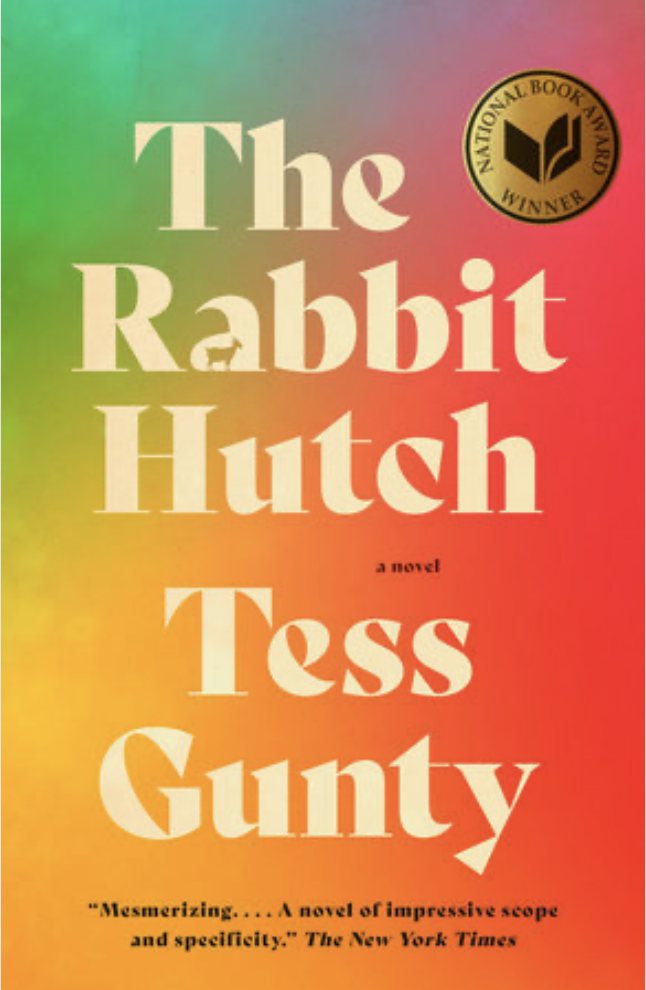
Buy your own copy here

As for the novel’s fictional setting of Vacca Vale, Indiana, Gunty said that the place was the only thing she knew for certain she wanted to portray, going in, that the setting started out being the MC—until she was about three-quarters of the way through writing the first draft.

She said she wanted to capture the “purgatorial” nature of post-industrial cities like Youngstown, Ohio, Flint, Michigan, and Gary, Indiana. (No shade intended, I don’t think!) How to capture the sensation of such places, like her hometown of South Bend, on which the novel’s setting is based? In the books she read, Gunty said, “I never encountered any place like my hometown.” And yet politicians and movies portray a flat stereotype of such post-industrial Midwestern places.

Gunty’s description sparked pride in me, last night. She described our Midwestern and Rust Belt cities as places of mystery, magnitude, and complexity. When you don’t see a place like your home reflected in literature, “you feel like it doesn’t matter,” she said. For Gunty, writing this novel, then, was an attempt to insist upon the “dynamism and multi-dimensionality” of her hometown—and others like it.

Like mine. Maybe like yours, too.

I encourage you to check out JML for their book talks and other events.

Have you read The Rabbit Hutch? What did you think? Did you read Emma Riva’s essay about it?

Like this post? Comment below or on my FB page. And please share with your friends and social network. 

Are you a Rust Belt writer interested in seeing if your own post, or author interview, or book review might be right for Rust Belt Girl? Hit me up through this site’s contact function.

Check out my categories above for more guest posts, interviews, book reviews, literary musings, and writing advice we can all use. Never miss a post when you follow Rust Belt Girl. Thanks! ~Rebecca

Enter your email address to subscribe to this blog and receive notifications of new posts by email.


Enlarging “Rust Belt lit,” and Megan Giddings’ THE WOMEN COULD FLY

When I say “Rust Belt literature,” what comes to mind? Gritty, realistic narratives, no doubt. Hard-bitten characters. Upper Midwest settings redolent of industry and machines. Or settings found in a time of post-industry, a time of automation over humanity–of darkness. Coal or steel may factor in, or maybe it’s a landscape made barren by the extraction of one and the decline of the other. More recently, themes appear to be borne from loss after loss: environmental destruction, job loss, poverty, the opioid crisis … 

When I said “Rust Belt literature,” did fantasy or speculative fiction come to mind? How about air, water, light? How about women? How about women flying?

You won’t find Megan Giddings’ novels tagged as Rust Belt lit at your local library, but you will here. For Giddings chose to set her latest, feminist dystopian novel, The Women Could Fly (HarperCollins, 2022), a story in which witches are real, not in a fantastical place but in Michigan and the Great Lakes. And why not?

The novel’s overarching plot: main character Jo is “offered the opportunity to honor a request from her mother’s will” by traveling to an island off Michigan’s Upper Peninsula, where she will explore the “powers women have to transgress and transcend” the limits women face in this larger world.

And, of course, there will be trouble, a lot of trouble. But back to the setting.

“She [Jo’s mother] had loved the lakes. Michigan was for luxury. Erie was for mourning. Ontario was for Canadians. Huron was for daydreaming. And Superior was for mystery. The lake that kept its secrets.”

Why not set a story about the secrets women keep for self-preservation on an imaginary island off an imaginary shore? Why Michigan’s UP? Verity, I presume. In this novel, the speculative elements rub up against the very real setting, and say to this reader: don’t get too comfortable. The nightmare scenario you might think can’t happen in real life, absolutely can–and it can happen right in your backyard. For, what weight does social commentary have if it’s set in a fantastical place? Much less than if that commentary is grounded in a place we think we know so well.

This is not your typical witch story (if there is such a thing) and my regular followers know this is outside my regular reading wheelhouse. From the dust jacket copy, so you get a sense (sans spoilers) of this dystopian time not altogether different from our own, here’s some backstory on Jo and her lost mother:

“Josephine Thomas has heard every conceivable theory about her mother’s disappearance. That she’d been kidnapped; murdered; had taken on a new identity; started a new family. Most troubling of all was the charge that her mother had been a witch, for in a world where witches are real, peculiar behavior can raise suspicions and result in a woman–especially a Black woman–being put on trial for witchcraft.”

How do we writers choose where to set our stories? Do we write of the places of our dreams? Google Earth and the ease of internet searching of local customs, accents, etc., mean a writer can set her story anywhere. (So you would think more writers would eschew the default American settings of NYC and Southern California–wonderful places both, but perhaps overexposed.) What makes us craft a setting after our home? I’ll let Giddings’ gorgeous riff on Michigan answer that question:

“One of the pleasures of driving through Michigan is the trees. Farther and farther north, they shift, become taller and thinner, go from full Christmas trees to pipe cleaner versions. The sky changes too. The clouds come lower, the blue always feels a little brighter, the towns spread farther apart, and there are more dips, hills to make up the distance. It wakes up something animal in me …”

In this novel, Giddings walks a literary tightrope between realism and speculative fiction, grief and humor, old prejudices and new possibilities, pragmatism and magic–and all in concise and biting prose. Enjoy the ride. You don’t even need to know how to fly!

How would you define Rust Belt lit? What are you reading and writing this week? Let me know in the comments.

Want more Rust Belt writing, book reviews, author interviews, writing advice, essays, guest posts, and more? Follow me here. Thanks! 

And a Happy Thanksgiving to all who celebrate!

*free header image courtesy of Pexels

Enter your email address to subscribe to this blog and receive notifications of new posts by email.