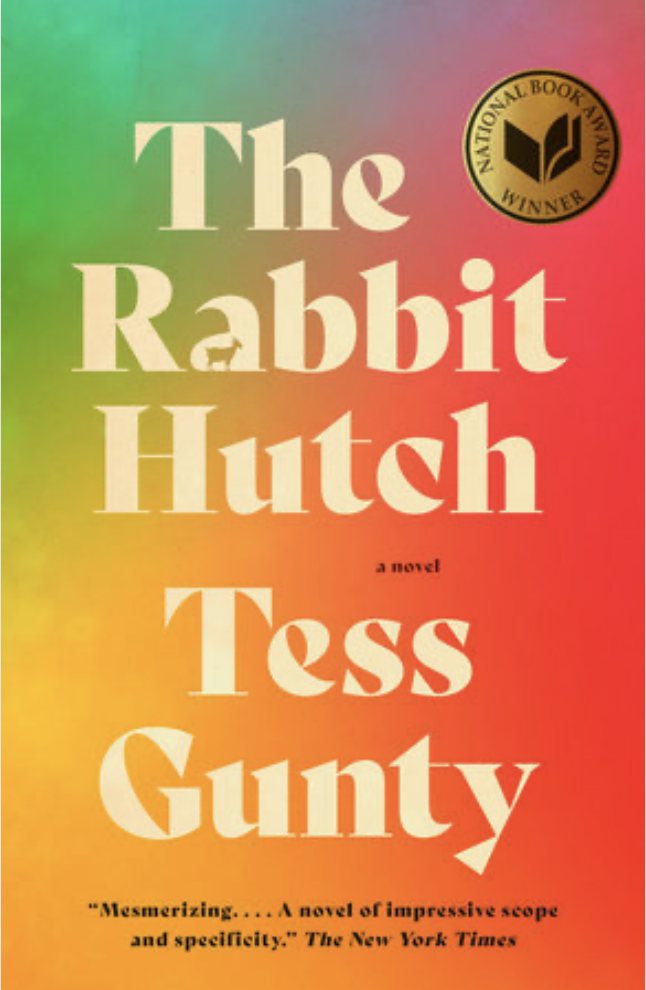
Tess Gunty’s 2022 debut novel, The Rabbit Hutch, won that year’s National Book Award for Fiction (and other awards) and also won hearts—especially among Rust Belt readers.
Pittsburgh-based author and art writer Emma Riva wrote a wonderful essay about The Rabbit Hutch published here at Rust Belt Girl I encourage you to read next—if you haven’t already.
I was late to the novel, myself, and was struck by how Catholic it felt, despite not being marketed that way (for obvious reasons).
I was thrilled to “meet” Gunty yesterday evening through the Jesuit Media Lab‘s conversation over Zoom with the author. A sizable group of us avid readers tuned in to listen to Gunty talk about being raised Catholic and writing about The Rabbit Hutch main character’s deep interest in female mystics and mysticism, about researching Hildegard von Bingen and discovering her “extraordinary theatre of mental activity” and agency, about technology and art and how Mary Shelley’s Frankenstein is a “perfect allegory for AI,” and much more!
“I wanted to make art out of my characters’ lives, including their digital lives,” the author said about her novel that still feels very much of this technological moment. (Gunty herself doesn’t partake in social media and, clearly, it benefits her writing. “You need to keep the tool of your mind as sharp and clean as possible,” she said.)
As for the novel’s fictional setting of Vacca Vale, Indiana, Gunty said that the place was the only thing she knew for certain she wanted to portray, going in, that the setting started out being the MC—until she was about three-quarters of the way through writing the first draft.
She said she wanted to capture the “purgatorial” nature of post-industrial cities like Youngstown, Ohio, Flint, Michigan, and Gary, Indiana. (No shade intended, I don’t think!) How to capture the sensation of such places, like her hometown of South Bend, on which the novel’s setting is based? In the books she read, Gunty said, “I never encountered any place like my hometown.” And yet politicians and movies portray a flat stereotype of such post-industrial Midwestern places.
Gunty’s description sparked pride in me, last night. She described our Midwestern and Rust Belt cities as places of mystery, magnitude, and complexity. When you don’t see a place like your home reflected in literature, “you feel like it doesn’t matter,” she said. For Gunty, writing this novel, then, was an attempt to insist upon the “dynamism and multi-dimensionality” of her hometown—and others like it.
Like mine. Maybe like yours, too.
I encourage you to check out JML for their book talks and other events.
Have you read The Rabbit Hutch? What did you think? Did you read Emma Riva’s essay about it?
Like this post? Comment below or on my FB page. And please share with your friends and social network.
Are you a Rust Belt writer interested in seeing if your own post, or author interview, or book review might be right for Rust Belt Girl? Hit me up through this site’s contact function.
Check out my categories above for more guest posts, interviews, book reviews, literary musings, and writing advice we can all use. Never miss a post when you follow Rust Belt Girl. Thanks! ~Rebecca


I have not read “The Rabbit Hutch” but I have driven by Gary, Indiana. I think “purgatory” is a fairly apt description. (I want to disclaimer that by adding “no shade intended,” but how can it be interpreted any other way? Sorry, Gary. Maybe you’re actually a lovely town!)
Also, the cover looks like the night sky these past two evenings.
LikeLiked by 1 person
I so wish I could see the Northern Lights in person! Culver’s and the Northern Lights–you guys have everything!
I’ve never been to Gary or to Flint, but Youngstown happens to be one of my favorite cities. Good food (Italian, Polish, Hungarian, etc.), good culture (catch the Butler Museum of American art, if you ever go), and amazing people. But I’m definitely biased. I do think, from the standpoint of an author, writing about such places is a whole lot more interesting that writing about cookie-cutter-type places–or even places that have been written about so much as to become cliched. I’m always fascinated by Cormac McCarthy’s answer to why he decided to write about the American Southwest (when he was from Tennessee) and his answer was basically, because no really good writers have written about it yet–which isn’t really true but he knew he could do something interesting with that setting.
LikeLiked by 1 person
I never knew that about McCarthy but I really like his work, so I can respect that decision!
And I agree with you completely. I’d rather write about someplace gritty than Mayberry.
LikeLiked by 1 person
I haven’t read The Rabbit Hutch but I do believe there’s a certain elegance to describing a city using multidimensional tones and going beyond stereotypes. A lot of writers fall prey to stereotyping a place and the people in it. You find that in both Western and Eastern literature imo.
LikeLiked by 1 person