A review of Avoiding the Rapture by Karen J. Weyant

By Marjorie Maddox

In Karen J. Weyant’s first full-length book of poetry, Avoiding the Rapture, there is no avoiding the evocative and sometimes contradictory landscape and convictions of the Rust Belt. In a town defined by its bars and churches, river and railroad tracks, closed factories and forbidden swimming holes, Weyant gives us both the desire to leave and the need to cleave. No matter our background, she makes this space ours—ownership and rebellion a familiar if not always pleasant home.

We begin with belief so strong it takes hold of a town—“Every girl I knew got religion/at the same time they caught Disco Fever.” Salvation is a type of escape to be embraced or rejected. “Facing uncertain futures,” the poet explains, “we waited to be whisked away in [both kinds of] sparkle.” And yet by “avoiding the rapture,” she counters, “[w]hen everything disappears, everything you see will be yours,” a mixed motivator for a place that when you aren’t reveling in it, you’re scheming a quick departure.

Within this back-and-forth identity quest, the narrator looks for signs and visions in roadkill rising from the dead, in Jesus in dryer steam at the local laundromat, in “one of the Horsemen/in the hind leg of a Holstein cow,” and in “saints/in real estate signs buckling under buckshot.” There are also “man-made miracles” where the narrator­­ “dump[s] grape juice into Gallagher Run,/hoping the muddy swirl would turn into wine,/. . . [or] pretend[s] the stale angel food cake. . . was really manna.” 

Woven throughout the book is a sequence that often begins “The Girl Who…” and perceptively defines identity. “The Girl Who Parted Mill Creek with Her Toes” offers nature as one way to “ignore the grown-up talk/of factory closings, lost jobs, and foreclosures.” This path also allows for leaving the church while retaining its lore and, at times, alure. For example, the post-industrial mass exodus of families is linked to the narrator’s Exodus-like parting of the creek with her toes. Likewise, in another poem, an abandoned and deteriorating church evolves into a new type of sanctuary.

Throughout, insects swarm, dazzle, or sting. There is “the drone/of factories in a metallic round of cricket song” and “june bugs hurling against back doors.” Not unlike the town’s inhabitants, in “To the Girl Who Talked to Summer Insects” “[s]ome insects were silent, others angry or lost.” Elsewhere, mayflies—“ghost stories [come] alive”—become reminders “we lived among the dead.” The plague-like buzzing of blackflies usher in arguments over money and heat. “June/ [is] heavy with horseflies. . . .cicada shells. . .cracked under our feet.” In dreams, butterflies get “caught in backyard grills”; in real life yellowjackets die in/escape from a flaming nest; the narrator rescues grasshoppers from a ball of ice. Eventually, end-of-the-world prophesies drown out miracles.  

In this way, even the word “miracles” begins to lose its mystery. In family life, the word becomes synonymous with describing impossible situations: a truck that “would need a miracle to get through the summer,” a sister who “would need a miracle to get through high school,” and a father who “would need/a miracle to get a job at his age.” 

As tensions increase in the run-down town, so does the narrator’s desire for flight. “[W]e planned our new world. . . . we knew we had to leave,” she recalls. The coming-of-age departures are small and large: heels, makeup, drinking, boyfriends with the nicknames of beers, the recognition that, on many levels, “every ripple has danger” and that [r]eal girls learn to toughen/the soles of their feet. . . .Accept . . .fate.” 

That doesn’t mean, however, that there aren’t moments of daring and flight. Through sheer determination, the narrator “[spins] in the August heat until [she] could fly.” Bravely, she catches bees or reaches out to touch a two-headed calf. We watch as her father helps her bury a dead bird. Always drawn to water, she listens to rivers talk and “sw[ims] late at night/in the gravel pit pond.” She counsels, “Follow the fireflies.”  

In these ways and others, Avoiding the Rapture whoops and hollers with independence and survival. It is a stirring, well-crafted ode to place, where “girls still ride the beds of pickup trucks . . . .[and] learn how to catch maple seeds/in their teeth, and how to spit them out.” It is a depiction of individuals who, even if they don’t learn to fly, learn to balance while wind “comb[s] through their long hair.”

Here’s to the young women of the Rust Belt, fiercely and perceptively portrayed in Karen J. Weyant’s new collection, Avoiding the Rapture.  
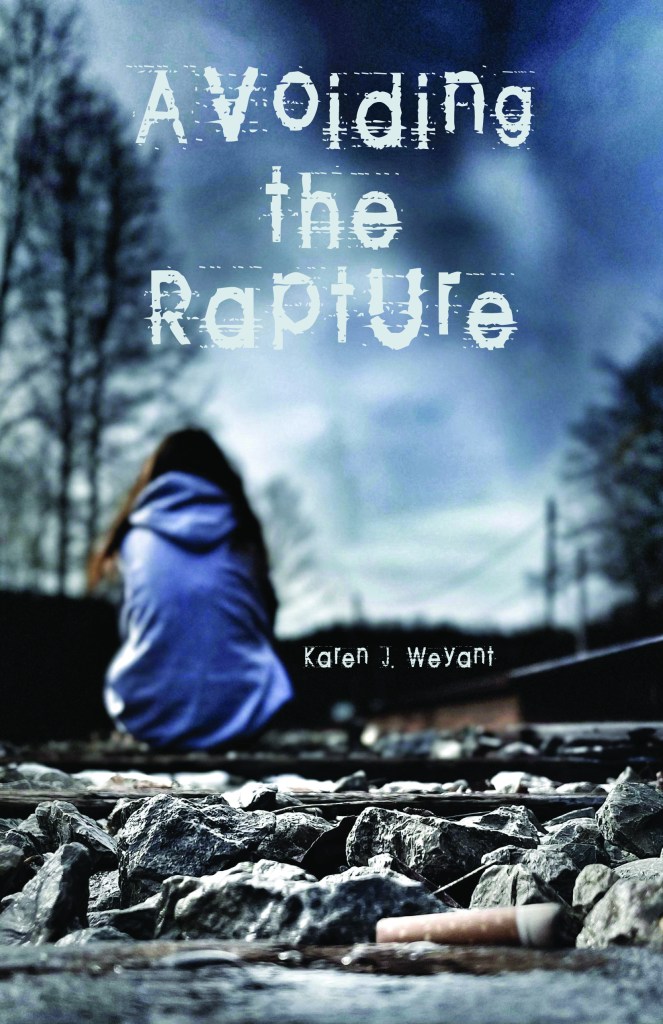

Avoiding the Rapture

By Karen J. Weyant

Riot in Your Throat $17


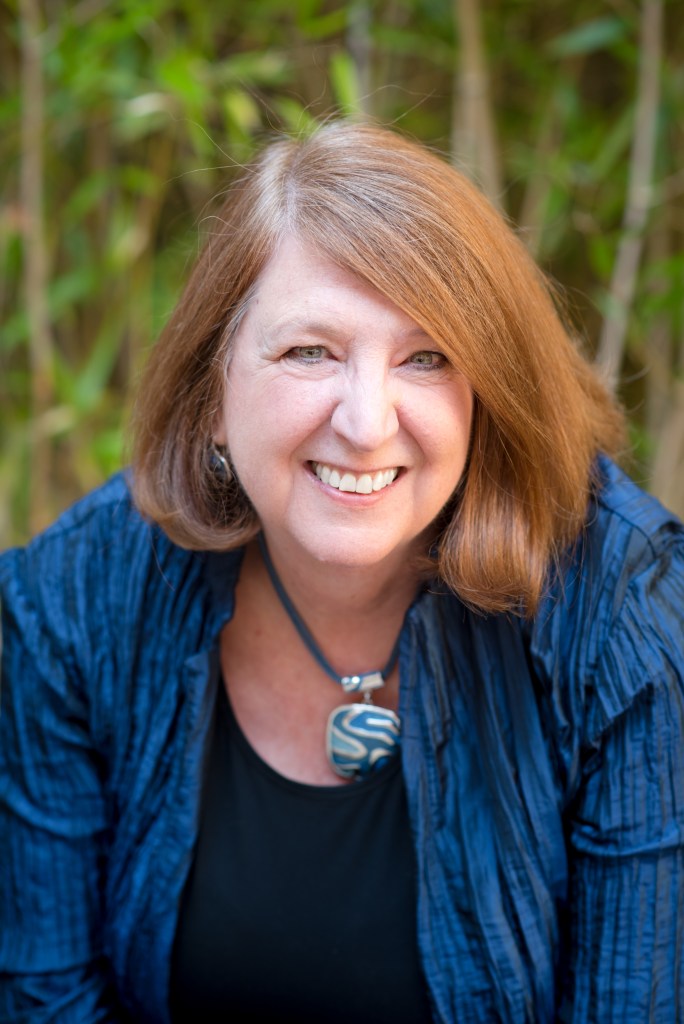
Karen J. Weyant‘s poems and essays have been published in Chautauqua, Crab Creek Review, Crab Orchard Review, Cream City Review, Fourth River, Lake Effect, Rattle, River Styx, Slipstream, and Whiskey Island.  The author of two poetry chapbooks, her first full-length collection is Avoiding the Rapture. She is an Associate Professor of English at Jamestown Community College in Jamestown, New York.  She lives, reads, and writes in Warren, Pennsylvania.


Professor of English at the Lock Haven campus of Commonwealth University, Marjorie Maddox has published 14 collections of poetry—including Transplant, Transport, Transubstantiation (Yellowglen Prize); Begin with a Question (International Book and Illumination Book Award Winners); and the Shanti Arts ekphrastic collaborations Heart Speaks, Is Spoken For (with photographer Karen Elias) and In the Museum of My Daughter’s Minda collaboration with her artist daughter, Anna Lee Hafer (www.hafer.work) and others. How Can I Look It Up When I Don’t Know How It’s Spelled? Spelling Mnemonics and Grammar Tricks (Kelsay) and Seeing Things (Wildhouse) are forthcoming in 2024. In addition, she has published the story collection What She Was Saying (Fomite) and 4 children’s and YA books. With Jerry Wemple, she is co-editor of Common Wealth: Contemporary Poets on Pennsylvania and the forthcoming Keystone: Contemporary Poets on Pennsylvania (PSU Press) and is assistant editor of Presence. She hosts Poetry Moment at WPSU. See www.marjoriemaddox.com 


Rebecca here, with many thanks to Marjorie for this beautiful review of Karen’s poetry collection. I can’t wait to dig in! What are you reading and writing this month, as we start working our way through the new year? Let’s discuss in the comments.

Are you a Rust Belt poet or writer? Do you write book reviews–or conduct interviews of Rust Belt authors? If so, think of Rust Belt Girl for a guest post, like this one. And check out the handy categories above for more writing from rusty places.

Find me on FB and on IG, Twitter, and Bluesky @MoonRuark

And follow me here. Thanks!

Enter your email address to subscribe to this blog and receive notifications of new posts by email.

Welcome to the 2023 Rust Belt Girl round-up…

I interrupt this Covid haze–mine, yes, I was gifted the virus for Christmas–to present a round-up of all the Rust Belt Girl goodness in 2023, made possible by you amazing readers and followers. (For you math and science types, here are your facts and stats):

2023 total views: 5,069, from 3,575 viewers, for 231 likes, and 170 comments. Thank you for engaging!

Most Viewed Post (MVP) 2023: A stellar review of Jason Irwin’s poetry collection, The History of Our Vagrancies, by Marjorie Maddox (Side note: I met Jason in person for the first time and reconnected with Marjorie in October at the Fall Literary Festival in Youngstown.)

2nd Place for MVP 2023 (and tops for most–and most heartwarming–comments): “Mad Dog, “Steel Poet,” Tim Russell, a literary reflection by poet and publisher Larry Smith. Thank you to Larry for being such a pillar of this literary community. (I also met Tim’s widow, Jodi, for the first time, in October–there were hugs!)

3rd Place for MVP 2023: The Rabbit Hutch‘s Rust Belt Renaissance, a review by Emma Riva, an author and art writer living in Pittsburgh, who is also the founder and EIC of Petrichor, Pittsburgh’s art scene magazine. Check it out!

Most Viewed Author Interview: My interview with John W. Kropf, author of Color Capital of the World. (Though John and I both live in the Greater Washington D.C. area, as luck would have it, we were in Ohio at the same time earlier this year, and I was able to meet him and his lovely wife Eileen at a reading and book-signing not far from where Color Capital takes place.)

And don’t miss all the other 2023 bloggo goodness, including interviews with Mitch James, author of the rural noir novel Seldom Seen; Valerie Neiman, author of YA novel The Lonely Backwater; and David Giffels, author of The Beginning Was the End: Devo in Ohio. (This makes three interviews with David at Rust Belt Girl, some kind of interviewing trifecta!)

Then there was John W. Miller’s beautiful guest essay: From Belgium to the Rust Belt. (In a fun coincidence, John and I ended up in the same storytelling course this fall–the writing world is a small one.)

And in other fun blog news, my 2022 review, Enlarging “Rust Belt lit” and Megan Giddings’ The Women Could Fly, was picked up by Belt Magazine in 2023.

2023 felt pretty good and creative outside of the blog, too: I published a short story and a poem(!) and started querying a novel (a couple of you blog followers and friends beta-read!). I am infinitely lucky and grateful to cross paths with as many of you as I do–even if only on these interwebs.

I think we deserve a happy and healthy 2024 with all the writerly and readerly connections we desire. Those of you local to these D.C./Baltimore parts, find me on January 14 at EC Poetry & Prose’s Salon Series. Thank you again to Patti, my fellow blogger–and extraordinary poet and spoken word artist “little pi”–for inviting me to read!

As for Rust Belt Girl, keep in mind that I love a guest post–author interview, book review, or essay on the writing life and beyond–so hit me up.

Want more Rust Belt writing, book reviewsauthor interviewswriting adviceessaysguest posts, and more in your life? Follow me here. Thanks! 

Oh, and if you want to check out my reading superlatives for 2023, they’re at Goodreads. Or, find me on FB. Share your top posts or top reads for 2023 in the comments. I’d love to hear about your writerly, readerly year.

(Off to nap…again.)

*free header image courtesy of Pexels

Emma Riva of Petrichor reviews WAYS OF PITTSBURGH

Rust Belt Girl readers, don’t miss the latest from Petrichor–Pittsburgh, Pennsylvania’s art scene magazine. Founder and Editor-in-Chief Emma Riva is doing an incredible job covering the scene.

Ways of Pittsburgh: Exploring and Painting our Skinny Streets captures the plein air painting of Pittsburgh’s own Ron Donoughe. Let me tell you, his work is like no plein air landscape painting I’ve ever seen! Donoughe paints the city’s narrow backstreets–even the graffiti. A real talent at capturing light, I think some of his paintings of houses resemble Edward Hopper’s work. See if you agree, when you check out Emma’s review–and give Petrichor a well-deserved follow!

If Emma’s name seems familiar, you might remember her review of Tess Gunty’s National Book Award-winning novel: The Rabbit Hutch‘s Rust Belt Renaissance–published right here at Rust Belt Girl.

We’re closing in on the end of the year, friends, which means reading roundup time! So, tell me, what’s been your favorite book of the year? Let me know in the comments.

Let’s start a discussion! Comment below or on my FB page. And please share with your friends and social network.

Check out my categories above for more interviewsbook reviewsliterary musings, and writing advice we can all use. Never miss a post when you follow Rust Belt Girl. Thanks! ~Rebecca

*header image courtesy of Pexels Free Photos

THE RABBIT HUTCH’s Rust Belt Renaissance

By Emma Riva

People in Pittsburgh will tell you where things are based on what used to be there. Most of the time, the landmark that used to be there is food related. A fancy seafood restaurant. An ice cream shop. In a small city, those are the sorts of things people remember. To out-of-towners, this might seem like a quaint practice, but something I’ve come to realize is that it is a profoundly human one.

As a fiction writer, I often find myself navigating the complicated narrative of how our memories and associations of the past interact with our experiences of the present. I look at a candle and think of my favorite candle store in Elizabeth, Pennsylvania, which I went to for the first time because I couldn’t use the bathroom on the Y46 bus and I bolted in not expecting them to have a restroom, but they did. The candle reminds me of my desire to go back there, of the friends I know in Elizabeth. All of this interacts with the energy of the place, the former boating hub, the Monongahela River Valley that built Lewis and Clark’s boat. All of that comes from the split second of looking at a burning wick. 

Sharpsburg over the Allegheny River from the 62 St. Bridge; photo credit: Emma Riva

Tess Gunty’s 2022 debut novel, The Rabbit Hutch, is a master class in this mixture of memory and present, owing in part to its setting within the Rust Belt. The novel’s setting of Vacca Vale, Indiana, is a facsimile of her hometown of South Bend, though she’s fictionalized a car manufacturer named Zorn as the ghost of industry haunting the town’s abandoned structures. “I wanted to be able to pull from Gary, Ind., and Flint, Mich., and Youngstown, Ohio, and a number of other cities in the Rust Belt whose economic devastation was much worse, I think, than it was in South Bend when Studebaker closed,” Gunty said in an interview with the South Bend Tribune

The Rabbit Hutch is a genre-bending work that follows a cast of characters who all live in an affordable housing complex called La Lapiniére, nicknamed “The Rabbit Hutch.” Its central character is Blandine Watkins, née Tiffany, an eccentric former foster youth obsessed with Christian mystics to the point where she changed her own name to a martyred French woman’s. But the book switches between the past and the present and between the perspectives of different residents of the apartment complex, including one of Blandine’s roommates, another  former foster youth who serves as an omniscient narrator for several parts of the book which foreshadow some horror described as Blandine “leaving her body.” Though the characters’ Vacca Vale has its echoes of Gunty’s own South Bend, it’s an imaginary future where the University of Notre Dame didn’t fill the gaps in South Bend left behind by Studebaker. Here’s what Gunty’s characters say of Vacca Vale, while stoned and watching a commercial for a new apartment complex, much nicer than the titular complex they live in:

“Vacca Vale, Welcome Home,” scoffed Todd, but he looked sort of emotional to me. “What the hell kind of slogan is that?”
	“More like—Vacca Vale: Don’t Touch the Rust,” said Malik. 
	“Vacca Vale: Excuse Me, Sir, Are You Lost?” I added.
	“Vacca Vale: We’ll Clean That Up in the Morning,” said Todd.
        We laughed. We warmed. We didn’t know who we were trying to impress.
	“Vacca Vale,” joked Malik. “We Used to Make Cars Here!” 
	“Vacca Vale: Where the Churches Outnumber the Humans.” 
	“Vacca Vale: Where the Rabbits Outnumber the Churches.” 
	“Vacca Vale: At Least You Can Still Fuck Here.”

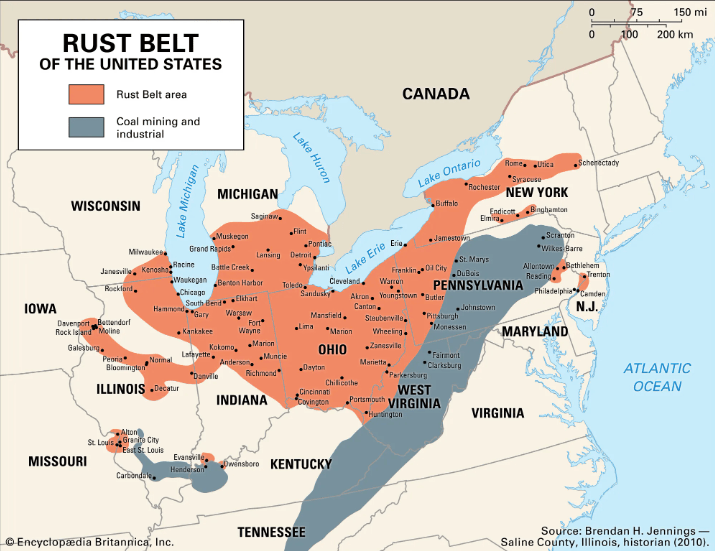
For many in the literary publishing world Gunty has ascended into, the Rust Belt is only a feeling, not a region. It’s an image from the movie Flashdance or a short chapter in a history textbook. So, it’s important to define what it is exactly we’re talking about when we say “the Rust Belt.” There’s some confusion among people who don’t live here about the categorical differences between the Rust Belt, Appalachia, and the Midwest. Pittsburgh and Buffalo aren’t exactly in the Midwest, but they’re still in the Rust Belt. The map in the Encyclopedia Brittanica looks like a gasoline blotch on a sidewalk or an oddly shaped hickey.

It’s a region defined by things which used to be there, sites of innovation and excess then turned to rot, now home to … what? Those of us who live there will be familiar with the exchange that takes place in one scene of The Rabbit Hutch. Blandine and Jack get into a heated argument in the loft of a real-estate developer who plans to “revitalize” their city. Blandine complains about how the real estate development is ruining Chastity Valley, one of her favorite parts of the city, and Jack shoots back: 

“Look,” says Jack. “I know what you want me to say. You want everyone to hate the Valley plan as much as you do. But I just don’t. A lot of people are excited about it, and I think you’re being sort of judgmental and shortsighted. I mean, a lot people say it’s going to help our economy and make jobs and stuff. And I’ve only met him a couple of times, but Pinky doesn’t seem that bad. From what I’ve heard, he grew up poor, he knows what it’s like not to have what you need, and now he wants to help Vacca Vale get out of the gutter. Sure, he’s making money off it. But so what, if it helps people at the end of the day? We need to get out of the gutter.”

Gunty then notes: “In the ensuing silence, Blandine spots a camera, situated atop a thick book called Rust Belt: The Second Coming.” There is much reference to Catholicism in The Rabbit Hutch, and “the Second Coming” refers to resurrection, that most American of impulses. It’s no coincidence that the nature park to be bulldozed for the buildings is called Chastity Valley. But The Rabbit Hutch is no hollow anti-gentrification plea. 

From having grown up in New York, I have a keen and nuanced understanding of gentrification and the ways in which contemporary activism often ignores its tangled nature. The Rabbit Hutch frames the Chastity Valley developments and the so-called “revitalization” of Vacca Vale as part of a meditation on the uncomfortable truth about change. One of the most gutting lines in the book is: “Six months after Tiffany/Blandine had submitted her court papers, proof of birth and $210, she discovered that the name Blandine is Latin for ‘mild,’ while Tiffany is Greek for “Manifestation of God.’”  I, too, went through long stretches of hating my own name, wanting to replace it with something more elegant and powerful. In those lines, Blandine reveals how, though her activism comes from a genuine love for Vacca Vale, there’s a deeper hypocrisy and insecurity there. Though she wants Vacca Vale to retain its grit, the scars that give it character, she is unable to deal with her own scars, to the point where she threw away her own name for a fantasy. 

The South Side from the Birmingham Bridge over the Monongahela River; photo credit: Emma Riva

There is much more to talk about in The Rabbit Hutch, and the only way to truly experience all of it is to read it for yourself. But here are a few sneak peeks. There’s the death of an aging child star and the vengeance of her bitter, angry son—another scar of the past opened into a wound. There’s the woman who moderates content on a site for obituaries, who spurns that son by deleting his callous comment on his mother’s obituary—a marker of the absurdity of how we deal with loss. 

The Rabbit Hutch is all about people on the margins, people who are orphaned by society in some way, regardless of their age or their circumstances. In the contemporary publishing industry, there’s a certain obsession with “marginalized” or “underrepresented” identities. It feels like a reduction, like generational oppression is a badge of suffering for coastal publishing executives to give out to those poor, unfortunate souls in quote-unquote Middle America. I’m perhaps one of the people Blandine and her friends might laugh at, who traded New York for this strange, desolate place. But I know exactly how Blandine feels about Chastity Valley, because I watched my childhood public library in Washington Heights get bulldozed to make space for an “affordable” housing complex with a supposed library inside of it, the skeleton of which now looms over Broadway like a dying animal. I know exactly how it feels to not care how many people get to live in that building or how many families get to make nicer dinners because of the paychecks the developer creates, because connecting to a sad, poor place makes you feel like your suffering matters in some grand story of socio-economic distress.

In the same conversation, above, Jack says to Blandine: “’I’m not judging you.’ The tenderness in his expression catches Blandine off guard, makes the room glitter vertiginously. ‘I just want to know what happened to you.’”

What happened to you? I hate the passive voice. As a literature tutor, my screed to my students is that passive voice makes them sound less confident. I don’t say weak but the implication is there. And of course, there are political and emotional implications. We’ve all heard mistakes were made or I was assaulted. Of course, it’s an important step in reclamation of your life and accountability to say You made mistakes or He assaulted me. But in modern American language, we are profoundly uncomfortable with the passive voice even when we overuse it. Being scarred by your history is a hard thing to admit. You have to admit that things affected you. That (how terrible to admit!) they damaged you. That (even worse!) you are damaged. The Rust Belt is one big, glaring scar of affectation and damage. Its very name is spoil and decay. We spend a lot of our lives teaching ourselves not to be affected by things. In The Rabbit Hutch, what Blandine seeks when she wants to leave her body, is truly to feel instead of simply to suffer. 

The Rabbit Hutch, winner of the 2022 National Book Award for fiction, is available from Penguin Random House or wherever books are sold.


Emma Riva is an author and art writer living and working in Pittsburgh. She serves as the managing editor of UP, an international online and print magazine covering street art, graffiti, fine arts, and their intersections in popular culture. She is also a staff writer at regional magazine Belt and a contributor to Pittsburgh-based art criticism site Bunker Review. You can find out more about her on her website and her Instagram and order her book Night Shift in Tamaqua wherever books are sold. 


Rebecca here, with huge thanks to Emma for her fascinating review.

What are you reading and writing this month, as we look forward to spring? Let’s discuss in the comments.

Are you a Rust Belt writer? Do you write book reviews or conduct interviews of Rust Belt authors? If so, think of Rust Belt Girl for a guest post, like this one. And check out the categories above for more writing from rusty places.

Find me on FB, and on IG and Twitter: @MoonRuark

And follow me here. Thanks!

Enter your email address to subscribe to this blog and receive notifications of new posts by email.

Reading rn …

WordPress, the lovely content management system that hosts the Rust Belt Girl blog and so many others, is running something called #Bloganuary. Hmm. Not exactly catchy. However, today’s prompt spurred me to write to you, dear followers and readers.

“Who is your favorite author and why?”

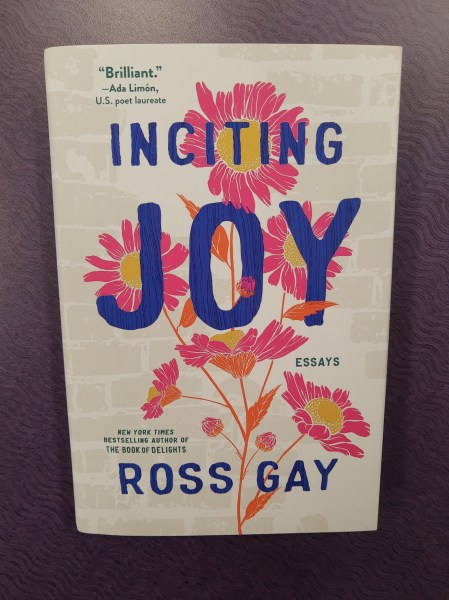
Well, we could be here a year, and I hate to choose favorites. But let’s go with the author I’m reading right now, who is certainly among my favorites. If you’ve ever had a friend who knows just the right thing to say when you’re mourning or elated, terribly empty or full to bursting … you know what it’s like to read Ross Gay.

You know, that friend you can sit with in companionable silence (is there anything better for us avid readers?) without any awkwardness. How is it that an author whose business is words exudes a watchful, waiting, respectful quietude? Yet, at the same time, Gay’s words demand to be read–in the chillest come-and-stay-awhile kind of way. The latest book from the Youngstown, Ohio, native, Inciting Joy: Essays, is an open invitation. Yet, let me make clear there is nothing easy about Gay’s work. This is heart-opening-with-a-crowbar stuff, and that takes work on the reader’s part. But if there is a more grace-filled writer alive today I don’t know them. For comparison: think a secular Henri Nouwen (who was, of course, a Catholic priest.) I bet Gay would excel at the Jesuits’ daily examen, just sayin’.

But isn’t that what the best essays do? Examine something of the author’s life? And in our reading, then, our own understanding is enlarged, enlightened. My favorite essay of the book so far is “Through My Tears I Saw (Death: The Second Incitement). It’s my favorite for its subject matter, the author’s father, “an uncomplaining dude if ever there was one” in his last days on earth; and also for Gay’s humor and voice (see: “dude”) when grappling with a subject as difficult as a parent’s death. I’m not spoiling anything to give you a bit of the conclusion of that essay: “It was through my tears I saw my father was a garden.” (And, yes, if you’re wondering: this is a book about joy–creating it, fashioning it out of what you have. Find me someone who doesn’t have pains and sorrows. Joy can be ours, too.)

There’s a lot of gardening, a lot of tending and watering, nurturing, pruning, and surviving in Gay’s work. Read a couple essays and you’ll quickly learn that this is not only metaphorical gardening. The author is a founding board member of the Bloomington Community Orchard in Indiana, where he’s a professor and a poet and essayist, and, from the sounds of it, a fairly uncomplaining dude, himself.

One of his poems from a previous book, “Ode to Drinking Water from My Hands,” which begins in a garden, inspired a short essay of mine, “Ode to an Ode about Hands.” Written during the darker days of the pandemic, my essay is about grief. How we tend to it, what we make of grief, is directly related to the joy we feel. (It’s not free is what Gay’s saying, I think, and I agree.)

Are you new to Ross Gay? Where to begin? I think of his The Book of Delights: Essays as the gateway drug. This is the book I gift to family and friends who might not even be big readers. Short essays about absolutely everything (including joy)–there’s a great chance you’ll connect with (and come back to over and over) at least a few. From there, I recommend his Catalog of Unabashed Gratitude, an award-winning collection of poems that reviewer Evie Shockley called “shout-outs to the earth’s abundance.” The Ross Gay trinity of poetry, gardening, and basketball wouldn’t be complete without an ode to the hardcourt, which you can find in Be Holding, an epic poem and a “love song” to basketball legend Dr. J.

Now for a couple plugs: Lit Youngstown, my favorite community literary organization, is hosting Gay twice this year. The first is an online reading; the second is the in-person, weekend-long Fall Literary Festival in Northeast Ohio, where Gay will be one of the featured writers. I’ll be at both. Maybe I’ll see you there!


Who’s your favorite author? Who are you reading right now? Are you taking part in #bloganuary? Have you made any fun connections?

Want more Rust Belt writing, book reviews, author interviews, writing advice, essays, guest posts, and more? Follow me here. Thanks! 

And check back here next week, when I will be interviewing John Kropf, author of Color Capital of the World: Growing up with the Legacy of a Crayon Company. You won’t want to miss it!

*header image is the cover of Inciting Joy: Essays by Ross Gay (Algonquin Books, 2022); jacket design by Christopher Moisan

Enter your email address to subscribe to this blog and receive notifications of new posts by email.

A review of The History of Our Vagrancies by Jason Irwin

By Marjorie Maddox

In his often haunting and unsettling poetry collection, The History of Our Vagrancies, Jason Irwin travels between neighborhood bars, churches, soup kitchens, diners, prisons, and county fairs. The real setting, however, is the grit and blur between past and present, hopelessness and hope—that often hard-to-define mix of place and identity just outside the obvious. “Aren’t we all living in the parentheses?” he asks. “One pine in a forest, in a forest in a forest.” In this way, Irwin examines our inner and outer landscapes, as well as what we reject or claim as “home”—with all its traditions, beliefs, and parentage. He holds up for us “our vagrancies, the histories of our comings and goings,/the doubts that invade our greatest aspirations, and propel our return.//Welcome home they say. Welcome home and don’t come back.”

Not surprisingly, then, several poems address and confront what has been passed down—both literally and metaphorically—from parents to son. In the book’s opening piece, “Poem about My Father Disguised as the End of the World,” Irwin lays out many of the book’s themes: landscape as “a façade,” “the unavoidable reckoning/of empty rooms,” both influence and suspicion of religion, and a childhood of mixed messages. “My father was an asteroid,” he states. “Some nights I caught sight of him crashing/through space. Other times he was the whiskey/in my glass, the voice crying ‘No.’” From the start, we understand there will be few divine or human saviors in these poems—“they’re only smoke signals in the fog”—the poet must find his own murky way.

Sometimes such recognitions occur while confronting parent/child relationships. In “Photograph of My Father, 1959,” Irwin confirms “I know we would not/have been friends.” While “still needing you,/needing to blame you,” Irwin as son can’t escape “all the words/that turn to smoke/in [his and his father’s] throats.” Likewise in “My Father Asks Me to Go to Church,” he acknowledges his father’s “own troubled alchemies.” Though they share a belief in miracles, their definitions vary drastically. Add to this the mother. When, in “Soothsayer,” a local evangelist demands to take the young Irwin to church to be healed, the mother counters, “’I don’t have time for this shit.’” Thus, each parent influences how the author paradoxically views the world. 

But let’s back up to how the author defines himself. In “The Condition of the Self as Related to Certain Trees,” he catalogs: “Small town, born and bred/my body…gnarled and irregular….Amputee, Dextrocardia….an old man’s hat….Son, lover, husband, fool.” In “Still Life with Leg Brace & Pontiac,” he juxtaposes his grandfather’s polished “’73 Grand Prix,” the possibilities inherent in his own first day of kindergarten, and how, underneath childhood’s fancy apparel, “[His] four-toed club foot fits/inside [his] shoe like the corpse of someone else’s foot.” Elsewhere in the book, he recognizes himself in a billboard at the county fair “advertising oddities” and as composing an alternate ending to life where “we’re happy with the people we’ve become.”

And yet in The History of Our Vagrancies, the poet also looks toward others—artists, authors, painters, philosophers, waitresses, old “codgers”—for insight. There’s the church visit to see rows of prisoners waving their hands, swaying, and singing “On Eagle’s Wings.” There’s Monk, Miles, and Bird and “a song/you find yourself riffing on/…all the colors/that kaleidoscope this dream/we keep dreaming….” There’s stealing Kerouac from the library, acknowledging the saint in Max at the soup kitchen, and recognizing in the silence and gaze of old men “the ruins of this company town,/where the sunbaked blacktop goes on/forever.” 

In a particularly poignant poem, Irwin describes phantom pain—“Hammer hits to the synapse. Blood thumping like a subwoofer in 4/4 time”—as well as how “[i]t no longer startles [him], like cruelty…” At poem’s end, he explains, “I shift in my seat, and scratch at the empty air.” Similarly, in “Things We Don’t Like to Talk About,” the pain and confession are familiar: regret, grief, fear. Both phantom and real, the hurt also is ours.

And yet, in addition to this sometimes “delirium of shadows and muffled voices,” The History of Our Vagrancies hints at moments of optimism. In the prose poem “Instinct,” Irwin insists, despite evidence to the contrary, “[T]here’s a room inside each of us where everything we’ve lost is/gathered.” Elsewhere, he carves “epitaphs into the sticky wood [of a bar],/believing, as only the doomed and pure of heart believe,/that we’ll be remembered.” At its end, the collection sounds a call to acknowledge and accept beauty where we are: “Look at the two of use sitting at the table drinking wine./Each moment of our lives has brought us here. Each moment/could have as easily led us somewhere else.”

Yes, look. On these rust-belt streets, on these ordinary corners, you, too, may imagine how “the sky transforms,” how once “God held us in his hands.” You, too, may gawk “at the Polish waitress/as she dances across the tile floor” and even join in. “Sometimes it takes a lifetime/,” explains Irwin, “…to let go of the torn shirt of our failures.” In The History of Our Vagrancies, Jason Irwin encourages us to do just that.

The History of our Vagrancies

By Jason Irwin

The Main Street Rag $14


Jason Irwin is the author of three full-length poetry collections, most recently The History of Our Vagrancies (Main Street Rag, 2020), and two chapbooks. He was a 2022 Zoeglossia Fellow and has also had nonfiction published in various journals including the Santa Ana Review and The Catholic Worker. He lives in Pittsburgh. Please see www.jasonirwin.blogspot.com.


Professor of English at Lock Haven University, Marjorie Maddox has published 13 collections of poetry—including Transplant, Transport, Transubstantiation (Yellowglen Prize); Begin with a Question (Paraclete, International Book Award Winner), and Heart Speaks, Is Spoken For (Shanti Arts), an ekphrastic collaboration with photographer Karen Elias—the short story collection What She Was Saying (Fomite); four children’s and YA books—including Inside Out: Poems on Writing and Reading Poems with Insider Exercises (Finalist International Book Awards), A Crossing of Zebras: Animal Packs in PoetryI’m Feeling Blue, Too! (a 2021 NCTE Notable Poetry Book), and Rules of the Game: Baseball PoemsCommon Wealth: Contemporary Poets on Pennsylvania and the forthcoming Keystone: Contemporary Poets on Pennsylvania (co-editor with Jerry Wemple, PSU Press). In the Museum of My Daughter’s Mind, based on her daughter’s paintings (www.hafer.work) + works by other artists, will be published in 2023 (Shanti Arts). Please see www.marjoriemaddox.com. (Author photo credit: Melanie Rae Buonavolonta)


Rebecca here, with many thanks to Marjorie for her wonderful review of Jason’s latest poetry collection. I can’t wait to pick it up! What are you reading and writing this month, as we dig into the new year? Let’s discuss in the comments.

Are you a Rust Belt poet or writer? Do you write book reviews–or conduct interviews of Rust Belt authors? If so, think of Rust Belt Girl for a guest post, like this one. And check out the handy categories above for more writing from rusty places.

Find me on FB and on IG and Twitter @MoonRuark

And follow me here. Thanks!

Enter your email address to subscribe to this blog and receive notifications of new posts by email.

Enlarging “Rust Belt lit,” and Megan Giddings’ THE WOMEN COULD FLY

When I say “Rust Belt literature,” what comes to mind? Gritty, realistic narratives, no doubt. Hard-bitten characters. Upper Midwest settings redolent of industry and machines. Or settings found in a time of post-industry, a time of automation over humanity–of darkness. Coal or steel may factor in, or maybe it’s a landscape made barren by the extraction of one and the decline of the other. More recently, themes appear to be borne from loss after loss: environmental destruction, job loss, poverty, the opioid crisis … 

When I said “Rust Belt literature,” did fantasy or speculative fiction come to mind? How about air, water, light? How about women? How about women flying?

You won’t find Megan Giddings’ novels tagged as Rust Belt lit at your local library, but you will here. For Giddings chose to set her latest, feminist dystopian novel, The Women Could Fly (HarperCollins, 2022), a story in which witches are real, not in a fantastical place but in Michigan and the Great Lakes. And why not?

The novel’s overarching plot: main character Jo is “offered the opportunity to honor a request from her mother’s will” by traveling to an island off Michigan’s Upper Peninsula, where she will explore the “powers women have to transgress and transcend” the limits women face in this larger world.

And, of course, there will be trouble, a lot of trouble. But back to the setting.

“She [Jo’s mother] had loved the lakes. Michigan was for luxury. Erie was for mourning. Ontario was for Canadians. Huron was for daydreaming. And Superior was for mystery. The lake that kept its secrets.”

Why not set a story about the secrets women keep for self-preservation on an imaginary island off an imaginary shore? Why Michigan’s UP? Verity, I presume. In this novel, the speculative elements rub up against the very real setting, and say to this reader: don’t get too comfortable. The nightmare scenario you might think can’t happen in real life, absolutely can–and it can happen right in your backyard. For, what weight does social commentary have if it’s set in a fantastical place? Much less than if that commentary is grounded in a place we think we know so well.

This is not your typical witch story (if there is such a thing) and my regular followers know this is outside my regular reading wheelhouse. From the dust jacket copy, so you get a sense (sans spoilers) of this dystopian time not altogether different from our own, here’s some backstory on Jo and her lost mother:

“Josephine Thomas has heard every conceivable theory about her mother’s disappearance. That she’d been kidnapped; murdered; had taken on a new identity; started a new family. Most troubling of all was the charge that her mother had been a witch, for in a world where witches are real, peculiar behavior can raise suspicions and result in a woman–especially a Black woman–being put on trial for witchcraft.”

How do we writers choose where to set our stories? Do we write of the places of our dreams? Google Earth and the ease of internet searching of local customs, accents, etc., mean a writer can set her story anywhere. (So you would think more writers would eschew the default American settings of NYC and Southern California–wonderful places both, but perhaps overexposed.) What makes us craft a setting after our home? I’ll let Giddings’ gorgeous riff on Michigan answer that question:

“One of the pleasures of driving through Michigan is the trees. Farther and farther north, they shift, become taller and thinner, go from full Christmas trees to pipe cleaner versions. The sky changes too. The clouds come lower, the blue always feels a little brighter, the towns spread farther apart, and there are more dips, hills to make up the distance. It wakes up something animal in me …”

In this novel, Giddings walks a literary tightrope between realism and speculative fiction, grief and humor, old prejudices and new possibilities, pragmatism and magic–and all in concise and biting prose. Enjoy the ride. You don’t even need to know how to fly!

How would you define Rust Belt lit? What are you reading and writing this week? Let me know in the comments.

Want more Rust Belt writing, book reviews, author interviews, writing advice, essays, guest posts, and more? Follow me here. Thanks! 

And a Happy Thanksgiving to all who celebrate!

*free header image courtesy of Pexels

Enter your email address to subscribe to this blog and receive notifications of new posts by email.

Cycling Through Columbine…and Chardon and Uvalde

I’m embarrassed to admit that, at first read, I took the title of JRW Case’s memoir, Cycling Through Columbine, at face value. That is, mostly literally. The cover image is of a man (maybe Case himself) on a bicycle, and I knew this memoir by my fellow Northeast Ohio native to be a travelogue–and the author to have a connection to Columbine. So you can see how I got there: cycling through, as in moving past, moving beyond the terrible 1999 school shooting that forever colored how we think of Columbine, Colorado.

It wasn’t until the recent school shooting in Uvalde, Texas, that I began to read the title’s first word in a different way–cycling as a repeating cycle of violence chronicled in these pages. The memoir is an emotional journey of remembrance and a physical journey of forward-moving action. But there is no moving beyond such violence, is there? Maybe only a “metabolizing,” as Case says, “the chaos of memories like those from Columbine.”

It was then that I lamented once more my own connection to a school shooting, however removed. Nearly 20 years after I graduated from Chardon High School, a student opened fire in the cafeteria, killing three other students. According to Wikepedia, the motive was a personal beef; the shooter is serving a life sentence. I’ve never written about this event, a stain on my hometown, but much more a stain on our collective American–and human–morality.

In one of Case’s blurbs, memoirist Emily Rapp Black summarizes the power of the reckoning with violence that Case attempts within these pages:

“The aftermath of Columbine is the aftermath for all of us.”

A little dust jacket plot summary to get you up to speed: JRW (Robert) Case’s “bicycle journey across the USA began during the summer of 2017, the story of which became this travelogue adventure, which includes a quest for values and the tragic massacre of Columbine in 1999 with its profound and pervasive implications. Robert worked then as a child protection attorney with a personal connection to one of the Columbine victims and deep ties to the community.”

If the form of this memoir is a bit ambitious–dual timeline narrative travelogue, utilizing written letters and texts from his past while contextualizing the narrative present with lesser-known history of spots along his route–Case’s heart is in it all. He grapples, and I like that kind of struggle for purchase in a memoir:

“…I find myself wondering if this adventure is more than just a travelogue about five guys who band together out of a shared interest in completing a bicycle tour across the USA,” Case says. “Or is it a coming of age story told by an aging parent trying to reconnect with a prodigal child, who is an adult daughter and Iraq war veteran? Or, maybe, the real story is a quest of a self-sufficient cyclist and former child protection attorney, who gets blown over by a ghost from Columbine, and has to come to grips with his long-avoided beliefs in a higher power?”

The memoir is all these things. Which makes me think that maybe neat narrative arcs are for fiction writers. Memoirs, like real life, can chart their own way, look forward and back, start and stop, and take detours before they find their way home.

Case’s bicycle journey begins is Astoria, Oregon, and ends in Minneapolis, Minnesota, short of his planned destination of Bar Harbor, Maine. Still, a summer of 2,000+ miles on a bicycle leaves him with plenty of time for exploration–emotional and physical, both. Case’s quest starts simply enough, as “a journey, a personal quest to reclaim some lost health and vitality.” He heads east, first among a group of cyclists, before breaking off on his own, left to find friendly campsites and the occasional motel room along with enough food-as-fuel to make the trip. The panniers over his bicycles sides can only carry so much. The one over his handlebars carries his trusty journal–the beginnings of this memoir.

“We have wind for breakfast this morning.”

In the reading of Case’s story, I note the camaraderie and language all its own between riders, these “self-propelled tourists,” and their bicycles. One of Case’s favorite things about cycling: “feeling a kind of kinship developing between me and this two-wheeled, mechanical device,” his own, Daedelus, named after the ancient Greek inventor. Cycling seems the perfect way to engage in a more eco-friendly tourism, while getting a real feel for the land and people along this country’s “blue highways.” Theirs is a much different experience than that of tourists enclosed in the metal, plastic, and glass of cars and trucks. All the senses are explored in this journey. “We have wind for breakfast this morning,” Case writes. Shortly into the trip, he and his pack of cyclists find themselves riding through several small-town July Fourth celebrations, and form a sort of Greek chorus in comment on the Americans they meet:

In one celebration they “joined in the festivities by purchasing, slicing, and consuming an entire watermelon, all five of us, in a grocery store parking lot. We aped for the passersby, grey-bearded men in bicycle attire laughing together and allowing the sweet sticky juice to run down our cheeks and chins. A few last-minute shoppers would even let their natural curiosity detain them long enough to connect with perfect strangers and ask the easiest of questions, “Where are you going? Where’d ya come from?” Such answers, for Case, are easier than the answers to the questions he’s sorting out in his mind on this quest for emotional peace.

A travelogue of this kind allows for much reflection, and Case turns his attention to sorting out one of the most harrowing events of his adult life, when two students from Columbine High School opened fire, killing twelve students and one teacher. In describing the events, Case’s voice is concise and clear, as it is throughout the memoir:

“When the shooting started, I was about fifteen miles away in Golden, Colorado, the home of Coors beer and Colorado School of Mines. But I worked at the courthouse. That’s where I was when I heard the news, eating lunch in the basement cafeteria…” his children were about the same age as the students who were killed, and, Case says, “that was more than I wanted to think about during the daylight hours.” The author was also there at the memorial service for the victims, national dignitaries spoke–with much grandstanding and not enough memorializing. “When do we start paying tribute to the victims?” Case wondered. The fact that the NRA was scheduled to come to nearby Denver within a week for its annual convention feels like fiction…but was not.

What’s that quote about time and distance?

Nearly twenty years later, on his cycling quest, Case would get the time in the saddle and distance–from Oregon to Minnesota–he needed to come to some emotional terms with Columbine. Except that it keeps happening, as we were reminded earlier this spring, when we learned of the news out of Uvalde. No printed record of these shootings can keep up, it seems. Case’s statistic is already out of date. “…more than two thousand living, breathing Americans have been killed or wounded in mass casualty events since the 1999 Columbine Massacre.”

How to balance grief with gratitude at being alive? For Case, a youth on his caseload left for school at Columbine one morning and never returned home. I struggle with this, as I drop my kids off at school each morning, and I pray. Case also grapples with the “higher power” and its place in our lives and finds a well-earned peace within these pages:

“With every crank of the pedals my endurance is building…my confidence grows. Today is for riding next to this wild and scenic river, a self-propelled visitor moving through majestic forests shimmering with filtered sunlight…I’m feeling grateful to be alive for the first time in years.”

Case’s memoir soars where he connects the emotional resonance of cycling with his emotional past. And in this connection, this parsing out of life’s lowest valleys and highest heights, we find hope. What more could we want from such a story?

Hope makes all the difference.

“The day is still young and there is hope for a better campsite ahead. My mid-morning fatigue is nothing compared to the hopeless resignation that once deadened my senses and stooped my shoulders when I came through the door after work on that first Friday evening, three days after the massacre. Hope makes all the difference.”

Cycling Through Columbine

by JWR Case

Bottom Dog Press, Inc. (2/04/22) $18

Thank you to the author for the copy for review!

*Features photo, free from Pexels, of Idaho, one of the states along JRW Case’s bicycle journey

Do you read memoirs? Have you written yours? Do you ride? Have you ever taken a cross-country trip? I’d love to hear about it. And, what are you reading or writing this week? 

Want more Rust Belt writing, author interviews, book reviews, writing advice, and more? Follow me here. Thanks!

Enter your email address to subscribe to this blog and receive notifications of new posts by email.

Read what you love … and other writing advice

I’ve been reading Francine Prose’s What to Read and Why, a dictatorial-sounding title, true, but a great book to explore the craft of reading. (I’m late to this one, published in 2018, as I am late to most things.)

Wait a minute, you say. Reading’s a craft now? Can’t I just read what I love? Of course, I say, and I’m sure Francine would agree. But if we’re reading for sport–that is reading to improve our writing or even ourselves–she is here for us. That is, this book–a compilation of essays responding to various works of literature–is a tool to employ to help us on our writing journeys. I especially enjoyed Prose’s essay in response to Charles Dickens’ Great Expectations, her essay on Jane Austen (I, embarrassingly, only recently read Pride and Prejudice for the first time), and her essay titled “Lolita, Just the Dirty Parts: On the Erotic and Pornographic,” (in case you like your Valentine’s Day reading on the saucy side.)

From that last essay on a novel I loved (for all kinds of writerly reasons–like fun play with an unreliable narrator) I especially liked her discussion on what’s been lost in how we think about “Eros and erotic, words that have always included the sexual but have also suggested the mysterious…connection between sex and life, between sex and pleasure, between the origin of life and the celebration of life…”

My guess is Lolita is a contender for the top spot in the latest rash of books to be banned and even burned…maybe partly due to limited understanding of Eros. I’m also guessing that many who would wish to rid the world of Lolita haven’t read it–“a work of art” that functions not to arouse the reader but to “deepen our well of compassion and sympathy.”

My quick take: I read what I love and leave the books I don’t love for others to consider. And in reading what I love I absorb the best of it as lessons to write well.

One delightful effect of my being between revisions of my WIP is that I have ample time to read. Add to that the fact that I’m not yet querying agents for my WIP, which means my reading time isn’t eaten up by searching for comps (comparative titles), and I am really reading what I love.

My TBR keeps climbing to the ceiling, but in addition to Prose’s craft book, I’m also reading Kirstin Valdez Quade’s The Five Wounds, based on her short story by the same name. (I highly recommend her collection if you are a short story fan.)

In nonfiction, I’m currently reading Final Bow for Yellowface: Dancing Between Intention and Impact by Phil Chan with Michelle Chase, about Asian representation in classical ballet. I heard Chan speak on a West Virginia University webinar, and this former dancer (me) was enthralled.

So, tell me, what are your Valentine’s Day reads? Are you knocking on Eros’s door for the holiday? Reading short stories or a novel? What’s the best nonfiction book you’ve picked up lately? Any of my current reads appeal to you?

Hankering for my latest Rust Belt interviews, book reviews, and more? Check out my categories above. I hope you’ll follow me here, if you don’t already, so you never miss a (quite infrequent) post or more unsolicited advice. Thanks for reading, and Happy Valentine’s Day! ~Rebecca

Enter your email address to subscribe to this blog and receive notifications of new posts by email.

My review of RUNNING FOR HOME, Edward McClelland’s debut novel

For many years, the Lordstown Complex, a GM auto factory in Northeast Ohio, was a landmark along my drive home to family.

“Not long now,” I’d mutter to myself or say to my kids, if they were with me, and we’d marvel at the sea of cars in the auto plant’s gargantuan parking lot—and at the cars we couldn’t see, being made inside the plant’s operations. Lordstown, something like a prayer and a beacon both, calling me back to the place I still call home.

Poetical references aside, Lordstown was an economic hub for the area, for decades. In the 60s, when my dad first moved to the Cleveland area, met my mom, and married, that plant was making the Chevy Impala and then the Pontiac Firebird. And the people who worked on the line were making salaries better than anything my dad could make as a draftsman. But we all know what happened to auto-making over the next few decades. And, with each pass in recent years, that Lordstown plant held fewer cars in the parking lot, meaning fewer employees working fewer shifts making fewer cars. Last I remember in its history as an auto plant, Lordstown was the home of the Chevy Cruze. I hate to disparage, but how many Cruze drivers do you know?

It was with this point of reference—a familiar setting—that I came to Edward McClelland’s debut novel, Running for Home, out now from Bottom Dog Press. An accomplished journalist and writer of nonfiction—I loved his How to Speak Midwestern—McClelland has covered and written about the post-industrial Midwest, from which he hails, for a long time. This is the first novel for the Lansing, Michigan, native–and it hit home for me.

Running for Home opens on the Empire Motors body plant, “a permanent symbol of my hometown, as well as a gateway to opportunity,” says the narrator, high-school student and runner, Kevin. What follows is a story of the fall of industry in a place, coinciding with the rise of “a slight Midwestern youth,” our protagonist, in this coming-of-age story.

From the jacket copy: “In this moving new novel, [Kevin] deals with a rough high school and a vanishing factory town through a devotion to his running sport and his caring family. Aided by a spunky girlfriend, a humble-wise coach, loyal teammates, and his earned self-awareness, he learns the value of reliance and home.”

What sets this coming-of-age story apart? A narrator with a voice and a passion that ring absolutely true. And they should. McClelland ran track and cross country at his high school, across the street from a Fisher Body plant. McClelland creates a Michigan town setting that leaves no detail of the early 80s unexplored; from the fashion and games popular with teenagers—like windbreakers and Galaga—to movies and music—like All the Right Moves and The Sex Pistols. 

In this novel, the author doesn’t shy away from questions of economics and environmental concerns, things that are often at odds when it comes to industry. From Kevin’s perspective as a runner, we get a good view. There’s “the ever-visible rainbow slick on the river’s surface, the effluent of automaking” and the sweetly sick smell of chemicals on the air. Once the plant closes, Kevin both appreciates being able to breathe a little easier and knows life will be tougher, going forward. It hits home when his dad must take early retirement.

The author is also adept at dramatizing and characterizing the generational differences among auto workers, like the narrator’s father and grandfather before him. What did cars mean to men, especially, through these decades? To build one with other men on a line? What does it mean when your life’s work is sent elsewhere? Of course, what is done to a place is also done to the psyche of a place. From this book, I got an insider’s view, including of union operations—and what striking and winning or losing looked like in this era of plant closures and relocations.

What propels the plot, outside of the external forces of the town’s industry declining, is Kevin’s striving for success on the track. His passion is crystal clear: 

I ran because I was a runner, because running was my nature. I believed the fastest form of myself was the most perfect form of myself.

In writing fiction, we are often taught to have some kind of a “ticking clock,” to propel our plots and keep our readers turning pages. In this novel, the ticking clock is a stopwatch, and, race after race, we root for Kevin’s success in a sport where fractions of a second mean the difference between success and failure, between a scholarship to college or a ticket to an uncertain future.

What I liked the most—and you might guess by the novel’s title—is that this is not a story about success by getting out. That is an all-too-common trope. But it’s not only a trope in fiction. In an American era of urban sprawl and overcrowding, the post-industrial Midwest still has many places that lose more people each year, many young people among them, than they gain.

Leaving is easy. Just ask me. Staying, despite–or maybe because of–the odds is harder.

Do you have a favorite coming-of-age story set in your native place? Did you stick close to your hometown? Do you run? I’d love to hear about it. And, what are you reading or writing this week? 

Want more Rust Belt writing, author interviews, book reviews, writing advice, and more? Follow me here. Thanks!

Enter your email address to subscribe to this blog and receive notifications of new posts by email.

Running for Home

$18 Bottom Dog Press