My interview with Ohio Poet Laureate Dave Lucas

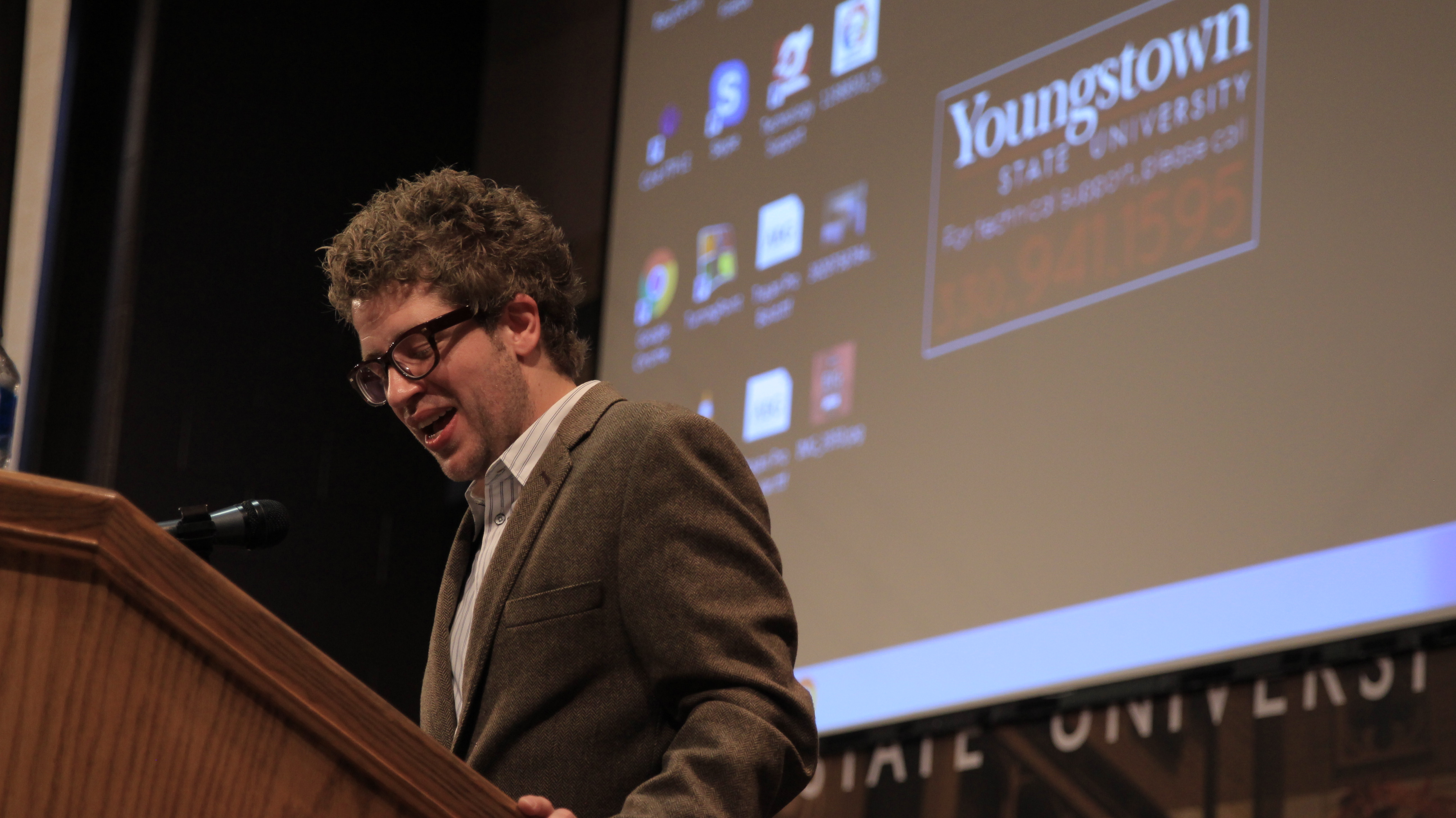
Ohio Poet Laureate Dave Lucas presenting at Lit Youngstown’s 2018 Fall Literary Festival*

Love poetry or hate it (btw, you don’t really hate it), Ohio Poet Laureate Dave Lucas is right there with you.

What’s it like to be a poet laureate? I asked Dave Lucas that–and more–in this interview over email. Here’s what the author, teacher, and “poetry evangelist” had to say.

Dave, how much does it mean for you to have been chosen as Poet Laureate of Ohio, and what’s up next for 2019?

If you’d asked me this a year ago, I would have said how honored I felt by the selection and how excited I was for the two years to come.  A year into my term I still feel honored and excited, but more than anything I feel gratitude.  I’m grateful for the opportunity to see parts of my home state I’ve never visited before, to talk about poetry in such varied settings and with so many people for whom poetry is a way of making meaning of their lives.

In 2019 I hope to continue those travels, but I also hope to “meet” more Ohioans virtually through the “Poetry for People Who Hate Poetry” project.  The project entails a monthly column syndicated in Ohio newspapers and media outlets; this year we hope to create a podcast version as well, so that we can promote poetry in whatever medium Ohioans get their information and culture.

As Poet Laureate, I imagine you’ve met many Ohioans in your travels around the state. What has surprised you most?

I’ve certainly been struck by the number and quality of poetry programs taking place at the regional and local levels.  These are workshops, reading groups, recitations, slams, and more, and I’ve encountered them everywhere I’ve traveled in Ohio.  The internet has of course been revolutionary for bringing people together around a common interest, but there’s something wonderful about seeing people gather in common physical space to talk about poetry.

In your Poet Laureate column on the Ohio Arts Council site, as well as in the classroom, you send the message that most of us love poetry, even if we don’t know it yet. Can you talk a little about how you define poetry and give us a couple examples of the kinds of poetic language we can find outside of what we traditionally think of as poetry?

Literary history tells us that anyone who attempts to define poetry today is about to be proven wrong tomorrow.  That’s both the pleasure and challenge of trying to say what poetry is or isn’t.  So I try to maintain as broad and flexible a definition as possible.  I think that poetry is the aesthetic pleasure we take in language.  Words are for play as well as work, as the groan-worthy puns of any good “Dad joke” will demonstrate.

So puns and jokes in general might be examples of the poetry we find outside of “poems.”  So are the metaphors we use to describe the world.  Riddles, jingles, lyrics, mnemonics, and more.  For instance, I’ve just finished a column (my sixth installment) about the artistry of slang, which Walt Whitman treats as the democratic aspect of poetry.  In this column I argue that even if you haven’t read a poem since high school, you participate every day in the artistry of language simply via the creativity of the slang you use. Read more

Sport in the Art of Place

I went for the art of the place: the earthy poetry and fiction borne by writers tied to the ever-evolving American Rust Belt, which has seen its share of glories and struggles, stemming from the rise and fall of mining and heavy industry.

And, I admit, I fretted just a little bit about what to wear. Stay with me…I haven’t gone all fashion blog on you.

No surprise that among the students of creative writing, the authors, editors, publishers, and poets attending the literary conference–there were ensembles of black, a poet skirt or two, and a pair of cat face-festooned flats (for real; they were fabulous shoes).

There was also a Browns cap. Yep, those Browns. The NFL team that went win-less last year (after which the people of Cleveland held a perfect-season parade).

At the sight of that beautiful brown and orange hat at a literary festival, I knew I’d found my people.

It got me to thinking, if you Venn diagram a place (and this is as math-y as I get), how much overlap is there between the place’s art and the place’s sport? Let’s think on that a minute, while I take you with me on another trip.

Earlier this month, as the fall foliage reached its peak color, my family visited the lovely village of Cooperstown, New York.


20181006_123517
At Cooperstown’s Farmers’ Museum’s 19th-century Historic Village, a lovely way to spend an afternoon with the kids

For its small size, Cooperstown is a place with impressive arts offerings, but it is known far and wide for being the home of the National Baseball Hall of Fame and Museum.

Read more

Rust Belt Girl roundup

wonder-woman-1694801_640.jpg

Writing advice with a “twist,” love on fire in Cleveland, and zombie raccoons, oh my!

It was a busy week here at Rust Belt Girl. In case you missed it:

I joined NPR and other credible news outlets in reporting the “zombie” raccoons of Youngstown, Ohio.

I reviewed Mark Winegardner’s 2001 masterpiece, Crooked River Burning, which follows two star-crossed lovers on a journey through Cleveland in the 50s and 60s.

Of course, what week would be complete without a little writerly advice, this time with a “twist,” for National Licorice Day?

And…I’m happy to report that I’m still welcoming new followers who found me by way of my Interview with “Furnishing Eternity” author David Giffels, which was featured on WordPress Discover March 31. See it, and so many other blogs worth your time, here. Always fun to discover something new.

Happy weekend discovering to you!

What’s on your literary plate?

~ Rebecca

*Free image courtesy of Pixabay.com


Love in Cleveland: a story-review of CROOKED RIVER BURNING

81zSeikDc3L

There’s something special about a love story set in the time and place one’s parents fell in love.

Paris? London? Niagara Falls? Nope. I’m talking about Cleveland, Ohio.

The real love story (that eventually begat me and my siblings) started with a blind date. Here goes: the young man who would become my dad met the young woman who would become my mom at her apartment door. Her first words to him: “You’re not as bald as they said you were.” Ah, romance. Long story short, she liked his car, a racing-green Austin Healey convertible, and him too, no doubt.

Crooked River Burning*, a novel by Mark Winegardner, explores parallel love stories—between a boy from Cleveland’s West Side and a girl from Cleveland’s East Side (read: upstart vs. old money); and between the people of Cleveland and their city itself.

From the book jacket:

In 1948 Cleveland was America’s sixth biggest city; by 1969 [the year my parents married] it was the twelfth…In the summer of 1948, fourteen-year-old David Zielinsky can look forward to a job at the docks. Anne O’Connor, at twelve, is the apple of her political boss father’s eye. David and Anne will meet—and fall in love—four years later, and for the next twenty years this pair will be reluctantly star-crossed lovers in a troubled and turbulent country.

The city of Cleveland is a microcosm of this changing country. The author gives the reader a window into organized crime in the 40s, when we meet real-life Clevelander Eliot Ness; into the 50s rock and roll scene starring disc jockey Alan Freed; and into the race riots of the 60s, when we meet Carl Stokes, the first black mayor of a major U.S. city.

For sports fans (Winegardner is also the author of The Veracruz Blues about baseball), there are stories plenty about the Indians and the Browns (with Art Modell cast as the Machiavellian villain he was, IMO.) Masterfully blending fact (replete with entertaining footnotes) and fiction, this novel is comparable to the works of E.L. Doctorow. Where Doctorow explored New York, Winegardner explores Cleveland.

Does Winegardner know Cleveland! One of my favorite Cleveland bits—and never more appropriate than now, as we endure “wet-winter” into April:

“In Cleveland there is no spring. In Cleveland there is winter, then a wetter-meaner sort of winter…Then one day winter/wet-winter ends and, bingo-bango, it’s summertime.”

But why talk weather when we can talk love? Wingardner on love:

“A person can be in love with the idea of love. A person can fall in love with the idea of another person. Less commonly, a person can fall in love with another person.

In fact, a person always falls in love with the idea of another person, not the person. Falling in love with the actual person takes time and too much honesty…

Some people luck out. The thing they’ve been calling love turns out to be just that. Such people exist. Film at eleven.”

Oh, you were looking for love between David and Anne? I’m not spoiling much when I tell you that the most romantic setting in the book, a snowy New York at Christmastime in a posh hotel suite, and Anne is down with the flu. On the other extreme, the setting of the Cuyahoga (“crooked”) River on fire finds our protagonists in, well, love as real as it gets.

Is the book perfect? Not quite. For me, some of the real-life Cleveland profile sections ran a little long: among them, Mayor Carl Stokes, Cleveland newspaper editor Louie Seltzer, maybe-murderer Dr. Sam Sheppard, pioneer news broadcaster Dorothy Fuldheim. Still, this book will find a place on my bookshelves, alongside Ian McEwan’s The Innocent, perhaps, for its mastery of a real time and place in history overlaid with a timeless love story and for a lyrical yet playful use of language.

But back to our fictional lovers…through their twenties and thirties, David and Anne attempt to make their childhood professional dreams (Cleveland mayor, and war correspondent, respectively) come true. But, like thwarted love stories talk of ships passing, most of us don’t become our childhood heroes.

If the real Cleveland love story—starring my dad and my mom—could have met the imagined one starring David and Anne, they would have come together in the late 60s. Both couples were in love as the real city burned its land and its water. The Cuyahoga River burned (helping to create the Clean Water Act); and the Hough Riots, among the first of the 1960s race riots, turned Clevelanders against their neighbors and even against themselves.

Like many Clevelanders who could, my parents left the city for a house in the country, where they would raise a few chickens and ducks, a goat named Esmeralda, and three human kids. In trading one setting for another, I’m sure they’d say they gained more than they lost. I wonder about those who didn’t leave.

Did Winegardner intend for this dual love story to be a cautionary tale? In 2018, one could read the book that way—especially through the lens of race. One of the most chilling parts of the book comes from Anne’s perspective. It’s a month after the riots, and Anne is questioning everything in her life and in her city:

“Human beings don’t destroy their own homes, do they? In Anne’s experience, they do…Rome burns. Has burned, is burning, always will be burning. Look harder. Smell it. It’s not Rome we’re talking about, sport. (Who knows but on the lower frequencies, Cleveland burns for you?) Yet you sit there. We sit there. Don’t move.”

My rating: 4.5 stars

What’s the best book you’ve read about your hometown? If you were going to write your own love story, where would you set it?

*Published in 2001 by Mariner Books (576 pages). Yep, I’m late to the party.

Like this review? Check out my “reviews” category above for more.

Thanks! ~ Rebecca


The sound of your story


pexels-photo-534263.jpeg

“Your voice sounds even weirder than normal.”

That’s my son talking, razzing my recorded voice again. (Yep, we’ve been here before.) For some reason, my resplendently nasal Northeast Ohio accent shines through especially when recorded.

No, I don’t sit around vanity-recording, but I conduct–and record–a lot of interviews for my job. (Luckily, I’m on the end that talks less.) And, then there’s something new on the creative/publishing front:

I’m recording a flash fiction piece of mine to divert my attention from work for a day submit for publication (and a nice award) to the Missouri Review‘s 11th Annual Miller Audio Prize.

Truly, I thought about having a friend read my submission (talking about you, R.!), which is allowed. This friend is a poet, and so she has had more practice reading aloud (in that soothing NPR announcer kind of way), but she also just has a lovely speaking voice–clear and pleasing to the ear.

Then, I thought, no, this story of mine takes place in my native Cleveland; the characters are Clevelanders. The voice should sound like it.

And so, for authenticity’s sake, I sought out the digital recording and editing app, Audacity. I’m learning to loop sounds for background (of seagulls; yes, we have seagulls–or lake gulls, anyway–on Lake Erie). And I’m re-learning how to cut out the extra-long pauses and goofs and “ums” in a sound file. My only previous experience editing sound files was during an internship with the online journal, Blackbird, in school, which was a long time ago.

What struck me this time around is how instructional it can be to look at the patterns of sound, like here:

Screen Shot 2018-03-10 at 9.23.29 PM

The flat lines are pauses between sounds, so I can quickly see when a pause is longer than the others–and decide whether that’s intentional, for dramatic effect, or not. (Like, I was sipping my coffee.) The blips are sounds, and to look at them can help me decide whether my phrases tend to be of the same length–and whether I meant it that way, or not. The higher the blip the louder my voice. Do I get a bit louder at the climax? Or softer? Did I do that on purpose?

This is a work in progress, so I’ll let you know how it goes.

Have you ever tried to see your writing in a different way–by hearing it in a different way? How’d it go?


What to do with sacred art when churches close?

-ccfcc17ba2079104
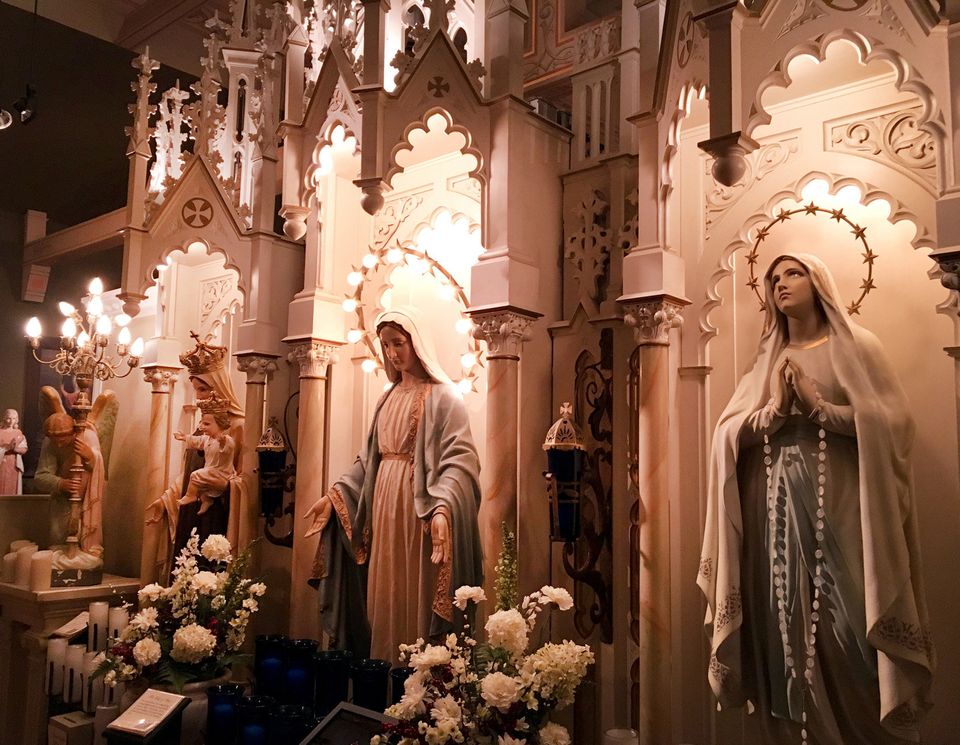
Image from the Museum of Divine Statues in Lakewood, Ohio, courtesy of The Plain Dealer

If the Rust Belt is a bastion of anything, that thing might be Catholicism. Or, maybe not–given that about 40 Catholic churches were shuttered in Cleveland, Ohio, alone over the last few decades.

As the city’s population waned and its churches closed, some of the sacred art was shipped out to existing and new churches; some wasn’t.

Thanks to a good friend and follower of Rust Belt Girl for putting me onto the story of Lou McClung. A makeup artist with his own cosmetics line housed in a former Catholic school, McClung bought the closed St. Hedwig Church (named for a beloved Polish queen) in the Cleveland suburb of Lakewood, Ohio, in 2011, and began restoring its statues. In an article in a 2017 issue of Catholic Digest, McClung said:

I do restoration artwork across the country and I thought it was important to remember where all of these statues came up. The art represents the immigrants and all their hard work and sacrifices that made these [now closed] parishes possible.

The artist lovingly restores the statues and researches and shares the provenance of each piece in the Museum of Divine Statues he founded. Lately, McClung’s museum has been receiving religious artwork not only from the Cleveland area but from all over the country.

Other Rust Belt locales preserving shuttered churches and their art include the Buffalo [New York] Religious Arts Center and the Jubilee Museum in Columbus, Ohio.

McClung’s restoration work for his Museum of Divine Statues is beautiful. Great pics can be found at these sites:

http://www.cleveland.com/style/index.ssf/2017/02/lou_mcclung_restores_curates_m.html#incart_river_home

https://patch.com/ohio/lakewood-oh/new-life-for-shuttered-catholic-church-in-lakewood


Me talk pretty one day*? Probably not.

20180114_165850
Mentor-on-the-Lake (pronounced Menner-on-the-Lake), Ohio. Photo credit: Bill Moon. Thanks, Dad!)

“You sound funny,” my son said.

“I know. I’m from Ohio.”

Too many of my conversations with my kids begin this way. But it’s true:

I sound funny here in Maryland. I am a linguistic fish out of water. My Maryland-born kids and I may speak the same language, but regionalisms and accent say a lot.

This time, my recorded voice was one half of a mock interview conducted by my son. I played the author of a book he’d read for a second grade school project. He sounded normal; I sounded every bit of my Cleveland-area upbringing.

Of course, growing up, I thought I sounded normal. Because Clevelanders “do naht hayev ayaccents.” Whether you cop to having an accent or not, they can raise spirited debate; they do in my house, where my Maryland-native husband’s “league” somehow rhymes with “pig.” Huh?

Accents seem to be having something of a heyday. Last month, a Bawlmerese–that’s Baltimore-ese–video went viral; in it, innocent words like “water,” “Tuesday,” and “ambulance” are murdered to become “wooder,” “Toosdee,” and “amblance.”

Back in my native land, Cleveland’s Belt Publishing has just published How to Speak Midwestern by Edward McClelland, who says:

Accents are part of our regional identity. And there is a feeling that these distinct accents aren’t as distinctive as they used to be.

In addition to regionalisms (like “pop” instead of “soda”), accents are a way to represent one’s native place. I do this with not a bit of shame! My “plaza”–hold your nose and you’ll get the a-sound right–is my son’s “plahza”; my “pajamas” is his “pajahmas.”

In this article, McClelland explains that the Cleveland accent is the Inland North accent, “marked by a raised ‘a’ that makes ‘cat’ sound like ‘cayat,’ a fronted ‘o’ that makes ‘box’ sound like ‘bahx.'”

What does all this mean for us writers?

Accent can be portrayed in our writing, and it can work well if done with a deft hand. In my current WIP, I’m writing characters who have an Italian accent, which often drops the “h” sound and rolls or taps the “r” sound–there’s a real musicality there. Not easy to write, but worth it to try.

Veering into dialect can get a little dicey. This Guardian article puts it plainly:

“Do ‘dialect-lite’ or be damned.”

Whether blogging or engaging in other creative writing, accent can provide interesting subtext.

Does your accent shine through? What do you say funny? I’ll start, below.

Comment here or join this Rust Belt Girl on FB.

*Title borrowed from the amazingly funny David Sedaris’s book of essays: Me Talk Pretty One Day


I’ll drink to this: Cleveland vineyard does good

DSC_0028.jpg=s1600x1900
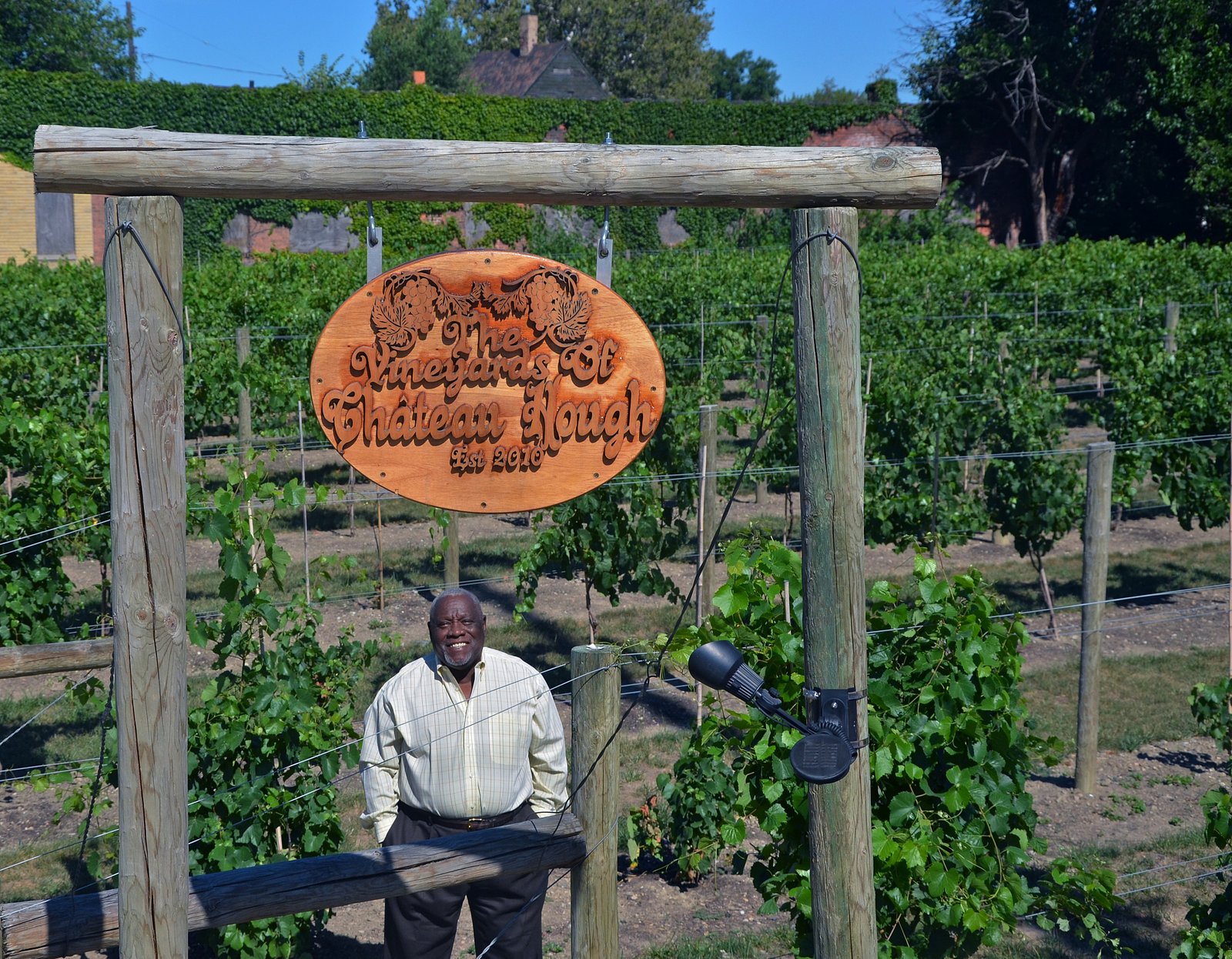
Image of Mansfield Frazier. Photo by Jan Thorpe for Good.

“Oh my God, we’re in Hough,” my mom said.

I was a teenager at the time, sitting in the front passenger seat beside my mom, who was driving, her nose just inches from the windshield, as she strained (pre-GPS) to find her bearing–inspecting road signs, as we passed boarded-up houses and sketchy markets we viewed out of our periphery. (One of inner city Cleveland’s most notorious neighborhoods, Hough wasn’t the sort of place you looked at head on.)

And then she did it:

She locked the car doors with a resounding “click” I was sure could be heard by all in a mile radius.

“Oh my God.” A devout Catholic, my mom wasn’t one to take the Lord’s name in vain. So I knew this was serious–being lost in Hough–but I also felt shame. Here we had been in Cleveland, taking in the sights at the art museum, grabbing a bagel or bialy in University Circle, maybe? I don’t remember if we were heading back home from a theater performance at Playhouse Square–or maybe I had had a ballet rehearsal.

Anyway, a few wrong turns and we were in Hough, the site of riots during my mom’s years as a student at nearby (Case) Western Reserve.

We got out of Hough; my mom found her way back through the parts of the city she’d known as a  student and young married woman, and we made it back to our house in the country.

It wasn’t until later that I contemplated those who never got out of neighborhoods like Hough; and much later that I contemplated those who didn’t want to.

Reading The Cleveland Anthology, I came across a piece by Mansfield Frazier called “A Vineyard In Hough.” Yep, a vineyard.

Here’s how it started: Frazier, who writes about “the problems of the underclass” and his wife, who holds a master’s degree in social work, didn’t want to be “arm’s length liberals,” so they moved to inner city Hough in 2000 in an attempt to “recreate a vibrant middle class neighborhood.”

There, they created a vineyard, a sustainable green project that encourages neighbors–including recent parolees–to work together on a project that creates “a much stronger social fabric.”

My mom passed away almost 12 years ago now, and in that time Cleveland–and Hough–has changed. I like to imagine how a trip to Hough might go now.

If you can’t pick up a copy of The Cleveland Anthology, here is a great article by David Sax on Chateau Hough, which uncorked its first bottles in June 2014.

What does urban revitalization look like where you live?

Cheers to the weekend! ~ Rebecca