Justin Nobel | Longreads | January 2018 | 14 minutes (3,538 words)
We begin with a glass of wine on the wraparound porch of Michele Garman, who lives with her husband Tom and teenage son Dominic in the rural Ohio community of Vienna. Just 200 feet from the family’s house is a narrow shaft that the oil and gas industry uses to pump waste riddled with toxic chemicals deep into the earth, one of Ohio’s 217 active Class II injection wells. “I still enjoy sitting out on my porch,” says Garman, “but it was a lot more enjoyable before the scenery changed.”
The small white and maroon trucks that deliver the waste often come at night, she says. They contain what regulatory agencies innocently refer to as produced water, or brine, a slurry generated during fracking operations that can contain more than 1,100 chemicals and which is carcinogenic, flammable…
I’m playing fast and loose with the English language today, redefining inkling as: a little inking, or a bit of writing, a literary snippet, if you will. This post is in response to today’s Daily Prompt: Inkling.
Rust Belt Girl followers know where I am in my journey toward traditional book publishing. Rather than call myself stalled in editing, I’d like to say I’m at a rest stop along the journey–one of those rest stops with a fabulous overlook. Only, I’m not looking out onto rolling farmland or a lake vista. I’m looking over my WIP (a historical novel manuscript) and trying to do more than edit. I’m trying to genuinely revise–or re-see–my story.
This requires brutality.
This requires killing my inklings, my snippets of lovely language that don’t move the story forward, that don’t evolve the characters, that maybe draw too much attention to themselves.
Today’s dead inkling:
Pregnancy had meant an intense inversion, feeling sensations from the inside—hosting, feeding, growing this glorious parasite.
In the days of printing out drafts–huge reams of paper–I would actually snip this snippet and put it in a jar I have for such things. Then, if I felt blocked or needed a prompt for a new story, I would select one and start from there. Today, my dead inklings wind up getting lost in my Mac world.
William Faulkner is credited for “kill your darlings,” and there’s been discussion about that phrase and other great writing advice here at WP this week.
But, now I’m getting down to it: slashing and burning.
No, I’m not talking about the zoo–unless that zoo is the wonderful world of novel manuscript revision (did my sarcasm shine through there?).
Rust Belt Girl followers know I’m currently reworking my historical novel, chapter by painstaking chapter. And, as with most things, I’m not doing it alone.
Robbins–quoted above–taught a historical novel-writing course as part of my grad program, way back when, when the first little seed of my novel was planted.
His advice is evergreen. To me, “give a monkey a monkey bar” means to give a character something to showcase what he or she can do. Phone calls and meandering strolls don’t let a character prove their worth–unless he suddenly realizes he’s lost his voice or she breaks a leg.
Today, I’ve dumped a scene where I had two guys sitting in a bar exchanging information in favor of a steep trek into the clouds of the Marin Highlands where a WWII battery fortification is being constructed. We’ll see if the scene goes or stays.
Mentor-on-the-Lake (pronounced Menner-on-the-Lake), Ohio. Photo credit: Bill Moon. Thanks, Dad!)
“You sound funny,” my son said.
“I know. I’m from Ohio.”
Too many of my conversations with my kids begin this way. But it’s true:
I sound funny here in Maryland. I am a linguistic fish out of water. My Maryland-born kids and I may speak the same language, but regionalisms and accent say a lot.
This time, my recorded voice was one half of a mock interview conducted by my son. I played the author of a book he’d read for a second grade school project. He sounded normal; I sounded every bit of my Cleveland-area upbringing.
Of course, growing up, I thought I sounded normal. Because Clevelanders “do naht hayev ayaccents.” Whether you cop to having an accent or not, they can raise spirited debate; they do in my house, where my Maryland-native husband’s “league” somehow rhymes with “pig.” Huh?
Accents seem to be having something of a heyday. Last month, a Bawlmerese–that’s Baltimore-ese–video went viral; in it, innocent words like “water,” “Tuesday,” and “ambulance” are murdered to become “wooder,” “Toosdee,” and “amblance.”
Back in my native land, Cleveland’s Belt Publishing has just published How to Speak Midwestern by Edward McClelland, who says:
Accents are part of our regional identity. And there is a feeling that these distinct accents aren’t as distinctive as they used to be.
In addition to regionalisms (like “pop” instead of “soda”), accents are a way to represent one’s native place. I do this with not a bit of shame! My “plaza”–hold your nose and you’ll get the a-sound right–is my son’s “plahza”; my “pajamas” is his “pajahmas.”
In this article, McClelland explains that the Cleveland accent is the Inland North accent, “marked by a raised ‘a’ that makes ‘cat’ sound like ‘cayat,’ a fronted ‘o’ that makes ‘box’ sound like ‘bahx.'”
What does all this mean for us writers?
Accent can be portrayed in our writing, and it can work well if done with a deft hand. In my current WIP, I’m writing characters who have an Italian accent, which often drops the “h” sound and rolls or taps the “r” sound–there’s a real musicality there. Not easy to write, but worth it to try.
Veering into dialect can get a little dicey. This Guardian article puts it plainly:
“Do ‘dialect-lite’ or be damned.”
Whether blogging or engaging in other creative writing, accent can provide interesting subtext.
Does your accent shine through? What do you say funny? I’ll start, below.
Lake Erie, iced. One of the Lake Erie Islands (Green Island), is in the distance. (Thanks for the pic, Dad!)
Hold up, wait a minute. Hold up, wait a minute…
Nope, you haven’t stumbled on a 90s music blog (but if you now have that old club song in your head, you’re welcome!)
Here at Rust Belt Girl, I promised a new thread this new year: a journey into the terrifying abyss that is the world of book publishing. That’s agent querying, novel synopses, novel submitting, etc.
How’s it going so far?
Um. Yeah, that.
Let’s just say, like so much of the Rust Belt at present, this Rust Belt Girl is on ice–at least as far as that project.
What happened?
Shall I add another metaphor into the mix? Well, I got the cart before the horse (ie: the agent query letter, synopsis, etc.) before the manuscript itself. And, really, the horse is a little bit lame. Not so much that it has to be put down or even put out to pasture. (Yep, I’m just running with this metaphor.) But maybe re-shod, rested, exercised–certainly made stronger. Race horse strong.
Who says?
A former writing teacher of mine, an author and editor whose feedback I trust wholeheartedly.
What now?
Thaw out? Get back on the horse? (Can I stop talking about ice and horses?)
Really though, I’m revising my novel manuscript (yet again) because I only get one chance with agents, and I don’t want to blow it. I’m really trying to “re-see” this story that’s been with me for years; these characters that I’ve known longer than I’ve known my own kids, which is a little crazy. It’s not an easy task to really re-envision an 86,000-word manuscript, and so I can’t rush it.
“Time is a great editor,” said my editor friend.
So, bear with me if this thread takes its time.
I mean, there’s an order to things–like seasons and horse-drawn things, right?
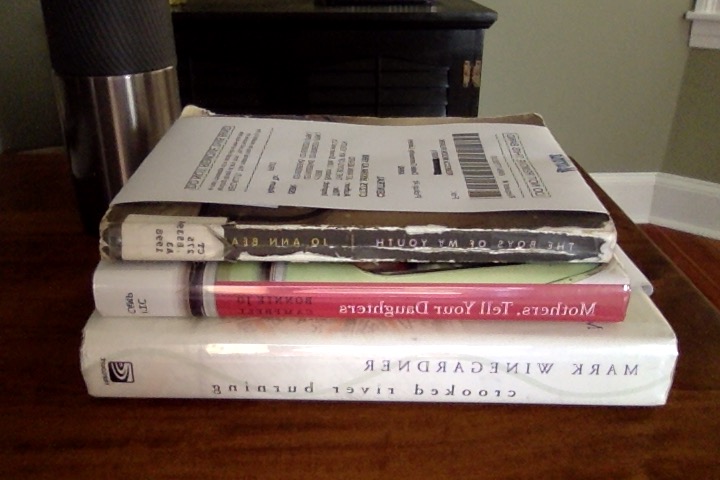
Yep, this pic is backwards–just testing your eyesight.
That’s…
one well-loved copy of The Boys of My Youth (by now a veritable classic among modern story collections) by Jo Ann Beard, author of the novel In Zanesville, which I reviewed here last year.
Mothers, Tell Your Daughters, a story collection by National Book Award finalist Bonnie Jo Campbell, queen of rural noir–if you’re asking me. I touch on her collection, American Salvage, here. Prefer novels? Campbell’s Once Upon a River is a nearly perfect little gem set in rural Michigan. Sorta rural rust.
Touted as a “masterful saga” of the “conflicted city” of Cleveland, Ohio, is Mark Winegardner’s Crooked River Burning. Can’t believe I haven’t read this one yet. The front material for the novel includes:
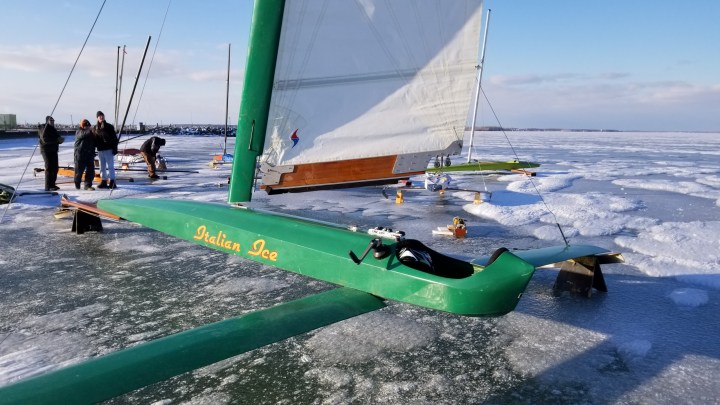
Nice shot of a Skeeter-class ice boat. (Thanks, Dad!)
Here at Rust Belt Girl, my followers know I am a dyed-in-the-wool Lake Erie booster.
My fondest memories of childhood take place at the lake–but they are usually warm memories.
However, fun on the Great Lakes doesn’t stop for a bit of cold and ice. My dad, who lives in Port Clinton, a Lake Erie town big on charter fishing, reports that the ice fishing is going strong this winter. Two thousand ice fishing shanties were counted on the lake at one time last weekend. That’s a lot of walleye!
For those who like to feel the 10 degree wind through their hair, there’s ice boating. Check out the Skeeter-class boat pictured above that can do 100 miles per hour in the right wind.
Brr, but maybe fun? (Honestly, I think I’ll stick to my indoor winter sports of reading and writing.)
Free image courtesy of KathrynMaloney at Pixabay.com
Think that’s a scene?
Sandra Scofield will tell ya:
In a scene, “Something changes or is revealed or new questions are raised; the ground is laid for future events, or the meaning of past events is made clear; characters show themselves to be who they are and make demands on one another. The story is moved along, often through conflict. The protagonist acts and is affected in some way. This happens through decisions and external acts, the stuff of change.”
As you see, today’s writing advice pertains to fiction writing and, specifically, the crafting of scenes. We all think we know what a scene is. But author Sandra Scofield makes sure we do with her classic craft book, The Scene Book: A Primer for the Fiction Writer.
Once we know exactly what a scene is and how to identify it in our stories…then what?
More fave advice from Scofield: put a box around them. (Yes, print the pages of your story or chapters out, and draw a box around each and every scene.) This way, it’s easy to see how much of your story is scene and how much is summary. This way, you can gauge if you have too much of one and not enough of the other. This way, you can easily shift scenes around so they add up to your best story.
Image of Mansfield Frazier. Photo by Jan Thorpe for Good.
“Oh my God, we’re in Hough,” my mom said.
I was a teenager at the time, sitting in the front passenger seat beside my mom, who was driving, her nose just inches from the windshield, as she strained (pre-GPS) to find her bearing–inspecting road signs, as we passed boarded-up houses and sketchy markets we viewed out of our periphery. (One of inner city Cleveland’s most notorious neighborhoods, Hough wasn’t the sort of place you looked at head on.)
And then she did it:
She locked the car doors with a resounding “click” I was sure could be heard by all in a mile radius.
“Oh my God.” A devout Catholic, my mom wasn’t one to take the Lord’s name in vain. So I knew this was serious–being lost in Hough–but I also felt shame. Here we had been in Cleveland, taking in the sights at the art museum, grabbing a bagel or bialy in University Circle, maybe? I don’t remember if we were heading back home from a theater performance at Playhouse Square–or maybe I had had a ballet rehearsal.
Anyway, a few wrong turns and we were in Hough, the site of riots during my mom’s years as a student at nearby (Case) Western Reserve.
We got out of Hough; my mom found her way back through the parts of the city she’d known as a student and young married woman, and we made it back to our house in the country.
It wasn’t until later that I contemplated those who never got out of neighborhoods like Hough; and much later that I contemplated those who didn’t want to.
Reading The Cleveland Anthology, I came across a piece by Mansfield Frazier called “A Vineyard In Hough.” Yep, a vineyard.
Here’s how it started: Frazier, who writes about “the problems of the underclass” and his wife, who holds a master’s degree in social work, didn’t want to be “arm’s length liberals,” so they moved to inner city Hough in 2000 in an attempt to “recreate a vibrant middle class neighborhood.”
There, they created a vineyard, a sustainable green project that encourages neighbors–including recent parolees–to work together on a project that creates “a much stronger social fabric.”
My mom passed away almost 12 years ago now, and in that time Cleveland–and Hough–has changed. I like to imagine how a trip to Hough might go now.







 Rust Belt Girl