From Petrichor, Pittsburgh’s art scene magazine: A photog. review by Emma Riva

I have long admired the art writing and advocacy of Emma Riva, Petrichor’s founder and editor-in-chief. After reading this exhibit review, you’re going to want to follow Petrichor and everything Emma does! Click below…

A little more from Emma about Pittsburgh’s art scene and her place in it:

“I do know one thing, whether Pittsburgh is in the Midwest, Appalachia, or the Mid-Atlantic, Pittsburgh is home. And something great is happening here.  My writing background is in the novel, and I’ve struggled with whether being an art critic and being an author are mutually exclusive. But maybe I was never meant to tell stories by myself. This magazine is the novel of our art scene here in Pittsburgh. I want us all to create it together.”

“Taking the Cow Path to Culture”: an Essay by Christina Fisanick

I’m thrilled to present the second in a series of guest posts interrogating place here at Rust Belt Girl. Christina Fisanick is a champion for Appalachian writing–and Appalachian voices, young and old. (Read her whole bio below.) “Taking the Cow Path to Culture” appears in her book, Pulling the Thread: Untangling Wheeling History, which was published in 2024 by North Meridian Press.

Taking the Cow Path to Culture 

by Christina Fisanick 

Route 88 meanders through the Ohio Valley countryside, connecting the city of Wheeling, West Virginia, to Oglebay Park and small, rural towns and farms along the way. More significantly, for some, Route 88 is the lifeline that carries students, faculty, staff and visitors to two of the area’s oldest institutions of higher education, West Liberty University and Bethany College. This important role earned Route 88 the seemingly humorous moniker, “The Cow Path to Culture,” and is a standing metaphor for much of life in the northern part of the Mountain State and throughout Appalachia.

Route 88 was once an actual cow path upon which animals were herded across the farmlands of the region. Like many other places in the country, it made more sense to locals to pave the beaten cow path than to blaze a new trail as modes of travel advanced. But as has been somewhat painfully obvious over the last century, maintaining the well-trodden road might not be the best way to go. 

In 1893, a minor New England poet, Sam Walter Foss, wrote a poem with a major message. “The Calf-Path” tells the story in verse of a path driven by a calf through Boston, which, after years of other animals, and eventually humans, following the path, was paved and became a major thoroughfare. The funny, yet poignant, poem takes readers on a journey through time and encourages deep thought about life decisions. Mainly, Foss wonders, why should we continue going down the same road in deed and thought when it might not be the most direct or even the best route?

Just like the calf path in the poem, Route 88 rambles and turns and plunges on its trek from Wheeling past Oglebay Park beyond the farmlands and homes and on to West Liberty University and then Bethany College. I commuted to West Liberty in the 1990s and cursed the winding road more than once during the icy winter months. My classmates and I anxiously wondered who would build a college on top of that hill? More so, we jokingly wondered how we made it to graduation.

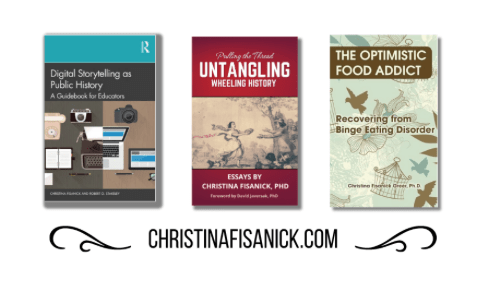
Covers of three of Christina Fisanick's books: Digital Storytelling as Public History; Pulling the Thread: Untangling Wheeling History; and The Optimist Food Addict: Recovering from Binge Eating Disorder

We were not the first students to ponder such things. A 1972 Sports Illustrated article tells the tale of four student-athletes from Israel—Avraham Melamed, Moshe Gertel, Yoel Kende and Danny Stern —and their “250-pound Irish Catholic coach,” Tom Grall. The students were recruited for the West Liberty swim team. Avraham Melamed described their journey from the Pittsburgh airport along Route 88 in harrowing, awe-struck terms then concludes: “It was easier getting from Ramat Yohanan [Israel] to Pittsburgh than it was to get from Pittsburgh to West Liberty.” Writer Mortin Sharnik paraphrases Melamed:

“All roads do not lead to West Liberty, but one that does, Route 88, is called the Cow Path to Culture. The Israeli was taken on a more scenic route, a roller-coaster ride over a ribbon of cracked concrete, with no guardrails to prevent a car from taking a shortcut down a ravine. Melamed kept his nose pressed to the car window, looking for the bright lights. Instead, he saw farms, strip mines and hairpin curves.”

The effort, of course, was worth it. The Israeli students went on to make the swim team as winning as West Liberty football, which at the time the article was written had two consecutive undefeated seasons. More so, they earned great educations from the oldest institution of higher education in the state of West Virginia.

While Sharnik’s article is a fascinating and humorous look at the past, it is the title that catches my attention: “Wandering Jews in an Unpromising Land.” Clearly, Sharnik was playing on the students’ ethnicity and well-known Biblical references. Regrettably, the term “unpromising” is simply the same old stereotype of West Virginia arrived at by taking the same old mental cow path. Now, 46 years later, that cow path has been paved over again and again, and few people outside the state (and even within its borders) are willing to blaze a new trail. West Virginia needs to free itself of the shackles of presupposition that continue to hold us back from achieving greater success.

These stereotypes not only negatively color West Virginia, but all of Appalachia. We are told time and again by the popular media (and even ourselves) that there is nothing here. Appalachia is a wasteland, people say. A no man’s land of little possibility and less opportunity, they echo. And more often than not, this lack is blamed not on politicians or exploitive company owners, but on Appalachians themselves.

This blame goes back decades to early literature, TV shows and movies that exploit the region’s hardships for book sales, ratings and box office records. Few can forget The Beverly Hillbillies and their clueless, backwoods characters with hearts of gold or the psychologically deranged figures from Deliverance. Popular culture tells us that Appalachians are poor, willfully ignorant souls who are too lazy to improve their lots in life. These ideals have been further entrenched by presidential “poverty tours” conducted by presidents and other politicians throughout the 1960s to prove to the American people outside the region that Appalachians are poor, white trash that need their help.

Unfortunately, many of our own people have embraced these ill-conceived views of ourselves and live accordingly. Of course, we never see ourselves as morally-bankrupt, ne’er-do-wells, but we willingly believe it of our neighbors. J.D. Vance does this in Hillbilly Elegy, of courseHe encourages the country to continue to blame Appalachians for our misfortunes. It is our own fault that we suffer from the world’s highest rates of opiate addiction, he argues. It is our own fault that many of our children live in poverty, he states. By continuing to claim that Appalachia’s poor are responsible for their own conditions, the nation’s eyes can be averted, not out of guilt but out of blame. Our country’s hands can be washed clean since Appalachians create our own misery and wallow in it.

It is easy to see why this particular cow path has been well-worn and paved over. It is to the benefit of politicians whose pockets are lined with money from the oil and gas industry to continue to shame and blame our people so that they never ask for more. Our land has been raped of resources while our people have been underpaid and exploited. None of this could happen if not for desperation and mentally following a well-worn cow path that leads to broad, self-defeating conclusions about poverty, drug abuse, and job loss.

Even now, young men fight for jobs in the dying coal industry for the promise of what they believe once was but will never be (again). Now is the time to take a different path. One that is not littered with stereotypes and preconceived notions. I am reminded, as I am sure you are by now, of another poem that urges readers to take the road “less traveled by.” I urge you, my fellow West Virginians, imagine a different life for yourselves and for generations to come. I’ll always take the cow path to culture to serve my alma mater. West Liberty University is in my heart forever. But my mind will be on a different metaphorical route that allows for new possibilities for West Virginia, Appalachia, and its people.

We no longer have to play the role of eager simpletons to keep our jobs. There are no jobs. Let’s create our own through education, new industries, and innovation. A change in mindset will make all the difference. In this moment we must abandon who we are told we are and become who we know we are. We are West Virginians. We are Appalachians. Toughened by adversity, wizened by necessity, and softened by empathy.


A photo of the cover of Pulling the Thread: Untangling Wheeling History, essays by Christina Fisanick, Ph.D. Forward by David Haversack, Ph.D.

Pulling the Thread: Untangling Wheeling History

By Christina Fisanick, Ph.D.

North Meridian Press


Photo of Christina Fisanick, Ph.D., with red hair and gold earrings and wearing a black sweater.

Dr. Christina Fisanick is the author or editor of more than 30 books and dozens of articles, essays, and poems. Her latest book, Pulling the Thread: Untangling Wheeling History, is a collection of essays focusing on little known stories from Wheeling’s past. She is currently working on an historic novel which takes place at Fostoria Glass in Moundsville, WV, in the years immediately following WWII and co-editing an anthology, “We Are Here!”: New Writing from Northern Appalachian (forthcoming for University of Kentucky Press). In addition, Fisanick is an English professor and an internationally recognized scholar in the teaching of digital storytelling as public history. Fisanick serves as the president of the Writers Association of Northern Appalachia (WANA) and the co-host of WANA LIVE!: The Reading Series. Learn more: christinafisanick.com.


Doesn’t this essay just get you thinking? What are a place’s histories, byways, characteristics, and quirks–and how have they shaped its people and its art? How have they shaped the stories we tell? For this series, I suspect we will get some fascinating answers to these questions and many more I haven’t thought of. I hope you’ll join in and share your thoughts!

Like this post? Want more? Comment below or on my FB page. And please share with your friends and social network. 

Are you a Rust Belt writer interested in seeing if your own post, or author interview, or book review might be right for Rust Belt Girl? Hit me up through this site’s contact function.

Check out my categories above for more guest posts, interviews, book reviews, literary musings, and writing advice we can all use. Never miss a post when you follow Rust Belt Girl. Thanks! ~Rebecca

Emma Riva of Petrichor reviews WAYS OF PITTSBURGH

Rust Belt Girl readers, don’t miss the latest from Petrichor–Pittsburgh, Pennsylvania’s art scene magazine. Founder and Editor-in-Chief Emma Riva is doing an incredible job covering the scene.

Ways of Pittsburgh: Exploring and Painting our Skinny Streets captures the plein air painting of Pittsburgh’s own Ron Donoughe. Let me tell you, his work is like no plein air landscape painting I’ve ever seen! Donoughe paints the city’s narrow backstreets–even the graffiti. A real talent at capturing light, I think some of his paintings of houses resemble Edward Hopper’s work. See if you agree, when you check out Emma’s review–and give Petrichor a well-deserved follow!

If Emma’s name seems familiar, you might remember her review of Tess Gunty’s National Book Award-winning novel: The Rabbit Hutch‘s Rust Belt Renaissance–published right here at Rust Belt Girl.

We’re closing in on the end of the year, friends, which means reading roundup time! So, tell me, what’s been your favorite book of the year? Let me know in the comments.

Let’s start a discussion! Comment below or on my FB page. And please share with your friends and social network.

Check out my categories above for more interviewsbook reviewsliterary musings, and writing advice we can all use. Never miss a post when you follow Rust Belt Girl. Thanks! ~Rebecca
*header image courtesy of Pexels Free Photos

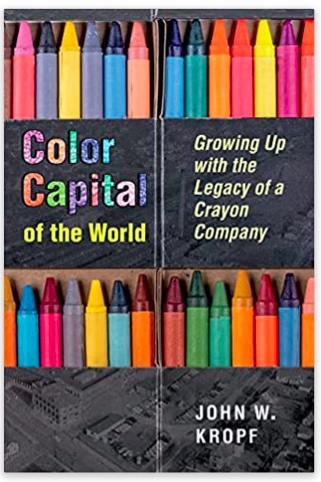
My interview with John W. Kropf, author of Color Capital of the World

For you Rust Belt boosters, Sandusky aficionados, history buffs, arts lovers, and education champions … I’m so pleased John Kropf agreed to answer my questions about his fascinating historical memoir …

John Kropf is the author of Color Capital of the World: Growing Up with the Legacy of a Crayon Factory (University of Akron Press, 2022). Color Capital provides a history of the crayon through the build, boom, and bust of the American Crayon Company. Readers will come away feeling a greater appreciation of the human story behind the crayon and the Ohio town that produced more crayons and paints than anywhere else in the world. Melissa Scholes Young, author of The Hive and Flood, described it as a “delightful and engaging read.” Kropf’s earlier work, Unknown Sands: Travels in the World’s Most Isolated Country, was praised as a fascinating narrative bound to hook adventurers. His writing has appeared in The Baltimore Sun, Florida Sun-Sentinel, The Washington Post, the Middle West Review, and elsewhere. Kropf was born in Sandusky and raised in Erie County, Ohio. He works as an attorney in Washington, D.C., area.

John, multiple lines of your family came together to make the American Crayon Company, begun not long after the end of the Civil War. Your grandmother was the one to tell you the stories of the company. In Color Capital, you write that it was at her “Sunday afternoon dinner table with its white tablecloth and real silverware [where it] felt almost like I was receiving a sacrament in church. I was hearing the gospel of the crayon.” You also write, “Crayons were my birthright.” What did it feel like to have this legacy, as a child, and then see it decline and finally disappear? 

Be careful of the stories you tell your children! My grandmother’s stories and the magic of crayons was a powerful combination for a young child. Crayons were somehow different–not like ball bearings or rolls of finished steel. Crayons were something easily understandable and exciting for a kid. And from a kid’s perspective, I thought there must be a way to keep it going. As I mentioned in the book, I desperately wanted to find a way to be part of it, but by the time I entered high school, I realized the company had been sold from the founding families and I could see the decline of the company coming. Maybe the hardest thing was decades later reading the stories in the Sandusky Register that the abandoned factory building had been neglected for so long it was falling into ruin. It was kind of like seeing an old family relative with no one to take care of them. There’s a head-heart issue going on–your head knows it is the natural end of a business but your heart reacts to mourn the loss.

I am a big crayon fan now! I never gave so much thought to the importance of crayons. One very important point you make in the book is that this was something made and built for children. I was fascinated to learn that the crayon movement and the kindergarten movement (pushed by German immigrants) coincided. Yes, there were crayons made for train workers, carpenters, and other industries, along with crayons made for artists; but the bulk of crayons made were made with children and their art and education in mind. In your research, what was the thinking behind these Germans interested in putting color sticks in children’s hands? What a shift after a time of war, I would think, this time of color. That shift in the company from the “rugged utility of blackboard chalk and industrial markers” to “pure creativity and imagination of children and artists.” What do you make of that?

Yes–it was an exciting time in education. The crayons that American Crayon Company and others, like Binney & Smith, created in the first part of the 1900s were practical and inexpensive. American Crayon even made “penny-packs” that had different pictures on the back of the package to encourage children to color. We think of computers in a similar way being introduced in the 1980s in schools and colleges. The introduction of affordable color crayons to young children was revolutionary. Coloring contests in schools were a big deal, where the winners could earn prizes and national recognition. American Crayon even developed a magazine written by educators, called Everyday Art, to help teachers with coloring projects. 

It goes hand and hand with the art education of young students that Sandusky was a pioneer in secondary public education, as one of the first towns in Ohio to develop a public high school. From your research, can you tell us what made Sandusky an education leader? What were the conditions that made that possible?

I think some of the conditions go all the way back to Ohio being part of the Northwest Territories. The Northwest Ordinance that carved out Ohio and other Midwest states mandated public education among its first articles. The emphasis on public education created a demand for new and innovative teaching techniques–the kind that drew one of American Crayon’s founders, Marcellus Cowdrey, to Sandusky to become its first superintendent of schools. Marcellus had been educated at a teaching academy in Kirtland, Ohio, and he emphasized good penmanship as a critical skill to learning. From his start in Sandusky, Marcellus wanted to ensure his students would have practical effective means of practicing their penmanship, starting with chalk on the blackboard. His techniques helped create Sandusky as an innovative center for public schools and set the stage for better writing implements. 

Your book helped me learn about Sandusky from the ground up, as “The Color Capital of the World,” as a relative of yours said the city was known. Sandusky is also known for its gypsum mines. I had no idea what gypsum was, until I read this, and I certainly didn’t know it was used to make crayons (among other things). You detail the development of the formula for crayons (slightly different across brands). I’m thinking the crayon recipe likely ran parallel to other industrial recipes. Can you give us a sense of what else was being developed in the time period that this development is happening?

Researching the book, I learned that gypsum deposits in northern Ohio were a vestige of glaciers. The deposits are found in silts and clays in the beds of former glacial lakes. William Curtis, the crayon company’s inventor, had access to the gypsum through his brother-in-law, John Cowdery, who ran a local outdoor nursery located near an abandoned quarry with a deep pond in it.  I like to think the American Crayon Company was truly connected to the land and water of Ohio and nearby Sandusky Bay.

In your book, you also give readers a history lesson of the greater area, going back to the end of the Revolutionary War. At the time, Sandusky was part of the Northwest Territories, created in 1787 by congressional ordinance. This fascinating piece of history I didn’t know: “…the ordinance did something the U.S. Constitution had not been able to do—explicitly ban slavery throughout the territory.” That fact, along with the fact that Canada is just across Lake Erie made Sandusky a “critical link” on the Underground Railroad. Can you tell us another historical fact of the area, one that maybe didn’t make it into the book?

Sandusky had been at the center of innovation in the 1800s. I mentioned in the book that the first chartered railroad west of the Allegheny Mountains was started in Sandusky, The Mad River and Lake Erie Railroad. The railroad created a demand for skilled mechanics and engineers and that is what attracted my great, great grandfather, Jonathan Whitworth who emigrated from England. It was his son who was one of the founders of the crayon company. 

It’s also worth mentioning that at the very end of the 1800s Sandusky begin building segments of an electric interurban railway that later merged Lake Shore Electric Railway that connected numerous small communities with Cleveland, Toledo, and Detroit. The was the second railway of its kind in the country. Coincidentally, Thomas Edison had been born in Milan, Ohio, in Erie County just 10 miles south of Sandusky. 

The American Crayon Company, at its peak, employed about 500 factory workers, salespeople, and staff across several offices around the country, with the factory in Sandusky. What was Sandusky like in this heyday?

I don’t know if it was the heyday, but as a child in the 1960s, Sandusky, like so many other small and medium sized towns, still had a thriving downtown shopping district including a department store. It was in the early 1970s that the Sandusky mall was built south of town and the downtown followed the pattern of so many others with stores closing. What’s ironic is now many of these malls are struggling to survive or closing. I’d like to think people truly value the downtown experience of a real town. 

There are glossy, full-color photos in the center of the book that really are compelling. Can you talk about your favorite photo(s)—one that was a challenge to get, maybe, or one with personal significance?

I suppose the one that I’m partial to is of William Curtis in his Union Army uniform holding a sword. He has the most intense, hardened look on this face. I try to imagine what he must have been thinking at the time. 

Your personal connections are what makes this a memoir, even more than a fascinating history of a place, and I most like when you consider how the generations before you might have felt. Your great-grandfather went from grocery clerk at age fifteen to a bank president to American Crayon Company president in thirty years. This is American Dream kind of stuff. You went to law school and have a good career. What do you think he would say if he time-traveled to the here and now to see you?

I’m not so sure I could imagine what he would say or think. I know, I’d have many questions for him about how he learned about business and how he took a risk with financing the crayon company. 

I found the parallels you draw in the book between Sandusky and your personal journey really illuminating. You write of the difficult times in your family, when over the course of a few years, your grandmother died, and then your parents divorced and you moved with your mother to a nearby town. You say, “The outside world in the mid-seventies also seemed to be in decline…Familiar stores in downtown Sandusky were closing and land was being cleared south of the town for the new Sandusky Mall.” (If that’s not a death-knell for our historic downtowns, I don’t know what is.) Do you think these parallel declines helped push you to go away for your education and career? 

I didn’t think about it consciously. I suppose I didn’t see the kind of opportunities that I wanted in my future with so many businesses closing. The metals company that my father worked for in Sandusky was bought out and he was transferred out of state. I even worked there a summer in college but that foundry was later shuttered and demolished. I suppose I was lucky enough to have very supportive and encouraging parents who had lots of books in the house that exposed me to many different places and ideas. Pursuing a law degree was what I felt was a form of security in reaction to the insecurity I saw around me.

After college, you made the same journey your grandfather did 70 years before, across the U.S. from Sandusky to Pasadena, California, where he had American Crayon offices. Why did you make his trek? And what was the most important thing you learned from yours?

I think having an adventure before I stepped into the professional world was something I had to do and it was also a way for me to connect with my grandfather who had just gotten out of the army after World War I [when he made his trip]. One of the parallels that I loved was that we were both 26 when we made our trips. I was preparing to start my first job as a lawyer and he was preparing to go into the family business at American Crayon. I even hope to write a book about his trip and my trip, together. I published a magazine article out of it and I still haven’t given up the thought that I could do a book on our parallel trips, me following in his footsteps.

In 1988, you moved to D.C. and started your professional journey. Fast-forward to your book. Why did you write it when you did? What was the impetus?

In short it was loss. In 2014, I first read about the abandoned American Crayon Company in Sandusky and the long drawn out wrangling over its demolition. A short time later, I lost both my mother and sister who were part of that crayon story. Two years in a row, I returned to Oakland Cemetery in Sandusky, both times to bury them next to the founding family members of the crayon company. My father also died about this time and I felt I was the last one standing that had the stories I wanted to share.

You talk about Sandusky as a younger sibling of Cleveland to the east and Detroit to the west. I’m reminded of the smokestacks our native cities have in common. You’ve been taking your story to the Cleveland area and other neighboring places. I’m guessing you’re hearing some similar stories of the rise and fall of industry and small manufacturing in other places. What’s the reception been like?

It seems like a natural fit to me that the story of an innovative and successful industry hits its bust. People understand that story in Cleveland, Akron, Toledo, Detroit, and many of the other Midwestern industrial towns. In researching my book, I read a lot of other memoirs from these cities and understood their build, boom, and bust stories.

You write, “…under the monochrome, gray skies of northern Ohio, was an explosion of color.” Northern Ohio, along the lake, is known for its overcast skies. I think it’s romantic but it can take some getting used to. I’m imagining crayons and colors mean so much more to children who don’t get to glimpse the sun from November through March. (That might be an exaggeration.) Can you tell us a personal childhood crayon story that didn’t make it into the book?

When I wrote that, I kept thinking about the contrast between the grayness of northern Ohio in the winter and the spectrum of brilliant colors being produced on the inside of the factory, and how the colors were being sent out to the world to help brighten things up. 

The fall of the American Crayon Company mirrors the decline of manufacturing and industry across the Rust Belt. What did it mean for Sandusky when the company was sold and the manufacturing moved to Mexico? What did it mean for you, personally, as a son of Sandusky and a legacy child of the American Crayon Company?

It seemed like adding insult to injury in ending such a great company. When I spoke at the Sadusky library about my book, there were union members from the factory who told me they refused to train their Mexican counterparts and that scabs had to be brought in to try to train them on the antiquated and delicate equipment. When the venture in Mexico failed within a year of its relocation, it seemed like there was some sort of small irony at play–equipment taken from the American Crayon Company transported outside the country was never meant to operate anywhere else but Sandusky, Ohio, U.S.A. 

What has it meant for you to see Sandusky come back again, the action on the waterfront, new condos where old industry was. What are your favorite places to go when you go back? How about your favorite local beer or other beverage? And, if there is one, a particularly Sandusky meal you never miss?

It’s actually very inspiring to see Sandusky making this transition. It will never be the same type of manufacturing center it was but I don’t think that could ever come back. What I’m pleased to see is the preservation of some of its great old limestone buildings and city and business leaders looking ahead to capitalize on Sandusky’s location on the waterfront along with nearby Cedar Point Amusement Park and Sandusky’s other historical sites and markers like the Underground Railroad.

Favorite places are the downtown waterfront, including a look at the coal docks that are a prominent feature of Sandusky’s skyline. Other stops are the Sandusky Library and Oakland Cemetery and newer spots like the rooftop bar of the Kilbourne Hotel that overlooks Sandusky Bay.  

As far as food goes, whenever I’m in town, I always stop for a Lake Erie Perch sandwich. 


Be sure to follow John on Twitter (@JKropf)–especially if you’re in Ohio. His pinned tweet lists his author events, a few of them next month!


Like this interview? Comment below or on my FB page. And please share with your friends and social network.

Are you a Rust Belt writer interested in seeing if an author interview or book review of yours might be right for Rust Belt Girl? Pitch me through this site’s contact function.

Check out my categories above for more interviews, book reviews, literary musings, and writing advice we can all use. Never miss a post when you follow Rust Belt Girl. Thanks! ~Rebecca

Enter your email address to subscribe to this blog and receive notifications of new posts by email.

Not that curve: Discover Prompts, Day 8

Interior: figurative artist Rick Casali’s studio.* See more at rickcasali.com

When a sculptor lives across the street, you get these kinds of curves. You get to see them form. And, yes, when your little kids visit the artist’s studio, the boys get to enjoy a different kind of anatomy lesson than the kind they get in school.

This afternoon of isolation, some of my boys’ science schooling is happening in the yard, where they are helping my husband plant a hydrangea bush. After some exercise and vitamin D, they’ll complete their science projects on the skeletal and muscular systems of the human body. As they were introduced to these systems, I marveled at their inter-dependency–both the systems’ and the boys’.

You would think they’d get sick of each other, my little guys, weeks into our isolation at home; yet, they don’t seem to. They have known each other–curving into one another, entangling their limbs–since the womb. And they still do this. The horseplay and wrestling–those are embraces. They’re not fooling me.

I’m grateful they have each other, and that I have them. And I’m hopeful that before too long our world will open back up again–to experience art and everything else.

For now, please check out Rick Casali’s art at his website, on FB, or on his YouTube channel. And thanks, Rick! *Image credited to the artist and used with his permission.

I’m chronicling our isolation with the help of WordPress Discover Prompts. This post was in response to Discover’s daily prompt: Curve. Care to join in? Looking for more to read? Check out my categories above, with author and photographer interviews, essays, stories, book reviews, writing advice, and more.

Open…water, heart, art: Discover Prompts Day 2

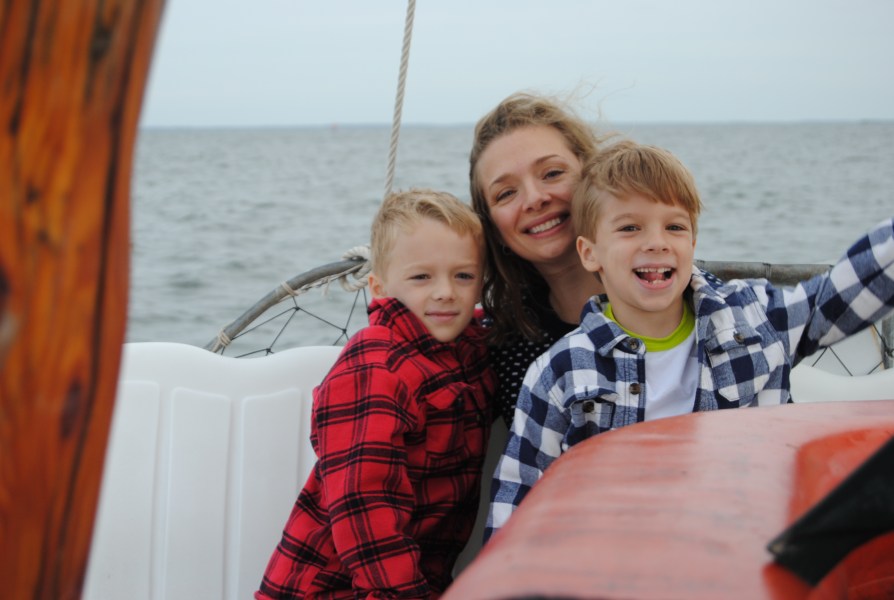
My boys and me on open water, cruising on the Rebecca T. Ruark (no relation but regional) one of the oldest working skipjacks on the Chesapeake Bay

I’m trying to remain open, these days of isolation, to what might pass for connection now. I try not to rail against the world for small annoyances–and thereby close my heart to possibilities. I try not to cry at the faulty internet connection that makes me drop my first-ever Zoom call. I should be happy for technology, for the virtual happy hour with my friends in town, happy to have friends, a town, a house, a basement I can sit in–which is dry despite all the rain–where the Wi-Fi works best.

Another friend dropped toilet paper at my kitchen door today–the best kind of pandemic calling card. Yet another friend, far away, is teaching her four-year-old his letters and decided to bring pen pals back. My own boys are practicing their cursive on loose-leaf (I’m glad we don’t have to re-purpose for the bathroom) and have discovered the joys of snail mail. My freelance work has me writing for hospitals, which makes fiction feel not just false but useless. My creative writing is changed, not closed, but working through different channels now.

A novelist friend, when addressing how to write at such a time as this, suggested acting like a different kind of artist. Writers, try on your dancing shoes. Performers, take to the page. That kind of thing. I desperately miss singing in my choir, raising my voice in song. I’ve written about it here and here and mused on singing for Ruminate, here. But I don’t seem to be able to open my mouth in song today.

I recent days, I have written a short essay and a flash fiction piece, departures from my WIPs–historical novels that don’t let me address this present moment. It’s a moment I don’t want to close myself off from–or forget–for the lessons it might teach me. Meanwhile, I should be teaching my kids; we should be writing a middle grade book together. Maybe we will, and set the story in a wooden boat.

The day before my state’s governor issued the latest isolation mandates, my husband and sons took to the water. My younger twin named the dinghy, “Aqua Dove”–big name for a small boat. With oars, a centerboard, and a little sail, I hope it will give my boys a sense of freedom on open water, when this is over.

WordPress is doing daily Discover Prompts. This was my response to Discover Prompts, Day 2: Open. I hope you might join in!

a bit of writerly advice for March 7, 2020…

Free image courtesy of KathrynMaloney at Pixabay.com

It’s been a minute, or much more than a minute, since I checked in with my blogger-reader-writer friends. How’s it been? Around here, work and family life have filled every spare moment of mine this past month, except for a few precious minutes before bed–that I give to reading (just finished Dominico Starnone’s Trick, trans. by Jhumpa Lahiri–and I’ll definitely be blogging about it).

Any creative writing I’ve been doing has been mostly in my mind. One thing I’ve been mulling over: why do we write about what we write about? Some write to excise their greatest anxieties. (“Write toward your fear,” go the writing prompts.) Some write to work through a conundrum, to better understand. Why do we pick the subjects we pick? Love, sex, parenthood, sickness, birds, flight, death, water, dance…

An artist chooses his subjects. That is the way he praises.

Friedrich Nietzsche

Why do you create what you create? Why do you write about, what you write about? What compels you? What are you writing–or reading–this weekend? I hope it’s a good one!

Want some more writerly advice? See my categories, above. And, as always, you can also find me at FB and @moonruark on Twitter.

Art Works

20181028_152516
This post’s photos taken by me of Donald Stoltenberg paintings on display (and for sale) at Annapolis Marine Art Gallery, Annapolis, Maryland.

Give me a painting of a shipyard over a regatta, a work boat over a pleasure cruiser. Give me the smell of diesel, sweat, and fish. Might not be pretty, but it works.

For me, art that works–that shows scenes of toil and industry, of creating and crafting–appeals more than art that features placid scenes. Sorry Manet, Monet, and pretty much anything on a rou de someplace.

Why? Well, there’s the Rust Belt influence, the legacy and lore of waterways that sustained the heavy industry that built places like my native Cleveland, Ohio, along Lake Erie, and like Pittsburgh, Pennsylvania, with its three rivers.

And, like Milwaukee, Wisconsin, where the late artist, Donald Stoltenberg, was born in 1927. Stoltenberg was new to me, until a recent visit to nearby Annapolis.

While I gravitate to industry and toil in art, I look for the same in the literature I read–and write. To me, a character is never more him- or herself than when working. Why? Simple. Work breeds conflict and conflict drives story.

Some of the best advice I received as a writing student was to introduce characters to  readers by showing them at work. This gets the characters out in the world, acting and reacting–and soon (as we all do) facing big problems, problems that will need to be, ya know, worked out.

So, as I think about the characters of my current WIP*, I’m putting them to work, testing their mettle, and seeing what they’re made of. Works for me, and I bet it’ll work for you.

What are you working on right now? A blog post? A story? A piece of art? What works for your characters? For you?


*Speaking of my WIP, I’ll be taking much of the month of November off from actively blogging to focus my attention on research and work for my WIP, as well as submitting to journals and agents before the end of the year. But I will be back! In the meantime, please see my categories above for writing advice, author interviews, publishing journey woes and successes–and keep on reading and writing (the Rust Belt and everywhere else).


Sport in the Art of Place

I went for the art of the place: the earthy poetry and fiction borne by writers tied to the ever-evolving American Rust Belt, which has seen its share of glories and struggles, stemming from the rise and fall of mining and heavy industry.

And, I admit, I fretted just a little bit about what to wear. Stay with me…I haven’t gone all fashion blog on you.

No surprise that among the students of creative writing, the authors, editors, publishers, and poets attending the literary conference–there were ensembles of black, a poet skirt or two, and a pair of cat face-festooned flats (for real; they were fabulous shoes).

There was also a Browns cap. Yep, those Browns. The NFL team that went win-less last year (after which the people of Cleveland held a perfect-season parade).

At the sight of that beautiful brown and orange hat at a literary festival, I knew I’d found my people.

It got me to thinking, if you Venn diagram a place (and this is as math-y as I get), how much overlap is there between the place’s art and the place’s sport? Let’s think on that a minute, while I take you with me on another trip.

Earlier this month, as the fall foliage reached its peak color, my family visited the lovely village of Cooperstown, New York.


20181006_123517
At Cooperstown’s Farmers’ Museum’s 19th-century Historic Village, a lovely way to spend an afternoon with the kids

For its small size, Cooperstown is a place with impressive arts offerings, but it is known far and wide for being the home of the National Baseball Hall of Fame and Museum.

Read more

For my ‘hood of humans: a retrospective and a gift

20180527_222603
The Port Clinton, OH, (Walleye capital of the world; don’t give me a hard time on this, MN) Walleye Festival 2018 at night. (Thanks for the pic, Dad!)

Nope, I’m not going to get all weepy on you (and I’m not going anywhere), but I am going to share a few of the coolest things that have come out of my first year, social–as in, social media.

A retrospective as it were (we will miss you, Daily Post.)

But first, a little tongue-in-cheeky lyrical accompaniment–hum along if you can–from “Brotherhood of Man” (a la How to Succeed in Business Without Really Trying):

There is a Brotherhood of Man,
A Benevolent Brotherhood of Man,
A noble tie that binds
All human hearts and minds
Into one Brotherhood of Man.


I don’t know a lot about brotherhood or business (OK, maybe a little about the business of writing), but I know that noble ties that bind are hard to come by anywhere.

Question: What connects us human readers and writers, really?

Answer: A love of ideas communicated as words, right? Carefully chosen ones–yes, all in the right order. Not the sort of stuff you can dash off between your Dunkin Donuts run and the office (unless you’re Hemingway and D.D. is a bar).

Rarely do I feel more alone in the writing world than I do while pawing my way through my FB feed populated by thousands of “writers” group members. You (and Mark Zuckerberg) don’t need me to tell you that there’s not enough real connecting–or even real socializing–going on, on social media, for writers, readers, or anyone else.

Not so for my WordPress Reader feed. Of course, I’ve taken the time to curate the scads of sites I follow. (If I’ve missed yours, let me know!) But there is, generally, great care and feeding done to the words that make up WP posts. And that care feeds community. So, here’s where I lament the draining of the Community Pool, especially, and and thank the WP editors for making it and the Daily Posts, like this, happen. (Not to worry, though, there is another pool I plan to dip my toes in and hope you might join me there.)

Back to the good care and feeding of our reading/writing community here and everywhere…remember when e-book readers made us fear the end of real books was nigh? In the same way I worried that email would disappear with my foray into social media. My findings: I still email the friends and fam I used to. And, guess what, people–even strangers–still respond to emails, even from bloggers (like this one), who reach out to writers they want to interview. I’m here to say email still works, and stay tuned for an author Q&A with Cinderland memoirist Amy Jo Burns, who will fill us in on her upcoming novel, Shiner!

My final finding in my very unofficial year-long social media study: the heated FB or LinkedIn debate: which is better suited to connecting with other writers and readers. My sense is that the pace of FB is more frenetic, making LinkedIn the place to connect with other communicators of your ilk looking to take the time to consider something more substantial than a jumping pygmy goat. (FB has cornered the goat video market, and that’s OK).

How do you best use social media to meaningfully connect with your fellow communicators?

I’d love to know.

And, as it’s the last day of short story month, I’d love to present a little gift, the latest issue of Flock literary journal (FREE to view online only until June 4), chock full of carefully tended words, all in the right order. Short stories not your thing (wah?)? How about a poem about honey? Art or interviews your bag? This issue’s got that too.

Hope you enjoy.