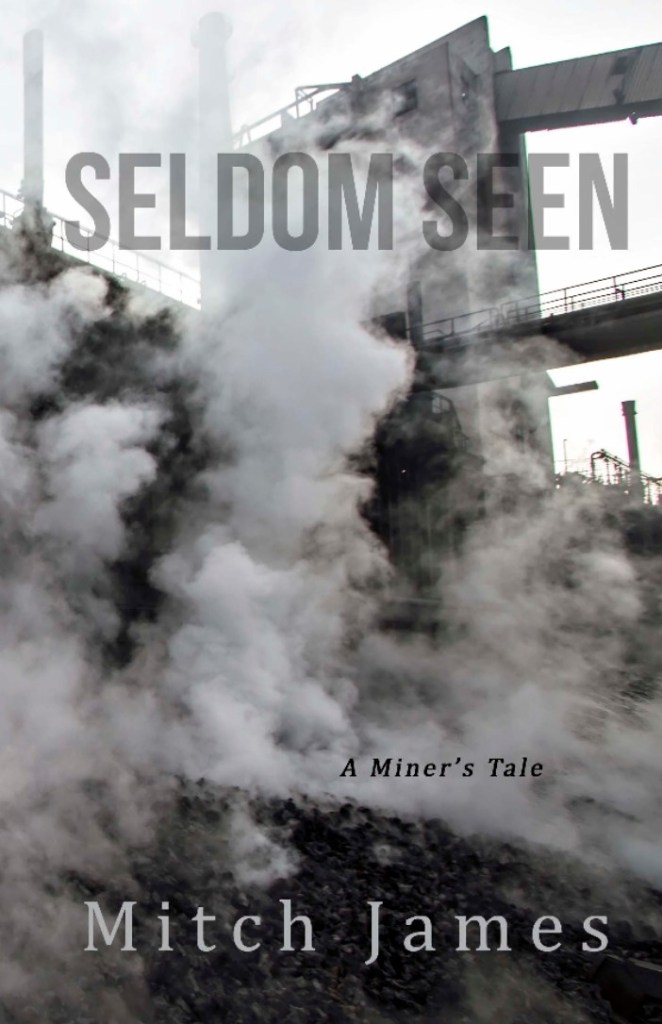
My interview with Mitch James, author of Seldom Seen: A Miner’s Tale

For my Appalachian lit aficionados, Grit Lit fans, and readers who aren’t afraid of the dark … I’m thrilled to share with you my conversation with author and professor Mitch James about his debut novel.

From the back cover, an intriguing blurb:

A dead mother. An auctioned childhood home. Loss in the womb of a coal mine.

Seldom Seen follows main character Brander, who encounters a “specter of a man who promises him that the answers to life are in Seldom Seen Mine, the largest coal mine in the United States.

With nothing holding him back, Brander … takes a job at Seldom Seen Mine, and fails at every attempt to amend his life, losing a friend, a lover, and maybe his mind.”

Reader friends, how does an author make good on such a blurb? I’ll tell you. With prose like this. I’m prefacing my first question for Mitch with one of my favorite passages in the novel. This is from early in the story, when Brander first enters Seldom Seen Mine:

Brander was surprised. The road was rather smooth and well-lit, the air stale but not dirty. They rolled along, everyone quiet. Brander stared around. The mine’s back had a skeletal structure of beams and crossbars and cribs, packed tight with backfill in places and all sealed up with gunite. It was surprisingly silent beneath the earth, the hum of the transport, the crunch of residue below the tires, the occasional whoosh of an air course. If not for the forced mechanization, there would be no sound, not like on the surface. Noise is life. But even free of men, the mine wasn’t dead, exactly; there was something, a kind of energy present in the long back road, an innate awareness, like the womb of a pulse-filled thing.

Mitch, welcome to Rust Belt Girl! Let’s dive in. The mine in this story works as much more than a compelling setting but a real character. I’d say we readers end up knowing as much about the mine as we do about Brander. How did you decide where to set this story? How did you learn so much about mines and mining? What kind of research did this entail?

I’m so happy to hear you’re engaging with the mine in that way because it is very much its own organism. It felt that way when writing the book, and it means a lot to hear that it felt that way to you as you read it. When I wrote the novel, I was up to my ears in rural Pennsylvania, working on farms, mountain biking old logging roads, kayaking rivers, and clearing land. I couldn’t get enough. I lived not far from the real Seldom Seen Mine. The research I did that allowed me to accidentally stumble into the idea for the novel also happened there. It was a perfect recipe—the need to express the region as I had experienced it as a transplant who had been there awhile, the need to tell Brander’s story, the need to imagine others’ lives and suffering alongside my own.

As for research, I read literary books on mining. There aren’t many. And I read short stories about mining in the U.S. and abroad. I read historical writing about mining at different periods in the U.S. in microfilm and microfiche. I watched a lot of YouTube videos, read instructional handbooks on mining equipment, found out who sold it, and found videos on how to operate it. I was friends with a mining engineer who guided me some.  A little bit of everything.   

Here at the Rust Belt Girl blog we’re a little fascinated with how place works in story. Place helps plots turn. Place also helps form characters. While a rural setting, I’d say that your Seldom Seen mine situates your novel squarely in Rust Belt lit territory. There are other commonly-appearing aspects to Rust Belt lit (or contemporary Grit Lit, writ large) that feature in your story: teenage pregnancy and the meth crisis for just two examples. Can you talk about how you explore such aspects of Rust Belt life and the characters living these lives without resorting to stereotypes in your novel (you do this well!)? 

I’m relieved to hear you don’t think my characters are stereotypical. I would never want that. That said, though, if I’m being honest, I think all fiction runs off a little bit of stereotype. I think most readers need to see characters that are somewhat familiar and that present themselves as equations they believe they can calculate, at least at the start. Lucky’s the gruff, crude, masculine man. Brander is the wounded, self-loathing Midwesterner. But beneath the stereotypes that reveal a small percentage of what makes up who we are is the rest of us, the best of us, the parts of us that are unique. Brander and Lucky also have these qualities within them. It’s my job to complicate their stereotypes by fleshing out the rest of their characters, for they drive the story. I see stereotypes everywhere, including in myself. But by seeing them, I can perceive their limits, their boundaries; I can peer around them to what else presents itself, and that’s gold as a writer, the stories everyone tells but doesn’t mean to.

Basically, look for the people within the people and write about that. Then be prepared to conscientiously employ a little stereotype to get the ball rolling.     
For those of us who are writers, ourselves, I wonder if you could take us through the process of crafting this novel. What was the first idea/image that came to you? When did you know you had to write this story? How long did it take? What’s your writing process like? We craft junkies want all the details!

The idea for the novel came to me when I was reading a translation of a Russian short story from the early 1800s, a story about a miner who encounters a ghost in a mine. The ghost starts manifesting in his life outside the mine until he goes insane and, if I remember correctly, kills himself. The story was so short. I wanted so much more. So I made it. 

When did I know I had to write the story? Immediately. I can always tell the difference between something I could write and something I must write. I had to write Seldom Seen.

As for the process, I woke up at 3 a.m., wrote a 1000 words a day five or so days a week, and had the first draft in a few months. Then it took me 10 years to publish the book, so you can imagine the revisions, drinking, and self-loathing that occurred after repeated failures. Brander had to get it from somewhere!  

I often wonder how Rust Belt lit will appear in American Literature textbooks a hundred years from now. Since you’re a college professor—maybe you wonder about this too? For me, my most formative American Literature course introduced me to William Dean Howells, the father of American realism. I’m not going to draw a perfectly straight line from American realism of the late 19th century to Southern Gothic of the early 20th century and the Grit Lit of today, but somebody could try. All that’s to ask where you see Seldom Seen fitting into the canon of American Literature? What are your reading/literary influences? What literary characters informed Brander, who—despite hard work and, yes, grit, fails, fails, and fails again?

It makes me feel a little pretentious to think of my work in any kind of canon. But my writing, including Seldom Seen, is influenced by myriad Appalachian, Midwestern, and American Western and South-Western writers, all rural and spread across the genres of fiction, nonfiction, and poetry. I would hope Seldom Seenwould be welcomed by the Appalachian literary community and rural literary communities more broadly. 

As for character influences, I have to be honest, I don’t know that I’ve ever consciously (though certainly subconsciously I have) created characters based on other characters about whom I’ve read. The characters begin with me, but they take over their story, and I just try and keep up and do justice through my writing to what they show me. I know that sounds mystic and woo-woo, but it’s the truth. For example, Lucky wasn’t a character I intended to have in the story, but when he showed up, he had plans, and I went along with them. Now, I can’t imagine the novel without him. 

As for the last part of your questions, I don’t need to read a book to see hard work, grit, and abundant failure in a person. I’ve witnessed it in the working poor rural communities I’ve lived in my entire life. But I want to make something clear; I’m not saying the working poor are failures or that their efforts are in vain. I was working poor until I was thirty-two years old. I worked fifty hours a week with multi-billion-dollar industries and still had no healthcare or money, and couldn’t afford a vacation or a car that could make it out of the county. Goals like a home instead of a rental, good health insurance, the ability to take a vacation or have a safe vehicle all create comfort and stability in one’s life. The working poor are grinding but failing to reach important thresholds like these and others. There are many reasons why, but amongst them are certainly socio-economic and political barriers. These folks, my mother and father, cousins, aunts, uncles, neighbors—they’ve taught me how to create characters with grit that fight and fight and fight.

This world has shown me how to write characters who fail.

And final question: What are you teaching, reading, and writing right now? What’s next?

I’m teaching various writing composition courses. I’m reading, gosh, so many random things. I feel like I read and read and finish nothing. I’m reading Larry McMurtry’s Horseman, Pass By; Marilynne Robinson’s Gilead; Adam Grims’ The Art and Science of Technical Analysis; Pema Chödrön’s When Things Fall Apart, and a textbook on world history because I screwed around too much in school when I was younger. I’m ashamed by how much basic knowledge I missed out on for being too stupid to know better. 

As far as writing goes, I just finished a book of poetry that a press requested and for which there is a promising chance of publication. I’m pitching a couple of short story collections and two novels and am kind of tinkering around on a new one, so if there are any publishers/agents out there who think my work and I might be a good fit, reach out. I’m doing some final revisions on two peer-reviewed articles due out soon as well. Keeping busy. 

Upcoming? I’m excited about the Lit Youngstown Fall Literary Festival. It’s one of my favorite events all year!  


Mitch James is a Professor of Composition and Literature at Lakeland Community College in Kirtland, OH and the Editor-at-Large at Great Lakes Review. Mitch is the author of the novel Seldom Seen: A Miner’s Tale (Sunbury Press) and has published works across the genres of short fiction, poetry, and academic scholarship. You can find his latest short fiction in Made of Rust and Glass: Midwest Literary Fiction Vol. 2Red Branch Review, and Bull; poetry at Shelia-Na-Gig, Watershed Journal, I Thought I Heard a Cardinal Sing: Ohio’s Appalachian Voices; and scholarship at Journal of Creative Writing Studies. Find more at mitchjamesauthor.com and on Twitter @mrjames5527. 


Like this interview? Comment below or on my FB page. And please share with your friends and social network.

Check out my categories above for more interviewsbook reviewsliterary musings, and writing advice we can all use. Never miss a post when you follow Rust Belt Girl. Thanks! ~Rebecca

Enter your email address to subscribe to this blog and receive notifications of new posts by email.

My review of RUNNING FOR HOME, Edward McClelland’s debut novel

For many years, the Lordstown Complex, a GM auto factory in Northeast Ohio, was a landmark along my drive home to family.

“Not long now,” I’d mutter to myself or say to my kids, if they were with me, and we’d marvel at the sea of cars in the auto plant’s gargantuan parking lot—and at the cars we couldn’t see, being made inside the plant’s operations. Lordstown, something like a prayer and a beacon both, calling me back to the place I still call home.

Poetical references aside, Lordstown was an economic hub for the area, for decades. In the 60s, when my dad first moved to the Cleveland area, met my mom, and married, that plant was making the Chevy Impala and then the Pontiac Firebird. And the people who worked on the line were making salaries better than anything my dad could make as a draftsman. But we all know what happened to auto-making over the next few decades. And, with each pass in recent years, that Lordstown plant held fewer cars in the parking lot, meaning fewer employees working fewer shifts making fewer cars. Last I remember in its history as an auto plant, Lordstown was the home of the Chevy Cruze. I hate to disparage, but how many Cruze drivers do you know?

It was with this point of reference—a familiar setting—that I came to Edward McClelland’s debut novel, Running for Home, out now from Bottom Dog Press. An accomplished journalist and writer of nonfiction—I loved his How to Speak Midwestern—McClelland has covered and written about the post-industrial Midwest, from which he hails, for a long time. This is the first novel for the Lansing, Michigan, native–and it hit home for me.

Running for Home opens on the Empire Motors body plant, “a permanent symbol of my hometown, as well as a gateway to opportunity,” says the narrator, high-school student and runner, Kevin. What follows is a story of the fall of industry in a place, coinciding with the rise of “a slight Midwestern youth,” our protagonist, in this coming-of-age story.

From the jacket copy: “In this moving new novel, [Kevin] deals with a rough high school and a vanishing factory town through a devotion to his running sport and his caring family. Aided by a spunky girlfriend, a humble-wise coach, loyal teammates, and his earned self-awareness, he learns the value of reliance and home.”

What sets this coming-of-age story apart? A narrator with a voice and a passion that ring absolutely true. And they should. McClelland ran track and cross country at his high school, across the street from a Fisher Body plant. McClelland creates a Michigan town setting that leaves no detail of the early 80s unexplored; from the fashion and games popular with teenagers—like windbreakers and Galaga—to movies and music—like All the Right Moves and The Sex Pistols. 

In this novel, the author doesn’t shy away from questions of economics and environmental concerns, things that are often at odds when it comes to industry. From Kevin’s perspective as a runner, we get a good view. There’s “the ever-visible rainbow slick on the river’s surface, the effluent of automaking” and the sweetly sick smell of chemicals on the air. Once the plant closes, Kevin both appreciates being able to breathe a little easier and knows life will be tougher, going forward. It hits home when his dad must take early retirement.

The author is also adept at dramatizing and characterizing the generational differences among auto workers, like the narrator’s father and grandfather before him. What did cars mean to men, especially, through these decades? To build one with other men on a line? What does it mean when your life’s work is sent elsewhere? Of course, what is done to a place is also done to the psyche of a place. From this book, I got an insider’s view, including of union operations—and what striking and winning or losing looked like in this era of plant closures and relocations.

What propels the plot, outside of the external forces of the town’s industry declining, is Kevin’s striving for success on the track. His passion is crystal clear: 

I ran because I was a runner, because running was my nature. I believed the fastest form of myself was the most perfect form of myself.

In writing fiction, we are often taught to have some kind of a “ticking clock,” to propel our plots and keep our readers turning pages. In this novel, the ticking clock is a stopwatch, and, race after race, we root for Kevin’s success in a sport where fractions of a second mean the difference between success and failure, between a scholarship to college or a ticket to an uncertain future.

What I liked the most—and you might guess by the novel’s title—is that this is not a story about success by getting out. That is an all-too-common trope. But it’s not only a trope in fiction. In an American era of urban sprawl and overcrowding, the post-industrial Midwest still has many places that lose more people each year, many young people among them, than they gain.

Leaving is easy. Just ask me. Staying, despite–or maybe because of–the odds is harder.

Do you have a favorite coming-of-age story set in your native place? Did you stick close to your hometown? Do you run? I’d love to hear about it. And, what are you reading or writing this week? 

Want more Rust Belt writing, author interviews, book reviews, writing advice, and more? Follow me here. Thanks!

Enter your email address to subscribe to this blog and receive notifications of new posts by email.

Running for Home

$18 Bottom Dog Press

What are you reading for Short Story Month?

Mother’s Day. Memorial Day. Let’s not forget the significance of the month of May for the lowly short story!

Yes, May is Short Story Month. You didn’t know? You didn’t send a card? Well, me neither. But I didn’t want this busiest of months to pass without sharing a bit of good news with my loyal Rust Belt Girl followers–that’s you.

My short story, “The Pearl Diver” has been published in the latest issue of CutBank, the literary journal of the University of Montana. You can read the opening excerpt here–or purchase an issue if you’d like to read the whole thing (and more fiction and poetry goodness therein).

My pearl-diving main character has never been to Montana (nor have I), but I sure am glad she and her story struck a chord with the journal editors there. It probably won’t surprise you to know that this story is set in Ohio–at a fictionalized SeaWorld Ohio, in fact. The fact that this SeaWorld no longer exists makes it historical fiction, I guess, though the story takes place in the 90s, which feels like just yesterday to me.

Here are some great pics of SeaWorld Ohio in its heyday.

Where I grew up in Northeast Ohio, we were just a half hour or so from SeaWorld, and the summers we visited for killer whale (remember we used to call orcas “killer whales?”) and dolphin shows; visit the penguins; and admire the human water-skier pyramids were the best summers. Of course, that was a different time, and we look at animals in captivity differently now.

I don’t remember if my parents ever bought me a pearl from the SeaWorld pearl diving exhibit, where divers, ya know, dove for pearls in a pool. But it was fun to think about working as a diver (I can’t dive well, myself) in a pool, kept captive for a summer–much like the animals swimming around in their tanks. What trouble might an almost-sixteen-year-old girl diver get into over such a summer? (Lots, as it turns out.)

I wrote the first drafts of this coming-of-age story in grad school (ages ago) and it landed me on a couple finalist lists for contests. But “The Pearl Diver” never found a home until now. And it’s a beautiful home–check out those illustrations and cover art!

I hope you enjoy the excerpt, and many more stories, as we close out Short Story Month.

Happy reading! ~Rebecca

~~~

Let’s chat! Comment below or on my FB page or find me at Twitter @MoonRuark. Want more Rust Belt writing, author interviews, book reviews, writing advice, and more? Follow me here. Thanks!

Enter your email address to subscribe to this blog and receive notifications of new posts by email.

A Different Kind of Beach Read: A Review of Dawn Newton’s THE REMNANTS OF SUMMER

“Know that you will never fall asleep on a beach again.” That’s what I tell would-be mothers when they ask what to expect of motherhood (because the books don’t tell you the half of it). Oh, of course I tell them the good stuff, too: an enlarged heart and sense of purpose and connection with a tiny body-and-soul that needs you like water, like everything.

And grief. To mother is to grieve–even if not actively–to know that one day this little being’s light will be extinguished. And we hope and pray that it happens after our own light is long gone, but we know that it will happen. Motherhood is carrying that knowledge around with us everywhere, while stoking our kids’ lights to make them brighter. To make them last.

In the coming-of-age novel, The Remnants of Summer, debut novelist Dawn Newton plumbs the depths of grief after our 14-year-old protagonist, Iris, falls asleep on the beach while babysitting not her child but her younger brother–who drowns.

“Iris is sinking.” So begins the novel’s summary, and Newton expertly weaves water into grief and redemption throughout this coming-of-age story set in a lakeside, working-class community in the 70s. It is grief-laden, this novel, but it’s also a balm–not only because the author taps into the nostalgia of youth, but because the author taps into the resilience of youth.

My best childhood days were spent at the lake. What better reward for lake-effect snow from December through March (and sometimes April) than summer at the water’s edge? The Remnants of Summer is set not far from Detroit, Michigan, but you’ll find your lakeside town in this story, I promise. You’ll remember the bike rides and trips for ice cream, the fishing and daydreaming. You’ll be reminded of the way the sun turns the rippling lake to sparkles.

Of course there’s a flip side to the idyllic lakeside story. The lake has taken Iris’s little brother the summer before, on Iris’s watch, and now the lake doesn’t shimmer like it always did. Her relationship with this place, her home, has changed; what’s more her relationships with her parents and older sister, Liz, have changed, too. Why won’t they blame her outright for her brother’s death, already? Instead Iris blames herself, over and over, and tries to keep afloat as she works a summer job and gets together with friends–but grief puts a shadow over everything.

Meanwhile, a serial killer has nabbed and killed several children in Michigan. This development is less a plot point than atmosphere–but true-to-history-atmosphere–and not germane to the story, except that it allows for Iris to ruminate on death and guilt outside her family situation. Likewise, she considers those soldiers missing and presumed dead–a neighbor’s cousin is MIA–in the ongoing war in Vietnam. These historical points set the scene, but I admit to wondering if this quiet coming-of-age novel was about to turn into a mystery. And I admit to thinking that a plot thread along those lines, woven through the family saga, might have been a good way to raise the stakes even higher.

When a neighbor’s uncle, a man about twice her age, makes a sexual pass, Iris considers new feelings, and new questions come burbling up: Did she want the attention? To feel special? Was she attracted or scared of him, or both? I was glad for these coming-of-age questions to round out Iris’s character and rescue her from her sinking grief.

I was also glad for the ending, which doesn’t wrap things up too neatly. Anyone who has experienced grief for a lost loved one knows there’s no wrapping it up. Grief ebbs and flows, and you ride it as best you can.

I won’t soon forget Iris. And I won’t soon forget the gorgeous prose the author uses to make this summertime story feel like it was mine for a time–language, characterization, and setting the novel’s strongest elements. One of my favorite passages, describing a summer concert on the water:

“…she told Iris she and her husband lingered around the edges of the circle the boats made in the water, listening for the faint strain of the pitch pipe, then the blend of the rich voices, from bass and baritone to soprano, voices mingling with those of complete strangers from the other side of the lake, in search of the harmony that hung in the air, waiting to be sung.”

How do you define “beach read” and what’s your favorite one? Got a favorite lake? Who writes your favorite settings the best? What are you reading, this week?

Looking for more Rust Belt book reviews, author interviews, and more? Check out my categories above, and find me on my FB page and over at Twitter as @MoonRuark

*Thanks to the folks at Mindbuck Media Book Publicity for sending me a copy of the novel for review! Pre-orders are available now, if you’re interested.

ALL THE WAY HOME and the back- and heart-breaking art of the DIY

2205542

I was sixteen before I knew a dad who didn’t drive a pickup truck.

Of course, this speaks as much to my limited teenage powers of observation as it does to my rural Ohio upbringing. Still…

My dad’s life was–and is–in his truck. A dad without a truck? How else would one: haul his 84 Lumber finds to turn the attic into proper living quarters; bring home fresh-split logs–and the log-splitter–to stoke the wood stove in winter; tow a rotted shell of a boat to be restored from the ribs up–in the workshop designed and built yourself?

In my eyes, my dad was the original DIY-er, before that catchy name was put to skillful industriousness, craftsmanship, and thrift.

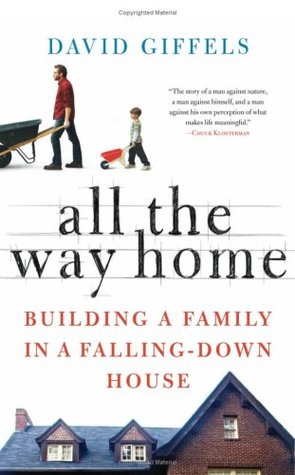
As such…reading award-winning Akron, Ohio, author David Giffels’ memoir All the Way Home: Building a Family in a Falling-Down House felt like going home. Cursory jacket copy summary:

With their infant son in tow, David Giffels and his wife comb the environs of Akron, Ohio, in search of just the right house for their burgeoning family…until they spot a beautiful, decaying Gilded Age mansion. A former rubber industry executive’s domain, the once grand residence lacks functional plumbing and electricity, leaks rain like a cartoon shack, and is infested with all manner of wildlife. But for a young man at a coming-of-age crossroads–“suspended between a perpetual youth and an inevitable adulthood”–the challenge is exactly the allure.

The tried-and-true tropes of female coming-of-age couldn’t be more different than those Giffels explores in this man vs. house tale. But in the reading of this heartfelt and oftentimes harrowing (as in Giffels hanging upside down out a second-story window to paint exterior trim) memoir, I completely understood his feeling compelled–even obsessed–to DIY.

Read more

Throwback Thursday: Why half the world should read IN ZANESVILLE

index

Even if you’ve never been there, you’ve heard enough to know the American Midwest isn’t sexy. I’m hardly the first Midwest native to admit to being from a Regular ‘Ol American Place.

The Midwest is “flyover country”–its detractors call it–between the glittering East Coast and shining West Coast. Yep, no matter how many Northeast Ohio boosters try, most of the U.S. will never be convinced of the beauty that is the “North Coast.” And that’s okay.

But…the insult that really stings: “Ohio is flat.”

It stings–not just because it’s a blanket generalization and untrue of my rolling Ohio hometown. (In fact, it stings more than memories of the same thing being said about my 6th grade chest–and that stung.)

It stings because flat is sameness. And don’t we (even States–if States had egos) want to feel special, unique, memorable: the opposite of same, boring, forgettable?

I am more than a home state booster; I’m a home state narcissist. You see, I picked up Jo Ann Beard’s novel, IN ZANESVILLE (pub. 2011), thinking it was set in Zanesville, Ohio.

It’s not. It’s set in Zanesville, Illinois, which, I sheepishly admit, is pretty much the same. In fact, it’s the sameness, the universality of the experiences of the novel’s fourteen-year-old narrator, that makes this novel so special–and yet relate-able to any reader who is or was ever a girl. And that’s about half the world. Read more