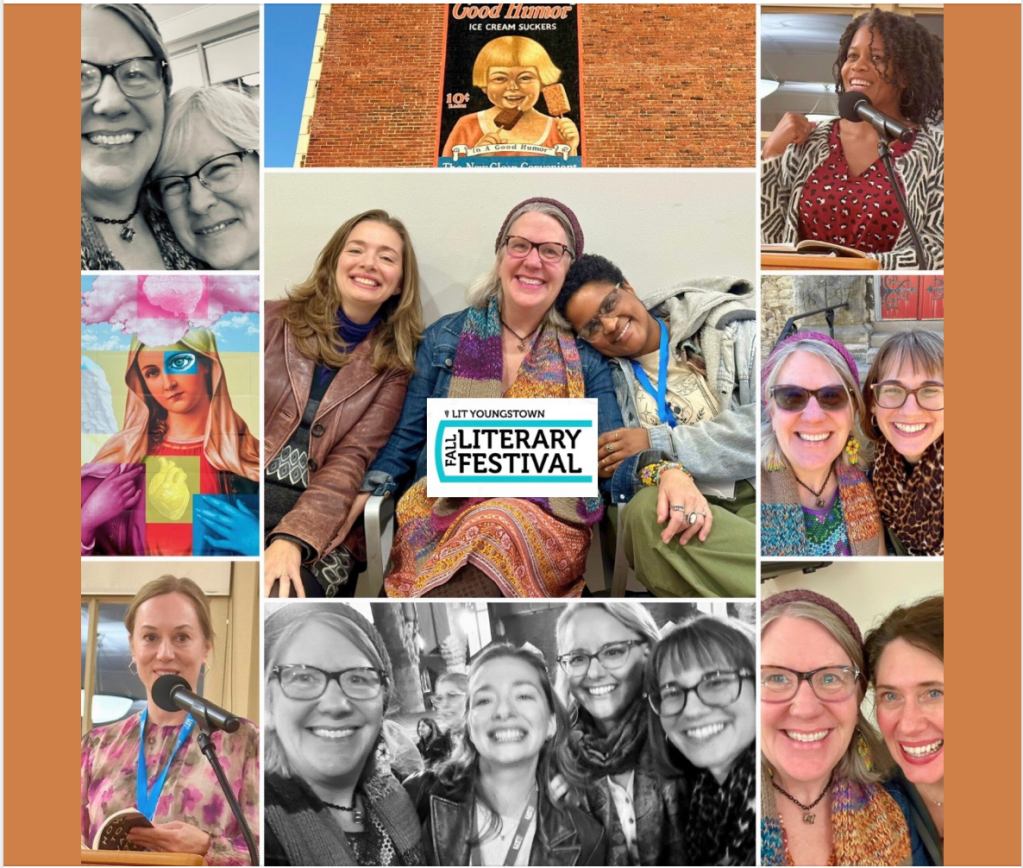
Last month, I attended Lit Youngstown‘s 8th annual Fall Literary Festival. From modest beginnings, the writing conference has grown to welcome some 200 attendees each year. Proud to be among them, I served on the planning committee for a couple years, have served as a session moderator, read my own creative work, sat on an editors’ panel, and, this year, engaged a featured writer in a conversation about her writing craft, process, and life.
I’ve met most of my writer friends through this literary festival. (You’re probably nodding your head, reading this. Such joy those in-between conversations, Elise, Susan, Jeremy!) Writers come to this conference for the genuine connections, the generative craft sessions, inspiring creative readings, and Youngstown pizza (or maybe that’s just me?). I was thrilled to walk away having experienced an abundance of all of the above again this year!
Can I entice you to make the trip, next year? Let’s hope this rundown does just that. (And, bring your friends.)
Day 1
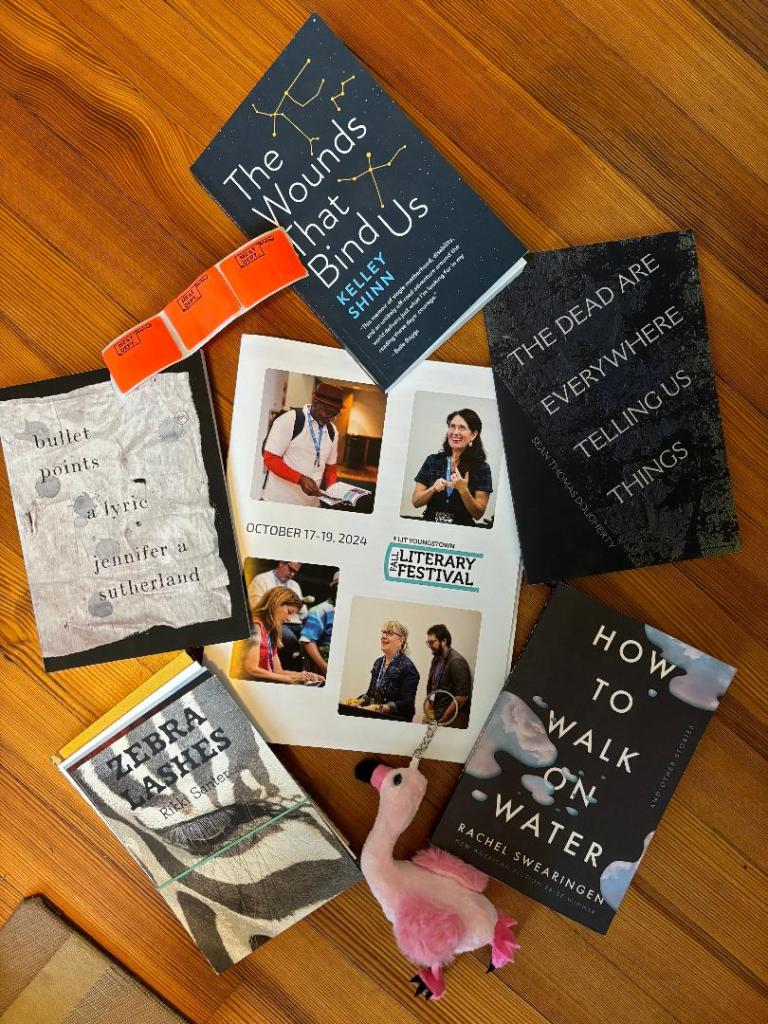
My first day of the festival began with meeting Rachel Swearingen, Chicago-based author of the award-winning story collection How to Walkon Water. After reading through her stunning book, twice, I had a feeling Rachel would have a lot to teach fiction writers, like me, about the craft of writing–and the inspiration behind it. Her morning session, “The More the Merrier: Juggling Multiple Characters in a Single Scene” tackled one of those age-old fiction-writing conundrums: how to make the dinner party (or other large group) scene sing, rather than sink.
Main takeaway: big group scenes can invite drama and suspense (think: Shirley Jackson’s “The Lottery”) but things can go awry when the writer hasn’t anchored the scene. Especially helpful to me was Rachel’s discussion of panning out and zooming in, as if we’re creating a scene on film. Featuring compelling examples from classic and contemporary stories, Rachel illustrated how great writers make scenes active to “write toward change.” For those of us (all of us?) who sometimes struggle to create a propulsive plot, these tips promised to help us give our stories the jhuzh they need!
One thing I love about literary festivals is the opportunity for literary escape. (And not just geographically.) I make it my mission to get outside my usual genres and comfort zones. I’m not joking when I say it’s only been a few years since I learned what ekphrastic writing was. So, taking part in an ekphrastic poetry workshop is far outside my usual lane. Of course, I jumped at the chance, when I learned that award-winning poet (and dancer!) Ama Codjoe was leading a workshop titled “Doorways into Ekphrasis” held at the Butler Institute of American Art, right across the street from our festival headquarters. (Confession time: I usually play hooky for one session of a festival or conference to visit a museum or gallery or other local arts hotspot; this time, I didn’t have to.)
Crowdsourcing time: help me find the name and artist of the piece I wrote about, please! Yes, I stared at a stunning piece of transparent, aqua glass sculpture–two rectangular columns, one larger and standing, one smaller, reclined–and didn’t write down the name of the piece or artist. The three minutes we took to examine the art we chose, without jotting a note–which should be 10 minutes, says Ama–honestly felt like hours. But this works, folks.
It’s fascinating now to look back at the notes I made after my examination and see how I went from describing the artwork’s material–ruined glass, panes shattered, shards–to the artwork’s position and pose–teetering, discarded, toppled–to what the pose might suggest: he has dropped his partner, who does not shatter, small glass tower sheared. Finally, I wrote a little in lines, inspired by the art:
How many the pains of art we
layer and nudge and shimmy?
How shiny this body, this instrument,
until we lay it down, sharded,
but not discarded, dust to dust,
sand to glass to sand.
For my last session of the day, I caught up with a couple writers I follow on social media but had yet to meet in person, so I was thrilled (and got their books I brought from home signed–yes, I’m that kind of literary nerd). The prolific and super generous Sean Thomas Dougherty and Jennifer Sutherland (her debut collection is Bullet Points: A Lyric) are poets who spend some time writing in the “slipstream,” in between literary genres. They and Sarah Carson and Cynthia Maria Hoffman read from their work and talked about what writing in between genres (is it a poem, nonfiction flash, a prose poem?) means for their work and creative outlooks. I was so rapt by the writers’ creative readings that I didn’t take many notes, but I did take this gem down from Sean Thomas: “We push against genre” so forms can (paraphrasing here) dissolve and come together again to address neurodiversity, trauma, and more.
Day 2
I am often reluctant to read my creative work in public. Poetry is meant to be read aloud; not so fiction. However, I thought it might be instructive to read from a blog post I wrote here at Rust Belt Girl and then read the resulting scene that appeared in a story of mine published in Great Lakes Review last year. Like public journaling, I find blogging fertile ground for planting the seeds of story. Pro tip: keep your reading short and everyone will like it.
Thank goodness I read first, because there is no way I’d want to follow memoirist Kelley Shinn or poet Rikki Santer, whose readings were nothing short of incredible. Kelley is the author of the memoir, The Wounds That Bind Us, which I bought at the bookstore directly after her reading from it (I got the last signed copy: conference win!). Rikki read from her collection, Resurrection Letter: Leonora, her Tarot, and Me, which was inspired by the surrealist painter Leonora Carrington–fascinating stuff.
Later that day, Rachel and I joined “in conversation” in a small theater to discuss her stunning debut story collection and its influences: from contemporary art to cult film to a creepy old radio program. I wondered if she went searching for inspiration or if it found her (both). I wondered how her growing up with her family in rural Wisconsin impacted her work (a lot). I am seriously kicking myself for not recording this conversation, but also it would have been a shame to interfere with the intimacy of the conversation. Those of us who write know that it can be a sacred space, and so to share a deep conversation about the inspiration behind the writing work can also feel so meaningful–you hate to break the spell.
Craft takeaways from Rachel: her process involves repeating steps: drafting, reverse outlining, noting of turns in the narrative, noting of where things get sticky or stick out–and here, an earlier Rachel might have smoothed those over, but now she explores them–and an opening up and rooting out of those interesting sticky spots.
In chatting, Rachel and I discovered that we’re both at work on novels set in Nordic/Scandinavian places (must be a Midwest thing). We shared inspiring writers: mine, Dorthe Nors; hers, Jon Fosse.
I was also inspired by Rachel’s fierceness when it comes to trying new genres on for size–in her case, the screenplay.
And the last big takeaway from Rachel, which I jotted during our conversation and aim to never forget (ahem, there’s been a reason it’s taken me three weeks to write this rundown): “Writing is energy management.”
Oh, and there was so much more I missed–next year, I will clone myself–on editing and writing and querying and “unlocking plot.”
Thank you to Lit Youngstown director Karen Schubert and all who make it happen, year after year. And trust me, you won’t want to miss next year’s festival. Thank you also to Rebe Huntman for letting me use the beautiful photo collage she put together (now, go pre-order her gorgeous memoir).
Tell me in the comments, did you attend the festival? What was the highlight for you? What did I miss? Do you attend writing conferences in general, book fairs? What gets your creative juices flowing?
Hankering for Rust Belt author interviews, book reviews, and more? Check out my categories above. I hope you’ll follow me here, if you don’t already, so you never miss a (quite infrequent) post. Thanks! ~Rebecca
I’m thrilled to share this guest post interview with Rust Belt Girl readers. What began as a Spotlight interview–between two of my favorite authors and people–for the Association of Writers & Writing Programs (AWP) has been gifted to us here, and I’m so grateful.
We talk a lot about writing as a communal act at Rust Belt Girl and about finding that community where we belong. The first time I met Karen Schubert in person, I’d just driven five hours, home to Ohio, to attend a literary festival I’d never been to before. I knew a few names but no faces. And no one knew me, so I dutifully popped on my name tag.
Even before my nerves could kick in, here comes the director, Karen Schubert, with the most gracious greeting–as if I were the keynote or a fully-fledged author, and not an emerging writer and editor with a blog.
I belonged. Just like that. And I’ve returned to that annual literary festival every year since. Last year, I served on the planning committee to do my own small part in welcoming new faces to the community.
“How does she do it?” This is a question I often ask about Karen Schubert. In addition to being co-founding director of Lit Youngstown, a literary arts nonprofit with programs for writers, readers, and storytellers…
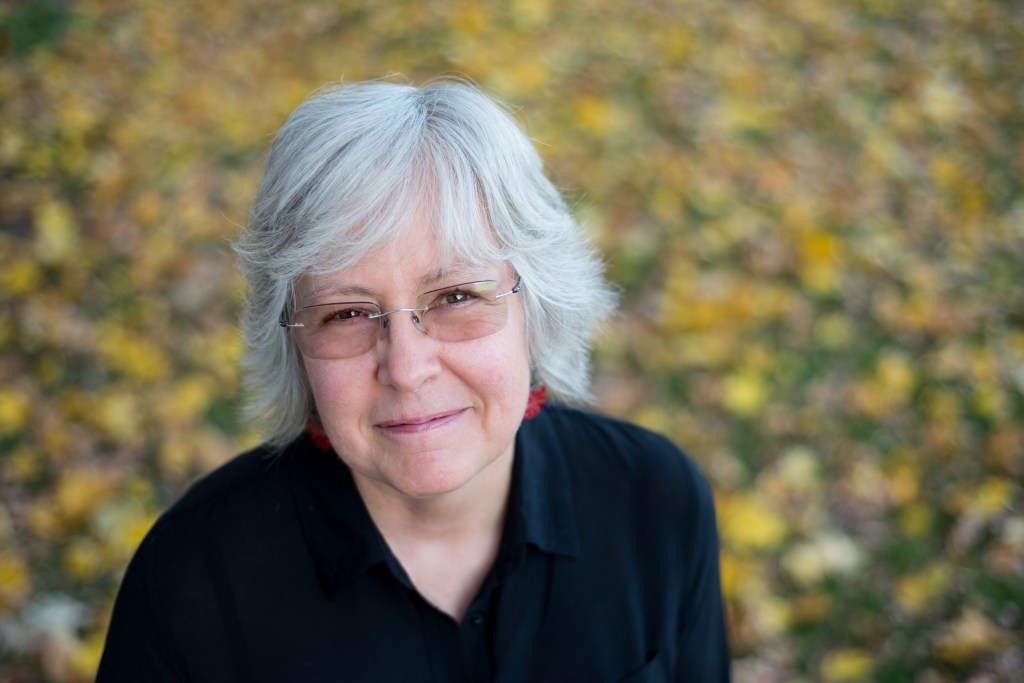
Lit Youngstown Co-founding Director Karen Schubert; photo credit: Melanie Rae Buonavolonta
Karen Schubert is the author of The Compost Reader (Accents Publishing), Dear Youngstown (Night Ballet Press), Black Sand Beach and Bring Down the Sky (Kattywompus Press), I Left My Wings on a Chair, a Wick Poetry Center chapbook winner (Kent State Press), and The Geography of Lost Houses (Pudding House Publications). Her poems, fiction, creative nonfiction, essays, reviews and interviews have appeared in numerous publications including National Poetry Review,Diode Poetry Journal, Water~Stone Review, AGNI Online, Aeolian Harp, Best American Poetry blog and American Literary Review. Her awards include the William Dickey Memorial Broadside Award, an Ohio Arts Council Individual Excellence Award in poetry, and residencies at Headlands Center for the Arts and the Vermont Studio Center. She holds an MFA from the Northeast Ohio Master of Fine Arts.
Thank you to Robert Miltner for asking “How does she do it?” here and to Karen Schubert for telling her story–and inviting us to tell ours.
Robert Miltner: Karen, you live in Youngstown, a midwestern rust belt city located within the Appalachian Ohio region. Your city was known for its blast furnaces and mills that, as Bruce Springsteen sings in “Youngstown,” “built the tanks and bombs that won this country’s wars.” In your poem, “Letter to Youngstown,” you write “Remember the world is full /of places like Youngstown, /and places nothing like Youngstown.” How does that reflect your sense of identity as the director of Lit Youngstown?
Karen Schubert: I’m not from here, although my mother’s family has been in the area since the early 1800s. I came to live in my grandparents’ farmhouse that I loved visiting as a child, and now I live in the city, in a five bedroom brick and frame house that must have been a stunner with its slate roof and cedar shakes. I bought the house on a teaching adjunct’s salary; that tells you what’s going on here. I think there’s a benefit in having been other places and having a sense of how things might work. But I’ve also been in Youngstown long enough to know what people might miss or seek, what our assets are, and who is doing amazing work. I once attended an AWP session on starting a literary arts nonprofit and someone said, “I can’t convince anyone to get behind what I’m doing because they don’t understand the concept.” I thought, that’s a problem I’ll never have.
Youngstown is economically poor yet arts rich…
Youngstown is economically poor yet arts rich—live music, performing arts—with an opera and two extraordinary concert halls including the original Warner Brothers theater, and several local theater companies. The visual arts are available through an outstanding American arts museum and a university museum. On the river, the shell of a steel mill came down a few years ago and a new amphitheater went up. In recent years, the city has hosted Margaret Atwood, Gloria Steinem, and Tarana Burke, as well as YoYo Ma through Kennedy Center outreach. Youngstown is also rich in literary arts. Lit Youngstown hosts readings at a supportive for-profit art gallery that champions local artists. While many community-based writers and writing program faculty stayed and enrich the community, like Christopher Barzak, Steven Reese, Will Greenway, and Philip Brady, others have left to great success, like Ross Gay, Ama Codjoe, Allison Pitinii Davis, and Rochelle Hurt. There is also a local culture that benefits from the immigrant grandparents who taught their children a profound love for the arts.
Youngstown State has been a part of the Northeast Ohio Master of Fine Arts [NEOMFA]; in fact, it was founded at YSU, and we were devastated to learn that YSU has decided to sunset their participation in the consortium. We are still processing the loss that will be to Lit Youngstown and the community.
Miltner: What inspired you to start Lit Youngstown in 2015?
Schubert: I lived in Cleveland for a few years, and there were many literary gigs. The summer of 2013 I was a writer-in-residence at Headlands Center for the Arts in San Francisco, and talked to writers and artists all summer who were doing fascinating work. I began wondering what might be possible in Youngstown.
Miltner: Did your experience as an AmeriCorps VISTA at a neighborhood development nonprofit influence your decision to start Lit Youngstown?
Schubert: Yes, certainly. I was hired by Youngstown Neighborhood Development Corporation to write for the Neighborhood Conditions Report including data from every census tract in the City. Grim statistics: 40% of city land abandoned, jobs clustered in edge suburbs, and Black infant mortality rates similar to Guatemala. But I also learned that incredible things were happening, important stories that needed to be told. One day we were out interviewing residents and a woman invited us inside. She was a member of a Black women’s motorcycle club. They had filled a dining room with long tables, conveyor-belt style, and were packing stacks of to-go boxes with dinners for local residents who were struggling. This is an example of Youngstown’s story, its resilience and social weave. What I learned from the neighborhood development nonprofit is to be fearless: work hard, collaborate, research, and don’t buy the idea of staying just in your lane, because everything is connected.
Miltner: How wide an array of literary programing does Lit Youngstown offer?
Schubert: We host a monthly reading series, writers critique group, book and film discussions, writing classes, a Winter Writing Camp for all ages, teen writers workshops, and a Fall Literary Festival. We also do many one-off events and collaborations, including an NEA Big Read grant with the public library and reading lunch poems with adults with disabilities at the nonprofit Purple Cat. One of our early projects was Phenomenal Women: Twelve Youngstown Stories. We interviewed Black women between the ages of 64 and 101 and published their stories and images from their lives. The collection is a rich archive of our city’s history, and the idiosyncratic details of the lives of these tremendously strong, intrepid and insightful women. One of the women worked in the War Room during the FDR administration. Many were tapped for jobs during the Civil Rights movement, to hold newly won ground.
Also, in partnership with the YSU Art Department, the vibrant 150-foot Andrews Avenue Memory Mural along a retaining wall of a historically important corridor has just been completed. We solicited memories from the local community, and students incorporated images and pieces of those, and their own, memories. Memory is important and complicated in a place like Youngstown, a city that has suffered so much loss and is struggling to conceptualize an identity. I think it’s especially important us to offer this younger generation the opportunity to imagine a city they can believe in.
A memory mural created in partnership between Lit Youngstown and the YSU art department; photo credit: Melanie Rae Buonavolonta
Miltner: Who are some of the writers you’ve brought in for your literary community?
Schubert: So many! We’ve had the privilege of hosting wildly accomplished writers including Philip Metres, Nin Andrews, Philip Memmer, James Arthur, Cody Walker, Kevin Haworth, Jan Beatty, and many faculty of the Northeast Ohio Master of Fine Arts. We’ve also mixed it up with student essayists; storytellers; an international poetry night featuring poems in the original language and the translation; and a humor night one April 1. One December evening Mike Geither read his play Heirloom; it was so moving I found it emotionally difficult to come back to the mic to close the evening. In 2019, we partnered with the Public Library of Youngstown & Mahoning County on an NEA Big Read grant and selected Into the Beautiful North. There were dozens of related events throughout the city for a month, like a mini film festival, immigrant narratives night, and ethnic foods potluck. Luis Alberto Urrea flew in to talk about the inspiration for the individual characters in his book.
Miltner: In a community that is economically challenged, how do you develop funding? And who in the community, or local institutions, or from the state level, contributes?
Schubert: Our community has been incredibly supportive, as have the foundations. We have built up a funding structure that is a mix of support from community members, benefactors, local foundations and state agencies. Our yearly fundraiser is a raffle for a large work of art, typically a birdbath by a local steel sculptor. In all, we have received nearly $200,000 in grants from the Ohio Arts Council, Ohio Humanities, and local foundations.
Miltner: What recent programming has been successful in your literary community?
Schubert: This year’s Fall Literary Festival was successful in the quality of presenters, and the engagement of participants. It’s always so great to see local writers talking with other writers, educators, editors and nonprofit administrators, asking questions and learning more about the literary landscape.
Miltner: The 2020 Fall Literary Festival was held as a videoconference. How was it different from an in-person conference?
Schubert: Well, to begin with, we had a virtual cookie table! I made Allison Pitinii Davis’s aunt’s Greek cookie recipe from the Youngstown Cookie Table Book published by Belt Publishing. Featured writer Janet Wong found cookies in the back of her pantry and described their staleness in hilarious detail. Zoom awkwardness aside, people were wanting to feel a sense of connection. I think they did, but one missing thing was conversations that spill into the hallway and coffee shops.
And we were back in person this year and I was surprised how rusty I felt. I made clumsy organizational mistakes. More importantly, I think feeling connected was also very important this year, and even though there were masks and fewer hugs, the comradrie was everywhere. There are many very fine conferences, so I always ask folks why they come to this one. They consistently say it is the connections they make here.
Miltner: How has the festival impacted your community?
Schubert: It’s the only Youngstown conference for adult writers. The English Festival at YSU, for middle and high school students, draws thousands each year, so there is local context for such an event among literary arts enthusiasts. But previously, adults would have to drive to Cleveland, Columbus, or Pittsburgh to attend in person, which we encourage them to do, but it’s also great to have a conference here.
…they come to hear contemporary work, talks on literature and bringing literature into the community for healing and cross-cultural connection.
Another benefit to local writers is meeting and engaging with writers from throughout the U.S. Really feeling part of something bigger. Of course, some of our attendees are not writers, but readers, students, educators, administrators, and they come to hear contemporary work, talks on literature and bringing literature into the community for healing and cross-cultural connection.
Those who attend from a distance appreciate the low cost of the conference, which makes travel and lodging more possible. And we are fortunate that Youngstown State University partners with us, because this allows undergraduate students to attend free, and some faculty members require their students attend. If YSU follows through with their plan to sunset the NEOMFA, leaving only an undergraduate minor in creative writng, I don’t know yet what that will mean for the conference.
Miltner: Would you share a project Lit Youngstown is currently working on?
Schubert: We had cancellations with the lock-down, including Whitman & Brass, an event that pairs staged readings and a brass quartet playing the music of his day. I was hoping to make this into a series, and was thinking next we would pair James Baldwin and Nina Simone. So Whitman & Brass has been rescheduled for March.
During the lock-down, we sent out an extensive survey to our community, and one consistent point of feedback is that some writers are looking for more in-depth continuity. So this month, we kicked off a series of nine monthly daylong Poetry Intensive workshops. In the morning we’ll talk about books, chapbooks, journals, submissions, presses, readings, things like that. Each afternoon, a different poet will come to talk about different aspects of poetry, and we’ll look at participants’ poems through that lens. For example, when you come, Robert, we’ll talk about the music in these drafts. I’m crazy excited.
Miltner: If an anonymous donor gave you a major gift for Lit Youngstown, what is the dream project you’d immediately implement?
The Big Dream is to buy a large building and begin a writing residency.
Schubert: First I would step up the development of our outreach program. We are inspired by the Wick Poetry Center at Kent State and Director David Hassler who has been a great mentor to us. I’d like for us to be doing outreach with immigrants, veterans, retired residents, patients in medical care, and sexual assault survivors. I love Literary Cleveland’s Essential Worker narratives. Our Outreach Coordinator Cassandra Lawton is currently working in the expressive therapy program at Akron Children’s Hospital and will soon begin a study on writing with cancer survivors.
The Big Dream is to buy a large building and begin a writing residency. In Youngstown, many historic buildings are languishing empty and selling for relatively low prices. I love the model of the Vermont Studio Center, putting studios into a former fire station and school, supporting an indie bookstore, creating links between artists-in-residence and the local elementary school and college.
Miltner: What advice would you offer to someone who might want to launch a community literary program in their city?
Schubert: Collaborate on everything. Keep thinking of new people to bring to the table, to help plan and run events, to shine a spotlight on other community work. For example, when I read Mark Winne’s Closing the Food Gap, a book about food policy, I recognized that it had a lot of relevance to what was happening in Youngstown, a citywide food desert. We partnered with a local co-op on our first book group series and, along with many community development partners, we brought Winne here.
I like to see the literary arts, in addition to creative expression, as a means to understand and work toward solving problems. During the lock-down, I was thinking about the kids at home and parents and teachers looking for literacy enrichment. So we wrote grants and purchased over $10,000 worth of wonderful books for nearly 800 children in Head Start. We also purchased high quality books for children in YSU Project Pass, a program that pairs education students with city 3rd graders who would benefit from reading skills support. Each year we send a $100 donation to a literary arts nonprofit we admire, and this year we selected Black Boys Read, a local initiative.
Miltner: You are yourself the author of several chapbooks and a full-length book. How has your being a writer yourself shaped your role in leading Lit Youngstown?
The Compost Reader (Accents Publishing), 2020, by Karen Schubert
Schubert: As a student, I went to conferences where I met writers like Bruce Bond, Denise Duhamel, Kimberly Johnson, and former NEA director Dana Gioia. I gained much from classes on how to edit, submit work, and shape a manuscript. From classes and conferences, I met writers who are now lifelong friends. Part of my work is trying to recreate those great experiences for those in our literary community.
Miltner: In your poem “Youngstown Considers the Future,” you write, “We are tired of our Titanic metaphors— / can’t decide if we’re patching up the hole, / steering toward warmer waters, or / arranging the deck chairs.” It seems to me that your dual role of writer/director is encapsulated in these lines. From your perspective, what fresh metaphor would you offer instead?
Schubert:. How about the metaphor of a mural: we’ve cut back the vines, purchased more primer than we knew we’d need, and now we’re ready to create a design harvested from memory and shaped by the young. How’s that for what community building looks like?
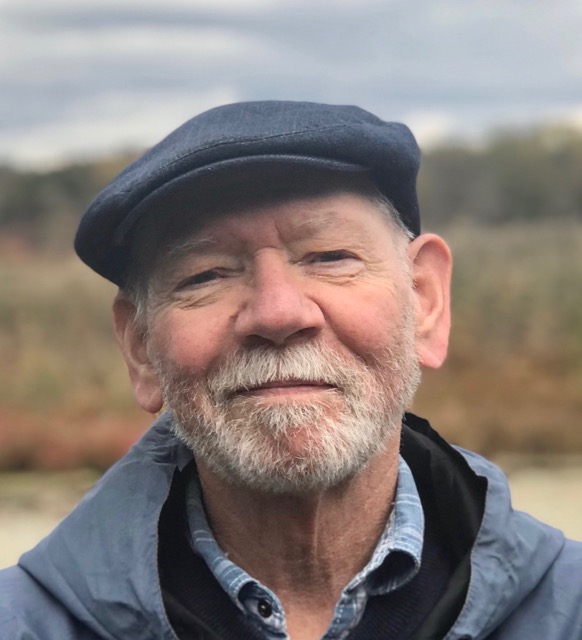
Robert Miltner is a writer, editor, and scholar. His books of poetry include Hotel Utopia, Orpheus & Echo, and Against the Simple, the short story collection And Your Bird Can Sing, and a collection of creative nonfiction, Ohio Apertures. He has received and Ohio Arts Council Award for Poetry, an Ohio Arts Council Writing Fellowship at Vermont Studio Center, and was Poet-in-Residence at the Chautauqua Institution in summer 2021. A professor emeritus from Kent State University Stark and the NEOMFA, and Editor of The Raymond Carver Review, Robert has been a member of AWP since 2012.
~~~
Read my interview with Robert Miltner for Rust Belt Girl here. Like this interview? Comment below or on my FB page. And please share with your friends and social network.
Are you a Rust Belt writer interested in seeing if your own author interview or book review might be right for Rust Belt Girl? Pitch me through this site’s contact function.
Check out my categories above for more interviews, book reviews, literary musings, and writing advice we can all use. Never miss a post when you follow Rust Belt Girl. Thanks! ~Rebecca




 Rust Belt Girl