“This Woman”: an Essay by Melissa Ballard

Essayist Melissa Ballard contributes the fourth in our series of guest posts here at Rust Belt Girl, and, let me tell you, you’re in for a treat. Melissa has a talent for bringing the past to life and making her ancestors feel like our shared family. In this essay we meet Phyllis, Melissa’s grandmother, a woman of Northern Appalachian Ohio, whom Melissa writes about in a loving yet candid way, deftly delving into what makes personhood–class, sex, education, place and much more. (We also hope Phyllis is having the “time of her life,” Melissa.)


This Woman

by Melissa Ballard

This woman is my grandma, but not yet. 

In this black and white photograph, a small, dark hat of woven straw covers her hair and shades her forehead. She wears a walking suit: a jacket and skirt in a light wool pin check with a belt of the same fabric, over a silky, patterned, blouse. The tips of the fingers of her left-hand rest in the pocket of her slim skirt. Her only jewelry is a ring on the little finger of that hand. I can imagine her cropped left foot pointing out, her dark stockings and t-straps. She slouches just a bit and turns her body toward the unidentified photographer. She looks directly at the camera. Her smile is slight, but it reaches her eyes. 

This woman’s slight curves contrast with the riveted metal beam, perhaps part of a railroad bridge, that rises at a sharp diagonal behind her. In the early 1920s, her family lived on a side street a few blocks from the train station in Dennison, Ohio. Her father was an inspector for the railroad, so she had a free pass to ride. 

This woman could be waiting for the early train to Pittsburgh or Columbus, where she will walk the streets with confidence, on her way to a job interview. But she is not. Or at least I don’t think so. I know little about this brief period, but I hope she is having the time of her life.      

In 1925 she has a job in an ice cream shop, lives with her parents. Both she and her mother, who is preoccupied with social status, are named “Margaret.” This woman has already started to express her individuality and goes by her middle name, Phyllis or, on documents, “M. Phyllis.”

On June 18, 1925, eleven days before her nineteenth birthday, Phyllis and her neighbor, Harry, will travel 65.3 miles, maybe by train, to Brooke County, a tapering finger of West Virginia tucked between Ohio and Pennsylvania, where they can get a marriage license with no waiting period. Later that day, they will return to Ohio and be married at the home of the groom’s family. 

I wonder whether Phyllis’ parents even attended. They had a reception for her later, but I gather it was her mother’s attempt at saving face. I can’t imagine she approved of my grandpa or his family, and I can easily hear her saying, “He’ll never make a decent living. You’ll end up in the poor house.” 

Five months and five days later, their first child will be born. On January 14, 1928, their second child, my dad, will be born.

Phyllis c. 1920

The woman I remember, my grandma, was in her fifties. She had slim legs but a solid middle. She wore silver, cat-eye glasses before they were retro. Her short, dark hair was streaked with gray and white, her fingernails chewed to the quick. Wearing a well-washed cotton housedress covered with a flowered or checked apron and heavy lace-up shoes, she kept chickens and goats, grew vegetables and flowers, ran the laundry through a wringer before hanging it outside to dry, cooked meals from scratch. She kept a battered pan under the kitchen sink, filling it with food scraps. Every morning she fed it to the three hound dogs Grandpa had brought home from the dog pound, kept in a pen at the back of the yard. “Oh, hush up,” she said as they yipped and howled at her. 

When Grandma wasn’t busy with chores, she answered the phone for Grandpa, who was the dog warden. She wrote messages in her flowery cursive: the name, address and phone number of the caller, and a brief description of the stray dog. She followed him to his dark green truck, reading her notes out loud. Grandpa never wrote anything down. Before she finished talking, he was backing out of the long driveway, kicking up gravel as he went. 

They lived in a worn-out house on a liminal strip of land in Brightwood, part of Goshen Township, Tuscarawas County; my parents and I had moved to a suburb of Cleveland. Once a month, we made the two-hour trip down home to visit, and I spent more time there during the summer. 

On hot afternoons, Grandma and I often sat together on the front porch swing, she doing her mending and me reading, trying to catch a breeze. A two-lane road ran close to the front of the house. The cars seemed to fly by, and the exhaust from the trucks taught me to mouth breathe, a skill I perfected when I ran into the hen house to collect eggs.  

This route was nicknamed the “slow road” after a highway, the “fast road,” was built behind the house. One summer Saturday, Grandpa drove us into town on the slow road to get ice cream. Grandma and I sat on a bench with our cones, people-watching while Grandpa ran one of his mysterious errands. If Grandma asked him where he was going, he always said, “I need to see a man about a horse.” Which was odd, because my grandparents didn’t have any horses.

On the way home, I noticed a large house on a hill. “Who lives there?” I asked.

Grandma stiffened. “That’s the poor house. Where you go to live if you don’t have any money. It’s not a nice place.” 

I immediately pictured a nineteenth-century orphanage from one of the many books I read. Rows of rusty metal cots with stained mattresses, thin sheets, and scratchy blankets. Peeling paint on crumbling walls. I shuddered and looked away. 

The dining room at Grandma’s was small, with windows on three sides, some covered in plastic to keep out drafts. It was an afterthought tacked on to one side of the house next to the living room. It contained a water-spotted stand of neglected African violets, a treadle sewing machine with a clove-studded dried orange tucked in one of its small oak drawers, a large dining room table and chairs, and a handmade oak China cabinet Grandma had purchased for ten dollars with the money she made selling eggs.  

When Grandma made Sunday dinner for our extended family it was served at noon. Grandma removed elegant pieces of stemmed glassware and individual salt cellars from the cabinet and set the dining room table with her good silverware. As we passed roasted chicken with gravy, noodles, and side dishes, Grandpa arrived late (he was known for having “girlfriends”), threw his work cap in the corner, and took his seat at the head of the table. 

Only now do I realize how little Grandma wasted. Usually, she cooked one of her own chickens on Sunday, but she occasionally made a pork roast. After the meal, any scraps of meat were set aside, combined with corn meal mush (I can only imagine her reaction to polenta recipes in upscale restaurants) and baked in a loaf pan. For breakfast the next day, she fried slices and we covered them with butter and syrup. They were delicious. 

Over time, and with deaths and disagreements, our extended family grew smaller, and we began eating all our meals in the large kitchen. The food was still delicious. One time, Grandma asked how everything tasted. Grandpa was the only one who didn’t answer. She stared at him, and he finally grumbled, “If anything’s not good, I’ll let you know.” Already showing signs of Parkinson’s, he poured a bit of his coffee into a saucer with shaky hands, and leaned down to slurp it. 

Eventually, an old couch was jammed into a corner of the dining room, next to the china cabinet. It became my reading space when I visited. Now, as I sit down to read on my own sofa, I look at that same cabinet on the front wall of my living room in Oberlin, just two hours away from where Grandma lived. I have covered the top with family photographs. 
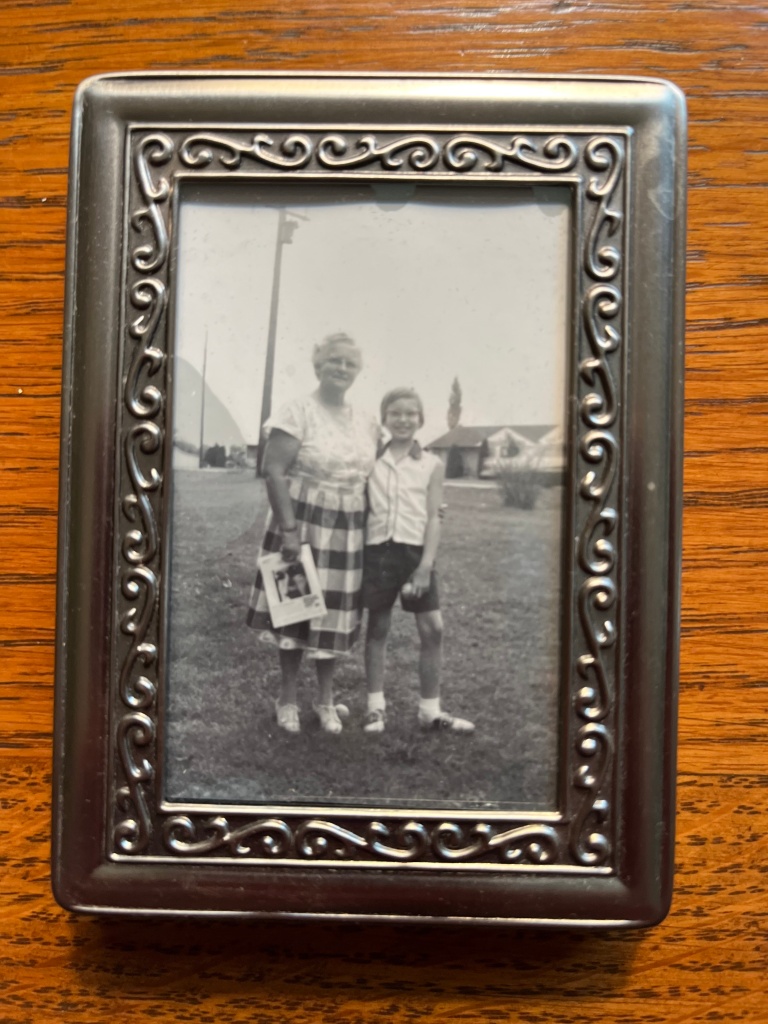
Phyllis and the author c. 1960

Grandma taught me how to tie my shoes–we were both left-handed–after everyone else had given up; gave me my first sip of coffee, strong but cut with generous portions of sugar and thick cream; slipped me some of her beer while we watched Gunsmoke. As I got older and visited less, we wrote letters.

Shortly after my twenty-first birthday, Grandma and I walk in her back yard. We stop under the hot sun to admire the clumps of purple, yellow, and white miniature pansies that flourish in the crumbling foundation of an old shed. I started college three years late; I tell her I am overwhelmed and don’t think I can do the work. She is quiet, removes a flowered hanky from her apron pocket, pats her damp forehead and the back of her neck. 

As we start slowly up the steps to the relative cool of the house, I link arms with her. I brush the cool copper of the bracelet she always wears because she believes it helps her arthritis. Her fingers are crooked, as mine are now. As I write this, I touch the copper cuff bracelet I bought years ago but have never worn. I keep it on my desk as a reminder of Grandma, and I wonder what happened to the soft, linked one she always wore. 

I open the back door with my other hand. Grandma suddenly stands as straight as she is able and says firmly, “You stay in school.” She adds this, which I will hear her say more than once: “You need to be able to make your own money.” 

After I’ve finished graduate school, married, and had a child. After Grandpa, who spent years in a nursing home with Parkinson’s, has died. On what will turn out to be the day my dad, her son, dies, Grandma moves into an assisted living facility.  With Dad being ill, no one has had the time to take Grandma to see the place prior to moving in. She’s been calling me several times a day, anxious about the change. 

She surveys the room: her favorite chair with an afghan she made folded over the back; her dresser, its top covered with a lacy scarf and family photographs, including several of my daughter; a large window that looks out on gardens; the new spread my mom placed on her bed that morning; a private bath.            

She leans close to me and whispers, “Oh, Melissa, this is beautiful. I was afraid it would be like the poor house.” 


Melissa Ballard has written essays for The Brevity Blog, BeltBerea College magazine, and other publications. She is currently working on a book-length collection of essays about the women in her Northern Appalachia family. 


Like this post? Want more? Comment below or on my FB page. And please share with your friends and social network. 

Are you a Rust Belt writer interested in seeing if your own post, or author interview, or book review might be right for Rust Belt Girl? Hit me up through this site’s contact function.

Check out my categories above for more guest posts, interviews, book reviews, literary musings, and writing advice we can all use. Never miss a post when you follow Rust Belt Girl. Thanks! ~Rebecca

Enter your email address to subscribe to this blog and receive notifications of new posts by email.

“Taking the Cow Path to Culture”: an Essay by Christina Fisanick

I’m thrilled to present the second in a series of guest posts interrogating place here at Rust Belt Girl. Christina Fisanick is a champion for Appalachian writing–and Appalachian voices, young and old. (Read her whole bio below.) “Taking the Cow Path to Culture” appears in her book, Pulling the Thread: Untangling Wheeling History, which was published in 2024 by North Meridian Press.

Taking the Cow Path to Culture 

by Christina Fisanick 

Route 88 meanders through the Ohio Valley countryside, connecting the city of Wheeling, West Virginia, to Oglebay Park and small, rural towns and farms along the way. More significantly, for some, Route 88 is the lifeline that carries students, faculty, staff and visitors to two of the area’s oldest institutions of higher education, West Liberty University and Bethany College. This important role earned Route 88 the seemingly humorous moniker, “The Cow Path to Culture,” and is a standing metaphor for much of life in the northern part of the Mountain State and throughout Appalachia.

Route 88 was once an actual cow path upon which animals were herded across the farmlands of the region. Like many other places in the country, it made more sense to locals to pave the beaten cow path than to blaze a new trail as modes of travel advanced. But as has been somewhat painfully obvious over the last century, maintaining the well-trodden road might not be the best way to go. 

In 1893, a minor New England poet, Sam Walter Foss, wrote a poem with a major message. “The Calf-Path” tells the story in verse of a path driven by a calf through Boston, which, after years of other animals, and eventually humans, following the path, was paved and became a major thoroughfare. The funny, yet poignant, poem takes readers on a journey through time and encourages deep thought about life decisions. Mainly, Foss wonders, why should we continue going down the same road in deed and thought when it might not be the most direct or even the best route?

Just like the calf path in the poem, Route 88 rambles and turns and plunges on its trek from Wheeling past Oglebay Park beyond the farmlands and homes and on to West Liberty University and then Bethany College. I commuted to West Liberty in the 1990s and cursed the winding road more than once during the icy winter months. My classmates and I anxiously wondered who would build a college on top of that hill? More so, we jokingly wondered how we made it to graduation.

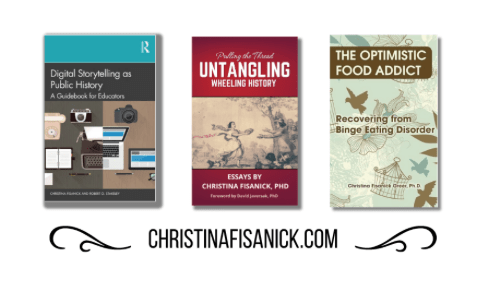
Covers of three of Christina Fisanick's books: Digital Storytelling as Public History; Pulling the Thread: Untangling Wheeling History; and The Optimist Food Addict: Recovering from Binge Eating Disorder

We were not the first students to ponder such things. A 1972 Sports Illustrated article tells the tale of four student-athletes from Israel—Avraham Melamed, Moshe Gertel, Yoel Kende and Danny Stern —and their “250-pound Irish Catholic coach,” Tom Grall. The students were recruited for the West Liberty swim team. Avraham Melamed described their journey from the Pittsburgh airport along Route 88 in harrowing, awe-struck terms then concludes: “It was easier getting from Ramat Yohanan [Israel] to Pittsburgh than it was to get from Pittsburgh to West Liberty.” Writer Mortin Sharnik paraphrases Melamed:

“All roads do not lead to West Liberty, but one that does, Route 88, is called the Cow Path to Culture. The Israeli was taken on a more scenic route, a roller-coaster ride over a ribbon of cracked concrete, with no guardrails to prevent a car from taking a shortcut down a ravine. Melamed kept his nose pressed to the car window, looking for the bright lights. Instead, he saw farms, strip mines and hairpin curves.”

The effort, of course, was worth it. The Israeli students went on to make the swim team as winning as West Liberty football, which at the time the article was written had two consecutive undefeated seasons. More so, they earned great educations from the oldest institution of higher education in the state of West Virginia.

While Sharnik’s article is a fascinating and humorous look at the past, it is the title that catches my attention: “Wandering Jews in an Unpromising Land.” Clearly, Sharnik was playing on the students’ ethnicity and well-known Biblical references. Regrettably, the term “unpromising” is simply the same old stereotype of West Virginia arrived at by taking the same old mental cow path. Now, 46 years later, that cow path has been paved over again and again, and few people outside the state (and even within its borders) are willing to blaze a new trail. West Virginia needs to free itself of the shackles of presupposition that continue to hold us back from achieving greater success.

These stereotypes not only negatively color West Virginia, but all of Appalachia. We are told time and again by the popular media (and even ourselves) that there is nothing here. Appalachia is a wasteland, people say. A no man’s land of little possibility and less opportunity, they echo. And more often than not, this lack is blamed not on politicians or exploitive company owners, but on Appalachians themselves.

This blame goes back decades to early literature, TV shows and movies that exploit the region’s hardships for book sales, ratings and box office records. Few can forget The Beverly Hillbillies and their clueless, backwoods characters with hearts of gold or the psychologically deranged figures from Deliverance. Popular culture tells us that Appalachians are poor, willfully ignorant souls who are too lazy to improve their lots in life. These ideals have been further entrenched by presidential “poverty tours” conducted by presidents and other politicians throughout the 1960s to prove to the American people outside the region that Appalachians are poor, white trash that need their help.

Unfortunately, many of our own people have embraced these ill-conceived views of ourselves and live accordingly. Of course, we never see ourselves as morally-bankrupt, ne’er-do-wells, but we willingly believe it of our neighbors. J.D. Vance does this in Hillbilly Elegy, of courseHe encourages the country to continue to blame Appalachians for our misfortunes. It is our own fault that we suffer from the world’s highest rates of opiate addiction, he argues. It is our own fault that many of our children live in poverty, he states. By continuing to claim that Appalachia’s poor are responsible for their own conditions, the nation’s eyes can be averted, not out of guilt but out of blame. Our country’s hands can be washed clean since Appalachians create our own misery and wallow in it.

It is easy to see why this particular cow path has been well-worn and paved over. It is to the benefit of politicians whose pockets are lined with money from the oil and gas industry to continue to shame and blame our people so that they never ask for more. Our land has been raped of resources while our people have been underpaid and exploited. None of this could happen if not for desperation and mentally following a well-worn cow path that leads to broad, self-defeating conclusions about poverty, drug abuse, and job loss.

Even now, young men fight for jobs in the dying coal industry for the promise of what they believe once was but will never be (again). Now is the time to take a different path. One that is not littered with stereotypes and preconceived notions. I am reminded, as I am sure you are by now, of another poem that urges readers to take the road “less traveled by.” I urge you, my fellow West Virginians, imagine a different life for yourselves and for generations to come. I’ll always take the cow path to culture to serve my alma mater. West Liberty University is in my heart forever. But my mind will be on a different metaphorical route that allows for new possibilities for West Virginia, Appalachia, and its people.

We no longer have to play the role of eager simpletons to keep our jobs. There are no jobs. Let’s create our own through education, new industries, and innovation. A change in mindset will make all the difference. In this moment we must abandon who we are told we are and become who we know we are. We are West Virginians. We are Appalachians. Toughened by adversity, wizened by necessity, and softened by empathy.


A photo of the cover of Pulling the Thread: Untangling Wheeling History, essays by Christina Fisanick, Ph.D. Forward by David Haversack, Ph.D.

Pulling the Thread: Untangling Wheeling History

By Christina Fisanick, Ph.D.

North Meridian Press


Photo of Christina Fisanick, Ph.D., with red hair and gold earrings and wearing a black sweater.

Dr. Christina Fisanick is the author or editor of more than 30 books and dozens of articles, essays, and poems. Her latest book, Pulling the Thread: Untangling Wheeling History, is a collection of essays focusing on little known stories from Wheeling’s past. She is currently working on an historic novel which takes place at Fostoria Glass in Moundsville, WV, in the years immediately following WWII and co-editing an anthology, “We Are Here!”: New Writing from Northern Appalachian (forthcoming for University of Kentucky Press). In addition, Fisanick is an English professor and an internationally recognized scholar in the teaching of digital storytelling as public history. Fisanick serves as the president of the Writers Association of Northern Appalachia (WANA) and the co-host of WANA LIVE!: The Reading Series. Learn more: christinafisanick.com.


Doesn’t this essay just get you thinking? What are a place’s histories, byways, characteristics, and quirks–and how have they shaped its people and its art? How have they shaped the stories we tell? For this series, I suspect we will get some fascinating answers to these questions and many more I haven’t thought of. I hope you’ll join in and share your thoughts!

Like this post? Want more? Comment below or on my FB page. And please share with your friends and social network. 

Are you a Rust Belt writer interested in seeing if your own post, or author interview, or book review might be right for Rust Belt Girl? Hit me up through this site’s contact function.

Check out my categories above for more guest posts, interviews, book reviews, literary musings, and writing advice we can all use. Never miss a post when you follow Rust Belt Girl. Thanks! ~Rebecca

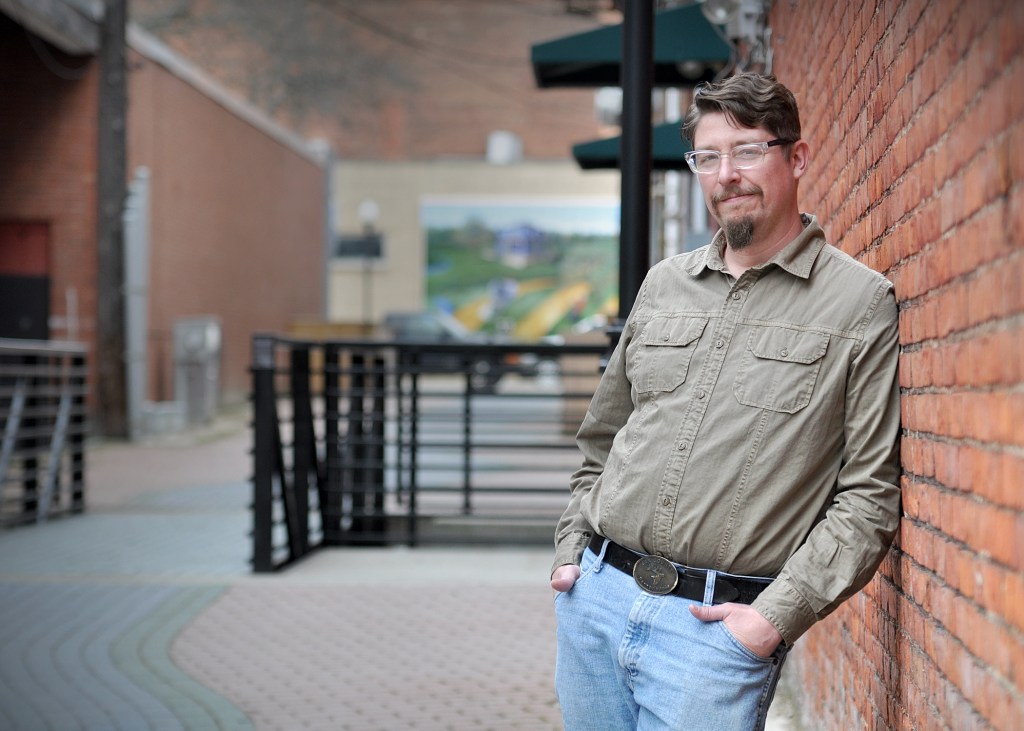
My interview with Matthew Ferrence, author of APPALACHIA NORTH: A MEMOIR

For a blog focused on the idea of place in all the stories we tell, I can’t think of a better person to talk to today. I met author and professor, Matthew Ferrence, at a writers conference in the spring, where I picked up his memoir, Appalachia North — the first book-length treatment of the cultural position of Northern Appalachia.

Matthew and I are from similar places. But more than a book of essays exploring geology and place, Appalachia North is a very personal memoir that allows the reader to journey alongside the writer as he is diagnosed with a brain tumor. From the book jacket:

Appalachia North is an investigation of how the labels of Appalachia have been drawn and written, and also a reckoning with how a body always in recovery can, like a region viewed always as a site of extraction, find new territories of growth.

***

Matthew, how did you come to write this book?

I wrote through a somewhat circuitous path for Appalachia North. The project began with a rejection, for a collection of essays I’d been working on for some time. But that opened up a conversation with Andrew Berzanskis, who was then editor-at-large for WVU Press (he’s now a senior acquisitions editor at the University of Washington Press), and a contract to write a book about northern Appalachia. While we both knew this was to take the form of a memoir, what we didn’t know is that I was going to be banging on the keys and finding some dreadful resistance. I’d recently finished treatments for my brain tumor, and I wrote an essay called “The Foxes of Prince Edward Island,” which was all about that. And I knew that I really wanted to write about recovery and brains and foxes.

So, one day I just decided that I’d do both, and see what happened if I tried to simultaneously write the book I had a contract for, and the book that was gnawing at me, somehow as one book. With that, the writing started to open up, and I began to see the connections between geography and self, between recovered bodies and recovered regions, of how erosion could function as a reframing metaphor of beauty and hope. Then, draft done, I had to tell Andrew. Who, much to his credit, looked at this new book he hadn’t bargained for, saw what it could be, pushed me to revise toward directions I’d neglected, and Appalachia North came into form.

I love the idea of mapping — both of your native geography and (the native geography) of your body. Could you describe the process by which you came to “see” the terrain of your journey enough to write it?

Mapping as a literal act came with the earliest versions of the book, that I would seek out the corners of the official parts of Appalachia north of the Mason Dixon line, to sort of survey and consider the delineations. As I did that, I was surprised by the recurring mutability of the lines that seem so permanent on an actual map. Most of all, I was struck by how the three counties of northeastern Ohio included in the official Appalachian Regional Commission map were late entries, “becoming” Appalachia forty-some years after the ARC put out its first map. So I became preoccupied with thinking about ways that map lines just don’t work. That connected with my figurative sense of self as an Appalachian exiled by birth, simply by the fate of being from Pennsylvania instead of the parts that usually count as Appalachia. This has bugged me for a long time.

For the body, I experienced the way clinical treatment exiles a person from a sense of self, because your body becomes defined by blood test numbers, and MRI scans, and radiation beam coordinates. Your sense of self becomes a cartography of medical rationality, and that makes you feel, well, not yourself really. You get lost the more you’re mapped. Somewhere in that irony, you start to get a sense that you’re tired of letting other people draw the maps.

Get Matthew’s memoir here!

In your essay, “Conduits,” you discuss those who make geographical maps — generally, those people in power. By writing about place, you do feel you’re map-making? Do you see this as a way to wrest some control over your native place?

For sure. Like, just the other day, a colleague was saying they didn’t really agree with my “claims” that Pennsylvania is part of Appalachia, because they spent a lot of time in “real” Appalachia in the North Carolina mountains. I was sort of stunned, frankly, because even the official maps back me up on this one! But at the same time, this is the tyranny of cartography: that people can draw lines for whatever reason they want. Money. Politics. Taxes. On and on. And there was some weird power exercised here in this very moment, about who gets to actually lay claim to the definition of a region…and in this case, as is often the case, the person making the definitive claim was not from the region and “correcting” someone from the region. We don’t even get to draw maps of our own places.

Yet the terrain — I love that word! — just doesn’t care. Trees grow. Dirt erodes. Mountains emerge. When you’re walking in the woods on many borders so clear on a map, you really can’t tell where the line is, since terrain is fluid. Really, there is no line. So in looking around at places on the ground where the lines are supposed to be, I started thinking a lot about all the lines that people try to place on our lives: healthy and not, for one, or legit Appalachian or not. Maybe because I’m on the “wrong” side of both of those lines, I became determined to refuse the lines altogether.

You challenge the conventions of regional dialect in one of your essays. As in, we’re supposed to say “Appalachia” a certain way — to prove we’re an insider in the region. Why this struggle for Appalachian authenticity, do you think? Why does it remain a region so intent on staying true to its roots? What does it mean for you?

I get the hard and fast claims for rightness in saying App-uh-latch-a, because lots of people have been made to feel small and unimportant for being themselves. Authenticity — including accent — becomes a way to fight for your own sense of worth. So on one hand I totally root for that, and I kind of relish the way Appalachians can smack down the folks who don’t know anything about the region. But at the same time, well, I don’t want to be kicked out of where I’m from. That’s the trouble of the northern part, for sure. We can feel sort of absent. Another one of my pet peeves: all sorts of people (again, who are not from here) keep telling me this is the Midwest. And I’m always thinking, fuck off on your Midwest. They’ll make some claim about jello salads or politeness, but it all comes with this sense of diminishment. Because they usually mean this in the context of explaining either how they’re from more sophisticated spaces not the Midwest, or as a way to deepen their disdain for northern Appalachia by refusing to even acknowledge it as being a place with its own claim to regionality.

I want to be clear, I don’t mean this to disparage the Midwest, but very much to defend how places like it, and like Appalachia, have to stick up for themselves as legitimate locales, as distinctive and meaningful, because everyone basically says over and over, fly-over country. So, on pronunciations, I love the variance of Appalachia, which has a whole spectrum of pronunciations, which is another way of saying it’s a place of vibrancy and nuance. I’m not going to give away my corner of that, so I’ve become comfortable using both the soft and hard vowels, but will still totally make fun of someone from outside the region who pronounces it wrong. The nice thing is, I can make fun of them no matter what they say. Cruel, I suppose.

In your memoir’s preface, you say, “So many writers…seek to make a declaration: this is what a place is.” You, like a good essayist, seem to be happier delving into the ambiguities of place. You also seek to reclaim your native place for the next generation — your own kids among them. How do you do this without defining that place?

Yes! This is what we love, I think, ambiguity and gray edges and journeys. I say this a bit cheekily: essayists love to squirm away from anything declarative, relish the provisional, even as we love to make big claims…which we then overturn and twist and turn inside out. On the matter of place, the big thing to me is that it matters, but when a place seems to carry rigid definitions — Trump Country, Red States, Fly-Over, all that — such restrictions wind up wrecking a place. That’s when we become totemic monoliths or, really, tools. So, for me and for my kids, I long for a vibrant connection to terrain and geography, with a sense that what a place means can also evolve and contradict and carry the fluidity the essayist loves. I want my kids to love a place, but I want them to be able to live in it with a sense of reciprocal love. I’m frustrated and angry, these days, by how places redouble their restrictive sense of who counts, who looks or loves or behaves the “right” way. That’s the wreckage of definition, as it crushes back to stereotype and turfiness and xenophobia and trope. Ambiguity, I think, invites inclusion and expansiveness. Because we can’t say this instead of that.

The language of geography and of the body — especially around medicine — can get really technical; yet, you do a lovely job of softening both of these languages. Instead of unapproachable moments of medical jargon, you note the moments of “mercy” between you and our doctors. You call it: “The precise language of medicine facing off against my growing recognition of life.” Yet, as a writer, language is your tool. Did it ever feel useless? Did you ever think, I don’t know how to write about what’s happening to my body in my language?

The veer to the metaphorical helps, for me at least. The peripheral look, the askance view, the detailed description of some concrete object that suddenly emerges with a new dimension of meaning, well for me, that’s how language becomes the only way to make sense of the ineffable. The biggest example is my recognition of the geology of my home, that it’s a dissected plateau instead of a worn out mountain. My Dad filled me in on that, part way through the writing, and it was a literal geological process that changed everything for me, metaphorically. Suddenly, I could see the post-surgical me in a different way, not as something grand that is now worn out and wrecked, but something shaping into a new form that can carry its own beauty. The metaphor was everything. On the flip side, cliché strikes me as the enemy of health writing, because it’s almost all you get from people when you’re ill. Directness felt better, on the page, that this happened and that happened. Combining the direct with the cascading metaphors helped me use language very much as the tool for narrative recovery.

In your essay, “The Molt,” you compare your emotional state, traversing your medical condition, to molting, as an animal does. Through your sickness you waited for “the hardening,” for a new shell, as it were, to help you bear up. Yet, the best writing, I believe, comes from exploring those times before the hardening, don’t you think?

I agree. Totally! I guess the hardening is the lived desire, that you just want things to stop being difficult, to end, maybe to stop feeling, at least for a little bit. Because things are so difficult. But, no, the hardening is a false desire, because actually developing it would be catastrophic. Maybe the essayist’s stance is to write about the moments when hardening fails and, more so, to write as an act of resisting hardening. Writing softens us up, so we can actually find the substance.

What’s your favorite thing to teach students in your college courses — about nonfiction writing and about Appalachian Studies?

About Appalachia, it’s pretty much always a combo of you’re in it and you are it. Up here in the northwest corner of Pennsylvania, there aren’t a lot of people who actively think about themselves as Appalachians, nor who have had any reason to think deeply about the region. Yet close to half of our students are from places that are literally in Appalachia. I love the immediate shake-up that provides, which I shared. First you think, that can’t be right. Then something like, but I’m not… And then, …but wait I am. So what we all think about Appalachia is…not accurate!

That moment of recognition and depth is what I love most about nonfiction itself, that we find new avenues constantly, so long as we cultivate a practice of curiosity and attention.

I love helping students unlock the potential in two disparate personal narratives, or figuring out how oblique research can deepen a complicated narrative line. Most of all, I love getting to spend time with a group of students all committed to the deep reflection of the world we walk around in. And language. Maybe this is really the best part: helping students understand the power of the lyric sentence, how the gestures of poetry and art, applied to real experience, yield the best nonfiction.

In thinking about your take on place, I learned that you’re taking a run at the PA House in 2020. In what ways did your writing get you to this decision?

Without a doubt, part of the motivation stems from writing books that have allowed me to dive deeply into how my home turf has been used and exploited by politics. That’s part of the framing of my candidacy, in fact, that there are stories that we tell ourselves over and over again that never turn out well for us. So let’s write new ones. The incumbent, as well, has not been, shall we say, a friend of the arts during his decade-and-a-half in office. My rallying cry, I suppose, came from his remarks suggesting that the state shouldn’t give student aid to people majoring in “poetry or other pre-Walmart majors.” Well now. Hmmm. That didn’t sit with me. Even if we want to stay in the spheres of practicality and economic policy, the arts sector is huge, and can have a tremendously positive impact on rural areas like ours. And at the same time, I long for a politics that doesn’t limit its vision to the spreadsheet. Politics is about people, in fact is the people. We talk about vision in politics, but we rarely see candidates who want to run on creativity and possibility.

I’d say the brain tumor factors in here, too: for one thing, I saw first hand what it means to get sick and suddenly see how expensive staying alive is. I was lucky, because of my insurance. Many other people would be bankrupt now, if they’d faced what I did. That’s not right. Then, existentially, I’m tired of living in a world attenuated by the small-minded nightmares of regressive politicians. Part of the after-effect of having a brain tumor is the relative ease at which I find myself saying, fuck it, and doing the thing that matters to me that’s the sort of thing we all have a tendency to be afraid to undertake. Running for office is that. I refuse to leave Appalachia to the troglodytes. The national narrative tells us that’s who we all are, and we most definitely are not. I want to stand up and write it differently.

What’s next for your writing? What should readers look out for?

I have two projects I’m wrestling with right now, each in very early stages. One is fiction, which is taking shape as either a novel or a collection of linked stories. Appalachian. Eco-futurist. Focusing on the possible presence of magical creatures in nighttimes threatened by a radical growth in light pollution. The other is an essay project, more or less the writing of a Catholic Mass, to address the ways I am simultaneously deeply lapsed from the Church yet unable to shake the feeling of mystical deep spirituality I find within it. In both projects, I’m trying to find a way to toggle toward radical beauty, to write of dark things but with gratitude and joy. I’m thinking of Ross Gay’s work in both poetry and nonfiction here, and how moving I find his devotion to that serious artistic stance. More and more, I find myself wanting to write toward hope and goodness, particularly as the world churning around us seems to only call us to critique, which is vital, but also wearying. Art helps us imagine new futures, and I long to imagine my way toward hopeful ones even when most of what we see suggests dystopia as our fate. Maybe we can write a better future into being.

***

Matthew Ferrence lives and writes at the confluence of Appalachia. He is the author of Appalachia North: a memoir and All-American Redneck, a well as numerous essays published in North American literary journals. He teaches creative writing at Allegheny College and in 2020 is vying for a seat in the Pennsylvania House of Representatives, representing Crawford and Erie Counties.

Find him here:
www.matthewferrence.com
www.electferrence.com
@mjferrence on twitter
canappalachia on Instagram