We writers love to talk about finding our literary voice (good piece on that here), along with our favorite tropes, motifs, and images. Basically…stuff we know.
We’ve all heard the “write what you know” advice, often attributed to ol’ Papa Hemingway. What he really said (and more Hemingway writing advice here):
Write about what you know and write truly and tell them all where they can place it…Books should be about the people you know, that you love and hate, not about the people you study about.
So, we read, travel, meet, live, repeat, and read some more–to amass the places, people, and ideas that we know fully, that become an integral part of us. So much so that these places, people, and ideas pop up in our writing as setting, characters, tropes and all those other fun literary terms.
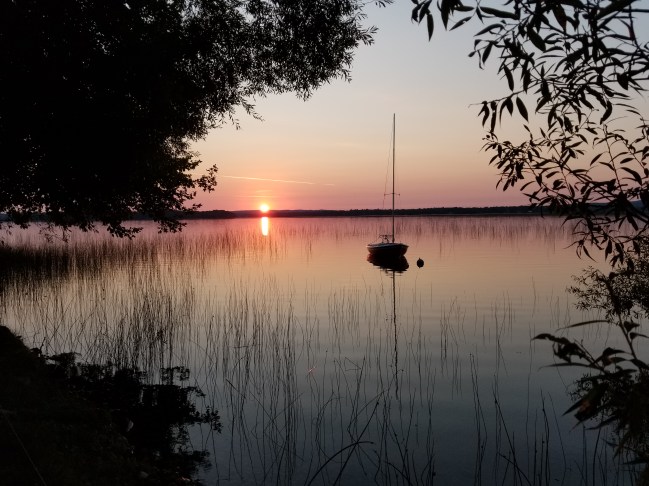
All that’s to say that our writerly voice and our place in the world (weekly photo challenge) go hand-in-hand. For me, the way to discovering my literary voice–my place on the page (definitely still a work in progress)–and my place in the world are parallel journeys. And both follow water.
They say the apple doesn’t fall far… My dad, a lifelong Lake Erie boater, went around the world’s waterways as a young man in the Navy and still didn’t get enough of the stuff. Being landlocked makes him itchy. (Here he is on his 1942 Lyman he restored himself.) I suppose I inherited some of his itch.
From the Great Lake of my girlhood to the river I’m on now (header photo)–water makes its way into much of my creative writing. Not only as setting and a handy trope, but I’m interested in water’s relationship with our human bodies (which are so much water!), and I wish I could fish and swim and dive with an expert’s ease. And there’s where I write what I don’t know, because I want to know more.
This summer I will do more to know more to write more. How’s that? And I’ll do it in a dinghy! Yep, we bought a dinghy–my little family’s first foray onto the water.
Does your place in the world inform your place on the page? I’d love to hear about it and to see pics!
It’s like driving a car at night. You never see further than your headlights, but you can make the whole trip that way. —E.L. Doctorow, novelist, essayist and professor best known for his works of historical fiction (who also maybe adored licorice).
Yep, doing something new here: A little writing advice chased by a little trivia (with a dash of speculation).
The headlights writing advice was provided to me (in response to my novel manuscript) by a former writing instructor and current friend, David L. Robbins, who has written about a million historical novels at this point. (Don’t know if he’s a licorice fan, but I’ll inquire.)
Why that advice?
Because, I admit it, I am a lover of the flashback. Sometimes called an analepsis (but not by me), a flashback is an interjected scene that takes the reader to a time before the current action. You know, backstory.
I’m a lover of the flashback within a flashback. (Though I know this is terribly wrong and something for which I should flog my writerly self.) Here we’re interrupting the forward moving action to talk about something in the past and then interrupting that something to talk about another past something. Whew!
And, heck, while we’re here, what’s wrong with a little flash-forward now and then?
What did Doctorow know?
A lot.
Sometimes the problem is we didn’t start the story in the right spot. If we’re constantly looking back, maybe that’s where the story should start. (Looking forward? Maybe we started too early in time.) Just don’t fall into the trap of turning backstory into dialogue for characters to deliver. Too much “remember the time…?” reads false.
So, in my novel-in-progress I killed my prologue because it took place years before the current action (and it was a prologue); and I’m doing my darnedest to drive by my headlights.
Do I promise to use no flashbacks, no flash-forwards?
No. Moderation in all things, as the Greeks said…those Greeks who called licorice “sweet root.” Did you think I’d forgotten what day it is?
Officially a weed, licorice has been prized for its health benefits for thousands of years, and is even said to have properties that may slow the effects of aging on the brain.
So, maybe have a piece of licorice to stimulate your writerly brain, turn on those headlights and get back to work.
I hope your last contact with us left you feeling all the feels you want to feel–and none you don’t.
Please consider paying those feels forward by purchasing our <<product>> / <<affiliation>> / <<service>> / <<whatnot>>…
You get the picture, right? Junk mail? Or maybe you don’t.
Truth is, most junk mail gets thrown out unopened, landing in the recycling bin before its myriad literary merits can be appreciated.
Yep, you guessed it. I’m a junk mail writer. And I am not ashamed. (OK, I’m a bit ashamed.) I don’t often talk about my day job here at Rust Belt Girl–I’m a compartmentalizer–but I got my start as a communications and marketing writer creating junk (ahem) direct mail for a large insurance company we will nickname Lizard. In the ensuing years I’ve found my niche in article-writing for universities and health systems. I tell the stories of students, alumni, professors, doctors, patients and donors. But I cut my teeth on junk. So, here they are:
5 things writing junk mail taught me about writing (in descending order for big feels):
5. Formulas are formulas because they work. As a student of creative writing, I eschewed formulaic writing. I ascribed to the whims and meanderings of the muse! In the business world, I learned that, just as no one wants to read a blog post that meanders for 5,000 words, no one wants to read a direct mail solicitation that strays from a tried-and-tested path. And so here we have one five-paragraph formula for direct mail appeals: #1: Lead; #2: Introduction of signer and idea; #3: Exploration of idea and connection to the reader; #4 Ask; #5: Wrap-up and thanks. I dare say we could apply this same formula to blog writing even–with the ask not for money but for time. Stick around my blog; I’ll show you why you should. Which brings me to…
4. Persuasion is an art worth studying. Oh, Aristotle. I’m sure my former English 101 students tired of me fawning over the big guy of persuasion, but I’m still not done. By thinking about Ethos (Greek for “character”); Pathos (Greek for “suffering” or “experience”); and Logos (Greek for “logic”) in our writing, we can convince our audience of just about anything. (OK, not a geocentric universe, sorry Aristotle.)
3. We write to one reader. There is much talk of lists in the direct mail world. Basically if you’ve ever connected with any company or organization anywhere, you’re on a list. (You don’t have to be up on the news–Cambridge Analytica anyone?–to understand that lists of personal data are big business.) However, even if I’m writing to a list of thousands of people, those people are individuals. Likewise, one of the best pieces of advice I’ve received as a newish blogger is to write to one unique reader: you.
2. Go ahead and try funny. I like to think I’m funny. I haven’t quite convinced my kids of this, but that doesn’t deter me. Funny on paper is even tougher. Still, it’s worth a shot. What? You don’t think funny when you think direct mail? Example: I was tasked to write a Valentine’s Day-themed appeal to former insurance customers. How to get the reader who had moved on to a new carrier to open the envelope from their ex-carrier? A “teaser,” basically a catchy lead printed on the envelope. My boss had us copywriters come up with dozens of teasers before we selected one, but this one came to me instantly. (I mean, how different is a former customer from a former lover, right?) Baby, come back. (Ok, maybe it’s not funny funny, but it still makes me chuckle, and if you too now have the 1970s Midnight Special song in your head, you’re welcome!)
1. “Try again. Fail again. Fail better.” Samuel Beckett wrote that, and he knew what was up. I admit it is with some trepidation that I write this post. It might fall on deaf ears; it might bomb. This, after the WordPress editors chose “My Interview with FURNISHING ETERNITY author David Giffels” to appear on WordPress Discover (cue the late, great Sally Field’s “You like me!” Oscar speech). Still, we can’t succeed if we don’t give it a go. As for direct mail, I don’t think I’m spoiling anything if I explain that the letter you receive from the president of your alma mater, your favorite charity, or your car insurance company was written by somebody like me, which makes me a ghostwriter of sorts. And anonymity can be freeing! How much of our writing would be better if we could forget ourselves and concentrate on our reader?
How about it? Have some writing advice to share? I’d love to get your take.
One of the things I know about writing is this: spend it all, shoot it, play it, lose it, all, right away, every time. Do not hoard what seems good for a later place in the book or for another book; give it, give it all, give it now.
Yep, lots of writers say this, but I thought this was a good reminder, coming from one of my fave women writers–on this day celebrating us.
Above, I’ve linked to a great (2016) article written by Julia MacDonnell at Philadelphia Stories. In it, she talks about meeting and learning more about Bonnie Jo Campbell, author of story collection Mothers, Tell Your Daughters. MacDonnell also details the specific knowledge Campbell draws on to write her award-winning fiction. In short, the Kalamazoo, Michigan, born and bred author:
“grew up on a farm, learning how to milk cows and castrate pigs. She rides, she runs, she rows. She has traveled with the Ringling Brothers Circus, hitchhiked across country, and organized cycling tours throughout Europe. In other words, she has plenty of specific knowledge to use as material.”
Whew!
What’s your material? Do you use it, mine it, shy away from it?
This advice from English novelist and essayist, Zadie Smith, seemed apropos today, as I woke up to a house without power. Yes, March is definitely coming in like a lion, roaring with wind. As I write, it’s still gusting up to 60 miles per hour on the other side of the windows of my home office–but the electricity is back.
Still, for me, it pays to unplug while writing and rewriting and rewriting. Plugged in, it’s too easy to check my email or blog stats (yes, I admit I’m a blog stat checker), or check in with the cats in my FB feed. And every time a high school age writer in one of the (online) writing groups I belong to asks how other writers keep from being distracted, I say “unplug, unplug”…while plugged into FB. Hmm. Clearly, I need to do better.
Best to separate the writing process from the business of writing. The latter takes lots of being plugged in; the former takes very little (except for, say, a quick web search for the price of a movie ticket in 1939 for my historical novel manuscript).
What do you think? Do you write while unplugged or plugged in? Can you resist the pull of social media long enough to get into the state of flow required to write?
Where I am, we’re soaked in more than words today (flood watches and warnings galore), and I’m happy for sump pumps and hopeful for drier weather, tomorrow.
As for the world of words, I abide by Crane’s advice to flood oneself with words–but I didn’t always. It used to be, I was careful to read one book at a time, careful that it not remind me too closely of the one-and-only-one WIP I was drafting, revising, or editing. These days, I’m not so careful. I’m usually reading three or more books at a time: one craft, one novel, one story collection. I’m usually working on my novel manuscript and a short story concurrently. And, of course, brainstorming the next blog post.
And this doesn’t include the research, reading, and writing I do for a living–for universities and health systems. It used to be I kept this work separate in my mind from the “creative.” But, words are words–and being awash in words of all kinds seems to help this writer pull “the right ones” out when needed (mostly, kinda).
What about you? How best do you write? Any tips you can share?
No. 10 on the list: get a cat, from writer Muriel Spark (or, a character of hers, anyway) who says:
If you want to concentrate deeply on some problem, and especially on some piece of writing or paper-work, you should acquire a cat.
Amen, says this writer, who admires the clean and aloof companionship provided by a cat. One better: I could do more than acquire a cat (or cats, as I have in the past); I could steep myself in the literature of cats, of which there is plenty. Here, from bibliophile blogger Bookish Beck, would be a good place to start.
Instead, I must delve into the world of dog. Why?
Because, people, I am about to be overthrown. Yes, this cat-lover is on the cusp of acquiring a dog.
And so, at a time when other people might be researching breeds or stocking up on carpet cleaner or dog chow… When others might be drawing up a contract to divvy the responsibilities between one Rust Belt Girl and the men with whom she shares a household–one regular and two pint-sized… I’m doing what I’ve always done to confront a problem.
Stare it down? Address it head on? (Have we met?)
I read around it.
D-O-G. Sounds simple enough, right? Feeding, caring, sheltering. I mean, I have done this before. As a kid, my family in Ohio had a beagle mix named Anne (after my best friend–sorry, friend). But Anne was an “outside dog” with a dog house. Before you start to worry, yes, she was allowed in the house on snowy days and nights. But no one would have thought for a second to let her onto the couch much less into a bed.
However, my current cohabitants don’t want an outside dog; they want a new member of the family. And a puppy at that.
And so…I delve into the literary world of the dog, which, I have to say is much more playful than that of the cat. Not better, just very different.
There’s a lot of outside–away from writing implements–that happens with dogs in print (and on screen). Here on WordPress, one blogger finds her faith strengthened on hikes with her dog, Belle, a Border Collie mix. Another blogger, at Poppy Walks the Dog, does just that with his Japanese Chin, Mimsy. Meet her here.
Poppy provides the upside to the supposed downside of severing oneself from the current WIP (chapters 1 and 2 revised, only 16 more to go, if you’re following), poop bag in hand to walk around the block:
Ambling yields the real benefit to these walks. Time. Time to think. Time to contemplate the news and social media that I left behind in the house. Time to remember and reflect on friends and family.
Time. Remember that thing? Could it be that I might find more time–more head space to create–by acquiring and walking a dog?
The reflecting on family part sounds especially intriguing. After all, this dog will be a joint responsibility, right? Right?
And so the reading around the dog question hasn’t stopped with me. Together, my boys and I listened to and loved the audio version of One Dog and His Boy, a “canine classic,” according to this review.
And then, in the middle of my reading of Bonnie Jo Campbell‘s latest story collection, Mothers, Tell Your Daughters, I met Roscoe, a stray dog who arrives at the home of a pregnant woman who decides to take him in:
…here was a living, breathing creature who needed me now, and in my fifth month, maybe my hormones were talking, too.
Or maybe those hormones were screaming, as the pregnant protagonist comes to believe that Roscoe is her late, handsome, philandering fiance, Oscar, come back to life as a twenty-pound mutt. The story is a wonder of intelligence and, well, wonder: mystery.
So, that’s where I am in my literary dog journey preceding my actual dog journey. Can’t say I’m not a planner–if only in (literary) theory.
Do you have a cat muse? A dog muse? Help a girl out here. I need advice.
Closing with the literary cliche that isn’t: a boy (mine) and a dog (neighbor’s). Stay tuned… ~ Rebecca
–novelist, memoirist, essayist, and craft book writer Sandra Scofield
Still working through Scofield’s The Scene Book to help me revise my WIP, a behemoth historical novel manuscript.
And work is just what it is. Okay, some days are better than others–the synapses firing at a clip. Sometimes it feels like crafting; once in a while it even feels like making art.
For me, mindset matters. Work demands discipline; I’m responsible to it. No one calls in late for work with excuses like, the muse didn’t speak to me or the mood wasn’t right.
Later today, much of the U.S. will watch two teams of men go to work. We call it play, but my guess is they don’t.
Tomorrow, muse or not, mood or not, it’s back to work…