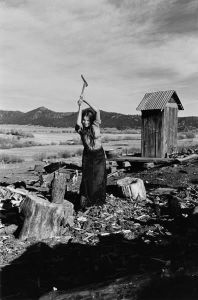
“There is still a plan,” I hope…I pray. On this Palm Sunday I share with you this post I found to be such a comfort, this week. Our stories–whatever they might be–are, as Allison K. Williams writes, “our valuable labor.” Stories, yours and mine, are also a comfort. This morning, my kids and I shared in the story of Christ’s Passion through virtual Mass over Facebook. It was weird, but the familiar words, along with the priest’s vestments of red, his blessing of spring green palms, were a rote and ritualistic balm. That’s the Church’s labor–its chopping of wood, its carrying of water. Whatever your story or labor, I hope you share it with someone today. I thank Allison K. Williams, Brevity’s Social Media Editor and a wonderful memoirist, essayist, editor, and coach for sharing hers. I encourage you to check out Brevity’s Nonfiction Blog, and Allison’s other work at idowords.net. Be well! ~Rebecca
We woke up and everything had been different for some time now. Maybe we finally slept through the night. Or embraced waking up early, wired without caffeine. Maybe the bleak haze had become familiar, waiting for something to feel like feeling again. Maybe a call came—your friend is dying. Or, I think we should take a break. Or a text, WE WOULD LIKE TO INFORM YOU THAT PUBLIC MOVEMENT RESTRICTION HAS BEEN IMPOSED.
Maybe we woke to the memory of weeks ago, some faraway country tracking their citizens, an alarmist friend stockpiling taco mix, our partner still warm-eyed and cuddly. All we want is to go back to sleep, back in time, to the moment before the pandemic, the break-up, that moment of sweet unknowing, when everything was still OK.
How can we write? How can we read?
How can we possibly address the page with our life, or…
My boys and me on open water, cruising on the Rebecca T. Ruark (no relation but regional) one of the oldest working skipjacks on the Chesapeake Bay
I’m trying to remain open, these days of isolation, to what might pass for connection now. I try not to rail against the world for small annoyances–and thereby close my heart to possibilities. I try not to cry at the faulty internet connection that makes me drop my first-ever Zoom call. I should be happy for technology, for the virtual happy hour with my friends in town, happy to have friends, a town, a house, a basement I can sit in–which is dry despite all the rain–where the Wi-Fi works best.
Another friend dropped toilet paper at my kitchen door today–the best kind of pandemic calling card. Yet another friend, far away, is teaching her four-year-old his letters and decided to bring pen pals back. My own boys are practicing their cursive on loose-leaf (I’m glad we don’t have to re-purpose for the bathroom) and have discovered the joys of snail mail. My freelance work has me writing for hospitals, which makes fiction feel not just false but useless. My creative writing is changed, not closed, but working through different channels now.
A novelist friend, when addressing how to write at such a time as this, suggested acting like a different kind of artist. Writers, try on your dancing shoes. Performers, take to the page. That kind of thing. I desperately miss singing in my choir, raising my voice in song. I’ve written about it here and here and mused on singing for Ruminate, here. But I don’t seem to be able to open my mouth in song today.
I recent days, I have written a short essay and a flash fiction piece, departures from my WIPs–historical novels that don’t let me address this present moment. It’s a moment I don’t want to close myself off from–or forget–for the lessons it might teach me. Meanwhile, I should be teaching my kids; we should be writing a middle grade book together. Maybe we will, and set the story in a wooden boat.
The day before my state’s governor issued the latest isolation mandates, my husband and sons took to the water. My younger twin named the dinghy, “Aqua Dove”–big name for a small boat. With oars, a centerboard, and a little sail, I hope it will give my boys a sense of freedom on open water, when this is over.
The wonderful editors at WordPress Discover are instituting a new thing, starting in April. I’m not typically one for writing prompts, but then there’s been absolutely nothing typical about these pandemic days–or my literary (or non) responses to them. Maybe you’ll join me in responding to one or more prompts. Maybe we’ll discover something new, hopeful, or even joyous together. I hope so… ~Rebecca
How are you? Three words. That’s about all we need to say right now, or during any period of grief, isn’t it? Then listen to the answer. But, let’s chat awhile. Really, what else do you have going on right now?
True story: lots of the typical emotional terribleness happened to me after my mom died, but there were some bright spots, too. Among them my induction into the Dead Mom Club.
Mom
OK, it’s not a real club–or maybe it is and my invitation’s been lost in the mail for 14 years. But, suddenly, I had a monumental thing in common with many people. However, being 30 at the time, I wasn’t friends with lots of those people. Most of my friends still had both their parents. But my husband had a couple friends who’d lost a parent on the youngish side–and suddenly we had this life-changing fact in common. That’s heavy. Whether we wanted to be or not (I choose not!) we were members of the same grief club.
Now, here we are in 2020, suffering from grief as a global entity. It’s a much bigger club no one gets out of belonging to. Let’s just hope the dues don’t skyrocket.
Sure, it’s grief we’re feeling–not that I recognized it as such, right away. It took something novelist Amber Sparks (a fellow native Midwesterner) and the funniest writer on Twitter said:
I just thought ‘I should call my mom, I need a mom right now,’ and I felt immense relief, and then I remembered my mom is dead and I am my own mom now.
Amber Sparks @ambernoelle, author of AndI Do Not Forgive You
Oh, it’s grief alright–even if the symptoms manifest differently for each of us. Even if we’re grieving different stuff on our own micro level. For me that’s missing experiencing the regular-level penitential stuff of Lent, rather than this penance on steroids. That’s taking part in a spring Lit Walk in my old ‘hood of Richmond, VA. That’s watching my kids play with friends that are not their twin. And don’t forget eating anywhere besides my own house.
Yep, what started as ennui is making its way through the ol’ stages of grief named by Kübler-Ross and co. Don’t believe me? Ask Harvard.
Now that we can name this heaviness, maybe we can do something about it. In the Harvard Business Review piece, “That Discomfort You’re Feeling is Grief,” writer Scott Berinato interviews David Kessler (one of Kübler-Ross’s and co.) for ideas on how to manage our pandemic-induced grief. My top takeaways and my own spins:
“Acceptance…is where the power lies”
Don’t ignore your anxious thoughts, but “find balance in the things you’re thinking”
Let go of what you can’t change, and focus on what’s in your control (i.e. washing your hands for the 512th time today)
Pull meaning from grief–for instance, appreciating the connections we can still make through the miracles of tech (i.e. what we bloggers have known all along!)
Allow your feelings to happen
I’ll admit it took awhile for this grief to hit me. I was busy figuring out how I was going to manage my kids’ schooling on top of my work and the care and feeding of boys all day. I got lost in the minutia. Then it hit me like a ton of bricks. Bricks of song. Follow me here: my choir director reached out with a choral piece on YouTube to share–because we choir members have been unable to share our voices with each other. So, I listened to the gorgeous choral strains and ugly-cried all over my keyboard. And then I felt a little better.
I’m not going to pat myself on the back for reaching the level of acceptance, because grief isn’t linear. I know that all too well.
But I also know that we’re in this club together, and for that I’m happy.
So, how are you? How have you been keeping? What have you done this week that’s made you smile? (Around here, we traveled in the way-back machine to introduce the boys to Jim Henson’s Muppets. Last night it was The Muppet Movie–I highly recommend.)
Have a little time on your hands for some more reading? I’ve been busy with my editing gig at Parhelion Literary Magazine, and wrote a short essay here. It’s light and optimistic and nature-y. If you like that, I encourage you to read around PLM’s Winter 2020 issue, with short stories, flash fiction, poetry, and nonfiction for every literary taste.
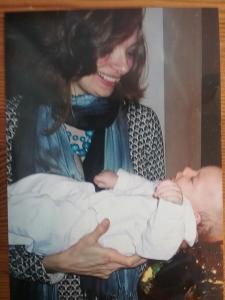
From my second wedding–same groom as the first. A story for another day.
The holy water font had brown cardboard over it–a haphazard lid to signal emptiness. The water had been drained from all the fonts at the church entrances but not the baptismal font. Not yet anyway; somebody said there was one baptism after Mass that morning. I saw the baby–rosy-cheeked in his mother’s arms–on my way out of church. My last Mass, maybe for all of Lent. My last time singing with the choir. I haven’t sung a note since, as if doing so would signal that this is the new normal: sad, bad impromptu soprano solos locked in my home office, dressed in my bathrobe, alone.
Gone was the singing in communion, the holy water, the hand-holding, and hand-shaking at the Sign of Peace. The next week, there would be no Mass at all. Should we shake some of our holy water around the house? My husband and I brought bottles home from Knock, Ireland, the only shrine I’ve ever visited, which we did for a day on our honeymoon, in between pubs and church ruins. We may have a bottle around still, though it might have gone moldy. We’ve been married 16 years as of yesterday. We got carry-out to celebrate, our first since we started playing keep-away from everybody we don’t live with, and it was wonderful. Every stranger-interaction–even picking up carry-out at a curb–seems imbued with a little holiness now, or grace, or gratitude in communing, however you like to see it.
Maybe I’d been spoiled by the choir voices around me, the Signs of Peace aplenty, a whole church full of, if not all friends, congregants–the whole of us choosing to be in the same place at the same time, for the same reason, more or less. I try to remember that it only takes two or three gathered in His name, but there is comfort in a crowd. In Longing for an Absent God: Faith and Doubt in Great American Fiction, a title that just keeps feeling more and more prescient, author Nick Ripatrazone says, simply: “Catholicism is a communal faith.”
In his book of essays, Ripatrazone unveils the role of Catholic storytelling in the American literary cannon. He takes the reader from Flannery O’Connor through Andre Dubus to living writers, like Cormac McCarthy, Alice McDermott–and Phil Klay (whom I’ve yet to read)–among others. Raised on the Mass, these writers share some sensibilities: the idea of faith in community, of liturgical seasons–rituals a comfort. Says Ripatrazone, “Catholics raised on a religion of mystery, image, smell, and song are particularly vulnerable to the pull of sentimentality.” Can me sentimental then.
Another modern novelist, Ann Patchett, has credited the Catholic faith for giving her “a boundless capacity for creativity and appreciation for metaphor.” If you’ve ever stepped foot in a Catholic church you can probably see that: everything is imbued with meaning. From Ripatrazone:
Catholicism is an assault on the senses. The thickly sweet smell of incense clouding a church. A finger dipped into the holy water fount; the almost otherworldly touch of it. The feel of a back against the hard pew…The Rise and refrain of hymns…the silence of prayer…the high drama of Lent.
It all means something, more than one thing. And certainly, there’s a performance aspect to the faith that isn’t lost on this Catholic kid raised on church and ballet–pretty much in equal measure. I recently, mistakenly, called the altar “the stage,” and it’s no wonder why. There’s the Mass’s “script,” with its accompanying ritualistic movements–very much body-centered–a reverential dance of signs and postures. There are “costumes” whose colors are filled with meaning. Right now, we’re penitential purple. Are we ever.
Which might be why that piece of ordinary brown cardboard over the drained holy water font bothered me so much–the lack of performance or ritual. Or, preparation. Ritual takes preparation, and none of us had any rehearsals for the effects of this pandemic.
So, my hope today is that we all lean into the rituals that provide us some comfort and connection–even if virtual.
What are you reading? How are you dealing? What rituals are you keeping or instilling in your household as you physically distance yourself from others?
Looking for a new author to read, a poet or memoirist? Check out my handy categories above, where you’ll find my writer interviews, book reviews, essays, writing advice, and more.
Let’s connect socially: find me on FB and @MoonRuark on Twitter
Free image courtesy of KathrynMaloney at Pixabay.com
It’s been a minute, or much more than a minute, since I checked in with my blogger-reader-writer friends. How’s it been? Around here, work and family life have filled every spare moment of mine this past month, except for a few precious minutes before bed–that I give to reading (just finished Dominico Starnone’s Trick, trans. by Jhumpa Lahiri–and I’ll definitely be blogging about it).
Any creative writing I’ve been doing has been mostly in my mind. One thing I’ve been mulling over: why do we write about what we write about? Some write to excise their greatest anxieties. (“Write toward your fear,” go the writing prompts.) Some write to work through a conundrum, to better understand. Why do we pick the subjects we pick? Love, sex, parenthood, sickness, birds, flight, death, water, dance…
An artist chooses his subjects. That is the way he praises.
Friedrich Nietzsche
Why do you create what you create? Why do you write about, what you write about? What compels you? What are you writing–or reading–this weekend? I hope it’s a good one!
Want some more writerly advice? See my categories, above. And, as always, you can also find me at FB and @moonruark on Twitter.
Happy Saturday to those of you around my side of the globe. A quick check-in: I know, I know, you just heard from me the other day with my take on Elena Ferrante’s My Brilliant Friend, the first of the Italian author’s Neapolitan quartet of novels exploring female friendship and much more. And, before that, I shared my dreams (and distractions) for 2020.
This year, I’m resolved to enjoy this writing-and-blogging community, the slow slog meditative process of writing and publishing, and the paths down memory lane I take as I write. And while I typically craft fiction–find some of it here at stories–I responded to a nonfiction call from the editors at Ruminate Magazine for readers to ruminate on “The Everyday.” That prompt led me to think of the joys of special holidays–like the baptism of my guys 10 years ago–and the joys of the mundane: Ordinary Time, ordinary time, and a warm piece of bread.
If you have a moment, my short essay (the second of the readers’ notes) is a two minute read–as are the other ruminations from readers around the country. But you might just want to stay a while, so we can, as the magazine’s About page says, “practice staying awake together.”
Italian author Elena Ferrante has had quite the effect on the American literary community–with her Neapolitan quartet of novels starting with My Brilliant Friend especially. Much of the more recent response (My Brilliant Friend was published in English in 2012) is likely due to this New York Times article: “The Ferrante Effect: In Italy, Women Writers are Ascendant.” And then there are the spoofs, including this one in McSweeney’sInternet Tendency called, simply, “I am Elena Ferrante,” that confirm Ferrante (a pen name, her real identity a mystery) has captured the American imagination.
She has captured this American’s imagination, anyway. Selfishly, I love the idea of women writers being ascendant anywhere, especially in a patriarchal culture dominated by, well, men–in literature and at home, in the neighborhood, at church…
Not all women readers have been as impressed by Ferrante as I have been, albeit only one novel into the quartet. A quick scan of Goodreads reviews of My Brilliant Friend, which follows the childhood and adolescent friendship between Lila and Lenú–sometimes fond, sometimes rivaling, always close–set against the backdrop of a poor neighborhood in post-war Naples reveals some dissent. “Why are the kids always throwing stones at each other?” one confounded reader asks.
Having studied up a bit on Italy between the wars for my own writing, it’s the stone-throwing, writ large–over the girls’ neighborhood, over their city, and over their country–that is most interesting to me. Often it’s stone-throwing in lieu of seizing any real, lasting power. (No real spoilers in this post–if you’ve read the summary.)
Oddly, some of the moments that describe the history of violence in this place are more lyrical than the moments devoted to friendship:
So she gave concrete motives, ordinary faces to the air of abstract apprehension that as children we had breathed in the neighborhood. Fascism, Nazism, the war, the Allies, the monarchy, the republic–she turned them into streets, houses, faces…
Isn’t this act of turning formless fear into places and characters just what a good writer does? So too do Ferrante’s characters expose this strange place to us through the everyday, the neighborhood. Leaving one of the girls to believe the other “…enclosed me in a terrible world that left no escape.”
The domestic, the old hearth-and-home, offers no respite from the violence, but only offers a different kind of violence. The neighborhood in this novel produces rival gangs, even agents of the Camorra (Neapolitan Mafia). Even inside Lina and Lenú’s homes there is violence–between husbands and wives, parents and children, mothers and daughters. No one is safe; certainly no one is ascending anywhere.
Perhaps the most startling admission in the (at least somewhat autobiographical) novel:
I feel no nostalgia for our childhood: it was full of violence.
How to rise above it all? How to escape the cycle of violence and poverty? This is Italy. So, God? No, Lenú ranks faith wholly inadequate to the task of pulling anyone out of her neighborhood, in a scathing derision of the Catholic Church–made all the more scathing as it’s delivered by a teenage girl:
[I] said that the human condition was so obviously exposed to the blind fury of chance that to trust in a God, a Jesus, the Holy Spirit–this last a completely superfluous entity, it was there only to make up a trinity, notoriously nobler than the mere binomial father-son–was the same thing as collecting trading cards while the city burns in the fires of hell.
Of course, this speech of Lenú is devastating–if also a bit humorous. We faithful, and we writers, alike, love a trinity, don’t we? But what a powerful image, those trading cards–reminiscent of the prayer and saint cards we Catholics receive at funerals and other ritualistic events. Were I to write about my own childhood and adolescence adhering to the rites of the Roman Catholic Church, there wouldn’t be much grasping at God. Rituals and ceremony, yes. What do I remember of my first communion in second grade? The white dress and veil I wore–the last veil I wore, not carrying on that particular tradition at my wedding, when I wore a tea-length dress to show off my legs.
If not God, where then can these adolescent girls, Lila and Lenú, turn to ascend from this violence they call home? Like all young people they dream of riches and fame–that would result, in their fantasies, from publishing a book “like Little Women…” But that dream fades as the girls’ intellectual and feminine powers grow. Lenú goes to high school, excels in languages, history, and even religion, mentored by a female teacher, a Communist distrusted by Lenú’s very-traditional mother. Lila turns her attention to a young man as savior. “He’s rich,” she says to her friend. “Also nice, also good.” Lenú considers those two adjectives as providing the “final blow to the shrine of childish fantasies.”
“Blow” such a telling action there–a violent end to a kind of shrine (a place of faith–even if fanciful). One chapter of life ends. The friends’ lives have diverged, a bit violently, one down the path of marriage and family, the other down the path of education:
Was it not true, then, that school was my personal wealth, now far from her influence?
Lenú weeps at this realization of the separation between the friends who have known each other, always.
This is a book that captures the violence of a time and place as it captures a female friendship, the portrayal of which–in my mind–makes these characters ascend (like their creator, Ferrante, a female writer in Italy) from their hurtful home. At least, I hope they do. There is more to come.
I can’t wait to see where Lina and Lenú go next.
Have you read any Elena Ferrante? Have you read My Brilliant Friend and the rest of the quartet? (No spoilers!) What did you think?
Have you known any of your current friends since early childhood? How have you traveled the same paths in life? How have your paths diverged?
Looking for a review? See my categories above for book reviews, author interviews, and more. And find me on Goodreads, where I try to at least rank what I’ve read. Let’s be friends there!
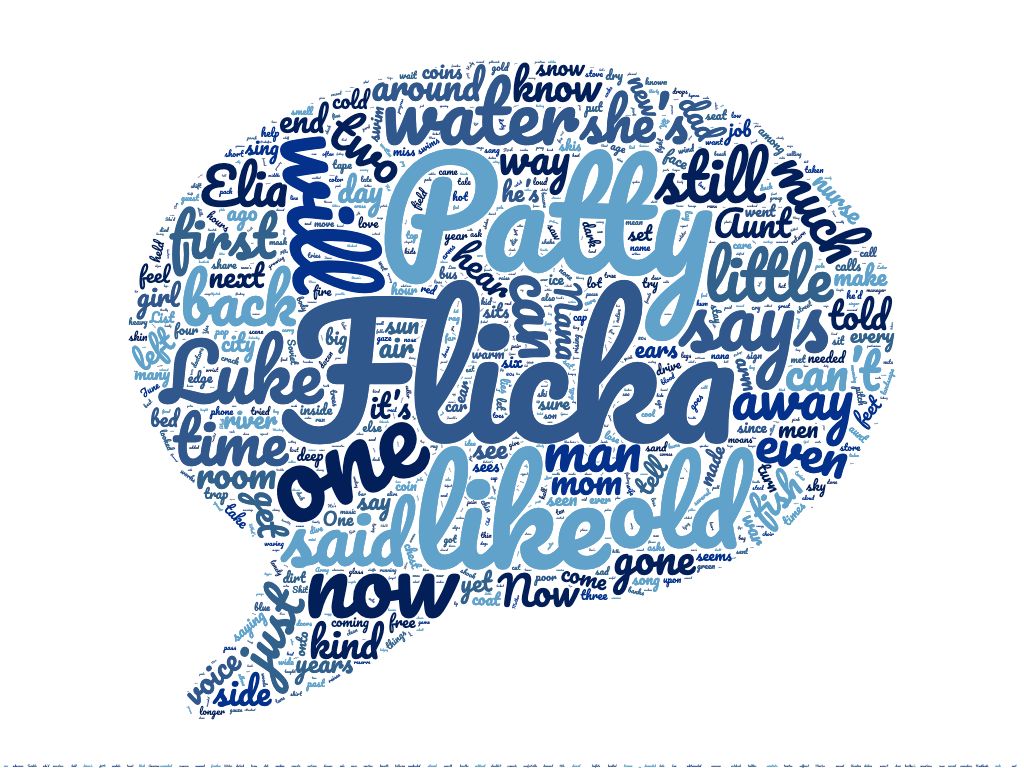
Dreamy word cloud from my current novel-in-progress created at wordclouds.com
Remember daydreaming? That old creativity-inducing distraction? I do–if just barely.
Now, even our distractions are automated and customized and curated by an algorithm that seems to know what we should be daydreaming about before we can even get to it. What’s more, the rabbit holes we find ourselves distractedly falling down end not in a constructively weird place–but all too often in a place that might be weird but probably will cost us money. So, a destination that leaves us both distracted and poorer. Happy 2020! From a fun piece by Kathryn Schulz from 2015 in The New Yorker. She saw it coming:
How did “rabbit hole,” which started its figurative life as a conduit to a fantastical land [in Lewis Carroll’s Alice’s Adventures in Wonderland], evolve into a metaphor for extreme distraction? One obvious culprit is the Internet, which has altered to an indescribable degree the ways that we distract ourselves.
Thank you for Internet-ing right here, this Monday morning, when there are so many rabbit holes clambering for us, desiring to drive us to distraction–to forget our intentions, our destinations, our worth, even ourselves.
Can I tell you I’ve been distracted?
While others have been setting down their 2020 resolutions, and even committing them to blog post (and, as such, according to the court of blog, making them treaties never to be broken!), I’ve been distracted. While others have been new-decade-to-do-ing and vision-boarding, I’ve been distracted.
Two weeks of 2020 in the crapper already, and I’ve made a word cloud. (See above.) Well, not me, but a website. OK, I plopped in the words–from my novel-in-progress–and out came a word cloud. I did pick the shape and the color scheme: blue.
Here’s another thing: I found a website, literature-map, that will show me (in an attractive visual-thesaurus web sort of way) which authors are most like my faves. A new-to-me fave:
If only I could pick the color scheme…
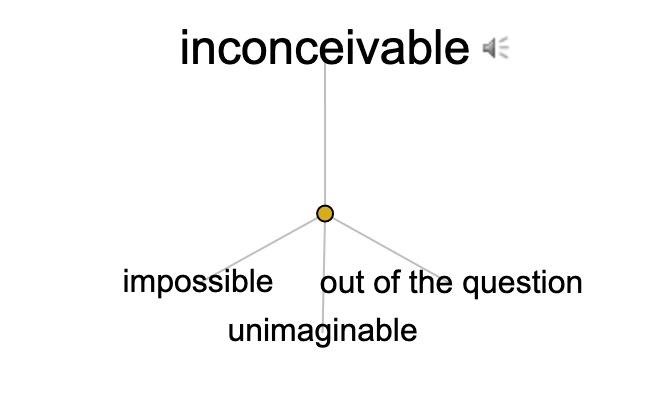
Hold up! You haven’t visited the visual thesaurus? Inconceivable! Here:
Which reminds me of The Princess Bride. What a movie. Inconceivable! Who was that actor? He’s still alive, right?
You see what I mean? This exercise in rabbit-holing isn’t to say that there’s anything wrong with distractions, or daydreams, but that I might be better served by being a little more intentional. You know: dreaming with intention, design, volition, even, dare I say, a goal.
So, I’m goal-setting-lite, meaning with enough wiggle room for constructive rabbit holes and even breaks. (Like, “intention” comes from the Latin intentus, meaning “a stretching out,” also “a leaning toward, a strain.” I mean, that sounds like exercise, which is never supposed to be easy, right?)
I’m reading with intention–right now Elena Ferrante’s My Brilliant Friend, the first of the Neapolitan quartet of novels by the highly-acclaimed Italian author–to inform my historical novel about an Italian family in WWII America. And I’m back over at Goodreads, where I’m going to try to keep better track of what I’ve read–outside of Rust Belt authors.
I’ve also been taking some lovely reading detours–having read over the last month a children’s book, a literary thriller, and a sci-fi screenplay–for friends and fellow bloggers who are highly-acclaimed in my eyes. And reading thinker-blogposts, like this one “On Breaks and Connections.” And next up on the ol’ TBR is a book of poetry–because poetry is the best kind of distraction.
Writing? OK, I didn’t use my Christmas break to gain great headway on my novel-in-progress (outside of the groovy word cloud)–what with Christmas and Christmas carols, cookies, and more cookies. However, I did get another chapter down. And then, in response to a call from a journal I admire, I wrote a thing–a creative nonfiction piece about Ordinary Time and ordinary time and making the everyday a holiday worth singing about and feasting over; and finding the blissfully mundane in a holiday. It’s a working rabbit hole, anyway. And the novel draft will be out of my brain and on paper, come June (wish me luck).
And editing. I wore that hat a lot over at Parhelion Literary Magazine, last year. My 2019 saw me shepherd three book reviews, five essays, and an author interview into the world, plus I conducted two interviews, and penned a piece on finding “twin skin” and solace in the essays of Randon Billings Noble. I adore this PLM gig and hope you’ll check me out over there, too. More good stuff to come in 2020.
Of course, it’s publishing that’s considered to be the big win, the brass ring, the dream destination for us writer-types. The agent querying continues, but I did have a couple short stories published last year in journals I love. And, lest I forget that this writing thing is about the path, and not the destination, I read this post for a different kind of “Resolution,” today.
Goals. I’ll get on it. I will. Right now, you’re here and I’m here, which means we’re in the very same rabbit hole (#bloggoals), if for only a few minutes–and that’s a win these days. As was being nominated for the Bloggers Recognition Award by one of my favorite blogging friends, Silvia, from Italian Goodness, who, when I told her I wasn’t sure if I was going to be able to hop on the nomination train, said these wise words: “Life is busy. Family comes first. Never stop dreaming, but prioritizing is the secret of happiness.” Truer words, folks… Thank you, Silvia! (And go make one her Italian recipes and make yourself so happy.)
Here’s to more connecting and dream-making in 2020–by a little luck and a pinch of intention.
Have you recovered from the Christmas cookie coma? New Year’s resolution-failure guilt getting to you, or is that just me?
Care to social media rabbit-hole together? You can find me at FB, on Twitter and IG @MoonRuark, and at Goodreads, where it appears as if I’m just getting the hang of this whole literary thing.
I can’t think of a better way to wrap up the year than this compilation of blogging successes from WordPress. Among them is my take, which I hope captures my sincere appreciation for this blogging community. Thank you for connecting with me and my blog in 2019! See you in 2020, friends. ~Rebecca

 We woke up and everything had been different for some time now. Maybe we finally slept through the night. Or embraced waking up early, wired without caffeine. Maybe the bleak haze had become familiar, waiting for something to feel like feeling again. Maybe a call came—your friend is dying. Or, I think we should take a break. Or a text, WE WOULD LIKE TO INFORM YOU THAT PUBLIC MOVEMENT RESTRICTION HAS BEEN IMPOSED.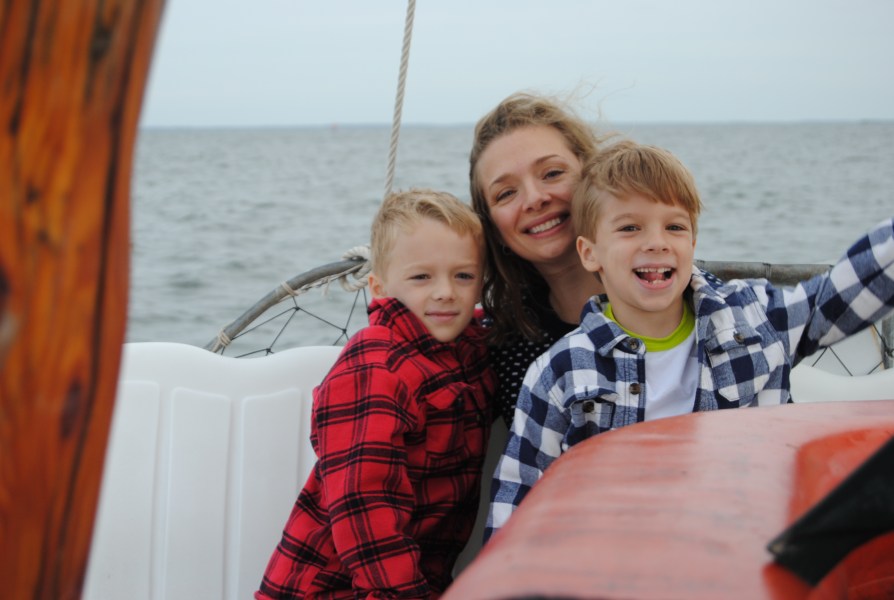





 Rust Belt Girl