A long-overdue lawn trimming revealed a rabbit’s nest in the yard. There are two babies that we can see. Twins, each no bigger than a child’s hand. A quick internet search revealed some interesting facts: that baby rabbits need only to nurse a couple times a day, and do so very quickly (unlike the seemingly endless nursing sessions I experienced with my own twins). But then, it’s “quick as a bunny,” not “quick as a baby.”
It was a joy to see the excitement on my more tender-hearted boy’s face at his discovery. While the boys left them alone–wild rabbits are not pets–they did name them: Peter and Bugs. Ordinarily, I wouldn’t worry that these rabbits might not make it. Death’s natural, and all that. Only, now I do worry–about that and everything else. I also worry I might not make it through this year without securing a real pet for my boys, something to hold and care for. I’ve suggested a domesticated rabbit; the boys are talking about a dog, again.
I’m chronicling my days of COVID-19-induced isolation here at the blog with the help of WordPress Discover . This post was in response to Discover Prompt Day 6: Hands. Won’t you join in?
Of course, I’m still reading and writing the Rust Belt and beyond. Looking for an author interview, writing advice, or story? See my categories above.
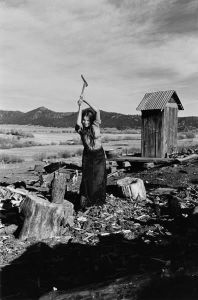
“There is still a plan,” I hope…I pray. On this Palm Sunday I share with you this post I found to be such a comfort, this week. Our stories–whatever they might be–are, as Allison K. Williams writes, “our valuable labor.” Stories, yours and mine, are also a comfort. This morning, my kids and I shared in the story of Christ’s Passion through virtual Mass over Facebook. It was weird, but the familiar words, along with the priest’s vestments of red, his blessing of spring green palms, were a rote and ritualistic balm. That’s the Church’s labor–its chopping of wood, its carrying of water. Whatever your story or labor, I hope you share it with someone today. I thank Allison K. Williams, Brevity’s Social Media Editor and a wonderful memoirist, essayist, editor, and coach for sharing hers. I encourage you to check out Brevity’s Nonfiction Blog, and Allison’s other work at idowords.net. Be well! ~Rebecca
We woke up and everything had been different for some time now. Maybe we finally slept through the night. Or embraced waking up early, wired without caffeine. Maybe the bleak haze had become familiar, waiting for something to feel like feeling again. Maybe a call came—your friend is dying. Or, I think we should take a break. Or a text, WE WOULD LIKE TO INFORM YOU THAT PUBLIC MOVEMENT RESTRICTION HAS BEEN IMPOSED.
Maybe we woke to the memory of weeks ago, some faraway country tracking their citizens, an alarmist friend stockpiling taco mix, our partner still warm-eyed and cuddly. All we want is to go back to sleep, back in time, to the moment before the pandemic, the break-up, that moment of sweet unknowing, when everything was still OK.
How can we write? How can we read?
How can we possibly address the page with our life, or…
“I’m so happy, I could sing.” I’m saying that never these days. Sure, there have been moments during this isolation when I’ve put my fear aside long enough to engage in a little car-trip sing-a-long. It was Day 14, when I had to go out to retrieve books from my kids’ school and rescue my dry cleaning from its hold-up situation. In the car by myself, all alone, I belted out notes along with Patti LuPone in Evita (read more about how she’s entertaining her fans from her basement right now). Then I mixed it up and got a little angsty–no surprise there–with Amy Winehouse. Finally, on my way home I swung from the vocal chandelier with Sia. It was a wonderful release.
Still, I can’t bring myself to practice the choral pieces I would have sung over Holy Week and Easter. I want to. In “Open Wide” I talked about my re-upped hobby (now that my boys are old enough not to need this enforcerin the pew). I talked about joining my middling soprano voice with others’ in praise of something bigger than all of us. Now, it won’t happen–at least it won’t happen the way I thought it would.
Maybe I need to do it, first, and feel it second? Perhaps one of the biggest takeaways from my creative writing program was that there is no writing muse. Not really. There is inspiration, sure. But, it’s closely followed by work, more work, a dash of intuition at times–which sometimes feels like a muse–and then more work.
Now, I’m thinking maybe I need to treat singing like I do writing. Do the work. Do the vocal exercises like I respond to writing prompts like this; blog, little by little, and don’t wait for inspiration. Make the inspiration. Make the song. I was just going to write: “be the song.” But, really, I’m not there yet.
Be well–and maybe sing today! I’ll be listening out. ~Rebecca
Looking for a good weekend read? Check out my categories above for author interviews, some of my own fiction, and more. Are we socially connected? Find me on FB and @MoonRuark on Twitter
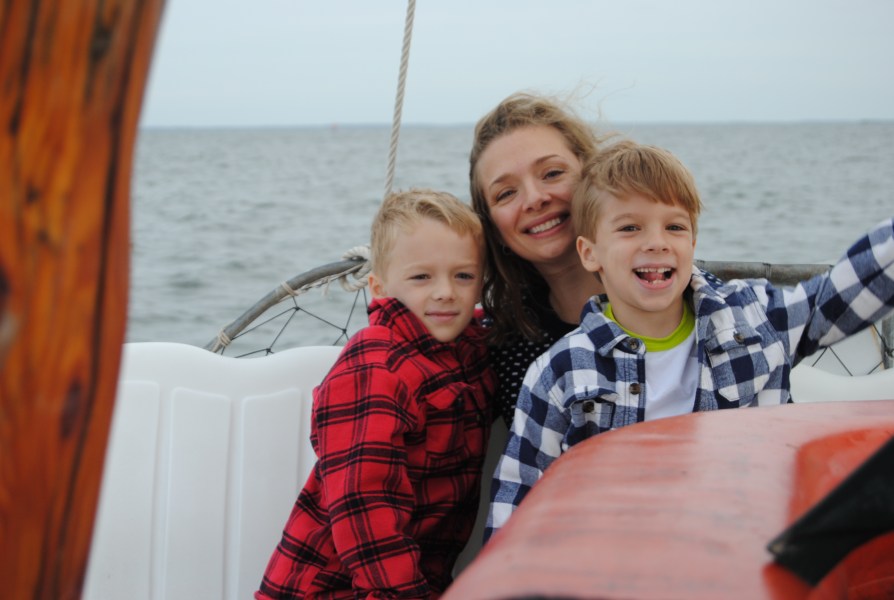
My boys and me on open water, cruising on the Rebecca T. Ruark (no relation but regional) one of the oldest working skipjacks on the Chesapeake Bay
I’m trying to remain open, these days of isolation, to what might pass for connection now. I try not to rail against the world for small annoyances–and thereby close my heart to possibilities. I try not to cry at the faulty internet connection that makes me drop my first-ever Zoom call. I should be happy for technology, for the virtual happy hour with my friends in town, happy to have friends, a town, a house, a basement I can sit in–which is dry despite all the rain–where the Wi-Fi works best.
Another friend dropped toilet paper at my kitchen door today–the best kind of pandemic calling card. Yet another friend, far away, is teaching her four-year-old his letters and decided to bring pen pals back. My own boys are practicing their cursive on loose-leaf (I’m glad we don’t have to re-purpose for the bathroom) and have discovered the joys of snail mail. My freelance work has me writing for hospitals, which makes fiction feel not just false but useless. My creative writing is changed, not closed, but working through different channels now.
A novelist friend, when addressing how to write at such a time as this, suggested acting like a different kind of artist. Writers, try on your dancing shoes. Performers, take to the page. That kind of thing. I desperately miss singing in my choir, raising my voice in song. I’ve written about it here and here and mused on singing for Ruminate, here. But I don’t seem to be able to open my mouth in song today.
I recent days, I have written a short essay and a flash fiction piece, departures from my WIPs–historical novels that don’t let me address this present moment. It’s a moment I don’t want to close myself off from–or forget–for the lessons it might teach me. Meanwhile, I should be teaching my kids; we should be writing a middle grade book together. Maybe we will, and set the story in a wooden boat.
The day before my state’s governor issued the latest isolation mandates, my husband and sons took to the water. My younger twin named the dinghy, “Aqua Dove”–big name for a small boat. With oars, a centerboard, and a little sail, I hope it will give my boys a sense of freedom on open water, when this is over.
The wonderful editors at WordPress Discover are instituting a new thing, starting in April. I’m not typically one for writing prompts, but then there’s been absolutely nothing typical about these pandemic days–or my literary (or non) responses to them. Maybe you’ll join me in responding to one or more prompts. Maybe we’ll discover something new, hopeful, or even joyous together. I hope so… ~Rebecca
How are you? Three words. That’s about all we need to say right now, or during any period of grief, isn’t it? Then listen to the answer. But, let’s chat awhile. Really, what else do you have going on right now?
True story: lots of the typical emotional terribleness happened to me after my mom died, but there were some bright spots, too. Among them my induction into the Dead Mom Club.
Mom
OK, it’s not a real club–or maybe it is and my invitation’s been lost in the mail for 14 years. But, suddenly, I had a monumental thing in common with many people. However, being 30 at the time, I wasn’t friends with lots of those people. Most of my friends still had both their parents. But my husband had a couple friends who’d lost a parent on the youngish side–and suddenly we had this life-changing fact in common. That’s heavy. Whether we wanted to be or not (I choose not!) we were members of the same grief club.
Now, here we are in 2020, suffering from grief as a global entity. It’s a much bigger club no one gets out of belonging to. Let’s just hope the dues don’t skyrocket.
Sure, it’s grief we’re feeling–not that I recognized it as such, right away. It took something novelist Amber Sparks (a fellow native Midwesterner) and the funniest writer on Twitter said:
I just thought ‘I should call my mom, I need a mom right now,’ and I felt immense relief, and then I remembered my mom is dead and I am my own mom now.
Amber Sparks @ambernoelle, author of AndI Do Not Forgive You
Oh, it’s grief alright–even if the symptoms manifest differently for each of us. Even if we’re grieving different stuff on our own micro level. For me that’s missing experiencing the regular-level penitential stuff of Lent, rather than this penance on steroids. That’s taking part in a spring Lit Walk in my old ‘hood of Richmond, VA. That’s watching my kids play with friends that are not their twin. And don’t forget eating anywhere besides my own house.
Yep, what started as ennui is making its way through the ol’ stages of grief named by Kübler-Ross and co. Don’t believe me? Ask Harvard.
Now that we can name this heaviness, maybe we can do something about it. In the Harvard Business Review piece, “That Discomfort You’re Feeling is Grief,” writer Scott Berinato interviews David Kessler (one of Kübler-Ross’s and co.) for ideas on how to manage our pandemic-induced grief. My top takeaways and my own spins:
“Acceptance…is where the power lies”
Don’t ignore your anxious thoughts, but “find balance in the things you’re thinking”
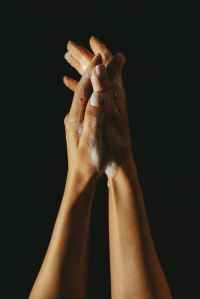
Let go of what you can’t change, and focus on what’s in your control (i.e. washing your hands for the 512th time today)
Pull meaning from grief–for instance, appreciating the connections we can still make through the miracles of tech (i.e. what we bloggers have known all along!)
Allow your feelings to happen
I’ll admit it took awhile for this grief to hit me. I was busy figuring out how I was going to manage my kids’ schooling on top of my work and the care and feeding of boys all day. I got lost in the minutia. Then it hit me like a ton of bricks. Bricks of song. Follow me here: my choir director reached out with a choral piece on YouTube to share–because we choir members have been unable to share our voices with each other. So, I listened to the gorgeous choral strains and ugly-cried all over my keyboard. And then I felt a little better.
I’m not going to pat myself on the back for reaching the level of acceptance, because grief isn’t linear. I know that all too well.
But I also know that we’re in this club together, and for that I’m happy.
So, how are you? How have you been keeping? What have you done this week that’s made you smile? (Around here, we traveled in the way-back machine to introduce the boys to Jim Henson’s Muppets. Last night it was The Muppet Movie–I highly recommend.)
Have a little time on your hands for some more reading? I’ve been busy with my editing gig at Parhelion Literary Magazine, and wrote a short essay here. It’s light and optimistic and nature-y. If you like that, I encourage you to read around PLM’s Winter 2020 issue, with short stories, flash fiction, poetry, and nonfiction for every literary taste.
From my second wedding–same groom as the first. A story for another day.
The holy water font had brown cardboard over it–a haphazard lid to signal emptiness. The water had been drained from all the fonts at the church entrances but not the baptismal font. Not yet anyway; somebody said there was one baptism after Mass that morning. I saw the baby–rosy-cheeked in his mother’s arms–on my way out of church. My last Mass, maybe for all of Lent. My last time singing with the choir. I haven’t sung a note since, as if doing so would signal that this is the new normal: sad, bad impromptu soprano solos locked in my home office, dressed in my bathrobe, alone.
Gone was the singing in communion, the holy water, the hand-holding, and hand-shaking at the Sign of Peace. The next week, there would be no Mass at all. Should we shake some of our holy water around the house? My husband and I brought bottles home from Knock, Ireland, the only shrine I’ve ever visited, which we did for a day on our honeymoon, in between pubs and church ruins. We may have a bottle around still, though it might have gone moldy. We’ve been married 16 years as of yesterday. We got carry-out to celebrate, our first since we started playing keep-away from everybody we don’t live with, and it was wonderful. Every stranger-interaction–even picking up carry-out at a curb–seems imbued with a little holiness now, or grace, or gratitude in communing, however you like to see it.
Maybe I’d been spoiled by the choir voices around me, the Signs of Peace aplenty, a whole church full of, if not all friends, congregants–the whole of us choosing to be in the same place at the same time, for the same reason, more or less. I try to remember that it only takes two or three gathered in His name, but there is comfort in a crowd. In Longing for an Absent God: Faith and Doubt in Great American Fiction, a title that just keeps feeling more and more prescient, author Nick Ripatrazone says, simply: “Catholicism is a communal faith.”
In his book of essays, Ripatrazone unveils the role of Catholic storytelling in the American literary cannon. He takes the reader from Flannery O’Connor through Andre Dubus to living writers, like Cormac McCarthy, Alice McDermott–and Phil Klay (whom I’ve yet to read)–among others. Raised on the Mass, these writers share some sensibilities: the idea of faith in community, of liturgical seasons–rituals a comfort. Says Ripatrazone, “Catholics raised on a religion of mystery, image, smell, and song are particularly vulnerable to the pull of sentimentality.” Can me sentimental then.
Another modern novelist, Ann Patchett, has credited the Catholic faith for giving her “a boundless capacity for creativity and appreciation for metaphor.” If you’ve ever stepped foot in a Catholic church you can probably see that: everything is imbued with meaning. From Ripatrazone:
Catholicism is an assault on the senses. The thickly sweet smell of incense clouding a church. A finger dipped into the holy water fount; the almost otherworldly touch of it. The feel of a back against the hard pew…The Rise and refrain of hymns…the silence of prayer…the high drama of Lent.
It all means something, more than one thing. And certainly, there’s a performance aspect to the faith that isn’t lost on this Catholic kid raised on church and ballet–pretty much in equal measure. I recently, mistakenly, called the altar “the stage,” and it’s no wonder why. There’s the Mass’s “script,” with its accompanying ritualistic movements–very much body-centered–a reverential dance of signs and postures. There are “costumes” whose colors are filled with meaning. Right now, we’re penitential purple. Are we ever.
Which might be why that piece of ordinary brown cardboard over the drained holy water font bothered me so much–the lack of performance or ritual. Or, preparation. Ritual takes preparation, and none of us had any rehearsals for the effects of this pandemic.
So, my hope today is that we all lean into the rituals that provide us some comfort and connection–even if virtual.
What are you reading? How are you dealing? What rituals are you keeping or instilling in your household as you physically distance yourself from others?
Looking for a new author to read, a poet or memoirist? Check out my handy categories above, where you’ll find my writer interviews, book reviews, essays, writing advice, and more.
Let’s connect socially: find me on FB and @MoonRuark on Twitter
As a June baby, I never gave much credence to astrological signs or birth stones, for that matter. (I mean, pearl, alexandrite, or moonstone. Really?) But back to signs: I’m a Gemini, the twin sign, and the “liveliest” of the air signs, whatever that means. I share this honor with dead Gems like Marilyn Monroe and live ones like Kanye West. So, I’m in complicated company.
Anyhow, this twin married another one just about 16 years ago. Six years later, we twinned Geminis had a set of actual twin babies. But even before they were born, I prepared myself to be a twin-mom. It’s a whole thing. I read (as I’m wont to do) the dos and don’t of twin-parenting, and I found that much of the emotional-care advice falls into two buckets.
Do treat your twins like two individual people and not a BOGO deal
Don’t fall into the trap of making twins into neat polar opposites for shock value or as a handy literary trope.
You know, as in good twin-bad twin, smart twin-dumb twin, funny twin-serious twin. It’s not only cruel but, in the case of good characterization (since this is a writing blog), just plain lazy.
So, I’m on the lookout for nuanced twin tales. Tell me what you’ve got in the way of literary fiction for adults and maybe YA, too, that features twins. I’m curious (and kinda self-quarantined, so I’ve got a little time).
I’m also interested in the way two characters who are not twins can be “twinned” in stories. Which brings me, a bit late (but really, we’re all self-distancing, so what else do you have to do?) to my latest read: Domenico Starnone’s novel, Trick, translated by Jhumpa Lahiri. (It’s true, she’s amazing in Italian, too.)
Cover image pulled from Europaeditions.com
A wonderful, surprising, and layered novel, Trick deserves an in-depth discussion–of setting, plot, inspiration, and characters. (In order, that’s Naples, Italy…grouchy grandfather babysits precocious grandson for a few days…a Henry James ghost story, card games, and more…and the aforementioned grandfather and grandson.)
Though separated by a 70 year gap in age, the grandfather and his grandson are twinned by Starnone, who breaks all the rules of twin-parenting while creating characters that are so real-feeling I half expected them to pinch me from the pages of my book. Indeed, Starnone treats the grandfather and grandson as a unit–in the Naples apartment, on the streets, and even in the bathroom where they take a pee together. (Never have I found a bathroom scene so endearing!) In conjoining these two disparate humans, the reader realizes how similar they are. (How similar we all are!)
Likewise, by showing the characters as dichotomies–old versus young, fragile versus agile, learned versus unlearned–Starnone illustrates how much we humans have in common. And this is true not only at the beginning and end of life (when frequent trips to the bathroom are necessary) but throughout the spectrum of our human existence on Earth. We all laugh, cry, yearn for love, endure pain, seek pleasure and distraction, and will die.
Starnone twins, or adds layers to, his characters using ghostly images–that pop up in the drawings the illustrator-grandfather makes and also in the older man’s imagination. The grandfather is also further layered by his memories of his dead wife, which cling to him–specifically his wife’s criticism. As a husband, he was distracted by his art, so much so that it made him at times into a “stranger,” a “tenebrous version of myself that had frightened her.” Perhaps he has always been someone with multiple versions of himself. As a child in Naples, “numerous me’s were in bud since early adolescence and yearned to assert themselves…”
Don’t we all have numerous me’s? It’s a trait sometimes foisted upon us Geminis, who are sometimes called two-faced. But shouldn’t we be many-faced–whether we were born in June, born singletons, or born twins? Isn’t this the kind of multifaceted characterization, which we readers and writers hope for? Why would we want life to be so much simpler, flatter?
Toward the end of the novel, Trick, the grandfather talks of clones of oneself, and the moment “you repel yourself.” That’s some trick, but the whole novel can be seen this way–as a sleight of hand, a trick of the eye.
Then there’s the “I” of youth, our youngest self. “How we love–all of us–our chatty little imp,” the grandfather muses. Which brings me to the climax of the novel. I won’t give away any spoilers here. But it happens that the grandfather and grandson are on the opposite sides of a glass door–and so ensues in the glass reflections a twin twinning. And everything is flip-flopped, when the “I” of youth saves the “I” of maturity–or does it?
“I’d wanted to keep the horror,” the grandfather thinks, “that spread through the house, through the street, on the face of the earth, at a distance… Instead it stretched, it split at the seams, it suffered, breaking into shards.” What image–of ourselves or another, a child or an adult, hasn’t suffered such a split? We are all many more than one thing. More than one reflection, one opposite, one twin.
Do you abide by astrological signs? Do you know any twins? Give me your favorite set of twins from popular culture. What are you reading and writing to endure this period of self-distancing?
Free image courtesy of KathrynMaloney at Pixabay.com
It’s been a minute, or much more than a minute, since I checked in with my blogger-reader-writer friends. How’s it been? Around here, work and family life have filled every spare moment of mine this past month, except for a few precious minutes before bed–that I give to reading (just finished Dominico Starnone’s Trick, trans. by Jhumpa Lahiri–and I’ll definitely be blogging about it).
Any creative writing I’ve been doing has been mostly in my mind. One thing I’ve been mulling over: why do we write about what we write about? Some write to excise their greatest anxieties. (“Write toward your fear,” go the writing prompts.) Some write to work through a conundrum, to better understand. Why do we pick the subjects we pick? Love, sex, parenthood, sickness, birds, flight, death, water, dance…
An artist chooses his subjects. That is the way he praises.
Friedrich Nietzsche
Why do you create what you create? Why do you write about, what you write about? What compels you? What are you writing–or reading–this weekend? I hope it’s a good one!
Want some more writerly advice? See my categories, above. And, as always, you can also find me at FB and @moonruark on Twitter.
Happy Saturday to those of you around my side of the globe. A quick check-in: I know, I know, you just heard from me the other day with my take on Elena Ferrante’s My Brilliant Friend, the first of the Italian author’s Neapolitan quartet of novels exploring female friendship and much more. And, before that, I shared my dreams (and distractions) for 2020.
This year, I’m resolved to enjoy this writing-and-blogging community, the slow slog meditative process of writing and publishing, and the paths down memory lane I take as I write. And while I typically craft fiction–find some of it here at stories–I responded to a nonfiction call from the editors at Ruminate Magazine for readers to ruminate on “The Everyday.” That prompt led me to think of the joys of special holidays–like the baptism of my guys 10 years ago–and the joys of the mundane: Ordinary Time, ordinary time, and a warm piece of bread.
If you have a moment, my short essay (the second of the readers’ notes) is a two minute read–as are the other ruminations from readers around the country. But you might just want to stay a while, so we can, as the magazine’s About page says, “practice staying awake together.”