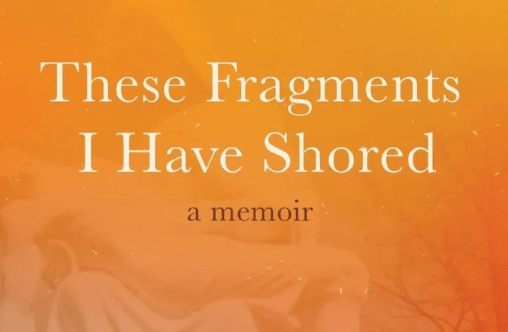
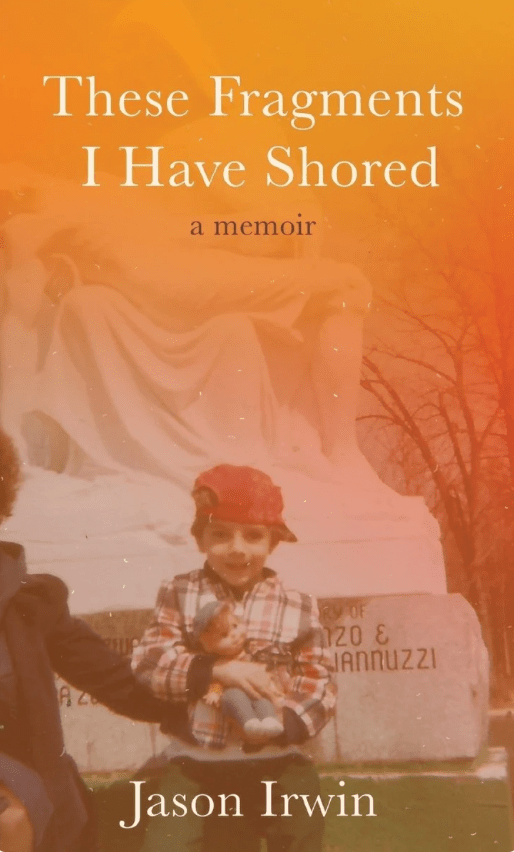
Refusing to bog itself down in any medical jargon or victimhood, Jason Irwin’s memoir “These Fragments I Have Shored” offers 265 pages of grief-writing that are as funny as they are unsparing. Irwin’s May 5, 2026, release is a memoir essay collection in accordance with his experience as caretaker for his mother over the last stretch of her life. With humor and humility, Irwin weaves two medical histories, placing his 1980s childhood—one spent in and out of surgeries, an ostomy bag fastened to his abdomen—in conversation with his mother’s cancer diagnosis nearly 40 years later. Not so much a chronology of illness but rather a family portrait of dysfunction, bodily decline and a mother-son relationship defined by mutual stubbornness.
It is Irwin’s refusal to stall in the dense medical digressions that allows him to move quickly from his own birth to his youth, all the way through his marriage and the death of his mother. His brevity is buoyed by a voice that feels conversational and cynical, without being glib. His pacing reflects the experience of chronic illness and its whiplash of appointments, argument and gallows humor.
Isolated and bullied for his surgical deformities, the sections of his childhood are vivid. But even in the passages of suffering, levity surfaces. In one tender anecdote, we learn of his childhood best friend Jojo, memorably described as “a phantom plucked from darkness.” The troublemaker with a good heart, the neighborhood delinquent who befriends and also protects Irwin, described as “threatening to kill anyone who made fun of my brace, the way I walked, or questioned why, at age twelve, my bicycle still had training wheels.” Inclusions such as Jojo render a whole image of instability—it can be destructive, but not without being formative.
In one devastating episode, a classmate punches Irwin’s ostomy bag. But the humiliation comes through plainly, without attempts of swelling authenticity. Not interested in being a victim, nor dignifying his younger self, Irwin details the destructive bravado of high school. He admits to drinking as a performance of toughness among many moments of cruelty. He confesses to his own actions as a bully, acknowledging, “I knocked books out of upper classmates’ hands as they walked the halls and made fun of those students I knew were weaker than me, like Ezra, a refugee from Central America, and Tammy, who chased after pennies I threw at her.” It’s here where the memoir’s humility lies and Irwin does not paint himself any kinder than he was. He calls it what it was: insecurity, and his candor is refreshing.
He approaches his deceased mother with the same clarity, depicting a woman with personhood rather than an archetype of maternal failure. Sixteen years after discovering a tumor in her nose, the cancer eventually spread to her bones, killing her just after her 75th birthday. We see her resist medical advice, refuse to stop smoking and grow petulant in doctors’ offices. In it, Irwin lets her read as irritable, even unpleasant, and we witness her unraveling along with him; from snide to exhausted, from a sick woman to a dying one. But, crucially, Irwin restores her to a fullness that posthumous portraits of motherhood tend to flatten. He shows us the mistakes she made, but also her agency: the late-in-life decision to enroll in college to study creative writing, her curt candor in the face of growing weakness. When her old friends try to reconcile with her upon her diagnosis, she dismisses it: “Fuck ‘em. If they can’t visit me while I’m healthy and alive, I don’t want them looking at my body when I’m dead, crying their fake tears.” She does not get reduced to the dying parent. Evidently, she was difficult. But Irwin makes sure we know she was a full person too.
Finally, Irwin gives us a self-referential depiction of being a creative. The fear of inadequacy and the suspicious longevity of art as a career is embedded in Irwin’s prose. The effect is intimate and locates Irwin among writers: “Sometimes I wondered if I was in over my head. Was I really a poet, I wondered.” Irwin struggles; he drinks; he creates. He falters and he keeps writing.
Irwin resists the manufactured epiphany. The memoir closes on a quiet image of his mother, still instructing him in how to endure. It is appropriate and true to the book’s spirit.
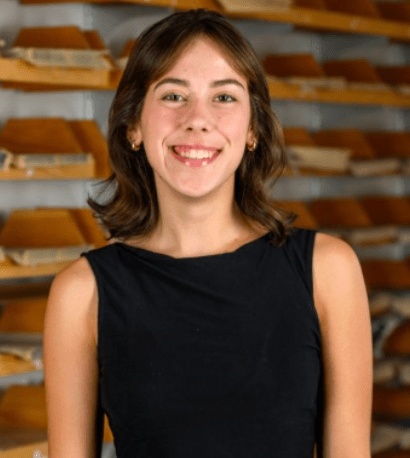
Emily Harris is a senior at the University of Pittsburgh studying History and Nonfiction Writing. She is Copy Chief at The Pitt News and has written criticism on contemporary memoir, narrative craft, and literary nonfiction.
Like this post? Comment below or on my FB page. And please share with your friends and social network.
Are you a Rust Belt writer interested in seeing if your own post, or author interview, or book review might be right for Rust Belt Girl? Hit me up through this site’s contact function.
Check out my categories above for more guest posts, book reviews, interviews, literary musings, and writing advice we can all use. Never miss a post when you follow Rust Belt Girl. Thanks! ~Rebecca
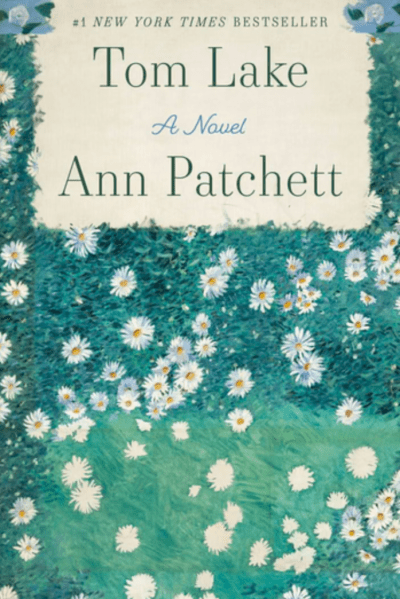
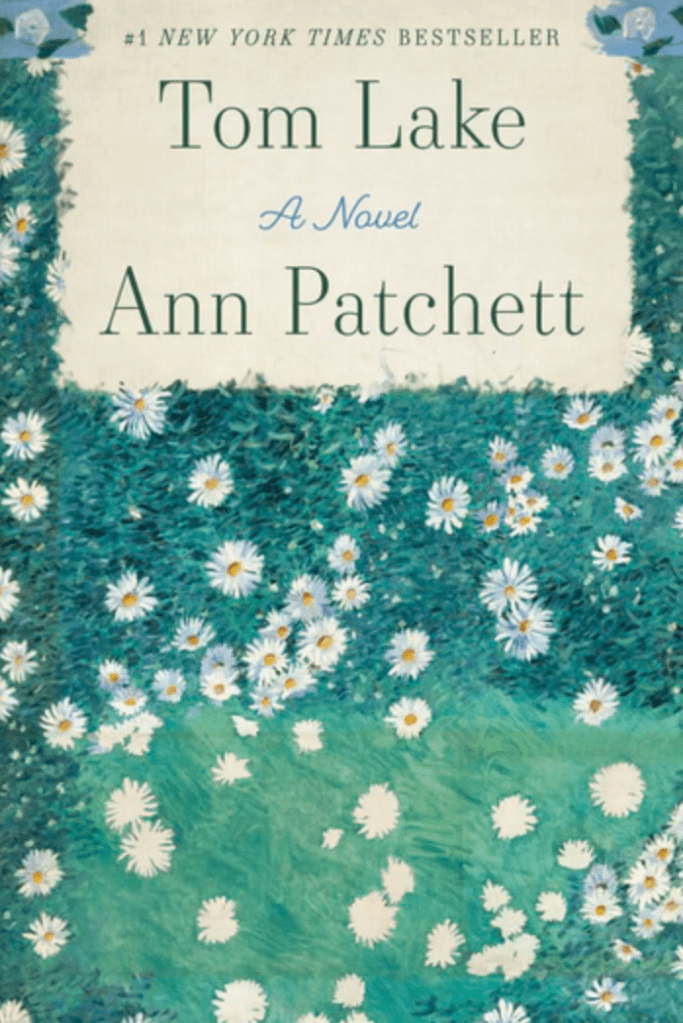
I am a writer who loves story—and homework. I’m sure I’m not alone there. So, before I sat down to read—or more specifically listen to Meryl Streep read—Ann Patchett’s most recent novel, Tom Lake, I watched Thornton Wilder’s classic play Our Town, which features quite a bit in Patchett’s story. I caught the excellent PBS “Great Performances” production from the 1980s featuring Spaulding Gray as the narrating stage manager, a young Penelope Ann Miller as Emily Webb, and Eric Stolz (swoon) as George Gibbs, her love interest.
Tom Lake, then, is a story about a story about telling stories—or, the act of dramatic portrayal. Lights, camera, characters. Confused yet?
Okay, the front story, or more immediate narrative of Tom Lake, follows 50-something Lara Nelson, a wife and mother living on a Northern Michigan cherry farm (another dramatic subtext) as she tells her three grown daughters, home during the 2020 pandemic, about her long-ago love affair with famous actor Peter Duke (think: a 1980s James Dean; I’m picturing 90210-era Luke Perry).
Note that in this novel there is not a whole lot of Rust Belt significance to hang our hats on here at Rust Belt Girl. This setting is not Rust Belt Michigan, but the Michigan of the Upper Midwest’s Fruit Belt. But, hey, we contain—and read—multitudes, right? And, really, Patchett rarely disappoints.
Told as a dual narrative, Tom Lake’s backstory follows the love affair between then-young actors, Lara and Peter, at a summer stock theatre in Michigan where they perform both Our Town and Sam Shepard’s one-act Fool for Love, which I need to watch next. (A girl can only do so much homework.) Quick distillation, Our Town is a gentle (even genteel in that puritanical New England way) portrayal of young love; Fool for Love explores romantic love’s dark and destructive side.
Image: Harper Collins website
So, Patchett’s novel Tom Lake is a story about the light and dark of love. But it’s also—and this might be even more interesting and applicable to us writers—a story about storytelling. Who tells the story, when, how, why, and about whom and to whom. What’s included in the storytelling and, maybe even more importantly, what’s left out?
A dual narrative novel is difficult to pull off; I know because I’ve tried this twice. Invariably, a reader will like one narrative more than the other and grow impatient when their favorite narrative is offstage. For me, Tom Lake’s 1980s narrative, its backstory, is more compelling (because much more is happening) than the 2020 narrative, which is mostly telling, with less forward-moving action (think: literal cherry picking). Which left the modern timeline feeling more like a frame or bookends for the real story—a way to go back in time to the main action and a way to come out of it again.
I won’t digress too long on why writers like Ann Patchett feel the need for modern-day frames for historical stories. (Yes, a novel set in the 1980s is considered a historical novel.) My guess is it’s because historical novels today are often relegated to the “genre” genre, as in not the literary fiction shelf. Okay, digression over.
My favorite (oft quoted) line from Our Town, which feels very instrumental to this discussion on storytelling (and okay there’s a little spoiler here): Toward the end of the play, the dead character Emily, who returns to her life for just one day, asks the stage manager if any living person ever realizes “life as they live it,” and he says no, but then adds an exception. “The saints and poets maybe—they do some.”
There’s a lot of smart stuff happening in this novel of Patchett’s when it comes to the all-important telling of life’s story—our human way of re-living what we can’t grasp with our little human minds in the moment. We can’t all be—though maybe we can all aspire to be—saints and poets.
Patchett’s main character, Lara, who is narrating her story of young love, to her grown daughters, is basically the stage manager of her own story, choosing how and what to tell as she goes. At one point Lara equates the stage manager in Our Town with God, which brings up interesting ideas about faith (Patchett was raised Catholic and it often shows in her writing) as well as destiny/Providence in our lives, and agency in how we portray our life stories.
What about the part of our story we leave untold, for our hearts, alone? I thought about this a lot as I read Patchett’s novel. For the main character, Lara, it was a dark part, and (dare I say) foolish aspect of young romantic love she shields from her grown daughters. In not telling her whole story, the light and the dark, is she playing God? Are we all?
In my writerly opinion, the darkness in her story Lara keeps to herself isn’t earned by the character, un unusual flaw in character development on Patchett’s part. (Also very important to know when to wrap up a narrative.) But it is a stumble far outweighed by all the really fine storytelling she does in this novel. If this criticism feels vague, it’s because I don’t want to spoil the reveal. (Read it and tell me what you think!)
If there’s one author I’ve followed closely for some time, it’s Patchett. Her annotated version of Bel Canto—my favorite novel of hers—makes a great gift for the literary fiction (or opera) lover. Of her more recent novels, her 2019 release, The Dutch House, felt like a near perfect novel to me: quiet, to be sure, with none of the Le Carre-like action of Bel Canto, but an incredibly immersive read with characters who felt like my own brother and sister by the end of the book. Family ties Patchett writes about brilliantly, if she’s a little less adept at depicting romantic love and specifically sex.
Saints? I might know a few in the making. Poets? I’m honored to know a good handful. But for the rest of us, Patchett’s got me thinking about how lucky we writers are to get to craft our stories. How lucky we readers are to watch other writers and poets tell their stories just as they wish. We receive such instrumental gifts this way!
Have you read this novel? Have you seen the plays that informed this novel? What elements of craft and storytelling did they bring up for you?
And…what was your favorite bookish gift you gave or received so far this holiday season?
Check out my categories above for more guest posts, interviews, book reviews, literary musings, and writing advice we can all use. Never miss a post when you follow Rust Belt Girl. Thanks! ~Rebecca
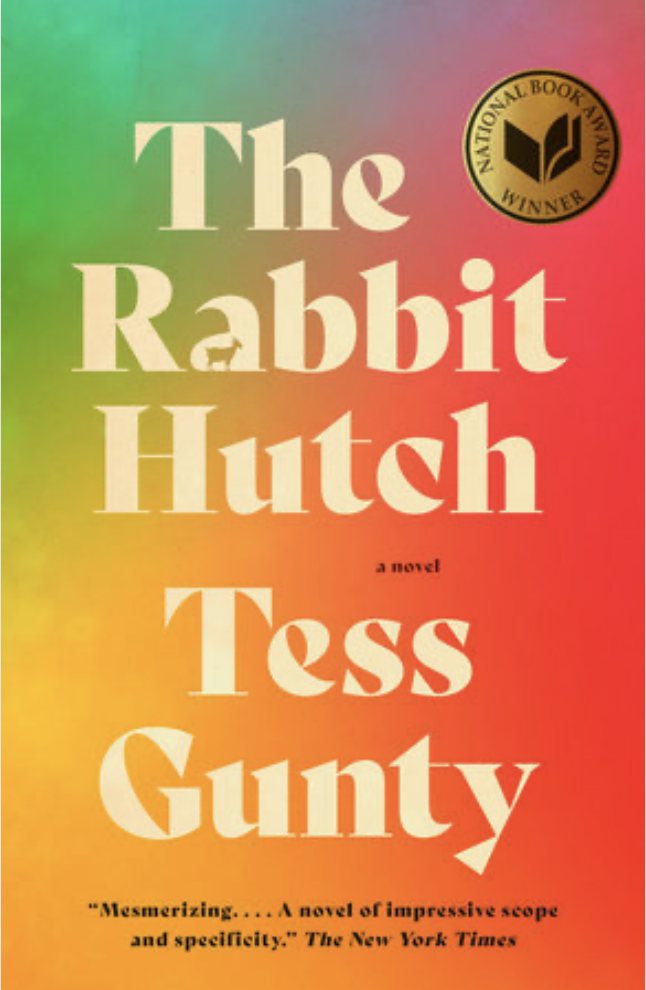
Tess Gunty’s 2022 debut novel, The Rabbit Hutch, won that year’s National Book Award for Fiction (and other awards) and also won hearts—especially among Rust Belt readers.
Pittsburgh-based author and art writer Emma Riva wrote a wonderful essay about The Rabbit Hutch published here at Rust Belt Girl I encourage you to read next—if you haven’t already.
I was late to the novel, myself, and was struck by how Catholic it felt, despite not being marketed that way (for obvious reasons).
I was thrilled to “meet” Gunty yesterday evening through the Jesuit Media Lab‘s conversation over Zoom with the author. A sizable group of us avid readers tuned in to listen to Gunty talk about being raised Catholic and writing about The Rabbit Hutch main character’s deep interest in female mystics and mysticism, about researching Hildegard von Bingen and discovering her “extraordinary theatre of mental activity” and agency, about technology and art and how Mary Shelley’s Frankenstein is a “perfect allegory for AI,” and much more!
“I wanted to make art out of my characters’ lives, including their digital lives,” the author said about her novel that still feels very much of this technological moment. (Gunty herself doesn’t partake in social media and, clearly, it benefits her writing. “You need to keep the tool of your mind as sharp and clean as possible,” she said.)
As for the novel’s fictional setting of Vacca Vale, Indiana, Gunty said that the place was the only thing she knew for certain she wanted to portray, going in, that the setting started out being the MC—until she was about three-quarters of the way through writing the first draft.
She said she wanted to capture the “purgatorial” nature of post-industrial cities like Youngstown, Ohio, Flint, Michigan, and Gary, Indiana. (No shade intended, I don’t think!) How to capture the sensation of such places, like her hometown of South Bend, on which the novel’s setting is based? In the books she read, Gunty said, “I never encountered any place like my hometown.” And yet politicians and movies portray a flat stereotype of such post-industrial Midwestern places.
Gunty’s description sparked pride in me, last night. She described our Midwestern and Rust Belt cities as places of mystery, magnitude, and complexity. When you don’t see a place like your home reflected in literature, “you feel like it doesn’t matter,” she said. For Gunty, writing this novel, then, was an attempt to insist upon the “dynamism and multi-dimensionality” of her hometown—and others like it.
Like mine. Maybe like yours, too.
I encourage you to check out JML for their book talks and other events.
Have you read The Rabbit Hutch? What did you think? Did you read Emma Riva’s essay about it?
Like this post? Comment below or on my FB page. And please share with your friends and social network.
Are you a Rust Belt writer interested in seeing if your own post, or author interview, or book review might be right for Rust Belt Girl? Hit me up through this site’s contact function.
Check out my categories above for more guest posts, interviews, book reviews, literary musings, and writing advice we can all use. Never miss a post when you follow Rust Belt Girl. Thanks! ~Rebecca
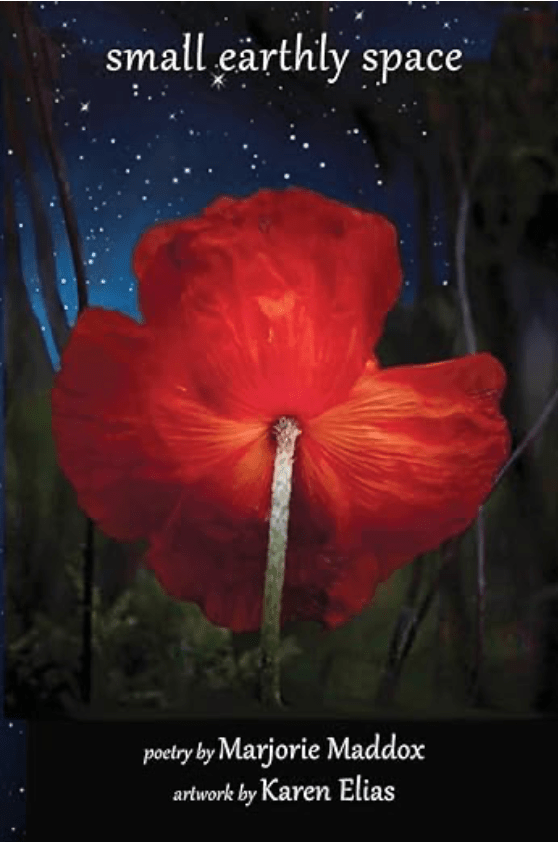
Marjorie Maddox’s new poetry collection, Small Earthly Space (Shanti Arts Publishing, 2025) accompanies a series of dreamy digital visual collages by artist Karen Elias. Together, they depict a world not only fraught with imminent disaster, but one of beauty and hope. Maddox’s poems, inspired by Ali Smith’s lyrical novel, Companion Piece, place the curlew as a central, and recurring figure in the collection. Like a canary in the coal mine, Maddox’s curlew warns about the environmental devastation that is happening now.
Known as the bringer of bad omens in Celtic folklore, forecasting bad weather, sorrow and death, the curlew, with its haunting cries, is also associated with the passing of seasons, rebirth, and renewal. “When our planetary conditions render even the saints tongue-tied and stuttering,” Maddox writes in the introduction, “the bird appears as guide, as psychopomp, as Beatrice in a kind of Dantean descent,” requiring us to “grow humble,” to “pass through the smallest of doors” and experience “the long, slow burn of loss.”
Maddox’s poems are also deeply religious and read like prayers or holy visions. “How far would you go for wisdom?” Maddox asks in “Dive Down,” where she links humanity’s fate with nature’s and invites the reader to dig deeper and discover those epiphanies hidden in daily life, to find “one drenched syllable of rescued hallelujah.” In “Tightrope Walker,” we are instructed to “unzip all our divisions” and position ourselves on the “fine line that binds sky and dirt” and “welds together every season of belief and reason.”
Known as the bringer of bad omens in Celtic folklore, forecasting bad weather, sorrow and death, the curlew, with its haunting cries, is also associated with the passing of seasons, rebirth, and renewal.
“Still Life: 1950s,” which opens section two, leaves nature and moves inward. The poem speaks of the fraught relationships of generations and the societal demands placed on mothers. “What can be said to the perfect mother?/Poised, she smiles beautifully but doesn’t hear.” In the accompanying collage, Karen Elias has created a powerful scene: the mother as a stone statue, sitting in on the sofa, elegant and demure, yet deaf to the needs of her daughter, who crouches on the stairs, doing her best to “protect… this beautiful sculpture,” not daring to speak unpleasant syllables, words that might cause her mother grief, or destroy the facade of their silent perfection.
Other poems speak of the uncertainty and allure of the unknown that lies just outside the boundaries of our perceptions and manicured lawns, and the anxiety of returning to a home that only survives in memory: a place full of phantoms, where picket fences turn to stone. “Strange Light,” the eerie black and white photo collage that accompanies the poem “Calling Hours: August 21, 2017,” has a bed that floats on water in an otherwise empty room. From the window the eclipsed sun, like a voyeur, peers in. The poem uses the eclipse (the first total eclipse since 1979 to be visible from anywhere in the U.S. mainland) as a metaphor for the death of a loved one. “What can harm us lingers there/beneath the bright posthumous display/of the body…” Maddox writes, noting that “looking directly or too long/into the face of the loved” could, like looking at the eclipsed sun, permanently harm us.
Throughout these poems of impending environmental and spiritual doom, a tempered hope permeates, a hope made possible by our faith and resilience, as well as our willingness to accept blame for the state of the world. In “Snapshot,” the dead arise and call for mercy. “Will you listen?” Maddox asks, like the prophets of old. “Will I?” she responds, before observing, “The earth/waits impatiently.”
The curlew returns in “The Witnesses” to see the devastation wrought by the 2018 wildfire in Curlew, Washington. “Smoke rewrites the sky,” Maddox writes, as “Flames attack its map and habitat.” The collection ends with a nod toward Emily Dickinson. “The curlew is the thing,” Maddox states in “Hope Is the Thing with Feathers.” It is “The beak wildly waving its frayed/but flapping ribbons/of persistence, of hope.”
Throughout these poems of impending environmental and spiritual doom, a tempered hope permeates, a hope made possible by our faith and resilience, as well as our willingness to accept blame for the state of the world.
The poems in Small Earthly Space are a dire plea to take up arms against the “Chaos/of this human-caused catastrophic carnival.” With an “ecstasy of words” Maddox dares us to “Embody the action of verbs” and “Delete the expected ending,” to imagine a world where “IF” still exists. In Maddox’s vision, however, imagining isn’t enough. It is our responsibility in the here and now to do something to ensure a better future, a world brimming with the “intoxication of possibility.”
Jason Irwin is the author of three full-length poetry collections, most recently The History of Our Vagrancies (Main Street Rag, 2020), and the memoir These Fragments I Have Shored, forthcoming from Apprentice House Press. In 2022 he was a Zoeglossia Fellow and took part in the Poetry Foundation’s Disability Poetics Project.
Like this post? Comment below or on my FB page. And please share with your friends and social network.
Are you a Rust Belt writer interested in seeing if your own post, or author interview, or book review might be right for Rust Belt Girl? Hit me up through this site’s contact function.
Check out my categories above for more guest posts, interviews, book reviews, literary musings, and writing advice we can all use. Never miss a post when you follow Rust Belt Girl. Thanks! ~Rebecca
You are forgiven if you’re not up on the middle school slang that has redefined the word “Ohio” (my beautiful native state) as cringey or weird.
Does that mean the writing from Ohio authors or about Ohio places is also weird? In some cases (and often my favorite cases) yes.
It has been more than a minute, Rust Belt Girl followers, and I appreciate you for hanging on. Busy days around here with a book project going and essays popping up here and there. And of course there’s work-work to contend with. And my teenagers who keep me hip (surely that’s not a word they’d use) through their generation’s reinvention of language, music, and fashion. (A whole wardrobe of hooded sweatshirts and oversized black jeans, anyone?)
But I’m thrilled to share with you my latest essay, which is part essay and part book review. The book? Matthew Meduri’s debut novel Collegiate Gothic. Part satirical campus novel, part crime procedural, and part Italian architectural treatise, this one is quite fun (and, yes, a little Ohio.)
What have you been reading and writing lately, readerly and writerly friends?
Hankering for Rust Belt author interviews, book reviews, and more? Check out my categories above. I hope you’ll follow me here, if you don’t already, so you never miss a (quite infrequent) post. Thanks! ~Rebecca
If you’ve ever visited Pittsburgh, you’ve likely encountered “Pittsburghese,” the local dialect of the people of Pittsburgh that distinguishes residents of the city from their Rust Belt neighbors. Pittsburghese is partially defined by dropping the words “to be” from certain phrases, such as The car needs washed instead of The car needs to bewashed. It’s using words such as pop instead of soda, or buggy instead of shopping cart. Sure, many linguists may say that these examples are not pure Pittsburgh (my mother, for example, who grew up in rural Pennsylvania, always called shopping carts, buggies). But there is one word that always seems to be on the lips of Pittsburgh citizens and on the t-shirts found in city souvenir shops. That word is the second-person plural vernacular, Yinz, a contracted form of “you ones” or “you’ins.”
It’s the word Yinz that echoed through my head as I read the latest poetry collection by Robert Gibb. Pittsburghese is an elegy for a place: Homestead, Pennsylvania, a borough located about 11 miles southeast of Pittsburgh. Homestead is rich with labor history, but like so many places, saw a huge economic decline in the 1970s and 1980s. With every image, I am reminded of the tiny Rust Belt town of my youth and the importance of story and memory.
The poems in Gibb’s collection take us through an industrial world struggling to survive, and thus, the overarching images in most of these poems have to do with debris, or rust – a word that is celebrated in the poem “The Etymologies of Rust.” In this poem, the narrator describes the red-orange oxidation that appears in so many poems written about the Rust Belt as a “slow, remorseless kind of oxidation” that is “red, orange or tawny. The ferrous of flakes.” It’s a perfect description for those of us who know rust intimately as the corrosion that flakes metal mailboxes, parts of bicycles and chain-linked fences. For Gibb, the color of rust may be beautiful, but the effects of rust are devastating for it “cankers like corrosion on idled iron.”
Physical landscapes, often held together by rust, are at the heart of many of Gibb’s poems. As someone who grew up in a small factory town, I recognize some of the images while others are new. I don’t know the slag pots described in “Deskulling the Slag Pots,” but I know the descriptions of derelict phone booths and furniture being auctioned off from fancy buildings. No matter the image, there is a story. And for many readers, the stories may be a bit familiar. For example, in the poem “Elegy for the Park Theater” the narrator tells us about a time when “we’d be plunged into darkness/Beneath the beam of light figures rode/Onto the screen.” In this world, the images are “mantis-like invaders from Mars” and “several avatars of Tarzan.” Later, he explains that the theatre became a roller skating rink. The transformation of space is common in places struggling to survive. In Gibb’s world, the theater turns into a roller skating rink – in my world, the single movie theatre found in my tiny hometown was turned into a hardware store before it was finally torn down. Other stories can be found in such poems as “The Play of Memory of Childhood Spaces,” where a narrator remembers a class trip to St. Anthony’s Chapel in Pittsburgh, or in “Voice-Over,” where the narrator recounts working different shifts in the mills when he “never got used to eating dinner/First thing in the morning, heading to work/At bedtime.”
Clearly, the narrator is present in many of these poems, as if drawing from personal memory, but other poems reflect more historical memory, taking their inspiration from photos and works of arts. For instance, in “Homestead, ca 1929, Oil on Canvas,” the poet describes a John Kane painting where “Homestead/Is crowded rows of houses/Steel mills billowing/identical plumes of smoke.” The first lines may not be especially picturesque, but later, the poem captures the artist at work, “painting scenes on the sides of boxcars during the lunchbreaks/at work.” The final lines in this poem are a commentary on what is to come for this world, as the “slurry is just right” because the economy is “about to tank as if in another country.” In another poem, “Worker, Steel Mill,” Gibb focuses on the human being seen in a 1955 photograph by W. Eugene Smith, by explaining that at first, he is “anonymous in those glare-filled goggles.” Later, in the poem, however, there is praise for this man who is “garbed/to be garbed in fire” and who works for “weeks have been divided into shifts” all because “of the cost of production.”
In spite of my love of story and image, my favorite poem is one that interrogates etymology, echoing the title of the collection. In “Pittsburghese” the poet explores the word jaggers which is “vernacular for brambles.” Jaggers are thorns, and if one is caught in jaggers, it is painful, but it is very possible to lift the thorns away. Still, there are the ones that “splintered beneath your skin” that are the most painful, even when the jagger is removed. There is a strong metaphor here: pain may be left behind, even when the source of that pain is removed, but resilience stands. And with this resilience is some kind of hope for a less painful future. It’s this type of hope that is found in every poem in this collection – even those poems that recall painful pasts.
In the preface to this collection, Anita Skeen, Wheelbarrow Books Series Editor, quotes Thomas Wolfe by saying “You can’t go home again.” She explains, “I would argue that in poems and in memory, you can.” Skeen goes on to say that the images remind her of her childhood home located near Charleston, West Virginia. Anyone who grew up in the Rust Belt will be reminded of home, and perhaps inspired to write about that home through the lens of history, memory, and image.
Karen J. Weyant‘s poems and essays have been published in Chautauqua, Crab Creek Review, Crab Orchard Review, Cream City Review, Fourth River, Lake Effect, Rattle, River Styx, Slipstream, and Whiskey Island. The author of two poetry chapbooks, her first full-length collection is Avoiding the Rapture. She is an Associate Professor of English at Jamestown Community College in Jamestown, New York. She lives, reads, and writes in Warren, Pennsylvania.
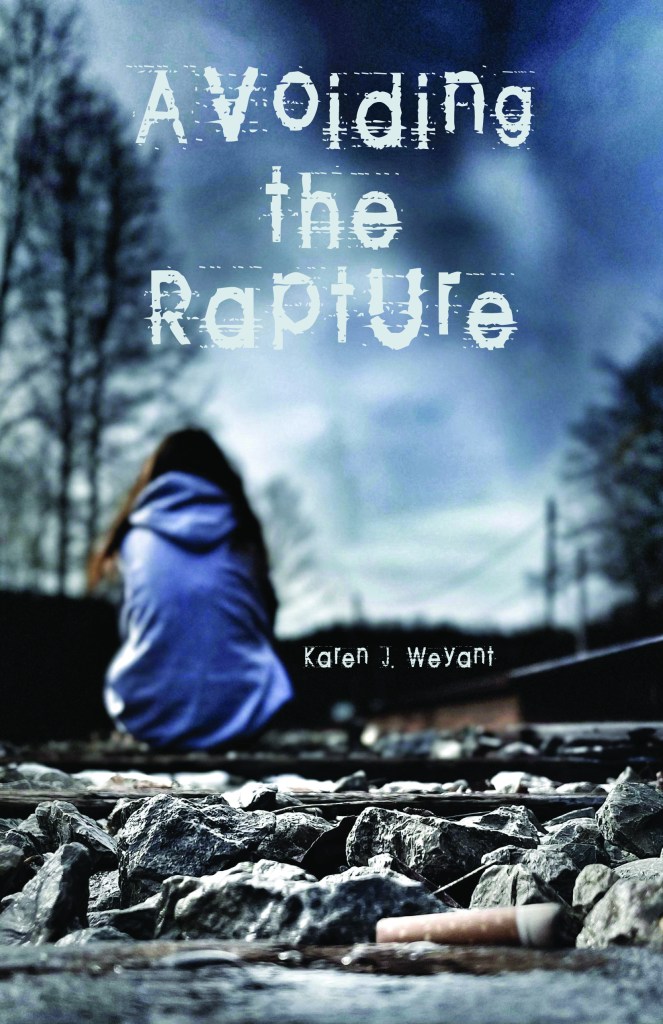
In Karen J. Weyant’s first full-length book of poetry, Avoiding the Rapture, there is no avoiding the evocative and sometimes contradictory landscape and convictions of the Rust Belt. In a town defined by its bars and churches, river and railroad tracks, closed factories and forbidden swimming holes, Weyant gives us both the desire to leave and the need to cleave. No matter our background, she makes this space ours—ownership and rebellion a familiar if not always pleasant home.
We begin with belief so strong it takes hold of a town—“Every girl I knew got religion/at the same time they caught Disco Fever.” Salvation is a type of escape to be embraced or rejected. “Facing uncertain futures,” the poet explains, “we waited to be whisked away in [both kinds of] sparkle.” And yet by “avoiding the rapture,” she counters, “[w]hen everything disappears, everything you see will be yours,” a mixed motivator for a place that when you aren’t reveling in it, you’re scheming a quick departure.
Within this back-and-forth identity quest, the narrator looks for signs and visions in roadkill rising from the dead, in Jesus in dryer steam at the local laundromat, in “one of the Horsemen/in the hind leg of a Holstein cow,” and in “saints/in real estate signs buckling under buckshot.” There are also “man-made miracles” where the narrator “dump[s] grape juice into Gallagher Run,/hoping the muddy swirl would turn into wine,/. . . [or] pretend[s] the stale angel food cake. . . was really manna.”
Woven throughout the book is a sequence that often begins “The Girl Who…” and perceptively defines identity. “The Girl Who Parted Mill Creek with Her Toes” offers nature as one way to “ignore the grown-up talk/of factory closings, lost jobs, and foreclosures.” This path also allows for leaving the church while retaining its lore and, at times, alure. For example, the post-industrial mass exodus of families is linked to the narrator’s Exodus-like parting of the creek with her toes. Likewise, in another poem, an abandoned and deteriorating church evolves into a new type of sanctuary.
Throughout, insects swarm, dazzle, or sting. There is “the drone/of factories in a metallic round of cricket song” and “june bugs hurling against back doors.” Not unlike the town’s inhabitants, in “To the Girl Who Talked to Summer Insects” “[s]ome insects were silent, others angry or lost.” Elsewhere, mayflies—“ghost stories [come] alive”—become reminders “we lived among the dead.” The plague-like buzzing of blackflies usher in arguments over money and heat. “June/ [is] heavy with horseflies. . . .cicada shells. . .cracked under our feet.” In dreams, butterflies get “caught in backyard grills”; in real life yellowjackets die in/escape from a flaming nest; the narrator rescues grasshoppers from a ball of ice. Eventually, end-of-the-world prophesies drown out miracles.
In this way, even the word “miracles” begins to lose its mystery. In family life, the word becomes synonymous with describing impossible situations: a truck that “would need a miracle to get through the summer,” a sister who “would need a miracle to get through high school,” and a father who “would need/a miracle to get a job at his age.”
As tensions increase in the run-down town, so does the narrator’s desire for flight. “[W]e planned our new world. . . . we knew we had to leave,” she recalls. The coming-of-age departures are small and large: heels, makeup, drinking, boyfriends with the nicknames of beers, the recognition that, on many levels, “every ripple has danger” and that [r]eal girls learn to toughen/the soles of their feet. . . .Accept . . .fate.”
That doesn’t mean, however, that there aren’t moments of daring and flight. Through sheer determination, the narrator “[spins] in the August heat until [she] could fly.” Bravely, she catches bees or reaches out to touch a two-headed calf. We watch as her father helps her bury a dead bird. Always drawn to water, she listens to rivers talk and “sw[ims] late at night/in the gravel pit pond.” She counsels, “Follow the fireflies.”
In these ways and others, Avoiding the Rapture whoops and hollers with independence and survival. It is a stirring, well-crafted ode to place, where “girls still ride the beds of pickup trucks . . . .[and] learn how to catch maple seeds/in their teeth, and how to spit them out.” It is a depiction of individuals who, even if they don’t learn to fly, learn to balance while wind “comb[s] through their long hair.”
Here’s to the young women of the Rust Belt, fiercely and perceptively portrayed in Karen J. Weyant’s new collection, Avoiding the Rapture.
Karen J. Weyant‘s poems and essays have been published in Chautauqua, Crab Creek Review, Crab Orchard Review, Cream City Review, Fourth River, Lake Effect, Rattle, River Styx, Slipstream, and Whiskey Island. The author of two poetry chapbooks, her first full-length collection is Avoiding the Rapture. She is an Associate Professor of English at Jamestown Community College in Jamestown, New York. She lives, reads, and writes in Warren, Pennsylvania.
Professor of English at the Lock Haven campus of Commonwealth University, MarjorieMaddox has published 14 collections of poetry—including Transplant, Transport, Transubstantiation (Yellowglen Prize); Begin with a Question (International Book and Illumination Book Award Winners); and the Shanti Arts ekphrastic collaborations Heart Speaks, Is Spoken For (with photographer Karen Elias) and In the Museum of My Daughter’s Mind, a collaboration with her artist daughter, Anna Lee Hafer (www.hafer.work) andothers. How Can I Look It Up When I Don’t Know How It’s Spelled? Spelling Mnemonics and Grammar Tricks (Kelsay) and Seeing Things (Wildhouse) are forthcoming in 2024. In addition, she has published the story collection What She Was Saying (Fomite) and 4 children’s and YA books. With Jerry Wemple, she is co-editor of Common Wealth: Contemporary Poets on Pennsylvania and the forthcoming Keystone: Contemporary Poets on Pennsylvania (PSU Press) and is assistant editor of Presence. She hosts Poetry Moment at WPSU. See www.marjoriemaddox.com
Rebecca here, with many thanks to Marjorie for this beautiful review of Karen’s poetry collection. I can’t wait to dig in! What are you reading and writing this month, as we start working our way through the new year? Let’s discuss in the comments.
Are you a Rust Belt poet or writer? Do you write book reviews–or conduct interviews of Rust Belt authors? If so, think of Rust Belt Girl for a guest post, like this one. And check out the handy categories above for more writing from rusty places.
Find me on FB and on IG, Twitter, and Bluesky @MoonRuark
Rust Belt Girl readers, don’t miss the latest from Petrichor–Pittsburgh, Pennsylvania’s art scene magazine. Founder and Editor-in-Chief Emma Riva is doing an incredible job covering the scene.
Ways of Pittsburgh: Exploring and Painting our Skinny Streets captures the plein air painting of Pittsburgh’s own Ron Donoughe. Let me tell you, his work is like no plein air landscape painting I’ve ever seen! Donoughe paints the city’s narrow backstreets–even the graffiti. A real talent at capturing light, I think some of his paintings of houses resemble Edward Hopper’s work. See if you agree, when you check out Emma’s review–and give Petrichor a well-deserved follow!
If Emma’s name seems familiar, you might remember her review of Tess Gunty’s National Book Award-winning novel: The Rabbit Hutch‘s Rust Belt Renaissance–published right here at Rust Belt Girl.
We’re closing in on the end of the year, friends, which means reading roundup time! So, tell me, what’s been your favorite book of the year? Let me know in the comments.
Let’s start a discussion! Comment below or on my FB page. And please share with your friends and social network.
People in Pittsburgh will tell you where things are based on what used to be there. Most of the time, the landmark that used to be there is food related. A fancy seafood restaurant. An ice cream shop. In a small city, those are the sorts of things people remember. To out-of-towners, this might seem like a quaint practice, but something I’ve come to realize is that it is a profoundly human one.
As a fiction writer, I often find myself navigating the complicated narrative of how our memories and associations of the past interact with our experiences of the present. I look at a candle and think of my favorite candle store in Elizabeth, Pennsylvania, which I went to for the first time because I couldn’t use the bathroom on the Y46 bus and I bolted in not expecting them to have a restroom, but they did. The candle reminds me of my desire to go back there, of the friends I know in Elizabeth. All of this interacts with the energy of the place, the former boating hub, the Monongahela River Valley that built Lewis and Clark’s boat. All of that comes from the split second of looking at a burning wick.
Sharpsburg over the Allegheny River from the 62 St. Bridge; photo credit: Emma Riva
Tess Gunty’s 2022 debut novel, The Rabbit Hutch, is a master class in this mixture of memory and present, owing in part to its setting within the Rust Belt. The novel’s setting of Vacca Vale, Indiana, is a facsimile of her hometown of South Bend, though she’s fictionalized a car manufacturer named Zorn as the ghost of industry haunting the town’s abandoned structures. “I wanted to be able to pull from Gary, Ind., and Flint, Mich., and Youngstown, Ohio, and a number of other cities in the Rust Belt whose economic devastation was much worse, I think, than it was in South Bend when Studebaker closed,” Gunty said in an interview with the South Bend Tribune.
The Rabbit Hutch is a genre-bending work that follows a cast of characters who all live in an affordable housing complex called La Lapiniére, nicknamed “The Rabbit Hutch.” Its central character is Blandine Watkins, née Tiffany, an eccentric former foster youth obsessed with Christian mystics to the point where she changed her own name to a martyred French woman’s. But the book switches between the past and the present and between the perspectives of different residents of the apartment complex, including one of Blandine’s roommates, another former foster youth who serves as an omniscient narrator for several parts of the book which foreshadow some horror described as Blandine “leaving her body.” Though the characters’ Vacca Vale has its echoes of Gunty’s own South Bend, it’s an imaginary future where the University of Notre Dame didn’t fill the gaps in South Bend left behind by Studebaker. Here’s what Gunty’s characters say of Vacca Vale, while stoned and watching a commercial for a new apartment complex, much nicer than the titular complex they live in:
“Vacca Vale, Welcome Home,” scoffed Todd, but he looked sort of emotional to me. “What the hell kind of slogan is that?”
	“More like—Vacca Vale: Don’t Touch the Rust,” said Malik.
	“Vacca Vale: Excuse Me, Sir, Are You Lost?” I added.
	“Vacca Vale: We’ll Clean That Up in the Morning,” said Todd.
        We laughed. We warmed. We didn’t know who we were trying to impress.
	“Vacca Vale,” joked Malik. “We Used to Make Cars Here!”
	“Vacca Vale: Where the Churches Outnumber the Humans.”
	“Vacca Vale: Where the Rabbits Outnumber the Churches.”
	“Vacca Vale: At Least You Can Still Fuck Here.”
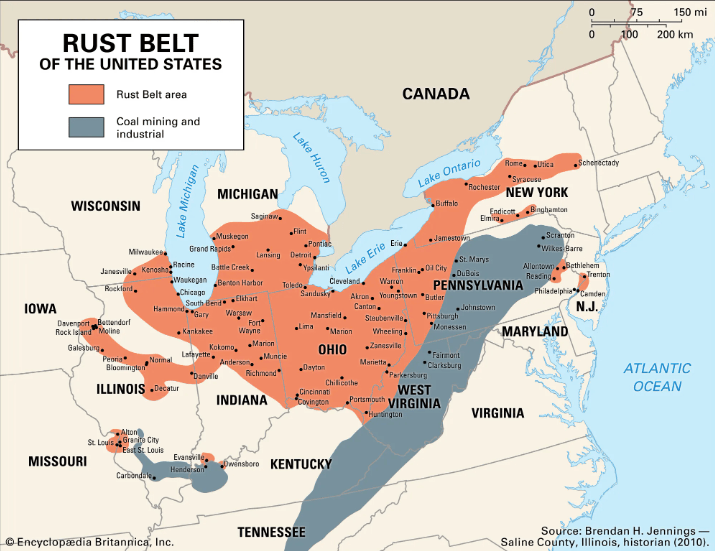
For many in the literary publishing world Gunty has ascended into, the Rust Belt is only a feeling, not a region. It’s an image from the movie Flashdance or a short chapter in a history textbook. So, it’s important to define what it is exactly we’re talking about when we say “the Rust Belt.” There’s some confusion among people who don’t live here about the categorical differences between the Rust Belt, Appalachia, and the Midwest. Pittsburgh and Buffalo aren’t exactly in the Midwest, but they’re still in the Rust Belt. The map in the Encyclopedia Brittanica looks like a gasoline blotch on a sidewalk or an oddly shaped hickey.
It’s a region defined by things which used to be there, sites of innovation and excess then turned to rot, now home to … what? Those of us who live there will be familiar with the exchange that takes place in one scene of The Rabbit Hutch. Blandine and Jack get into a heated argument in the loft of a real-estate developer who plans to “revitalize” their city. Blandine complains about how the real estate development is ruining Chastity Valley, one of her favorite parts of the city, and Jack shoots back:
“Look,” says Jack. “I know what you want me to say. You want everyone to hate the Valley plan as much as you do. But I just don’t. A lot of people are excited about it, and I think you’re being sort of judgmental and shortsighted. I mean, a lot people say it’s going to help our economy and make jobs and stuff. And I’ve only met him a couple of times, but Pinky doesn’t seem that bad. From what I’ve heard, he grew up poor, he knows what it’s like not to have what you need, and now he wants to help Vacca Vale get out of the gutter. Sure, he’s making money off it. But so what, if it helps people at the end of the day? We need to get out of the gutter.”
Gunty then notes: “In the ensuing silence, Blandine spots a camera, situated atop a thick book called Rust Belt: The Second Coming.” There is much reference to Catholicism in The Rabbit Hutch, and “the Second Coming” refers to resurrection, that most American of impulses. It’s no coincidence that the nature park to be bulldozed for the buildings is called Chastity Valley. But The Rabbit Hutch is no hollow anti-gentrification plea.
From having grown up in New York, I have a keen and nuanced understanding of gentrification and the ways in which contemporary activism often ignores its tangled nature. The Rabbit Hutch frames the Chastity Valley developments and the so-called “revitalization” of Vacca Vale as part of a meditation on the uncomfortable truth about change. One of the most gutting lines in the book is: “Six months after Tiffany/Blandine had submitted her court papers, proof of birth and $210, she discovered that the name Blandine is Latin for ‘mild,’ while Tiffany is Greek for “Manifestation of God.’”I, too, went through long stretches of hating my own name, wanting to replace it with something more elegant and powerful. In those lines, Blandine reveals how, though her activism comes from a genuine love for Vacca Vale, there’s a deeper hypocrisy and insecurity there. Though she wants Vacca Vale to retain its grit, the scars that give it character, she is unable to deal with her own scars, to the point where she threw away her own name for a fantasy.
The South Side from the Birmingham Bridge over the Monongahela River; photo credit: Emma Riva
There is much more to talk about in The Rabbit Hutch, and the only way to truly experience all of it is to read it for yourself. But here are a few sneak peeks. There’s the death of an aging child star and the vengeance of her bitter, angry son—another scar of the past opened into a wound. There’s the woman who moderates content on a site for obituaries, who spurns that son by deleting his callous comment on his mother’s obituary—a marker of the absurdity of how we deal with loss.
The Rabbit Hutch is all about people on the margins, people who are orphaned by society in some way, regardless of their age or their circumstances. In the contemporary publishing industry, there’s a certain obsession with “marginalized” or “underrepresented” identities. It feels like a reduction, like generational oppression is a badge of suffering for coastal publishing executives to give out to those poor, unfortunate souls in quote-unquote Middle America. I’m perhaps one of the people Blandine and her friends might laugh at, who traded New York for this strange, desolate place. But I know exactly how Blandine feels about Chastity Valley, because I watched my childhood public library in Washington Heights get bulldozed to make space for an “affordable” housing complex with a supposed library inside of it, the skeleton of which now looms over Broadway like a dying animal. I know exactly how it feels to not care how many people get to live in that building or how many families get to make nicer dinners because of the paychecks the developer creates, because connecting to a sad, poor place makes you feel like your suffering matters in some grand story of socio-economic distress.
In the same conversation, above, Jack says to Blandine: “’I’m not judging you.’ The tenderness in his expression catches Blandine off guard, makes the room glitter vertiginously. ‘I just want to know what happened to you.’”
What happened to you? I hate the passive voice. As a literature tutor, my screed to my students is that passive voice makes them sound less confident. I don’t say weak but the implication is there. And of course, there are political and emotional implications. We’ve all heard mistakes were made or I was assaulted. Of course, it’s an important step in reclamation of your life and accountability to say You made mistakes or He assaulted me. But in modern American language, we are profoundly uncomfortable with the passive voice even when we overuse it. Being scarred by your history is a hard thing to admit. You have to admit that things affected you. That (how terrible to admit!) they damaged you. That (even worse!) you are damaged. The Rust Belt is one big, glaring scar of affectation and damage. Its very name is spoil and decay. We spend a lot of our lives teaching ourselves not to be affected by things. In The Rabbit Hutch, what Blandine seeks when she wants to leave her body, is truly to feel instead of simply to suffer.
The Rabbit Hutch, winner of the 2022 National Book Award for fiction, is available from Penguin Random House or wherever books are sold.
Emma Riva is an author and art writer living and working in Pittsburgh. She serves as the managing editor of UP, an international online and print magazine covering street art, graffiti, fine arts, and their intersections in popular culture. She is also a staff writer at regional magazine Belt and a contributor to Pittsburgh-based art criticism site Bunker Review. You can find out more about her on her website and her Instagram and order her book Night Shift in Tamaquawherever books are sold.
Rebecca here, with huge thanks to Emma for her fascinating review.
What are you reading and writing this month, as we look forward to spring? Let’s discuss in the comments.
Are you a Rust Belt writer? Do you write book reviews or conduct interviews of Rust Belt authors? If so, think of Rust Belt Girl for a guest post, like this one. And check out the categories above for more writing from rusty places.
In his often haunting and unsettling poetry collection, The History of Our Vagrancies, Jason Irwin travels between neighborhood bars, churches, soup kitchens, diners, prisons, and county fairs. The real setting, however, is the grit and blur between past and present, hopelessness and hope—that often hard-to-define mix of place and identity just outside the obvious. “Aren’t we all living in the parentheses?” he asks. “One pine in a forest, in a forest in a forest.” In this way, Irwin examines our inner and outer landscapes, as well as what we reject or claim as “home”—with all its traditions, beliefs, and parentage. He holds up for us “our vagrancies, the histories of our comings and goings,/the doubts that invade our greatest aspirations, and propel our return.//Welcome home they say. Welcome home and don’t come back.”
Not surprisingly, then, several poems address and confront what has been passed down—both literally and metaphorically—from parents to son. In the book’s opening piece, “Poem about My Father Disguised as the End of the World,” Irwin lays out many of the book’s themes: landscape as “a façade,” “the unavoidable reckoning/of empty rooms,” both influence and suspicion of religion, and a childhood of mixed messages. “My father was an asteroid,” he states. “Some nights I caught sight of him crashing/through space. Other times he was the whiskey/in my glass, the voice crying ‘No.’” From the start, we understand there will be few divine or human saviors in these poems—“they’re only smoke signals in the fog”—the poet must find his own murky way.
Sometimes such recognitions occur while confronting parent/child relationships. In “Photograph of My Father, 1959,” Irwin confirms “I know we would not/have been friends.” While “still needing you,/needing to blame you,” Irwin as son can’t escape “all the words/that turn to smoke/in [his and his father’s] throats.” Likewise in “My Father Asks Me to Go to Church,” he acknowledges his father’s “own troubled alchemies.” Though they share a belief in miracles, their definitions vary drastically. Add to this the mother. When, in “Soothsayer,” a local evangelist demands to take the young Irwin to church to be healed, the mother counters, “’I don’t have time for this shit.’” Thus, each parent influences how the author paradoxically views the world.
But let’s back up to how the author defines himself. In “The Condition of the Self as Related to Certain Trees,” he catalogs: “Small town, born and bred/my body…gnarled and irregular….Amputee, Dextrocardia….an old man’s hat….Son, lover, husband, fool.” In “Still Life with Leg Brace & Pontiac,” he juxtaposes his grandfather’s polished “’73 Grand Prix,” the possibilities inherent in his own first day of kindergarten, and how, underneath childhood’s fancy apparel, “[His] four-toed club foot fits/inside [his] shoe like the corpse of someone else’s foot.” Elsewhere in the book, he recognizes himself in a billboard at the county fair “advertising oddities” and as composing an alternate ending to life where “we’re happy with the people we’ve become.”
And yet in The History of Our Vagrancies, the poet also looks toward others—artists, authors, painters, philosophers, waitresses, old “codgers”—for insight. There’s the church visit to see rows of prisoners waving their hands, swaying, and singing “On Eagle’s Wings.” There’s Monk, Miles, and Bird and “a song/you find yourself riffing on/…all the colors/that kaleidoscope this dream/we keep dreaming….” There’s stealing Kerouac from the library, acknowledging the saint in Max at the soup kitchen, and recognizing in the silence and gaze of old men “the ruins of this company town,/where the sunbaked blacktop goes on/forever.”
In a particularly poignant poem, Irwin describes phantom pain—“Hammer hits to the synapse. Blood thumping like a subwoofer in 4/4 time”—as well as how “[i]t no longer startles [him], like cruelty…” At poem’s end, he explains, “I shift in my seat, and scratch at the empty air.” Similarly, in “Things We Don’t Like to Talk About,” the pain and confession are familiar: regret, grief, fear. Both phantom and real, the hurt also is ours.
And yet, in addition to this sometimes “delirium of shadows and muffled voices,” The History of Our Vagrancies hints at moments of optimism. In the prose poem “Instinct,” Irwin insists, despite evidence to the contrary, “[T]here’s a room inside each of us where everything we’ve lost is/gathered.” Elsewhere, he carves “epitaphs into the sticky wood [of a bar],/believing, as only the doomed and pure of heart believe,/that we’ll be remembered.” At its end, the collection sounds a call to acknowledge and accept beauty where we are: “Look at the two of use sitting at the table drinking wine./Each moment of our lives has brought us here. Each moment/could have as easily led us somewhere else.”
Yes, look. On these rust-belt streets, on these ordinary corners, you, too, may imagine how “the sky transforms,” how once “God held us in his hands.” You, too, may gawk “at the Polish waitress/as she dances across the tile floor” and even join in. “Sometimes it takes a lifetime/,” explains Irwin, “…to let go of the torn shirt of our failures.” In The History of Our Vagrancies, Jason Irwin encourages us to do just that.
Jason Irwin is the author of three full-length poetry collections, most recently The History of Our Vagrancies (Main Street Rag, 2020), and two chapbooks. He was a 2022 Zoeglossia Fellow and has also had nonfiction published in various journals including the Santa Ana Review and The Catholic Worker. He lives in Pittsburgh. Please see www.jasonirwin.blogspot.com.
Rebecca here, with many thanks to Marjorie for her wonderful review of Jason’s latest poetry collection. I can’t wait to pick it up! What are you reading and writing this month, as we dig into the new year? Let’s discuss in the comments.
Are you a Rust Belt poet or writer? Do you write book reviews–or conduct interviews of Rust Belt authors? If so, think of Rust Belt Girl for a guest post, like this one. And check out the handy categories above for more writing from rusty places.











 Rust Belt Girl